Gordon Collis
Bert Thornley
Peter Smith

Spirit of Carlton Past and Present
We represent the past players and officials of the Carlton Football Club
By Tony De Bolfo
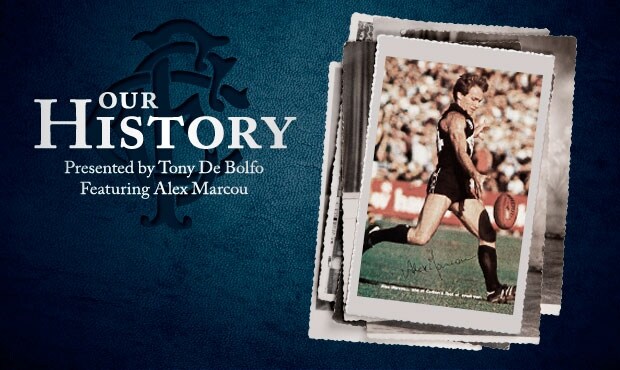
“My Dad always said to me ‘I always knew you were going to be a footballer’, because from the time you’d get up in the morning you’d get that ball and go out in the back whether it was summer or winter, cold, in your bare feet just kicking this ball around.”
The speaker is Alex Marcou, Carlton’s three-time premiership player and a key component of football’s fabled “Mosquito Fleet”.
That the little man in the No.34 guernsey managed to play the game at all, let alone at League level, is something of a minor miracle given the incredible challenges he faced as the son of new Australians who settled in Thomastown.
And yet it was “right place, right time” for the 134-game member of the 1979, ’81 and ’82 Grand Finals and Carlton Hall of Famer, whose talent was identified by the Grand Old Man of Princes Park, the late Newton Chandler.
In this podcast, exclusively for carltonfc.com.au, Marcou talks candidly about a whole range of issues including;
• his Greek Macedonian heritage and the harsh realities of war for his father and mother;
• difficulties with language in his early years;
• Sergio Silvagni’s intervention to thwart his transfer to Essendon
• his hand in each of Carlton’s three Grand Final triumphs;
• his hilarious take on what was happening to him when the streaker invaded the MCG turf on that one day in September 1982;
• which member of the ‘Mosquito Fleet’ he’d first name in his team – Ashman, Buckley, Harmes, Johnston or Sheldon;
• his greatest regret in football; and
• what Carlton means to him.
To listen to Alex Marcou, click here.
By Tony De Bolfo
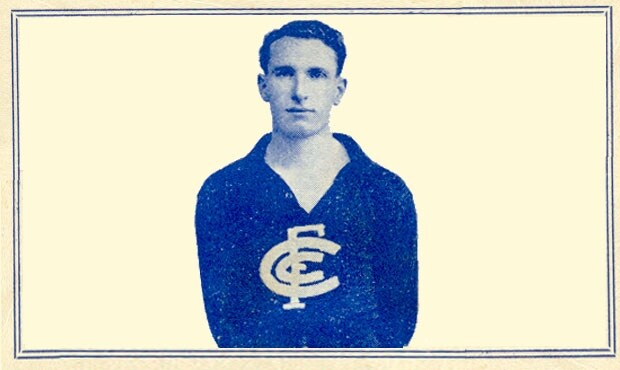
Don McIntyre, Carlton’s oldest surviving club best and fairest, the last existing member of its victorious 1938 Grand Final team over Collingwood, and, as such, the Blues’ only surviving pre-World War II premiership player and club champion, is today celebrating his 98th birthday.
McIntyre, who still follows the fortunes of his team from afar, lives a quieter existence thesedays. His last foray into the old Carlton ground came three years ago when he generously donated four precious personal items of memorabilia for future display at the club – the Terry Ogden Memorial Medal for Most improved Player in 1936; the Angus Travill Medal and Robert Reynolds Trophy for best and fairest in 1937; and the 1938 VFL Premiership Medal.
Born in Geelong on March 5, 1915, Daniel Gordon McIntyre, as a young boy, followed the local football outfit with unbridled enthusiasm.
“I used to go with my grandfather and hardly missed a game down there through the early teen years,” McIntyre remembered in an interview back in 2008.
“Being a very enthusiastic young supporter I thought it was the best thing that could happen to you, to get down to Corio Oval and see them play on a Saturday afternoon. I can still remember the first Brownlow Medallist, “Carji” Greeves, number 20, playing in the centre, Jocka Todd, Cliff Rankin and so on.
Ultimately recruited to Carlton from Packenham, McIntyre represented Carlton in 100 matches between 1935 and ’42. A quick flick through Carlton’s annual reports of the day go some way to telling the tale of his personal achievements. In the 1936 report, the then secretary Newton Chandler declared McIntyre a worthy recipient of the memorial medal struck the previous year to mark the untimely death on March 2 “of that manly and brilliant little player, Terry Ogden”.
“The Terry Ogden Memorial Medal for the ‘Most improved’ player, was awarded to Mr. Don McIntyre. Don, in his first season, proved one of the best ‘Back Pocket’ players in the League. His success proved very popular,” Chandler wrote.
Then in late 1937, Chandler wrote in glowing terms of McIntyre’s taking of the Robert Reynolds Trophy (a forerunner to the John Nicholls Medal) for club best and fairest.
“As predicted in the previous Season, Don developed into the finest Back Pocket Player in the League. He was most consistent and the honor was richly deserved,” Chandler wrote.
The Carlton Football Club extends its best wishes to its oldest living player, Don McIntyre, on the occasion of his 98th birthday.
Follow Tony De Bolfo on Twitter: @CFC_DeBolfo
By Tony De Bolfo
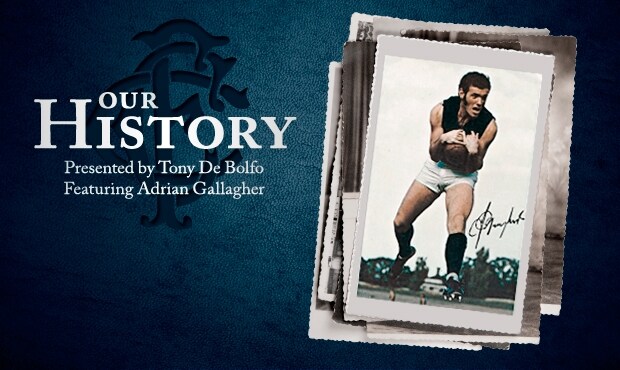
“Ron Barassi was the best thing that happened to Carlton in 150 years . . . other than Chris Judd coming.”
The speaker is Adrian Gallagher – Carlton’s Team of the 2oth Century’s No.1 rover – and with John Nicholls and Sergio Silvagni a member of what was, and perhaps still remains, football’s greatest following division.
Wearing the No.10 made famous by the late John James and now donned by Matthew Watson, Adrian Gallagher is the only man in this club’s history to have represented Carlton at all levels – Under 15s, Under 16s, Under 17s, Under 19s, reserves and seniors. His 165 games over nine seasons also took in the Premierships of 1968, ’70 and ’72 . . . but don’t bother asking ‘Gags’ to name a favourite.
As he said: “Premierships are like children – you can’t pick your favourite”.
Adrian Gallagher recently gave up his time for what was the first of a series of podcasts exclusively for www.carltonfc.com.au. To hear Adrian talk of the great Ronald Dale, the Premierships and today’s Carlton team, click here.
Follow Tony De Bolfo on Twitter: @CFC_DeBolfo
Happy 60th birthday to John Tresize.
———————-
From the Blueseum:
Career: 1977 – 1978
Debut: Round 1, 1977 v Geelong, aged 24 years, 35 days
Carlton Player No.: 863
Games: 14
Goals: 1
Last game: Round 3, 1978 v Melbourne, aged 25 years, 48 days
Guernsey No. 22
Height: 180cm
Weight: 78kg
DOB: 26 February, 1954
Tresize wore guernsey #22 in 14 games for Carlton from Season 1977 onwards. He kicked 1 goal for the Blues. He was born in Bendigo and recruited from Kennington (Bendigo). During the 1978 season, he headed back to the bush to play for his original club Kennington.
Happy 85th to Tom Leehane!
————–
From the Blueseum:
Playing Career : 1948
Debut and Only Game: Round 15, 1948 Vs Footscray, aged 20 years 175 days
627th Carlton Player
Goals : 0
Guernsey No. 29
Height : 180 cm (5’11”)
Weight : 83 kgs (13.1)
DOB : February 14, 1928
Wearing guernsey #29 and standing at 180cm, Leehane played 1 game for Carlton in 1948. His only Carlton game was a victory over Footscray at the Western Oval by 68 points. He then went and joined his brother at Essendon where he played another 7 games without scoring a goal.
Leehane’s father, Steve, played 82 games for the Blues starting in 1914.
Leehane was recruited from CBC North Melbourne, and prior to that he played for East Brunswick YCW.
Latest past player videos to be uploaded to our youtube channel, SpiritofCarltonTV.
The 2012 Spirit of Carlton Past and Present Annual Report is now available. Read it to find out all the activities of the SOC in 2012.
Do not forget to get your SOC membership for 2013.
Also, do not forget we have a free function coming up in early March, a Pleasant Sunday Morning.
A very happy 90th birthday to Doug Williams today!
————————
From the Blueseum:

Career : 1944 – 1951
Debut : Round 11, 1944 vs Footscray, aged 21 years, 162 days
Carlton Player No. 594
Games : 120
Goals : 7
Last Game : Round 12, 1951 vs Hawthorn, aged 28 years, 168 days
Guernsey No. 12
Height : 178 cm (5 ft. 10 in.)
Weight : 70 kg (11 st.)
DOB : 3 February, 1923
Premiership Player 1945 & 1947
A skilled and consistent wingman for the Blues in a fine career spanning eight seasons, Doug Williams was a member of Carlton’s legendary 1945 and 1947 Premiership teams, as well as the losing Grand Final side of 1949. He was recruited from Yallourn in Victoria’s Latrobe Valley in 1944, and rarely missed a match in his first five years.
Deceptively tall and slender, Williams was quick, agile and strong overhead. A typical wingman of that era, his style of play was to provide a link between defenders and forwards, so he rarely ventured into attack. In his 120 games of VFL football, he kicked just seven goals. Nevertheless, he was widely regarded as one of the better centre-line players of the post-war years.
Williams was given his first opportunity at senior level for the Blues in July 1944, in a Round 11 match against Footscray. On that typically wet and windy afternoon at the Western Oval, Carlton’s scoreless last quarter was costly, and Footscray got home by three points. Williams’ impressive first-up effort however, ensured that would retain his place in a promising Carlton side for the rest of the year.
In Doug’s second season, Carlton got off to a very shaky start. Three heavy defeats in a row sent the Blues tumbling to the bottom of the VFL ladder, before a stirring mid-year revival culminated in a 53 point thrashing of Footscray in the last of the home and away rounds. That win snatched a finals berth for the Blues, and set the stage for one of the most sensational and controversial final series of all.
In August 1945, World War II ended when the Japanese Government signed an unconditional surrender to the Allied nations. Seven years of widespread death and destruction was ended at last, and the VFL proclaimed the 1945 flag – to be contested by South Melbourne, Collingwood, North Melbourne and Carlton – as the Victory Premiership. Instead, it has gone down in football history as the ‘Bloodbath’ Grand Final.
Carlton’s path to the ’45 Premiership was littered with the carcasses of North Melbourne and Collingwood, who were both vanquished in hard, spiteful games on the way to a deciding clash with the hot flag favourites South Melbourne. For Doug Williams, gaining a place in that Premiership play-off topped off a good season. He had missed just two games since his debut, and followed up his selection in the Victorian state side earlier in the year by controlling his side of the ground in Carlton’s Preliminary Final win over Collingwood.
On that sensational day, Doug lined up against South’s Billy King, who, like Williams, was considered a star in the making. King later paid tribute to his opponent for keeping him out of the fierce physical clashes – some within the rules, but most without – that began in the second quarter and intensified as the Grand Final degenerated into a series of rolling brawls.
There were passages of good football – even when the rain came in the second half – but they were instantly forgotten amid the mayhem. Eventually, the Blues’ inspirational captain Bob Chitty led his team to victory by almost five goals in a match that resonated through the league for years afterward. Nine players were reported, on fifteen charges. The eight found guilty were handed suspensions totalling 68 games.
Carlton’s eighth VFL Premiership in 1947 is fondly remembered for the last-minute goal by Fred Stafford – a celebrated snap-shot that won the ultimate football prize for the Blues by one point – and for the outstanding leadership of our first-year captain, Ern Henfry. A champion centreman from WA who led by example, the key to Henfry’s game was his superb disposal, which brought those around him into the game.
Among those to benefit most from his new captain’s influence was Doug Williams. He, Henfry, and Fred Fitzgibbon (himself notorious for his part in the 1945 Finals battles) made a formidable combination across the middle of the ground for Carlton, and as a combination, were a driving force for the Blues throughout the ’47 finals and beyond.
When Carlton shaped up to Essendon in 1949 Grand Final, Williams, Henfry and Fitzgibbon plunged into the fray together once more. But this time, neither they nor their team-mates had any answer to a rampaging Essendon. Spearheaded by their young full-forward John Coleman, the Bombers blitzed the Blues by 73 points – bringing to an end a golden era of three Grand Final appearances in six years by the team from Princes Park.
Perhaps inevitably, Carlton began a period of stagnation in 1950. After almost a decade of joy, the champions who had sustained the Blues through the tough football campaigns of the war years had reached the twilight of their careers, and the team began fading to the lower half of the ladder.
On a wet Saturday afternoon in July at Glenferrie Oval, after Carlton beat Hawthorn by 17 points, Williams brought the curtain down on his senior career in the navy blue number 12 guernsey. He wasn’t quite finished however, and stayed around long enough to celebrate one more flag, when Carlton beat Essendon by 12 points in the 1951 Reserves Premiership. In a fitting finale, Doug was the master of his side of the MCG once more on Grand Final day, and walked off the ground a winner for a third time.
The following year, Williams was appointed captain-coach of Tasmanian club North Launceston, and took the Robins into the NTFA finals at his first attempt. But home was calling for Doug and his wife Margaret, and in 1953 they returned to the Latrobe Valley. There, Doug rounded out a long and memorable career with one last season for the Morwell Tigers, which included another premiership, and to cap it all off – a Best and Fairest.
A happy 50th birthday to Darren Ogier!
——-
From the Blueseum:
Career: 1985-1987
Debut: Round 7, 1985 vs Sydney
926th Carlton Player
Games: 13
Goals: 15
Last game: Round 16, 1987 vs West Coast
Guernsey No. 34 (1987), 49 (1985 – 1986) and 52 (1982)
Height: 184cm
Weight: 81kg
DOB: 2 February, 1963
Think about the revolving door of players tried and tested at full forward throughout the 1980s: Ross Ditchburn, Warren Ralph, Warren McKenzie, Phil Poursanidis, Michael Gallagher, Peter Sartori…
… the list goes on. Darren Ogier was one of the merry-go-round who never quite established himself, despite being a prolific goal kicker in the Reserves. His claim to fame was being the first Blue to sport a genuine mullet, which obviously proved inspirational to another young, impressionable recruit, a certain S. Kernahan.
Ogier, due to limited opportunities headed to North Melbourne for the 1988 season. While at the Roos’, he played two games and kicked three goals, the last of those two games was against the Blues where he potted two goals. The following season (1989), he headed north of the border to Sydney where he played a further eight games and kicked 16 goals. His last two games for the Swans he kicked 5 goals against Footscray, then 4 goals against the Eagles. Then he never played VFL football again! His VFL career was a total of 23 games and 34 goals at three clubs spanning five years.
In 1991, while living in England, Ogier guided the Earls Court Kangaroos to the British Australian Rules Football League premiership. He was an assistant coach at the Northern Bullants from 1998 to 2001 and served as the senior coach of Katamatite in 2006. The following year he joined the Murray Bushrangers, of the TAC Cup, as an assistant coach and was promoted to senior coach for the 2010 season.
Darren Ogier was originally recruited from Northern Suburbs club Hadfield.
Ogier also played with the Blues Little League in 1974.
Latest past player videos to be uploaded to our youtube channel, SpiritofCarltonTV.
A happy 60th birthday to Mike Fitzpatrick.
———
From the Blueseum:
Career : 1975 – 1983
Debut : Round 1, 1975 vs Geelong, aged 22 years, 67 days
Carlton Player No. 850
Games : 150
Goals : 150
Guernsey No. 3
Last Game: Elimination Final, 1983 vs Essendon, aged 30 years, 218 days
Height: 191 cm
Weight: 91 kg
DOB: January 28, 1953
Premiership Player: 1979, 1981, 1982
Premiership Captain: 1981, 1982
Captain: 1980-1983
Best and Fairest: 1979
Carlton Hall of Fame (1992)
When the Prime Minister of South Africa’s Cape Colony, Cecil Rhodes, died in 1902, he left one of the world’s great legacies. The multi-millionaire bachelor directed that his fortune be used to provide scholarships to outstanding young men and women from the British Empire and America, on the proviso that candidates must have demonstrated a combination of “scholastic excellence, sporting prowess and strong character.”
One of Western Australia’s brightest young men won a Rhodes Scholarship in 1975. His name was Mike Fitzpatrick. While studying Engineering at the University of WA, he was also playing WAFL football for Subiaco, on the verge of an outstanding VFL career that would see him afterward recognised as one of the great captains of the Carlton Football Club.
By late 1974, Fitzpatrick had already notched up 97 senior games with Subiaco. A mobile, skilful ruckman, he was targeted by several VFL clubs before Carlton won his services. He arrived at Princes Park and celebrated his 22nd birthday before making his debut in round one, 1975. At 191 cm and 91 kg he gave away height and weight to many opponents, but he was clever, athletic and an outstanding mark. Adept at assessing his opponents’ strengths and weaknesses, he was a fierce competitor who hated being beaten. “Fitzy” played every game that year, and by season’s end was already considered a future captain of the Blues.
His studies took him to England’s Oxford University in 1976 but he was able to return for the latter part of that VFL season, including two losing finals matches. He was away again throughout 1977 and managed just two appearances in 1978. After his full-time studies were completed, Fitzy and indeed, all Carlton supporters, were keen to have him back in 1979 – and he didn’t disappoint. With Fitzpatrick and the wiley veteran “Percy” Jones making up a formidable ruck division, the Blues had a great year, topped off with a fighting 5 point Grand Final victory over Collingwood. Fitzy had a superb final series; showcasing his tenacity and an ability to lift himself and his team on big occasions. He was a popular and deserving winner of Carlton’s Best and Fairest award.
Soon after the glory of the ’79 Premiership, ructions split the Carlton Football Club when President George Harris was tipped out of office and replaced by Ian Rice. Percy Jones retired as a player to take on the coaching role, and Mike Fitzpatrick was appointed captain. It was a popular decision all round, and The Blues began 1980 as flag favourites. Carlton went to top of the ladder after the home & away rounds, only to let themselves down by losing successive finals to crash out of contention. This brought an end to Percy Jones‘ senior coaching career. His place was taken by former Hawthorn Premiership coach David Parkin, who happily, found an immediate empathy with Fitzpatrick. Both were committed to success in every way, and both were prepared to pay the price for that success. Together they were a daunting proposition, committed to making amends for past failure.
Driven by that disappointment in 1980, Carlton finished the 1981 home & away rounds on top of the ladder by percentage over Collingwood, and went on to face the Magpies in the Grand Final. On that special day, Fitzpatrick rucked tirelessly all match against Peter Moore, and had the better of the Brownlow Medallist as the Blues won their thirteenth Premiership by a comfortable 20 points. Bruce Doull won the Norm Smith medal for Best on Ground, with Fitzy next best in the votes.
Season 1982 should be remembered as one of Carlton’s greatest ever. Not just for the feat of winning consecutive Grand Finals, but rather for the enormous physical effort required by every member of the team to defend the title. In a tough season, Fitzpatrick was inspirational on countless occasions. Always dangerous in attack, he regularly pushed forward to deliver vital goals when they were most needed. And when emotions spilled into confrontation, the captain was always there to fly the flag. He may have been a man of books, but he always stood ready to look after himself and his smaller team-mates when required.
Carlton began the ’82 finals in third spot behind Richmond and Hawthorn. In a torrid Qualifying Final against Hawthorn, Blues’ stars Wayne Johnston and Peter Bosustow were reported and subsequently suspended for two weeks and one week respectively. Carlton steamrolled the Hawks in the second half to win by 58 points. Then on the following Saturday, Carlton were no match for Richmond in the second semi-final. As always, the Tigers relied on physical pressure to unsettle their opponents. They hit hard and hit often to beat the Blues by 23 points; giving away 62 free kicks to Carlton’s 36, on the way to a week’s break and a place in the Grand Final.
While Richmond had their week off, the Blues met Hawthorn once more in the preliminary final. Bosustow had returned, but Jimmy Buckley and Mark Maclure didn’t come up at training. On selection night David Parkin and the match committee swung Fitzpatrick to centre half-forward to cover for Maclure, and Wow Jones into first ruck. In another fierce, physical clash, Leigh Matthews ran through Carlton’s Rod Austin in the first few minutes. First on the scene to even up was Mike Fitzpatrick, and soon there were prostrate Hawks aplenty. That incident sparked the Blues. Enough was enough and they refused to take a backward step from that moment on. When “Curly” Austin ran back out onto the ground after half-time, the whole team lifted further to win by five goals.
After three successive gruelling matches, Carlton were at long odds against Richmond in the Grand Final. The Blues regained Johnston, Maclure, and Buckley, while the Tigers were at full strength, rested and confident. As expected, Richmond went hard at the man and the ball from the opening bounce. Spot fires broke out all over the ground as Carlton slammed on two goals in the first two minutes, while commentator Lou Richards couldn’t take it all in and exclaimed, “this is the toughest opening ever!”
At half time Richmond had clawed their way to an eleven point lead, but Carlton had had four more scoring shots and an edge in general play. Fitzpatrick and big Wow Jones were on top of the Richmond rucks, Bruce Doull was impassable in defence and Wayne Johnston was brilliant in the centre. Coach Parkin demanded that his players take the initiative in the third quarter. He sent wingman Wayne Harmes to the back pocket, and captain Fitzpatrick to centre half-forward. Both moves were justified as the Blues ran rampant. Fitzy was the focal point in attack, marking strongly twice to kick telling goals as Carlton slammed on 5.4 to Richmond’s six behinds for a 17 point lead at three-quarter time.
As the fresher and fitter of the two teams, Richmond were expected to finish strongly, but that didn’t happen. The Blues were magnificent in that last quarter as wave after wave of Tiger attacks foundered on the rocks of the Carlton defence. Mike Fitzpatrick limped off the MCG late in the quarter with a satisfied grin on his face and appreciative applause swelling around the ground. The final margin was 18 points. Fitzy had won his third Premiership medal – his second as captain.
That ankle injury, and others to his hip and hands, plagued Mike throughout the 1983 season. When he and his beloved Blues limped into the finals that year, only to lose the first elimination final, he knew it was time to call it a day. Tributes from friends and foes everywhere poured into Princes Park when he announced his retirement after 150 inspirational games and 150 goals in his familiar number 3. He was 30 years old. A marvellous sporting career had ended, but there were more impressive achievements ahead.
With a Bachelor of Engineering (Hons.) from the University of WA, as well as a Bachelor of Arts (Hons.) from Oxford University to his name, Mike Fitzpatrick has been as spectacularly successful in his subsequent business career as he was on the football field. After a couple of seasons as Vice President of the AFL Players Association, he spent time in New York with the giant financial house Merrill Lynch before returning to Australia to senior positions with the Victorian Treasury and Telecom Australia. He then founded Hastings Funds Management Ltd and continues as the company’s Managing Director. He has also been Chairman of the Australian Sports Commission, a member of the Melbourne Park Tennis Centre Trust, and a Director of the Carlton Football Club.
In 1992, Fitzy was elected to the Carlton Hall of Fame. In early 2000 he was named on the bench in Carlton’s Team of the 20th Century. In 2003 he was appointed to the Board of the AFL Commission, and in March 2007 he became one of the most powerful and influential figures in the game, when he succeeded Essendon’s Ron Evans as AFL Chairman.
Cecil Rhodes would surely have approved.
Latest past player videos to be uploaded to our youtube channel, SpiritofCarltonTV.
Tom Carroll
Ron Stone
Ron Barassi
John Lloyd
A happy 60th birthday to Rod Austin.
——-
From the Blueseum:
Career : 1972 – 1985
Debut : Round 6, 1972 vs Geelong, aged 19 years, 100 days
Carlton Player No. 835
Games : 220
Goals : 20
Last Game : Round 12, 1985 vs Footscray, aged 32 years, 140 days
Guernsey Nos. 45 (1972) and 21 (1973–85)
Height : 180 cm (5 ft. 11 in.)
Weight : 80 kg (12 stone, 8 lbs.)
DOB : January 26, 1953
Premiership Player: 1979
Carlton Hall of Fame (1997)
Rodney Austin was born on Australia Day in 1953, and recruited by Carlton from the vaunted local college team Holy Child / St Dominic’s. With his thick mop of hair and an awkward kicking style, he was quickly dubbed ‘Curly’ by his team-mates – some of whom saw a resemblance to one of the Three Stooges. But there was nothing slapstick about the way ‘Curly’ went about his football. In time, he developed into a versatile, consistent defender who was rarely beaten for an entire game. One of the most popular players of his era, he won Premiership glory with the Blues in 1979, and was cruelly denied a place in both the 1981and ’82 flag sides by injury.
Austin wrote his name into Australian Football folklore in July, 1977 at Princes Park. Standing in for Geoff Southby at full-back against Hawthorn, he kept the Hawks’ champion full-forward Peter Hudson goalless on one of just two occasions in Hudson’s brilliant 129-game, 727-goal VFL career. Although he gave away eight centimetres in height and at least two kilograms in weight that day, Curly’s steely concentration proved too much for Hudson, setting up one of the great individual rivalries of the decade.
Two years later, Austin returned from injury on the eve of the finals, and was named as a reserve for the Grand Final against Collingwood. On a sodden MCG, in front of more than 112,000 fans, the Blues beat their fiercest rivals by five points, thanks to some desperate late brilliance by Wayne Harmes. With just a minute or so on the clock, Harmes’ committed chase, dive and swipe at the ball in the right forward pocket delivered the ball to Ken Sheldon, who goaled to seal Carlton’s twelfth Premiership. Curly was in a back pocket on the siren, having come off the bench early to allow Harmes to push forward.
The Blues finished the home and away rounds of season 1980 second on the ladder by percentage, only to crash out of the finals after successive defeats. Coach ‘Percy’ Jones was promptly sacked, and former Hawthorn captain and Premiership coach David Parkin appointed in his place. Austin blossomed further under Parkin’s coaching, playing solid, dependable football throughout 1981, in a rock-hard Blues defence.
After topping the ladder in ‘81, Carlton crushed Geelong by 40 points in the second semi-final. Curly was as solid as always in a back-pocket that day, before a groin muscle tear sent him limping off late in the game. That blow ruled him out of the Grand Final side, and he was watching from the stands the following week as his relentless team rebounded from 21 points down in the third quarter to skittle Collingwood for the second time in three years.
Carlton’s superb 1982 back-to-back Grand Final victory over Richmond came after one of the toughest finals campaigns in this clubs’ long and proud history. Ending the home and away rounds as the third of five finalists, Carlton beat Hawthorn in the Qualifying Final, lost to Richmond in the Second Semi, then faced the Hawks again in the Preliminary Final for a the right to play Richmond for the flag.
David Parkin knew the key to victory over Hawthorn was to limit the influence of their champion Leigh Matthews, and the man he turned to was Curly Austin. Barely five minutes into the game, however, Matthews hit Austin with a classic shirtfront, and knocked him senseless. After being revived on the field, Curly refused to be taken off. He ran back to his position, chested Matthews with an attitude that said; ‘is that the best you can do?’ then proceeded to cut the Hawks’ gun forward out of the rest of the game. Carlton won by five goals, Austin won the Blues’ Best Player award, and looked forward confidently to his Grand Final appearance – at least until midway through the next morning’s training run.
During one of the drills that Sunday, Curly was accidentally kicked in the thigh by team-mate Frank Marchesani. Deep bruising appeared and by Tuesday afternoon it was obvious that Austin wouldn’t be playing. On Grand Final day he was laid up in a hospital bed, as Carlton – led magnificently by captain Mike Fitzpatrick and ‘The Dominator;’ Wayne Johnston – upset the Tigers to win the Blues’ fourteenth Premiership. As a testament to the club’s regard for Curly, coach Parkin and a group of senior players made his hospital ward one of their first destinations that night, taking the Premiership Cup along with them.
That was to be Austin’s last chance at further Premiership glory. Nevertheless, he continued playing consistent and reliable football for three more seasons before retiring as a player after Carlton’s early exit from the 1985 Finals. Never one to take anything for granted, disappointment or regret over those two missed Premierships was never an issue with him. He has always maintained his gratitude at being a Carlton Premiership player, saying that only a comparative few experience winning a flag, and he treasures the achievement.
After hanging up his boots, Curly accepted an offer to be on the match committee in 1986 under Mick Malthouse, and later he would coach the Reserves team at Footscray, this included coaching the reserves to a premiership in 1988. In 1989 he was appointed senior coach at Fitzroy for two years, and in 1994 and ’95 he was in charge of the Victorian State of Origin team. Always a popular figure at Princes Park, Curly was elected to the Carlton Hall of Fame in 1997.
Austin’s son, Nick Austin played a reserves game for Carlton in 2002. Nick’s sporting prowess was with the Carlton Cricket Club in the Premier League as a left-arm opening bowler. Nick made history in November 2012 when he played his 200th game of cricket for Carlton. Nick and Rod became the first father-son combination to play 200 games of League football and 200 games of Premier Cricket.
 All past players are invited to attend a Pleasant Sunday Morning event organised by the Spirit of Carlton Past and Present.
The idea of the event is to bring as many people who were once involved with the club back to the club.
Let’s face it, for players in particular, the final memory of the club for most is not a pleasant one as very few players get to choose the timing of the end of their association with a club.
What we want is for as many people as possible to remember the good times that the club provided, to re-engage and get together at the club to share the good memories together. Whether you played one game or one hundred in the U19s, Reserves or Seniors we all share the connection to the Carlton Football Club. So bring your family and enjoy a special day.
The event is free, drinks will be available as well as a free BBQ.
We would love to see you there. If you have a team-mate who you think would be interested please tell them about this, a flyer for distribution is available through THIS LINK.
Current players will be attending the early part of the event after a recovery session so take the opportunity to come along and see the present as well as the past.
Place: Visy Park
Date: Sunday 3rd March, 2013
Time: 9:30am-1:30pm
Please Register your attendance either via email at:
mandy.hunter@carltonfc.com.au
OR
Phone Mandy Hunter on 9389 6256
A very happy 87th birthday to Allan Greenshields. Allan is a great supporter of the Spirit of Carlton and attends many of our functions.

————–
From the Blueseum:

Playing Career : 1947 – 1949
Debut : Round 1, 1947 vs Melbourne, aged 21 years 86 days
Carlton Player No. 614
Games : 16
Goals : 2
Last Game : Round 6, 1949 vs Geelong, aged 23 years 119 days
Guernsey Nos. 29 (1947-48) and 19 (1949)
Height : 178 cm (5 ft. 10 in.)
Weight : 74 kgs (11 stone, 9 lbs.)
DOB : January 22, 1926
Premiership Player : 1947
A capable utility who was a reserve in Carlton’s 1947 Premiership team, Allan Greenshields spent three seasons at Princes Park without managing to establish himself in a strong Carlton line-up. He earned the wry nickname of ‘Splinters’ in his debut year, by being named on the bench in ten of his thirteen senior games.
Two of those matches were memorable finals victories over Essendon; the 1947 second Semi Final, and two weeks later, the famous last-minute triumph over the Bombers in the Grand Final. Yet despite that promising start to his career, Greenshields played only three more times for the Blues over the next two seasons, and in 1949 decided that perhaps there were more opportunities elsewhere. He played his last match in navy blue against Melbourne at Princes Park in round 6, 1949, and went out on a high note when he slotted both of his Carlton career goals in a solid 39-point win over the Demons.
Later that same year, he turned out for St Kilda, in the first of 57 appearances he would make as a defender for the Saints in a six-year stay at the Junction Oval.
Greenshields played at various clubs, that included; Rainbow, Pascoe Vale and Coburg.
Latest past player videos to be uploaded to our youtube channel, SpiritofCarltonTV.
|
Notice of Annual General Meeting Notice is given that the 2012 Annual General Meeting of the Spirit Of Carlton Past And Present Inc Will be held on: Date: Monday, 4 February, 2013 Time: 6.00pm Address: George Harris Function Room,Visy Park, Royal Parade, Carlton North |
|
The detailed Notice of AGM and Proxy form can be downloaded from the following links: |
A very happy 40th to Kouta!
————————
From the Blueseum:
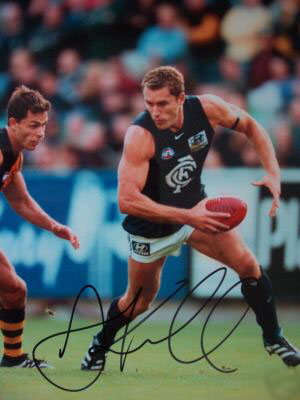
Career: 1992 – 2007
Debut : Round 13, 1992 vs Adelaide, aged 19 years, 147 days
Carlton Player No. 985
Games : 278
Goals : 226
Last Game : Round 17, 2007 vs St Kilda, aged 34 years, 191 days
Guernsey No. 43
Height : 190 cm (6 ft. 2 in.)
Weight : 95 kg (15 stone, 0 lbs.)
DOB : 18 January, 1973
Premiership Player: 1995
Leigh Matthews Trophy (AFLPA MVP) : 2000
Best and Fairest: 2001, 2005
All Australian: 1995, 2000
Leading Goalkicker : 1997
Club Captain: 2004 – 2006
Throughout the history of VFL/AFL football, few individual players have actually changed the game. However, such was the impact of Anthony Koutoufides – “Kouta” to the masses of Blues supporters he thrilled during his celebrated 15-season career at Princes Park between 1992 and 2007 – that today he is recognised as the prototype of the 21st century footballer.
A 191 cm powerhouse with pace, endurance and sensational all-round skills, Koutoufides starred in Carlton’s 1995 Premiership victory over Geelong, won two club Best and Fairest awards, and was twice selected as an All Australian. In 1997 he was Carlton’s leading goal-kicker, and in 2000, was voted the AFL Players Association’s Most Valuable Player. Late in his career, amid his club’s darkest hours, he stepped up to the captain the Blues for three seasons, before retiring one year later as one of the most respected and admired men ever to have played the game.
Kouta’s heritage spanned four cultures. His father; Dimitrios (‘Jim’ to his friends and family) was born in Egypt to Greek-Cypriot parents, while his mother Anna came from northern Italy and met her future husband while on holiday down under. As part of the vast post-World War II migration from Europe to Australia, the couple settled in Melbourne’s northern suburbs at Lalor, and Anna produced three sons. The two eldest, Paul and Anthony, became keen schoolboy track athletes from their early teens, while they also embraced the Australian code of football. Before long therefore, a choice had to be made.
Anthony was an outstanding junior prospect who represented his state in three disciplines; the 100/110 metre hurdles, high jump and decathlon. From the age of 15 he was being talked about as a potential Olympian, although he and Paul were also enjoying success on the football field with Lalor Juniors. The crunch came in 1989, when the brothers were approached by Carlton scout Wayne Gilbert with an invitation join the Blues’ Under-19 squad. Despite the fact that both were keen Collingwood fans at the time, there was no hesitation. Paul and Anthony couldn’t wait to get to Princes Park.
Paul went on to play a couple of seasons of Under-19 football and one Reserves match for Carlton, without progressing to senior level. Anthony followed the same pathway, but from his earliest games his mature physique, outstanding agility and appetite for the contest marked him as something special. At first he was seen as a key defender, especially when he moved up to Reserve grade in 1992 to take on the full-back role, and won the Carlton Reserves Best and Fairest. Considering that he also made his senior debut the same year and played six first-grade matches, it was an outstanding achievement.
Having played through the lower grades in guernsey number 46, Anthony requested a change to his favourite number 43 when he was promoted to Carlton’s senior squad, and made an eye-catching debut against the Adelaide Crows at Princes Park in round 13, 1992. Sitting on the interchange bench until just before half-time, he ran onto the field and became involved in the play straight away with a clever shepherd that allowed Ron De Iulio an easy goal. Shortly afterwards, he kicked a smart goal himself from deep in a pocket with the second kick of his career, after his first attempt had been smothered. The Blues won by 23 points, and Anthony’s career was up and away.
Later in the year, in round 23 against Collingwood at VFL Park, Waverley, spectators got a glimpse of the future when Koutoufides shrugged off an opponent, swooped on the ball and picked it up with one hand. A gob-smacked Carlton coach David Parkin later said to him; “I’ve been waiting twenty years to see what you just did.” A few weeks later, Anthony finished off an impressive first season by collecting 19 possessions, four marks and his first Brownlow Medal vote as Carlton lost to West Coast at Subiaco in the last round of the year. He carried the ball in one hand that day too, and it rapidly became his trademark.
Koutoufides’ second season in 1993 started full of promise, only to be derailed by the first in a long series of injuries. After playing the first five games in defence, he damaged ankle ligaments in round 6 against Collingwood, and spent 10 weeks on the sidelines. Back to match fitness late in the year as the Blues tuned up for the finals, he was running into form again on the eve of the Grand Final against Essendon, but on selection night was overlooked in favour of Mark Athorn. Two days later, Anthony could only watch in despair as Essendon’s ‘Baby Bombers’ demolished Carlton by 44 points to win the flag.
Carlton’s fan base began to really embrace Koutoufides in 1994, especially when coach Parkin decided to play him on a wing and see if the opposition had anyone with the size and speed to match him. Invariably, they didn’t, and by mid-year the first cries of “Kout-ta, Kou-ta!” were echoing from the stands. Against Richmond at Princes Park in round 23, he provided a constant avenue to goal for the Blues, picking up 27 effective possessions as the home side destroyed the Tigers by 113 points. A few weeks later, his blossoming career reached a new level when he experienced his first two senior finals. Carlton lost both however, going down in successive weeks to Melbourne and Geelong.
Anthony’s fourth season in 1995 was simply sensational. In 25 games he kicked 22 goals, and collected 25 possessions (or more) on six occasions. He took more marks, earned more Brownlow Medal votes (12) than any other Blue, and was selected as an All Australian, before he almost single-handedly demolished Geelong in the Grand Final. Playing on a wing, but ranging far and wide through the midfield, Kouta racked up 31 possessions and eight telling marks on that unforgettable afternoon, as a remorseless Carlton ground the Cats into the dust and claimed the Blues’ 16th Premiership. Among a host of Navy Blue stars, Greg Williams was awarded the Norm Smith Medal as best on ground – but Koutoufides too, would have been worthy winner.
Kouta’s form in 1996 mirrored that of his team – occasional lapses, indispersed with regular successes. He didn’t miss a match all season, and kicked 24 goals while averaging 21 effective disposals and six marks per game. He produced an absolutely stunning performance against the West Coast Eagles in round 5 at Subiaco, hauling down 18 big marks (amid 35 possessions) as Carlton won a thriller by one point. At the end of the home and away season, he finished equal with Fraser Brown as the club’s top vote-catcher in the Brownlow Medal with 12 votes, before being one of his team’s best in a disappointing final series that saw the Blues eliminated by straight-sets losses to West Coast and Brisbane.
In 1997, after four consecutive finals campaigns, Carlton crashed to eleventh place on the ladder. Kouta played his 100th game in round 15 against Melbourne, as a raft of stars including long-serving captain Stephen Kernahan,Greg Williams, Justin Madden, Earl Spalding and Mil Hanna all reached the end of their careers. While the next generation of leaders – including Koutoufides – continued their progress, coach Parkin sometimes asked his star mid-fielder to play up forward, and Anthony generally delivered.
Playing on a wing against Collingwood at the MCG in round 4, 1997, Kouta racked up 32 possessions in a solid win. Later in the year, during the return game in round 19, Parkin sent him to full-forward, where he took a couple of screamers and kicked 6.4 from 22 possessions and 7 marks. Carlton came out on top again by 16 points, and that big haul helped him reach a total of 28 goals for the season. It was a modest return, but good enough to win him Carlton’s Leading Goalkicker Award, ahead of Justin Murphy (26 goals) and Stephen Silvagni (25).
Under a new captain in Craig Bradley, the Blues aimed for real improvement in 1998 – until the awful news broke that Jim Koutoufides had been diagnosed with lung cancer at the age of just 58. His death in March devastated his close-knit family, and by association, everyone involved at the Carlton Football Club. A stricken Anthony still played 21 games for the year, although he and the team as a whole were never really in finals contention, and once again finished eleventh.
Eventually, with the support of his many friends, colleagues and team-mates, Kouta returned to something near his brilliant best in 1999, averaging 20 possessions and 6 marks per game to finish runner-up to Matthew Allan as Carlton’s Best and Fairest. Standout games included 27 possessions and 7 marks against St Kilda in round 6; 25 disposals and 12 marks against Brisbane in round 11, and 23 possessions and 10 marks against Hawthorn in round 14. But those numbers were all but forgotten after the Blues qualified for the finals in sixth place, and fought their way through to a Preliminary Final showdown against minor premiers and hot flag favourites Essendon. The Bombers were gunning for their 16th flag to equal Carlton’s record, and the Blues had set themselves to stop them. What transpired that day produced one of the greatest finals matches of all time.
In front of 80,000 at the MCG, an under-manned, bloody-minded Carlton simply refused to be beaten. Trailing by 11 points at three-quarter time, the Blues kicked 6.2 to Essendon’s 4.2 in a frantic last quarter, to win by a point – largely due to 30 minutes of football from Koutoufides that was described by a stunned Stephen Kernahan as “the greatest quarter of football ever played.” Running hard to all parts of the field, Kouta had ten kicks, four clearances, three defensive rebounds, six marks and kicked two great goals in an epic quarter that brought a truly famous victory. Such was the euphoria around Princes Park in the days after that sensational game, that the following Saturday’s Grand Final loss to North Melbourne was almost an anti-climax. Sure, Carlton hadn’t won another flag – but neither had Essendon!
Kouta played his 150th game in round 2, 2000 in a 42-point win over Hawthorn at Princes Park, and was enjoying another prolific season when he picked up a career-best total of 39 disposals, 13 marks, 4 hit-outs and 2 goals in Carlton’s big win over Sydney in round 8. Demonstrably at the peak of his form, he was a clear favourite for the Brownlow Medal, before the Blues hosted North Melbourne at Princes Park in round 11. When that game began, Kouta was stunned to be manned up in the midfield by the Kangaroos’ champion centre half-forward and captain Wayne Carey.
It was a match-up for every football lover to savour, but Koutoufides rose to the challenge and turned it into a non-event. Leading the Roo captain a merry dance, Kouta kept Carey under a tight wrap and won the football himself 38 times – earning 17 kicks, 21 handpasses, 8 marks and kicking five terrific goals in a vital win that cemented a top-two ladder position the Blues. Kouta later conceded that this was in fact, his best-ever individual effort. “When people ask me which was the best game I ever played,” he said some time afterward, ”It would have to be the one against North Melbourne.”
By round 20, 2000, Carlton was comfortably sitting second on the ladder when disaster struck in the form of a posterior cruciate ligament strain to Kouta’s left knee. The surgery required ended his season, but he had been so good during the previous five months that he was still named as an All Australian, as well as the AFL Players Association Most Valuable Player (now known as the Leigh Matthews Trophy). Carlton responded by offering him an unprecedented 5-year contract (rumoured to be worth one million dollars) which was quickly accepted. From then on, Kouta would be a Blue for life.