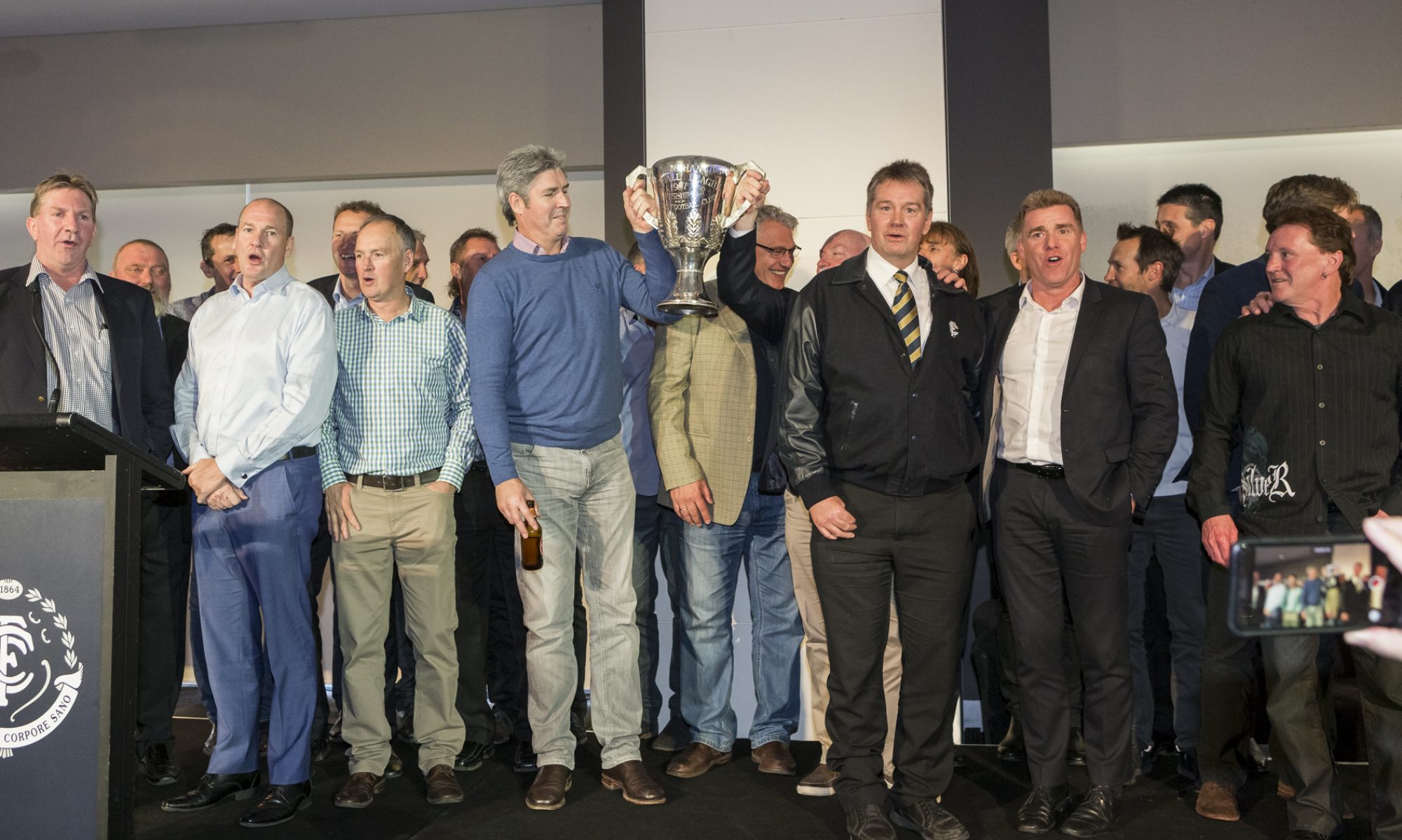

Premium Seats Available for Carlton vs Adelaide
Just a reminder that FREE premium reserve seats are available to Spirit of Carlton members for this Satuerday’s clash between the Blues and the Crows.
If you want these limited seats it is first in best dressed. If you haven’t signed up as a member as yet this is your opportunity to do so and get access to premium seats.
Please call Mandy on 03 9389 6256
Happy 86th to Kevin Hart
A happy 86th birthday to Kevin Hart today!
Sadly, we do not have any contact details for Kevin, if anyone who reads this knows his whereabouts please let us know via email at admin@spiritofcarlton.com.au
——-
From the Blueseum:
Career : 1950
Debut : Round 1, 1950 vs Melbourne, aged 23 years, 1 day
Carlton Player No. 638
Games : 5
Goals : 3
Last Game : Round 11, 1950 vs Fitzroy, aged 23 years, 71 days
Guernsey No. 36
Height : 171 cm (5 ft. 7 in.)
Weight : 70 kg (11 stone)
DOB : April 21, 1927
A rover who made his senior debut for Carlton the day after his 23rd birthday, Kevin Francis Hart wore guernsey number 36 in his five matches for the Blues in 1950. Born in Moreland, he honed his football skills at Preston YCW, before he served briefly as an 18 year-old with the Royal Australian Navy in 1945 – the last year of World War II.
In 1947 he was recruited by Fitzroy, and appeared in 19 matches for the Maroons over three seasons. He crossed to Carlton in 1950, and was selected as a reserve twice before he made his on-ground debut when Carlton took on Geelong at Kardinia Park in round 9 of that year. A huge crowd of 23,000 packed into the stadium, and the home fans were in delirium when Geelong led by five goals at three quarter time. But helped by a freshening wind, Carlton swamped the Cats in the last fifteen minutes to win by a point. Hart shared the roving with Fred Stafford and was effective, kicking two goals.
That was the high-point of Hart’s brief stay at Princes Park, because he played only twice more for the Blues, and finished up after a surprise 25-point loss to his former club in round 11. His career as at Carlton lasted five matches over exactly 70 days, and produced a 3-2 win/loss result.
In 1951 Hart accepted an offer to join Diamond Valley League club Macleod, and played there for two seasons to round off his football journey.
Our History: Peter Bosustow
By Tony De Bolfo
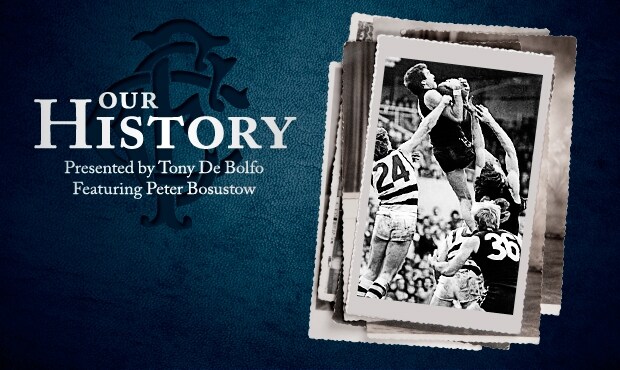
“I was that excited that I was going to wear the Navy Blue jumper. It wasn’t a fluke that I chose Carlton. I had two players that I really wanted to play football with – one was Wayne Johnston and one was Mark Maclure . . . ”
So says Peter Bosustow, whose all-too-brief playing career – 65 games in three seasons from 1981 through 1983 – took in the two Grand Final triumphs of 1981 and ’82 – the former the third leg of the mark of the year, goal of the year, premiership year treble.
As those who saw him play will truly attest, Bosustow was a living, breathing highlights reel – complete with the high marks, spectacular goals and the collective triumphs that set the David Parkin-coached Carlton teams apart.
Wearing the No.4 guernsey he later tried to win back from a young Stephen Kernahan, Bosustow soon got the turnstiles ticking over at Princes Park (and anywhere else for that matter), playing with an audacity and a flair less seen now where “team” and “structure” are the more familiar buzzwords.
But 30 years ago he WAS the Buzzword… or more precisely “The Buzz”.
Recently in town from his native Perth to feature in a series of whistle-stop sportsman’s nights through regional Victoria, Peter Bosustow dropped by the old ground to turn the pages of his glorious youth for the on-going series of “Our History” podcasts for www.carltonfc.com.au.
In this podcast, Bosustow offers his own unique take on a number of pivotal moments in his time, including;
• how his late father, the former Carlton footballer Bob Bosustow, advised him not to go to Arden Street after North Melbourne signed him on a form four;
• how he jetted into the SCG to watch a Carlton-Essendon match and inked a form four in the Sir Donald Bradman Stand;
• life with the club’s roustabout Leo Brooks with whom he lodged in Drummond Street and memories of Leo’s grandsons Mark and Jason Moran;
• breaking Robert DiPierdomenico’s sternum at Princes Park in only his second match;
• a premonition that he would take Mark of The Year a week before he took it;
• his best Carlton player seen; and
• a disastrous Tribunal hearing that effectively brought his playing career to an untimely end.
To listen to Peter Bosustow reflect on his action-packed career in the latest “Our History” podcast, click here.
Follow Tony De Bolfo on Twitter: @CFC_DeBolfo
Happy 83rd to Doug Beasy
Happy 83rd birthday to Doug Beasy!
————–
From the Blueseum:

Career : 1951 – 1959
Debut : Round 1, 1951 vs Hawthorn, aged 21 years, 4 days
Carlton Player No. 647
Games : 129
Goals : 124
Guernsey No. 17
Last Game : Semi Final, 1959 vs Melbourne, aged 29 years, 148 days
Height : 178 cm (5 ft. 10 in.)
Weight : 75.5 kg (11 stone, 12 lbs.)
DOB : 16 April, 1930
Best and Fairest 1956
Victorian Representative 1955 & 1957
The son of 1932 Carlton captain Maurie Beasy, Doug Beasy was a fine player in his own right through nine lean seasons at Princes Park in the 1950s. An elusive midfielder-forward with neat foot-passing skills and an uncanny ability to lose his man, he won Carlton’s Best and Fairest award in 1956, and emulated his father by representing Victoria a year earlier.
Born Douglas Edward Beasy, he was raised on the family farm at Dunolly and won his local club’s Best and Fairest as an 18 year-old in 1948. The following year he came to Carlton, and made his senior debut on a half-forward flank in the Blues’ first match of 1951 – a memorable game against Hawthorn at Princes Park. Beasy was quietly effective and kicked his first career goal that afternoon, but he was outshone by his fellow first-gamer Keith Warburton, who dazzled the crowd by booting seven goals on debut at full-forward, in a big win by the Blues. Afterwards, Beasy was eased into the senior side over the season, playing the first two, and the last five games of the year inguernsey number 17. Carlton wound up in seventh spot on the ladder and missed the finals, but Doug continued on with the Reserves and was outstanding in a hard-fought Grand Final victory over Essendon.
Always confident of his ability, Beasy established himself in Carlton’s senior side in 1952, and didn’t miss a game. In 20 matches as a rover, half-forward or centreman, he kicked 20 goals and earned five Brownlow Medal votes – the third-best at the club behind Ollie Grieve andFred Davies. In early September, he played finals football for the first time, when Carlton lost a cliff-hanger Semi Final to Fitzroy by a solitary point. But from then on, he was to make only two more finals appearances during his career – losing both – as the Navy Blues entered a period of mediocrity that was to last a decade.
In June 1955, Doug Beasy and John James both represented Victoria against South Australia at the MCG. In his first representative outing, Doug came on to the ground as 20th man late in a game already won and had little influence. Two years later, on July 20, 1957 at the North Hobart Oval, Doug kicked three goals against Tasmania in Victoria’s 25-point victory. Between those two games for the Big Vee, he edged out his good mate James to win Carlton’s Best and Fairest award in 1956.
In 1957, Beasy celebrated his 100th game for the Blues by kicking three goals in a good win over Footscray in round 14 at Princes Park. By the end of the home and away rounds, Carlton had climbed back in the top four – only to be knocked out of contention in the first Semi Final by Hawthorn. Beasy shared the roving duties with Leo Brereton on that remarkable Saturday afternoon, when a monster hail-storm flooded the MCG at half-time, and the Blues lost by 23 points.
Almost exactly two years later, Doug’s VFL career wound up when he limped off the MCG on the way to his third successive loss in a final. In front of 72,000 spectators on a sodden and windy MCG, the Blues were no match for eventual premiers Melbourne in the 1959 second Semi Final, going down by eight goals. Beasy didn’t play in the following week’s Preliminary Final loss to Essendon, and announced his retirement from VFL football at year’s end.
In 1960, Doug was appointed captain-coach of VFA club Box Hill. Playing in the centre for the Mustangs, he won the 1961 Liston Trophy as the Association’s Best and Fairest player, even as his team languished near the foot of the table.

Milestones
50 Games : Round 16, 1954 vs Essendon
100 Games : Round 14, 1957 vs Footscray
100 Goals : Round 18, 1957 vs Essendon
Footnote
As at 2012, the Beasy football genes are still represented at elite level, in the person of Hawthorn’s Brendan Whitecross. The grand nephew of Doug, and the great-grandson of Maurie Beasy, Whitecross is a promising 183 cm midfielder-forward recruited by the Hawks at number 29 in the 2007 National Draft.
“Carlton footballer Doug Beasy went out to the North Balwyn Methodist Church Sunday School anniversary Sunday to talk to children. He took with him a Carlton guernsey to illustrate some point in his address.
“What is this?” he asked the goggle-eyed 300, pointing at the guernsey. They told him.
“And what does this mean?” he asked, pointing to the entwined C.F.C. on the front. They told him.
“And what’s this for?” he asked, pointing at the number on the back. One boy told him.
“For when you get reported.”
(Argus September 27 1955 p1)
Our History: Keith McKenzie
By Tony De Bolfo
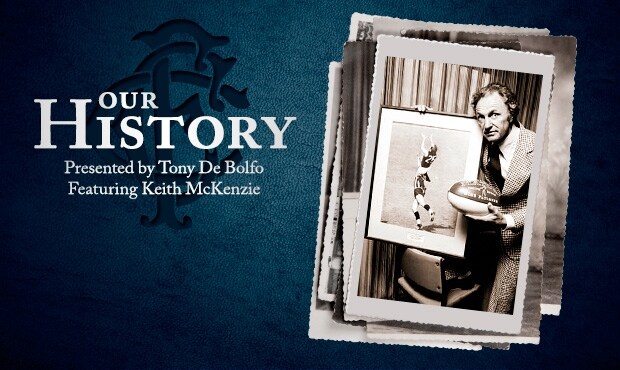
“In 1971 Ron Barassi asked me to join him as his assistant at Carlton and I knew then what I never had. I found Barassi’s coaching the ultimate… it changed me from a fellow who was dejected and disappointed at not being successful as a coach to a winner in a club which had a tradition of success…”
These are the recollections of the former North Melbourne club champion and coach Keith McKenzie, in a speech he penned for a keynote address more than 30 years ago.
The speech was hidden amongst Keith’s papers for more than three decades. Now, in the wake of their recent rediscovery, Keith shares Barassi’s secrets for the latest in the series of “Our History” podcasts.
Keith also played in the time of John Coleman. These were the halcyon days of the VFL, when football was territorial, and people were getting on with their lives in the immediate post-World War II years.
So with Anzac Day fast approaching it’s apt that Keith, himself a returned serviceman who at 90 still marches, has the forum.
In the following podcast for carltonfc.com.au, Keith discusses;
• serving his country and later playing for his club through the dark days of wartime and beyond;
• the lessons learned by Barassi from his three quarter-time address in the 1969 Grand Final that served him so well at three quarter-time of the ’70 Grand Final;
• his own quarter-time speech to the Carlton players as stand-in coach to John Nicholls in Round 14, 1975 – moments before they banged on 14.1 in the second quarter of The Battle of Windy Hill; and
• his brief period as Carlton General Manager from 1976, and his role in the later recruitment of the likes of Ken Hunter and Val Perovic.
To listen to Keith McKenzie’s interview for “Our History”, click here.
Happy 84th to Tom Simmons
Happy 84th to Tom Simmons today!
——–
From the Blueseum:

Career: 1948 – 1949
Debut : Round 6, 1948 vs Essendon, aged 19 years, 39 days
Carlton Player No. 624
Games : 27
Goals : 23
Last Game : Round 16, 1949 vs Collingwood, aged 20 years, 115 days
Guernsey No. 2
Height : 183 cm (6 ft. 0 in.)
Weight: 82.5 kg ( 13 stone)
DOB : 13 April, 1929
Best First Year Player: 1948
Tom Simmons was recruited from Northcote Juniors. A superbly built 6-footer, he was a star junior all-round athlete, winning the 100 and 200 yard championships of Melbourne Technical Schools, as well as the high and long-jump titles. He also won the 220 yards dash at the Inter-Technical schools championship at Olympic Park. Later, the warm days of summer were filled by playing seconds for the Carlton Cricket Club.
Tom amassed an impressive 27 games in just two years, playing mainly on either the half back or half forward flank for the Blues – all before the age of twenty one. During this time Tom’s display of impressive pace, long kicking, high marking and a determined appetite for the ball made him a difficult opponent for opposition teams. Laurie Kerr opined, “He looked and performed like Mighty Mouse on the field.” Umpire Harry Beitzel referred to young Simmons on the field as ‘champion’. The future looked bright, Carlton had just played off in a Grand Final, a strong team full of champions pointed to a bright future, and perhaps Tom might soon also rise to the lofty level his potential suggested.
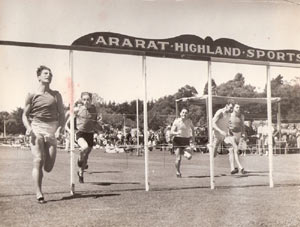 Then in a pre-season game before the 1950 season, a knee injury tragically struck down the young athlete. However, Tom was determined to return. After two knee operations, full fitness eventually returned to the point where in the professional running season over the summer of 1950-51 Tom won the Terang, Ararat and Maryborough Gifts within a few short weeks. Then a decision had to be made; to continue on the lucrative professional running circuit (albeit off shorter marks) for events such as the Bendigo 1000 and Stawell Gift – or attempt to resurrect a fledgling footy career.
Tom chose to return to his beloved Blues, aiming to fill the hole left by the retirement of champion full forward Ken Baxter. Regular track watchers soon observed the young Simmons at training, taking spectacular marks over seasoned veterans such as Bert Deacon and the towering Jack Howell. With pace to burn, and a strong pair of hands, the position of full forward seemed a natural progression for Tom. It is not clear what happened next; perhaps it was the demands of the lateral movement of football rather than the straight running of sprinting that pressured an already weak knee, or perhaps it was the sudden rise of freakish goalkickerKeith Warburton – but sadly, Tom never got to play another senior game for the Blues.
Tom married his sweetheart Lorraine the following year, and forged a successful career as an industrial chemist working for companies such as Revlon and Estee Lauder. Tom and Lorraine raised a family of seven children, and Tom regularly attended Carlton games with his family for years after his football career ended.
Happy 81st Birthday to Kevin O’Brien
Happy 81st birthday to Carlton past player, Kevin O’Brien today!
———————-
From the Blueseum:
Career: 1954 – 1957
Debut: Round 3, 1954 vs Richmond, aged 22 years, 20 days
Carlton Player No. 680
Games : 9
Goals : 3
Last Game : Round 12, 1957 vs Hawthorn, aged 25 years, 86 days
Guernsey Nos. 22 (1954-56) and 37 (1957)
Height: 188 cm (6 ft. 2 in.)
Weight: 100 kg (15 stone, 10 lbs.)
DOB: 10 April, 1932
A vigorous ruckman with strong family ties to the Carlton Football Club, Kevin James O’Brien was born in Melbourne’s inner-western suburbs at Newport, and recruited by the Blues from Parade College at Bundoora in 1953.
A nephew of Carlton Hall of Fame member Paddy O’Brien, and brother in-law to North Melbourne’s Bryan ‘Skinny’ Martyn, Kevin wore guernsey 22 in his first couple of seasons at Princes Park, which began on a high when he was a member of the Blues’ 1953 Reserves Premiership team.
He made his senior debut in a defeat by Richmond at the Punt Road Oval in round 3, 1954, and kicked his first career goal the following week against Footscray at Princes Park, in an extraordinary game that saw the Bulldogs’ full-forward Jack Collins boot nine goals in the first half (and none thereafter) as the Bulldogs held off the fast-finishing Blues by 11 points. The following Saturday, Kevin’s third match brought up his first win – by 3 points over Essendon at Windy Hill in round 5.
In 1955, O’Brien was granted leave of absence by the club, but retained on the list “to be considered for selection when available.” As things turned out, that wasn’t until midway through 1956, when Carlton lost to Melbourne at the MCG in round 13, and he spent most of the afternoon sitting outside the boundary as 19th man.
In 1957 O’Brien switched to guernsey 37 before adding another five matches to his tally. In four of those games, he started from the bench as either 19th or 20th man – including his last appearance for the club in a nine-point win over Hawthorn at Glenferrie Oval in round 12.
Our History: Vin Catoggio
By Tony De Bolfo
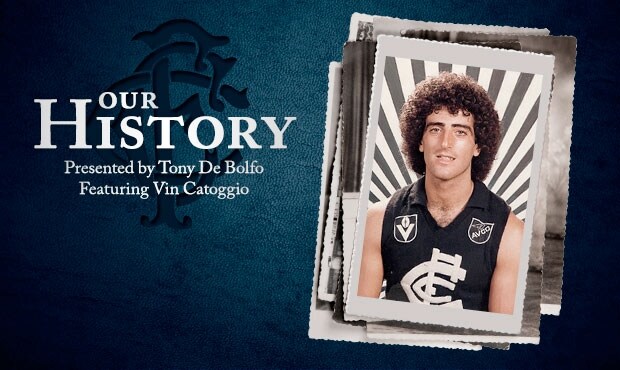
“To be honest, all I can remember is ‘I don’t belong here’. I was a skinny little kid and I was looking at blokes like ‘Jezza’ and the way they were built, and Crosswell, ‘Vinny’ Waite, ‘Doully’ and Southby… I just felt embarrassed.”
Modestly reflecting on his first foray into the Carlton Football Club is the much-loved former player Vin Catoggio. A Morrish and Gardiner Medallist in successive seasons, Vin’s senior career was confined to 71 senior appearances over eight seasons with a Grand Final appearance amongst them. But has there ever been a greater Carlton cult hero than “Vinny The Cat”?
Vin lived with his Italian-born parents in the shadows of the Legend Stand at the Garton Street end of the old Princes Park ground, and through the 1970s and 80s he dazzled the dark Navy Blue faithful with the pace, the pirouettes the canny evasive skills . . . and of course, “the ’fro”.
Similarly, he was subjected to all the twists and turns this often cruel game presents. Fate would take him across the Nullabor to Subiaco, back to Carlton for a second stint and then onto Melbourne and finally Sydney, where his League career would end some than ten years after it had begun.
But home was always where the heart is for the man in the No.4 guernsey, whose trademark afro hairstyle is a little shorter and a little greyer thesedays, but remains firmly affixed to the head of one of Carlton’s most endearing and enduring characters.
Vin Catoggio is this week’s guest of the “Our History” podcast exclusively for carltonfc.com.au
In the following interview, Vin discusses;
• the profound influence of his first coach Mr. Carroll at the neighbouring Princes Hill Football Club and the unorthodox training methods employed as he perfected his unique balking skills;
• his parents’ migration stories, the family’s territorial links with the Carlton area and his childhood recollections of Princes Park;
• his winning of the Morrish and Gardiner Medals in successive seasons for Carlton and his first senior game against Collingwood at Princes Park;
• an early promise made to him by the then captain-coach John Nicholls;
• the impact of his unexpected call-up for the 1973 Grand Final; and
• what Carlton means to him
To listen to Vin Catoggio’s interview for “Our History”, click here.
Happy 81st Birthday to Harry Sullivan
Happy 81st birthday to Blues past player, Harry Sullivan today.
—————————————
From the Blueseum:

Career : 1950 – 1954
Debut : Round 18, 1950 vs South Melbourne, aged 18 years, 139 days
Carlton Player No. 646
Games : 31
Goals : 16
Guernsey No. 2 (1950), No. 3 (1951 – 54)
Last Game : Round 13, 1954 vs Melbourne, aged 22 years, 99 days
Height : 183 cm (6 ft. 0 in.)
Weight : 82.5 kg (13 stone, 0 lbs.)
DOB : April 8, 1932
Harry Sullivan joined Carlton from Brighton Technical School in 1949 at the age of 17, and played in our Under 19 Premiership side in that same year. Over the next two seasons he made his way up through the Reserves, and was selected for his senior debut in round 18, 1950, when Carlton finished off a dismal year by losing to South Melbourne by almost six goals at Princes Park.
By then, the strongly-built youngster was looked upon as a likely replacement for Carlton’s champion centre half-forward Ken Baxter, who was due to retire at season’s end. But as Sullivan’s potential couldn’t be properly assessed until he had played more games at the top level, he was sent to the key forward post in round 6, 1951 and stayed there throughout the season.
By the end of that year, there was no denying that Sullivan’s all-round skills were quite good – the problem was that as a key forward, he just didn’t kick enough goals. His first 15 matches produced only 12 majors, with a best haul of two. He was briefly tried in defence in 1953 – with unspectacular results – and although his season ended on a bright note when he was a member of that year’s Reserves Premiership team, it seemed as though his future at Carlton lay as a spare parts player and a regular bench-warmer.
Understandably, Harry wasn’t happy with that situation, especially when he wasn’t selected in the seniors again after round 14, 1954. So, after 31 games in five seasons at Princes Park, he was granted a clearance to Collingwood.
His first season at Victoria Park was much like those that came before; 10 games, 5 goals and regular demotion to the seconds. Then, in early 1956, someone had the bright idea of trying Harry at full-back, and a star was born.
In September of that year, Sullivan was at full-back for the ‘Pies in their Grand Final loss to Melbourne, and played there again when they defeated the Demons two years later to deny Melbourne four flags in a row. Cool under pressure, near-impossible to shake off, and renowned for his ability to punch the ball from his opponent’s grasp at precisely the right moment, Harry also represented Victoria in 1958, on the way to 78 games and immortality among the Collingwood legions.
Surprisingly, Sullivan retired from VFL football in 1960 at the age of 28, due to the pressures of his burgeoning business interests.
Latest Edition of the AFLPA’s Inform Magazine
The latest edition of the AFLPA’s ‘Inform’ magazine can be read by Clicking The Link.
Opening Round Tickets
Just a reminder that FREE premium reserve seats are available to Spirit of Carlton members for this Thursday’s opening clash between the Blues and the Tigers.
If you want these limited seats it is first in best dressed. If you haven’t signed up as a member as yet this is your opportunity to do so and get access to premium seats.
Please call Mandy on 03 9389 6256
Happy 88th Birthday to Jim Clark
Happy 88th Birthday today to Jim Clark!

Career : 1943 – 1951
Debut: Round 7, 1943 vs Melbourne, aged 18 years, 86 days
Carlton Player No. 582
Games : 161
Goals : 2
Last Game : Round 18, 1951 v Essendon, aged 26 years, 160 days
Guernsey No. 26
Height : 178 cm (5 ft. 10 in.)
Weight : 76 kg (12 stone)
DOB : 24 March, 1925
Premiership Player: 1945, 1947
Victorian Representative : 1948, 1949, 1951
Club Best & Fairest 1951
Invariably described as loyal, brave and determined, James Robinson (Jim) Clark was a star for the Blues through the uncertain years of World War II, and the youngest member of Carlton’s 1945 Premiership team. Playing alongside Bert Deacon and Bob Chitty at half-back in that torrid ‘Bloodbath’ Grand Final against South Melbourne, Clark stood his ground – time after time – when it mattered most. His persistence and ability under pressure that day earned the respect of his opponents and his team-mates alike.
Two years later, he won his second flag when Carlton beat Essendon by one point in another fabled moment in club history. Seemingly headed for defeat deep into time-on in the last quarter of the 1947 Grand Final, the Blues snatched a last-ditch victory when rover Fred Stafford swooped on the ball at half-forward, and goaled on the run from 25 metres. Again, Deacon and Clark – this time joined this by Jim Baird – held the Carlton defence together and provided the springboard for the last-quarter attacks that eventually brought victory.
With those two VFL Premierships to his name by the age of 22, it may have seemed that Clark’s career had peaked – but this was far from the case. Carlton met Essendon again for the 1949 flag, only this time the Bombers were far too good and thumped the Blues by 73 points. Essendon’s sensational full-forward John Coleman was the difference between the two sides; his sixth goal late in the last quarter was his 100th for the season. Although the year ended in disappointment, Clark enjoyed another good season and held his place in the Victorian state team for a second successive year.
After three Grand Final appearances in six years, Carlton hit the wall and slipped to eighth in 1950, and seventh the year after. But while the Blues were struggling as a team, Jim Clark’s career peaked on a personal note when he was a popular winner of Carlton’s Best and Fairest award. As well, he was selected for Victoria a third time, and became the youngest Carlton player to reach the 150 game milestone in round 6 of that year against Melbourne at the MCG. It was a record that would stand for 21 years, until eventually surpassed by Adrian Gallagher in 1972.
Happy 50th to Neil Gaghan
A very happy 50th to Neil Gaghan today!
——-
From the Blueseum:
Career : 1985
Debut : Round 11, 1985 vs Collingwood, aged 22 years, 78 days
Carlton Player No. 928
Games : 3
Goals : 0
Last Game : Round 13, 1985 vs St Kilda, aged 22 years, 90 days
Guernsey No. 52
Height : 183cm
Weight : 79kg
DOB : 24 March, 1963
When the ill-fated Brisbane Bears were established at Carrara on the Gold Coast in 1986, the AFL decreed that to supplement the fledgling club, each of the other league teams were required to release two or more players to them.
One of Carlton’s nominations was Neil Gaghan, a 23 year-old utility who had managed just three senior games for the Blues before taking a prominent role in Carlton’s 1986 Reserves Premiership. Neil agreed to the move, and travelled north to play another three senior games for the Bears in 1987, but was then delisted. Having taken a liking to life in the Sunshine State, Gaghan settled in Brisbane, where he joined the Kedron-Grange Football Club and gave them good service for a number of seasons.
In 1993, Gaghan took over the role of coaching Kedron-Grange, where he was ably assisted by two very high-profile ex-Blues in Jim Buckley as part-time football manager, and Wayne Johnston as the club’s star new recruit. Then, only three weeks into the season, Gaghan stepped down from his role because of work commitments – thus allowing Johnston to become captain-coach of the club.
Neil’s younger brother was an absolutely outstanding prospect as a junior, and would have been eligible to go to Carlton from one of the Blues’ prime recruiting zones. Sadly, he was killed in his mid-teens in a car accident on the Hume Highway.
Neil Gaghan was originally recruited through Fawkner / Moomba Park and then the Blues Under 19’s. At a very young age, he had also played with the Blues Little League in 1974.
Career Highlights
1984 – 7th Reserves Best & Fairest
1985 – Equal 6th Reserves Best & Fairest
1986 – Reserves Premiership
Champion wingman John Chick dies
By Tony De Bolfo
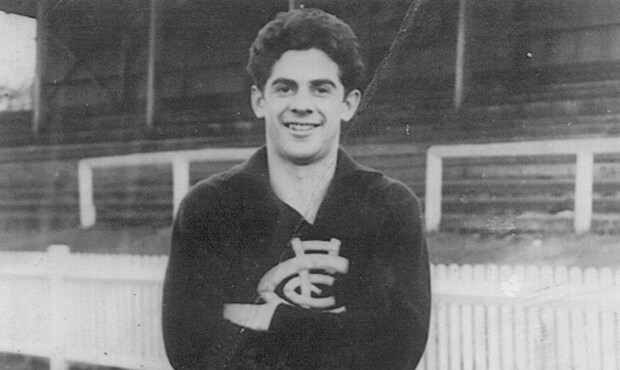
John Chick, the talented former Carlton wingman of the 1950s, has died peacefully in his native Tasmania at the age of 80 after bravely battling Alzheimer’s disease.
The oldest of six children, each of whom survive him, Chick first came to the attention of Carlton recruiting officers when he turned on a clinic for New Town (later Glenorchy) in its 1951 TANFL Grand Final demolition of North Hobart.
“It was a chance thing,” Chick’s daughter Sue Saunders said this week. “Somebody from Carlton came to Newtown to look at another player, but saw Dad and picked him up.
“He was always the sporting type, and as a young boy he was a very good tennis player. I’m pretty sure that when he came to Carlton he also played cricket for them and when he was told he had to give it up for football he was quite disappointed.”
Wearing the No.23 made famous by Bert Deacon and now worn by Lachie Henderson, Chick was 19 when he completed his senior debut for the Blues in the opening round of 1952 against North Melbourne at Arden Street. Twice finding the big sticks from half-forward, Chick contributed handsomely to the team’s creditable 23-point victory over the “Shinboners” that day, in what was the first of 119 matches over nine seasons in Carlton teams coached by Perc Bentley, Jim Francis and Ken Hands.
Chick’s on-field showings, marked for their durability and consistency throughout the 1950s, were duly acknowledged. He finished in the top five placegetters for the Robert Reynolds Trophy (now the John Nicholls Medal) in four consecutive seasons from 1954 and in 1956 was recognised with All-Australian honors after featuring prominently for Victoria through the ANFC Championship in Perth.
In the 17th round of 1957, against Fitzroy at Princes Park, Chick was reported for an incident involving the Lions’ Wally Clark. A subsequent eight-match suspension would rob him of a place in Carlton’s first finals appearance in five seasons, but he would be there when the Blues met Melbourne and Essendon in the ’59 first semi and preliminary finals respectively.
That year, 1959, Chick was named vice-captain in succession to Laurie Kerr. According to the club’s ’59 Annual Report, Chick “fully justified the committee’s action with many valuable games on the wing, distinguished by good kicking, clever ball handling and elusiveness on the move”.
“Dad loved his years at Carlton,” Sue said. “We tended to get the party stories because Carlton was very social back then and he liked a beer – but then they all did.
“We were all Carlton members and he would often take the family over to Melbourne to watch the team play. He followed Carlton all the way through, and he was there with John James and John Nicholls for the last game at Princes Park.”
Nicholls, generally regarded as Carlton’s greatest ever footballer, caught the tail-end of Chick’s on-field career.
“I played with John for two or three years and my brother Don was good friends with him. There was ‘Chicky’ on one wing and Graham Gilchrist on the other,” Nicholls said.
“He wasn’t nuggety, but he had thick, strong upper legs which did cause him a bit of trouble with hamstrings. In saying that he was a good footballer who earned All-Australian selection and he was a lovely bloke.”
Gilchrist concurred with Nicholls’ assessment of Chick the footballer.
“The only time I really spent with John Chick was out on the ground because he wasn’t a really outgoing bloke, but he was a very good player, a good thinker and he was very close to his family,” Gilchrist said.
“He played on one side of the wing and me on the other, which is bloody ridiculous when you think about it now because nobody moved around much and you tended to stay in your set positions.”
In 1961, Chick returned to Tasmania to accept the role of captain-coach of New Town (by then renamed Glenorchy) and led the Tasmanian Magpies from last to a Grand Final in his first year. According to his daughter, “we were always assured that what happened at Glenorchy was due to his astute guidance”.
Chick later coached Huonville in the Tasmanian country league, before accepting the role of Assistant Coach to Ray Giblett at Sandy Bay and later to Ian Bremner at North Hobart. He assumed senior coaching duties from Bremner for two seasons from 1979 before relinquishing the position to John Devine, and he even dabbled in athletics as coach.
“Football was very much a part of Dad’s life,” Sue said, “but he always moved on”.
“He was very private, but he was also very competitive . . . and he never lived in the past.”
Chick, who died last Sunday night, is survived by his wife of 61 years Margaret, daughters Sue and Gaylee, son Darren and grandchildren Sam, Ned, Georgina and Megan.
His funeral will be held in Hobart on Thursday, with the Carlton players to wear black armbands into Thursday week’s opening round match with Richmond at the MCG as a mark of respect.
Happy 60th Birthday to Renato Serafini
A happy 60th to Renato today!
——–
From the Blueseum:
Career: 1977 – 1978
Debut: Round 16, 1977 vs South Melbourne, aged 24 years, 102 days
Carlton Player No. 869
Games: 7
Goals: 6
Last game: Round 4, 1978 vs Essendon, aged 25 years, 35 days
Guernsey No. 23
Height: 188cm
Weight: 86kg
DOB: 18 March, 1953
Wearing guernsey 23, Serafini played 7 games and kicked 6 goals for Carlton after debuting in Season 1977.
He is listed as being 188cm tall. He may be better remembered as a Lion, having spent considerable time with Fitzroy. Serafini played from 1971 until midway through 1977 with the Lions, in his time with them he played 81 games and booted 117 goals.
Serafini was originally recruited from Assumption College, Kilmore.
Serafini and the Blues departed company at the end of the 1978 season. In 1979, he headed to VFA club Frankston and in his first year at the club, he kicked 95 goals and was the competition runner-up in the goalkicking award that year. Serafini then transferred to rival VFA club Coburg for the 1983 season.
Happy 85th to George Ilsley
A very happy 85th birthday to George Ilsley today!
————-
From the Blueseum:
George Ilsley
Playing Career : 1954
Debut : Round 1, 1954 Aged 26 years 33 days
674th Carlton Player
Games : 2
Goals : 1
Last Game : Round 2, 1954 Aged 26 years 40 days
Guernsey No. 27
Height : 174 cm (5’8½”)
Weight : 80.75 kgs (12.10)
DOB : March 14, 1928
Ilsley was recruited from the Bendigo club Eaglehawk for the start of the 1953 season. George debuted for the Blues in the opening game for the 1954 season against South Melbourne at the Lake Oval. Playing on the wing he scored a goal in the Blues’ 5 point loss to the Swans.
The following week Carlton played Melbourne at Princes Park. George was again selected on the wing, but the Blues lost the game this time by 19 points. It would be the last senior game George Ilsley would play. Ilsley would play only 2 games for the Blues, both in Season 1954 (he was on day permits to play both of these games).
George Ilsley was dissatisfied with city life and returned to Eaglehawk during the season, he was equal third in the Jack Michelsen Medal for best and fairest in the Bendigo Football League for 1954.
George went on to make his mark with the goldfields’ club after playing his first game in 1949 as a 15 year old. He played in two premierships in the 1950’s and captain-coached the club for three years, as well as representing the Bendigo League on more than a dozen occasions. He played more than 350 games for the Hawks, and captained-coached Northern United for 2 years.
George Ilsley was appointed ground manager in 1965, and 47 years on, is still (June 2012) the ground manager for the Eaglehawk Football & Netball Club!
1965 Eaglehawk Football Club Life Member
1986 Bendigo Football League Hall of Fame
1994 Bendigo Football League Life Member
2005 Eaglehawk Football Club Team of the Century – Centre Half Forward
2006 Eaglehawk Football Club rename best & fairest medal as George Ilsley Medal
2008 Eaglehawk Football Club Hall of Fame Living Legend
See Ilsley’s Blueseum Image Gallery (below) for for further details.
Thanks to the Ilsley family for the above information and photos.
Congratulations to David Rhys-Jones and Geoff Southby
Congratulations to David Rhys-Jones who was inducted into the Carlton Football Club Hall of Fame tonight and also to Geoff Southby who was elevated to the status of the 12th Legend of the Carlton Football Club.
Ken McKaige Cup Bowls Day
All Carlton past players are encouraged to take part in the Ken McKaige cup bowls day which is an event put on by the combined past players association where teams of past players from different teams can compete and enjoy the day. The Spirit of Carlton Past and Present would love to see one or two teams compete as Carlton past player representatives and is willing to take care of the fees for those teams. Please see the details below for contact details.

Vale Elizabeth Nettlefold
Our sincere condolences go to our SOC executive member, David Nettlefold whose wife Liz passed away yesterday (7/3/13) after a long illness.
http://tributes.theage.com.au/obituaries/theage-au/obituary.aspx?n=liz-nettlefold&pid=163504525