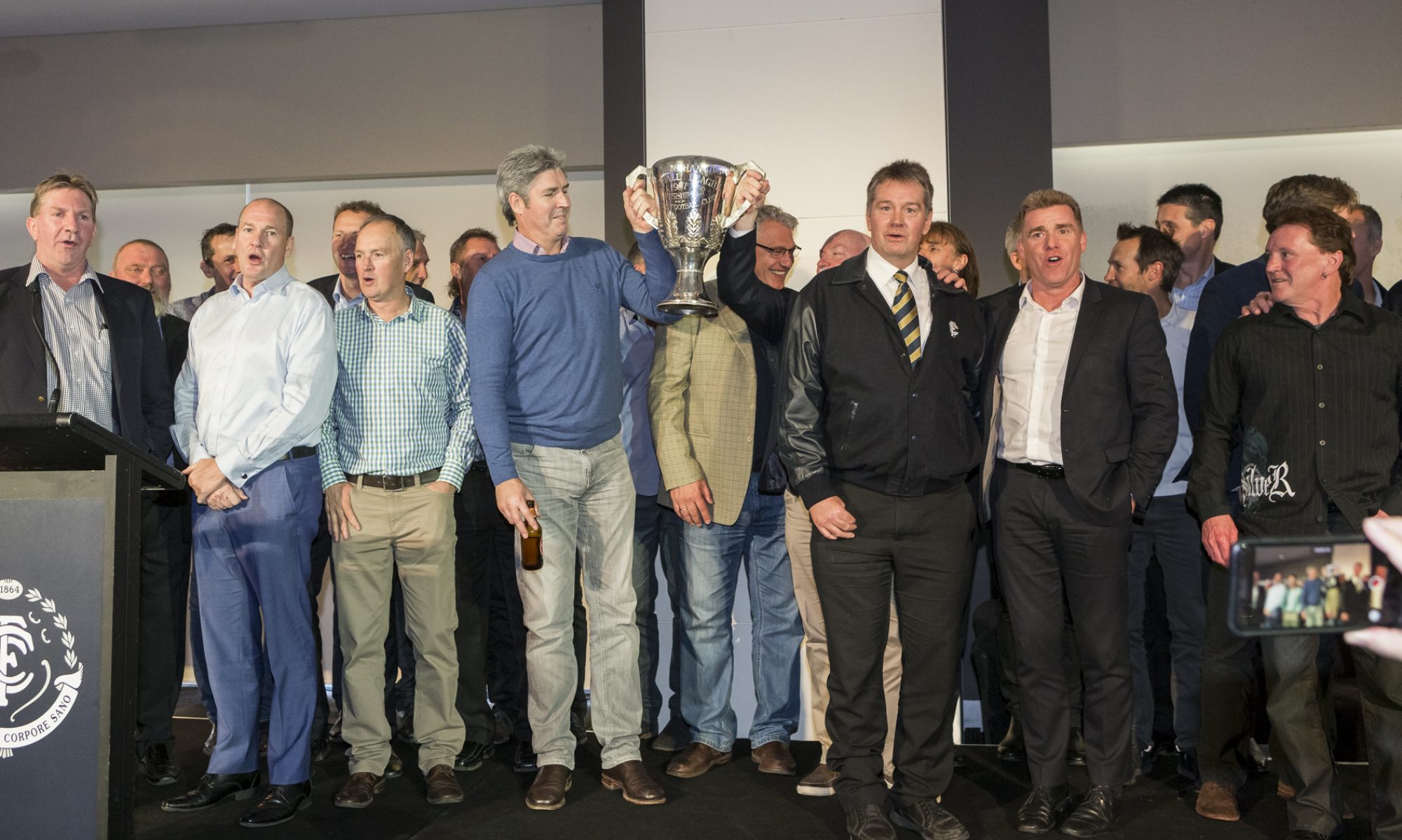

Notice of AGM
Notice of Annual General Meeting
Notice is given that the 2014 Annual General Meeting of the Spirit Of Carlton Past And Present Inc
Will be held on:
Date: Tuesday, 21st April, 2015
Time: 6.00pm
Address: Don Chipp Lecture Theatre, Ikon Park, Royal Parade, Carlton North
Matthew Allan’s 40th
Happy 40th birthday to Matthew Allan.
———
From the Blueseum
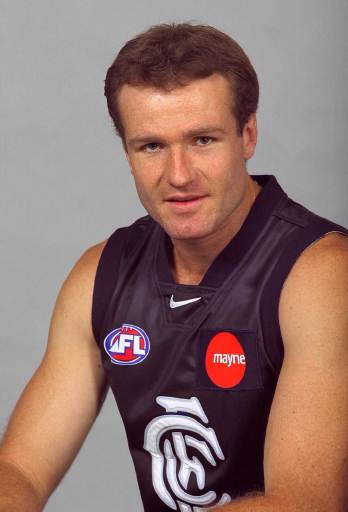
Career: 1994 – 2003
Debut: Round 15, 1994 vs Brisbane, aged 19 years, 126 days
1000th Carlton Player
Games: 140
Goals: 72
Last Game: Round 16, 2003 vs Sydney, aged 28 years, 143 days
Guernsey No. 24
Height 198cm
Weight 104kg
DOB: 26 February, 1975
Best and Fairest: 1999
All Australian: 1999
Victorian State Player: 1999
International Rules Series: 1999
Recruited from North Ringwood where he only started playing as a 14 year old (he also played at Mooroolbark and Olinda), Matthew Allan was drafted as a zone selection and spent a number of years on the list as the understudy to Justin Madden before finally given his go. He started playing for Carlton in the last year of the Under 19s in 1991 and wore number 44. He then played in Carlton reserves and in the Eastern Ranges Under 18s where he was a member of the Vic Metro Championships side and was an Under 17 All-Australian. He kicked a goal on debut against the Bears at Optus Oval in Round 15, 1994, and in his early years would be famous for wearing thick thigh pads.
When finally given the responsibility of being number 1 ruckmen in 1996 – 7 as Madden began to decline, Allan delivered on his promise. Beginning with more & more games (19 games in 1996), Allan would improve his stats seemingly every year and before too long was a competition leading ruckman, earning his first Top 10 B&F performance in 1997 – his first of 3 in a row.
Allan had a massive season in 1999 when he was All Australian, won the club Best and Fairest and played in the Grand Final. He would manage 19 goals, as a ruckman, and break his own impressive average disposals output with 15.6 per game. The Allan – Capuano matchup was a key determinant to the game, and a match-up written about before the game, but Capuano would take the honours on the day whilst North took the flag.
The left footed Allan, who would hardly ever use his right, was famous for taking the ruck but – as distinct from the traditional kick behind play – would move forward to steal a goal or two. In some games, Allan despite his size appeared to be all over the field. He became a key player over 1998 – 2000.
However, a series of serious foot injuries over 2001 to 2003 reduced Allan from league leading ruckman to a guy who struggled to train. He managed just 8 games in 2001, 4 in 2002 and 6 in 2003. It was a sad sight to see one of our young players struck down.
In addition to his injury problems, Allan was deregistered in 2003, given some ‘under the table’ payments soon after our salary cap breaches. Allan was hauled through the coals, and with his injuries behind him, sought greener pastures away from Carlton. Wearing the number 24 in the Carlton seniors, the 198 cm ruckman had played 140 games for the Blues.
Allan was traded to the Bombers for Pick 57 in the 2003 Draft, where he played a further 2 seasons before retiring and playing 21 games and scoring 1 goal with the Bombers where he wore number 27. In 2006 he was the Bendigo Bombers General Manager.
Allan wore No.51 (1992) and 45 (1993) when he played with Carlton reserves.
Latest Videos – Klomp/Maclure/McConville
Robbert Klomp
Mark Maclure
Peter McConville
Latest Videos – Fitzpatrick/Harmes/Johnston
Fitzpatrick
Harmes
Johnston
2015 CPPA Bowls Day
Invitation to CPPA bowls day. If you are interested in putting a team together please contact us at admin@spiritofcarlton.com.au

Latest Videos – Buckley/Davis/English
Jim Buckley
Craig Davis
Des English
Crones commit to Carlton archive
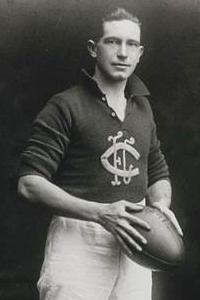 David Crone played 22 games for the Blues. (Photo: Carlton Football Club)
In the 117 seasons since the formation of the VFL, only four men can lay claim to having represented the Carlton Football Club at League level as both senior player and President. They are, in reverse order, Stephen Kernahan, Ian Collins, Horrie Clover and the first of them, David Crone.
And late last week, in response to the club’s request to seek the support of Members and supporters to help build the Carlton archive, Barry Crone came forward with a digitised copy of a precious and long-held family keepsake of his late great uncle.
The glorious studio image, which now finds its way into the football club’s collection, depicts David Crone in all his Carlton finery – from the uncluttered dark navy Blue guernsey with handwoven monogram down to his anklets and high cuts, Crone’s truly Carlton from top to toe.
Dated 11/9/1920, the image also carries Crone’s signature.
The photograph is an important one for the club, because it now brings balance to an image previously forwarded by another descendant John Ray, of Crone in civilian dress and Presidential mode.
A farmer’s son hailing from the Victorian town of Donald on the Richardson River, David Henry Crone was born in May of 1893. In the early days he plied his footballing craft as a budding young ruckman for South Ballarat and later completed a brief three-game stint with the now-defunct Fitzroy, before returning to the farm then joining Carlton on the cusp of the 1917 season.
Crone completed his senior debut against Richmond at Princes Oval in June of the ’17 season, in what was a meritorious 44-point win for the home team on the occasion of Rod McGregor’s historic 200th game for the club. Sporting the No.30 later worn by “Mick” Price, Vin Waite and his son Jarrad, Crone ably supported the team’s No.1 ruckman Harry Haughton.
Turning out in 18 senior matches for the Blues through 1917 and ’18, Crone was finally accepted for military service (having previously been rejected on medical grounds), but his departure for the frontline never happened because the war ended.
Having not left Australian shores, Crone was offered an immediate discharge – and yet he sought to volunteer for a tour of duty with the Australian Naval and Military Expeditionary Force, whose task it was to secure all former German territories and installations in New Guinea and the Solomon Islands.
He spent a year in the tropics, and returned home to resume his on-field career at Carlton through 1920. Wearing the No.15 in his second stint, the 25 year-old managed four more senior appearances – the last of them at half-forward alongside Horrie Clover in the seventh round match against Geelong at Corio Oval, on Saturday, June 12, 1920.
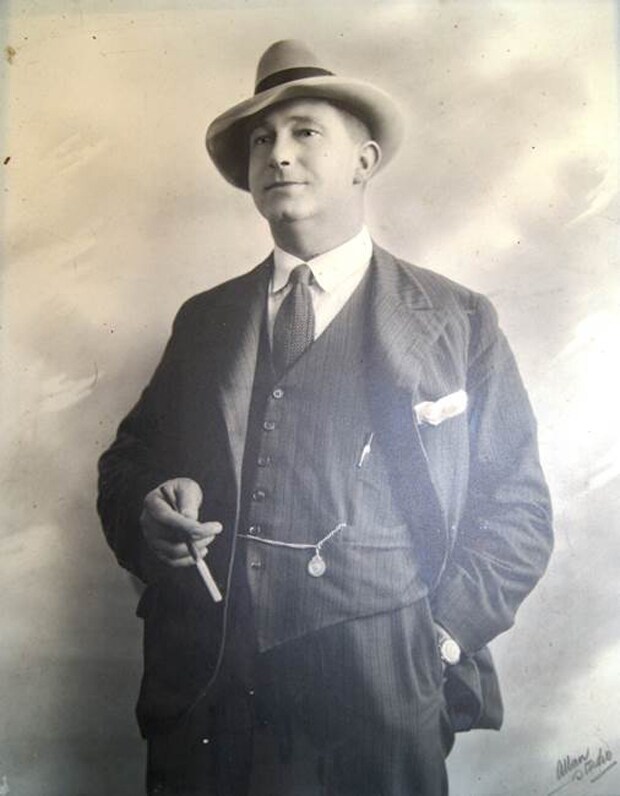
Nine years later, Crone assumed the mantle as Carlton President – the club’s 17th since Robert McFarland in the club’s inaugural year of 1864 – and he ably served in that capacity for nine years until he was succeeded by KG (later Sir Kenneth) Luke on the eve of the drought-breaking 1938 Premiership season.
A true measure of Crone’s stature in the game is perhaps best be measured by the tribute paid by the then secretary Newton Chandler in the Carlton Football Club’s 1937 annual report, beneath the headline “THE PRESIDENT”;
“Sincere regret was expressed not only by the committee and Members of the Club but by the football patrons of Victoria when the resignation of Mr. D.H. Crone was announced. Mr. Crone, who had been a member of the Committee of Management for a period of 13 years (the last nine years as President), was a wonderful ambassador to the game. As Chairman of the Propaganda Committee – and other Sub-Committees of the Victorian Football League, Mr. Crone did much to foster the games in the schools, while his efforts to assist the game in the country was of great value to the Australian code. The time given in the interests of the game by some Club officials is little realised by Members. During the 13 years that Mr. Crone was a member of the committee he attended more than 2,000 meetings in connection with the management of your Club, and as a delegate to the Victorian Football League, Mr. Crone leaves behind a record of service which has not been surpassed in the history of the Club.”
David Crone was just 66 years-old when he died in November 1959. But today, some 55 years after the event, he is remembered.
As his descendant Barry proudly declared in the message accompanying his grand image: “Please see the attached copy of a photo of my great uncle, Dave Crone, who was a past player and long standing club president, and the reason that most of the next four generations of Crones have followed the Blues”.
If you have a precious item or items that help tell the tale that is uniquely Carlton’s, or like Barry Crone boast a precious image/s of Carlton’s past, please contact club historian Tony De Bolfo – 9389 6241 or tony.debolfo@carltonfc.com.au.
Latest Videos – Ashman/Austin/Bortolotto
Rod Ashman
Rod Austin
Mario Bortolotto
“ShaneO” honoured for services to football
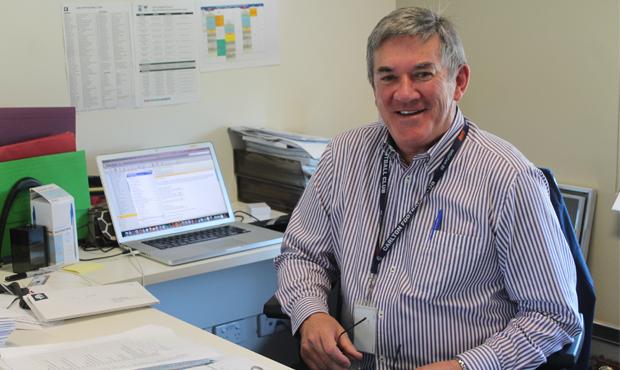 Football Administration Manager Shane O’Sullivan. (Photo: Carlton Football Club)
Thirty-five years of exemplary service to Footscray, Brisbane and most notably Carlton has earned Shane O’Sullivan universal acknowledgement as the 2014 recipient of the AFL’s Jack Titus Award.
Endearingly known to those in the caper as “ShaneO”, O’Sullivan becomes the award’s 40th recipient since its inception in 1977, and only the fifth winner with Carlton connections after Newton Chandler in 1984, Bruce Comben (1989), Keith McKenzie (1993) and Wes Lofts (2001).
The award – which carries the name of the much-respected former Richmond player, match committee member, vice-president and senior coach – will be bestowed upon O’Sullivan, now officiating as Carlton’s Football Administration Manager, at the League’s 2015 Annual General Meeting in March.
O’Sullivan knew nothing of his nomination, and only learned of his award by way of correspondence in the mail late last month.
“I got a letter from the League, and saw Gil’s (AFL CEO Gillon McLachlan’s) name at the bottom. I thought it must have been one of those Christmas wish cards, but when I opened it up I found out exactly what it was,” he said.
“It’s really humbling. To be included alongside some of the great names in footy to have won this award, well, I’m pretty chuffed about it. Keith McKenzie was actually my very first boss as General Manager when I first came to Carlton, and I’m very pleased to be in the company of others like Graeme Richmond, Ian Drake and Jim Cardwell.”
O’Sullivan’s League football odyssey commenced as Promotions Officer in the Carlton Premiership year of 1979. His responsibilities back then included organising clinics and training schedules for Under 19, reserve and senior players, and liaising with the club’s local and country regions.
The following year, he was promoted to Assistant General Manager, a position he retained through the back-to-back Premiership seasons of 1981 and ’82.
For O’Sullivan it only seems like yesterday that he first reported for work – the week “Jezza” led out the likes of Doull, Jones and Maclure in the opening round of the ’79 season against Geelong.
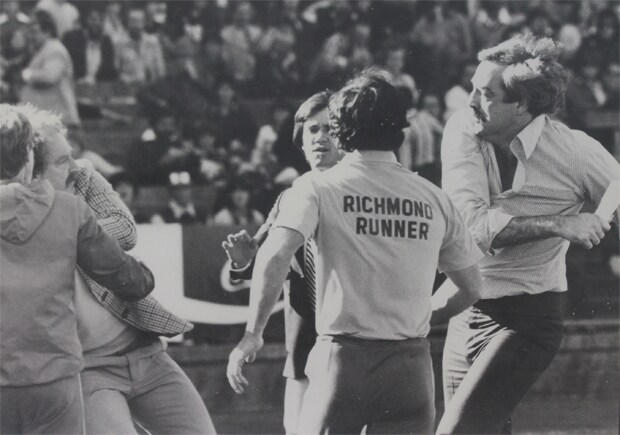
Shane O’Sullivan rushes in to break up the infamous stoush between Percy Jones and Tony Jewelll in 1980. (Photo: Carlton Football Club)
“Wes Lofts was standing there in his big, long overcoat and I just couldn’t believe I was beginning work and it was football I was working in,” O’Sullivan said.
“You dream about playing League football and I trained at Richmond in 1978 and early ’79 although I wasn’t good enough.
“But the next best thing is to remain involved and earn a living out of it, and 35 years later you wonder where in the heck all those years have gone.”
At the end of the ’82 season, and after much cajoling from the then Footscray President Dr Tony Capes, O’Sullivan accepted the position of Bulldogs General Manager. The role presented numerous challenges, but the club made real progress under the GM’s watch – and he was an integral figure in the push for Michael Malthouse’s appointment as Senior Coach in ’84.
Always one to help grow the game, O’Sullivan accepted the role of General Manager of Football for the Brisbane Bears Football Club when it was admitted into the competition on the eve of the 1987 season. At that pivotal moment he helped establish the foundations and culture of the new club, and was chiefly responsible for assembling the Bears’ playing list, appointing coaches and sourcing a training base.
For six years, O’Sullivan committed his energies to Brisbane, forging healthy relationships with the respective senior coaches Peter Knights, Paul Feltham, Norm Dare and Robert Walls before returning to Melbourne at the conclusion of season ’92.
After a brief stint with VFA outfit Oakleigh as Senior Coach in ’93 (during which time he also assisted North Melbourne in a part-time capacity in recruiting), O’Sullivan’s working life came full circle with his appointment as Carlton Recruiting Manager, a position he retained for 12 years. Since 2004, he’s served as Carlton’s Football Administration Manager, a role which sees him working closely with coaches, players, and staff in all departments.
In his 25 years at Carlton, O’Sullivan has worked closely as trusted adviser to no fewer than seven Senior Coaches – Alex Jesaulenko, Peter Jones, David Parkin, Wayne Brittain, Dennis Pagan, Brett Ratten and Michael Malthouse.
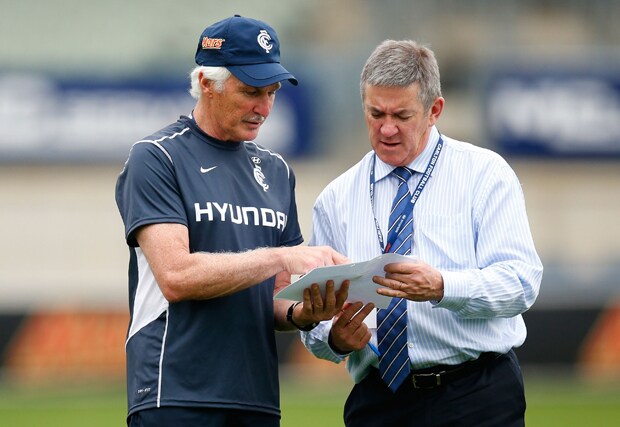
Shane O’Sullivan has worked with Mick Malthouse at the Bulldogs and Carlton. (Photo: AFL Photos)
Similarly, he has also built strong relationships with the players, and played a significant part in their development both on and off the field.
The Carlton Football Club, through its CEO Steven Trigg, formally nominated O’Sullivan for the award last November, with Testimonials from former Carlton Senior Coach David Parkin, current Senior Coach Mick Malthouse and current player Chris Judd.
“Over the past 35 years, Shane has given outstanding service to the game of Australian Rules Football through his extraordinary contribution to a number of AFL Football Clubs,” Trigg said.
“The commitment, innovation and initiative Shane has consistently demonstrated in carrying out his duties in the various positions he has held, makes him a highly credentialed nomination for the Jack Titus Award.”
The following Testimonials, submitted to the AFL by Carlton at the time of O’Sullivan’s nomination for the Jack Titus Award, best reflect the depth and breadth of the man’s contribution to Australian Rules, commencing in 1979 and spanning some five decades.
No doubt he’s a survivor, particularly so in the wake of the salary cap fall-out when he had to summon all his survival instincts.
“Without being over the top about it, Carlton means everything to me. Carlton was where I started, the club was good enough to again put me on when I came back and I suppose that when the Elliott era ended I was lucky to survive because people were put off and I’m indebted to those who kept me here,” he said.
And he continues to adapt, for it’s adapt or die – and here’s his trade secret.
“It’s just the love of the game and always being prepared to pitch in and do anything that you can,” O’Sullivan said.
“I’d like to think I keep moving with the times. Each year I try to reinvent myself a little bit to keep moving so that you’re not considered an old timer – and when you’re in a footy club all the young people keep you young.”
David Parkin
“My association with Shane O’Sullivan extends over a period of more than thirty years. For five decades I’ve had the privilege of working in Australian Football with a number of exceptional administrators, but none more competent and committed than Shane.
Without ever getting frustrated (in what is a consistently pressured environment) he has always carried out his management tasks, with a set of very professional and personal attributes, second to none. This man, across three AFL Clubs, in a variety of administrative roles, has serviced the needs of players, coaches, support staff and Boards, in a very special, caring and effective way.
Shane’s outstanding service to the game makes him a worthy recipient of the Jack Titus Award.”
Mick Malthouse
“There’s no one in my mind more worthy of winning an award for services to football than Shane O’Sullivan.
My history with Shane goes back a long way, so this is a very brief account of a long association.
I first met Shane in the late 1970s. He was a young man coming down from Bunyip in the bush, trying to make his way into VFL football. In reality, who can make it when you’re a left footer, slow, short and a little bit tubby? But he was desperate and no one would try harder than Shane would. As it turned out, Shane didn’t make it on the field, but it was no surprise to see him later become involved in the game in an administration capacity at Carlton.
My next association with Shane was when he appointed me as coach of the Footscray Football Club in 1984. He made myself, my wife and my kids feel very welcome at the club and he set standards for me there, in regard to family relationships, that I would take on to West Coast and Collingwood. Shane is the kind of person who builds relationships with people based on mutual trust, loyalty, and pride in getting things done.
From Footscray Shane went to Brisbane where he did the hard yards, before arriving back at Carlton. Of course, we reintroduced ourselves at Carlton two years ago, but in between although he was part of the opposition, he never treated it as such. No matter where we both worked, Shane always treated me as a great friend and a football person.
Shane O’Sullivan has given so much of his life to football and he’s still passionately in love with it. He loves nothing better than to see young men succeed – and he helps them do that by letting them worry about football and he will worry about everything else for them. He is the most giving person I have ever struck in football, because for Shane it’s all about making sure that things happen for people and he will take care of the rest.
If you delved further into Shane’s work in the AFL, you would find that it spans in so many directions in regards to knowledge of the game, helping people, promoting the game and a hunger to succeed. To sum it up: for a person to have a heart attack on the bench and apologise for that because he missed the last half of the game … well, it says so much about Shane O’Sullivan.”
Chris Judd
“Shane O’Sullivan has been a wonderful servant to the Carlton Football Club and in many ways is the type of employee that has almost become extinct in modern day football. As AFL footy has become a bigger and bigger business, many employees in administrative positions hold climbing up the corporate ladder and furthering their own careers as a more important pursuit than seeing the football club they work for achieve success and in turn bring happiness to the hundreds of thousands of supporters that follow it.
In the current era, Shane’s passion for the success of the Carlton Football Club stands out. There’s no job too small, no ego and no nonsense. If he was involved at a local footy club, he’d be the guy chopping up the oranges and making sure the drinks were filled, while also chasing down sponsors as well to keep the club a float. Whilst at Carlton he isn’t called on for as wide an array of tasks as this, he’s the sort of guy who you could never imagine saying ‘I’m not doing that, because that’s not my job’. I’ve known Shane since I was sixteen and travelled to Ireland and he’s someone who treated me just as well when I was a sixteen year-old hoping to break into the AFL as he did when I was Captain of the club, and I’ve always enjoyed having him at Carlton.”
Barry Gill’s 70th
Happy 70th birthday to Barry Gill.
————
From the Blueseum
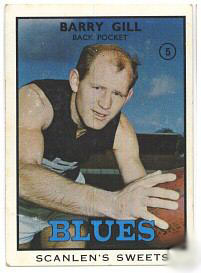
Career : 1964 – 1972
Debut : Round 2, 1964 vs Hawthorn, aged 19 years, 94 days
Carlton Player No. 759
Games : 132
Goals : 5
Last Game : Round 10, 1972 vs Hawthorn, aged 27 years, 133 days
Guernsey No. 21
Height : 184 cm (6 ft. 1 in.)
Weight : 82.5 kg (13 stone, 0 lbs.)
DOB : January 21, 1945
Premiership Player 1968, 1970
His possession rate was never particularly high, and there was nothing flashy or flamboyant about Barry Gill. He was however, dependable, brave, and a valued member of the 1968 and 1970 Carlton Premiership teams.
Barry’s older sibling John had already established himself at Princes Park by the time the brothers from Casterton in western Victoria teamed up for the Navy Blues in 1964. Like John, Barry was a strong mark, and deceptively quick for his size. John preferred to play up the ground, while Barry’s steady concentration made him the ideal defender.
When Melbourne legend Ron Barassi shocked the football world by accepting a lucrative offer to captain-coach Carlton in 1965, he and Gill struck up a rapport that lasted throughout Barassi’s tenure at Carlton. Gill’s dedication and self-motivation made him a fixture in the Blues defence, and he was solid as ever on a half-back flank when Carlton beat Essendon by just 3 points to claim the 1968 Premiership.
In 1969, Gill played in a back pocket alongside Wes Lofts when the Blues defended our title against Richmond in that year’s decider. Although he was just 24 years old by then, premature baldness was making him unmistakeable on the field. While it was unfortunate, his hair loss helped to highlight Barry’s work rate, and this in turn made him a particular favourite of many Blues supporters. There were almost 120,000 people at the MCG that day to see the Tigers prove too good for us by four goals.
Redemption from that defeat however, was not long in coming. Twelve months later – in September 1970 – Barry was part of perhaps the most memorable occasion in Carlton’s long and proud history, when the Blues surged back from 44 points down at halftime in the Grand Final to snatch the Premiership flag from Collingwood’s grasp. Again in a back pocket (but this time next to Kevin Hall, who had sensationally replaced Lofts at full-back) Gill blanketed the resting Magpie rovers all day and conceded just one goal for the game.
Like many of his team-mates, that brilliant victory was the pinnacle of Barry’s career. He played on for another two seasons, but was overlooked for a place in the 1972 flag side and retired from VFL football at the end of that year. He had worn guernsey 21 in all of his 132 games, and kicked just 5 goals in his rare forays upfield.
In 1973, Barry was appointed captain-coach of VFA club Williamstown, and led the Seagulls to mid-table finishes in his two years in charge. Later – in the late 70’s or early 80’s – he coached the Coragulac Under-18s in Victoria’s Western Districts. One member of his squad was a young Peter Foster, who would later represent Fitzroy and Footscray, as well as play for Victoria and Australia. Foster later credited a lot of his football development to Barry Gill, who mentored him and gave him the confidence to become a League footballer.
Gill also wore Guernsey No. 13 during the 1962 season when he played with Carlton reserves team.
Radio SEN Barry Gill Interview
Barry features in this 1 hour interview by Mark Fine & Geoff Poulter
Part 1 www.sen.com.au/audioplayer/Audio/Barry-Gill-Feature-Part1/5359
Milestones
50 Games: Round 17, 1967 vs Colllingwood
100 Games: Round 17, 1970 Vs Fitzroy
Career Highlights
1968 – Premiership Player
1970 – Premiership Player
1971 – 6th Best & Fairest
Former Carlton footballer’s memoirs released
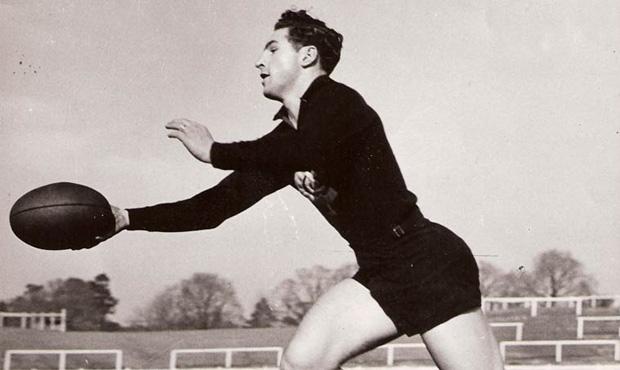 Tom Simmons during his playing days with the Blues. (Photo: Carlton Football Club)
Tom Simmons, whose football prowess at Princes Park in the post-World War II years of Henfry and Deacon was more than matched by his prodigious talents as a professional athlete, was also it seems a man of letters.
A little over 12 months since his passing at the age of 84, Tom’s written recollections penned in his final days have been forwarded to the club by his son Tony.
The letters offer a unique insight into Tom’s formative years in East Brunswick and his all-too-brief Carlton playing career.
Recruited to Carlton from Northcote District juniors in Melbourne’s inner-city north, Thomas Edwin Francis Simmons’ reputation on the track preceded him. Standing six foot in the old measurement, he had taken the 100 and 200-yard championships of Melbourne Technical Schools, together with the high and long-jump titles, and had also triumphed in the 220-yard dash at the Inter-Technical schools championship at Olympic Park.
With the permission of son Tony, Tom’s personal memoirs of another time at Carlton and in the neighborhood can now be reproduced, in the first of two parts.
Part 1 – My early life
This record of my life begins before I came into the world! My mother was hit by a cable tram in Sydney Road Brunswick just after she became pregnant. She was caught under the front bogie of the tram. A crane had to be used to lift the tram in order to release my mother. She was not badly injured. This incident typified the toughness and endurability of my mother’s life until she passed away at the age of 99 years 11 months.
I was born at home in a rather small 2-bed room tenement house in East Brunswick. We had a “wash house” in which was installed a tin bath, two concrete sinks (one of which had a wringer attached), a wood fried copper for boiling up the washing. In order to have a bath, hot water from the copper had to be bucketed into the tin bath and cold water from the tap was used to adjust the temperature. I lived in that house for 18 years with my parents and younger brother Harry.
My father served in the Great War from 1914-18 and participated in the Gallipoli Campaign. He was exposed to nerve gas that had an effect on his health until his death in 1956.
I had a happy, uneventful childhood in a rather poor working class suburb. For 10 years I attended the South Brunswick State School and I suppose I was an ordinary student. At the age of eight I broke my leg and for seven weeks I was pulled to school by my brother in a two- wheel box cart.
During summer evenings and weekends I joined a group of carefree neighbourhood kids playing street cricket, using a telephone pole as the wicket. We would often play a game, which was popular amongst street-kids called “Tip-Cat” and it involved striking a wedged shaped piece of wood about six inches long to make it leap far enough above the ground to enable it to be hit as far as possible down the road. Avoiding windows was a problem.
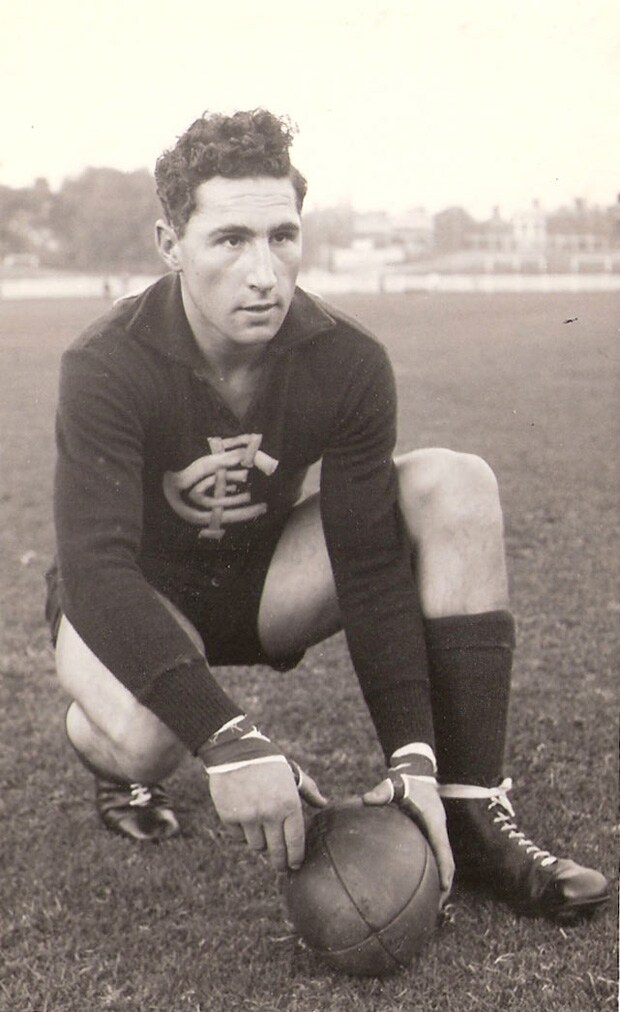
Tom Simmons during his days with the Blues. (Photo: Carlton Football Club)
During the football season, us street kids could not afford the luxury of a proper leather football but we had heaps of fun in the street kicking around a paper ball made by rolling up newspaper into an elongated ball three inches wide and six inches long wrapped with string.
When my brother and I were about seven years old we had a paper delivery round. We did that for 10 years. We signed in at the newsagent shop at 5am, got our stack of newspapers and did our deliveries on foot to houses in about ten streets. After completing the paper rounds at 6am, I would eat a few sausage rolls and go back to the newsagent to get some more papers (The Sun, The Age, The Argus and The Sporting Globe) to sell on the trams. I would jump on a tram and sell papers. After two stops I would get off and wait for the next tram. I would do this for 5-6 stops then cross the road and work the trams on the other line until I got back to the shop. We were home by 7am so we had to chase breakfast and do cleaning chores because our mother had an early morning cleaning job (which she did for 40 years!)
Another of my jobs as a kid was with a rather large bread factory (this was before the present hot-bread shops). My job was to help a bread-carter with home deliveries, which were done from a horse- drawn cart. When we got back to the factory, I had the responsibility to unsaddle the horse, hose him down then lead him to his stall and make sure he had enough chaff.
My mother, who was not all religious, made me attend from the age of nine Sunday School at the Anglican Church in Brunswick. My friends and I would muck around and I do not recall learning anything about God! The church formed a basketball team in 1944. Although I was only 15 years I played for two years and the team were champions. Some players in the competition went onto to play VFL football.
I attended the YMCA in City Rd, across the bridge in Swanston Street from the age of eight to 15. There was a heated pool but no bags were allowed. I played basketball and did athletics. I attended summer camps at Shorten on Westernport Bay. At the age of 16, I won the State Championship for 200 yards.
Part 2 – My football career
I was not involved in competitive football until the age of 18 when I joined Northcote Juniors Football Club.
In the VFL in those days, clubs were allocated zones. If you lived in a certain zone you could not join a football club in another zone. I lived in East Brunswick, which was a Carlton zone. That restrictive system was abandoned in 1960.
During my first and only season with Northcote Juniors, a Carlton scout Jim Francis attended one or two matches looking for potential Carlton recruits. The next year I couldn’t believe I was invited to attend training at Carlton and was given the opportunity to become a member of the senior list of players. In those days each VFL club had a team playing in each of the three grades – the Thirds for kids from 14 to 18 years, the Seconds for players aged 16 to 30 and the Firsts where the players ranged from 18 to 33. In my case I was asked to train with the senior team in mid-1949 and went straight into the Firsts team without playing any matches in the Seconds or Thirds competition.
Carlton was a famous football club and I was greatly honoured and found that when I first ran out onto Princes Park with my teammates most of them were seasoned stars.
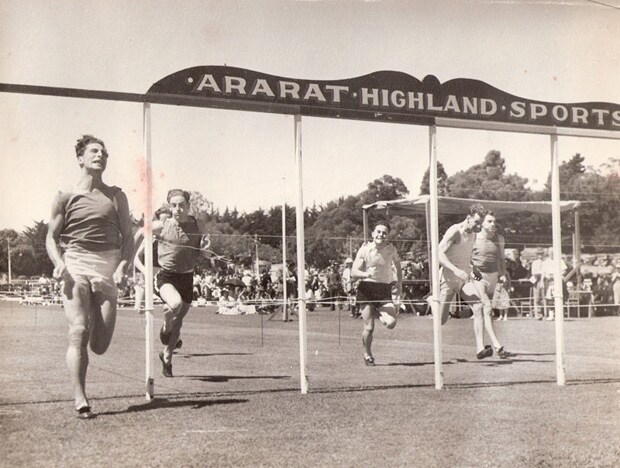
I enjoyed the training sessions each Tuesday and Thursday from 4.30pm to 6.30pm. as the youngest member of the team I was determined to improve my skills and earn the respect of my teammates. Fortunately I had a high level of physical fitness and in fact I was the fastest player in the team. My friends thought I had an obsession with fitness. They were probably right! In 1949 very few of the team possessed a car. In the streets I would be doing running and I enjoyed doing broad jumps over driveways on the footpaths.
The football season comprised 20 home and away games. I was fortunate to play 17 games in my first season and was awarded the best first year player.
In my second season I was seriously injured in a match against Collingwood during the 11th game. My right knee was badly damaged in a collision with an opposing player. I had two torn cartilages. Surgery was performed by a top orthopaedic surgeon to remove the cartilage, but I missed the remainder of the season.
During the summer months I regained my physical fitness but my knee did not regain its strength. I was not confident that my knee would allow me to play out a match with my former vigour and strength so reluctantly I retired from football.
I was devastated.
My short career of 28 games ended abruptly during that match against Collingwood. In those days playing for a VFL club was all about loyalty and team spirit. The only financial reward was a payment of £4 [about $8] per game.
Adam White’s 40th
Happy 40th birthday to Adam White.
———-
From the Blueseum
Career : 1997 – 2000
Debut : Round 2, 1997 vs the Kangaroos, aged 21 years, 88 days
Carlton Player No. 1014
Games : 44
Goals : 21
Final Game : Round 21, 2000 vs Port Adelaide, aged 24 years, 203 days
Guernsey No. 30
Height : 188 cm (6 ft. 2 in.)
Weight : 89 kg (14 stone, 0 lbs.)
DOB : January 9, 1976
Adam White showed glimpses of real potential during his first three seasons at Princes Park, and played in two of Carlton’s 1999 epic finals matches. However, he is probably best remembered for a bizarre incident during the Blues’ loss to Adelaide in 1997, when he crashed into a field umpire and knocked himself out cold. After 44 senior appearances, White retired from AFL football in 2000, and launched a new career as an independent film-maker.
Well-built, with good pace and aerial skills, White was recruited by the Blues with pick 41 in the 1994 National Draft. Originally from East Burwood, he had impressed as a creative midfielder with the Eastern Ranges at Under-18 level. Carlton assigned him guernsey number 42 to start with, but after one season he switched to number 30. Two seasons of Reserves football followed, before Adam was selected for his first senior game against North Melbourne in a Monday night match at the MCG in round 2, 1997. Starting on the interchange bench, he was eased into the match, and kicked a goal on debut as the Blues went down by 26 points.
Over the next four seasons, White became a regular bench player who seemed most comfortable in the spaces on a wing. Like many others, consistency proved elusive, although he could be quite dynamic in bursts – as he showed against Collingwood in round 21, 1998 when he dashed from the centre and kicked a spectacular goal with one of his 22 possessions.
In 1999 he played finals football for the first time, but was sparingly used off the interchange bench in both the Semi Final victory over West Coast, and the following week’s one-point triumph over Essendon. He didn’t make the cut for the Grand Final against North Melbourne, and a persistent thigh strain disrupted his progress in 2000. He did eventually work his way back into the senior side, although his only appearance for the year – against Port Adelaide at Football Park in round 21 – was to be his last at top level.
Adam remained with Carlton Reserves throughout 2001, and retired at the end of the season. He headed back to East Burwood the following year, where he completed his tertiary studies in video production and photography before launching his new career behind the camera.
Over the next decade, White earned plaudits for his work as a director and producer of short films, including ‘A Black and White World’, ‘Toucan’ and ‘Attack’, along with the 10-episode TV series ‘Kane & Disabled’.
Brian Kekovich’s 70th
Happy 70th birthday to Brian Kekovich.
—————-
From the Blueseum

Playing Career : 1967-1968
Debut : Round 1, 1967 vs Fitzroy, aged 21 years, 97 days
Carlton Player No. 794
Games : 34
Goals : 97
Guernsey No. 16
Last Game: Grand Final, 1968 vs Essendon, aged 22 years, 264 days
Height : 187 cm
Weight : 86 kg
Date of Birth: 7 January, 1946
Premiership Player: 1968
Leading Goalkicker: 1967, 1968
The older brother of North Melbourne champion Sam Kekovich, Brian was a star full-forward from Myrtleford who arrived at Princes Park in 1967 with huge expectations on his shoulders. In his 34 games for Carlton in two seasons, Kekovich showed the same mercurial ability as his brother later would, before his promising career was cruelly cut short by a chronic back injury in the midst of Premiership celebrations.
At 187 cm and 86 kg, with strong hands and a powerful left foot kick, Kekovich settled into a Carlton team on the rise and booted 36 goals in his first season. Carlton finished second after the home and away rounds of 1967, then disappointingly lost both their finals matches to end the year in third place. Those losses spurred the Blues into season 1968. We were beaten by Essendon twice during the year, yet still finished runners-up. Then we marched into the Grand Final with a 36 point upset win over the Bombers in the second semi-final. In mid-season of that year, Brian had hurt his back when he was crunched in a marking duel, but ignored the pain and played on. He had made a big impression in only his second year of VFL football, booting 59 goals by the time the Blues met Essendon – who had beaten Geelong in the Preliminary Final – yet again on Grand Final day.
A strong, swirling cross-field wind turned the ’68 Grand Final into a close, mistake-ridden encounter. The match was highlighted by Kekovich’s four goals in Carlton’s winning tally of seven; and wingman Gary Crane’s superb game on the wing to be voted Best on Ground. Carlton won by three points to claim our first flag since 1947. Brian’s contribution to the flag win was significant, as highlighted by the fact that our five losses for the year were the only five matches he missed – a remarkable statistic!
Only a short while after the Grand Final – when Kekovich sought treatment for his back – the diagnosis came as a total shock. He was advised to retire from football immediately – or risk spending the rest of his life in a wheelchair. Unfortunately for him and for Carlton, Brian’s short but successful career in the number 16 Navy Blue guernsey was over.
Jamie Dunlop’s 50th
Happy 50th birthday to Jamie Dunlop.
——–
From the Blueseum

Career: 1987 – 1990
944th Carlton Player
Debut: Round 4, 1987 vs West Coast, aged 21 years, 103 days
Games: 21
Goals: 3
Final Game: Round 21, 1990 vs Hawthorn, aged 24 years, 232 days
Guernsey No. 24 (1987 – 1990)
Height: 196cm
Weight: 85kg
DOB: 5 January, 1966
Recruited from St Marks in outer-suburban Fawkner (he also played for Fawkner), Dunlop was a bullocking 196cm ruckman who played 21 games for the Blues in the late 1980s, starting in 1987. His game time was limited as Justin Madden was slowly developing into one of Carlton’s all time great ruckmen, and others like Peter Sartori and Mick Gallagher were reasonable backups. He was aggressive but never really took advantage of his strength, and was a victim of the list purge in the early 90s. He was reported in his first game against West Coast Eagles for striking Laurie Keene, he was given a reprimand.
His older brother Daryl Dunlop had also played for the Blues U/19’s and Reserve teams.
He was known for a particular party trick of being able to eat a McDonalds “Quarter Pounder” and “Cheesburger” together in one bite.
Dunlop wore No.54 and No. 40 in 1984, No. 42 in 1985, and No.52 in 1986 whilst playing with the Blues reserves.
Career Highlights
1985 – Equal 3rd Under 19s Best & Fairest
1986 – Reserves Premiership
1986 – Reserves 3rd Leading Goalkicker
1987 – Reserves Best Clubman Award
1990 – Best Clubman Award
1990 – 3rd Reserves Best & Fairest
1990 – Reserves Premiership
Dennis O’Sullivan’s 70th
Happy 70th birthday to Dennis O’Sullivan.
————-
From the Blueseum

Career : 1965
Debut : Round 9, 1965 vs Fitzroy, aged 19 years, 160 days
Carlton Player No. 774
Games : 3
Goals : 0
Last Game : Round 11, 1965 vs St Kilda, aged 19 years, 179 days
Guernsey No. 35
Height : 179 cm (5 ft. 10 in.)
Weight : 77 kg (12 stone, 2 lbs.)
DOB : January 5, 1946
Dennis O’Sullivan joined the Blues in 1965, the first year of Ron Barassi’s tenure as captain-coach of the Blues. A local lad from Melbourne’s northern suburbs, he had begun his football career at Coburg YCW, before moving on to Batman, then Essendon Under 19’s.
Although he had been cut by the Bombers after just one season in 1964, O’Sullivan believed that he was good enough to play senior VFL football. Therefore, the next year saw him at Carlton, where some good showings in the pre-season practice matches won him a place on the Blues’ list. He had played mostly as a rover-forward to that point of his career, but when he was sent to the back pocket in the Reserves, he found his niche.
After a string of eye-catching games with the seconds, O’Sullivan became the 12th Blue to wear guernsey number 35 in a VFL match when he was called into Carlton’s senior team in round 9, to enjoy a big debut win over Fitzroy at the Brunswick Street oval. Another good victory followed in round 10 at Princes Park, when the Baggers accounted for Footscray, but the following week he was relegated to the bench before the Blues went down in a thriller to St Kilda in their first-ever clash at Moorabbin.
Thereafter, O’Sullivan played out the year at the lower grade, showing consistent good form without earning another chance at the top level. Despite being a clear winner of the Reserves Best and Fairest award, he was delisted at season’s end.
O’Sullivan wore No.53 whilst playing reserve grade football for Carlton in 1963 and 1964.
Barry Beitzel’s 80th
Happy 80th to Barry Beitzel.
————-
From the Blueseum
Career: 1955 – 1957
Debut: Round 17, 1955 vs South Melbourne, aged 20 years, 236 days
Carlton Player No. 696
Games: 2
Goals: 0
Last game: Round 18, 1955 vs Geelong, aged 20 years, 243 days
Guernsey No. 21 (1955) and 36 (1957)
Height: 182cm
Weight: 72kg
DOB: 20 December, 1934
Wearing guernsey number 21 and listed at 183cm (6 foot) in height, Beitzel played 2 consecutive games for Carlton at the end of Season 1955.
Beitzel was recruited from Sale via Morwell and Maffra.
Barry is the cousin of senior V.F.L. Umpire and long time football broadcaster Harry Beitzel. Harry sent his cousin a telegram before his debut match;
“Congratulations and best wishes on the big occasion. Concentrate on the ball always, and you will topple the best. Signed Harry.”
 Barry won the 1955 Carlton seconds best and fairest award with 22 votes, runner-up was Barry Archbold 21 votes, and Kevin Bergin third with 20 votes.
Beitzel also wore No. 35 whilst playing with Carlton reserves in 1956.
A message from David Rhys-Jones and Geoff Southby
Spirit of Carlton – Past and Present
Carlton Football Club Former Players and Officials
Spirit of Carlton Membership for 2015 Now Due
The Spirit of Carlton invites Carlton former players and officials to join or renew their membership for 2015.
The Spirit of Carlton was formed to embrace the Carlton Past Player and Officials Association and to extend our range of activities to provide ongoing support to the Carlton Football Club and, in particular, to support past players and officials who are suffering hardship after their football careers.
SOC also seeks to provide opportunities and functions to help bring former players and officials back together to help renew old acquaintances and friendships.
Helping to meet these aims, the SOC was integrally involved in, and financially supported, the 150th Carlton Football Club Birthday celebrations earlier this year. Our involvement was to ensure that we could get as many former Carlton players to the function as possible.
I am sure all those who attended would agree that it was the best Carlton Football Club function we have been to in our respective lifetimes and the function provided a unique opportunity for Carlton players from across many decades to meet and get together, many for the first time.
In order for the SOC to continue to provide opportunities for former players to keep in contact we urge you to either join the Spirit of Carlton, or renew your membership NOW, for season 2015.
A membership form can be downloaded by CLICKING THIS LINK.
May we also take this opportunity to wish you and your loved ones a Merry Christmas and a happy and safe New Year
Yours sincerely
David Rhys Jones (President) Geoff Southby (Secretary)
For the
Spirit of Carlton Executive
December 2014
Rod Ashman’s 60th
Happy 60th to Rod Ashman.
————-
From the Blueseum
Career: 1973 – 1986
Debut : Round 5, 1973 v Fitzroy, aged 18 years, 153 days
Carlton Player No. 838
Games: 236
Goals: 370
Last game: Round 15, 1986 v Fitzroy, aged 31 years, 214 days
Guernsey No. 14
Height : 175 cm
Weight : 76 kg
DOB : 3 December, 1954
Premiership Player: 1981, 1982
Carlton Hall of Fame (1993)
Team of the Century
Rodney Ashman was one of Carlton’s greatest rovers. A brave and skilful player who was part of two Premiership teams, he continued to serve the Blues for many years after his wonderful playing career ended.
As a junior in his home town of Eaglehawk, “Ashy” was a strong-marking, straight-kicking full forward until he stopped growing and was forced out of the goal-square by taller and heavier opponents. He turned himself into a clever centreman/rover and soon caught the eye of VFL scouts. Zoned to Carlton, he arrived at Princes Park following the Blues’ 1972 Premiership season. He was given guernsey 14 and played his first senior game off the bench in 1973, aged 18.
At 175 cm and 73 kg he wasn’t the biggest or fastest on-baller in the game, but Ashy was a superb ball handler. His disposal by hand or foot was always accurate and his bravery was legendary. By 1979 he was firmly entrenched among the elite rovers of the VFL, only to be bitterly disappointed when injury kept him out of that year’s Premiership team. All that changed in 1981, however, when the nuggety blonde terrier was a star in the Blues emphatic Premiership win over Collingwood. That flag capped a fabulous year for Ashy; he had represented Victoria, finished second in the Brownlow Medal and was pipped by one point by Ken Hunter in Carlton’s Best & Fairest award.
In 1982, The Blues did it again; defending their title with a gutsy Grand Final victory over strong favourites Richmond. Ashman kicked two vital goals at crucial times to see the Blues home by 18 points. In the maelstrom of the packs that day, Ashy suffered concussion for the umpteenth time in his career. So from then on the Club doctors insisted that he wear a lightweight padded bicycle helmet every time he played. It made little difference to him; he just kept boring in regardless.
By coincidence, Rod’s senior career started at Waverley Park against Fitzroy in May 1973, and ended at the same venue – against the same opponent – thirteen years later. But even so, he wasn’t quite done. He played out the year in the Reserves team, and claimed another flag victory on Grand Final day 1986, when the firsts crashed to defeat against Hawthorn in Bruce Doull’s last game. Rod would play no more, but he wasn’t lost to his beloved Blues.
He was elected to the Carlton Board of Directors in 1987, and became the seniors’ skills coach the following year. In 1989 he took over as Reserves coach and guided his young team to another Premiership in 1990. Three years later, he was elected to the Carlton Hall of Fame, and in May 2000 – to the acclaim of the football world – he was named in a forward pocket in the Blues’ Team of the 20th Century. Rod Ashman is also the uncle of Blues great Peter Dean.
Rod’s enormous contribution to the Carlton Football Club continued in 2007, in the role of Player Welfare Officer.
In 1989, the Bendigo Football Netball League named the Best on Ground award for the U/18’s Grand Final the Rod Ashman Medal in honour of the champ from Eaglehawk. Ashman also won the League’s best and fairest in the U/18’s in 1971 the same year they won the premiership.
Peter Rohde’s 50th
Happy 50th to Peter Rohde.
————
From the Blueseum

Career: 1984-1987
Debut: Round 4, 1985 vs Geelong, aged 20 years, 152 days
925th Carlton Player
Games: 46
Goals: 6
Last game: Round 20, 1987 vs Geelong, aged 22 years, 269 days
Guernsey No. 41 (1984 – 1987).
Height: 185cm
Weight: 87kg
DOB: 19 November, 1964
Peter Rohde played 46 games for the Blues commencing in Season 1985, mainly as a wingman. His debut game was most impressive, racking up 33 disposals. Rohde was a talented winger for the Blues who had an impressive debut season in 1985. By 1987, games were becoming harder to obtain and as a result he sought a clearance to rival club Melbourne for the 1988 season.
Rohde was your typical hard-working midfielder, but it was at Melbourne he found himself playing mostly at Full Back. As far as #41’s go, he still remains Carlton’s most capped player in that guernsey. Rohde transferred to Melbourne Football Club in 1988 and retiring in 1995. Rohde would rack up another 117 games for 22 goals whilst playing for the Demons. He wore No.41 for both clubs.
Later he would achieve success with Norwood when he took to a premiership in 1997 in the SANFL as a coach. This ultimately led to his appointment as an assistant coach at the Western Bulldogs. Towards the end of the 2002 season, the resignation of incumbent coach Terry Wallace led to Rohde being made caretaker coach for the final round clash with Collingwood at the MCG which the Bulldogs won. However, after being given the position of full-time coach for 2003, the Bulldogs finished last and in 2004 struggled again and finished 14th. He was eventually sacked. He is currently a part of the Football Department (as Football Operations Manager) at the Port Adelaide Football Club.
Rohde has three children, Matthew, Ashleigh and Ella, and is married to Robyn.
Rohde was originally recruited from Bendigo club Sandhurst, he wore No.54 in the 1983 season whilst playing with the Blues reserves.