The Spirit of Carlton Past and Present recently held our annual general meeting.
At that meeting the 2014 Annual Report was presented.
It can be downloaded using THIS LINK.

Spirit of Carlton Past and Present
We represent the past players and officials of the Carlton Football Club
The Spirit of Carlton Past and Present recently held our annual general meeting.
At that meeting the 2014 Annual Report was presented.
It can be downloaded using THIS LINK.
By Tony De Bolfo
On the 50th anniversary of Carlton’s audacious signing of Ron Barassi – the deal that changed the face of football – rare colour film of the Barassi era of the 1960s and early ’70s has been made public for the first time.
The footage, kindly made available to the club by members of the O’Shaughnessy family, has been sourced from the home movies of the late Brian O’Shaughnessy, a former chairman of the Carlton Social Committee in the Barassi years and a long-serving VFL Tribunal advocate through the 1970s and ’80s.
Barassi, the six-time Melbourne Premiership player, was confirmed as Carlton Senior Coach two days before Christmas 1964, in a move that rocked the game’s foundations to its very core.
He is the subject of a number of highlights of the O’Shaughnessy film, including:
Gordon Collis, Carlton’s Brownlow Medallist of 1964, recently returned to Visy Park to view the edited O’Shaughnessy highlights package for the first time. In the Balnarring footage of ’65, Collis is seen riding a horse bareback with Maurie Sankey, the 100-game Carlton ruckman who at just 25 years of age lost his life in a car accident in November of that year.
Collis, on viewing this film for the first time, said: “That was terrific. I got quite a buzz out of it. It certainly brought back memories”.
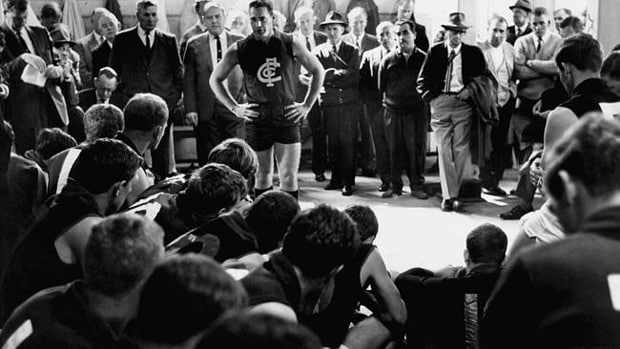
Ron Barassi addresses his troops ahead of a pre-season game, 1965. (Photo: Carlton Football Club)
“The strange thing is, I really don’t have a distinct memory about jumping on the back of that horse. I’ve been on a lot of horses in my time, and maybe getting on a horse wasn’t such a big deal,” Collis said.
“It positively dates the Sankey thing, because it was towards the end of ’65 that he died. I found that side of it quite touching because me and one or two others were then sharing a house with Maurie. It made me think, looking back on it, that you don’t really appreciate the impact of these things at the time.
“His (Sankey’s) death was a huge loss for the club. Like most big men he was a little slow in blossoming, he was nearing the peak of his powers, and not only from an individual point of view. He had such a magnetic personality about him. People would be drawn to him.”
O’Shaughnessy died in August 2012 at the age of 91. The year before, he was the recipient of a 90th birthday to-camera greeting from the great Ronald Dale.
Barassi has since been forwarded a copy of this film, which is to be screened in the display cabinet in the foyer by the reception area at Ikon Park.
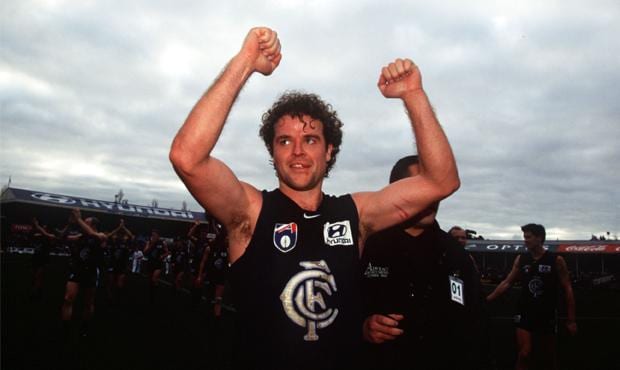 1995 Carlton premiership player Fraser Brown will present the matchday ball on Saturday. (Photo: AFL Photos)
Carlton’s 1995 Premiership player Fraser Brown is to present the matchday ball to the officiating field umpires prior to the first bounce in Saturday’s Round 3 match against Essendon at the MCG.
Brown will also be inducted into Carlton’s newly-established Ring of Honour which appears via LED signage on matchdays at all Carlton home games at the venue. Brendan Fevola, who presented the matchday ball to the umpires in the season opener against Richmond, is the first Carlton cult hero represented on the signage.
Recruited to the club from Lilydale in the Yarra Valley, Brown is a revered hardnut who played for keeps through 177 senior matches in 12 seasons for the Blues. He is of course best remembered for the match-winning tackle laid on Dean Wallis in the closing seconds of the 1999 Preliminary Final.
In a previous interview, Fraser gloriously articulated his feelings about that very special moment.
“All I can remember is the elation. I’ve never felt that elation ever in sport. Ever. And that’s Grand Finals included. I’ve never felt the way I felt at the end of that game. We were the underdogs and when you win like that … Christ almighty,” Brown said in typical forthright command of the Queen’s english.
“You might have seen that photo on siren time. I was screaming at the sky. I don’t think I was saying much. Only screaming. That was fair dinkum elation. To feel that way was amazing. That was the day [Jeff] Kennett got the arse too.
“Whenever you play Essendon or Collingwood, and to a lesser degree Richmond, you lift another cog. Anyone who’s played for Carlton should know that. And when you lift another cog, anything can happen.”
Brown’s involvement in one of the last dramatic plays of the prelim will be talked about for as long as they’re talking footy, the tackle on Wallis having been laid with half a minute left on the clock.
VIDEO: Watch Brown’s famous one-percenter in the dying stages of the ’99 prelim
“I remember seeing him [Wallis] taking the mark and coming at me,” Brown recalled. “Nothing against him or anything, but I saw him take someone on before, so I anticipated which way he would dodge. And I anticipated the right way, locked him in . . .
“I was airborne when I tackled him, and I was confident as I could be of holding him in. In my brain I was thinking ‘I’ll get him, I’ll get him, I’ll get him’, don’t worry about that. You wouldn’t be playing otherwise, would you? If someone’s running at you, are you going to say ‘I don’t know whether I’m going to hold him or not?’ It’s ‘I’ll f…ing hold him or I won’t be here next week’.
“It was almost as if I’d seen a replay before I grabbed him. I just knew which way he was going to go.”
When the final siren brought to a stunning conclusion one of the greatest of all Carlton victories – 16.8 (104) to 14.19 (103) – Justin Murphy famously hoisted the football heavenward.
Within seven days, Murphy would be gone, having wrecked his knee in a losing Grand Final, but he too will be remembered for as long as those frenetic final moments of the ’99 prelim are replayed and replayed and replayed.
As for the man who affected football’s most famous one-percenter, Brown’s still dining out on it.
“I don’t know how many times I’ve been asked by people, whether in business, in sport, or at the pub, about that moment,” Brown said. “The majority of them are Essendon supporters who say ‘You bastard. You cost us the 1999 Grand Final’, and it’s still lingering.
“They thought they were home and hosed to go all the way of course, and they would have beaten North (in the Grand Final) for sure. I’m going to say that now, aren’t I?
“You then go and ask a few true Carlton supporters who have been through the run of the mill, and I know that while there isn’t as much elation as in winning a Grand Final, seeing that game from start to finish still blows them away.”
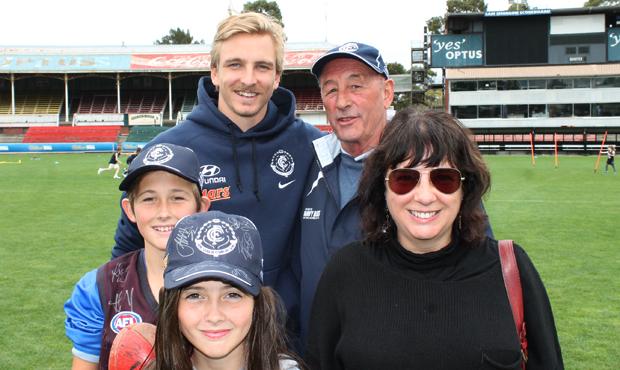 The two No.27s Dennis Armfield and Bill Armstrong AO, together with Bill’s daughter Michele and grandchildren Jed and Josie. (Photo: Carlton Football Club)
It’s 56 years since he last donned the No.27 – but Bill Armstrong AO renewed acquaintance with its current keeper Dennis Armfield at the old Carlton ground, members of the Armstrong clan closely in tow.
Armstrong, the club’s 1958 reserve grade B&F whose senior appearances for the old dark Navy Blues were confined to just two through 1958 and ’59, joined his daughter Michele and grandchildren Jed (13) and Josie (11) on the ground for what was a super clinic conducted by the club for the children currently holidaying.
There the fleet of foot former wingman and sometime foot runner met Armfield and posed with him and his family in this picture for posterity.
“This is the third year in a row I’ve brought my grandchildren along to the clinic,” Armstrong said.
“It’s been great to bring them back and I might say that my four children – three boys and Michele – are all Carlton supporters.”
Recruited to Carlton from Chelsea in 1955, Armstrong didn’t take on the game until the age of 17, but was part of Chelsea’s all-conquering Premiership team in that year.
A fitter and turner by trade, he was working beneath the engine of a car in his workshop when two suited gentlemen appeared requesting his signature to play for Carlton as an on-field successor to Laurie Kerr.
“I was a bit staggered by all that, but signed up, played all the practice matches and then played a few reserves matches between games for Chelsea.”
After a year abroad in 1957, Armstrong won his first senior call-up (together with the late John Stephenson) for Carlton’s final home and away match of the ’58 season against South Melbourne at Princes Park.
He remembers how excited he felt in donning the No.27 for his first senior game, which resulted in a two-point win for the home team.
“The thing I remember most is that a lot of my supporters from Chelsea came up for the game,” he said. “In those days they were allowed in the rooms before the game, so there was a fair bit of excitement around.”
Known for his turn of speed, Armstrong revealed that he’d often told people quizzing him on his League career “that I was so fast I forgot to take the ball with me”.
And yet, his natural pace definitely worked to his advantage in his only other senior appearance for Carlton – against Footscray in the second round of ’59 at the Western Oval.
“I remember Ted Whitten chasing me around the ground saying ‘I’m going to get you, you little bastard, but I was fast enough to get away from him,” Armstrong said.
“I played reasonably well in that game, as a replacement for the late Johnny Chick – a great guy and a great footballer.
“The following week I didn’t get selected and I was always a bit disappointed about that because I thought I was worth another try.”
In 1960, Armstrong crossed the Nullarbor and turned out for West Perth. He remembers turning out for a match against East Perth and witnessing first-hand “Polly” Farmer’s genius – “he (Farmer) was uncanny the way he could take the ball and handball it,” said Armstrong, who was also exposed to Nicholls’ greatness at Carlton.
Regrettably a broken leg put paid to Armstrong’s season – a Premiership season for the WA Falcons no less – and he returned to Princes Park to again try his luck. But it just wasn’t meant to be.
Armstrong renewed ties with Chelsea in a golden era, as part of the all-conquering Grand Final teams of 1962 and ’63, and he followed up with a flag representing East Burwood in ’64.
By then, Armstrong had already embarked on what would prove to be his lifelong calling, as a volunteer, first with what he considered “a fairly radical group within the Catholic Church”, the Young Christian Workers.
“I became involved with YCW through my local parish in 1952/’53. I always look back on that period as my university period,” Armstrong said.
“That was where I learnt about life, that to be able to work with people you really have to be prepared to listen to them.”
Armstrong rose to become National President of YCW then joined the Overseas Service Bureau, which assisted with the establishment of the Australian Volunteers International program in 1963.
Through the 1970s, Armstrong committed to an organisation known as Action for World Development, which he said was posing serious questions about poverty and poverty’s cause on a global scale.
Then in 1982, he recommitted to Australian Volunteers International, this time after accepting the position of Chief Executive Officer, a position he held until his retirement in 1982.
During that time, Armstrong oversaw the growth of that organisation from a staff of 12 to 130 people nationally and with it the annual budget from less than $400,000 to more than $20million.
In 2003, Armstrong was awarded the Order of Australia “for service to the international community and the provision of overseas aid and development through Australian Volunteers International, and to fostering greater understanding of different cultures and raising awareness of social justice and human rights issues”.
Today, Armstrong commits his boundless energies to the cause as Board Member of Indigenous Community Volunteers – an organisation whose charter is to offer hands-on help rather than hand-outs.
Not surprisingly, Armstrong looks on with admiration at the commitment to community of all AFL clubs and their players, Carlton included and Dennis Armfield amongst them.
“This is tremendously heartening to me,” Armstrong said.
“It’s extremely important that footballers with such an enormous following are seen to be community-oriented and seen to be leaders in the community, not just on the football field.
“One of the problems affecting athletes in all sports is that you read about their misdeeds, but there’s a hell of a lot of good work being done which tends not to be seen. I know my own grandson Jed was in hospital at one stage last year and two of the Carlton players paid him a visit. That was an incredible thing for him at the local level.”
Happy 70th to Gil Lockhart.
————–
From the Blueseum
Career : 1966
Debut : Round 6, 1966 vs Footscray, aged 21 years, 50 days
Carlton Player No. 784
Games : 2
Goals : 0
Last Game : Round 7, 1966 vs Geelong, aged 21 years, 57 days
Guernsey No. 45 (1966).
Height : 173 cm (5 ft. 8 in.)
Weight : 67 kg (10 stone, 7 lbs.)
DOB: April 7, 1945
Since 1911, only five Blues have carried the number 45 onto the field in a senior VFL/AFL game. The first of this select group was Gilbert Leslie Lockhart, who made his debut on the bench for Carlton against Footscray at Princes Park in round 6, 1966.
A busy, determined wingman, Lockhart had earlier represented the Blues at Under 19 level, before returning to play senior football for his local club, Beaumaris. In 1965, Beaumaris enjoyed a dominant season in the South East Suburban Football League, before winning the Premiership with a huge victory over Carnegie in the Grand Final.
The following year, Lockhart was drawn back to Carlton, where his good early-season form with the Reserves gained him selection for the match against Footscray in round 6. Playing at home, the Blues easily accounted for the Bulldogs, with captain-coach Ron Barassi providing outstanding leadership in a Best on Ground effort. Both the 19th and 20th men – Lockhart and Maurie Fowler – were given a run in the last quarter, and were on the field when the final siren sounded.
A week later in round 7, Carlton made the long trek to Kardinia Park to take on finals contenders Geelong. Lockhart warmed the bench as 19th man again, and his team looked like stitching up a surprise win when they led by 19 points at three-quarter time. But Geelong rallied, and aided by a freshening breeze off Corio Bay, kicked 3.3 to Carlton’s one solitary point, and won by exactly that margin.
Lockhart was then omitted from the team for round 9. He was unable to force his way back in before the season ended, and he was told that his services were no longer required.
By Tony De Bolfo
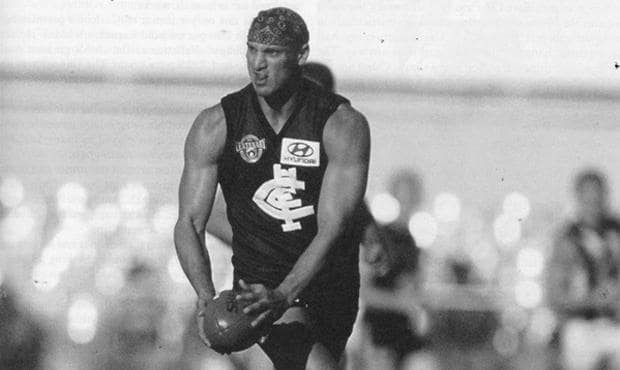 Carlton great Mil Hanna wears a bandana in a practice match against Collingwood in February, 1997.
Okay, so it may not carry the clout of Bruce Doull’s headband . . . but the Hanna Bandana – that triangular strip of blue and white cloth that shielded Milham Hanna’s cranium from the relentless Australian sun – has earned renewed attention with Chris Judd putting in the hard yards through the pre-season.
“The Juddster” is unlikely to take to the track any time soon sporting a bandana – which is a shame according to Mil given the item’s potential marketability.
“I’d love to see Chris Judd wear a bandana in Carlton colours,” said Hanna, Carlton’s 190-game Premiership player of 1995.
“I’m surprised they’re not walking out of Carlton’s merchandise shop. Have you taken a look at today’s supporters? They’ve all got shaved heads.”
Mil remembered donning the bandana on a regular basis through the pre-season period. He would soak the bandana in cold water to be sun smart, in the tradition of the late Jim Stynes who tended to sport the baseball cap pre-season, “but I was also trying to set a trend”.
“I’m trying to think if I wore the bandana into a home-and-away game. I’ve got a shocking memory but I reckon I might have,” Hanna said.
“It would have been early in the season where we were playing somewhere pretty warm. It would been in one of ‘Parko’s’ (Coach David Parkin’s) games because I wouldn’t have got away with it in ‘Wallsy’s’ (Coach Robert Walls’) time.
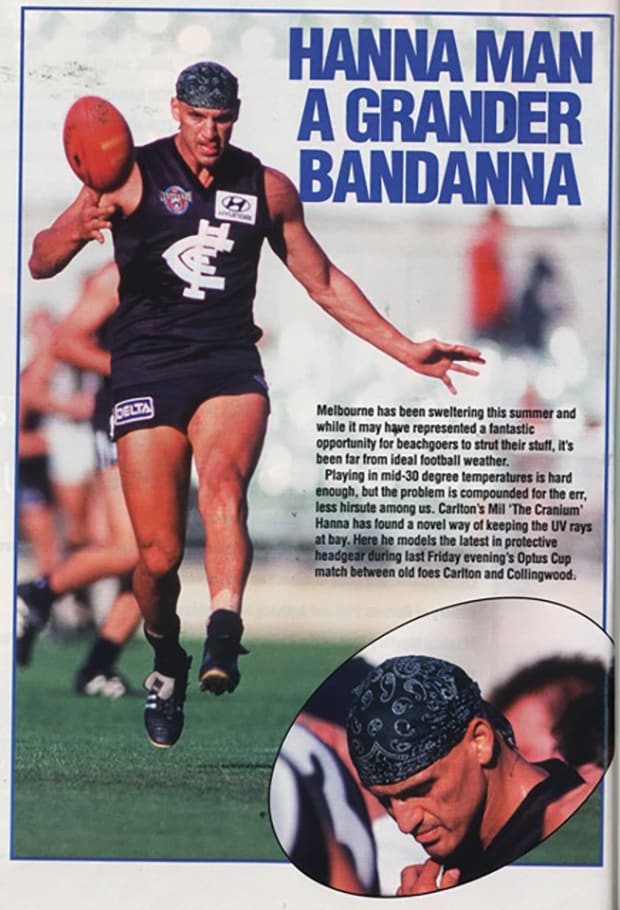
Mil Hanna wears the bandana in a pre-season practice match against Collingwood in 1997.
Hanna has also revealed for the first time an incredible story relating to Grand Final week in 1995, when rumours abounded that Carlton & United Breweries had offered him $1 million to sport a temporary CUB tattoo on the back of his bald head for the big one against Geelong.
“The rumour was about. It wasn’t started by me and I never found out who started it, but that’s all it was – a rumour,” Hanna said.
“The funny thing was that a week before the Grand Final I got a call from a bloke at Essendon Nissan who said ‘We want to talk to you about a sponsorship proposal, to put an Essendon Nissan tattoo on your head’,” Hanna revealed.
“I said ‘How much are you going to pay me to make a fool of myself on Grand Final day?’ and the bloke said ‘$2000’. I said ‘You’ve got to be joking – there’ll be millions watching on Grand Final day – what would you pay for an ad on TV?’.”
Hanna added that in retrospect he should have marketed the Hanna Bandana, noting that the original item was now gathering dust in a drawer somewhere at his Mum’s house.
By Tony De Bolfo
The glorious post script to HSV Seven’s footage of the Carlton-Collingwood Grand Final of 1970 is not so much visible, but audible – that moment where the siren goes off like a firecracker to forever consign the most famous comeback in football history to the record books.
You can blame the late Ralph Madge for that. Madge, officiating as Carlton timekeeper the day the black and whites blew a 44-point lead on football’s grandest stage, got caught up in the delirium.
“I once asked Dad why he kept sounding the siren to end the 1970 Grand Final and he said to me ‘I had to celebrate – we came back from nowhere’,” Ralph’s son Greg Madge said.
“A few months after the game, it might have been the following March, they replayed the game at the club. Dad was there to listen to the siren ring out again and again, having savoured the chance to watch the entire replay because as gameday timekeeper he was always too busy focussing on the umpire.”
That mad Madge moment, when Ralph Madge sounded Collingwood’s death knell, came at 5.04pm on the evening of Saturday, September 26, 1970. We know this because the time is recorded on the VFL Timekeepers Report lodged with the League.
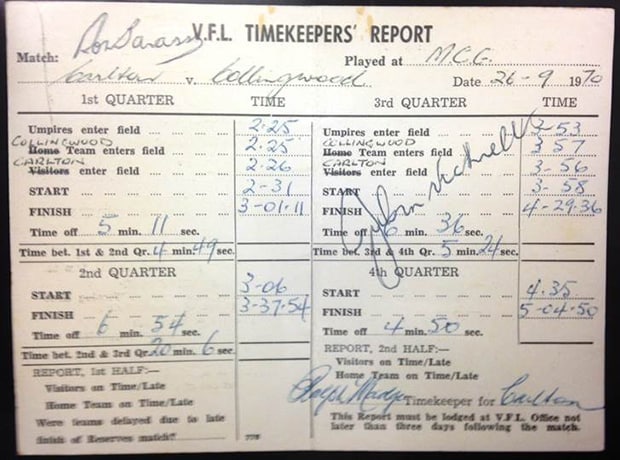
The timekeepers’ report from Carlton’s 1970 Grand Final triumph. (Photo: Supplied)
It’s one of six Grand Final Reports submitted by Ralph for each of the six Carlton Grand Final victories at which he officiated – 1968, ’70, ’72, 81, ’82 and ’87. The obvious exception is the Grand Final of ’79, as Ralph, a Life Member of the club, was on long service leave at the time Carlton knocked Collingwood over again.
“Dad told me he came back from long service before the ’79 Grand Final, but they’d replaced him with a temporary timekeeper,” Greg recalled. “He told me ‘I would have felt like a bit of a p…k to have taken over from him for the finals’.”
Some years ago, Ralph framed duplicates of each of his Grand Final reports – all signed by the Carlton captains and coaches of the day – in a montage to his quarter of a century as Carlton timekeeper.
Ralph, who served as Carlton’s timekeeper through arguably its greatest era of the 1960s, ’70s and ’80s, died the day before the good guys thumped Essendon in the 2011 Elimination Final. Yesterday, his boy handed the montage over to the club for the purposes of its archive.
“The framed montage came to grief over time and a couple of items fixed there have gone askew,” Greg said.
“My wife’s not overly keen on football anyway and thinking it through my Dad would have loved the montage to be here.”
A Fitzroy supporter in his early years, Ralph Theodore Madge’s connection with Carlton was first forged through the club’s reserve grade team manager Bert Thomas, a next door neighbour.
The story goes that Thomas invited Madge to Princes Park to officiate as property steward after the sudden death of Norm Cataract in 1966. In that first year, Madge leant his support to reserves coach Jack Carney.
In an earlier interview, Greg said his father gave timekeeping “a bash for a year”, and then assumed duties from George Smith as Senior Timekeeper in 1967. It was a position Madge held until 1990 when Max Harvey took over.
“I must admit that I rode on Dad’s coat tails in those early days at Carlton,” Greg fondly recalled. “I got to sit in the old wooden press box by the Gardiner Stand where the timekeeper was, and I got to see the new faces like Alex Jesaulenko and Brian Kekovich.”
Our video tribute to Malcolm Fraser using never before seen footage of Malcolm celebrating with the Blues.
Vale Malcolm Fraser.
By Tony De Bolfo
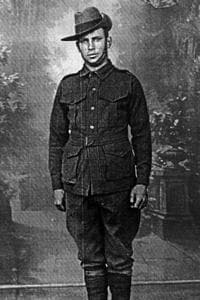 Private “Fen” McDonald played 10 games for Carlton through 1911 and ’12. (Photo: Supplied)
On the afternoon of April 25, when the Carlton and St Kilda players observe a minute’s silence on the Centenary of the Anzac Day landing, solemnly watching on will be local Brunswick resident Chad Nash.
From the terraces of the stadium in Wellington, just moments before the teams do battle in the historic fourth round, Chad will stand in mute tribute to those who gave their young lives in wartime.
Clasping a precious memorial medallion, Chad’s thoughts will inevitably turn to the all-too-short existence of his great uncle – the former Carlton footballer Fenley John McDonald – who was there at Gallipoli on that fateful day 100 years ago.
At dawn on April 25, 1915, Private “Fen” McDonald, together with members of the 7th Battalion of the Australian Imperial Force, was rowed ashore under relentless fire from well-prepared defences.
Somewhere there – perhaps on the water’s edge, or on the sparse, bullet-swept slope behind the beach, Fen was cut down.
He died a month to the day before turning 24 . . . and his body was never found.
As one of 4200 Australians who fell in this nation’s baptism of fire, Fen has no known grave. But the boy from Nagambie will forever be considered amongst the most revered of Australia’s casualties of war, his name having been etched into the ANZAC memorial at Lone Pine.
Fen McDonald was a 10-game Carlton player through 1911 and ’12. He was also this club’s first keeper of the No.14 dark Navy Blue guernsey as he played at a the time when guernsey numbers were first introduced. In the 103 years since, Fen’s number has been worn by the likes of Rod McLean, Rod Ashman, Michael Sexton and now Liam Jones, who was Fen’s age at the time of his drafting to this club.
Recently, Chad paid a sentimental visit to the old Carlton ground where his great uncle once vied for infinitely smaller stakes.
Chad came back with the medallion – the “Dead Man’s Penny” as it was so nicknamed – which was presented to the next-of-kin of those who paid the ultimate price.
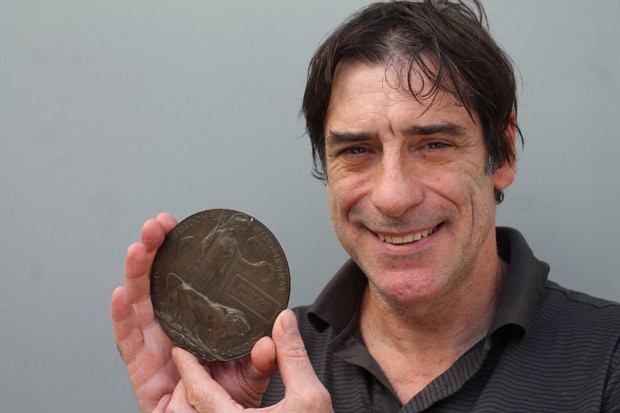
Chad Nash with Private Fen McDonald’s medallion. (Photo: Carlton Football Club)
“The reason I brought the penny to the club so it could be present on the 100th anniversary of his death,” Nash said.
“This is a real physical token and it’s a poignant reminder of Fen and his short life. It’s a reminder that Fen was, as a Carlton player, part of a society whose people were asked to lay their lives on the line.
“The Carlton players have a connection with Fen because he was a player. They also have another connection because they, like him, are young.
“And as it happened he died on the day. He died arriving.”
The bronze medallion, measuring 120 millimetres in diameter, features an image of Lady Britannia surrounded by two dolphins (representing Britain’s sea power) and a lion (representing Britain) standing over a fallen eagle (symbolising Germany).
Inscribed around the outer edge of the medallion are the words ‘He died for freedom and honour’. Encased in a frame next to Lady Britannia is the deceased soldier’s name (in this instance Fenley John McDonald) with no rank provided to reflect equality in sacrifice.
The plaque was accompanied by a letter from King George V, which stated: “I join with my grateful people in sending you this memorial of a brave life given for others in the Great War”.
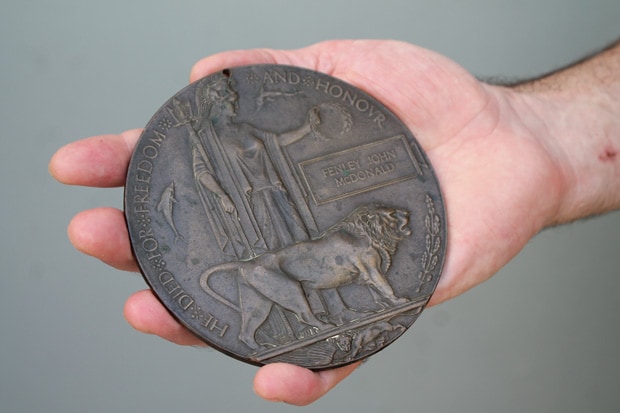
More than a million medallions were produced, marking the sacrifice of men and women who died between August 4, 1914 and April 30, 1920. Most medallions were gratefully received, but many were returned by families to the Australian Government in protest for the profound loss of their loved ones.
For Nash, Fen’s penny serves as a reminder of a short life unfulfilled.
“It also serves as a reminder that war, in the end, is personal,” Nash said.
“If you look at the number, Australia lost an awful lot of people, and of a particular age group also – that’s a generation of young people, something in the order of two per cent of the entire population, and it’s so very sad.
Happy 50th to Earl Spalding.
——-
From the Blueseum
Career : 1992 – 1997
Debut : Round 1, 1992 vs Brisbane, aged 27 years, 10 days
Carlton Player No. 980
Games : 211 (102 at Carlton)
Goals : 106 (43 at Carlton)
Last Game : Round 19, 1997 vs Collingwood, aged 32 years, 151 days
Guernsey No. 11
Height : 198 cm (6 ft. 6 in.)
Weight : 110 kg (17 stone, 4 lbs.)
DOB : 11 March, 1965
Premiership Player 1995
Blues supporters of the 1990’s loved this big West Australian key position player, even as they covered their eyes and crossed their fingers whenever he lined up a shot on goal. Although he was surely one of the most ungainly kicks to have ever played AFL football, Earl “Duke” Spalding was a consummate team player – brave, unselfish and a strong pack mark. During a notable 211-game career at Melbourne and Carlton, he figured in three Grand Finals, and collected a richly-deserved Premiership medal with the Blues in 1995.
Nicknamed “Duke” after the catchy 1960’s pop song; “Duke of Earl”, Spalding first made the back pages of the daily newspapers in his home town of Perth in the summer of 1984-85, when he was selected in the WA cricket team for that season’s Sheffield Shield competition. A tearaway fast bowler, Spalding played four matches for his state, before deciding that Australian football was his preferred sport.
After two particularly impressive seasons as a ruckman-forward with Perth in the WAFL, Earl was recruited by Melbourne in 1987. He went on to play 109 games over five seasons for the Demons – including their loss to Hawthorn in the 1988 Grand Final – and represented his home state on six occasions. Yet he never really became an automatic selection in Melbourne’s senior side. By 1991 he was intent on a change of clubs, and Carlton snapped him up with our number five selection in that year’s national draft.
At Princes Park, The Duke struck an immediate rapport with senior coach David Parkin, who began building a forward structure based around the 198 cm Spalding and team captain Stephen Kernahan in the key attacking posts. It all seemed to be coming together nicely, too, when Carlton cruised into the 1993 Grand Final against Essendon – but the younger, fresher and more committed Bombers simply blew the Blues away.
Having been found wanting, Carlton went searching for pace in 1994, and found it in the likes of Adrian Whitehead and Troy Bond. However, it was the recruitment of ex-Brisbane Bear Brad Pearce – a quick-leading, dangerous goal-sneak – that rounded out Parkin’s plan, and turned the spotlight squarely on Earl Spalding. In the Duke, Parkin had fashioned a centre half-forward who busted a gut for his team week after week. If he didn’t mark the ball cleanly himself, then he generally brought it to ground, where his second and third efforts to tackle, chase and shepherd in support of his team-mates were invaluable.
Perhaps the passage of play that typified Spalding’s approach came early in the second quarter of the ’95 Grand Final between Carlton and Geelong. The Blues led by 13 points at the first change, knowing full well that the Cats were setting themselves to come back hard. A few minutes into the second term, Geelong’s Peter Riccardi gathered the ball deep in defence for his team, burst into space, and steadied before kicking toward his intended target. Just then, Spalding came from nowhere. Showing amazing agility, he smothered the ball off Riccardi’s boot, picked it up, ran on, and slammed through a great goal from close in. Carlton’s confidence soared, and from then on we were never going to be beaten. The roar from the stands that greeted the Duke when he was presented with his Premiership medal seemed to genuinely move the big bloke, and was testament to just how completely the Carlton faithful had embraced the former Demon.
In his later years at Princes Park, Earl worked hard at correcting his kicking style, and it may surprise some readers to learn that by the end of his career at Carlton, he had balanced his over all goal-kicking ledger at 169 goals, 163 behinds. He wore guernsey number 11 throughout his time at Princes Park, and retired after Carlton beat Collingwood in the Match of the Day at the MCG in round 19, 1997.
Among Earl’s many fond memories of his six seasons in navy blue, one would surely be the day that he and his brother Scott played together at Carlton for the first and only time. The occasion was round 1, 1993, when Fitzroy beat the Blues by 6 points in an upset, but Carlton gained most from the game because of the debut of future captain Andrew McKay.
Although he was 32 years old when his AFL career came to an end, Spalding returned to WA in 1998 to be re-united with Scott at East Fremantle, and the brothers shared the joy of a Premiership together at last when the Sharks beat West Perth comfortably in that year’s WAFL Grand Final.
Earl eventually hung up his boots for good in 1999, to take on the role of assistant coach with East Fremantle (coached by ex-Blue Wayne Blackwell). Two years later, he was appointed senior coach of the Sharks, but spent just one season in the job before returning to the AFL as an assistant coach with the Fremantle Dockers.
|
In 2012, “The Duke” coached Perth-based amateur club Wesley-Curtin to its first ever senior premiership. That flag, won in B-Grade, saw the Tigers promoted, and 12 months later Spalding added another highlight to his outstanding resume by steering his team to a 32-point victory over University in the 2013 WAAFL A-Grade Grand Final.
50 Games (Carlton): Round 14, 1994 vs North Melbourne
100 Games (Carlton): Round 6, 1997 vs Sydney Swans
150 Games (AFL): Qualifying Final, 1993 vs Essendon
200 Games (AFL): Round 5, 1996 vs West Coast Eagles
100 Goals (Carlton): Round 18, 1996 vs Fremantle
100 Goals (AFL): Round 15, 1993 vs Brisbane Bears
1992 – Equal 7th Best & Fairest
1995 – Premiership Player
1995 – 4th Best & Fairest
Happy 50th birthday to Peter Dean.
———-
From the Blueseum
Career : 1984-1998
Debut : Round 11, 1984 vs Footscray, aged 19 years, 94 days
Carlton Player No. 919
Games : 248
Goals : 41
Last Game : Round 22, 1998 vs Port Adelaide, aged 33 years, 174 days.
Guernsey No. 35
Height : 188 cm
Weight : 85 kg
DOB : 9 March, 1965
Premiership Player 1987, 1995
Victorian Representative 1986, 1995
Carlton Hall of Fame: 1998
He began his career on a Monday, and finished it on a Sunday. He rarely polled highly in the Brownlow Medal, or even in Carlton’s Best and Fairest award – but Blues’ supporters of the eighties and nineties loved Peter Dean. They loved his dash, his courage, his consistency, and the way he wore his heart on his sleeve when he pulled on his Famous Old Dark Blue number 35. Throughout his 248 games with the Navy Blues – including the ’87 and ’95 Premierships – ‘Deanie’ (later also dubbed ‘Helmet’ for his bowl haircut when he first came to Carlton from the bush, or ‘The General’ for his on-field leadership) was one of the most popular Carlton players of his era.
A right-footed defender, Dean played forward at the start of his career, and seemed destined for a role in attack when he kicked three goals from centre half-forward in his debut match against Footscray at Princes Park in June, 1984. A year later he had settled into Carlton’s backline, but never lost his hunger for a six-pointer. He loved to charge forward and shoot for goal on the run, often celebrating madly to the joy of Carlton fans.
Dean stood at 188 cm but was capable of playing in either of the key defensive posts. He had stamina, unshakeable concentration, and rarely lost touch with his man. A dasher by nature, he played his best football on opponents of various sizes across half back. Short or tall, it didn’t bother The General.
Dean began his journey to Princes Park from South Bendigo, where he was an outstanding junior. Dean was of great pedigree being the nephew of Rod Ashman. Selected in the Victorian Teal Cup (under 17) squad in 1982, and the Bendigo League representative team a year later, he played his first senior match for the Blues at Princes Park in a remarkable game against Footscray. Carlton’s score midway through the second quarter on that Queen’s Birthday holiday Monday stood at 11 goals straight, before ‘Curly’ Austin missed a sitter, and the Blues’ accuracy evaporated. We still coasted home to win by 34 points, but for a while all sorts of records were under threat.
Dean played 13 games in his first year, 19 in 1985, and all 24 matches in 1986, when his consistent form won him a place in the Victorian State team that went down to Western Australia by three points in Perth. Later in the year, Carlton battled through to Dean’s first Grand Final from third place on the ladder, only to suffer a crushing defeat by Hawthorn. To a man, the Blues were wounded deeply by their failure to send champion defender Bruce Doull, and incumbent club captain Mark Maclure off with a victory in their last chance at another flag, but redemption wasn’t long in coming.
Twelve months later, Dean was a vital cog in a superb defensive effort by Carlton in the 1987 Premiership decider rematch against the Hawks. The temperature soared into the 30’s before the first bounce on Grand Final day, and the first half was a contest of wills between two totally committed teams. The fitter and fresher Blues eventually got on top in the second half however, and won by 33 points. Dean was assigned the task of picking up Hawthorn’s mercurial match-winner Gary Buckenara – keeping him goalless – while firebrand David Rhys-Jones won the Norm Smith Medal at centre half-back. The General lived up to his nickname that afternoon, and really celebrated the win – including a bit of joyous blue language while receiving his Premiership medallion. Years later, he claimed that his mother still hadn’t forgiven him!
As so often happens in elite sport, the joy of that Premiership win lasted only until early in the next season for Peter Dean. Playing at centre half-back, he had an impressive first three matches in 1988, as Carlton thrashed Hawthorn, the Brisbane Bears and Essendon by an average of 51 points over successive weeks. But against Essendon he was caught under a pack and severely damaged a hip. Complications developed, and he didn’t return to the senior team until Round 9, 1989 against Fitzroy.
Dean was awarded his second Victorian guernsey in 1991, and again travelled across the continent to play WA in Perth. This time, the Westerners triumphed by a record 76 points. Meanwhile, the Blues began building toward another Premiership with Dean settled in a Carlton defence that included stars like Stephen Silvagni, Michael Sexton, Ange Christou and Dean Rice.
In 1993 he was in stellar form before he suffered a collapsed arch in his right foot during Carlton’s round 19 win against Richmond. He was sadly missed throughout Carlton’s tough finals campaign, which culminated in another Grand Final loss – this time, by 44 points to Essendon Although the ‘Baby Bombers’ looked to have Carlton’s measure from early on, one can only wonder what impact the tenacity of Dean just may have had if he had been patrolling across half-back on that fateful day.
Dean’s desperation was legendary, but almost taken for granted by fans of the era. Smothers, tackles and shepherds were his specialty, and when combined with his goal-saving marking and dash from defence, it’s easy to see why he was such a crowd favourite. He played almost every game in 1994, including our straight sets losses to Melbourne and Geelong in the finals, before finally getting his chance to play in another Grand Final in 1995.
Few teams in the long history of the VFL/AFL have been as dominant as the Navy Blues were on Saturday, September 30, 1995, when the Carlton Football Club won our sixteenth Premiership with an emphatic victory over Geelong. The final margin of 61 points actually flattered the Cats, because the Blues had the game won at three-quarter time, and the last term was a celebration.
Carlton had many great players on that unforgettable afternoon – including Peter Dean – who was simply everywhere when the Blues stamped their authority on the match in the first quarter. Chasing hard, and earning a pivotal contested ball against two opponents, he set the standard for a Carlton defence that from then on, was just magnificent.
He even had the chance to go for a run at times, and set up a memorable goal in the second term by smothering the ball off the boot of Geelong’s Peter Riccardi, then gaining possession and handballing on to Matt Clape – who gave it back as Dean kept running into the forward 50. Dean’s kick was marked by Greg Williams in the square, and Diesel’s easy goal put the Blues five goals up. His statistics of 12 kicks and one handball don’t tell the story of Dean’s day, because he was clearly among Carlton’s best from the viewpoint of many fans – especially when he attempted a star jump from the presentation dais, but slipped and fell – almost crushing guest presenter Bob Davis!
Into the veteran stage of his career after that, Dean went on to play another 41 matches for his beloved Blues over three seasons, while increasing injury concerns signalled the twilight of his stellar career. As determined and committed as ever, he made the last of his 248 appearances for the Blues against Port Adelaide at Football Park in Round 22, 1998. The Blueboys gave him an appropriate send-off too, when they hammered Port by nine goals. Dean rotated off the bench in a cameo role, and was chaired off the ground by his emotional team-mates. Barely three years later, he was inducted into the Carlton Hall of Fame.
A qualified electrician by trade, Dean returned to civilian life for a while, but the void left in his life after football demanded to be filled. Dean played for 5 seasons with DVFL club Northcote Park, coaching the Cougars to the 2002 premiership after figuring in three as a player. In 2003 he continued to coach the Cougars, he also coached the DVFL representative side against the Eastern FL. By 2004 he was back into harness as assistant coach of Carlton’s VFL affiliate; the Northern Bullants. He then took charge of the Murray Bushrangers in the elite Under-17 TAC Cup competition, and in 2008 accepted a role as backline coach for the Western Bulldogs.
|
50 Games: Round 19, 1986 Vs Collingwood
100 Games: Round 15, 1990 Vs Collingwood
150 Games: Round 5, 1993 Vs St Kilda
200 Games: Round 15, 1995 Vs Adelaide Crows
1985 – 8th Best & Fairest
1986 – 8th Best & Fairest
1987 – Premiership Player
1990 – Equal 5th Best & Fairest
1991 – 4th Best & Fairest
1991 – Peter Sullivan Memorial Trophy (Most Carlton Votes in the Brownlow Medal)
1993 – 10th Best & Fairest
1994 – 3rd Best & Fairest
1994 – Best Clubman Award
1995 – Premiership Player
1997 – Pre-Season Premiership Player
1998 – Equal 4th Reserves Best & Fairest
Happy 50th birthday to Paul Payne.
————
From the Blueseum

Career: 1989
Debut: Round 3, 1989 vs Geelong, aged 24 years, 41 days
958th Carlton Player
Games: 5
Goals: 0
Last game: Round 22, 1989 v Brisbane Bears, aged 24 years, 181 days
Guernsey No. 27
Height: 189cm
Weight: 85kg
DOB: 6 March, 1965
Paul Payne wore the #27 in 5 games for the Blues in 1989, after coming across from Melbourne via Pick 40 in the 1989 Pre-Season Draft. The Blues coaxed him out of retirement for 1989 season. Payne mainly played in the back half and could hold down a key defensive position.
Payne played 28 games for Melbourne from 1985 to 1988 and kicked five goals before retiring to join the police force.
Payne was originally from the Goulburn Valley club Tatura, which is located in country Victoria.
