Richard Dennis’ 50th

Happy 50th birthday to Richard Dennis.


—————–

From the Blueseum.


Career : 19871991
Debut : Round 2, 1987 vs Collingwood, aged 20 years, 247 days
Carlton Player No. 943
Games : 57
Goals : 40
Guernsey No. 3
Last Game : Round 21, 1991 vs St Kilda, aged 25 years, 9 days
Height : 185 cm (6 ft. 1 in.)
Weight : 82 kg (12 stone, 13 lbs.)
DOB : 31 July, 1966
Premiership Player 1987

Like his fellow West Australian Peter Sartori, Richard ‘Rocky’ Dennis was a boom recruit for the Blues whose career was derailed by a serious injury before it really got going. A versatile forward from East Perth, Dennis arrived at Princes Park in 1987 with good mate Steve Da Rui amid big expectations, and played in a Premiership team in his first year. But mid-way through his second season, one of his knees gave way, and from then on he was never quite the same player.

Dennis stepped into the spotlight in Perth when he starred for the Royals as a teenager during 1985-’86. At 185 cm, his strong marking allowed him to play as a key forward, although his agility at ground level made him more suited to a flankers’ role. Carlton believed that he could develop into a real attacking weapon alongside Stephen Kernahan and Sartori, and so presented him with the number 3 guernsey recently made famous by the Blues’ 1981 and ’82 Premiership captain Mike Fitzpatrick.

Dennis made a dream start to his new career, celebrating a win over Collingwood on debut at Waverley Park, and quickly establishing a regular place in a powerful Carlton line-up. Quick for his size and a good distributor of the ball on his preferred right foot, his form was so consistent by July that he was selected in the WA State of Origin team that met Victoria at Subiaco, and was narrowly beaten in a superb contest. Dennis quickly showed that he was a strong, fearless overhead mark that could fly with the best of them.

By finals time in the AFL, Carlton had claimed the minor premiership by 4 points over Hawthorn, and by coincidence, met the Hawks twice more on the way to claiming our 15th flag on Grand Final day. Dennis was consistent and reliable in both matches, yet he surely must have thought he was dreaming when he and his team-mates paraded the Premiership cup around the pulsating MCG on that hot and sunny afternoon.

Sadly, that optimism lasted only another few months. In March 1988, Rocky represented WA twice more during the AFL Bicentenary Carnival in Adelaide, and his stature in the game moved up another notch. But in mid-July, when Carlton met Collingwood in the match of the day at the MCG, the football gods turned their backs, and his world caved in around him. The game is fondly remembered by Carlton fans as the stage on which Carlton’s champion defender Stephen Silvagni soared to an impossible height in taking one of the greatest marks of all time – but it also included the awful moments when two Blues; Dennis and Warren McKenzie, had their careers brought to a crash-stop when their knees buckled under them and ended to their seasons. The injury sustained by Dennis was done in his typical fearless approach on the ball where he took a mark running with the flight of the ball. He pirouetted in the air and landed on the soft MCG turf whereupon his body twisted with his momentum but the knee didn’t.

It was almost a year before Dennis returned to Carlton’s senior team, and although he was selected in the WA state side for the match against Victoria in May, it was plain to see that the edge had been taken off his confidence. His cause wasn’t helped by Carlton’s form slump, either. As the Blues slid from third in 1988 to eighth in 1989, Dennis played ten matches. That fell away to six in 1990, and another six in 1991.

Never a club to dodge the hard decisions, Carlton told Dennis that he was being put up for trade, and found a suitor at North Melbourne. The ‘Roos sent handy utility Ron De Iulio to Princes Park, and Rocky Dennis crossed to Arden Street in a deal that certainly fell Carlton’s way. De Iulio became a minor cult figure in his 100-plus games in navy blue, while Dennis lasted just one season with the northerners, kicking six goals in 13 matches.

Ultimately, the Richard Dennis story is a minor tragedy. But the bottom line is that in one special season, he climbed to the pinnacle as a footballer, playing for his state and winning a Premiership medal. No doubt he yearned to play much longer, but there are many other 100-gamers who would cheerfully swap their careers with his.

By 2000, Dennis was back at East Perth, in a mentoring role for the clubs’ younger players.

Milestones

50 Games: Round 12, 1990 Vs Brisbane Bears

Career Highlights

1987 – 9th Best & Fairest
1989 – 4th Reserves Best & Fairest
1991 – Equal 4th Reserves Best & Fairest

Alan Mangel’s 60th

Happy 60th birthday to Alan Mangels.

————

From the Blueseum.


Career : 19741980
Debut : Round 15, 1974 vs Richmond, aged 17 years, 348 days
Carlton Player No. 847
Games : 88
Goals : 25
Last Game : Round 9, 1980 vs Essendon, aged 23 years, 300 days
Guernsey No. 10
Height : 179 cm ( 5 ft. 10 in.)
Weight : 80 kg (12 stone, 8 lbs.)
DOB : 29 July, 1956

Alan Mangels was a gifted footballer who seemed born to play for the Old Dark Navy Blues, although ultimately, his career didn’t do full justice to his ability. Prior to playing 88 games over seven seasons from 1974 to 1980, Mangels made history as the youngest player ever to sign with the Carlton Football Club when he was recruited at the tender age of 10 years and 314 days on June 9, 1967.

At that time, Mangels was in the midst of a close association with the Blues through his grandmother Margaret, who was the sister of Carlton’s legendary 1945 Premiership captain Bob Chitty. As well, Alan’s father; Alan senior, had represented the Blues at Under 19 level, and played in successive Premierships for the thirds in 1948 and 1949 – the latter as captain. Therefore, much of the Mangel’s family’s social life revolved around the club, and Alan was coached in the skills of the game by his father almost as soon as he could walk.

In 1967, Alan officially wore the colours of Carlton onto the field for the first time as captain of our inaugural Little League team. That same year, his family moved house from the northern suburb of Merlynston – in Carlton’s recruitment zone – to nearby Oak Park, in North Melbourne’s territory. So, to ensure that Alan played his future football at Carlton, the Blues took the extraordinary step of registering the promising youngster as an Under 19 player before he had even reached the age of eleven!

Mangels played his first game with the Under 19’s two years later, and soon dazzled some good judges with his ability. Thanks to his father’s diligence, Alan could drop-kick with accuracy and penetration off both feet, was strong in the air for his size, and had plenty of tenacity. The only drawback to his game was that he wasn’t naturally quick, but he read the game well and was a consistent ball-winner.

In 1974, Mangels graduated from the Under 19’s to Carlton’s Reserves team, where he was given the honour of wearing the number 10 guernsey previously carried by champion rover Adrian Gallagher. Assigned to the centre or as a ruck-rover, he quickly found his feet, and put together a series of eye-catching displays. Although it was obvious quite early that he was ready for elevation to senior level, he had to wait for that opportunity until round 15, when Carlton took on Richmond on a Sunday afternoon at the MCG. In a low-key debut however, he spent most of the game on the bench, watching on as the Tigers toppled Carlton by 30 points. Two more games from the pine followed, before he was included in Carlton’s starting line-up at last – and kicked his first career goal – in a 22-point victory over St Kilda at Moorabbin in the last game of that season.

Mangels’ career really began rolling in 1975, when he established himself on a centre wing for the seniors, and played 19 matches, including Carlton’s narrow Semi Final defeat by Richmond. He saw finals action again in 1976, when the Blues lost a nail-biting Preliminary Final to North Melbourne by one point, and finished the year off with a personal triumph. Over that season, he notched up 14 senior appearances. In between, he dominated another dozen or so Reserves games to such an extent that he was a clear winner of the Gardiner Medal as Best and Fairest in the competition.

As so often happens, that honour seemed to jinx Mangels career thereafter. Injuries began taking a toll, and others stepped up while Carlton began building toward the glory of the 1979 Premiership. Alan played 19 games in 1977, and 14 more in 1978, although he was left out of Carlton’s finals campaign, and never got the chance to savour the adrenalin rush of the MCG in September again.

After missing out on a place in the Blues’ 1979 Premiership squad, Mangels seemed to be recapturing his best form when he played the first nine games of 1980 in succession. But when he was told that the club intended to trade him to Melbourne as part of the Greg Wells transfer fee, he flatly refused and requested an immediate clearance to Geelong. As these situations so often do, the matter dragged on well into the latter half of the year before a deal was eventually struck, and Mangels departed for Kardinia Park.

Although potentially his best football was still ahead of him at that time, ankle and hamstring strains plagued the rest of Alan’s career. He was a star for the Cats in their 1981-82 Reserves Premiership double, but managed only another 13 senior matches before retiring in 1983, with 101 VFL games and 31 goals to his credit.

After leaving Sleepy Hollow, Mangels joined his local GFL club St Albans for a few seasons, the Saints were unstoppbale in the mid 1980’s playing in four Grand Finals in five years including premierships in 1984 and 1985. Mangels then headed north to settle in Queensland.

Milestones

50 Games: Round 18, 1977 Vs Melbourne

Career Highlights

1972 – Under 19s Most Serviceable Award
1974 – Reserves Best & Fairest Award
1976 – 2nd Reserves Best & Fairest
1976 – Gardiner Medal; VFL Reserves Competition Best & Fairest

Carlton & Vin Catoggio (x 2) – A True Blue Tale

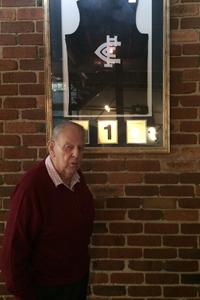
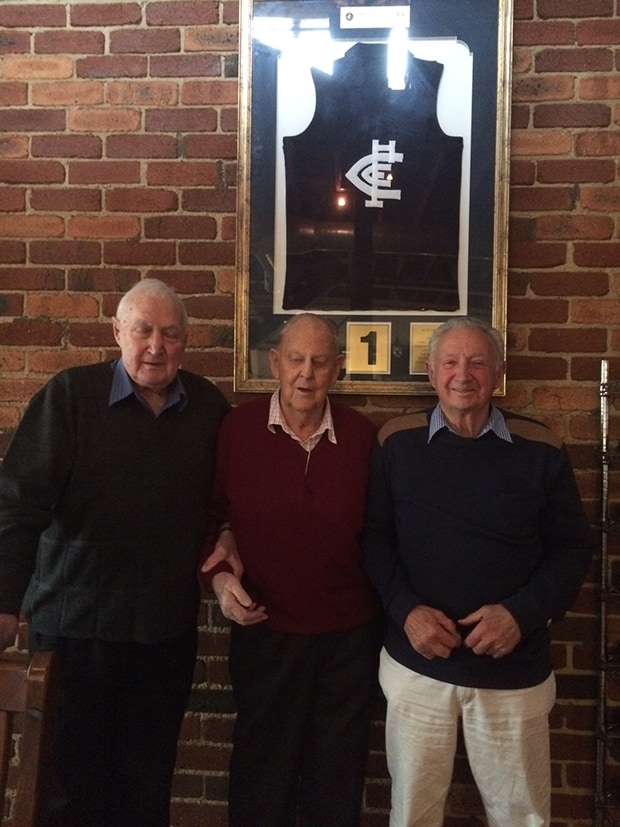
From left to right: Vin Catoggio sen., Vin Catoggio and Dom Catoggio.

From left to right: Vin Catoggio sen., Vin Catoggio and Dom Catoggio.

The Afro, the pirouette, the sidestep – it was all part of the Vin Catoggio persona when the great man was strutting his stuff through winter Saturdays at Princes Park.

And yet, who would know that one of the most endearing of all Carlton footballers followed in the footsteps of another Vin Catoggio – “Uncle Vin” to the 71-game cult hero?

The existence of Vin Catoggio I came to light recently when Jamie Sanderson of www.blueseum.org forwarded an image (below) to the club of the Carlton District Grand Final team of 1958. Featured amongst the Rovers’ ranks, sporting the famed CFC guernsey, is Vin Catoggio esq., who we’ll refer to as Vin Catoggio sen. for the purposes of this article.


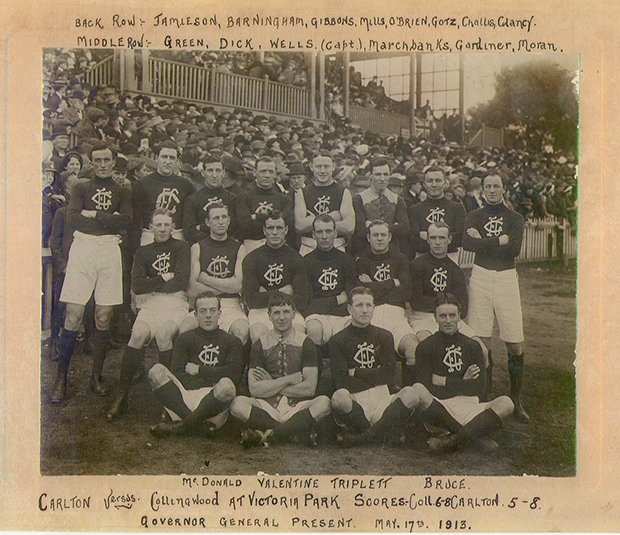
Carlton District, 1958 premiers. Vin Catoggio sen. is pictured on the far left in the middle row.

Vin Catoggio jun., when contacted for comment this week, confirmed that the Vin in question was one of three Catoggio brothers, and a lifelong Carlton Member and supporter to boot.

“Vin was a brother to my father Leo who died last year and to Uncle Joe who died 12 years ago, so he’s the last of that line,” Catoggio jun. said.

“With respect I still call him Uncle Vin. Him and his dear wife Betty, together with my cousin Dom and his wife Evon, always ring mum up and take her out to lunch, and she’s 90 now.

“Uncle Vin ended up playing for Preston in a Premiership in the VFA in the early 1960s. He was a left footer, a very good kick, and he played off a half back flank, but you know what? I’ve never asked him if he could twist or turn and I don’t know if he wore No.4.”

Catoggio jun. also revealed that another uncle on his mother’s side – Dom Catoggio, now nearing 80 – was a contemporary of Sergio Silvagni’s in the Carlton thirds of 1955/56.

“Uncle Dom was a Catoggio also, even though he was on the other side of the family. His father and my mother’s father were first cousins. Dom was a good player too, he played a few reserves games for Carlton in ’57, but he did his knee later on at Yarragon, and that was the end of him.”

The Catoggio name is still inextricably linked with both the football club and the Carlton area, remembering that Vin’s mother lives within the shadows of the old Princes Park ground on Garton Street – not far from where Vin, at 124 Garton, was once domiciled.

Uncle Dom, meanwhile, lived on Rathdowne Street, across the road from the old taxi depot.

When this reporter made a follow-up call to Catoggio sen. recently, the voice on the other end replied: “Have you got the right Vin?”.

Once that was settled, Catoggio sen. conceded that his name had posed an issue or two over the journey – particularly when Vin jun. was up and running in the ’70s. As he said: “Supporters used to ring me thinking I was the bloke running around for Carlton in the No.4, but I played for Carlton Rovers and I wore the No.20”.

“In saying that, I just dragged out an old record from when I was playing for Carlton fourths, and would you I’m listed in the team sheet as No.4.”

Catoggio sen., now 77, explained that after completing his national service at Puckapunyal in April 1957 he pursued his own football career at senior level.

“I thought about going over the road to try out at Carlton, but I thought the list was already set, so I followed a mate of mine, Bernie Quix, to Carlton Rovers,” he said. “Not walking across the ground to ask the question is the one regret I have, because who knows?”

Catoggio sen. was no slouch either, as Carlton Rovers was part of what was then a vibrant Sunday competition, which drew big numbers and attracted League types like North’s Jock Spencer and Jack Edwards, Richmond’s Don “Mopsy” Fraser and Essendon’s Norm McDonald – the latter whom Catoggio sen. once stood.

“Carlton Rovers used to play on the No.1 Oval where the Carlton Cricket Club is based now. We shared the ground with Carlton Stars,” Catoggio sen. said.

“In 1958 we played Kensington in the Grand Final. Jock Spencer was playing for Kensington, while Jack Streader – a Fitzroy ruckman and pretty good player – played for us. I think we got up by five points and I had a good game.”

Catoggio sen. remained with Rovers until the end of the ’61 season, before joining VFA outfit Sandringham in ’62.

That proved a logistical nightmare.

“I had to drive from North Carlton to training and by the time I got to training they were walking off,” Catoggio sen. said.

“I only played reserves there and in ’62 I went to Preston (now Northern Blues). Having played most of the season for Preston reserves I was called up for the finals and was part of the winning Grand Final team of ’63. We beat Waverley and the game was played at Toorak Park.”

He then turned out for a few more Preston senior games in ’64, took line honours in the club’s reserve grade best and fairest count , then got his marching orders in ’65. He turned out for one more season with Diamond Valley Football League outfit Reservoir Lakeside, then gave the game away.

Then, when Catoggio jun. burst onto the scene, Uncle Vin was back with a vengeance.

“Watching Vin play was really enjoyable. I used to go to every match at Princes Park with cousin Dom, and the two families never missed.”


Former Carlton cult hero Vin Catoggio pictured in 1979. 

Though the days of Carlton Rovers are long gone, the spiritual home, to this day, remains fundamental to the Catoggio raison d’etre.

“Even now I walk Princes Park every Sunday,” said Catoggio jun., “and when I get to the ground I go into a daze.

“That’s when I think about getting a footy and balking the elms like I used to in the old days.

Angelo Azzopardi – Carlton’s knight of Malta

Former Carlton footballer Angelo Azzopardi, the son of Australia's first Maltese free settler. (Photo: Blueseum)

Former Carlton footballer Angelo Azzopardi, the son of Australia’s first Maltese free settler. (Photo: Blueseum)

If multiculturalism means “the existence, acceptance, or promotion of multiple cultural traditions within a single jurisdiction” then Carlton can surely claim football’s multicultural dominion.

Amongst the club’s historic ranks is a solid collective born beyond Australian shores – from the Indian-born Fred Pringle through to the London-born Wayne Blackwell.

Then there are those boasting generational links with the old world – from Wally Koochew, whose father was Chinese and mother of Nordic extraction, through to Anthony Koutoufides, the son of a Greek Egyptian-born father and Italian-born mother.

Another such Carltonite was truly of another time. His name was Angelo Azzopardi, whom history records was the son of Australia’s first Maltese free settler.

The much-resourced Carlton historic website www.blueseum.org, through its dedicated researcher Pete McLean, unearthed precious details of Australia’s first Azzopardi family.

Angelo’s father, the seaman Antonio Azzopardi, was born in Zejtun, a city in the south eastern region of Malta, in 1805. An image of him is included in the photographic montage published by Thomas Foster Chuck in 1872 entitled “The Explorers and Early Colonists of Victoria and he is listed as number 84, “A. Azzopardi”.


Antonio Azzopardi, Australia’s first Maltese free settler. 

Antonio deisembarked the barque Mary Hay in Melbourne in 1839 – just four years after the city’s founding by John Batman. Antonio initially toiled as a mail contractor before turning his hand to the publishing game as a canvasser with Melbourne’s The Herald newspaper. In time he acquired RM Abbott’s printing works and duly pursued a career in the printing profession.

Antonio’s son Angelo (later to represent the Carlton Football Club in its pre-VFA years), was born in this city on August 8, 1846 – one of four children (three brothers and a sister) raised by Antonio and his Scottish-born wife Margaret Hannah Sandeman, who had exchanged marital vows at the Congregational Church the previous October.

At one point, Angelo and his siblings followed their mother back to their homeland, and legend has it that on his return aboard the SS Great Britain, Angelo spoke with a Sean Connery-esque brogue.

Back in Melbourne, and according to The Dictionary of Australian Artists Online (DAAO), Angelo Azzopardi followed his father into the printing profession, and pursued a career as artist-engraver and publisher.


An early Azzopardi football engraving.

At some point in the 1870s, Angelo established an independent printing business headquartered in the Herald Passage – an old cobblestone lane tucked behind the city’s GPO Building. For a time he workd in partnership with Oliver Levey, a subsequent owner of The Herald, and later Hildreth & Co. Angelo’s presence obviously impacted on local planners, as a 1937 edition of Morgan’s Melbourne street directory lists the passageway as “Angelo Lane”.

That lane was later incorporated into the Myer complex.

Angelo alsogained local fame as a watercolour painter who exhibited his works at the 1866 Melbourne Intercolonial Exhibition. He also pursued an interest as an engraver and silversmith by way of the Eureka Electrotype and Stereotype foundry out of 17-19 La Trobe Street, between Exhibition and Springs Streets at the top end of town.

According to newspaper records, Angelo turned out for Carlton through two stints – 1868-1870 and 1875. He was named for the club in five matches in his maiden season, which took on rivals such as Geelong, South Yarra and Emerald Hill, but it remains unclear as to how many matches he actually participated in.

The 19th century publication, “The Footballer”, carries on one of its front cover a sketch of what appears to be a Geelong footballer in full flight as he carries the ball. Beneath the figure’s left  heel in small print, appears the name Azzoppardi. Could this be the footballer or the artist?

Angelo James Azzopardi was 49 when he died in neighbouring Brunswick on January 18, 1896 – a year before Carlton became a foundation member of the fledgling VFL.

A death notice acknowledged that Angelo died suddenly at his home, 74 Cassels Road, just off Moreland Road, and was survived by his dear wife Annie, who co-incidentally was also a Scot.

One hundred and twenty years after Angelo’s untimely passing, the Azzopardi name remains inextricably linked to this football club’s stirring multicultural story.

Vale Allan Greenshields

The late Allan Greenshields (left) with Ken Hands, the only surviving member of Carlton's 1947 premiership team. (Photo: Carlton Football Club)

The late Allan Greenshields (left) with Ken Hands, the only surviving member of Carlton’s 1947 premiership team. (Photo: Carlton Football Club)

Former Carlton footballer Allan Greenshields, the 20th man who never got a run in the 1947 grand final, has died at the age of 90.

With Greenshields’ passing, Ken Hands becomes this club’s only surviving member of the ’47 premiership team – and Hands is also the last man standing from the ’45 “Bloodbath”.

Though Greenshields managed just 16 senior appearances for the Old Dark Navy Blues, not a day went past that he didn’t think about what might have been on that last Saturday in September ’47.

As 20th man on that fateful afternoon against Essendon, he took his place on the timber alongside Ken Baxter, the only player of that era to represent Carlton in the two premierships that bookended the Second World War – 1938 and ’45 – as well as ’47.

These of course were the days prior to interchange and, as fate would have it, Greenshields never got the call-up. When Freddy Stafford sunk Essendon with that match-winning snap in the dying moments of the ’47 Grand Final, Greenshields was still watching on in his dressing gown.

“Have I thought that it might have been me in that position?,” said Greenshields in a recent interview? “Oh absolutely . . . absolutely . . . it would have been nice”.

“I didn’t get a run and that was tough because we were struggling all day long. We were behind Essendon all day and Essendon should have won it because of all those behinds. We’d kicked something like eight straight to half-time and they’d kicked 8.11.

“We finished up winning it by one point (13.8 (86) -11.19 (85)) as you know . . . and on the fence, where the coach (Percy Bentley) sat with the selection committee, they were imploring Perc to put me on because we weren’t getting the result we were looking for – and Freddy Stafford hadn’t had a touch for the whole game.”


Carlton’s 1947 premiership team on grand final day. Allan Greenshields is pictured on the far right.

Greenshields remembered that as the match wore on, members of the Carlton’s brains trust gained voice as they called on Bentley to make a change.

“They (the selectors’) were saying ‘Put Allan up for Fred, but he (Bentley) wouldn’t do it. He said, ‘No, we’ll just wait a bit longer’,” Greenshields said.

“Well as it happened, the ball came out from a throw-in by the boundary, landed in Fred’s arms and being a right footer he turned around and goaled with a left foot snap of all things . . . 25 yards out from goal, right through the centre.

“So he (Bentley) was vindicated and I was left lamenting,” (laughs).

Born in the southern Mallee town of Rainbow in 1926, Greenshields relocated to Melbourne through his employment with the bank in 1942 and turned out in games for Pascoe Vale the following year – losing out to the competition’s best and fairest Des Rowe by a single vote.

On the recommendation of the renowned Carlton recruiter Newton Chandler, Greenshields put pen to paper to play for the club – and the rest, as they say, is football history.

Greenshields’ last hurrah in Dark Navy came against Melbourne at Princes Park in the sixth round of 1949, and he went out on a high when he slotted both of his Carlton career goals in a 39-point victory over the Redlegs.

Later that same year, he turned out for St Kilda, for the first of 57 appearances over six seasons at the Junction Oval.

But Greenshields heart forever beat Blue, and he supported Carlton until the end.

Allan Greenshields’ wife of 22 years Millicent died in 1977. He is survived by his sons Mark and John, daughters Sue and Jackie, and grandchildren Tom, Kate and Jack.

The Carlton footballers will wear black armbands as a mark of respect to the late Allan Greenshields in Saturday night’s match with Collingwood at the MCG.

Bill Armstrong’s 80th

Happy 80th birthday to Bill Armstrong.


—————-


Career: 195859
Debut: Round 18, 1958 v South Melbourne, aged 22 years, 56 days
Carlton Player No. 722
Games: 2
Goals: 0
Last game: Round 2, 1959 v Footscray, aged 22 years, 308 days
Guernsey No. 27
Height: 177cm
Weight: 77kg
DOB: 28th June, 1936

Bill Armstrong was recruited from Chelsea, and played 2 games for Carlton in 2 different seasons. He shared his debut in Round 18 of 1958 with John Stephenson, before playing an additional game in 1959.

In 2003 Bill was awarded the Order of Australia “For service to the international community and the provision of overseas aid and development through Australian Volunteers International, and to fostering greater understanding of different cultures and raising awareness of social justice and human rights issues.”1

Picture
Bill Armstrong AO, inaugural chairman of the CHART Board of Management

Career Highlights

1958 – Reserves Best and Fairest Award.

Tony Bourke’s 40th

Happy 40th birthday to Tony Bourke.


————

From the Blueseum.


Career: 1998-1999 (On list: 1995 -1999)
Debut: Round 13, 1998 vs Fremantle, aged 22 years, 8 days
1027th Carlton Player
Games: 4
Goals: Nil
Last Game: Round 5, 1999 vs Geelong, aged 22 years, 315 days
Guernsey No. 40 (1995 – 1999).
Height: 201 cm
Weight: 91 kg
DOB: 13 June, 1976

The word ‘Beanpole’ is often used in sport as it in in life, and let me tell you, Tony Bourke is the Carlton definition. Bourke was a 201cm ruckman who weighed just 91 kilos.

Bourke played 4 games for Carlton but was on the list for 5 years. He was drafted in the 1994 Draft at pick 67 but did not play his first senior game until Round 13, 1998– his only one for the year – failing to gather a possession and just a solitary hit out. He managed to play 3 games in 1999, from rounds 3-5, managing no more than 6 possessions and 15 hit outs in one of those games but otherwise failing to have much of an impact- only having the 2 kicks in his 4 game career. The presence of Madden and Allen and later Porter meant limited opportunity for Bourke in the seniors.

Furthermore, injuries significantly damaged his career, rupturing his spleen in a 1997 pre-season game, which forced him to miss the entire season. He missed a number of games in 1999 with a foot injury. His height and relative mobility ensured that Bourke was retained by Carlton for a long time, though the club finally ran out of patience in 1999, after drafting a number of other potential young ruck men.

The most well known event in Bourke’s playing career was in the VFL when he was involved in an incident with Cat Billy Brownless, who was alleged to have kicked Bourke in what is a serious charge in AFL footy.

Bourke was recruited from Ballarat Rebels U/18’s, his junior club was East Ballarat.

Dean Strauch’s 50th

Happy 50th birthday to Dean Strauch.


—————-

From the Blueseum.


Career : 19861989
Debut : Round 17, 1986 vs Essendon, aged 20 years, 46 days
Carlton Player No. 939
Games : 5
Goals : 0
Last Game : Round 22, 1989 vs Brisbane, aged 23 years, 91 days
Guernsey Nos. 51 (1986) and 14 (1987-89)
Height : 179 cm (5 ft. 10 in.)
Weight : 77 kg (12 stone, 2 lbs.)
DOB: 4 June, 1966

Another product of the Bendigo Football League (Carlton’s prolific recruiting zone throughout the nineteen-seventies and eighties) Dean Strauch came to the Blues from Golden Square in 1986. His father, Neville, was the Carlton zone coordinator for Bendigo at the time. Although he carried the same relatively rare surname, Dean was not related to Denis Strauch, who had played for the Baggers some thirty years prior.

A versatile midfielder or forward, Dean soon turned heads with a string of impressive games with Carlton’s Reserves side, and was selected for his senior debut on a big stage against Essendon on a Sunday afternoon at the MCG in round 17, 1986. In guernsey number 51, Strauch took up a place on a half-forward flank, alongside his captain, Mark Maclure, and the legendary Wayne “Dominator” Johnston. The Blues fielded a strong side on paper, but proved no match for a more cohesive Bomber combination that took control after half-time, and beat the Blues convincingly.

The following week, Strauch was relegated to the interchange bench for Carlton’s clash with Sydney at Princes Park, where he celebrated his one and only victory at senior level. He then played out the rest of the year with the seconds – although a leg injury ruled him out of the Blues’ triumphant Reserves Grand Final team. Even so, his first year in the VFL ended on a positive note when he was a clear winner of Carlton Reserves’ Best and Fairest award.

In 1987, Strauch switched to guernsey number 14, and strong pre-season form saw him included in the Carlton side that took on the ’86 Premiers; Hawthorn, at Glenferrie Oval in a Grand Final rematch in round 1. Dean shared the roving duties with Bernie Evans that afternoon, only to be overwhelmed by the Hawks’ tenacity and team-work to the tune of 45 points. That heavy loss apparently led to questions about Strauch’s commitment to elite level football, so shortly afterwards he was sent back home to Bendigo to play out the year and decide where his football future lay.

Back at Princes Park in 1989, Strauch was selected for the first game of the season – a narrow loss to St Kilda at Moorabbin – and the last; a six-goal thrashing by Brisbane at Carrara Stadium in round 22. In between, he remained a standout at Reserves level and regularly appeared in the newspaper best player columns. Unfortunately for Dean, that wasn’t enough to secure his future. He was delisted by the Blues at the end of that year, and returned to Golden Square.

In 1990, Strauch won the Nalder Medal as Best on Ground in the Ballarat Football League Grand Final. Although Golden Square was well-beaten by South Bendigo, Strauch kept the Bulldogs in contention for most of the game and kicked three goals in an inspirational solo effort.

Largely because of that brilliant performance, Strauch was given another chance in the VFL when he was picked up by Collingwood in the 1991 mid-season draft at pick 17. Dean’s former Carlton team-mate Fraser Murphy was also selected by the Magpies in that same draft. Happily, both Blues avoided sullying their reputation by playing again at senior level for the Purloiners.

Career Highlights

1986 – 7th Reserves Best & Fairest
1986 – Reserves Best First Year Player Award

Syd Jackson – In his own words

Originally published in the Herald Sun on May 26, 2016

by Syd Jackson


FOOTBALL has given me opportunities most only dream of. Do you know the biggest crowd to ever watch a game? I do.

At the 1970 Grand Final between Collingwood and Carlton 121,696 people crammed into the MCG.

I know because I not only saw it, I played in it – one of the greatest finals ever.
Collingwood gave us a first half footy lesson. Everyone thought it was all over when they led by 44 at half time.

I can’t remember what Ron Barassi said in the break but it can’t have been pleasant.

It worked though because we knocked their lead back to 17 in the third and went on to win by 10 – the greatest comeback in Carlton’s long history. Sometimes I think I can still hear that crowd.

You don’t get many experiences like that in life and I’ve shared in the recognition that team earned ever since, which is a good feeling.

But here’s the thing. I’m not really Syd Jackson at all.

I mean, I am, in a sense, but that’s not what my mother called me.

I have no idea what she did name me, but it would have been in the language of our people from the desert country out around Leonora in WA.

White people there called me Sydney, after the actor, Sid James, apparently.

When I was only tiny they came and took me and my sisters to a place called Moore River Native Settlement. Someone there gave me the surname Jackson.

Later we were sent off to different missions. So I lost my mother, my sisters, my language and my real name. I couldn’t tell you what my birthday is.

Officially it’s 1 July, the new financial year. Plenty of us kids that were taken have that ‘birthday’, but it’s made up.

So the truth is I was brought up in a country that was very, very bad at recognising Indigenous Australians.

Along with many others, I never got the most basic piece of recognition, the piece of paper that says you were born, that you’re Australian.

Years later I was picked in a side to play overseas but almost couldn’t go when I said I had no passport.

Trying to organise one I was asked for my birth certificate.

“What certificate?’’ I said.

In the end the VFL had to appeal all the way to the Prime Minister. PM John Gorton directed that a passport be issued. Recognition at last.

I was grateful for that, but my mob have been in this country since long before recorded human history. You shouldn’t need two premierships to be recognised as an Australian.

The AFL is supporting RECOGNISE this weekend.

It’s the campaign to change Australia’s Constitution to recognise Indigenous Australians and their connection to this land for thousands of years.

You’ll see the ‘R’ logo everywhere – show your support at recognise.org.au.

I congratulate the AFL for this. It shows how much times have changed since I was a boy.

That’s a good feeling too.

 Highlights

 2015 WA Hall of Fame Video


Of the Kimberleys and Carlton – Rod Waddell tells

A recent photo of former Blue Rod Waddell.

A recent photo of former Blue Rod Waddell.

Of the thousands who claim it as an “I was there the day moment”, none was more impeccably placed to view Peter Bosustow’s Mark of the Year than the bloke in the No.10 dark Navy Blue guernsey.

Rodney Steven Waddell was front-on to the pack when “The Buzz” completed that famous leap in the shadows of the since-demolished Robert Heatley Stand at Princes Park.

“I was under the pack waiting for the crumbs, when all of a sudden Bosustow came out of nowhere and took this big mark,” Waddell said this week.

“I was right in front of it, No.10, and that was a huge grab. It was inspiring and really lifted the team to another level.”

Waddell emerged from the dugout that day, for what was the first of five senior appearances for the Carlton Football Club through the Premiership seasons of 1981 and ’82.

This was a landmark moment in Carlton history – Round 18, 1981 versus Geelong, in what doubled as Bruce Doull’s 250th senior appearance for the club. In the lead-up to the match, injury and illness had robbed coach David Parkin of household names Barry Armstrong, Rod Austin, Jim Buckley, Wayne Harmes, Warren Jones, Robbert Klomp, Alex Marcou and Val Perovic – and yet the replacements still found a way in crafting a meritorious 33-point victory over the visitors.

“We were pretty much depleted but we actually beat them and David Parkin rated it as one of the greatest victories,” Waddell recalled. “I remember he had a plaque made up of that team and it’s probably still up at the club today.”

Magnificently, Waddell’s clearance to Carlton came at a cost of four Premiership points to Collingwood’s reserve grade team, as Waddell had turned out for the Magpies illegally.

At the time he was chasing leather for the then Diamond Valley League club Lalor, then coached by the former Collingwood half-forward Barry Rist. Rist was hell-bent on getting Waddell to Victoria Park on the strength of Waddell’s best afield showing against Reservoir-Lakeside in the 1980 DVFL Grand Final

“Naturally he (Rist) was a mad Collingwood supporter and wanted me to end up there, so he took me over to his place in Diamond Creek which was in Collingwood’s zone. But I lived in Lalor which was Carlton’s zone.”

Not surprisingly, Collingwood and Carlton soon waged war over Waddell, and a subsequent VFL investigation ensued. Ultimately the League ruled that the player was indeed zoned to Carlton, and the black and whites were duly fined $500 and stripped of the four competition points they had earned with Waddell in their team.

This week, with Carlton and Geelong meeting in the AFL’s Indigenous round, Waddell, whose League career ended after a further 20 senior appearances for the Cats, will watch on with much interest. Co-incidentally, Rod’s sister is the mother of Steven Motlop, who’ll be going around in the hoops at Etihad Stadium on Sunday.

It’s more than 30 years since Waddell, now nearing 60, last played League football, and interviews have been truly scarce – perhaps the legacy of his disinterest in the world of social networking, mobile phones and the internet.

But Carlton’s No.10 is going well and was only too happy to reflect on his amazing life and times, after being located in his home, just a few kilometres south-west of the Bendigo CBD.


Rod Waddell (No.10) gets the perfect view of Peter Bosustow’s 1981 Mark of the Year. (Photo: AFL Media)

This is Rod Waddell’s story: 

“I was born in the Kimberleys in Western Australia. My mother, Mavis Lacey, was Indigenous and my father, Steve Waddell, was white. He was born in Heidelberg in 1931 and lived on the family’s dairy farm. I remember he used to tell this story to my Aunty Maureen that he jumped on a horse in Heidelberg and said ‘Tell Dad I won’t be home’ – and that was the last my grandfather ever saw of him.

I grew up in a place between Derby and Kununurra, on the Mount Elizabeth cattle station run by my father’s people. My father was a bullcatcher and he used to drag guys around the bush with him chasing wild bulls. I was only eight and he had me tying up these wild bulls by the legs. It was so isolated up there that some of the wild cattle lived and died without seeing a man.

In terms of my family story I can go back as far as when I was a kid on the cattle station. I remember going out hunting natural game with the Aboriginals on the station. We used to hunt flying foxes and goannas. We’d use boomerangs to catch the flying foxes, then skin them. We’d then dig a hole, fill the hole with rocks and heat the rocks. We’d put the foxes on the rocks and cover them with paperbark. We’d leave them to cook for an hour and a half, and they were quite nice to eat.

With the goannas you’d get them in holes or up trees. You’d hunt them with a stick or a boomerang, skin them and cook them under the ground or on hot coals. If you didn’t know any better you’d think you were eating chicken breast.

We also used to find honey from a native bee which they call “sugar pot”. The bee was like a little bushfly which produced wonderful native honey . The honey was protected by a dark casing in the side of a tree, you could cut the casing out to find the honey, and a lot of honey there was too. You could basically stick your hand in to retrieve the honey because the bush bee didn’t sting.

In the end, Mum resolved to send my younger brother and I down to Melbourne for schooling. I moved to Lalor with Raymond and I was probably seven or eight at the time. I lived with one aunty and he lived with another, and my sister Stephanie returned to Darwin to live with my mother.

That was hard for me because when I was up there I didn’t want to come down to Melbourne and when I got to Melbourne I didn’t want to go back. No sooner had I settled in one place than bang – I was suddenly back in another.

I never played footy in Darwin, but I did at Lalor Primary School where Alex Marcou and David Glascott went. I started playing playground footy there, I caught on to the game, I really enjoyed it and the rest as they say is history.

When I came to Carlton the famous ‘Mosquito Fleet’ was up and running and it was difficult to break in. In saying that, I didn’t want to leave Carlton, but in those days the contract they had put to me wasn’t going to kick in until the end of the ’82 year. If that was the case I could be approached by other clubs – and that’s what happened with Geelong, even though David Parkin didn’t want me to go.

Funny thing, I sat in the stands watching the 1981 and ’82 Grand Finals. I was actually close to making the 1981 Grand Final. I trained right through the ’81 finals series at a time when Rod Ashman was battling a niggling injury and it looked like I might have got a run in his place. But we knocked Geelong off in the semi and got the week’s break, which gave Rod the chance to get himself right . . . and he won everything but the Brownlow Medal that year.

If there was 22 a team back then like today I would have been there. But the main thing is that the team won.

I had no problem at all with Carlton. It was a great club, I didn’t really want to leave, I had a lot of mates down there and it was just that I got a better offer and my girlfriend at the time encouraged me to take it.


Rod Waddell during his days with the Blues. (Photo: Carlton Media)

After finishing at Geelong I went back to Lalor to play a few games then joined Jerilderie in the Murray League. We were up against teams like Finley, Deniliquin and Cobram, and won a few Grand Finals. I played with Russell Jeffrey and Mark and Paul Motlop who played all over Australia. Russell Jeffrey, who played at St Kilda, was a good mate of mine and he helped me out when I was coaching there for a time.

I also used to play footy up in Darwin, for Nightcliff, which meant that in those days I was playing 12 months of the year.

After I finished my playing days with Jerilderie believe it or not I started shearing. I knew nothing about shearing, but I got into the industry and started to travel. It was around 1989 and work took me to south-west Queensland, which is when I gave football away. A friend of mine, Bill Stapleton, who was the runner at Carlton through the 1980s, then bought an abattoir in Ararat. He phoned me to say “Can you come down to help me for 12 months?”, which I did . . . and 12 months turned into 15 years.

When I came back to Ararat I came out of football retirement after 12 years of not playing football and ended up playing for the Marong Football Club just outside of Bendigo, after meeting up with a bloke named Teddy Rogers. I’m now living outside of Bendigo and I’m back involved in the shearing run. I have a mate in the industry and I help him out a bit but it’s more casual thesedays. When you’re young you think you’re bulletproof, but it catches up with you.

I never had any kids of my own, but I was with a lady for 16 years and she had three kids which I helped bring up. The eldest one at the time was six and they’re all in their 20s now, and they’re really good kids.

These days I’m still a Carlton and a Geelong man. I’ve got a soft spot for both of them and my nephew plays at Geelong of course.

I still love Carlton and I still catch up with old teammates. At a 70th birthday for one of the old Blue Diamonds Dicky Merton I caught up with Wayne Harmes and Des English.

The Indigenous round was unheard of when I was a playing, but it’s a good thing I reckon. When I was playing I got a fair bit of racial abuse, more from the crowd than the players, but I actually took it the other way and used it to my advantage. My view was ‘If they’re calling me this I must be doing something right’ and you lifted to another level.

These days I’m happy where I am living and I’m in no hurry of moving, but who’s to know?

Healthwise I’m not too bad. Other than a groin problem and a bruised achilles I never got a lot of injuries out of the game. That’s about all I got out of football, so I was quite lucky.”

The Carlton team v Geelong, R.18, 1981 at Princes Park:

(Rod Waddell’s senior debut)

B: Des English, Mark Maclure, Peter McConville

HB: Ken Hunter, Bruce Doull, Rohan Burke

C: Phil Maylin, Ken Sheldon, David Glascott

HF: Rod Waddell, Scott Howell, Wayne Johnston

F: David McKay, Peter Bosustow, Denis Lenaghan

R: Mike Fitzpatrick, Greg Wells, Rod Ashman

I/C: Brendan Hartney, Mario Bortolotto

Coach: David Parkin

More By Tony De Bolfo, Carlton Media

Bob Crowe’s 80th

Happy 80th birthday to Bob Crowe.


————

From the Blueseum.


Career : 19541964
Debut : Round 17, 1954 vs Fitzroy, aged 18 years, 86 days
Carlton Player No. 683
Games : 129
Goals : 62
Last Game : Round 18, 1964 vs Fitzroy, aged 28 years, 87 days
Guernsey Nos. 27 (1954) 34 (1955 -’56) and 14 (1957 –’64)
Height : 185 cm (6 ft. 1 in.)
Weight : 72.5 kg (11 stone, 6 lbs.)
DOB : May 27, 1936

Recruited from bayside Mentone, Robert Bromley “Bob” Crowe was a wiry, versatile all-rounder who goaled with his first kick in senior football, and later, played in the Blues’ 1962 Grand Final loss to Essendon. He wore three different guernsey numbers in his career, and played his first, his last, and his 100th game against Fitzroy, in a career that spanned almost exactly ten years.

Bob wore guernsey number 27 in his senior debut as Carlton’s 20th man against the Roys at Princes Park in round 17, 1954. The Blues’ star full-forward “Nobby” O’Brien kicked ten goals in a big win that afternoon, but Bob also etched his name into the history books too, when he came on late and snapped a major at his very first opportunity. However, despite that illustrious start, he found it difficult to hold his place thereafter, and made just 20 appearances in his first three seasons. He changed to guernsey number 34 for 1955-56, but it was only when he switched to guernsey number 14 in 1957 – and embraced Blues’ captain Ken Hands’ advice to back his ability and play as an attacking half-back flanker – that he became a regular member of the team.

In 1959, Bob was involved in an unusual incident prior to another match against Fitzroy – this time at the Brunswick St. Oval in round 10. He was on his way down the player’s race to the field that day, when he slipped and fell, injuring his right knee. When the field umpire was informed, he made the correct decision to allow the Blues to substitute another player – because Crowe’s injury had happened before the game had officially started (refer to extract below).

Carlton made the finals on just three occasions in Bob’s career – in 1957, 1959 and 1962 – the latter being his best and most consistent season. In July 1962 he was selected in the Victorian representative squad that played South Australia, before celebrating his 100th game in Carlton’s controversial Semi Final victory over Melbourne. September saw the Blues progress to their first Grand Final for thirteen years – with Crowe in his regular half-back position alongside Wes Lofts and Graeme Anderson – but Essendon proved too good and won by 32 points.

Bob went on to play another two seasons after that, and finished on a high when Carlton again demolished Fitzroy in the last round of 1964. By then still only 28, he still had plenty of good football left in him when he retired from VFL football to join VFA Club Dandenong.

Race Crash Ruling
Carlton began the day virtually one man short when Bob Crowe stumbled while running down the race and injured his knee before reaching the playing field. He did not recover, limping with obvious pain whenever the ball came his way during the game, and failing to keep up with play. Carlton appealed to the umpire, and were allowed to substitute one of their reserves halfway through the first term, although technically Crowe’s mishap had taken place off the field. – 100 Years of Australian Rules Football.

Milestones

100 Games : Semi Final, 1962 vs Melbourne

Career Highlight

1962 – Victorian Representative

How Egan Lead the Way

By Tony De Bolfo


In the lead-up to Sunday’s match at Etihad Stadium, thoughts turn to the little known life of a man who in so many ways blazed a trail for both the Carlton and North Melbourne Football Clubs more than 80 years ago.

Before Syd Jackson and Cyril Mann, before Barry Cable and the brothers Krakouer, came Alf Egan – Alfred George Egan – the first known Indigenous footballer to have represented both clubs at senior League level.

Born on April 3, 1910, Egan hailed from the tiny town of Myamyn in Victoria’s south west. Little is known of his early childhood, although the following article (entitled LAKE CONDA ABORIGINES – only three Pioneers remain), which appeared in the local Portland Guardian of February 8, 1943, offers a little insight into Alf and his bloodline.

The article, which laments the dilapidated state of the local Aboriginal station, acknowledges the enduring presence of the Indigenous elders James Lovett, Mrs HC Connolly (a daughter of the king of the district’s tribe “King Billy”) and Alf McDonald – the latter one of Alf Egan’s forefathers.

The article reads in part;

Mrs Lovett has (illegible) grandchildren and 20 great grandchildren. She was born at Condah about 85 years ago and (illegible) under an operation when she was over 80 years of age, this being the first time she was attended by a doctor. She was walking around the sports ground quite smart for her age. She has three great-grandsons in the AIF.

Her brother, Alf McDonald, is 83 years of age . . . He was well-known for his ability in breaking in horses and also stock riding. He was a boundary rider for Mr. Cope , and also for Mr. Fred Co..Drayton for a number of years and also for Mr. T. H. Laidlaw and Selwyn Stewart. He was (illegible) Ettrick and reared a family of seven, and has quite a number of grandchildren. One known as Alf Egan played football with well-known Wanderers team, later with Carlton and North Melbourne.

Listed as Carlton’s 478th senior player since 1897, Egan completed his senior debut at Princes Park against Essendon in the third round of 1931. Named on a half-forward flank alongside another first-gamer Bernie O’Brien, Egan would boot a goal in the first of his 36 games for the Blues through the course of three seasons as a ruckman/forward.

Egan was part of Carlton’s Senior XVIII which took to the field against Richmond in the play-off for the 1932 premiership pennant. He was named at centre half-forward after Jack Green was ruled out with an injury sustained against Collingwood in the previous week’s preliminary final, on a day in which Harry “Soapy” Vallence booted a lazy 11.

Regrettably, the Tigers took out the match with two time-on goals in the final quarter, but Egan earned plaudits for a stoic showing on the game’s biggest stage.

For whatever reason, Alf’s tenure at Princes Park ended with Carlton’s loss to Geelong in the first semi-final of 1933. At just 23, he saw fit to follow his football dream at North Melbourne, but by the end of ’35 and after just 15 senior appearances his League career was at an end.

Little is known of Egan’s life away from the game. It is known that in the mid-1950s he married May Cabner in Richmond and that she bore him a son, John.

Sadly, heart disease would claim Egan’s life at just 51. According to the death certificate, his occupation was listed as ‘labourer’ and he was of no fixed address, so presumably he was estranged from his family.

Egan was cremated by order of the Coroner without an inquest. His cremated remains were placed in Church of England, Compartment C, Section 14, Grave 40 at Springvale Botanical Cemetery, the service having been conducted on January 26, 1962.

Since Egan first ran out on that second Saturday in May of ’31, 15 Indigenous footballers have followed at Carlton – in order of senior debut, Cyril Mann, Syd Jackson, Rod Waddell, Mark Naley, Sean Charles, Troy Bond, Justin Murphy, Cory McGrath, Andrew Walker, Eddie Betts, Joe Anderson, Jeff Garlett, Chris Yarran, Liam Jones and Clem Smith.

At North there are 23 – Percy Johnson, Bertie Johnson, Allan Bloomfield, Barry Cable, Craig Holden, Phil Krakouer, Jim Krakouer, Derek Kickett, Andrew Krakouer, Adrian McAdam, Warren Campbell, Byron Pickett, Winston Abraham, Gary Dhurrkay, Shannon Motlop, Daniel Motlop, Eddie Sansbury, Djaran Whyman, Matt Campbell, Cruize Garlett, Daniel Wells, Lindsay Thomas and Jed Anderson.

Alf Egan
April 3, 1910 – January 1962
478th Carlton player
Guernsey no. 27
36 games, 20 goals 1931 – 1933
Senior debut: Round 3, 1931 v Essendon, aged 21 years, 43 days
Last game: Semi Final, 1933 v Geelong, aged 23 years, 159 days

Cyril Mann
April 31, 1918 – March 3, 1964
548th Carlton player
Guernsey no. 25 (1939), 27 (1940-’45) and 34 (1942)
42 games, 65 goals 1939 – 1942
Senior debut: Round 4, 1939 vs Footscray, aged 20 years, 255 days
Last game: Round 3, 1945 vs Essendon, aged 26 years, 247 days

Syd Jackson
July 1, 1944 –
808th Carlton player
Guernsey no.5
136 games, 165 goals 1969 – 1976
Senior debut: Round 1, 1969 vs St Kilda, aged 24 years 278 days
Last game: Preliminary Final, 1976 vs North Melbourne, aged 32 years 79 days
Premiership Player 1970, 1972
Carlton Hall of Fame 2006

Rod Waddell
May 23, 1957 –
898th Carlton player
Guernsey no.10
Five games, two goals 1981 – 1982
Senior debut : Round 18, 1981 vs Geelong, aged 23 years, 70 days
Last game : Round 8, 1982 vs Footscray, aged 24 years, 357 days

Mark Naley
March 11, 1961 –
940th Carlton player
Guernsey no.17
65 games, 74 goals 1987 – 1990
Senior debut: Round 1, 1987 vs Hawthorn, aged 26 years, 16 days
Last game: Round 21, 1990 vs Hawthorn, aged 29 years, 166 days
Premiership player 1987

Troy Bond
July 14, 1973 –
992nd Carlton player
Guernsey no.8
36 games, 26 goals 1994 – 1995
Senior debut: Round 1, 1994 v Adelaide, aged 20 years, 256 days
Last game: Preliminary Final, 1995 v North Melbourne, aged 22 years, 71 days
AFL Rising Star Nominee: Round 18, 1994

Justin Murphy
April 24, 1976 –
1007th Carlton player
Guernsey no.18
115 games, 105 goals 1996 – 2000 & 2001 – 2003
Senior debut: Round 1, 1996 vs Collingwood, aged 19 years, 342 days
Last game: Round 19, 2003 v Port Adelaide, aged 27 years, 108 days

Sean Charles
May 18, 1975 –
1022nd Carlton player
Guernsey no.10
One game, 0 goals 1998
Round 1, 1998 v Adelaide, aged 23 years, 314 days

Andrew Walker
May 18, 1986 –
1079th Carlton player
Guernsey no.1
195 games*, 132 goals* 2004 –
Senior debut: Round 5, 2004 vs West Coast, aged 17 years, 341 days
AFL Rising Star Nominee: Round 5, 2004

Cory McGrath
February 4, 1979 –
Guernsey no.20
50 games, four goals 2004 – 2006
Senior debut: Round 11, 2004 v Adelaide, aged 25 years, 122 days
Last game: Round 22, 2006 vs Sydney, aged 27 years, 211 days

Eddie Betts
November 26, 1986 –
1084th Carlton player
Guernsey no.19
184 games, 290 goals 2005 – 2013
Senior debut: Round 1, 2005 vs North Melbourne, aged 18 years, 120 days
Last Game: Semi Final, 2013 vs Sydney, aged 26 years, 262 days

Joe Anderson
December 24, 1988 –
1101st Carlton player
Guernsey no.26
17 games, 0 goals 2007 – 2010
Senior debut: Round 4, 2007 vs West Coast, aged 18 years, 118 days
Last Game: Round 11, 2010 vs Melbourne, aged 21 years, 162 days

Jeff Garlett
August 3, 1989 –
1116th Carlton player
Guernsey no.38
107 games, 183 goals 2009 – 2014
Senior debut : Round 1, 2009 vs Richmond, aged 19 years, 235 days
AFL Rising Star Nominee: Round 19, 2010

Chris Yarran
December 19, 1990 –
1122nd Carlton player
Guernsey no.13
119 games, 90 goals 2009 – 2015
Senior debut: Round 7, 2009 vs Fremantle, aged 18 years, 142 days
AFL Rising Star Nominee: Round 1, 2010

Liam Jones
February 24, 1991 –
1158th Carlton player
Guernsey no.14
14 games, 13 goals 2015 –
Senior debut: Round 1, 2015 vs Richmond, aged 24 years, 37 days

Clem Smith
February 3, 1996 –
1159th Carlton player
Guernsey no.25
7 games, 0 goals 2015 –
Senior debut: Round 1, 2015 vs Richmond, aged 19 years, 58 days

Adrian Gallagher’s 70th

Happy 70th birthday to Adrian Gallagher.


————–

From the Blueseum


Career : 19641972
Debut : Round 6, 1964 vs St Kilda, aged 18 years, 11 days
Carlton Player No. 762
Games : 220 (165 at Carlton)
Goals : 274 (236 at Carlton)
Last Game : Grand Final, 1972 vs Richmond, aged 26 years, 148 days
Guernsey No. 10
Height : 179 cm (5 ft. 10 in.)
Weight : 72 kg (11 stone, 10 lbs.)
DOB : May 12, 1946
Premiership Player 1968, 1970, 1972
Best and Fairest 1970
Leading Goalkicker 1966
Carlton Hall of Fame (1992)
Team of the Century

Carlton’s history is lavishly embroidered with the deeds of its little blokes; the rovers, the wingmen, the forward and back pocket players who have brought glory to themselves and the Old Dark Navy Blues for more than 150 years. So whenever the question is asked, “who has been the best of all Carlton’s small men?” a lively debate is assured. One thing is certain, however – the name Adrian “Gags” Gallagher would have to feature prominently in any informed discussion. Over eight seasons between 1964 and 1972, Gallagher teamed with champion ruckman John Nicholls and ruck-rover Serge Silvagni to form the greatest of all of Carlton’s first ruck combinations. A club leading goal-kicker and Best and Fairest, Gags was instrumental in bringing three Premiership banners to Princes Park.

Gallagher was recruited by the Blues in 1960 from Yarram in Gippsland. With the assistance of the club, he attended University High School, where he was an exceptional cricketer as well as a star footballer with Carlton’s Under 15, Under 17 and Under 19 teams. In 1963 he underlined his potential when he was voted Best on Ground in Carlton’s Under 19 Premiership triumph, and that same season finished third in the competition’s top individual award, the Morrish Medal.

By then Nicholls and Silvagni had been playing together for three seasons, with an array of different rovers at their feet. But almost as soon as Gallagher pulled on his guernsey number 10 to play his first senior match against St Kilda in 1964, the two big men found their perfect foil in the 179 cm, 73 kg red-headed youngster. Although Gags was not particularly quick across the ground, he was an instinctive reader of the play, a great crumber off the packs and deadly around the goals. His disposal skills by hand or foot were excellent, and he soon developed into a tough, durable competitor.

Adrian’s debut season as a senior player came at a pivotal time for the Blues, coinciding with the election of George Harris as President, quickly followed by the sensational recruitment of Melbourne champion Ron Barassi as captain-coach. Barassi energised the club, and three seasons later Gallagher experienced finals football for the first time before the Blues were eliminated by Geelong in the 1967 Preliminary Final. Gags’ 26 disposals and three goals in that match added to his growing stature, and established his credentials as a big-game player.

By 1968 there was no doubt that Nicholls, Silvagni and Gallagher were the most effective ruck combination in the game. Nicholls’ strength and exquisite palming skills, Silvagni’s tireless work ethic and Gallagher’s elite disposal made them a daunting proposition in every game they played. Most of the time Gags was a dependable rather than prolific goal-kicker, but in round 19, 1968 he had a day out – racking up 33 disposals and seven majors in a big win over Fitzroy at Princes Park. Just a month later, Barassi coached the Blues to a dramatic 3-point victory over Essendon in the Grand Final, with Nicholls, Silvagni and Gallagher all listed among the team’s best half-dozen players in Carlton’s first Premiership for 21 years.

In round 19, 1969, Gags played his 100th game against Richmond at Princes Park on an afternoon when Brent Crosswell kicked 6 goals for the Blues, but the Tigers won easily in a portent of things to come. Although Gallagher was best on ground when Carlton easily accounted for Collingwood in the second Semi Final, neither he nor his team could hold the fast-finishing Tigers in the Grand Final, and the Blues were beaten convincingly in what Gags later said was the low point of his career.

But things turned around quickly, and although he missed the first six matches of 1970 because of injury, Gallagher went from the worst day of his career to revel in his best within 12 months. Playing intense, consistent football, he averaged 23 possessions per game on the way to taking part in – and winning – his third Grand Final in front of almost 122,000 fans when the disciplined Blues scored an almost impossible victory over Collingwood on September 26, 1970 at the MCG. And to make his contribution to that extraordinary win even sweeter, a few days later Gags edged out Alex Jesaulenko to be acclaimed as Carlton’s Best and Fairest.

The Blues suffered a Premiership hangover in 1971 and missed the finals on percentage, although Gallagher enjoyed another excellent season – kicking a second bag of seven goals against South Melbourne in round 17, before finishing runner-up to Geoff Southby as Best and Fairest. Sergio Silvagni retired at the end of that year, leaving Nicholls and Gallagher to collect their third Premiership in six seasons when Carlton endured a gruelling finals campaign and beat hot favourites Richmond for the ’72 flag.

To the chagrin of Carlton’s supporter base, that third Grand Final triumph was to be Gallagher’s last game in navy blue. Shortly afterwards, the VFL instigated a controversial and short-lived regulation that allowed players who had spent a decade or more at one club to become free agents, and sell their services to the highest bidder. North Melbourne was one of the instigators of this rule, and they made a huge offer to Gallagher – only to be trumped at the last minute by Footscray. The Bulldogs’ offer was simply irresistible and Carlton couldn’t match it, so after 165 games and three flags at Carlton, Gags headed for the Western Oval with plenty of good football left in him.

However, there was no Nicholls and no Silvagni at the Western Oval, and although Gags continued to play with his usual whole-hearted endeavour for the tri-colours, his three seasons there were largely unremarkable. At the end of 1975 he announced his retirement, having added another 54 games and 38 goals to his tally, only to make the briefest of comebacks for his former coach Ron Barassi at North Melbourne in 1973. But he was injured in his one and only appearance for the Shinboners, and never played again.

In the years after his playing career ended, Gags maintained his involvement in the game at various levels. When Barassi returned to coach Melbourne in 1981, he took Gallagher with him as one of his assistants. Then in 1992, after Gags was elected to the Carlton Hall of Fame, Blues coach David Parkin invited him back to Princes Park as a member of the match committee. From then on, he was a familiar face in the Carlton coaches box for more than a decade.

In May 2000, the Blues announced their Team of the 20th Century. The on-ball division?
Nicholls, Silvagni and Gallagher – of course.

Footnotes

In April 1971, Gallagher hit the headlines for the wrong reasons when Ron Barassi singled him out during pre-season training and ordered him to do 20 push-ups for not putting in a maximum effort. Gags refused, so Barassi suspended him from the opening match of the season against North Melbourne. The incident blew up when Gallagher’s future wife Suzie Colquitt went to the Melbourne newspapers to complain that Barassi was treating his players like schoolboys. Gallagher later said that he was penalised because Barassi believed that he was not sprinting at top pace in circle work. Gags explained that he was restricted because his new boots had given him blisters, but Barassi would not relent, so Gallagher didn’t play in the game that North Melbourne subsequently won by 26 points at Arden St.

After he retired from the game, Adrian ran a couple of inner-Melbourne hotels in partnership with his former team-mate Peter “Percy” Jones, including the Blush & Stutter in Carlton. During the 1980s, Gags and Percy were also co-hosts of radio programs on Melbourne station 92.3 EON FM.

Milestones

50 Games : Round 11, 1967 vs Essendon
100 Games : Round 19, 1969 vs Richmond
150 Games : Round 8, 1972 vs St Kilda

100 Goals : Round 17, 1968 vs South Melbourne
200 Goals : Round 22, 1971 vs Collingwood

Career Highlights

1963 – Under 19s Best & Fairest Award
1963 – Under 19s (3rds) Premiership Player
1967 – 5th Best & Fairest
1968 – 5th Best & Fairest
1968 – Premiership Player
1969 – 6th Best & Fairest
1970 – Robert Reynolds Memorial Trophy: Best & Fairest Award
1970 – Premiership Player
1971 – Arthur Reyment Memorial Trophy: 2nd Best & Fairest
1972 – 6th Best & Fairest
1972 – Premiership Player

Mick Gallagher’s 50th

Happy 50th birthday to Mick Gallagher.


—————–

From the Blueseum


Career: 1987-1989
Debut: Round 7, 1987 vs Geelong, aged 21 years
945th Carlton Player
Games: 16
Goals: 17
Last Game: Round 16, 1989 vs Footscray, aged 23 years, 74 days
Guernsey No. 29
Height: 196cm
Weight: 86kg
DOB: 9 May, 1966

Michael Gallagher, recruited from Bendigo club Golden Square, played 16 games for Carlton commencing in Season 1987, kicking 17 goals. Standing at 196cm, Gallagher wore the #29 guernsey and was a mobile goal-kicking forward come ruckman.

He debuted on his 21st birthday just a day after Peter Motley‘s career ending car crash and played his last senior game in the draw against Footscray in 1989. Gallagher kicked three goals on debut, but tragically in his debut season, he was curtailed by a serious knee injury that arguably cost him a place in that years’ premiership team.

The Blues were starting to feel the squeeze of their salary cap, and just prior to the start of the 1990 season Gallagher and fellow Blues team-mate Mick Kennedy were harshly sacked to make room within the salary cap. Gallagher later transferred to North Melbourne for the start of the 1990 season. He would then play from 1990 to 1992 with the Kangas in which he would play another 38 games and kick a further 6 goals.

Gallagher wore No.53 when he played with Carlton’s reserves in 1985.

Career Highlights

1985 – U/19’s 5th Best & Fairest
1985 – U/19’s Leading Goalkicker 56 goals (2nd in the competition)
1986 – Reserves Premiership
1989 – Reserves Most Improved Award

Revealed: Carlton’s class of ’76 in living colour

The Nine Network's colour poster of Carlton's 1976 team. Player names mentioned at bottom of article.

The Nine Network’s colour poster of Carlton’s 1976 team. Player names mentioned at bottom of article.

Forty years ago in living colour – it’s the Carlton Football Club’s on-field finest, pictured in the 1976 season.

Through the generosity of long-time supporter and member of The Carltonians Cameron Dare, a fold-out team poster of 1976 is now part of the club’s ever-growing archive.

The Nine Network, in conjunction with long-gone station Radio 3DB and British tobacco importer WD and HO Wills, released the poster featuring Carlton coach Ian Thorogood and his 29-man squad in full playing strip, in a team photo captured in the players’ room within the since-demolished Robert Heatley Stand on the cusp of the ’76 season.

Featured in the poster, which retailed for the princely sum of 75 cents, are the household names – Carlton Premiership players Alex Jesaulenko, Barry Armstrong, Rod Ashman, Rod Austin, Bruce Doull, Peter Jones, Trevor Keogh Mark Maclure, the late John O’Connell, Phil Pinnell, Robert Walls, Geoff Southby, Syd Jackson and David McKay – the latter pair sporting their prized guernseys with Australian crest worn with distinction on the Premiership team’s Orlando World Tour of late ’72.

Others appearing include the one-game player Wayne Deledio (father of Richmond’s Brett), Craig Davis (father of Collingwood’s and Sydney’s Nick) and Graeme Whitnall (father of Lance), together with  the late Danny Halloran.

Also there are Wayne Farquhar and David B. McKay, destined never to play a senior game in the old dark Navy Blue.

Four-time Carlton Premiership player David McKay – that’s David Robert James “Swan” McKay – believed that DB McKay later pursued an on-field career with Glenelg.

“We actually used to call him ‘DB’, although I have no idea what the ‘B’ stands for,” McKay said.

“DB was a flanker, quite a handsome boy as opposed to the rest of the rabble. DB’s father Mal was the butcher at Strathmore who bought the business from Phil Pinnell’s father George – and Phil worked there for Mal during school holidays. DB ended up working as a car salesman in South Australia, but I think he’s back in Melbourne now.”

McKay also believed that Farquhar was a local kid whose connection with Carlton could be sourced to the club’s Under 19s.

“I don’t know what happened to Wayne. He was a nice fellow, he would have been taller than DB, and he would have played key position.”

Notable absentees in this team photo are Jim Buckley, Ray Byrne and Mike Fitzpatrick, who would all appear in an alternative group photograph later featured in Carlton’s 1976 Annual Report.

Having won the first seven matches of the ’76 season, only to then drop the next five between rounds 8 and 12, the Carlton players racked up a further nine consecutive victories until drawing the final home and away game with Footscray.


An alternative photograph of Carlton’s 1976 team.

Earning the week’s break as minor Premier, the Blues then dropped the first semi to Hawthorn and were bundled out in the Prelim against North, in what doubled as the final senior appearances for O’Connell and Jackson.

Dare said he had no hesitation in donating the poster to the archive.

“To be honest I was only given the poster last week,” Dare said. “A close friend passed it on to me and I thought it might be of greater value to the club, so I decided I’d like to hand it in.”

The Carlton squad of 1976 featured in the Nine poster is as follows;

Back row: Russell Ohlsen, Garry Higgins, Barry Armstrong, Danny Halloran, Rod Austin, Graeme Whitnall, Greg Towns, Leigh McConnon

Third row: Phil Pinnell, Mark Maclure, Eric Pascoe, Rod Galt, Peter Jones (DVC), David McKay, Trevor Fletcher, Geoff Southby, Wayne Farquhar

Second row: Rod Ashman, Robert Walls (VC), Ian Thorogood (Coach), Alex Jesaulenko (Capt.), Bruce Doull, David B. McKay, Syd Jackson

Front row: John O’Connell, Trevor Keogh, Alan Mangels, Vin Catoggio, Craig Davis, Wayne Deledio

More By Tony De Bolfo, Carlton Media

When Carlton saved ‘The Acrobat’

A recent photo of former Carlton footballer Keith Warburton. (Photo supplied by Peter Warburton)

A recent photo of former Carlton footballer Keith Warburton. (Photo supplied by Peter Warburton)

Today he lives quietly in a nook of Victoria’s glorious Goulburn Valley. But there was a time when Keith Warburton – the Carlton footballer famously dubbed “the acrobat in football boots” – hovered precariously between life and death and the denizens of the football world held their collective breath.

It happened at the MCG on the afternoon of Saturday, September 6, 1952, in what was Warburton’s one and only finals appearance, the first semi-final involving the now-defunct Fitzroy.

Carlton lost to the Gorillas by a miserable point – 8.20 (68) to 10.9 (69) – with the golden point booted in the dying seconds by Fitzroy captain Alan Ruthven.

But the match was overshadowed by “Warby’s” dreadful injury – the result of a wayward blow to the lower abdomen incurred in the opening quarter of the contest.

“I got an accidental elbow to the lower stomach early in the game from Bill Stephen, one of the fairest players of the game,” Warburton recently recalled.

“I actually turned around in a pack as Bill was coming through. He put his arm up to protect himself and he collected me. I was dry reaching all through the game, but played it out. It was then that I got into trouble. In the rooms after the game I passed blood in the toilet and later collapsed at the club dance.

“I was bundled into a car and taken to the Royal Melbourne, but was later ferried to Prince Henry’s Hospital by a little mate of mine from Cheltenham, Lexy Robertson.

“We got there and it was full of drunks. There I collapsed and a sister came in and put me straight into the operating theatre. After the op my condition worsened over the next few days.”


Keith Warburton is one of Carlton’s few surviving members of that fateful 1952 semi-final against Fitzroy.

Warburton underwent emergency surgery to have part of his bowel removed – the legacy of a severed minor artery leading to the bowel – and as news of Warburton’s perilous condition filtered through, supporters gathered for a vigil outside Prince Henry’s.

Back at Princes Park, all from Carlton President Ken Luke down were mobilised into action, with Ken Hands and Jack Howell amongst the many answering the blood bank’s appeal for precious plasma.

This was big frontpage news, with The Argus of Tuesday, September 9 carrying a report headlined ALL WORRY ABOUT SICK STAR.

The article featured an image of Warburton’s wife of 65 years Rose in the company of nurse Aileen Keilan, who was afforded the lofty task of tending to the desperately ill footballer. Another image featured two young Carlton fans, Ike Weir and his brother Sam, hovering around the Bakelite radio in their pyjamas awaiting updates on their hero’s condition. A further image featured a hospital switchboard attendant taking calls from concerned members of the public.

The newspaper report, in part, read as follows;

While Keith Warburton, Carlton football idol, still battled for life in Prince Henry’s Hospital, countless thousands of people throughout the State yesterday waited anxiously for news.

The news late last night was “No change. He is still on the danger list, but is maintaining the slight improvement he showed on Sunday”.

Doctors at the hospital are confident that Warburton’s fine physical condition will help him recover. 

The Warburton drama has aroused greater interest than any injury to a player has ever done before. Yesterday it even drove interest in the end-season matches into the background.

Just before noon yesterday it was widely rumoured that a wireless station had announced the young forward’s death. The rumor spread quickly throughout the city. In hotels, clubs, shops and on the street the topic was “bad luck about Warby”. 

The hospital, receiving telephone inquiries at the rate of six a minute, finally was forced to issue an appeal to the public to desist – they were interfering with the work of the hospital. 

Hundreds rang from factories and offices to pass on the news to workmates. Hospital officials reported that they could not recollect when so many inquiries had been received about a patient’s condition.


The newspaper report in The Argus, Tuesday September 9, 1952.

Warburton to this day is thankful for all those who helped him through his darkest hour.

“I can remember many people popping in to offer blood. It was unreal,” he said. “I had a ruptured bowel and burst intestine. My belly blew right up. I can remember looking down and all I could see was a great big stomach.”


Carlton supporters come to the aid of their hero, as reported in this article from The Argus.

In time, and to the relief of all football lovers, Warburton came through. Remarkably he made the cut for the opening round match of the 1953 season, against Footscray at Princes Park, albeit with the necessary safeguards.

“I later had to play with a big belt on. It was like a girdle around my midriff and it slowed me up a bit,” Warburton said.

“I had it stuck there in the cupboard for a while and only a year or so ago I threw it away.”

At 26 years and 24 days, Warburton’s on-field career came to an untimely end. It happened in Round 11, 1955, against Richmond at the Punt Road Oval in game no. 74 for Warby.

On leaving Princes Park, he accepted the role of captain-coach at Tatura. “I was only supposed to hang around for 12 months as coach of Tatura as I was going to head up to Mildura,” he recalled.

“But ‘Spider’ O’Toole, who was, the big cattleman here said ‘See that land out there? You can take what you want, put a house on it and stay here’ and that’s what I finished up doing.”

Years later, Warburton watched on with pride when his son Peter completed his Carlton senior debut in coach Ron Barassi’s final season of 1971. Throughout it all, the old man pursued his post-game interests.

“I had a nursery for a while, grew veggies and kept dogs,” Warburton explained. “I trained greyhounds and made a stack out of it. It was cash and it kept me going. I was an owner/trainer.

“I never retired from work until late – I used to pick horses and greyhounds up for people.”

The great irony of course is that 64 years later, Warburton is one of the few surviving members of the Carlton team who took to the field on that fateful Saturday afternoon against Fitzroy. Save for captain Ken Hands, Doug Guy and Max Thomas, all of the 20 who represented the team in the ’52 first-semi have since gone.


This report from The Argus shows the lengths Keith Warburton’s teammates went to to save his life.

Thesedays Warburton labors with “a busted knee” suffered towards the end of his playing days. He’s survived two heart bypasses, had a tumor removed from his head and undergone a kidney op after learning his right kidney wasn’t working.

But he’s still going strong.

A grandfather to 14 and great grandfather to a footy team of 18, Warburton doesn’t follow the game anymore. As he said: “It’s played so differently now and I’ve said so before, but I’ve also been told I’m out of touch.”

And yet, as he nears his 87th birthday, he still keeps a place in his heart for the place he remembers as Princes Park and the people who made it.

“When I joined Carlton in 1951 I used to catch the train from Bonbeach to Flinders Street and the tram up Royal Parade to the ground. Back then I was playing for two quid,” Warburton said.

“It’s hard thinking about some of these things at Carlton now because it’s such a long time ago. My wife bought out the scrapbooks and there were players in some of the teams I just don’t recall, but I do remember Dennis Zeunert, Peter Webster, Johnny James, Bill Milroy and Ken Hands.”

At two pound a game, “Warby” was undoubtedly underpaid. For few at Carlton, with the probably exception of Peter Bosustow, crammed so much so soon into his career highlights reel.

“Carlton people remembered me as a mad acrobat and I’ll tell you why,” Warburton said.

“As a kid I once got into a circus to have a look. I got under the tent and watched the acrobats perform all these tricks. From then on everything I did was acrobatic and that’s why they called me ‘The Acrobat’.”

More By Tony De Bolfo, Carlton Media

Carlton honours ‘lost soldier’ Alby

Albert 'Alby' Paterson's name is added to Carlton's Great Fallen memorial plaque at Ikon Park. (Photo: Carlton Media)

Albert ‘Alby’ Paterson’s name is added to Carlton’s Great Fallen memorial plaque at Ikon Park. (Photo: Carlton Media)

This time last year, on the 100th anniversary of the Gallipoli landings, a permanent memorial to Carlton’s Great Fallen of two world wars was unveiled at the old ground.

That solemn morning, in a ceremony involving the coaches, players and staff, the stone memorial and plaque carrying the names of 16 former Carlton footballers lost in conflict was unveiled by Joan Schinner. Joan was just a little girl when her father the 1938 Carlton Premiership player Jim Park was killed in action in Wau, New Guinea on February 9, 1943.

Assisting Joan in the unveiling was Chad Nash, the great nephew of 10-game former Carlton footballer Fenley McDonald who was killed at Gallipoli on April 25, 1915.

“Fen” was one of 11 Carlton footballers known to have lost their lives in the war to end all wars, until January this year when a twelfth – Carlton’s “lost soldier” Albert (“Alby”) Henry Paterson – surfaced some 96 years after his untimely passing.

The breakthrough came by way of an email forwarded to the football club by David Paterson, to whom Alby was a great uncle.

Now domiciled in Tura Beach, a suburb of Merimbula on New South Wales’ South Coast, David wrote to ask whether Alby could be recognised as a former Carlton footballer who made the ultimate sacrifice in wartime.

Alby’s service record, it seems, was not known to this club’s or the AFL’s historians, as his surname was incorrectly recorded as Patterson with two ts rather than one.

Read the profiles of Carlton’s Great Fallen

David advised that Alby was born in the old goldmining town of Happy Valley, just south of Ballarat near the town of Smythesdale in 1875. Happy Valley no longer exists.

Recruited from nearby Ascot Vale, Alby represented Carlton in the then VFA years through the winters of 1892-’96, and turned out for his one and only League appearance for the old dark Navy Blues in the second round of 1897.

That came against South Melbourne at the Lakeside Oval, when Paterson A. took his place in the pivot.

On parting company with Carlton, Alby, together with his wife Sarah Gazzard and daughter Amy, relocated to the Western Australian goldfields town of Kalgoorlie. There, from 1900 until 1915, Alby and Sarah parented three more children – Laura, Kenneth and Jessie – and Alby chased the leather for the Mines Rovers Football Club.


Carlton’s Great Fallen memorial plaque at Ikon Park. (Photo: Carlton Media)

“Alby was selected to play for WA in the state carnival of 1904, but his son died and he was unable to play,” David said.

Alby was 41 when he answered the nation’s call, enlisting for wartime duties on December 31, 1916. Service records show that he stood five feet seven inches in the old measurement and tipped the scales at 180 pounds. His was a fair complexion, with hazel eyes and brown hair, and he carried a scar on the left side of his upper lip (no doubt obscured by the handlebar moustache). He also stated his occupation as miner.

In August 1917 in Melbourne, Alby hauled his kitbag up the gangway of the Southampton-bound ship Themistocles en route to France.

At the Australian General Base Depot in Rouelles some three months later, he joined members of the 3rd Australian Tunnelling Company, which was aligned with the Royal Australian Engineers for the course of the war. Each tunnelling unit was occupied in offensive and defensive mining which involved the placing and maintaining of mines under enemy lines, as well as other underground work such as the construction of deep dugouts for troop accommodation, the digging of subways, saps (a narrow trench dug to approach enemy trenches), cable trenches and underground chambers for signals and medical services.

During the Allies’ great advance to victory in Autumn of 1918, the 3rd Australian Tunnelling Company was responsible for the construction of a road bridge at Moudit under shellfire. What exactly happened to Alby is unclear, but what is known is that by July of 1918 he was admitted to hospital with lobar pneumonia –a form of pneumonia that affects a large and continuous area of the lobe of a lung.

Alby was still in hospital when the Armistice was declared and four days later, on November 15, 1918, was transferred to the 3rd Aust Auxiliary Hospital at Dartford.  Not until late December did he board a hospital ship bound for home.

The H.T. Marmara departed the Liverpool docks on December 21, 1918 with Sapper Paterson invalided home for discharge due to pneumonia.  Urine test was conducted during the voyage and Sarah was advised by Base Records of her husband’s impending return.

The Marmara finally docked in Fremantle on January 27, 1919. On March 2 of that year, Alby was discharged from the Military due to medical unfitness and awarded a pension.

Twelve months later, on April 16, 1920 Albert Henry Paterson died at Trafalgar, a goldfields town some three kilometres east of Boulder.

Last week, the club arranged for the etching of Sapper Albert Henry Paterson’s name into the plaque beneath the names of the 11 other Carlton footballers who so bravely gave their lives in the First World War.

Lest we forget.


More By Tony De Bolfo, Carlton Media

Justin Murphy’s 40th

Happy 40th birthday to Justin Murphy.


————-

From the Blueseum


Career : 19962000 and 20022003
Debut : Round 1, 1996 vs Collingwood, aged 19 years, 342 days
Carlton Player No. 1007
Games : 185 (115 at Carlton)
Goals : 151 (105 at Carlton)
Guernsey No. 18
Last Game : Round 19, 2003 vs Port Adelaide, aged 27 years, 108 days
Height : 183 cm (6 ft. 0 in.)
Weight : 90 kg (14 stone, 2 lbs.)
DOB : 24 April, 1976

The tale of Justin Murphy has many chapters – from his elation at holding the ball high as the final siren sounded in one of Carlton’s most famous victories, to the devastation of wrecking his knee in a Grand Final the very next week. And from twice being recruited (and twice being traded) by the Blues, to eventually playing 185 senior games at four clubs in an AFL career that spanned 11 seasons.

Born in Victoria with a strong indigenous heritage, Murphy started out as a junior with the Kew Football Club and De La Salle Old Collegians, before moving on to TAC Cup football with the Central Dragons (forerunners of the Sandringham Dragons). A skilful outside midfielder and a thumping right-foot kick, Justin made the Under-18 All Australian team in 1993, and was recruited by Richmond at number 3 in the National Draft. The following year, he made a sensational start to his senior career when he kicked five goals for the Tigers on debut against Essendon.

But he soon clashed with Richmond coach John Northey, and doubts about his discipline began to emerge. As a consequence, Murphy played his twelfth and last game in yellow and black against Sydney at the SCG in May, 1995. Later that same season, he was traded to premiers Carlton for defender Ben Harrison and draft pick number 35, in a win-win deal for both clubs.

At Carlton, Murphy was allocated guernsey number 18, worn previously by “Captain” James Cook, and turned out for his first game in his new colours in the opening round of 1996 against Collingwood. Carlton won convincingly in front of 70,000 at the MCG, with Murphy notching up 19 possessions, 6 marks, 7 tackles and his first goal for his new club. Rounding off an impressive year, he played finals football for the first time, although the Blues didn’t lift when they needed to, and were eliminated by successive losses.

Murphy’s second finals series in 1999 marked both the apex and the low point of his career. After being demolished by the Brisbane Lions in a one-sided Qualifying Final at the Gabba in Brisbane, the Blues shocked everyone by bouncing back and inflicting a nine-goal hiding on the West Coast Eagles in the following week’s Semi Final at the MCG. Murphy was prominent in both of those games, averaging 24 disposals and five inside-50 entries per match, to help set up a Preliminary Final clash against Essendon.

Carlton started as rank underdogs against the Bombers, but the team played inspirational football for most of the afternoon and pulled off a sensational victory by one precious point. Murphy began at half-forward that afternoon, racking up 22 possessions, 5 marks and 5 inside-50s before the final siren sounded with the ball in his hands. His jubilation at that moment – as he held the Sherrin above his head in triumphant disbelief – was splashed across newspapers and television screens galore for weeks afterward, providing one of the iconic moments in Carlton’s history. More on Murphy’s exploits on this day are explored in the exclusive Blueseum article – ‘Bomber Blues’.

Within seven days however, Justin’s joy turned to devastation, when he tore ligaments in his right knee during the third quarter of the Blues’ Grand Final defeat by North Melbourne, requiring a full reconstruction that sidelined him for the best part of a year. Meanwhile, Carlton’s long-serving senior coach David Parkin had stepped aside in favour of his assistant Wayne Brittain, with whom Murphy later admitted, he did not enjoy the warmest of friendships. Still, it came as a shock when Brittain informed him late in 2000 that he had been traded to Geelong for the Cats’ draft pick number 11.

Although he had been an ardent Geelong fan throughout his childhood, Murphy had whole-heartedly embraced the Blues, and his rejection was hard to take. Yet to his credit, he knuckled down at Sleepy Hollow and had a good season, averaging 21 disposals in 18 games to finish third in the club’s Best and Fairest. But his heart was still at Carlton, as he had clearly shown late in the season during a physical encounter at Princes Park, when Geelong defender Darren Milburn smashed Blues champion Stephen Silvagni to the turf with a front-on charge as Carlton’s full-back stretched for a mark. While Silvagni was carried from the field, Murphy made his disgust at Milburn’s actions clear to everyone – including Milburn himself – so it came as no surprise when Justin was traded back to Carlton at the end of that one season.

After Geelong accepted Carlton’s offer of draft pick number 23 for Murphy, he and Brittain appeared to settle their differences. The Blues had made the finals again during Justin’s absence, and were confident of doing it again in 2002 – but the season turned into an unmitigated disaster for all concerned. Decimated by injury and with a gaping hole in defence created by the retirement of Silvagni, Carlton was the punching bag of the competition for most of the year. Brittain was sacked at season’s end – having overseen the Blues’ first-ever wooden spoon – while the entire playing list was subjected to intense scrutiny. Although Murphy’s statistics for the year had been relatively good (20 games, 15 goals, average 19.5 disposals per game) his lapses had become more frequent and the club needed more from him.

Carlton began 2003 in disarray under a new coach in Denis Pagan, shortly after being found guilty of breaching AFL salary cap rules. Fined close to a million dollars and denied access to the country’s best new talent for two years, the Blues cobbled together a line-up of veterans and retreads recruited from rival clubs and struggled through the year to finish second-last, with four wins from 22 matches. Although the season wasn’t without some personal highlights for Murphy (he played his 100th game for Carlton in round 1 against Sydney, and kicked five goals in a vintage performance against his old club Richmond in round 12) he generally found the going tough, as rival teams realised he could be tagged out of games. He averaged just 14 disposals in his 16 matches, then had a falling-out with his coach and the match committee and requested a trade to Essendon.

At first Carlton refused, and negotiations took longer than they should have, but eventually, after 115 matches in navy blue, Murphy was released to the Bombers in straight swap for defender Cory McGrath. Justin gave his fourth club good service in 40 games over two seasons, before retiring from AFL football at the age of 29 in September, 2005.

In 2006, Murphy joined two other former Blues in Corey McKernan and Anthony Franchina at Heidelberg in the Northern Football League, where he was spectacularly successful. In more than 100 games for the Tigers, Murphy played in four successive Premierships between 2006 and 2009, with the 2007 and 2009 teams remaining undefeated. In 2012 (aged 35) he transferred to Tatura in the Goulburn Valley Football League and won another flag when the Bulldogs easily accounted for Seymour in the Grand Final.

As late as 2014, Murphy was still playing suburban football with the Knox Falcons in the Eastern Football League.

Played out every young man’s dream of holding the football come siren time on the winning side of a one-point score line as Carlton defeated Essendon at the MCG in the Preliminary Final of 1999. Armed with a zone-breaking boot and unique size and speed, he bounced from club to club NBA-style for much of his career. Should he have found a home during the initial phase of his career he could have showcased (long-term) his talents for one club. Upon reflection however he was simply perfect trade-bait given his versatility.

Milestones

50 Games (AFL) : Round 1, 1998 vs Adelaide Crows
50 Games (Carlton) : Round 17, 1998 vs Western Bulldogs
100 Games (Carlton) : Round 1, 2003 vs Sydney Swans

100 Goals (AFL) : Round 10, 2002 vs Fremantle
100 Goals (Carlton) : Round 12, 2003 vs Richmond

Career Highlights

1997 – Pre-Season Premiership Player
1998 – 7th Best & Fairest
2002 – 8th Best & Fairest
2002 – Peter Sullivan Memorial Trophy (Most Votes for Carlton in the Brownlow Medal)

Precious gift perpetuates Park’s memory

The late Jim Park, 1938.

The late Jim Park, 1938.

Ken Luke thought so much of Jim Park that when the Carlton Premiership player of ’38 enlisted for wartime duties the former saw fit to present his friend with a small but practical gift.

It was March 1941, and Luke, the much-admired and long-serving Carlton President and metal-spinning and silverware business owner, handed over a silver rations plate which Jim could put to use through his days of active service as Lieutenant of the 2/6th Infantry Battalion.

The plate, which carries Jim’s war service number on its underside, is inscribed as follows;

VX 51193
J.W. PARK

PARAMOUNT
STAINLESS WARE
K.G. LUKE MELB
MAR 41

Today, some 75 years after Jim first took possession of “KG’s” very personal token of appreciation, the plate’s existence has finally been revealed.

For all these years it’s been in the keep of 94 year-old Olive Moriarty who in another life as a teenage girl, worked with Jim at a Melbourne finance firm through the mid-1930s.

“I was much younger than Jim was. I was just a youngster in the office and he really became my mentor because he believed in education,” said Olive, who for many years lived in a two-storey terrace at 175 royal Parade.

“Jim had a kid brother and he used to call me kid too. He used to say, ‘Listen kid, you should do such and such’. He was a very good man with people and he was a gentleman in every sense of the word.”


A young Olive Moriarty.

The Jim Park story has its origins in Bendigo, where he was born on Valentine’s Day 1910. Jim was the third-born son in a family of four sons and three daughters raised by Dr. Alexander Park and his wife Ethel.

In 1919, after Dr. Park relocated with his family to a practice in Moonee Ponds, Jim furthered his education at Scotch College and, later, Dookie Agricultural College.

By then, Jim’s footballing prowess had been identified by Carlton scouts, and in 1932 despite apparent overtures from Melbourne he joined the club – making his debut in the fourth round of that season, against Hawthorn at Princes Park.

Jim ably represented Carlton in 128 senior games, including the 1938 Grand Final when he crucially nullified Collingwood’s champion full-forward Ron Todd.

His last game in the famed No.26 guernsey came when the old dark Navy Blues met Footscray at Princes Park, in what was the last round of the 1940 home and away season.


The plate gifted to Jim Park. (Photo: Supplied)

Seven months later, Jim bid farewell to family and football club – and accepted with typical humility the silver plate from the prez.

“The plate was given to Jim by Ken Luke – a great President and very much Jim’s friend – before Jim left for the Middle East,” Olive said.

“He left in early March 1941, but the 6th returned to Australia on August 4, 1942. They were needed at home because the Japanese had already bombed Darwin and the Japs’ mini-submarines were in Sydney Harbour.”

For a brief period, Jim was stationed back in Melbourne. This was a time when the Americans established a temporary military tent hospital just north of the newly-constructed Royal Melbourne Hospital, together with a large military camp known as Camp Pell in nearby Royal Park.

“The first contingent of Americans arrived in Melbourne on New Year’s Eve 1941 and were well and truly part of the scene when the 6th battalion got back the following August,” Olive said.

“The troops of the 6th went on leave soon after returning to Australia and there were many incidents where tempers were running high between the Australians and Americans . . .


A closer look at the plate. (Photo: Supplied)

“Though Jim was officially on leave, he spent a great deal of that time patrolling the Melbourne streets in an effort to keep his soldiers out of trouble. He was absolutely devoted to his troops and was very much a respected officer.”

In September 1942, members of the 2/6th Infantry Battalion underwent a crash course in jungle training at the Kuranda military base in the far north, en route to New Guinea. Olive recalled that Jim and his fellow soldiers, on arrival in Milne Bay on the south eastern tip of this island, soon fell victim to malaria in epidemic proportions. As she said: “the soldiers were fighting disease as well as the Japanese”.

Tragically, Jim’s life was nearing its truly untimely end.

On Tuesday, February 9, 1943, whilst leading his men into action at Wau, Lieutenant James William Park was killed. He was just five days shy of his 33rd birthday and he left behind his beloved wife Marjorie and their treasured two year-old daughter Joan.

Jim was buried in Wau West, then reburied at Lae War Cemetery. He is one amongst the 2818 soldiers of the Second World War laid to rest there.

On May 8, 1943, before the commencement of the first match of the season at Princes Park, the Carlton and Richmond teams, their respective club committees and a solemn group of supporters, observed a minute’s silence to the memory of a man widely known as ‘Gentleman Jim’.

A lone bugler then played the last post.

Later, The Sporting Globe Football Annual best articulated the widespread sorrow of the football community with this tribute;

“Jim Park had the admiration of officials, players and supporters alike at Carlton, for he played the game hard and fairly. He asked no quarter from anyone and he gave none. Yet with all his battling, he was scrupulously fair – a gentleman on and off the field.”

In the days, weeks, months and years after Jim’s passing, the gifted silver plate has remained in Olive Moriarty’s precious keep.

Question is, how did she come to acquire it in the first place?


Olive Moriarty today. (Photo: Supplied)

“I’m not sure that Jim ever took it with him, but it was when he came back from the Middle East that he gave it to me,” Olive said. “I remember him saying ‘This is unnecessary for me to take. Would you like to have it?’. We were very good friends you see.

“I kept the plate for years and years in the bottom of my cupboard, until one day I mentioned its existence to my son Peter who is an avid, avid Carlton supporter. I told him ‘This might be of interest to you’ – and of course it was.”

In truth, Ken Luke’s great gift carries an even greater resonance now, for it helps perpetuate the memory of a man of stature who was James William Park.

As Olive so rightly noted: “Jim has been dead since 1943 and that’s a long time ago . . . a hell of a long time”.

“But as I and anyone else alive who knew him will tell you, he was a very fine man.”

More By Tony De Bolfo, Carlton Media