Leo Brereton’s 80th

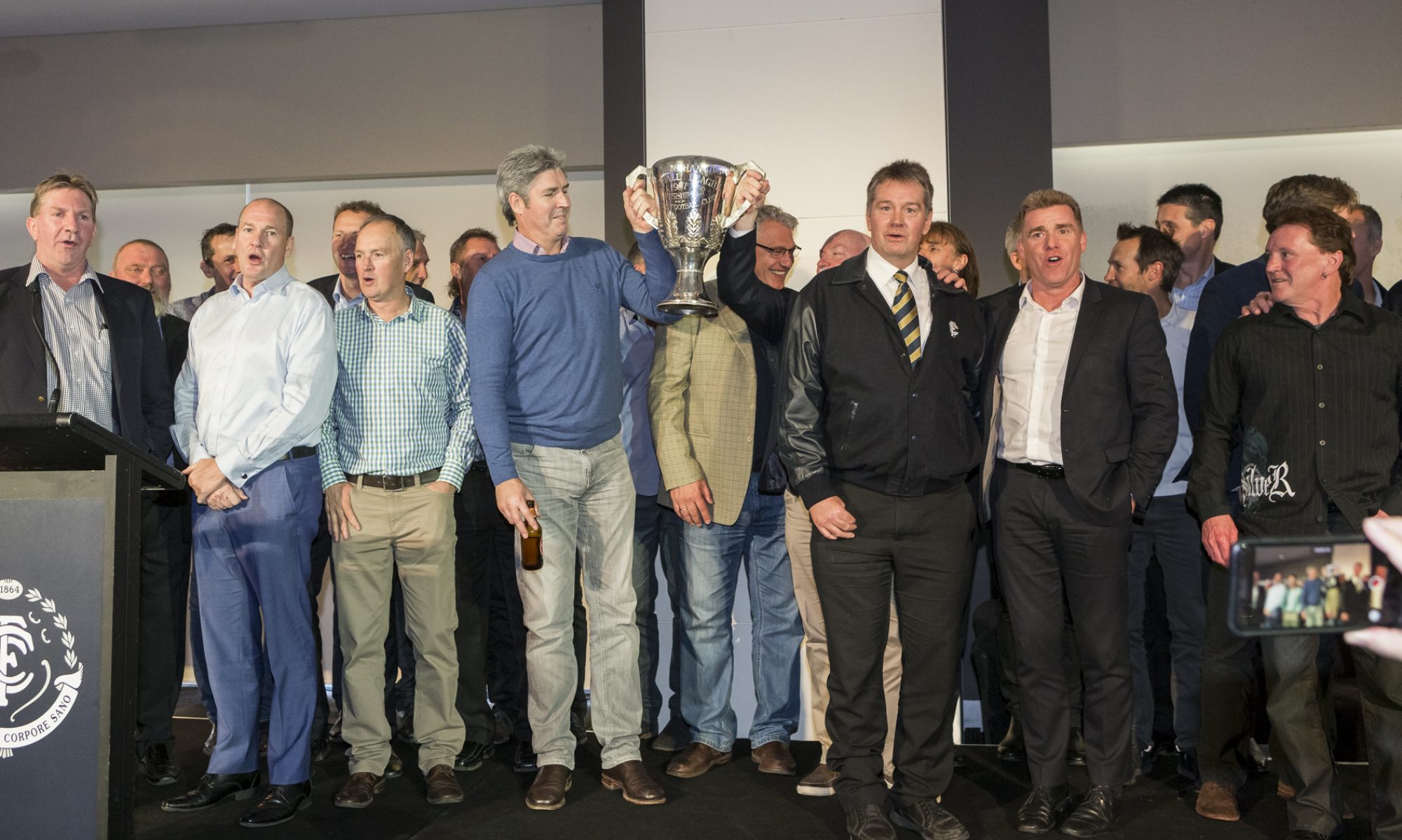
Happy 80th birthday to Leo Brereton.


—————–

Leo Brereton


Career : 195762
Debut : Round 1, 1957 vs Hawthorn, aged 20 years, 170 days
Carlton Player No. 707
Games : 72
Goals : 129
Guernsey No. 6
Last Game: Preliminary Final, 1962 vs Geelong, aged 25 years, 318 days
Height : 174cm
Weight : 70kg
DOB : 1 November, 1936
Leading Goalkicker: 1960

Recruited from the Murray River town of Cohuna, Brereton was a small, nippy rover with excellent goal sense. He wore guernsey number 6 in his 72 games for the Blues in seasons 1957 to ’62, including finals appearances in 1957, 1959 and 1962.

Brereton would share his debut game in 1957 with Club Great John Nicholls.

A skilled crumber, he kicked 130 career goals, including 44 in 1960 to win Carlton’s goal kicking award.

The Age May 01 1963 reported that Leo had been cleared to Nagambie.
“Brereton, who is 26 and has played 70 games with the Blues, has been unable to force his way into the senior team this season. Nagambie club officials were at Princes Park last night and discussed the clearance with Carlton officials.
Brereton will continue to train with Carlton.
Carlton chairman of selectors, Mr. Percy Bentley, said last night Nagambie was getting a League player who had plenty of football ahead of him.
The Blues’ action in clearing him was a reminder to country clubs generally that League clubs were prepared to help them whenever possible.”

Leo Brereton

Another Melbourne import. Brereton came from Carlton to Manuka this season and struck great form. He was Manuka’s star in a dismal team effort last week and will lift the team today with his brilliance.
(Canberra Times September 05 1964)

Milestones

50 Games: Round 11, 1960 vs Melbourne
100 Goals: Round 4, 1961 vs South Melbourne

Hands’ 90th celebrated

The birthday boy: Carlton great Ken Hands celebrates his 90th birthday.

The birthday boy: Carlton great Ken Hands celebrates his 90th birthday.

Ken Hands, Carlton’s last surviving member of both the 1945 and ’47 premiership teams, turns 90 on Wednesday – and in the lead-up to the big day, club luminaries joined family and friends in celebrating the significant milestone with the former captain, coach and best and fairest.

Rarely do you see the Nicholls brothers Don and John together – but Hands originally had a hand in their recruitment to Carlton and there they were, photographed flanking their former teammate beneath his old No.1 guernsey, at a birthday gathering at Richmond at the weekend.

In a previous interview for the publication Out of the Blue, Hands reflected on the recruitment some 60 years ago of Don and his younger brother John Nicholls, the latter considered Carlton’s greatest player ever to lace a boot.

“In those days the coach, the captain, the secretary and a few others used to do the running around Victoria trying to sign players,” Hands said.

“I can recall going up there not long after Don had won the best and fairest in the Ballarat League when he was 14 or 15, and that’s who we went up to sign.

“We were at the Nicholls farm outside Primrose talking to the boys’ father when John and Don got off the bus. I can still see John now with his short pants and great big tree trunk thighs and I can remember saying to Perc Bentley, ‘God, have a look at him!’ And the old man said, ‘Well, if you get one you’ll get them both’.”

John and Don followed Hands down the race and onto Princes Park in the opening round of 1957, in what doubled as ‘Big Nick’s senior debut – and the latter learned much from the then Carlton ruckman and captain.


Left to right: John Nicholls, Ken Hands and Don Nicholls beneath Ken’s framed No.1 guernsey at Hands’ 90th birthday celebrations.

“Apart from his coaching, Ken showed me by example what a good captain should be; of the advantage it was for a team to have a strong leader – a ruckman for preference, but a leader who set an example, who will protect the players, who will kick that valuable goal when needed and will give the necessary lift to a side. Certainly Hands did this,” said Nicholls in an interview for the aforementioned book.

“In his years as coach, Ken taught me the importance of the use of the body in marking duels and ruck duels, and how to go about getting your body between your opponent and the ball.”

Also present for Hands’ 90th birthday celebrations was the former Fitzroy half-back of the 1940s and ‘50s Bill Stephen – as were Hands’ daughters Janet and Robyn, son John, grandchildren Callum, Alastair and Louise and all staff of Ken Hands Agencies.

Recruited to Carlton from amateur club Geelong Scouts, Hands’ lifelong association with the club commenced in the closing days of the Second World War. Considered one of the most significant figures in Carlton history, Hands represented the old dark Navy Blues in 211 matches between 1945 and ’57. From ’59, Hands commandeered Carlton teams from the coach’s box, taking the ’62 team to the VFL Grand Final.

Though he made way for Ron Barassi on the eve of the 1965 season, Hands’ place in Carlton history was already assured – and along the way he was rewarded with his naming in the club’s Team of the 20th century, induction into its Hall of Fame and subsequent elevation to Legend status.

More By Tony De Bolfo, Carlton Media

Peter Jones’ 70th

Happy 70th birthday to Peter Jones.


——————


Peter Jones


Career : 19661979
Debut : Round 16, 1966 vs Melbourne, aged 19 years, 297 days
Carlton Player No. 790
Games : 249
Goals : 284
Last Game : Grand Final, 1979 vs Collingwood, aged 32 years, 344 days
Guernsey No. 28
Height : 198 cm (6 ft. 6 in.)
Weight : 109 kgs (17 stone, 2 lbs.)
DOB : October 20, 1946
Premiership Player 1968, 1970, 1972, 1979

Best and Fairest 1973
Victorian Representative 1977
Senior Coach 1980
Carlton Hall of Fame (1988)

Part actor, part comedian and an all-round quality footballer, Peter ‘Percy’ Jones stands as one of the truly unique characters in the long history of the Carlton Football Club. A four-time Premiership player, his unbounded enthusiasm on the field – and his legendary exploits off it – endeared the lanky Tasmanian to generations of Blues’ fans after he arrived from North Hobart in 1966 as a gangly 20 year-old. A serious car accident soon after his arrival injured both of his legs, but he recovered in time to play the last three games of the year, and showed enough for Carlton’s new coach Ron Barassi to persist with him.

By 1968 ‘Percy’ had settled into the senior team as understudy to John Nicholls in a forward pocket, where his strong marking and accurate kicking was a valuable to team morale as his mad-cap antics in the dressing room. Out on the field, his effusive joy at every Carlton goal – whether it was kicked by himself or a team-mate – began to create something of a rat-bag persona that bewildered supporters at first, but his Chaplinesque reaction whenever a free kick was awarded against him was always hilarious. All of this was just a sideshow however, because within four years Percy had proven himself a real asset in both the 1968 and 1970 Carlton Premiership teams, and from then on the Jones legend unfolded.

In August 1971 at the Junction Oval in St Kilda, Carlton were playing Fitzroy in a game crucial to the Blues’ finals chances. The match started in sunshine, but just after the half-time break a thick fog rolled over the ground from nearby Port Phillip Bay. It was so dense that players only a metre or so apart couldn’t see each other, while the time-keepers caught only glimpses of the players and had to rely on the emergency umpire to relay the occasional scores. Late in the last quarter, the Blues were deep in trouble on the scoreboard, when the ball came bouncing past Percy, who had dropped back into defence. ‘There it is!’ he shouted – and a Fitzroy opponent pounced on the ball and goaled. Carlton lost an extraordinary game, and missed that year’s finals by two points!

Forgiveness didn’t take long however, because Percy atoned with a dominant display against a powerhouse Richmond in the 1972 Grand Final. The Tigers went in as hot favourites after drawing with, then beating Carlton in the second Semi Final. The Blues then had to fight through a tight Preliminary Final against St Kilda, while Richmond had a week off. John Nicholls had replaced Barassi as Carlton’s coach and decided on a bold strategy in the decider. He made eight positional changes, including placing himself at full-forward and handing Percy the daunting task of single-handedly taking on the Tigers’ ruck division. Then he told the Blues to attack at all times, and to ignore the inevitable defensive errors and turnovers.

The plan and the switches worked brilliantly, and Carlton won by 27 points in the highest-scoring Grand Final of them all. Jones was superb all afternoon, rucking unchanged to dominate the Tigers’ big men, while Nicholls himself bagged six goals. If there had been a Norm Smith medal available that day, Percy would surely have been a contender. Boosted by that performance, and on top of his game, Jones was consistently good throughout 1973 and deservedly won the Blues’ Best & Fairest award. On the field, his exuberance was at its height. The Carlton faithful loved his antics, while he drove the opposition to distraction.

On one famous occasion, he played on after a mark in the goal square. But as he tried to drop the ball on to his boot, he missed – and kicked the goal post! On another, he lit a firecracker in the Carlton Social Club while Prime Minister Malcolm Fraser was watching a game, and created mayhem. Late in his career, he was struggling to keep up in a pre-season training run when a tram appeared, so Percy jumped on board to ease his aching legs. He might have gotten away with it, too – except that Carlton’s fitness adviser at the time was standing nearby when Percy hopped off!

Jones’ career culminated with the 1979 Premiership. By then aged almost 33 and somewhat in the shadow of Mike Fitzpatrick, Jones responded to his captain-coach Alex Jesaulenko, who challenged the big bloke to show his doubters that he wasn’t a spent force. Percy gave his all that day; more than holding his own in the ruck as the Blues knocked over Collingwood by five points, thanks some last-gasp brilliance by utility Wayne Harmes.

In the ructions that split Carlton over the summer of 1980, Jesaulenko resigned when George Harris lost the Presidency to Ian Rice, and Percy retired as a player to take over as senior coach. Unfortunately, although the Blues playing list was as strong as any in the VFL, Jones struggled to connect with his former team-mates. Carlton made the finals, only to lose twice in a row and bow out. In one of those games, against Richmond, Percy was leaving the field after the quarter-time break when he noticed sports psychologist Dr. Rudi Webster in the Tiger’s huddle. Webster had spent 1979 at Carlton, but wasn’t retained for 1980 and had joined the Tigers. Incensed at what he saw as betrayal, Perce let fly verbally at Webster. Richmond coach Tony Jewell then stepped in, and suddenly fists were flying. Cooler heads prevailed before anything more than pride was damaged, but Carlton lost and Richmond went on to win the flag. Jones was then shifted sideways. David Parkin became the new coach, and Percy was appointed to the club committee, where he served loyally and cheerfully in various positions for many years.

In his thirteen seasons at Princes Park, Percy wore his number 28 guernsey in 249 games. He kicked 294 goals – and let the world know all about every one of them. An influential member of four Premiership teams, he was a Best & Fairest winner, a state representative, vice-captain, board member and club legend. And he did it all with a kind of mischievous glee.

After football, Percy ran a couple of inner-Melbourne hotels in partnership with his former team-mate Adrian ‘Gags’ Gallagher. The best known of these was the Blush & Stutter in Carlton. At one time he also stood for election to the Victorian Lower House, using the wonderful slogan; ‘Point Percy at Parliament.

Adding to his long list of awards, Jones was elevated to legend status in the Tasmanian Football Hall of Fame on July 5, 2013.

Milestones

50 Games: Round 1, 1970 vs Essendon
100 Games: Semi Final Replay, 1972 vs Richmond
150 Games: Round 8, 1975 vs Melbourne
200 Games: Round 11, 1977 vs Footscray
100 Goals: Round 22, 1970 vs Melbourne
200 Goals: Round 13, 1975 vs Collingwood

Career Highlights

1968 – Premiership Player
1970 – Premiership Player
1972 – Premiership Player
1973 – Robert Reynolds Memorial Trophy: Best & Fairest Award
1974 – 5th Best & Fairest
1975 – Perc Bentley Trophy: 3rd Best & Fairest
1977 – State Representative
1978 – Equal 8th Best & Fairest
1978 – B. J. Deacon Memorial Trophy: Best Clubman Award
1979 – Premiership Player

Percy Jones feature Video
http://www.youtube.com/watch?v=3dFXSUU1-Ao&list=UUBDbvpbtwAIj2Lmz_7jJXKg&feature=c4-overview (external link)

Mark Porter’s 40th

Happy 40th birthday to Mark Porter.


—————-


Mark Porter


Career : 19972001
Debut : Round 16, 1997 vs Essendon, aged 20 years, 281 days
Carlton Player No. 1019
Games : 55
Goals : 13
Last Game : Semi Final, 2001 vs Richmond, aged 24 years, 339 days
Guernsey Nos. 46 (1997) and 11 (1998-2001)
Height : 199 cm (6 ft. 7 in.)
Weight : 101 kg (15 stone, 12 lbs.)
DOB : 11 October, 1976

A wearer of the number 11 guernsey, Mark Porter was called up from the rookie list to replace the suspended Matthew Allan against Essendon in Round 16, 1997 and made a magnificent debut – routing his more experienced opponents from the very first bounce. The 199 cm Porter was an old-fashioned, blue collar ruckman who gave his all for the team. His running to create space and his hard work around the ground – he made 45 tackles in 2001 – provided an insight into the type of effort big Mark put in each and every game.

For most of 1998, he and Allan formed an excellent ruck combination – but from then on, it was rare for them to play together for any length of time. Usually, this was because one or the other was injured. After 19 games in 1998, Porter missed more than a season and a half due to an ongoing knee injury. In fact, he didn’t make it back into the senior team until Allan himself hurt a knee in round 16, 2000, and was sidelined for six matches. In his absence, Porter stepped up to the role of number one ruckman, until the Blues’ twin towers were reunited for the last four games of the year.

In 2001, Porter played all but two games, while Allan was restricted to just eight appearances by a nagging series of foot and groin problems. Overall, the pair only made it on to the field together on seven occasions. At the end of that year, Carlton – desperate for a marking forward – stunned virtually everyone by trading the reliable Porter for Corey McKernan from the Kangaroos. It wasn’t a popular deal with the fans. Porter had won wide appreciation for his work ethic, and had battled hard to overcome injury. On top of that, Matthew Allan would play just 10 more games before he broke down again with foot problems. He was then traded to Essendon, and this left the Blues with severley depleted ruck stocks.

Porter went on to play three more honest seasons with the Roos, adding 55 games – the same number he had played at Carlton – before being delisted.

Carlton recruited Porter from VFA club Coburg, he had originally played for Wangaratta and King Valley.

Porter would win the Fothergill / Round Medal in 1995 it is presented to the most promising young talent in the VFL competition.

Milestones

50 Games: Round 19, 2001 Vs Adelaide Crows

Career Highlights

1997 – The Past Players’ Association Encouragement Award
1997 – 2nd Reserves Best & Fairest

‘The fighting Maras’ – a family story

(Left) Alf and his younger brother Wilkie, Richmond, 1930s and (right) Alf Egan, Carlton footballer, 1932. (Photo: Supplied)

(Left) Alf and his younger brother Wilkie, Richmond, 1930s and (right) Alf Egan, Carlton footballer, 1932. (Photo: Supplied)

A tick over two years ago, a story appeared here about the life of Alf Egan. Egan, who was also known as ‘Tom’, is forever remembered as Carlton’s first known Indigenous footballer to lace a boot.

Listed as this club’s 478th senior player since 1897, Egan completed his senior debut, against Essendon, at Princes Park in Round 3, 1931. Named on a half-forward flank alongside another first-gamer Bernie O’Brien, Egan would boot a goal in the first of his 36 games for the Blues through the course of three seasons as a ruckman/forward.

Egan’s stoic display at centre half-forward in the 1932 Grand Final earned him universal acclaim. Alas, his time at Princes Park ended just a year later, with Carlton’s loss to Geelong in the first semi-final of 1933.

At 23, Egan saw fit to follow his football dream to North Melbourne, but by the end of ’35 and after just 15 senior appearances it was all over for him at League level.

While the previous article shed precious light on Egan’s hometown of Myamyn in Victoria’s south-west, little was recorded of his later years – other than that he was known to have fathered a son to a Richmond woman in the 1950s.

A labourer by profession, Egan of no fixed address would sadly succumb to heart disease at the age of just 51, with his cremated remains placed in a compartment of the Church of England section at Springvale Botanical Cemetery in January 1962.

The article of 2014 concluded with a plea to any of Egan’s descendants to make contact to help fill in the gaps.

Recently, one of them did – Egan’s son the much-respected Aboriginal elder Ted Lovett, himself a former Fitzroy footballer, who played two games on permit with the Lions in 1963 and a further seven in ’64.


“I’ve had a tough life but I’ve got through it”. Ted Lovett, 2016 (Photo: Supplied)

Ted is proud of the fact that Egan is remembered as Carlton’s first Indigenous player and that he played League football before Doug Nicholls. Here, he reflects on the life of a father he never really knew and at 75, ponders his own incredible life’s journey, the great capacity to prevail and the triumph of the spirit.

I didn’t know much about “Tom” down home, but I have a handwritten book about the Egans. I know that Dad lost his uncle Bill in the Battle of the Somme. I also know that his big brother Mick served in New Guinea during the Second World War, and his younger brother Wilkie died of natural causes in Richmond.

The Egans and the Lovetts were first cousins and my grandfather was brought up strict Church of England. My younger sister Georgina was the only family member to get the Egan name on her birth certificate, and she was born after grandfather had died.

All our mob were Gunditjmara – “The Fighting Maras” as they called us. Football was our natural game and we used to kick a possum skin stuffed with charcoal.

My Mum (‘Gertie’) and Dad met in Heywood, but I was born in Carlton and most of us were born in Melbourne. We had a stepbrother who died, but we never knew him and still don’t know anything about him. 

I had an older brother Victor who became a professional boxer, Tommy (who was a better footballer than me), Dorothy (a tomboy who could also play footy), me and Georgina. We were all taught how to look after ourselves because there was a lot of racism around. 

Tommy and Dorothy have all since died and they died in that order. Now there’s only me and Georgina left, I’m 75 and she’s 73.

We all lived with Mum at 85 Young Street, Fitzroy (it’s housing commission now) and Dad lived with his family at 90 Somerset Street, Richmond. We’d catch the tram there and get off near the Skipping Girl. They lived a few blocks up on the right.

They weren’t happy times in Fitzroy because we more or less lived in poverty there. There’s a clipping from The Sun going back years ago of the five of us – all my brothers and sisters, and Mum living in poverty.

Later on, I worked in Aboriginal Affairs in the early days of the movement, the radical times. That was in the ’70s, with all the marches, and I did a lot for the Aboriginal people. I received the Centenary Medal for services to the Ballarat Aboriginal community.

I was about 15 years old when my Mum died of leukemia. My brothers and sisters were all there the night she died at St Vincent’s Hospital. My Dad died in sad circumstances in Burnley in 1962 and I’d say I was about 20 at the time. 

Dad didn’t really have anything to do with us in those early years and after a while I was made a state ward, but through no fault of the family. I went to Mildura fruit picking and me and an Italian boy got hauled in by the police for walking the streets. We were rounded up on the Friday night and went to court on the Monday. The Italian boy went home with his mother and I was made a state ward – and I had eight years of institutionalisation – Royal Park, Turana and the Salvation Army Boys’ Home.

In the end, I worked for the department that made me a ward of the state.

I never really played junior football, because from the time I was 14 I played seniors. Funny thing, Charlie Sutton wanted me and Tommy to go to Footscray as we’d previously played out at Brooklyn, but Tommy was mad Fitzroy and so we stayed put.

I played nine games for Fitzroy, but I had a few problems with my colour. I had natural ability – I played anywhere, sometimes full-forward, but mainly wing, half-forward or halfback. Playing for North Ballarat later on, I won the Henderson Medal in 1963 and ’65 – the first person to win the Ballarat League’s best and fairest award twice.


(Left)Ted Lovett, in his Fitzroy strip, contesting a mark in a training session with Ballarat’s Howard ‘Plugger’ Lockett, father of the great Tony Lockett, and (right) Lovett in his playing days. (Photos: Supplied)

I am very heartened that there are rules preventing racial intolerance now, but today they wouldn’t know what prejudice was.

I’ve had a tough life but I got through it – and I’m a great believer that history’s history, I can’t do anything about it and it’s all in the past.

I go to bed at night and if I wake up I’ve got another day to live. That’s the way I live now and I keep it simple.

Ian Nicoll’s 70th

Happy 70th birthday to Ian Nicoll.


—————


Ian Nicoll


Career : 19671970
Debut : Round 12, 1967 vs Fitzroy, aged 20 years, 286 days
Carlton Player No. 801
Games : 41
Goals : 30
Last Game: Round 22, 1970 vs Melbourne, aged 23 years, 331 days
Guernsey No. 23
Height : 179 cm
Weight : 73 kg
DOB : October 2, 1946

Recruited from the Wangaratta Rovers club in northern Victoria (Ovens & Murray League), Ian Nicoll was a busy left-footer who contributed strongly in most of his 41 games for Carlton. He debuted for Carlton in Round 12, 1967 alongside Ken Jungwirth.

In 1969 he shared the roving duties with Adrian Gallagher in the Blues’ Grand Final loss to Richmond. Nicoll lined up for VFA Club Preston during the 1971 season.

LiIian’s homage to her famous father-in-law

Lilian O'Cock was very proud of her father-in-law, Wally O'Cock, Carlton's first league goalkicker.

Lilian O’Cock was very proud of her father-in-law, Wally O’Cock, Carlton’s first league goalkicker.

The 94-year-old daughter-in-law of Wally O’Cock – the first player to kick a goal for Carlton in League competition – has forwarded to the Club a collection of previously unseen photographs, certificates and general correspondence chronicling the man’s life and career.

Lilian O’Cock, whose late husband Horace was Wally’s son, was also able to shed her own precious memories of the famous Carlton figure, with whom she first made acquaintance in New South Wales almost 80 years ago.

“I was 16 when I met Wally in Holbrook. He was a very kind man,” Lilian said.

“I met him in 1938, the war broke out the following year and Horrie went to the Middle East in ’40.”

The story of Wallace Alfred Richard O’Cock is this. He was born in the Melbourne inner-city suburb of Clifton Hill on June 17, 1875. His father, was a bank manager named Alfred Ferrie O’Cock, his mother, Anne Wallace, and records indicate that Wally’s paternal grandfather originally hailed from Somerset in south west England

The dedicated club website Blueseum notes that Wally joined Carlton in its final year in the VFA (1896) and was one of the first players considered for selection for the opening round match of the fledgling VFL – Saturday, May 8, 1897. It also notes that Wally lined up a placekick in the second quarter of the match against Fitzroy at Brunswick Street and sent it sailing through the posts – the history-making six-pointer, Carlton’s first.

That July, after being laid up for a period with injury, Wally endeavoured to force his way back into the Carlton team. Initially he was overlooked for selection after failing to obtain a medical clearance, but the Club registered him under the name Alfred Wallace and he promptly booted two goals in a match-winning performance against the Fuschias.

The Wallace surname is itself famous in sporting circles. Wally’s uncle Donald Smith Wallace was an MP and pastoralist who owned the respective Melbourne Cup winners of 1888 and 1890, Mentor and Carbine – and as a descendant Graeme Cumbrae-Stewart OAM said in a previous interview, “the story goes that Donald got Carbine on the cheap”.

Wally’s 15 goals from ten matches through season 1897 earned him the plaudits as Carlton’s first leading goalkicker. He would manage a further 31 appearances for the Club over the next four years, despite having been in absentia for all of 1900 for reasons unknown.

He was only a few days short of his 26th birthday when he turned out for Carlton for the last time, against Essendon at the East Melbourne Football Ground in June 1901. He later fronted for a local outfit in Preston, but his glory days on the paddock were long gone.

“I remember Dad telling me that Wally was a nuggety little bloke with a fiery temper,” said Cumbrae-Stewart.

“I believe he had to give up footy after he copped a spike from a boot to his leg. He was also left with a permanent limp, which forced him to give up his work as a commercial traveller with MacRobertson’s.”

Cumbrae-Stewart’s story is borne out in Lilian’s precious images of Wally, who carried a walking stick in later life.


Old photos Lilian has kept show her husband Horace and her father-in-law Wally making their way to the MCG
in 1937. (Photo: Carlton Media) 

According to Cumbrae-Stewart, Wally relocated to the small southern New South Wales town of Holbrook to work for his brother-in-law Adam Anderson and his wife Alice who managed at property called Wentworth.

“He later took on his own property, but fire wind and rain ruined it and he went broke,” Cumbrae-Stewart said. “He then started as a stock and sales agent in Holbrook, during which time he and his wife Luisa Durrant raised six children.”

But Wally would ultimately return to Melbourne, as Lilian explained.

“Towards the end of his life, he came down from Holbrook and for a brief time lived with an aunt of Barry Humphries in North Caulfield,” she said. “He returned to Holbrook to live with his eldest daughter, but then asked my husband and I if he could come back down to live with us, at 55 Norwood Road, Caulfield North.”

Wally O’Cock was 74 years of age when he died in Richmond’s Epworth Hospital on June 14, 1951. His body was returned to Holbrook, and laid to rest in a grave shared with his beloved wife who died nine years previous.

It’s now almost 120 years since Wally O’Cock created history for Carlton, and Lilian is almost certainly the last living person to have known him.

Thanks to her, Wally’s story endures.

Tributes paid to the life of Brian

John Nicholls leads the victory lap for the 1970 Grand Final. Brian Bearman is pictured on the far left wearing the tie. (Photo: C & J Stuckey Pty Ltd Photographics)

John Nicholls leads the victory lap for the 1970 Grand Final. Brian Bearman is pictured on the far left wearing the tie. (Photo: C & J Stuckey Pty Ltd Photographics)

Tributes are being paid to the long-serving Carlton statistician Brian Bearman, who died recently at the age of 82.

Brian’s working relationship with Carlton took in the Barassi era and beyond, and spanned almost 40 years. His loyalty to the club was rewarded with Life Membership in the club’s Premiership year of 1987.

Five years previous, Brian’s brother Ken was awarded Life Membership for services as timekeeper. In 2000, Brian’s son Lewis was similar recognised for his contributions as a statistician – “three Life Members of the Carlton Football Club none of whom ever played a game,” as Lewis observed.

Born on November 12, 1933 in Manchester, Brian Bearman, together with his brothers and parents, boarded the first Australian-bound passenger ship from the UK after the Second World War. The Bearmans made the move as Brian’s grandmother was advised that a warmer climate was in the best interests of her health – and she pitched for Australia because she heard you couldn’t get a decent cup of tea in South Africa.

On disembarking the vessel in Brisbane in 1947, the Bearmans settled in the city, only to relocate to Melbourne five years later.

When Barassi accepted the role of Carlton Captain-coach on the cusp of the 1965 season, Ken Bearman was already keeping time for the club. According to Lewis: “Barassi wanted a statistician and Ken said to his brother ‘you love the club – you can do that’.

“And that’s exactly what happened. From ’65, Brian started keeping stats with people like Margaret and Grant Salomon and his good mate the late Ron Bromley. Then in 2000 when Wayne Brittain took over and replaced a lot of statisticians with a lot of computers, Brian stayed on for a couple of years with the Carlton Heritage Committee.”

James Koochew, Brian’s successor as Carlton’s head statistician in 1994, said that he was but a young man of 26 at the time “and Brian had been doing the job for longer than I’d been alive”.

“I remember that Geoff Walsh made the announcement that I was taking over and Brian was the first bloke to stand up to offer his congratulations,” James said.

“That was a measure of the man. He was a true gentleman.”

In more recent years, and though his friendship with Stephen Gough, Brian fulfilled duties as a guide at the National Sports Museum. But he remained an active Carlton supporter to the end.

“There’s a photograph of Dad running a victory lap with ‘Big Nick’ and the Carlton players after taking stats in the 1970 Grand Final,” Lewis said. “That moment was one of the joys of his life – to run the victory lap with them.”

Brian Bearman died peacefully in Cabrini Palliative Care. He is survived by his beloved wife of 54 years Ruth, son Lewis, daughter Tanya now living in the United Kingdom, and four grandchildren.

Kevin Bergin’s 80th

Happy 80th birthday to Kevin Bergin.


————

Kevin Bergin


Career: 1955-56
Debut: Round 9, 1955 v Essendon, aged 18 years, 269 days
Carlton Player No. 692
Games: 12
Goals: 12
Guernsey No. 36
Last game: Round 2, 1956 v Melbourne, aged 19 years, 219 days
Height: 175cm
Weight: 73kg
DOB: 15 September, 1936

Bergin played 12 games for the Blues commencing in Season 1955, and managed to average a goal a game in his brief time at Carlton. He wore guernsey #36.

Bergin transferred to Collingwood for the 1957 season where he played a further 5 games as well as booting 4 goals.

Bergin was recruited from Carlton Districts and Old Paradians (Bundoora).

Career Highlights

1955 – Reserves 3rd Best and Fairest Award.

Maurie Pope’s 80th

Happy 80th birthday to Maurie Pope today.

We spent the morning with Maurie last year, http://spiritofcarlton.com.au/blog/2015/08/06/a-morning-with-maurie/


———-

Maurie Pope


Playing Career: 19561958
Debut: Round 16, 1956 v Collingwood, aged 19 years, 335 days
Carlton Player No. 706
Games: 7
Goals: 2
Last game: Round 18, 1958 v South Melbourne, aged 21 years, 353 days
Guernsey No. 32 (1956) and No. 26 (195758)
Height: 199 cm (6ft 6in)
Weight: 99 kgs (14st)
DOB: September 4, 1936

Pope played 7 games for Carlton after debuting in Season 1956 in 32 for one game.

Maurie then wore Guernsey No. 26 in 1957 and 1958 for 6 games, playing half his games as a forward pocket. In the Round 15, 1958 game against St Kilda, Pope kicked two of Carlton’s eight goals in what was a close victory by just five points.

Pope came through Carlton’s Under 19’s.

Maurie Pope headed to SANFL club West Adelaide for the 1959 season.

Footnote:

ARMY HAS FIRST CLAIM ON BLUES’ BIG “CHOOKA”

To read The Argus report click here> http://nla.gov.au/nla.news-article71650918 (external link)

Carlton 49ers convene on Lygon St

Left to right: Carlton 49ers Don Hyde AM, Hugh Cornell and George Handley.

Left to right: Carlton 49ers Don Hyde AM, Hugh Cornell and George Handley.

Their ranks may be thinning – it’s 67 years ago after all – but members of Carlton’s under-19 premiership team of 1949 – “the Carlton 49ers” – this week celebrated past glories with gusto at a reunion in neighbouring East Brunswick’s Gelobar Café.

Of the 19 who took the chocolates from Geelong in that Grand Final (9.8 (62) to 7.9 (51)), only three managed to make it along – chief organiser Hugh Cornell, George Handley and Don Hyde AM.

Notwithstanding the seven team members who have since died and a further five whose whereabouts remain unknown, four more including captain Alan ‘Alby’ Mangels (the father of Carlton’s 88-gamer Alan jun.) fired in their apologies for various reasons.

But there lending support was Alan Bell (son of the then Carlton Secretary Harry Bell, the Spirit of Carlton’s Dennis Munari and the club’s resident statistician Stephen Williamson.

“When I think about the ’49ers I think about those players who went on to become top players at League level,” said Hyde, who so capably called League football on radio and television for almost 40 years.

“I think of Harry Sullivan, Keith Robinson, Max Thomas and so on. I think back and I say to myself, ‘Gee, I played with those guys’.”

Brunswick-born and bred, and an old St Joseph’s North Melbourne boy, Hyde later represented the Kangaroos at reserve grade level because he was residentially tied to the club. He also chased the leather at Deniliquin and Maryborough, during which time he began to pursue a career in radio.

“I remember one day at Deniliquin the manager said to me ‘Our main commentator is not available – you play, so you must be able to broadcast’ – and that’s how it all started,” he said.

The ’49 triumph completed back-to-back grand final victories for the team, whose members also include Ian Clover and Dick Gill, the sons of Carlton greats Horrie Clover and Frank Gill respectively. Jim Francis, the Carlton Premiership player at senior level in 1938, served as coach throughout that period, having assumed control of the junior outfit when it was first admitted to the Northern District Football Association in 1944.

Francis, who succumbed to a knee injury the previous season,imparted his football nous on the players, with University High School sportsmaster Mr. Gaynor offering his services as an administrator.

The then Secretary Harry Bell, in his season overview for the 1944 Annual Report, somewhat prophetically reported:

“Mr. Gaynor and Jim Francis formed the ideal combination for the control of the boys, and it is hard to assess their value to your Club, but it is thought that full realisation of the plan may be expected in two or three years, when five or six of these boys will be regular First Eighteen players, and when this is achieved it may then be recognised that the fielding of an under 18 years team in the N.D.F.A. was one of the most progressive steps ever undertaken by the Carlton Club”.

Cornell recalled that in those fledgling years of the Under 19 competition, Collingwood was the only team not represented, “which is somewhat surprising when you think about it”.

“I think the 12th team at that time was a TAA team,” he recalled.

Cornell also remembered his old mentor with great affection.


Don Hyde AM views the team photo.

“Jim Francis was a wonderful coach. He asked his players to play hard and fair,” Cornell said.

“He was a real gentleman. He was always very measured and he never lost his temper.”

For the record, Carlton’s Trophy winners in the ’49 Premiership year included Harry Sullivan (Best and Fairest), Tom Jones (Most Consistent), Keith Robinson and Noel Rundle (who tied for Best Team Man), Max Thomas (Most Serviceable Player) and George Ferry and Gerald Burke (who tied for Most Improved Player).

With the exception of Rundle, all award winners later represented Carlton at senior level – Ferry in 139 games, Burke (87), Sullivan (31), Thomas (24), Jones (seven) and Robinson (two).

Cornell has dutifully convened reunions of the Carlton 49ers in every year since 1999 – the 50th anniversary of their famous victory at the old Princes Park ground.

“It was a difficult task after 50 years trying to find out where all the lads were, but we’ve effectively been meeting every year since ’99,” Cornell said.

Carlton FC Under 19 Premiers, 1949

Carlton players pictured are as follows;

3rd row: Jim Johnson, Brian Amarant, Ray Clover, Keith Robinson,

Harry Sullivan, Tom Jones, Ron Price, Don Hyde, Dick Gill

2nd row: Ambrose Curtis, Hugh Cornell, George Ferry, Alan Mangels (c.), George Stafford, Noel Rundle, George Handley

front row: George Crowley, Max Thomas, Maurie Rossi, Charlie Blake, Gerald Burke, Ken Reed

Coach Jim Francis stands is in the back row, fifth from the right.

Peter McKenna’s 70th

Happy 70th birthday to Peter McKenna.

——————

From the Blueseum.


Career : 1977
Debut : Round 2, 1977 vs Fitzroy, aged 30 years, 225 days
Carlton Player No. 864
Games : 11
Goals : 36
Last Game : Round 18, 1977 vs Melbourne, aged 30 years, 337 days
Guernsey No. 27
Height : 191 cm (6 ft. 3 in.)
Weight : 86 kg (13 stone, 8 lbs.)
DOB : 27 August, 1946

One of the game’s all-time great full-forwards, Peter Julian McKenna created yet another headline when he was traded by Collingwood to Carlton at the age of 30 in 1977. Often described as the “pop star footballer,” McKenna had played 180 games and kicked a mammoth 838 goals in 11 seasons for the Magpies, but by 1975 he had fallen out of favour at Victoria Park, and was often playing with the seconds.

Midway through that year, McKenna was severely injured when an opponent’s knee crashed into his lower back during a Reserves match. He was rushed to hospital, and had part of one kidney removed. Although that incident ended his season, he was keen to play on in 1976, so Collingwood sent him across Bass Strait to Devonport to assess his future. In 17 games with the Tassie Magpies, McKenna booted 79 goals and re-ignited his desire to play VFL football. However, when he approached Collingwood about a comeback, he was told there was no longer a place for him on their list.

Meanwhile, Carlton was struggling with the anguish of losing the 1976 Preliminary Final to North Melbourne by a solitary point. When the news broke that McKenna was open to offers, the Blues match committee decided that he was worth taking a punt on, and negotiations resulted in a swap of players between the two clubs. Collingwood asked for, and got 1972 Premiership wingman David Dickson. McKenna got Carlton’s number 27 guernsey, and the opportunity to make the Blues attack his domain.

At first, McKenna’s arrival at Princes Park was not universally popular among the Carlton faithful, because until then he had been a despised rival, and many Blues supporters believed that he was past his best. Only those who recalled his stellar 1970 season (when, in four clashes against the Blues, he had kicked bags of 8, 9, 9 and 6 goals respectively) thought he might have something left to offer.

Well, was the McKenna experiment a success? Probably not, because it failed in its primary objective of getting the Blues into another final series. Carlton wound up the year sixth on the ladder, and it was obvious by mid-season that McKenna was a spent force – particularly after he was quoted as saying that he hated playing against Collingwood. Still, he had some memorable moments – especially early on – when his deadly accurate right-foot drop-punts produced 24 goals in five matches between rounds 3 and 7.

Overall, McKenna averaged better than three goals a game in his 11 matches as a Blue, and his VFL career ended on a positive note when he steered through his last four goals in Carlton’s big win over Melbourne at VFL Park, Waverley in round 18. On that same day, a young Ken Sheldon kicked six goals, and a barrel-chested teenager named Wayne Harmes impressed on his debut in guernsey number 54.

In 1978, McKenna was cleared to VFA club Port Melbourne. Later, he also turned out for Geelong West and Northcote before his retirement in 1980. When his playing days were over, he became a long-serving football commentator for the Channel 7 network.

Footnotes :
While at Collingwood, McKenna recorded two pop songs; Things to Remember and Smile, both of which made the Melbourne singles charts. Later he published a book; My World of Football, which was floridly subtitled; “the candid, provocative, innermost thoughts and technical secrets of an Australian football hero.”

He was a regular on Melbourne television in those days, and in 1971, he joined Daryl Somers as the first co-host of Hey Hey It’s Saturday, which was broadcast on Saturday mornings by Channel 9. But after eight episodes, the Magpies told him to choose between television and football, so he was replaced by Ossie Ostrich.

McKenna began his working life as a teacher at Fairfield state school, a job that lasted only until he became a VFL star. After a varied business career and almost two decades as a football commentator, he was appointed a chaffeur to the Victorian Parliament in 2004.

John Leatham’s 70th

Happy 70th birthday to John Leatham.

—————-

From the Blueseum.


Career : 1967
Debut : Round 3, 1967 vs North Melbourne, aged 20 years, 249 days
Carlton Player No. 796
Games : 2
Goals : 0
Last Game : Round 4, 1967 vs Melbourne, aged 20 years, 256 days
Guernsey No. 45 (1967).
Height : 183 cm (6 ft. 0 in)
Weight : 76 kg (12 stone, 0 lbs.)
DOB : 23 August, 1946

Only the second Blue to wear guernsey number 45 in a senior game for Carlton (after Gil Lockhart in 1966) John Leatham was a speedy wingman recruited from Maffra Rovers in the North Gippsland Football League. He donned the navy blue strip for two consecutive games early in 1967, but couldn’t settle in at Princes Park, and his career was over by season’s end.

Leatham made his debut for Carlton against North Melbourne at Princes Park in round 3, 1967. His centreline partners on that cloudy afternoon were Ian Robertson and Cliff Stewart, and the Blues ran out comfortable winners by 16 points.

The following week in round 4, Carlton’s unbeaten run continued when a sharp Blues combination shook Melbourne off early in the contest, and then thrashed the Demons by ten goals. Although just about every Bagger got a swag of possessions, the match committee still made changes for round 5, and Leatham was one of those omitted.

No doubt deeply disappointed, he played only one or two further Reserves matches before deciding to forsake the dream of VFL football, and was back playing in the country only a few weeks later.

Here at the Blueseum, we believe that John was the first ex-player to contribute information to his own biography – and for that we are most grateful.

Blue Jewry begins with Barney

Barney Lazarus was Carlton's first Jewish footballer.

Barney Lazarus was Carlton’s first Jewish footballer.

When the Carlton Football Club acknowledges the many and varied contributions of members of its vibrant Jewish community at the President’s Luncheon this Sunday, thoughts tend to turn to the Smorgons and the Pratts at board level rather than those who have made their mark as Carlton players.

True, Richard Pratt, in another life as the club’s resident Under 19 ruckman, took out the 1953 Morrish Medal for competition best and fairest before life led him on a vastly different career path.

Before Dick was Fitzroy’s three-gamer of 1897 Herbert (“Bert) Rapiport – acknowledged as League footballer’s first Jewish footballer – who fronted up for Carlton in a few exhibition matches through the 1800s – amongst them an exhibition game on the MCG in tribute to A.G Spalding, a visiting American whose family established the famous sporting goods chain.

But as neither Pratt nor Rapiport played a senior League game, one must turn back the hands to 1902, to identify Carlton’s first Jewish senior footballer – one “Barney” Lazarus – who completed his senior debut for the Old Dark Navy Blues, against Geelong at Corio Oval, in the eighth round of 1902.

Named on a half-back flank, Barney was part of Carlton history on that winter afternoon in June, as the visitors’ narrow four-point victory was their first over the Pivotonians since the VFL’s inception five years previous.

Barnett Joseph Lazarus was born in London on December 18, 1879. He was a boy of six when his parents led him down the gangway of a Sydney-bound sailing ship before relocating not long afterwards to the colony of Melbourne.

Recruited to Carlton from Carlton Juniors after plying his early footballing craft at neighboring Princes Hill (and possibly Prahran), Barney would represent the seniors in just seven appearances, the last of them the 15th Round of 1902, in what was Jack Worrall’s maiden season as club secretary.

At some point following the completion of his Carlton career, Barney relocated to Sydney. The NSW Australian Football History Society records that Barney turned out for Redfern through the 1907-’10 seasons, during which time he also represented the Combined Sydney outfit in matches against the likes of South Melbourne, Norwood and Fitzroy; and New South Wales against Geelong, Collingwood, Queensland and North Adelaide.

Little is known of Barney’s life after the game (and only this grainy image puts a face to the name). But the dedicated Carlton supporter and part-time genealogist Bernie Kuran recently shed more light.

Barney, it seems, married in 1912 and died 50 years later, on May 6, 1962 at the age of 83. He was laid to rest at Sydney’s Rookwood Jewish Cemetery – according to cemetery records in plot 259 in section 19, row 13.

At Rookwood, his Hebrew name is identified as Boruch ben Leib (Son of Leib).

But at Blueland, it’s Barney.

Ken Jungwirth’s 70th

Happy 70th birthday to Ken Jungwirth.


——————–


Career : 1967
Debut and Only Game : Round 12, 1967 vs Fitzroy, aged 20 years, 346 days
Carlton Player No. 800
Games : 1
Goals : 0
Guernsey No. 47
Height : 183 cm (6 ft. 0 in.)
Weight : 78.5 kgs (12 stone, 5 lbs.)
DOB : August 3, 1946

A 183 cm utility originally from Murrumbeena High School, Ken Jungwirth played four games for Melbourne in 1966, only to be delisted by the Demons and picked up by the Blues. In round 12, 1967 at Princes Park, he made a brief appearance off the bench in his one and only senior game for Carlton against Fitzroy.

The ladder-leading Blues were expected to have little trouble with the last-placed Lions on that Saturday afternoon, but the visitors came to play and trailed by just 4 points at three-quarter time. Only the steadiness of key forwards Brian Kekovich (four goals) and Wes Lofts (three) eventually got the home side over the line by 8 points.

While the resurgent Blues continued to build toward the triumphant Premiership victories of 1968 and 1970 under legendary coach Ron Barassi, Jungwirth finished off 1967 with Carlton Reserves. In the off-season, he was cleared to VFA club Prahran, and was a reserve in the Two Blues Grand Final line-up that lost to Preston.