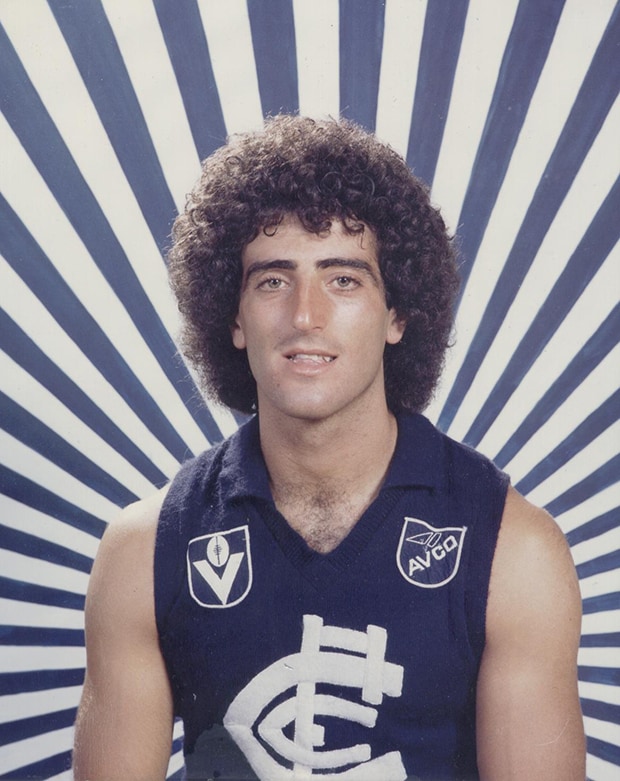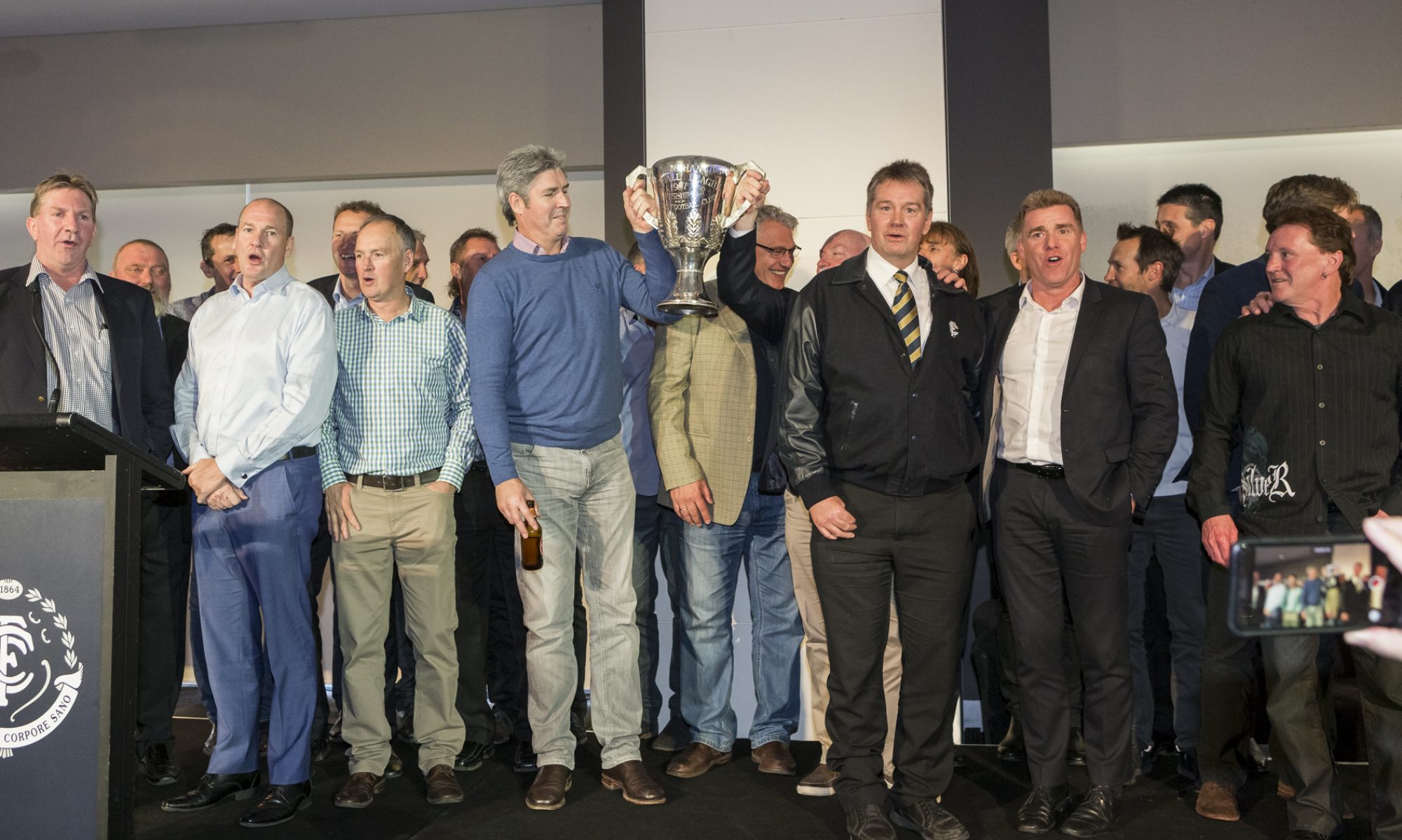

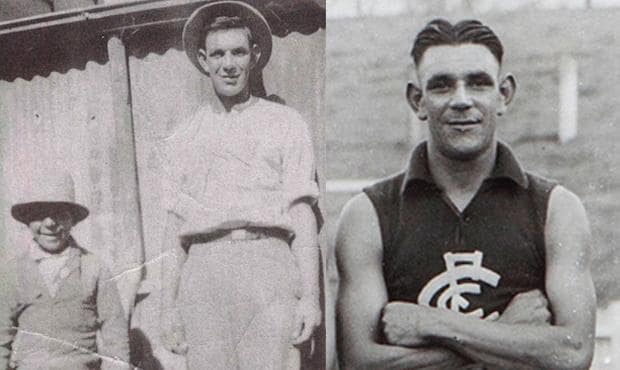
Phil Maylin’s 60th

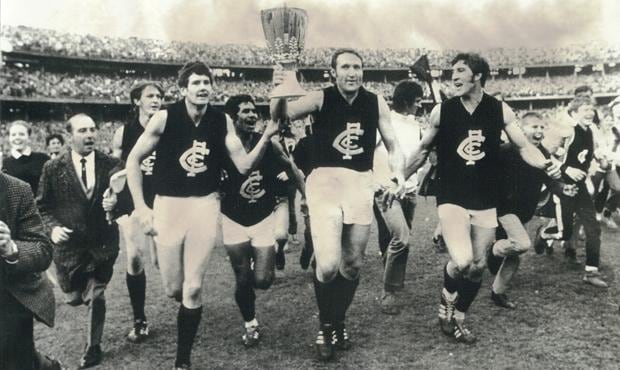
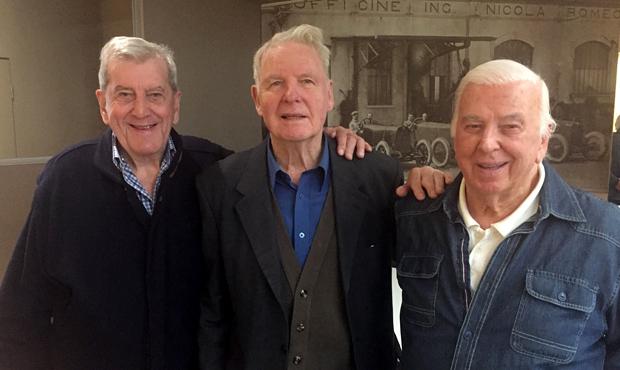
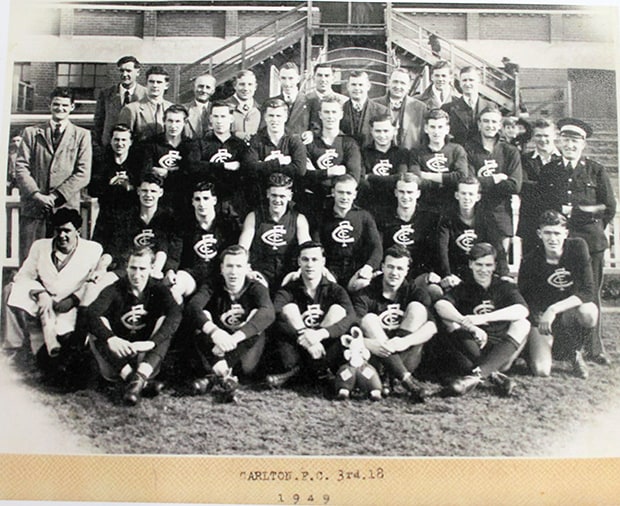
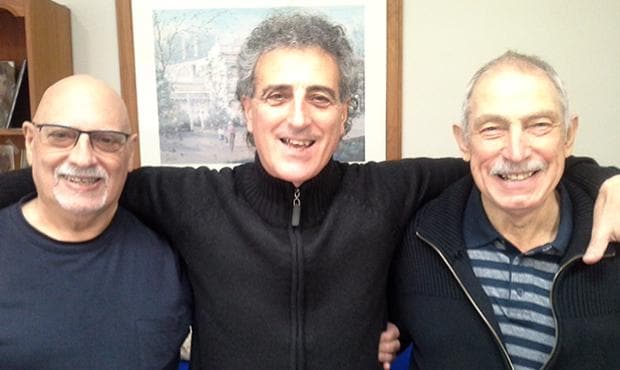
Happy 60th birthday to Phil Maylin.


————-

From the Blueseum


Career : 1980 – 1984
Debut : Round 1, 1980 vs Collingwood, aged 23 years, 343 days
Carlton Player No. 881
Games : 89
Goals : 48
Last Game : Round 22, 1984 vs South Melbourne, aged 28 years, 134 days
Guernsey No. 13
Height : 175 cm (5 ft. 9 in.)
Weight : 76 kg (12 stone)
DOB: 20 April, 1956
Premiership Player: 1981, 1982

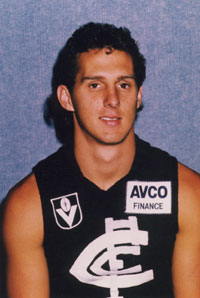
A hard-working, tenacious utility from South Australian club Woodville, Phil ‘Shark’ Maylin was a month short of his 24th birthday when he made his debut for the Blues in 1980, and went on to be a popular member of Carlton’s 1981 and ‘82 Premiership sides. Virtually from the day of his arrival at Princes Park in the late summer of 1979, his application and work ethic demanded that a place be found for him in the reigning Premiership team.

Wearing guernsey number 13, Maylin went through a baptism of fire against Collingwood in his first senior game at Victoria Park in round one of 1980. Playing on a wing alongside Ken Sheldon and Peter Francis, Phil earned respect for his hardness at the contest, as Wayne Johnston kicked seven goals and Carlton won a torrid clash by 38 points. Former St Kilda defender Val Perovic also did well for the Blues in his first appearance for his new club, while Peter ‘Percy’ Jones made a good start to his senior coaching career.

When the home and away season concluded that year, Carlton had only Geelong perched above us on the ladder. The Blues seemed right in the hunt for another flag – before heavy defeats by Richmond and Collingwood bundled the Blues out of the finals in straight sets. Reacting swiftly, Carlton’s unhappy hierarchy promptly sacked Jones and installed former Hawthorn Premiership coach David Parkin in his place.

Meanwhile, Maylin had done everything asked of him in his debut year. He had played in 22 of Carlton’s 24 matches (including both finals) and notched 11 goals as a free-running wingman. When Parkin arrived, he and Phil found immediate rapport, and it wasn’t long before Maylin was being asked to shoulder more responsibility as a ruck-rover and occasional centreman.

Bolstered by more quality local and interstate recruits – including future champions Ken Hunter and Peter Bosustow – Carlton swept to the Premiership in 1981. Brushing aside Geelong and Collingwood in successive finals matches, the Blues claimed their thirteenth VFL flag. In those games, Maylin held his own in his first taste of the pressure-cooker tempo of finals football. Again running off a wing (alongside former Melbourne champion Greg Wells and youngster David Glascott) Phil was among the Blues’ best players in Carlton’s emphatic 40-point win over Geelong in the semi-final at Waverley Park.

Two weeks later, the same trio held sway across the centre of the MCG in a typically tough Grand Final watched by more than 112,000 spectators. The Blues – inspired by captain Mike Fitzpatrick and Norm Smith medallist Bruce Doull – over-ran Collingwood in the last quarter for a glorious 20-point victory.

One day short of one year later, the Blues made it back-to-back flags – after a torrid campaign of four sudden-death finals matches in successive weeks. Winding up the 1982 home and away rounds in third place, Carlton began their Premiership defence impressively, beating Hawthorn by ten goals in a Qualifying Final. Maylin played in the centre that day, releasing Wayne Johnston to roam across half-forward. But the plan went awry when ‘The Dominator’ was reported for striking, and suspended for two weeks.

To compound the disappointment, Richmond then comfortably beat the Blues by 23 points in the Second Semi-Final. Maylin supported Fitzpatrick in the ruck on that occasion and both battled hard, but the Tigers’ dominant first-quarter established a lead that Carlton couldn’t overhaul. That defeat forced the Blues into a Preliminary Final rematch with Hawthorn. Maylin returned to the centre against the Hawks, with Glascott and Frank Marchesani on the wings. All three played their part in an emphatic 31-point victory that set up another Carlton-Richmond Grand Final.

Wayne Johnston’s return to the Carlton line-up boosted the Blues on Grand Final eve, especially so because the star of the previous week; full-back Rod Austin, had been ruled out of the decider by a thigh injury. David Parkin recast his side, sending Bruce Doull to full-back, Jim Buckley into the centre, and Maylin back into a ruck-roving role at the feet of Warren ‘Wow’ Jones. Each of those moves clicked. The Blueboys withstood everything that a committed Tiger outfit could throw at them, steadying in the last quarter to win Carlton’s 14th Premiership by a margin of 18 points.

As has happened to so many players at every VFL/AFL club, the euphoria of double Premiership success lasted only until the following season for Phil Maylin. Injuries, and a tapering-off in consistency, restricted him to only eight senior appearances in 1983. He saddled up again in 1984, playing 11 games and booting eight goals, but by mid-season it was obvious that the blossoming potential of youngsters like Paul Meldrum, Mick Kennedy and WA recruit Wayne Blackwell was going make it increasingly difficult for Maylin to hold a place in Carlton’s senior team. He pulled on his boots for the last time as a Blue in the final round of the ’84 season, playing on a half-forward flank in Carlton’s six-goal win over South Melbourne at Princes Park.

Shortly afterwards, Phil applied for, and was granted a transfer to Footscray, where his qualities as a clubman and a mentor to the younger players was soon appreciated as much as they had been at Carlton. He played another 33 matches over two seasons for the Bulldogs, then retired from VFL football to accept an offer to captain-coach VFA club Springvale (now the Casey Scorpions). He was an immediate success with the Scorpions, taking them to the 1987 VFA Premiership with a win over Port Melbourne that is still celebrated as the defining moment in the club’s history.

In 1993, Maylin and two other former Blues; Alex Marcou and Peter McConville, formed an organization they called the VFL – Virtually Forgotten Legends. As well as being a social club for former players and officials, its aim was (and is) to raise funds for a wide variety of charitable causes. In the first five years of its existence, the VFL distributed over $200,000.

Later, Maylin returned to the Western Oval as an assistant to the Bulldogs’ senior coaches Terry Wallace and Peter Rohde, as a prelude to launching a coaching career in his own right. In 2003 he was appointed senior coach of the Eltham Football Club in the Northern (formerly Diamond Valley) Football League – a position he held for six years, before he somewhat sensationally switched to neighbouring Bundoora in 2009.

Milestones

50 Games: Round 6, 1982 Vs St Kilda

Career Highlights

1980 – 6th Best & Fairest
1980 – Best First Year Player Award
1981 – 9th Best & Fairest
1981 – Premiership Player
1982 – 2nd Best & Fairest
1982 – Premiership Player
1983 – Night Premiership Player

Tim Rieniets 50th

Happy 50th birthday to Tim Rieniets.


——-

From the Blueseum.


Career : 19901991
Debut : Round 6, 1990 vs North Melbourne, aged 24 years, 21 days
Carlton Player No. 968
Games : 24
Goals : 6
Last Game : Round 18, 1991 vs Brisbane Bears, aged 25 years, 97 days
Guernsey No. 36
Height : 183 cm (6 ft. 0 in.)
Weight : 79 kg (12 stone, 6 lbs.)
DOB : 14 April, 1966

A smooth-running ruck-rover with impressive disposal skills, Tim Rieniets was a standout junior at Wangaratta Rovers when he was recruited by North Melbourne in 1985. He spent two seasons at Arden St. with the Kangas’ Under 19 (32 games) and Reserves (13 games) squads without breaking into the senior team, then crossed to Coburg in the VFA to became one of the stars of the competition.

Rieniets was an outstanding contributor in Coburg’s back-to-back Premiership triumphs over Williamstown in 1988-89, leading his captain, VFA legend Phil Cleary, to say later that Rieniets ‘played like he was superhuman’ in both Grand Finals. Largely because of those two best on ground performances, Carlton selected Tim at pick 27 in the 1990 pre-season draft, along with his team-mate Adrian Bassett.

The Blues’ judgement seemed sound at first, especially when Reiniets came off the interchange bench and goaled with his first kick – and perhaps his second but not even the player himself remembers! – in his senior debut against his former club in round 6, 1990 at Princes Park. He kept his place in the side for 11 more matches after that, although by late in the season it was obvious that his future lay in defence. Still, he had shown promise in his debut year, which ended on a high when he played across half-back in Carlton’s Reserves team that scored an upset victory over Melbourne seconds in the curtain-raiser at the MCG on Grand Final day.

But after a shocking loss by Carlton in round 18 of that forgettable year, and after suffering a partial tear in his ACL, Reiniets was not to be seen again in the Carlton seniors (although he did play Reserves in 1992 after a full pre-season). Thereafter he headed to back to VFA club Coburg for a season, then in 1993 played for rival VFA club Werribee with his ex-Blues team-mate Dom Fotia.

Rieniets was born in Creswick and educated at Galen College, Wangaratta. Outside of football, he was a clerk with the Melbourne City Council.

Career Highlights

1990 – Reserves Premiership Player

Carlton’s reluctant recruit passes away

The late George Ilsley.

The late George Ilsley.

George Ilsley, Carlton’s homesick rural recruit who earned legendary status in the Bendigo Football League, has died at the age of 84.

Born in the Murray River town of Koondrook in 1932, George Ilsley’s prodigious football talents were such that by 14 he was representing the neighboring Kerang club at senior level.

In 1949 Ilsley joined Eaglehawk for what would become a lifelong association both on and off the field with the Bendigo League’s Two Blues. There in ’53, Ilsley finished runner up in the League’s Best and Fairest to Sandhurst’s Noel Evans – the same year Eaglehawk took the pennant under the watch of its captain-coach, the Carlton Premiership player Ollie Grieve.

By then, Ilsley had made his mark as a big occasion player and matchwinner of renown. Though he stood just 174cm in his long stops (and specially heeled boots) he tipped the scales at 80kg. Ilsley was regarded as the Bendigo Football League’s most accomplished centre half-forward, and performed just as capably in the back half.

During the ’53 season, and almost certainly at Grieve’s urging, Ilsley trialed briefly in five Carlton reserve grade matches. The following year, match permits were arranged and Ilsley turned out at senior level, albeit briefly.

Wearing the No.27 (co-incidentally worn by Grieve who remains Carlton’s games record holder in the guernsey), Ilsley, then 22 years old, lined up on a half-forward flank against South Melbourne, in what was the opening round of the ’54 season.


George Isley, in the lead-up to his first senior game for Carlton, together with Denis Zeunert, Princes Park, 1954.

That Saturday afternoon at the Lake Oval, Graham Kerr, Noel “Nobby” O’Brien and Denis Zeunert also turned out for the visitors for the first time.

Ilsley booted a goal in that game, which went South’s way by five points in a nail biter. The following week he turned out in an injury-depleted outfit which fell 29 points adrift of Melbourne at Princes Park.

Not long after, Ilsley advised coach Percy Bentley that he was going home.

Back at Eaglehawk, Ilsley took over from where he left off, earning Best on Ground status when the Two Blues beat Kyneton to claim the 1957 BFL flag. Between 1958 and ’60 he captained and coached Eaglehawk, before briefly defecting to Northern United in the Golden City Football League.


Flying Ilsley! One of many high-flying marks taken by George Isley for Bendigo against Ballarat, in a best-on-ground performance at Queen Elizabeth Oval in a representative match, 1956.

In 1962, Ilsley was adjudged Best and Fairest in the GCFL, then returned to Eaglehawk to eventually rack up more than 350 senior games. During that time, he also represented the BFL in more than a dozen inter-league matches.

In 1965, Ilsley was appointed Ground Manager for the Eaglehawk Football & Netball Club at Canterbury Park – a position he held until he passed.

Throughout it all, Ilsley was constantly acknowledged for his lofty on-field achievements, as Life Member and Hall of Fame member of both Eaglehawk and the Bendigo Football League; and centre half-forward in the Two Blues’ Team of the Century – a team which included fellow former Carlton players Grieve, Rod Ashman, Alf Baud, Des English, Fred Jinks and Greg Kennedy.

Ten years ago, Ilsley was further acknowledged when Eaglehawk’s Best and Fairest trophy was renamed the George Ilsley Medal.

Ilsley’s eldest grandson, Mick Ilsley, said his grandfather never harboured any regrets about what might have been with his VFL career.

“My grandfather was very content with his life and how it all panned out. He was later asked to try out at Geelong and numerous other League clubs but he just couldn’t be lured down,” Ilsley said.

“He always said football in the big smoke wasn’t for him. He didn’t like the hustle and bustle of city life and he loved the country.

“He was a very quietly spoken man. He didn’t like to talk about himself or his football exploits, and we actually had to talk him into attending the Bendigo Football League Hall of Fame to be inducted because he didn’t want to go.

“This was because he was never one to dwell on the past. It was more about the future and his family.”

Ilsley died suddenly at his home on April 8. He is survived by his beloved wife Mollie, sons Terry, Chris, Mick and Gerard, and their extended families.

A service of thanksgiving for the life of the late George Ilsley will be held in the Mulqueen Family Chapel, 15-25 Bridge Street, Bendigo on Thursday, April 14, at 11.00am. The funeral cortege will leave at the conclusion of the service for the Eaglehawk Lawn Cemetery, by way of Canterbury Park, the home of the Eaglehawk Football Club.

More By Tony De Bolfo, Carlton Media
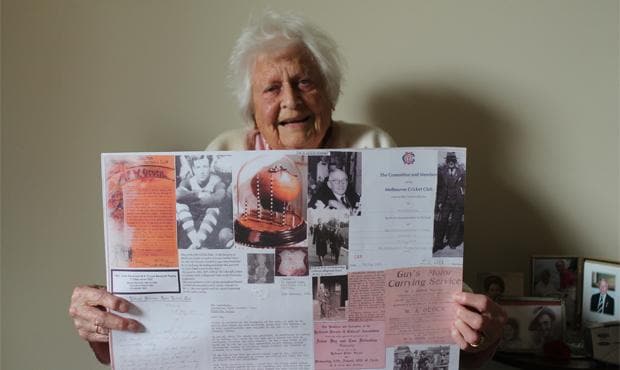
 

There is also a fitting memorial piece written Richard Jones on George’s impact on the Eaglehawk Football Club.

https://australianrules.com.au/2016/04/11/vale-george-ilsley-by-richard-jones/

Mil Hanna’s 50th

Happy 50th birthday to Mil Hanna.


—————

From the Blueseum


Mil Hanna


Career: 1986-1997
Debut: Round 1, 1986 vs Hawthorn
934th Carlton Player
Games: 190
Goals: 83
Last Game: Round 22, 1997 vs Richmond
Guernsey No. 47 (1 game) and 13 (189 games)
Height: 186cm
Weight: 89kg
DOB: 5 April, 1966
All Australian: 1992
Premiership Player: 1995

Milham Hanna was an extraordinarily well built but enigmatic wingman / defender for the Blues in between 1986 and 1997. As an outstanding junior footballer he always seemed destined as being a future senior player with the Blues. He was selected in the All-Australian Team for the 1983 Teal Cup after representing Victoria in the carnival. Hanna was a local lad recruited from East Brunswick.

More commonly called “Mil”, or affectionately as “the Cranium” for Rex Hunt fans after Hanna’s golden barren dome (Hanna was prematurely bald at a very early age, with only fuzzy sprigs of hair at the commencement of his career), Hanna played 190 games for Carlton before retiring in the 1997 season.

Hanna’s debut is perhaps one of the greatest horror stories that can be suffered by a footy player. Much like the Carlton debut of Dean Rice, where he suffered a severe knee injury, but even worse as it was Hanna’s first game overall, Hanna busted his knee in Round 1 of 1986 against the Hawks. He was retained by the Blues but not seen again until Round 7, 1987.

Of Lebanese descent, Hanna had a long right foot kick on him but hardly ever used his left. Sometimes famous for his turnovers, Hanna’s pace and agility meant that he could be played in many positions across the wing or half back, plus the occasional stint up forward. A 5 goal game against the Hawks at Waverley in 1995 sticks in the mind – he was kicking them from everywhere on that day. Hanna also had a distinctive action when tackled of immediately dropping the ball and flapping his arms, giving away the occasional holding the ball free kick.

Hanna was to become a regular in the team over 1989 and 1990, with over 20 games each year, and a 100 game player by the time the Blues hit their straps in the early to mid 1990’s. Interestingly, Hanna was also in our top 5 goalkickers in 1991 with 23 majors at over a goal per game.

Hanna played 19 games in 1993, including our Grand Final loss to the Bombers, a game in which he was knocked heavily by tough-man Dean Wallis in what was arguably a defining moment of the match.

Hanna would play all games in 1994 and 1995, including playing on the wing in the Grand Final. Hanna’s brilliant opening quarter in the “Grannie” cannot be underestimated, with Hanna scorching the outer wing on Aaron Lord (our nemesis from the 1994 finals campaign) and delivering beautifully to Brad Pearce for one special goal in our first quarter onslaught. Geelong switched the wings in the second quarter, giving Kouta to chance to dominate – as he did. But there is no doubt Hanna was a key player at the start of the game.

Mil began to slow down over 1996 and 1997, departing in 1997 after only a handful of games for the year. But he would retire a 190 game Premiership Player for the Blues.

As a footnote, it was common amongst Carlton fans of the era to believe that Hanna’s lack of hair was due to disease. However, my research indicates that it is just baldness, plain & simple. Presumably this will be correct until this section of the Blueseum is updated for a more correct ‘truth’. (Steve)

One of the all-time most under-rated footballers. Capable of brilliant individual bursts that showcased both his dynamic athletic background and raw power His physical frame redefined positional AFL football on the wing. A Lebanese version of Jaime Oliver.

Milestones

50th Game: Round 5, 1990 vs Footscray
100th Game: Round 15, 1992 vs Richmond
150th Game: Qualifying Final, 1994 vs Melbourne

Career Highlights

1985 – Reserves Best First Year Player Award
1985 – Reserves Equal Runner-up Goalkicker 38 goals
1987 – Reserves Premiership Player
1988 – 3rd Reserves Best & Fairest
1989 – 5th Best & Fairest
1991 – Equal 9th Best & Fairest
1992 – 2nd Best & Fairest
1992 – All Australian
1995 – Premiership Player
1997 – Pre-Season Premiership Player

When Clark traded stops for spikes

Jim Clark played 161 games for the Blues from 1943 - 1951. (Photo: Carlton Football Club)

Jim Clark played 161 games for the Blues from 1943 – 1951. (Photo: Carlton Football Club)

On the eve of the 135th running of the Stawell Easter Gift it’s rather timely that Lesley Clark, daughter of the late Carlton dual Premiership wingman Jim Clark, should share this image of her Dad in his silks and spikes sporting the blue sash earned as a footrunner at Stawell.

The photo was captured 70 years ago – not long after Jim, appropriately nicknamed “Racehorse”, took out the 75 yard sprint at Stawell, in what was the first meeting there in four years since the race was abandoned owing to the Second World War.

“For memory the photo was taken in the backyard of Dad’s oldest brother’s place in Kyneton. He was Lloyd Clark, who played with and coached Kyneton,” Lesley said. “Uncle Lloyd was picked up by Collingwood and was listed to play in 1938 or 1939, but he didn’t want to come to Melbourne and chose to stay in Kyneton.”

“My father very much valued that sash. My brother Greg has the sash now, which is good.”


Jim Clark after the Stawell Gift, 1946. (Photo: Clark family)

In the Carlton Football Club’s ’46 Annual Report, Clark’s effort at Stawell was acknowledged by the club – together with his Most Consistent Player Trophy and long service awards hard won at Princes Park.

Similarly, fellow Carlton footballer Jim Baird was commended for “his outstanding success at the Bendigo and Stawell Athletic Carnivals where he started in 15 races for 11 wins and two thirds including 3rd placing in the famous Stawell Gift”, the nation’s richest footrace.

Ditto Vin Brown, who finished fifth in the Gift and, like Clark and Baird, represented Carlton in the Premierships of 1945 and ’47.

Clark was 22 by the time he had played his part in both the ’45 and ’47 Grand final conquests. A three-time Victorian representative, he would later take out the ’51 Robert Reynolds Trophy (now the John Nicholls Medal) for Club Champion.

By then, Clark was 161 games into his senior career and at the peak of his football powers. But he had played his last game for Carlton – the lure of a new house proving too great for him not to accept the role of captain-coach of Echuca.

Those who might like to contribute old photographs or film to the Carlton Football Club archive are urged to contact the historian on 9387 1400.

More By Tony De Bolfo, Carlton Media

Jezza, Fev and the tale of two paintings

Anthony Pavlou stands proudly beside his painting of Alex Jesaulenko's moment of brilliance against Richmond in the 1972 semi-final replay. (Photo: Carlton Media)

Anthony Pavlou stands proudly beside his painting of Alex Jesaulenko’s moment of brilliance against Richmond in the 1972 semi-final replay. (Photo: Carlton Media)

When long-time Carlton Member Nola Frawley fronted up to the Great Northern Hotel for a writers’ group gathering in December last year, her eye was taken by the metre-square painting of Alex Jesaulenko gracing the pub wall.

The metre-square oil, depicting “Jezza” completing the quintessential giant leap for mankind against Richmond in the ’72 second semi-final replay, instantly captured Nola’s attentions.

But what she couldn’t find was the artist’s signature – nor anything else relating to the artwork’s provenance as the resident publican was relatively new to the establishment.

Nola turned to the club for an answer, and within minutes that answer was forthcoming. The brushman was in fact Anthony Pavlou, son of the late former Carlton player, director and past players’ association President Chris Pavlou, who remembered completing the work around 2003.

“I remember painting it. I reckon it was auctioned off at a Carlton past players’ function and I’d forgotten where it ended up,” Pavlou said.

“I normally include my signature and the year of the painting in the bottom right hand corner, but for whatever reason I didn’t do so for this one. I’d actually forgotten where this painting end up, but I’m happy that it’s at the Great Northern, an iconic Carlton pub.”

Pavlou recalled that the painting took him a fortnight and he worked of photographs of the mark, taken in front of the since-demolished Smokers’ Stand at the MCG.

“It took me a long time to paint because of the faces in the background. I wanted to depict the typical non-excitable MCC members.”

The painting subsequently sold at a Carlton Football Club auction for $3500, although Pavlou has no knowledge of the identity of the purchaser.

But in popping into the Great Northern to renew acquaintance with the painting, which carries the signature of Jesaulenko himself, Pavlou confirmed that he would return to the pub to led his own signature to the canvas.

Another famed Carlton No.25 was also the subject of Pavlou’s artistic skills – the former full-forward Brendan Fevola, whose painting now hangs from a wall of the bar in the Yarrawonga Hotel where “Fev” turned out for the Pigeons in his post-AFL years.


The Fevola painting. (Photo: Supplied)

As Pavlou recalled: “The painting was auctioned with ‘Fev’s Yarrawonga guernsey and the owner of the pub bought it”.

Yarrawonga Hotel publican Tony Mitchell confirmed the story.

“There was a pub ‘do’ at the Yarrawonga RSL about seven years ago and I’d just opened the pub. It was an auction for charity and Fev was just making his grand entrance for the Pigeons,” Mitchell recalled.

“A lot of people have their photos taken by the painting and Fev’s a fan of it too.”

Anthony Pavlou is currently establishing a new art studio and encourages any supporters interested in commissioning him to paint their favourite Carlton player to call him on 0419 761400.

More By Tony De Bolfo, Carlton Media

Vale Ivan Rohrt, 1920-2016

Former Carlton President Ivan Rohrt has passed away.

Former Carlton President Ivan Rohrt has passed away.

Former Carlton President Ivan Rohrt, a member of George Harris’ famed Progress Party and a key figure in the establishment of the old Social Club, has died.

Rohrt, whose role as Melbourne City Councillor proved vital to the club’s interests through a golden era both on and off the field, passed away on Wednesday afternoon in a Camberwell nursing home just a fortnight shy of his 96th birthday.

Rohrt’s son Richard said his father simply died of old age – “and he’d always joked that he’d already seen his epitaph at the club”.

“Dad’s surname was often confused with Jack Wrout’s and he remembered that after Jack died he was sitting in the stands when the cheersquad raised the banner upon which were the words ‘RIP JACK ROHRT’.

“Dad felt terrible for Jack’s family and came home saying ‘I’m really spooked – I’ve just seen my name on an RIP’.”

Ivanhoe Borch Rohrt, the son of a Norwegian-born father and English-born mother, was born in the South Gippsland town of Yarram on March 23, 1920.

In an interview with this reporter for the club’s publication “Out Of The Blue” some years ago, Rohrt talked of how he “always had a soft spot for Carlton”, particularly after fate dealt its hand.

That happened when Rohrt’s father, a local cream carter, was advised by a GP that it was in the best interests of his health to ditch the heavy labor and find employment elsewhere.

In 1940, the Rohrts took over the running of North Carlton’s famous watering hole The Rising Sun Hotel (now the chic Italian food and wine providore Enoteca Sileno) at 920 Lygon Street.

“There were 32 pubs in Carlton and we always reckoned we had the best beer,” Rohrt said of The Rising Sun. “If you didn’t support Carlton then your pub was no good, and that was why I was a Carlton supporter.”

In those carefree days, cars were scarce and supporters would tram it to the pub, down a couple of thirst-quenching ales, then hotfoot it up Richardson Street and through the turnstiles into the old ground. Rohrt, who later combined civic duties with those of his family’s hotel business, unhesitatingly declared Saturday “the busiest day of our week”, and such was the frenetic nature of matchday pub life that he was rarely able to get to Princes Park.

Until one day when Carlton got him.

“It was Melbourne Cup morning 1964 and two fellows came in off the Lygon street entrance. One of them said to me ‘Are you Councillor Rohrt?’, and I said yes that I was a Melbourne City Councillor for 15 years (and a member of three major committees, including the finance and public works committees),” Rohrt said.


L to R, Russell Ohlsen, Ivan Rohrt, Mark Maclure, syd Jackson, Alex Jesaulenko and Ian Thorogood, circa 1976. (Photo: Carlton Football Club)

“Initially I thought they were ratepayers coming to talk to me about a hole in the footpath or something. Anyway I said to them ‘I’ll get back to you when I settle down here’.

“It got a bit quieter in the next half an hour and I said ‘What can I do for you two?’ and the taller man said ‘My name is George Harris and this is Eddie Fakhry. You’re a city councillor – would you be interested in joining the (Carlton Football Club) reform group?’. Naturally I said ‘Well, I’ll have to ask the missus’ and my wife Joan was not fussed. After a couple of days of giving it some thought I rang George Harris and said ‘Yes, I’m prepared’.”

Rohrt believed that he was approached to join the Harris ticket in late 1964 after the late Don Chipp rejected an initial approach. Incredibly, he had never previously met any of Harris’ running mates, but was unfazed nonetheless.

As he said: “It was a very exciting time because it opened up a new era for me, and a hotel keeper being involved in the main sport in the area was a good business move too”.

Not withstanding his role in the Barassi putsch, Rohrt’s impeccable connections with the City of Melbourne ensured that he would be a key player in future negotiations to secure funding for just such an entity – and yet the process took a substantial personal toll.

“It was one of the most stressful times I had in public life. My hotel licence was hanging on it and it was a very worrying time for me. I’d put a lot of time into getting the money for Carlton,” Rohrt said.

“It’s been on my mind now and again for many, many years. After the council meeting  was over and we got this money to build the social club, one of the councillors said to me ‘You’re in a bit of trouble, Rohrt’. I said ‘What trouble?’ and he said ‘you’ve got a pecuniary interest. I said ‘pecuniary interest?’. I thought that was putting a quid in your pocket.

Regardless, Rohrt resolved that it would be in his best interests to step aside, albeit temporarily.

“I rang George (Harris) and told him that because I was a hotel keeper I’d run the risk of losing my licence if I was challenged and there’d be a gaol term associated with this,” Rohrt said.

“I said ‘George, I think I better resign’ and George understood.”

At a subsequent meeting, influential Carlton powerbroker Sir Leo Curtis addressed the faithful and strongly urged Harris to reinstate Rohrt if ever a vacancy became available.

“That (a vacancy) happened a few months after that speech and I was grateful to get back onto the board because I loved the club and helped them so much,” Rohrt said.

The Carlton Social Club was officially opened by the former Australian Prime Minister Sir Robert Menzies prior to the first round match with Geelong at Princes Park on April 15, 1968 – the same day the precious talent who was Brent Crosswell made his senior debut in Dark Navy.

By the end of ’69, the social club had generated profits of more than $150,000, vindicating the extraordinary lengths to which men like Rohrt had gone.

A Vice-President at Carlton, Rohrt was later elevated to the Presidency with Harris’ departure. His reign as President was somewhat rocky. On March 31, on the eve of the 1976 season, John Nicholls resigned as Captain-Coach and five days later Secretary Allen Cowie suddenly died.

And yet it was under Rohrt’s watch in that same year that Carlton secured the American-based company Avco for what was then the largest sum ever pledged to a VFL club – $135,000 over three years.

Richard Rohrt said his father was of a time “when Carlton was a family . . . and he loved every minute of it”.

“It really goes back to the old fashioned days when the President and members of the Committee would all gather for training, get their two pennies’ worth in with the match committee and the Chairman of Selectors who was Jack Wrout, then retire to the committee room’s bar where Dad would open up,” Richard said.

“As a man, Dad was tall and well-presented, and nothing was ever a problem. He was one of the longest-serving members of the Melbourne City Council representing the Labor Party and there was nothing he wouldn’t do for anyone. He wanted to represent as many people as he could.”

Rohrt is survived by his beloved wife of 67 years Joan (now 90), son Richard, daughter Susan and six grandchildren.

Funeral arrangements are yet to be finalised.

Carlton players taking to the field for Friday night’s Nab Challenge match with Sydney will wear black armbands as a mark of respect to Ivan Rohrt and the club’s late long-serving bootstudder and Life Member Dennis Turner.

More By Tony De Bolfo, Carlton Media

Blues’ bootstudder dies

Former Carlton bootstudder Dennis Turner has died.

Former Carlton bootstudder Dennis Turner has died.

Dennis Turner, one of the last of the Carlton Football Club’s bootstudders, has died at the age of 79.

Turner served as a senior bootstudder through the late 1980s and 1990s, having completed a myriad of tasks as Carlton’s Under 19 and reserve grade team manager, commencing in 1969. His brother Hugh also officiated as a Carlton trainer.

Bob Lowrie, who started as a trainer with the thirds at Carlton on the same day as Turner, remembered that Dennis would regularly front up at the club of a Sunday morning to cook breakfast for the players when they left the track.

“Dennis also worked behind the bar at ‘Nick’s Nightclub’. He was a really, really good bloke and I had a lot of time for him. He would do anything for the Carlton Football Club,” Lowrie said.

Turner’s commitment to the club was rewarded with Life Membership in 1988 – the same year in which Premiership players Ken Hunter and David Glascott, together with club dentist Dr Don Hall, were similarly acknowledged.

Laurie Carter, the club’s bootstudder until 2007 who worked at the craft with Turner, Lou Saccardo and the late Frank Finn, remembered that they all served through that transitional phase following the introduction of moulded soles.

“When the moulded ones came in with four stops in the top and two in the heel, some of the players wanted a couple more in the heel, so Dennis and me and the others would knock them in – 13, 15 and 19mm,” Carter recalled.

“Fraser Murphy always went for the 19 mil no matter what the weather was like and Stephen Kernahan always wore screw-ins. He said to me one day that his father once said to him ‘If you’re going to play League football you wear stops.”

Carter recalled that Turner combined duties at Carlton with those as a security guard at the Serum Laboratories.

“In the early days when they’d train in the afternoon he’d work in the morning and knock off early to get to the club. Now they train in the morning so it’s all changed,” Carter said.

“Dennis always did his job, and he stood up for others,” Carter said.

More By Tony De Bolfo, Carlton Media

Ex-players/officials in emotional homecoming

Past players & officials reunion Carlton, in conjunction with the Spirit of Carlton, invited past players and officials for a barbecue during the boys training session today.

The past eight decades of Carlton Football Club life were recently represented at the old spiritual home, when former players and officials reunited for a barbecue convened by the Spirit of Carlton.

Ken Hands, the last surviving member of the infamous “Bloodbath” Grand Final of 1945, was there with members of his family. Hands’ old teammates Ken Hopper and Bill Redmond – the latter the club’s first Under 19 Best and Fairest in 1946 – were also in tow.


Three generations of the late Fred Stafford, who kicked the winning goal in the Blues’ 1947 Grand Final triumph. (Photo: Supplied)

From the 1950s, former David Browning, Graham McColl, Ron O’Dwyer, Ron Robertson, Sergio Silvagni and Peter Webster made the pilgrimage back to the ground they remembered as Princes Park, as did Ian Collins, Garry Crane, David McKay, Dennis Munari, Maurie Fowler from the 60s.


David ‘Swan’ McKay with grandchildren Jack, 6, and Ben, 4. (Photo: Supplied)

Jim Buckley, Vin Catoggio, Peter Fyffe, Garry Higgins and Ken Sheldon flew the dark Navy Blue banner for the 70s, while the 80s was represented by David Glascott, Adrian Gleeson, Mark Naley (who jetted in from Adelaide), David Rhys-Jones and Stephen Silvagni.

Andrew Cavedon turned out for the ’90s, as did Simon Wiggins for the 21st century.


Simon Wiggins with his children. (Photo: Supplied)

Representing former officials of the club was Foster Heatley (grandson of the legendary Robert Heatley) and di Pekins, whose grandfather Tom Warne and uncle Bert Warne served as groundsmen for the first 67 years of Princes Park’s life.

Carlton President Mark LoGiudice also attended, together with fellow director Kate Jenkins and CEO Steven Trigg.


The Hands clan, clockwise from left: Ken, son John, daughter Janet, daughter Robyn and granddaughter Louise. (Photo: Supplied)

For Webster, the return to the old stomping ground proved a surreal experience.

“It’s 65 years since I last set foot in the Carlton rooms,” said Webster, the former Carlton vice captain who was photographed with his family in front of the old No.3 locker.

“When I was last here there was the Gardiner Stand, the Heatley Stand and that was it,” Webster said.

“I got a chance to talk to Serge Silvagni, Ken Hands, Ken Hopper and Bill Redmond – they’ve all changed but I haven’t.”

Click here to see Carlton Media’s gallery from the reunion

Robertson, the 30-game half-forward between 1952 and ’56, described 21st century Carlton with its state of the art facilities as “a bit of an eye-opener”.

He was, after all, of a time when football was oh so uncomplicated. Take his recruitment for example.

“I had a strong connection with old Newton Chandler. He was the one who got me down here,” Robertson said.

“I was at the tech school when he first came up to see me, and when he came up he always used to come armed with a big bunch of flowers for Mum. Mum would say to me ‘Oh Ron, I think you ought to go to Carlton with that nice Mr Chandler’. Gee he was an old conman. He was the master of it.”


Ron Robertson (left) and Peter Webster. (Photo: Carlton Media)

In returning to Carlton, Robertson conveyed the sentiments of all present in commending the club and Spirit of Carlton for convening the reunion.

“I’ve been busy up on the farm and it’s been hard to get back over the years,” said Robertson, who made the trek from his old hometown of South Bendigo.

“But it’s great that days like these happen. It’s not all about running out there and kicking the footy, it’s about forming a club that’s united and has good fellowship.”


Three-time premiership player David Glascott pictured in front of the No.32 locker. (Photo: Supplied)

More By Tony De Bolfo, Carlton Media

Ex-Blue seeks club support for cause

Gary Higgins by the locker bearing his old No.29. (Photo: Carlton Media)

Gary Higgins by the locker bearing his old No.29. (Photo: Carlton Media)

Garry Higgins admits that his impetuosity probably cost him his senior career at Princes Park.

But Carlton’s best first year player of 1975 has well and truly found his calling in the community at large – which is why he’s calling on his old club to lead the way in raising awareness to problems associated with family violence.

A hard-working Rotarian in his home town, Higgins is front and centre as Family Violence Coordinator for the organisation’s local initiative Say NO2familyviolence in Maryborough.

Located in Victoria’s Central Goldfields district and boasting an estimated population of 12,500 citizens, the town’s closest regional cities are Bendigo to the north east and Ballarat to the south east, with the smaller communities of Bealiba, Carisbrook, Dunolly, Majorca, Talbot and Bowen- vale-Timor make up the outlying districts.

Regrettably, Maryborough is today known for one of the state’s highest unemployment rates of 11 per cent which is around twice the state average. Worse still, the socio-economic indexes which monitor disadvantage, economic resources, education and occupation, have consistently rated Maryborough amongst Victoria’s worst.

Which is why Higgins, together with fellow Maryborough Rotarians, was mobilized into action.

For Higgins, motivation was based on the premise that remedying the issue was the responsibility of all living within the area.

“Two and a half years ago, the Rotarians of Maryborough undertook a strategic plan, which gave us the direction to focus on our local community,” Higgins said.

“Our club realised that the community itself had to change its own situation, rather than having to rely on members of the bureaucracy who fly in to places like ours, fly out again and leave nothing behind.

“We work very closely with our local council through its welfare department which is called ‘Go Goldfields’ and the state government have put a lot of money into helping us to try to address that disadvantage.”


1975 team photo: Garry Higgins in the back row (centre) standing between Eaglehawk’s Greg Kennedy (left) and Dunolly’s Wayne Deledio, father of Richmond’s Brett.

Higgins said addressing the issue of family violence was a particular focus for Rotary “in a town where high levels of generational disadvantage, unemployment and low literacy and numeracy skills goes hand in hand with it”.

“It’s a hangover from the old manufacturing days, because Maryborough was built on the blue collar industries like the metal and the rag trades which are no longer around of course.

“So we’ve seen a big change to the community.”

Though the statistics paint a grim picture, Higgins hastens to add that there has been a breakthrough.

“When we first started three years ago, 60 per cent of all pre-school age children in Maryborough required speech therapy,” he said. “Now after three years it’s down to 30 per cent and that’s a huge turnaround.”

In terms of its anti-family violence push, Maryborough Rotary enlisted the support of the district’s local police, health service and secondary colleges – together with members of the legal fraternity and actual family-violence victims.

This week, the organization turns to Higgins’ former club, as the Carlton players complete their community visit to Maryborough.

For Higgins, the timing is right – particularly given the obvious culture change to which Carlton has been subjected.

As he said: “What an opportunity for this club to take a lead role in this area”.

More By Tony De Bolfo, Carlton Media

Damian Lang’s 40th

Happy 40th birthday to Damian Lang.


————

From the Blueseum

Damian Lang


Career: 1998
Debut: Round 7, 1998 vs Port Adelaide, aged 22 years, 67 days
1025th Carlton Player
Games: 3 (8 AFL games in total)
Goals: 1 (5 AFL goals in total)
Last Game: Round 9, 1998 vs North Melbourne, aged 22 years, 81 days
Guernsey No. 44 (1988 – 1989).
Height: 191cm
Weight: 78kg
DOB: 3 March, 1976

Lang played 5 games with the Sydney Swans in 1994 and was later rookie listed by Carlton and played 3 games from round 7-9 in 1998. He was a 191 cm forward who could kick goals. In the reserves he could mark on the lead – he wasn’t a pack marker – from 40 metres out on the boundary and slot it through. His shots on an angle were a real highlight, and surely signs of a youth spent in the pocket. Unfortunately, Lang was also only 78kg and wasn’t of the size to be a key forward in the AFL.

He remained on the rookie list from 1997 to 1999 but did not manage a senior game in either of the 1997 or 1999 seasons and was not retained beyond 1999.

In 2000, Damian Lang headed off to play with VFL club Coburg-Fitzroy with ex-Blues teammates Matthew Hogg and Damien Lock. Lang then headed to Ovens & Murray team Wangaratta Magpies for the 2002 season.

Lang was originally recruited from Leeton, NSW.

Ron Barassi’s 80th

Happy 80th Birthday to Ron Barassi.


————–

From the Blueseum

Ron Barassi


Career : 19651969
Debut : Round 1, 1965 vs Hawthorn, aged 29 years, 49 days
Carlton Player No. 768
Games : 254 (50 at Carlton)
Goals : 329 (35 at Carlton)
Last Game : Round 7, 1969 vs Melbourne, aged 33 years, 80 days
Guernsey No. 31
Height : 178 cm (5 ft. 10 in.)
Weight : 83.5 kg (13 stone, 2 lbs.)
DOB : 27 February, 1936
Captain: 1965, 1966, 1967, 1968
Coach: 1965, 1966, 1967, 1968, 1969, 1970, 1971
Premiership Coach: 1968, 1970

Two days before Christmas, 1964, the Carlton Football Club created a furore by announcing that it had signed Melbourne legend and six-time Premiership player Ron Barassi as captain-coach of the Blues for five years. The news rocked football to its foundations; at that time Barassi was to Melbourne what Lennon was to McCartney – or what sunshine was to summer. It was absolutely unthinkable that he would agree to play football for anyone else but the Demons.

Barassi was born to play for Melbourne. His father had represented the Red & Blue in 58 games – including the 1940 flag side – before he was tragically killed in action in World War II. When Ron’s mother remarried and moved to Tasmania, he stayed on in Melbourne to further his promising football career and boarded at the home of Melbourne’s great coach Norm Smith. Under Smith’s guidance, Barassi became a champion. At 178 cm and 83 kg Ron was a solid type, not particularly blessed with an abundance of pure football talent. But he was tough, relentless and an inspirational leader who hated to lose any sort of contest. In Melbourne’s golden era of 1953 to 1964, Ron played in no fewer than eight Grand Finals, winning six Premierships – two as captain. Wearing the same number 31 guernsey as his father, he was the games’ outstanding ruck-rover, and its most recognisable figure. Meanwhile, at Princes Park the Blues were in turmoil. Torn by disputes and divided loyalties, Carlton had made the finals only five times since their last Premiership in 1947. It was time for swift and drastic action. A reform group of committeemen and influential supporters, headed by club dentist George Harris and former star back pocket Laurie Kerr swept to power in an election landslide on December 7, 1964.

Harris became the new President. He immediately declared the position of senior coach vacant, and called for nominations. More than twenty hopefuls replied, including the incumbent, Ken Hands, but few were interviewed – because Harris had heard a whisper that Barassi was interested in spreading his wings into coaching. Harris quickly contacted Barassi and arranged a meeting. After long discussions, Ron expressed interest and promised a quick answer. The following morning he called back, saying; “I’m sorry. I’ve changed my mind. I can’t leave Melbourne.” Harris however, refused the rebuff. At seven o’clock the next morning he was back on the phone to the Barassi home. It took three hours more of earnest discussion, but when Harris did eventually put the phone down, Ron was the new captain-coach of the Old Dark Navy Blues.

The news shook the VFL like never before. Author John Powers in his book The Coach wrote; “The move shattered many people’s beliefs in the traditional concepts of sportsmanship and loyalty. Letters of protest poured into the papers and the Melbourne Football Club. Small boys wept.” Leonie Sandercock wrote in Up Where Cazaly? ; ”It signified a critical point in the development of football in Melbourne, a turning point after which traditional notions of the game revolving around club loyalty meant less and less. It marked the beginning of the new professionalism, in which money and new challenges spoke louder than old loyalties.” Carlton’s tough back-pocket Ian Collins was just bewildered. He later said; “First of all, one committee was in, then they were all out. Then the coach, with whom I’d had four years experience – was suddenly removed, and a player I didn’t like terribly much was fronting up to coach at Carlton. Such things don’t happen very often. They were a shock to the system.”

And indeed there were some shocks in store. Barassi was a fierce disciplinarian as well as a visionary. His coaching ethos revolved around eliminating errors in both the individual and the team. “Practice makes perfect is bullshit,” he would say; “only perfect practice makes perfect.” Most importantly, his methods worked, and the Blues improved markedly from tenth to sixth in 1966 (when Ron himself finished 3rd in Carlton’s Best and Fairest award) to third in 1967. Then, after 49 games in Carlton’s number 31 guernsey, Barassi retired as a player late in the ’68 season, and guided the Blues into the Grand Final against Essendon from the coaches box. Before more than 112,000 people at the MCG, Carlton won a cliff-hanger by three points, and made Ron an instant Carlton legend.

In 1969 Barassi made a surprise comeback for one last game – in round 7 against his beloved Demons, to complete 50 matches for Carlton and ensure that any sons that came along in the future would be eligible to play for either the Blues or Melbourne under the father-son rule as it then stood. However, in an anti-climactic end to a great playing career, Barassi tore a hamstring in the third quarter and was coaching from the boundary line when the final siren sounded to herald a 30-point win to the Blues. Later that year, Carlton met Richmond in the Grand Final, and were were over-run in the final quarter by a fanatical Tiger team that was too quick and too committed for a Carlton side that gave it’s all, but fell short when it mattered most.

Precisely twelve months later came Barassi’s finest hour. It began at half time in the 1970 Grand Final, when Carlton trailed Collingwood by 44 points. With nothing to lose, Ron gambled on a bold tactic that he had nurtured for years – telling his team to play on at every opportunity, and to use handball to keep the ball moving at all costs. He also made some astute positional changes, and sent 19th man Ted Hopkins on to the ground in a forward pocket. In one of the greatest comebacks in finals history, Hopkins ran riot, kicking four goals as the Blues steamrolled Collingwood to win by 10 points.

Ron Barassi departed Princes Park following the 1971 season. In a VFL career in which he played 254 games and kicked 329 goals, he had worn our Navy Blue guernsey in 50 games, kicked 35 goals, and coached six seasons for two memorable Premierships. More importantly, he had swept away the complacent attitudes that existed before his arrival, and built the platform for Carlton’s dominance in the next decade. After leaving Carlton, he made a brief comeback as a player for VFA Club Port Melbourne in 1972 (where, coincidentally, he was coached by Ian Collins) before hanging up his boots for good to become heavily involved in the media.

Two seasons later, he signed to coach North Melbourne in similar circumstances to those that had occurred prior to his arrival at Carlton. The ‘Roos had had a shakeout, and were hellbent on success. Some clever recruiting paid off, and Barassi won two more Premierships at Arden Street in 1975 and 1977. In 1981 he returned to Melbourne at last, but during five years at the helm couldn’t lift them to a flag. Long an advocate of Australian Football as a truly national code, Barassi next answered an SOS from the Sydney Swans in 1993 but couldn’t lift them from the bottom rungs of the ladder in his three year stay. Despite limited success, one of his primary roles in Sydney was to lift the profile of the battling club , and it should not be overlooked that he blooded a lot of youngsters during his time in the Harbour City, many of whom helped them reach the 1996 Grand Final.

Still one of the most recognisable faces in the country, Barassi remains heavily involved in the game that has been his lifelong passion. Melbourne and The Kangaroos have legitimate claims to his allegiance, but he will forever be revered at Carlton for that wonderful stroke of genius – one day in September, 1970.

Vale Carlton’s Rat of Tobruk

The late Colin Prosser. (Photo: Sunshine Coast Daily)

The late Colin Prosser. (Photo: Sunshine Coast Daily)

Colin Prosser, a former Secretary of the Carlton Football Club and one of this nation’s last surviving Rats of Tobruk, has died in Caloundra at the age of 94.

Mr. Prosser was, as reported in the Sunshine Coast Daily, “a frail old man with dementia when his life drew to a close in a Currimundi nursing home last Thursday (February 18).

“But in his day, Mr. Prosser and 14,000 Australian men just like him had been heroes. As the Rats of Tobruk, they held off one of the most strategic ports in the Middle East against relentless attacks by the German and Italian forces for 241 days.”

Born in Victoria in 1921, Mr. Prosser apparently lied about his age to join the army in 1939, not long after the outbreak of the Second World War.

Service records indicate that Mr. Prosser served his country in the Middle East for around two and a half years until 1943. At least some of his time was served in the army field workshop.

Following the war, Mr. Prosser found work as a correspondent for The Argus newspaper in Melbourne and, later, as an ABC broadcaster both in Australia and abroad.

Mr Prosser replaced Cr. Larry Floyd as secretary of the club and Finance Committeeman on September 1, 1955. Quaintly, his Strathmore address and four-digit telephone number were included in the annual report of that year.

1955 was a pivotal year, for it was also Ken Luke’s final year as President, having served in that capacity for a then record 18 years since the Premiership year of 1938.

It was also the year in which Perc Bentley, who commandeered Carlton to the 1945 and ’47 Grand Final victories, relinquished Senior Coaching duties to Jim Francis.

In signing off as Secretary in ’55, Floyd, in a letter of appreciation in Carlton’s Annual Report, wrote;

“To my successor, Mr. Colin Prosser, I wish the greatest measure of success in the carrying out of the many duties that are required from a full-time secretary of a League club. In the short time that I have worked with him, I feel that he has the capacity, enthusiasm and energy for the post and deserves all the support and loyalty that can be given him in the task of getting the Club on to the top of the list.”

Ken Luke also offered the highest praise;

“Your new Secretary, Mr. Colin Prosser, has commenced his duties and already is showing excellent results. He has travelled many hundreds of miles recruiting new potential players. I am sure our new Secretary will be a great acquisition, and we trust that his term in office will bring success to our club, both on and off the field.”

Prosser’s term as secretary was all too brief – ending on August 31 in the Melbourne Olympic year of 1956 when he was replaced for a brief period by the grand old man of Princes Park, Newton Chandler – and later by Allen Cowie.

“It is regretted that because of illness Mr. Colin Prosser had an interrupted season as Secretary,” Chandler noted in the ’56 Annual Report.

“At the end of his term of office, when the President made a presentation to Mr. Prosser, the best wishes of the Club and the committee were conveyed to him for his success in his new sphere.”

Vivienne Kerr, Carlton’s No.1 female ticketholder and the wife of the late former Carlton player and powerbroker Laurie Kerr, remembered Mr. Prosser from his all-too-brief secretarial days.

“Colin was a very nice fellow, a gentle soul, who was a tiny bit fragile when he came back from the war. He was a bit unsure of himself,” Vivienne said.

“He worked with Laurie at The Argus. He had the occasional grand plan . . . he was quite good.

A lovely memory Vivienne has of Mr. Prosser involved the visiting Trinidadian pianist Winifred Attwell.

“Whilst Winifred was in Melbourne on a concert tour, Colin asked her if she would put on a private show for the hierarchy of the Carlton Football Club at The Chevron. We had dinner with her and she played piano for us all night.”

Vivienne believed Mr. Prosser relocated to Queensland not long after his Carlton tenure ended “and Laurie pretty much lost contact with him”.

Mr. Prosser was amongst the last surviving members of Australia’s Rats of Tobruk, who held off one of the most strategic ports in the Middle East against relentless attacks by the German and Italian forces for 241 days.

Five years ago, there were thought to be just 150 Rats of Tobruk still living.

News of Mr Prosser’s passing was conveyed to the club by local funeral director Glenn Greyson, himself a Carlton supporter.

Mr Prosser’s funeral is to be held at the Gregson and Weight chapel at Caloundra tomorrow (Friday), February 26. He and his wife had no children and at the request of his power of attorney, a representative from the Caloundra RSL Sub-branch will read his wartime history at a poppy service.

Mr. Prosser’s carer, Salvation Army volunteer Joy Prior, told the newspaper that Mr Prosser were truly deserving of recognition.

“You see someone shuffling along in a wheelie walker and you don’t know what they’ve done in their life,” she said.

“We enjoy the freedom that we’ve got today because of people like Colin.”

The Carlton players will wear black armbands in memory of Colin Prosser, in Sunday’s NAB Challenge match against Essendon at Ikon Park.

More By Tony De Bolfo, Carlton Media

Precious images emerge from Barassi years

Left to right: Graeme Emanuel, Ron Barassi, Graham Donaldson and John Nicholls embrace at the final siren during the 1968 Grand Final.

Left to right: Graeme Emanuel, Ron Barassi, Graham Donaldson and John Nicholls embrace at the final siren during the 1968 Grand Final.

On the eve of his 80th birthday on Saturday (February 27), Ron Barassi is the subject of never-before-published images captured on or about the time of his much-heralded crossing from Melbourne to Carlton as captain-coach in early 1965.

The digitised images were converted from colour slides belonging to the family of the late Graeme Emanuel – a long-serving member of the Carlton Football Club Board who, with the likes of Laurie Kerr, Sir Leo Curtis and Sir Maurice Nathan, was central to the Barassi recruiting coup.


The late Graeme Emanuel, looking resplendent in the Carlton uniform. (Photo: Emanuel family)

The images were graciously forwarded to the club by Emanuel’s son Craig, who for the past 30 years has lived in California but still follows his father¹s old club with great interest.

“From the age of five, I pretty much followed Dad to Carlton every Saturday,” Emanuel said in an email.

“He and I would sit in the same seats in the Heatley Stand behind the goal posts. We¹d often go down into the rooms before the game and at half-time, then go in again afterwards ­ especially if we won.

“We also used to show up at training frequently on Thursday nights, and hung out at the club on many a Sunday after watching World of Sport . . . great memories.”

Amongst the collection are these candid photographs:


Barassi deep in thought with the then Carlton captain John Nicholls and Chairman of Selectors Gerald Burke at a family barbecue gathering to celebrate Barassi’s much-heralded arrival at the Emanuel family home, Cantala Avenue, Caulfield, around February 1965. (Photo: Emanuel family)


Carlton players partaking in beach cricket at the Balnarring seaside property of Chairman of Selectors Jack Wrout in April 1965. (Photo: Emanuel family)


Adrian Gallagher and Ken Greenwood making the best of it in a leaky boat at the Balnarring property in April 1965. (Photo: Emanuel family)


Left to right: Bert Deacon posing with John Nicholls and Emanuel himself. (Photo: Emanuel family)


The controversial tour to New Zealand in October 1965 when Barassi survived a near-death experience on Mt Cook. (Photo: Emanuel family)


The late Maurie Sankey dons the skiis in New Zealand, October 1965. (Photo: Emanuel family)


The late Maurie Sankey takes the reins of horse in New Zealand, October 1965. (Photo: Emanuel family)

In forwarding these precious snapshots, Craig also assisted the club in providing details of his father’s life, of which Carlton was so very much a part.

“I don’t know where Dad’s love of Carlton began,” Craig conceded, “but perhaps it was because he studied at Melbourne University which was close to Princes Park.”

Craig revealed that Graeme was born in Auckland on March 10, 1934 the son of Joseph and Bernice Emanuel – Bernice having been born in Sydney on December 15, 1903 and Joseph in Brisbane on August 28, 1904. He added that his father married Sandra on April 2, 1957 and practiced as a lawyer until June 1972 when the family relocated to Rumson New Jersey for just under three years.

“Dad had practiced at the law firm of Slonim Velik and Emanuel, a leading entrepreneurial law firm in Melbourne.  His partner Leon Velik was my uncle, that is, the husband of my father’s sister,” Craig said.

According to club records, Emanuel had previously been elevated to the vacant position on the Carlton committee on October 10, 1961. The vacancy had been created following the sudden death on September 12 of that year of Harvey Dunn senior, a former Carlton footballer in the 1920s whose son Harvey junior was the first League footballer recruited under the father/son Rule (with Ronald Dale Barassi, as it happened, the second).

Emanuel, who would also serve as a member of the club’s finance committee and as an honorary Carlton Ground Representative, was described in the 1961 annual report as “a professional man of standing”, with the club expressing every confidence “that he will prove an acquisition to our administrative ranks”.

Never was a truer word spoken, for Emanuel brought clout to a club down but not out – on the cusp of what was arguably its greatest ever era under Barassi with whom he is famously pictured at siren time on Grand Final day 1968, and again following the master coach’s last hurrah in Round 22, 1971.

Emanuel’s role in the getting of Barassi is undisputed, as Laurie Kerr’s widow and Carlton’s No.1 female ticketholder Vivienne Kerr has previously attested.


Barassi has some fun in the snow in New Zealand, October 1965. (Photo: Emanuel family)

“In mid-1963 – I can’t remember the date but one Sunday night – Sir Leo Curtis phoned Laurie. The discussion went that perhaps Laurie might sound Ron Barassi out, so Laurie arranged a luncheon with Ron, I think at the Hotel Australia,” Vivienne recalled in a previous interview with this reporter.

“Laurie was very satisfied emerging from the lunch. He didn’t put Ron in an embarrassing position by saying ‘This is what you must do’. It was just to sow the seed. This was what Laurie did, and that was how he operated. He did some amazing things in his life.

“It was maybe 10 months later that Ron was approached by Graeme Emanuel and Kevin McEncroe on behalf of all members of the [Carlton Football Club] board to put the thing to Ron.”

“I had one sibling, Joanne, who was born in March, 1958.  Together we all moved to the United States in June of 1970, Craig and his sister Joanne relocated with their parents to the United States where Graeme went into business with an associate in starting up a real estate investment company – and investing in a feature film.

“The film he invested in while we were living in America was called ‘Happy Mother’s Day Love George’ starring Ron Howard who today is one of the world’s leading film directors!

“Five years later the family returned to Australia where Graeme furthered his interests in various real estate and other business ventures including a film distribution company.

“Dad sadly died at a very young age after they discovered a brain tumor, but he never ceased to love watching Carlton play and until he was no longer able – we would go nearly every week,” Craig recalled.

“During the years my father was actively involved in the club there were a group of us that would often attend together including the Smorgons, the Newtons, the Beaconsfields and the Barons.  I have continued to be friends with all of them to this day evening though I moved to the United States on February 10, 1985. I have a daughter Sophia and a son David who are 21 and 24 respectively.  My son loves Aussie Rules and often we watch the games on TV in the United States.”

Graeme Emanuel died in Melbourne on November 22, 1978.  He is buried in Springvale Cemetary just outside of Melbourne and is survived by his wife Sandra and his two children Joanne and Craig.

Almost 40 years on, Craig continues to uphold the tradition established by his dear Dad in following the old dark Navy Blues. As he said: “I continued to be an avid Carlton fan, never missing a game in Melbourne and occasionally travelling interstate when the Blues started playing in Sydney and other states – and to this day whenever I return to Melbourne during the footy season I almost always go to a game eat a meat pie and yell at the umpire”.

At Carlton, Graeme Emanuel’s place in history endures – thanks to a few precious images and the very personal recollections of an eternally grateful son.

More By Tony De Bolfo, Carlton Media

Matthew Lappin’s 40th

Happy 40th birthday to Matthew Lappin


———

From the Blueseum

Matthew Lappin


Career: 1999 – 2007
Debut: Round 1, 1999 vs Essendon, aged 23 years, 36 days
Carlton Player No. 1 030
Games: 196 (Carlton; Overall: 251)
Goals: 221 (Carlton; Overall: 247)
Guernsey No. 12
Last game: Round 20, 2007 vs Essendon, aged 31 years, 182 days
Height: 182cm
Weight: 78kg
DOB: 17 February, 1976
Leading Goalkicker: 2001

What a pleasure it is to write a profile on Carlton star, Matthew Lappin. There’s no doubt that “Skinny” Lappin was a club favourite given his small stature, amazing skill levels, freakish goal abilities at times and well, let’s be honest, cheap trade price where we grabbed him from the Saints (together with Pick 58) in return for picks 22 and 53 in 1998. Begley and Schwarze were OK players, but nowhere in the league of our Matty Lappin.

Lappin was originally drafted in 1993 with pick #40. Over 5 seasons with the Saints, it is fair to say that Lappin, although seen to be skilled, underperformed with 55 games and 26 goals.

But the trade to the Blues suited Lappin, who found himself the key small forward on the list. He made an immediate impact, with a Mark of the Year in his first game for the Blues – Round 1, 1999, being leading goalkicker in 2001 (49 from a small forward) and fast became one of the senior players on the team. He has also become very reliable for injuries with minimal games lost, playing 178 games with the Blues between 1999 and 2006 at just under 20 a season.

But the best was probably yet to come. Although Lappin turned down a lucrative offer to join Richmond in 2002 as the Blues fell to the wooden spoon, Lappin was thrown back to defence in 2003 and 2004 and became a key rebounding defender. In 2004, Lappin made the All-Australian team and was very very very unlucky not to win the inaugural John Nicholls Medal, coming third in a tight contest with David Teague and Nick Stevens. The money was on Lappin, who had a standout year. In 22 games at half back he averaged 20.2 disposals and 5.2 marks a game

Lappin had a tougher year in 2005, as the entire team struggled to win matches and was thrown around all over the field. He still played all 22 games, averaging 16.8 possessions, kicking 25 goals and finishing sixth in the Best and Fairest. Come seasons end and some tricky contract negotations, Lappin remained loyal to Carlton, signing up for 2 more years. He was made vice captain in 2006.

In 2006, Lappin played the first 13 games but his unbroken run of 69 consecutive league games came to an end in Round 14 after withdrawing just before the game with a knee injury. He returned in Round 15 but struggled to get into the game, only gathering 7 possessions. He spent the next 2 games in the VFL but returned in Round 18 with renewed enthusiasm and had between 23 & 36 possessions in the final 5 games of 2006. For the seventh straight year, Lappin finished in the top 10 at the club for possessions. Even though 2006 had been an up and down year for Matthew, he again finished in the top 10 in the Best and Fairest.

Lappin would have an up and down 2007; from a slow start in Rounds 1 and 2 to a pivotal forward role in our resurgence in the Essendon clash, to near BOG against the Eagles the week after and 5 goals against the Bulldogs, and then again to a few quiet games in the middle of the year. Lappin would kick 18 goals to Round 15 to prove himself still dangerous around goals. He played his 250th AFL game against St Kilda in Round 17 and again managed to kick a goal.

Shortly after pulling out of the Round 21 clash versus North with a sore back apparently caused by unfolding a stroller, and on a sad day for Carlton, Lappin announced his retirement after 196 games in Navy Blue, and 251 AFL games overall. Unfortunately, Blues fans were not able to say goodbye to Lapin in his final game in Round 20, but he would leave us with 2 lasting memories in that game through his two majors of the day – a wonderful left foot impulse snap from 25 metres out after a contest, and a rollicking bouncing shot from outside of the 50.

Skinny was a Champion player and a favourite of many Carlton fans. Lappin also had International Honours in 2001, 2005 and 2006, proving again that he was one of the best, and most elusive, players in the land of this era.

Lappin’s stellar contribution to the Club was not yet complete, however, with his appointment as an Assistant Development Coach for 2008. The role saw him continue in Northern Blues colours in 2008 before moving to an Assistant (Forward line) Coach role at the Club for the 2009 and 2010 seasons. Lappin became part of Mick Malthouses’ stable in 2011 when he was appointed as an assistant coach at Collingwood.

Would lose weight just looking at a buffet. Although devoid of build his ability to control his body in any number of positions was exceptional. A complete player who could play well above his height when required, his flexibility allowed him to play the role of Mr. Fix-it to perfection.

Milestones

50th Carlton Game: Round 1, 2001 vs Fremantle
100th Carlton Game: Round 7, 2003 vs St Kilda
150th Carlton Game: Round 13, 2005 vs Western Bulldogs
100th AFL Game: Round 21, 2000 vs Port Adelaide
150th AFL Game: Round 2, 2003 vs Collingwood
200th AFL Game: Round 8, 2005 vs Geelong
250th AFL game: Round 17, 2007 vs St Kilda

100 Goals (Carlton): Round 18, 2001 vs Essendon
200 Goals (Carlton): Round 18, 2006 vs Melbourne
100 Goals (AFL): Round 4, 2001 vs Adelaide
200 Goals (AFL): Round 3, 2005 vs Collingwood

Career Highlights

1999 – Mark Of The Year
1999 – 9th Best and Fairest
2001 – Leading Goalkicker
2001 – International Rules Series
2001 – 3rd Best and Fairest
2002 – 10th Best and Fairest
2003 – 4th Best and Fairest
2004 – 3rd Best and Fairest
2004 – All Australian
2004 – Most Carlton Votes in the Brownlow Medal
2005 – Pre Season Premiership Player
2005 – International Rules Series
2005 – 6th Best and Fairest
2006 – 8th Best and Fairest
2006 – Internatonal Rules Series
2007 – Pre-Season Premiership Player

Past players/officials reunion planned

By Tony De Bolfo


The Carlton Football Club is opening its doors to all senior footballers who ever wore the dark Navy Blue guernsey, together with former officials and staff members, to a reunion gathering and free barbecue breakfast at the old ground.

The club, in conjunction with the Spirit of Carlton, is extending the invitation to the aforementioned – together with their wives and/or partners, children and/or grandchildren – to also view a closed training session involving the current-listed footballers under Brendon Bolton’s watch on the morning of Saturday, March 5.

Carlton is opening up the inner sanctum – the locker room – to enable former players to be photographed on the day with their loved ones by the lockers carrying their old guernsey numbers. The club will also hold a free barbecue breakfast at which those players and officials who so ably served Carlton can renew their old friendships.

Recently setting the tone were descendants of dual Carlton Premiership player the late Charlie McInnes – his daughter Laurie Morgan, grandson Luke and great granddaughters Ava and Alexa – who paid the old ground a welcome visit to be photographed in front of ol’ Charlie’s No.31 locker.

For the McInnes clan, it was as if the club had given Charlie back.

“It was absolutely sensational to see Dad’s locker, but to have Luke there and my two granddaughters to share the moment made it really lovely,” Laurie said.

“It means a lot to go back. I’d only ever been in the old rooms a couple of times and they weren’t done up like they are now.”


Charlie McInnes (left) and Rod McLean join Richmond’s Dick Harris in pursuit of the pigskin, MCG circa 1930s. (Image courtesy of Luke Morgan)

Charlie, who died in neighboring Brunswick at the age of 76 back in 1992, represented Carlton in 118 senior appearances from 1938 to 1946, which also took in the wartime years. Those 118 games included the 1938 and ’45 Premiership games against Collingwood and South Melbourne, both of which Charlie started as 19th man.

According to Laurie, her father famously (or perhaps infamously) crossed paths with the former Collingwood rover Lou Richards, when the latter debuted for the black and whites at Princes Park in the 6th round of 1941.

“Lou mentioned Dad in his book and I suspect it’s a tale, but he said he introduced himself to Dad before the first bounce and Dad shook his hand and wished him well – but by the time the ball was bounced Lou was flat on his back having been punched in the face,” Laurie said.

“I remember Dad talking to me about the old boots they used to wear. He said they all wore highcuts, which is why there were never any ankle injuries.

“In truth, Dad was a quiet man. He didn’t say very much and he’d finished playing by the time I was born. But he had a love for Carlton all his life and in later years he used to take me to the old ground.”

As with Laurie, Charlie’s grandson Luke was similarly captivated by the Carlton locker room, specifically the locker No.31.

“It was fantastic to be in the room, it was quite emotional for Mum and it was great to get my girls involved too. They’re only young and this was their first experience in being immersed in the club,” Luke said.

“I was very nervous walking in to the locker room because I know it’s normally off limits. I had that incredible feeling walking in – it was very special and truly exciting.”

Carlton Past Players & Officials Reunion

Where: Ikon Park
When: Saturday 5 March 2016, 9:00am

Expressions of interest to attend should be directed to the form on the following page. http://www.carltonfc.com.au/news/2016-02-09/past-playersofficials-reunion-planned


Spirit of Carlton Legends Lunch – February 28th Carlton vs Essendon Ikon Park

As the Blues prepare to take on archrival Essendon at their traditional home in Princes Park, we’re giving you the chance to soak up all the pre-game excitement and atmosphere right before the first bounce.

On Sunday 28 February the Spirit of Carlton is holding a game-day luncheon in the George Harris Room at Ikon Park.

Col Kinnear will be your MC, while other past players including Geoff Southby will also be in the room.

Your ticket includes a two-course lunch and beverage package, as well as reserved seats to watch the Blues take on the Bombers.

CLICK HERE TO BOOK

Len Cottrell’s 80th

Happy 80th Birthday to Len Cottrell.


——-

From the Blueseum


Len Cottrell

Career: 195859
Debut: Round 3, 1958 v Geelong, aged 22 years, 89 days
Carlton Player No. 715
Games: 12
Goals: 2
Last game: Round 18, 1959 v North Melbourne, aged 23 years, 214 days
Guernsey No. 32
Height: 185cm
Weight: 83kg
DOB: 27 January, 1936

Cottrell played 12 games for the Blues commencing in season 1958. He was recruited from Myrtleford.

In his debut match against Geelong The Age said;
“Recruit Len Cottrell did a splendid job in his first League match but, against a team with stronger rovers, the Blues could have been in trouble.”

He kicked 2 goals and wore the No. 32 Guernsey.

Ian Robertson’s 70th

Happy 70th birthday to Ian Robertson.


————-

From the Blueseum

Ian Robertson


Career : 19661974
Debut : Round 1, 1966 vs Richmond, aged 20 years, 90 days
Carlton Player No. 779
Games : 129 (125 at Carlton)
Goals : 86 (85 at Carlton)
Last Game : Round 8, 1974 vs Footscray, aged 28 years, 120 days
Guernsey No. 34
Height : 185 cm (6 ft. 1 in.)
Weight : 89.5 kg (14 stone, 1 lb.)
DOB : 25 January, 1946
Premiership Player 1968, 1970, 1972

A familiar figure to generations of young fans as a television commentator with the Channel 7 network, Ian Robertson had previously been a star in three Premiership teams for Carlton – an elegant, pacey, versatile player who was a brilliant exponent of the running drop-kick.

Born in suburban Footscray in 1946, Ian Anthony ‘Robbo’ Robertson grew up in the lush farming country around Wonthaggi in south-east Victoria. By his mid-teens, everyone at Dalyston Football Club was predicting a VFL career for the rangy key forward, so early in 1966, Ian’s father wrote to the Footscray Bulldogs, requesting a trial for his son. But when no answer came from the Western Oval, another letter was sent to Carlton Football Club, and the Blues’ new captain-coach Ron Barassi replied with an invitation to a trial game. Impressed with the tall youngster’s attitude as much as his ability, Barassi signed him on the spot, and their association couldn’t have begun at a better time. After years of mediocrity, Carlton had stunned the football world by recruiting Barassi, and the Navy Blues were on the road back to Premiership glory.

Robertson’s first senior game was played on Anzac Day, 1966, against traditional rival Richmond at the MCG. It was a big occasion and Carlton’s half-forward line was very well synchronised. Flankers Bryan Quirk and Jim Pleydell wore guernsey numbers 32 and 33 respectively, while at centre half-forward Robertson made his debut in number 34. The trio kicked five goals between them, but an open, entertaining contest eventually went to the Tigers by one straight kick.

Robbo went on to play eight games in his debut season, switching between centre half-forward, full-forward, centre and wing. At 185 cm he was appreciably taller than most wingmen of that era, yet he was rarely beaten for pace when he played out wide. And his marking skills and penetrative kicking made him an exciting prospect. Although Carlton missed the finals in 1966 by ending up sixth on the ladder, with a little more luck (we lost four games by a goal or less) the Blues might have sneaked into the top four.

Before the 1967 season began, Footscray complained to the VFL that Carlton’s recruitment of Robertson contravened AFL rules. According to the Bulldogs, Ian’s father had assured them that his son would play at the Western Oval before Carlton intervened. Those allegations were strenuously denied by the Blues, and the matter dragged on for weeks – only ending when the Blues reluctantly agreed to settle the matter by clearing our big-hearted ruckman Ken Greenwood to the ‘Dogs as compensation for missing out on Robertson.

Carlton’s determination to hang on to Robbo was quickly justified, when he blossomed into one of the rising stars of the VFL in ’67. Barassi shared the conviction that tall wingmen were an advantage in ideal conditions on the MCG at finals time, and so challenged Robertson to make one side of every league ground his own. More often than not, that’s exactly what he did. He played in all 20 of Carlton’s matches in ‘67, and kept his attacking skills ticking over with a handy contribution of 21 goals. Carlton finished second on the ladder to qualify for ourfirst final series for five years, only to be knocked out of contention by Richmond and Geelong in successive weeks. Even so, there was no doubt that the Blues were building momentum.

The re-emergence of Carlton as a league power began with our 1968 Grand Final victory over Essendon – the Blues’ first Premiership in 21 long years. On a windswept MCG, in front of almost 117,000 spectators, Carlton beat a dogged Bombers team by three points in a low-scoring thriller. The Blues’ superb centreline of Gary Crane, Brent Crosswell and Ian Robertson – aided by the ruck dominance of captain John Nicholls – was the springboard for the Premiership that had been yearned for at Princes Park since 1947.

Boosted by that performance in his first Grand Final, Robbo stepped up a gear in 1969, when his spectacular long kicking and rock-solid consistency made him one of the most popular of Carlton’s stars. After beating Collingwood in the second semi-final of that year, the Blues qualified for their second successive Grand Final as favourites against Richmond. But on match day the Tigers staged a massive form reversal, and with Robbo’s opponent Billy Barrot chopping us up across the centre, they eventually triumphed by 25 points.

The deep disappointment of that loss lasted only until the 1970 Final Series, when Robbo wiped the slate clean with another fine game in the most famous Grand Final of them all. Facing a fit and confident Collingwood at a packed MCG, Carlton trailed by 44 points at half time, forcing Barassi into engineering a football miracle. Urging his team to play on at all costs; to run, to back each other up and handball, handball, handball – he saw his boys come roaring back into the game after the long break. Kicking eight goals to three in the third quarter, and five goals to one in the last, the Blues overwhelmed Collingwood to snatch the flag by ten points. Understandably, Barassi, Robbo and every Bluebagger celebrated long and hard after that incredible day.

Robbo made his fourth Grand Final appearance and earned his third Premiership medal in 1972, this time at the gleeful expense of Richmond. The Tigers had beaten Carlton convincingly in three of their four matches that year, including a replay of the drawn second semi-final. After thrashing the Blues by six goals in the rematch, the Tigers became red-hot Premiership favourites.

However, it was Carlton who came out smoking on Grand Final day, fired-up by the passion of new captain-coach John Nicholls. Looking to unsettle the Tiger’s confidence, Nicholls and the match committee opted for a game plan of all-out attack from the first bounce, and the ploy worked beautifully. In another superb display of skill and accuracy in front of goal, Carlton slammed on a record score of 28.9. 177, coasting in the last quarter to allow Richmond to salvage some pride and finish with a scoreline of 22.18. 150. Robbo controlled his wing all day as part of a dominant centreline, while Peter Jones, Robert Walls, Bruce Doull, Alex Jesaulenko and Nicholls himself were simply outstanding on another glorious day for the Old Dark Navy Blues.

That third ascent to the top of the football mountain marked the high point of Robbo’s career. He had missed only a handful of senior games in the previous five years, but in 1973 he was struck down by injury and played just one game. Form and fitness then eluded him into early ’74, and he was forced to wait until round six before he was given another opportunity at senior level. Whatever the cause, the old spark was proving hard to rekindle for Robbo, but it was still a shock for many Carlton Fans when the club announced that all parties had agreed to his mid-season transfer to – yes, Footscray.

Ironically, Robbo’s last game for Carlton – in round six of 1974, was against the Bulldogs at Princes Park – and ended in a draw! One week later he was at the Western Oval, where he managed just four games before bowing to the inevitable and hanging up his boots at season’s end. In an enviable career, he had racked up 129 games, 87 goals and three Premiership medals.

Happily, Robbo wasn’t immediately lost to either the Carlton Football Club or the wider football community. For many years after his retirement he was a regular on the sports night circuit and later, a long-serving television football commentator. While he was sometimes accused him of bias toward the Blues, most fair-minded viewers appreciated his incisiveness behind the microphone. Carlton supporters on the other hand, loved the obvious fact that Robbo always wore his heart on his sleeve – and his heart beat Navy Blue.

Milestones

50 Games: Round 2, 1969 vs Hawthorn
100 Games:Round 16, 1971 vs St Kilda

Allan Greenshield’s 90th

Happy 90th birthday to Allan Greenshields.


————–

From the Blueseum

Allan Greenshields


Playing Career : 19471949
Debut : Round 1, 1947 vs Melbourne, aged 21 years 86 days
Carlton Player No. 614
Games : 16
Goals : 2
Last Game : Round 6, 1949 vs Geelong, aged 23 years 119 days
Guernsey Nos. 29 (1947-48) and 19 (1949)
Height : 178 cm (5 ft. 10 in.)
Weight : 74 kgs (11 stone, 9 lbs.)
DOB : January 22, 1926
Premiership Player : 1947

A capable utility who was a reserve in Carlton’s 1947 Premiership team, Allan Greenshields spent three seasons at Princes Park without managing to establish himself in a strong Carlton line-up. He earned the wry nickname of ‘Splinters’ in his debut year, by being named on the bench in ten of his thirteen senior games.

Two of those matches were memorable finals victories over Essendon; the 1947 second Semi Final, and two weeks later, the famous last-minute triumph over the Bombers in the Grand Final. Yet despite that promising start to his career, Greenshields played only three more times for the Blues over the next two seasons, and in 1949 decided that perhaps there were more opportunities elsewhere. He played his last match in navy blue against Melbourne at Princes Park in round 6, 1949, and went out on a high note when he slotted both of his Carlton career goals in a solid 39-point win over the Demons.

Later that same year, he turned out for St Kilda, in the first of 57 appearances he would make as a defender for the Saints in a six-year stay at the Junction Oval.

Greenshields played at various clubs, that included; Rainbow, Pascoe Vale and Coburg.