
Serge Silvagni’s 80th

Happy 80th birthday to Serge Silvagni


Career : 19581971
Debut : Round 7, 1958 vs South Melbourne, aged 19 years, 330 days
Carlton Player No. 718
Games : 239
Goals : 136
Last Game: Round 22, 1971 vs Collingwood, aged 33 years, 61 days
Guernsey No. 20 (1958) and No. 1 (1959 – 1971)
Height : 183 cm (6 ft. 0 in)
Weight : 92 kg (14 stone, 7 lbs.)
Date of Birth: June 28, 1938
Premiership Player: 1968, 1970
Best and Fairest: 1962, 1968
Leading Goalkicker: 1959
Captain: 1964
Victorian Representative: 1962, 1963
Carlton Hall of Fame (1989)
Carlton Legend (2016)
Team of the Century

The Sergio Silvagni story mirrors that of thousands of European settlers in Australia following World War II. His parents had arrived years before the start of the conflict and settled in Carlton, but Sergio grew up in a time when his family’s homeland; Italy, had been a recent enemy. Team sports were a perfect a way of assimilating, so he took to the local game in primary school.

By his late teens he was a standout in senior school football with Parade College, and in 1956 he was invited to try out in a practice match with the Under-19 squad at Carlton. With fifty players involved and changes only being made at the regular intervals, he didn’t get a run until after half time – only to be sent to full-back to play on the team’s gun full-forward. In Serge’s words, he “blitzed” the bloke because he was so annoyed at having to wait to get his chance. Only later was he told that the officials at the game knew he could play, but they didn’t call on him earlier because they couldn’t pronounce his name!

The dark-haired, solidly-built kid with determination written all over him forced his way into Carlton’s senior team in 1958. Originally given guernsey number 20, such was his impact that prior to the ’59 season his coach Jim Francis insisted that he switch to number 1. By this time Serge was a rapidly-maturing 21 year-old, standing 183 cm. When not playing or training with the Blues, he continued working in his father’s concreting business – hard physical labour that paid big dividends in the powerful 92 kg physique he developed.

By 1962 Silvagni was established among the very best ruck-rovers in the game and was selected in the Victorian State team. A one-pace performer, he ran and worked as hard in the last minute of the game as he had in the first. He was a superb team player and a strong, safe mark; when Serge took front position or swooped on the ball at ground level, only a Mack truck could shift him. He wasn’t quick, but he read the play superbly and revelled in the fiercest contest.

Carlton made the 1962 Grand Final, only to lose to Essendon by 32 points, with Silvagni named among the best for the Blues. A couple of weeks later, Serge won Carlton’s Best and Fairest award with a record number of votes, polling in 19 of a possible 22 games. And in a portent of things to come, he had already developed a special on-field relationship with the Blues’ emerging champion ruckman John Nicholls.

Two years on, the third member of perhaps the greatest ruck combination of all played his first game for the Blues. Adrian Gallagher came to Carlton from Yarram, and claimed a rover’s spot in the senior team from day one. From 1964 to 1971 Nicholls, Silvagni and Gallagher were the most respected on-ball trio in the game. Nicholls’ brilliant palming, Silvagni’s tenacity and Gallagher’s fluent disposal made them a potent combination.

Serge was honoured with the captaincy in ’64, but the Blues had a poor year, finishing tenth before the sensational arrival of Ron Barassi in 1966 revitalised the club. Two years afterward, Carlton beat Essendon by 3 points in a dour struggle before a record crowd on Grand Final day to claim our first flag in 21 years. Serge was in his element in that ’68 Grand Final, and was among Carlton’s top half-dozen contributors. He then topped off a great season with another Best & Fairest award.

In 1970 we saw him on the podium with a Premiership medal around his neck again, and with that infectious grin still in place after a herculean effort helping the Blues fight back to eventual victory from a hopeless position at half-time against Collingwood. In many ways, that was Sergio Silvagni’s (and Carlton’s) finest hour, because the whole team adopted “Silva’s” never-say-die attitude, and pulled off a football miracle.

Aged 32, Serge wanted to retire after the 1970 triumph, but coach Barassi and the match committee talked him into just one more season. Somewhat understandably, the Navy Blues faded to fifth that year, despite another big-hearted effort from their socks-down champion wearing number 1. When Serge eventually called it quits, supporters from every club acclaimed him. There was open, genuine affection for a man from humble beginnings who made the Carlton Football Club – and the wider community – a better place by his presence.

Happily, the Sergio Silvagni story did not end there. After 239 games and 136 goals, two Premierships, one year as captain, two Best & Fairest awards and two Big V appearances, he went on to further serve the Blues as a committeeman, selector and even a caretaker coach for three matches in 1978. In 1989 he was elected to the Carlton Hall of Fame, and in May 2000 – when the Carlton Team of the 20th Century was announced – Nicholls, Silvagni and Gallagher were right where they richly deserved to be, as the team’s first ruck combination.

Honours kept coming for Serge in 2007 when he was named on the interchange bench in the Italian Team of The Century. At full back in that side, as well as in the corresponding AFL Team of the Century, was Stephen Silvagni – the champion son of a champion father. Then in May, 2016 – only months after his grandson Jack Silvagni was drafted by the Navy Blues – Sergio was awarded the ultimate accolade for a Carlton player when he became an official Legend of the Club.

1971 Poll on Best Ruck-Rovers of All-Time

In third place was the recently retired Sergio Silvagni. Firstly he said he had enough after the 1970 season but was persuaded to don his boots for another year. ‘Old Serge’ will never be forgotten. He was an untidy looking player with his great bulging thighs and calf muscles and the navy blue socks always hanging down over the top of his boots. Off the field Silvagni had a dry personality. In front of the TV cameras he brought many a laugh with his humour. But, despite his unruly football attire, Silvagni was a master of the ruck-rover role. No-one battled harder when the going was tough; when someone had to bore in, head down, into a milling pack, Sergio was just the man. Serge might not have been the most artistic or gifted player the game has produced, but if he made up his mind to get the ball – and that was pretty often – he usually got his way. He won Carlton’s best and fairest award in 1962 and 1968; was captain in 1964; played in the 1968 and 1970 premiership sides and for Victoria in 1962 and 1968. A career that took in 239 games and included 135 goals, which was started back in 1958. (Football Life)

1st – Ron Barassi (Melbourne / Carlton)
2nd – Kevin Murray (Fitzroy)
3rd – Sergio Silvagni (Carlton)

Milestones

50 Games: Round 8, 1961 vs Richmond
100 Games: Round 18, 1963 vs Footscray
150 Games: Round 2, 1967 vs Hawthorn
200 Games: Round 13, 1969 vs Hawthorn

100 Goals: Round 10, 1966 vs North Melbourne

Career Highlights

1957 – 2nd Under 19s Best & Fairest
1958 – 5th Best & Fairest
1958 – Terry Ogden Memorial Trophy: Best First Year Player Award
1961 – Perc Bentley Trophy: 3rd Best & Fairest
1962 – Robert Reynolds Memorial Trophy: Best & Fairest Award
1963 – Arthur Reyment Memorial Trophy: 2nd Best & Fairest
1964 – 5th Best & Fairest
1965 – Arthur Reyment Memorial Trophy: 2nd Best & Fairest
1967 – Perc Bentley Trophy: 3rd Best & Fairest
1968 – Robert Reynolds Memorial Trophy: Best & Fairest Award
1968 – Premiership Player
1970 – Premiership Player
1971 – 5th Best & Fairest
2007 – Italian Team of The Century

Spirit of Carlton Special Resolution

Spirit of Carlton Special Resolution

At our recent AGM (held at 6pm on Tuesday, May 30 at Ikon Park), there was a special resolution for the current year by the Spirit of Carlton Committee and attending members. It was recommended and proposed by the Spirit of Carlton committee that the incorporated entity be de-incorporated and a new structure formed within the administration of the Carlton Football Club.


Incorporation v De-Incorporation – Background Information

  • The SOC is currently a registered incorporated association under Vic Government Consumer Affairs
  • Due to the ever increasing and excessive costs to the SOC and work required by the CFC for achieving annual compliance and auditing under Victorian Consumer Affairs Association rules, the CFC and the SOC have questioned seriously whether the SOC should continue as an Incorporated Association.
  • It was proposed that the SOC could become a special entity of the CFC under the guidance of the SOC committee.
  • As per Vic incorporated Association rules, exiting or de-incorporation requires a formal special resolution to be put at a SOC AGM.
  • A special resolution relating to this proposal was put to the last SOC AGM in May 2017.
  • Members at the meeting argued that there had not been enough background information available prior to that AGM to be able to vote on this special resolution.
  • It was agreed that the special resolution be put to the May 2018 AGM and appropriate background information be forwarded to members prior to the AGM.
  • It should be noted that the CFC Coterie Group, The Carltonians, have recently de-incorporated for the same reasons as above.


OUTCOME: The motion to De-Incorporate was carried and as such the Spirit of Carlton will now become a special entity of the CFC.


IMPORTANT:

  • The existing committee will continue on during the transition and are currently reviewing a committee nominations process under the new structure.
  • The core purpose of the SOC remains unchanged –  Our mission is to bring together past players & officials and current players to renew and build the Carlton spirit and at the same time raise funds to help improve the Carlton team performance and team spirit by running major events on an annual basis. In addition to the above, we aim to provide welfare assistance to past players who are deemed to be in real need of support as well as to help preserve and present the history of the Carlton Football Club.
  • All remaining funds following de-incorporation will be transferred and quarantined within the Carlton Football Club as a SOC budget and administered by the committee.
  • The SOC website remains as is. http://spiritofcarlton.com.au/
  • Moving forward there is no requirement for an AGM. An information night will be held in future to update members as required.
  • Members information will be updated as outlined below.


Spirit of Carlton Committee Formation Process

Following the SOC AGM, a committee meeting was held on Friday the 15th of June. It was recommended that the current committee continue during the transition phase to ensure consistency. A draft of a committee formation process was presented to the committee and is currently under review. Once finalised by the existing committee, the new process will be sent to members and timings for the nominations will be communicated.


Privacy Laws and Communication to Members

It is important to note that under new privacy laws, the new structure will enable the Spirit of Carlton to communicate more freely with its members and the AFLPA via the Carlton Football Club. Members will have greater control over the communications they receive. In the coming months the SOC Committee and CFC will undertake a process to ensure all past and present players & officials contact details are accurate and up to date.


Next Events

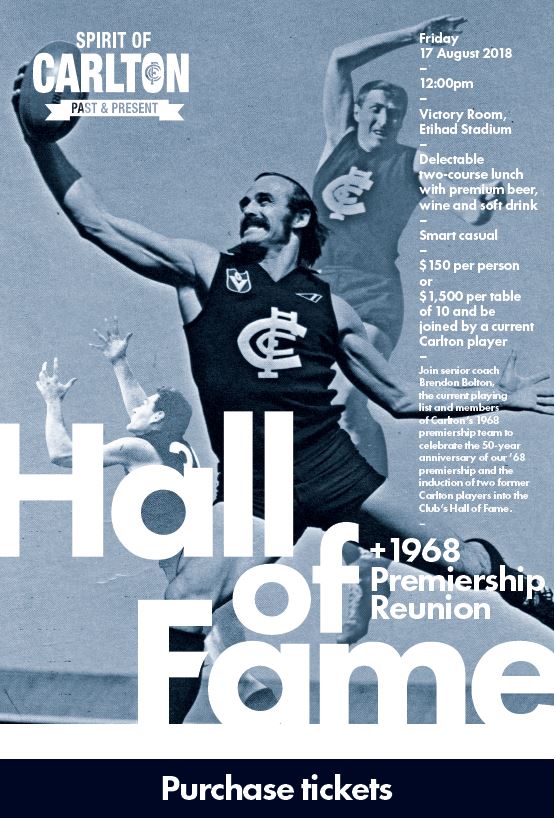
Please note that the next event will be the annual Spirit of Carlton luncheon at Etihad Stadium, Friday 17 August. Join senior coach Brendon Bolton, the current playing list as well as members of the 1968 Carlton Premiership team as they celebrate the 50 year anniversary. There will also be an induction of two players into the Carlton Hall of Fame.


  • SOC Annual Dinner – Wed Sept 12, 6.30 pm Fitz Café Fitzroy


2017 Annual Report

A copy of the 2017 Annual Report is available here for members reference.

Simon White’s 30th

Happy 30th birthday to Simon White


show_image.php?id=35606
Career : 20102017
Debut : Round 4, 2010 vs Adelaide, aged 21 years, 303 days
Carlton Player No. 1127
Games : 87
Goals : 12
Last Game: Round 19, 2017 vs Geelong, aged 29 years, 42 days.
Guernsey No. 43
Height : 190 cm (6 ft. 2 in.)
Weight : 87 kg (13 stone, 10 lbs.)
DOB : 17th June, 1988

West Australian Simon White was recruited by the Blues as a mature-age rookie in the 2010 AFL Rookie Draft. Originally from the Carine Junior Football Club, White made his WAFL debut for Subiaco in 2009, and had a stellar year – earning the Lions’ Rising Star award before playing in their Grand Final loss to South Fremantle.

A versatile, strong-marking defender capable of pinch-hitting roles up forward, Simon was compared to former West Coast Eagle Adam Hunter during pre-draft discussions. When he was still available at number 56, Carlton snapped him up with their fourth round selection, and allocated him guernsey number 43. Only five other players in Carlton’s history have worn this number at senior level, and two of them were all-time greats in David McKay and Anthony Koutoufides.

After an impressive pre-season, White played just once at VFL level for the Northern Bullants before being called into Carlton’s senior team for the trip to Adelaide to take on the Crows in round 4, 2010. Handed the big task of controlling Adelaide captain Brett Burton, Simon did all that could have been asked of him. His 18 possessions and 11 marks, while keeping ‘The Birdman’ to the solitary goal, was influential in a big win by the Blues.

Over the following five weeks, White averaged 15 disposals and almost 8 marks per game as Carton strengthened their hold on a top eight ladder position. He kicked his first career goal with a textbook drop-punt from deep on a flank against Collingwood in round 6, before Hawthorn toppled the Blues by 50 points in round 9, and Simon suffered a knee ligament strain that kept him out of senior football for the rest of the year. Still, the club liked what they saw throughout White’s debut year, and promoted him to the senior list at the 2010 National Draft.

Unfortunately, Simon’s second season mirrored his first, and he just couldn’t shake the curse of injury. He played five of Carlton’s first six matches in 2011, before tearing a hamstring, and that injury kept him out of the senior side for ten weeks. Eventually recalled for round 15, he promptly damaged the same medial ligament that had troubled him previously, and didn’t play again that year. During the off-season, Simon underwent remedial surgery on his knee. As part of that procedure, an artificial LARS (Ligament Augmentation & Reconstruction System) ligament was implanted to help strengthen the joint, but his body tissues did not accept the synthetic fibres, and the repaired ligament ruptured again while White was beginning another comeback with the Northern Blues in round two of 2012.

More surgery and a long rehabilitation program later, he was welcomed back into the Blues’ senior line-up at last for round 19, when Carlton hosted Sydney on a Sunday afternoon at Docklands. Deep in defence for most of the game, Simon collected 15 disposals and nine marks in a solid return, although Carlton’s finals hopes took another heavy hit with a 22-point defeat. White retained his place in the side through to the end of a tumultuous season for the club, and his dedication was rewarded when his contract was renewed for another 12 months. Unfortunately, the same did not happen for senior coach Brett Ratten, who was sacked by the club’s board and replaced by former West Coast and Collingwood Premiership coach Mick Malthouse.

White was overdue for a smile from Lady Luck in 2013, and seemed like he was getting it when he played in nine of Carlton’s first 13 games, before a relatively innocuous incident during a VFL match in late July wrecked another season. Playing for the Northern Blues against Box Hill, Simon tried to duck under an opponent’s tackle, but slipped and copped an old-fashioned “coat-hanger.” Although he was stunned at the time and sat out the remaining minutes of the game, he seemed to make a quick recovery and completed a full training session three days later. Less than 24 hours after that however, a precautionary scan revealed that he had fractured vertebrae at the base of his neck. Eight weeks in a full neck-brace and another four in a collar support wasn’t the best way to see out the season, but with those precautions Simon was at least able to commence his preparation for 2014 on time, and in good shape.

White went on to enjoy his most productive season to date, playing 19 games in a variety of defensive roles that also gave him the freedom to influence the scoreboard when the opportunity arose. On a Sunday afternoon at Docklands in round 16, Simon had a day out against St Kilda, when he started the game in attack, and kicked four majors as the Blues ended a four-game losing streak and slaughtered the Saints by 85 points. Despite that big win however, Carlton still finished 2014 in a miserable 13th spot on the ladder. White’s growing maturity was one of the few positives to emerge from a wretched season, and his contract extension for another two years was well deserved.show_image.php?id=37180

The buzz around Princes Park in the lead-up to season 2015 seemed a good omen for the club, but soon proved to be totally misplaced. The Blues lost their first three games by big margins, and from that point on, the season descended into near-chaos. In late May, as defeat followed defeat, Malthouse was sacked and replaced by his assistant John Barker.

A big factor in Carlton’s demise was that the club was being decimated by injury, and White was among the casualties. During the Blues’ heavy loss to West Coast in round two at Subiaco, Simon had strained the medial ligament in his left knee once more. He played twelve of the next seventeen games, but was rarely at his best before he suffered another knock to the suspect joint in early August. So a fortnight later, the club decided that Simon’s season was over. He would undergo surgery yet again, with the aim of having him ready to begin pre-season training for 2016. Simon accepted that latest set-back with his usual positive attitude, one of the reasons why he was such a popular winner of Carlton’s Best Clubman Award at season’s end.

Former Hawthorn assistant coach Brendon Bolton was appointed to the senior role at Carlton in 2016, and it didn’t take him long to recognise White’s attributes. Given a variety of roles in defence – often in a key position – Simon rarely lowered his colours as he completed another consistent 17-game season.

After playing 11 games in the 2017 White was delisted at the end of the season by the Blues.

2018 – White would join Doncaster East in the second tier of the Eastern League.

Des Lyons’ 80th

Happy 80th birthday to Des Lyons.


Career : 1960
Debut : Round 1, 1960 vs Richmond, aged 21 years, 313 days
Carlton Player No. 729
Games : 2
Goals : 1
Guernsey No. 20
Last Game : Round 3, 1960 vs St Kilda, aged 21 years, 332 days
Height : 183 cm (6 ft. 0 in.)
Weight : 95.5 kg (15 stone, 0 lbs.)
DOB : 9 June, 1938

Throughout the decades after World War II, the football press used to be filled with stories of the “March Champions” – country recruits at each VFL club who were making a big impression in the weeks before the football season began. Invariably, these future stars could “kick a bag of spuds over a wheat silo”, or “flick off a light switch, and jump into bed before the room was dark.” Sadly, such hype was rarely justified, and most of those who showed real potential early often succumbed to home-sickness within a few short weeks.

One such recruit for the Blues was Des Lyons, from Barellan in the Riverina in southern NSW. A powerfully-built 183 cm forward, he had strong hands, good endurance and a booming kick. In 1955, at the age of 16, he had briefly trained with Collingwood, but soon missed the open spaces and went back home. Over the next five seasons, Lyons played senior football with both Barellan and Leeton, where his talent was obvious, and attracted an offer of another crack at first grade football with Carlton.

Des agreed to terms, and bypassed the Reserves to make an immediate senior debut for the Blues against Richmond in the first round of the 1960 season at Princes Park. Wearing guernsey number 20 at centre half-forward, he took some time to adjust, while Richmond held sway and were travelling like winners at the last break with a handy lead of 28 points. The Blues found some extra energy in the last quarter however, and surged back into contention, with Lyons providing a reliable marking target. Carlton kicked 4.5 in a dominant last term – including a long bomb from Des that split the big sticks. Richmond were held to a solitary point for the quarter, and Carlton snatched a nail-biting draw.

Injury kept Lyons out of round 2, but he was back in action on a cold and wet afternoon at the Junction Oval in round 3, when the home side had six more scoring shots than the Blues, only to lose by four points. Shortly afterwards, Des told Carlton that he would not be continuing on. The lure of a family business, along with the comfort of a close-knit community was too strong, and it drew Des home to the bush once more.

Over the next nine seasons, Lyons forged a superb career in Riverina football with Leeton, winning three Premierships, two League Best and Fairests, two club Best and Fairests and the South West District League’s top goal-kicker award in 1967. He represented the SWDFL on 20 occasions, and more than 50 years later, is still regarded as one of the Riverina’s all-time greats.

Footnote:

The Age said of Lyon’s debut;
“Des Lyons played brilliantly in the first half to be the focal point of the Blues’ attack. He was quiet later but splendid marking and accurate kicking made him a constant danger.”

Photo:

Des Lyons in the South West District Football League team, July 28 1963. Courtesy of griffithswansarchive.com

Rod Waddell’s 60th

Happy 60th birthday to Rod Waddell.


Career : 19811982
Debut : Round 18, 1981 vs Geelong, aged 23 years, 70 days
Carlton Player No. 898
Games : 5
Goals : 2
Last Game : Round 8, 1982 vs Footscray, aged 24 years, 357 days
Guernsey No. 10
Height : 178 cm (5 ft. 10 in.)
Weight : 76 kg (12 stone, 0 lbs.)
DOB: 23 May, 1957

Rodney Steven Waddell was a talented, pacey, aboriginal footballer who forced his way into one of the strongest Carlton teams ever assembled when he made his debut for the Blues on the eve of the 1981 finals. Although he was a reluctant recruit at first – having already played Reserves football at Collingwood – Carlton claimed him under the VFL zoning rules in force at the time, and Rod eventually played five matches while the Navy Blues won back to back flags in 1981-82.

Waddell began his senior football career with Southern Districts in NSW, but it was his slashing performance as a ruck-rover for Lalor in the 1980 Diamond Valley Football League Grand Final, against Reservoir-Lakeside, that made VFL scouts take notice. Collingwood and Carlton soon became involved in a tug of war over his services, and the Magpies seemed to have come out on top when Waddell turned out for two Reserves games with them early in 1981. Carlton however, was convinced that the 23 year-old was residentially tied to us, and a VFL investigation quickly agreed. Collingwood were fined $500 for flaunting the zoning rules, and stripped of the four competition points they had earned with Waddell in their team. Rod was then welcomed to Princes Park, and presented with our number 10 guernsey.

After spending most of the remainder of 1981 with Carlton’s Reserves, Waddell was eventually called into the seniors in August, as one of six changes for the round 18 Match of the Day against Geelong at Princes Park. Stationed on a half-forward flank, he flashed in and out of the game, kicked a nice goal, and had a grandstand view as Carlton’s mercurial forward Peter Bosustow took Mark of the Year. Carlton won by 33 points, in a fitting tribute to champion defender Bruce Doull in his 250th game.

While elbowing his way up into the senior side was a creditable achievement by Waddell, the bigger task by far after that was to stay there. After all, Carlton had assembled a fleet of midfield runners that was the envy of every other club, and Rod faced intense competition for his place in the side each week from a galaxy of stars such as Ashman, Buckley, Sheldon, Harmes, Marcou, Keogh, Armstrong and Glascott. Although Rod didn’t lack self confidence, it was a daunting prospect indeed.

Waddell’s second match came on a Sunday afternoon at the MCG against South Melbourne in round 19, when he came off the bench to replace his captain Mike Fitzpatrick during the third quarter, and helped his side to 23-point win. His third was another unforgettable occasion; the second Semi Final against Geelong on the wide expanses of Waverley Park, in front of a crowd of 66,000. Waddell had a relatively easy day and warmed the bench for most of the game, as Carlton dominated the second half, and qualified for the Grand Final with an emphatic win by 40 points.

During the fortnight leading up to the Premiership-deciding clash between traditional rivals Carlton and Collingwood, the Blues’ concerns revolved around two players who were automatic inclusions if fit; full-back Geoff Southby, and rover Rod Ashman. Southby was never a real chance of playing because of a torn thigh muscle, and he was replaced on selection night by Scott Howell. Ashman, however – with ongoing concerns about a knee – only convinced the selectors he was right on the day before the match, and Waddell was the obvious choice to make way for him. On that fabled Saturday afternoon, Howell and Ashman both put in solid efforts in a spine-tingling contest that eventually fell to the resolute Blues by 20 points.

As Carlton set about defending that hard-fought flag in 1982, Waddell managed two more senior appearances by round 8, but then was informed by the match committee that his future lay down the Western Highway at Geelong. The Cats, knowing full well the depth of talented small men at Princes Park, had approached the Blues to secure the services of Waddell, and come up with an offer hard to refuse. Waddell too, realised that he would get far more opportunities at Sleepy Hollow, and was happy to make the move.

Rod added another 20 senior matches and 10 goals to his credit over the next three seasons, although the highlight of his time with the Cats was his dominant game in the 1982 Reserves Grand Final defeat of St Kilda. Playing as a ruck-rover, Waddell kicked six goals and was clearly Best on Ground.

After finishing at Geelong in 1984, he headed off to Darwin in the off-season and took part in another Grand Final when his team Nightcliff lost to St Mary’s in that season’s NTFL Grand Final. He then returned to Victoria, and rejoined the Lalor Bloods to finish off an interesting and varied career. He would later play at Ararat and Marong Football clubs.

Rod Waddell’s sister is the mother of Geelong premiership player Steven Motlop.

Scott Freeborn’s 40th

Happy 40th birthday to Scott Freeborn.


Career: 2000-2002 (Listed Player: 1998-2003)
Debut: Round 5, 2000 vs Essendon, aged 21 years, 324 days
1039th Carlton Player
Games: 48
Goals: 17
Last Game: Round 9, 2002 vs Adelaide, aged 24 years, 6 days
Guernsey No. 17 (2000 – 2003).
Height: 183cm
Weight: 87kg
DOB: 20 May,1978

Scott Freeborn was a blonde-haired left footer originally rookied by the Blues in 1998. Brother of Collingwood / Kangaroo player Glen, Scott played 48 games for the Blues between 2000 and 2002. He was recruited from Port Adelaide Magpies, but also played for Woodville-West Torrens.

Freeborn’s time on the rookie list was spent on the wing and half forward, in the No. 46 guernsey (1998 – 1999). His form was sufficient to be promoted by season 2000, when he made the seniors for the Round 5 clash against the Bombers. Over the season, he played as a defensive midfielder where his strength and endurance were most useful. Tight as a player, Freeborn also was an oddity in that he would slice his preferred left foot often, kicking the occasional airball.

In 2001, Freeborn played almost the entire season of 23 games in defence, including finals performances versus Adelaide (win) and Richmond (loss)- missing just one game due to a thigh injury. Come 2002 however, he would manage just 7 games- missing the start of the season with an Achilles injury and suffering a broken collar bone mid season, which would force him to miss the remainder of that year. Osteitis pubis and a debilitating foot injury would then severely impact on his career, forcing him to miss the whole of season 2003 without playing a single game and he was then delisted.

Career Highlights

2000 – Best First Year Player Award

Scott Howell’s 60th

Happy 60th birthday to Scott Howell.


show_image.php?id=38830
Career : 19801985
Debut : Semi Final, 1980 vs Collingwood, aged 22 years, 126 days
Carlton Player No. 866
Games : 39
Goals : 12
Last Game: Round 6, 1985 vs Essendon, aged 26 years, 359 days
Guernsey Nos. 40 (1976 – 82) and 12 (1983 – 85)
Height : 193 cm (6 ft. 4 in.)
Weight : 88 kg (13 stone, 12 lbs.)
DOB: May 10, 1958
Premiership Player 1981

The only third-generation Premiership player in VFL/AFL history, Scott Howell spent nine seasons at Princes Park, beginning with the Under 19 team in 1976. Like his champion father Jack “Chooka” Howell, Scott was a loyal servant of the Blues, and he made the most of his ability with a memorable game in the 1981 Grand Final.

“Chooka” Howell played 137 matches for Carlton from 1942 to 1954, including the desperately-close ’47 Premiership victory over Essendon. Some 25 years earlier, Chooka’s father, Jack (Senior) was Best on Ground for South Melbourne when the Bloods beat Collingwood for the 1918 flag. So Scott’s triumphant victory in 1981 – also over Collingwood – completed the Howell family’s unique achievement of three Premierships in successive generations.

Scott was recruited by Carlton from East Sandringham as a 17 year-old in 1975. He developed his craft as a mobile tall defender in the thirds and seconds teams for four seasons, until he was called into the Blues’ seniors for the cut-throat first Semi Final against Collingwood in 1980. That made Scott only the second Carlton player to make his debut in a final, after Maurie Beasy in 1920. Starting on the interchange bench, Scott was sparsely used as Carlton went down to a rampaging Collingwood by 50 points. First-year Blues coach Peter ‘Percy’ Jones was then promptly sacked, and replaced by ex-Hawthorn Premiership coach David Parkin.

Under Parkin, Carlton collected the minor premiership in 1981, before brushing aside Geelong in the Second Semi Final to set up yet another Grand Final showdown against Collingwood. The Magpies had beaten the Blues in each of their three previous clashes that year, and their prospects were boosted in the lead-up to the game when Carlton’s champion full-back Geoff Southby was ruled out with a lower back injury. The player Parkin chose to replace Southby was Howell, who had enjoyed a consistent season of 14 games in the Blues defence.

In the 48 hours prior to the Grand Final, all eyes were on Victoria Park and Collingwood’s captain Peter Moore; their 198 cm star ruckman/forward and 1979 Brownlow Medallist, who was battling to recover from a hamstring strain he had suffered in the Magpies’ narrow Semi Final win over Fitzroy. After their last training session, Collingwood coach Tom Hafey gambled by selecting his match-winner as a permanent forward pocket, with the aim of stretching the Blues’ defence. David Parkin countered by assigning Howell to shadow Moore, and told him to run the Magpie skipper up the ground at every opportunity. Scott carried out his instructions to the letter, and although he had only a handful of possessions himself, Moore was hardly sighted. Carlton dominated the second half of the match to win by 20 points, and Howell completed the remarkable three flags in three generations feat for his family, whilst also becoming the first (and so far, only) Blue to wear guernsey number 40 in a Premiership team.

Although his career at Princes Park lasted another four years after that 1981 triumph, Howell was never able to claim a permanent place in a formidable Carlton team that remained a flag contender for more than a decade. He was overlooked for the 1982 flag side, and in 1983 changed his playing number from 40 to number 12. That same year, he warmed the bench when Carlton’s season ended with a 33-point defeat by Essendon in the Elimination Final.

Scott’s last senior game for the Blues came at Windy Hill in round 6 of 1985 against Essendon, when the Bombers thrashed their visitors by 109 points. It wasn’t the best way to finish up, but happily Scott’s place in Carlton’s history was already resting on more positive achievements. He played out the rest of the year with Carlton Reserves and experienced the thrill of one last Grand Final at the MCG when the Blues were beaten by Hawthorn in front of a massive crowd.

In 1986, Howell and his Premiership team-mate Mario Bortolotto were cleared to VFA club Sandringham. The Zebras took advantage of Scott’s versatility, and his first two years were outstanding. Playing primarily in the ruck, Howell kicked 36 goals in 36 games, and won consecutive Best and Fairests in 1986 and 1987. Injury curtailed his third season however, and he retired at the age of 30 in 1988.

Career Highlights

1976 – 4th Under-19s Best & Fairest
1981 – Premiership Player
1983 – Night Premiership Player
1984 – 6th Reserves Best & Fairest
1984 – Reserves Best Clubman Award
1985 – 5th Reserves Best & Fairest

Phil Poursanidis’ 50th

Happy 50th birthday to Phil Poursanidis.


Career: 1988-1989
Debut: Round 6, 1988 vs St Kilda, aged 19 years, 364 days
952nd Carlton Player
Games: 3
Goals: 3
Guernsey No. 49 (1988 – 1989).
Last Game: Round 22, 1989 vs Brisbane, aged 21 years, 117 days
Height: 192cm
Weight: 87kg
DOB: 9 May, 1968

Poursanidis was seen as a key forward prospect when he was recruited from the Paramount Football Club in the mid-eighties, he would play two seasons with the Carlton thirds and captained the team during the 1987 season. The highlight of his time at Carlton came when he kicked eight goals in a Reserves Grand Final win in a twenty point win against the Saints.

He was given three senior games at full-forward over 1988 and 1989, but could only manage three goals. Although he was a good mark, he was considered only as a full forward and unfortunately was never tried in other positions. He made his debut in the same game as Gerard Butts and Michael Garvey.

Poursanidis would later play a season at VFA club Preston before hanging his boots up at the age of 25.

Career Highlights

1986 – U/19’s 4th Best & Fairest
1987 – U/19’s 4th Best & Fairest
1987 – U/19’s Captain
1987 – Reserves Premiership Player
1988 – Reserves Leading Goalkicker 40 goals (5th in the competition)

Upcoming Event: AFLPA Game Day Function

AFLPA Game Day Function

Date: Sunday, 20th May, 2018: MCG
Venue: Medallion Club Dining Room (in the Great Southern Stand)
Enter Gate 6 and take Lifts 14 & 15 to Level 2.
Cost: $30 per head (This includes entry to the MCG, Platinum seating on 2nd level, and before game gourmet canapes and half-time finger food) NB: Cash Bar facilities are available.
Dining Room open: 11.45 am
Game start: 1.10 pm
Enquiries: Call Ciaran Sheehan (AFLPA)
Ciaran Sheehan
Alumni Programs Coordinator
D: 03 8651 4366 | M: 0409 020 054 | www.aflplayers.com.au

Former ruck-rover Tom Jones dies

Tony De Bolfo, Carlton Media

Former Carlton footballer Thomas Jones, a seven-game senior player with the club through 1951 and ’52, has died at the age of 87.

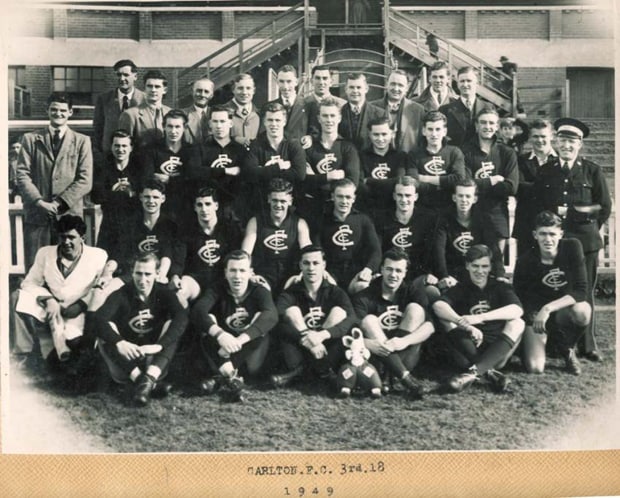
Recruited from Altona, Jones pursued his football dream through the club’s Under 19s outfit for which he was a Premiership player in 1948 and ’49, and then its reserve grade outfit where he also savoured Grand Final victory in 1951 – the year he also completed his senior debut. He is pictured amongst the 49ers at Princes Park, the tallest of the Carlton players standing in the back row.

An old teammate from the 49ers, Hugh Cornell, remembered Jones taking on ruck duties back then.

“Tom was a big fellow, he featured in the ruck. I’m afraid I lost track of him. He was very tal, and very strong, and made all the difference when you’ve got someone like that.”

“I’m afraid I lost track with him in recent years, but I remember him as a very pleasant fellow to deal with. He was a nice person.”

1949 U19 Team Image
Tom Jones (the tallest player pictured) featured in the 1949 U19 team. (Photo: Carlton Media)

Jones’ first senior appearance came in the 16th Round of 1951 against Fitzroy at Brunswick Street, when he was named ruck-rover. He completed his senior debut with Bill Milroy and George Stafford.

The dramatic contest ended in a draw, with the lively Keith Warburton booting five goals for the visitors.

Recalled after a long layoff for the 9th round contest with Richmond in 1952, Jones savoured his first Carlton victory, by a solitary goal, in a low-scoring affair at Punt Road.

That afternoon, white waterproof footballs were used for the first time.

Round 10, 1952 saw Jones play his part in a 55-point win over Footscray at Princes Park, with Jack Spencer booting six goals in an inaccurate team tally of 15.22.

The following week, Jones booted two goals in the Blues’s comfortable 37-point win over Hawthorn at Princes Park – a match best remembered for Ollie Grieve’s report by a boundary umpire for attempting to strike a spectator.

At the subsequent hearing, Grieve told members of the Tribunal that he merely had lost balance after flying for a mark and had crashed into the boundary fence and the hapless spectator. The charge was promptly thrown out.

Named in a forward pocket for the 12th Round of 1952, Jones booted a goal in another drawn contest, with Carlton and Melbourne locked at 50-50 when the final siren sounded. The following week, he contributed to a hard-fought win over North Melbourne in sodden conditions at Princes Park. 

Incredibly, Jones’ seventh and final senior appearance for Carlton – the Round 14 contest of 1952 with South Melbourne at the Lakeside Oval – mirrored his first and fifth matches matches, with final scores dead level.

In 1953, Jones resolved to pursue his playing career with Footscray, stringing together 13 senior appearances through the ’53 and ’54 seasons.

Jones died peacefully on April 20. His wife Coral predeceased him. He is survived by sons Brad, Steve and Michael, daughters-in-law Susan, Tish and Angie, and four grandchildren.

Tony Lynn’s 50th

Happy 50th birthday to Tony Lynn.


Career: 1994-1996
Debut: Round 3, 1994 vs Geelong, aged 25 years, 346 days
995th Carlton Player
Games: 27
Goals: 14
Last Game: Round 1, 1996 vs Collingwood, aged 27 years, 337 days
Guernsey No. 15
Height: 178cm
Weight: 78kg
DOB: 29 April, 1968

Tony Lynn was a right foot, back pocket player with a distinctive bowl style haircut, who played for the Blues between 1994 and 1996. Originally from Queensland (Morningside), but drafted from Central Districts in South Australia, Lynn was most probably picked up by the Blues after a fantastic game for the Allies where he had the ball on a string. He played his first game for Carlton just before he turned 26 years of age.

Lynn would play 27 games for the Blues, including 20 in 1994. A nuggety looking player, on occasion Lynn could roost a 50 metre goal and seemed to revel in running forward despite predominantly being played back. He kicked 14 goals overall.

Lynn turned up for the Brisbane Bears for a Season in 1988, in his time with the Bears he played six games and booted five goals.

Career Highlights

1995 – 2nd Reserves Best & Fairest

To the memory of Don Hall

Tony De Bolfo, Carlton Media

DON Hall, a 10-game Carlton senior player in three seasons from 1958, has died after a short illness at the age of 80.

Born in Trafalgar, but recruited to Carlton from the late Vin Waite’s Morwell Football Club, Hall was nine days shy of his 21st birthday when he donned the dark Navy Blue guernsey for the first time at senior level. That was when he followed his captain Bruce Comben down the race and onto Princes Park for the Round 8 match of ’58 against Hawthorn.

In so doing, Hall, wearing the No.34 now sported by Andrew Phillips, became the 719th player since the VFL foundation season of 1897 to represent his club.

Named 20th man for that contest, and taking his place on the pine with Vic Garra, Hall savoured the moment, as the Jim Francis-coached Carlton accounted for the visitors by eight points.

His final appearance came in the fifth round of 1960, against Essendon at Windy Hill, on a day in which Leo Brereton (named alongside the former in a forward pocket) booted six goals in a losing team.

Hall’s son Peter said that while his father rarely reflected on his League career in the presence of others, he did open up to me “and I was pretty proud of him”.

“Dad told me that at Carlton he played in every position known to man and he did boast that he once kicked three goals on Verdun Howell,” Peter said.

“He was also a very good drop kick. He could hit the centre of Princes Park with a drop from full-back, but he also played forward and though he only stood six foot he played ruck. He had a good jump and a bit of speed.”

Hall1958Team
Carlton’s team of 1958. Don Hall is pictured in the back row, second from the left. (Photo: Carlton Football Club)

Asked the reason for his father’s all too brief time with the old dark Navy Blues, Peter explained that his father’s trade was the priority at the time.

“I think he was very proud and quite content with what went on,” Peter said. “He would have liked to play a few more, but circumstances dictated that. He was a builder by profession and in truth building came first and foremost and sport second.

“I know his time at Carlton was short and I think at one point he even asked for a clearance to Collingwood but thank God he didn’t get it. I just couldn’t have handled that.”

Beyond the Blues, Hall represented VFA club Oakleigh before heading across the border to Lockhart in the New South Wales Riverina.

“Footy got him up there and being a builder meant that he could also find work pretty easily – and he ended up coaching five teams there, from juniors through to seniors,” Peter said.

But Hall always kept an active interest in the fortunes of the Carlton team. A cherished moment was returning to a past players function some 15 years ago, and being reunited with Comben and also Sergio Silvagni, who completed his Carlton debut in that same season of 1958.

As Peter said of his father’s time at Carlton: “He loved it”.

“We lived in Geelong when Gary Ablett senior started playing and he fell in love with him, so much so that he used to say he barracked for Geelong. But don’t worry, he was a Carlton supporter through and through, and so am I . . . ”

Don Hall died peacefully in an aged care facility in Warrnambool on Monday. A private funeral was subsequently held at his request.

He is survived by his wife Helen, son Peter, daughter Natalie, daughter-in-law Kathy three grandchildren and three great grandchildren.

The Carlton Football Club also wishes to acknowledge the recent passing of lifelong supporter Keith Brown, aged 100.

In late January, Keith celebrated the significant milestone at the Mentone RSL by donning the famous dark Navy Blue guernsey presented to him as a birthday gift by Jed Lamb. On that occasion, Keith spoke of his fond memories of home matches at Princes Park and of his favourite all-time player the legendary Harry ‘Soapy’ Vallence.

College, kinfolk combine for Chapman

Tony De Bolfo, Carlton Media

A TOTAL of 1194 men – the first of them Jimmy Aitken, the most recent Lochie O’Brien – have represented the Carlton Football Club at senior League level since the VFL’s foundation season of 1897.

Until today, all but 229 of that illustrious corps were represented by at least one portrait image safely stowed within the Club’s ever-expanding digital archive.

Now make it 228. For with the assistance of Scotch College Archive & Museum Archivist Paul Mishura, a glorious image of Etienne Samuel ‘Sam’ Chapman has surfaced, more than 120 years after he first laced a boot for the old dark Navy Blues.

ChapmanPic1.jpg
A portrait of former Blue Etienne Samuel Chapman. (Photo courtesy of Scotch College Archive & Museum)

Chapman is one of 11 Carlton players known to have been schooled at Scotch, amongst them Liam Jones. The 11 in order of senior debut with this Club are as follows;

William ‘Winky’ Weir (who represented his club in the historic opening round of the fledgling 1897 season), Chapman (Round 2, 1897), the club’s first Irish-born footballer Frederick Scott (Round 4, 1902), Jim (later Sir James) Kennedy (Round 1, 1905), Johnny Davies (Round 8, 1922), one-game player Ralph Peverill (Round 3, 1929), Bruce Scharp (Round 16, 1930), 1938 premiership player Jim Park (Round 4, 1932), David Honybun (Round 1, 1984), Ian Muller (Round 14, 1984) and Jones (Round 1, 2015).

And through the diligence of Petrina Dakin, to whom Chapman is a maternal great grandfather, the following story can accompany this precious image of the then 15 year-old, a member of Scotch’s Premiership-winning XI of 1891.

Etienne Samuel Chapman (1876 – 1949)

Etienne Samuel Chapman was the ninth child and the first son of Edward Samuel Chapman and Talitha Jane Chapman (nee Woolley). His parents were both born in Hobart, Tasmania, in 1842. They married in 1860 and moved to Melbourne in about 1863. The couple had 14 children.

Etienne’s father was known as ‘Augur’, a famous racing writer and sporting editor of The Australasian, weekly sister paper to The Argus, in the 1870s-1890s, until his untimely death from tuberculosis in 1892 aged 50.

Etienne was born on 26 April 1876 at the family home in Albert St, East Melbourne.

He attended Scotch College from 1888 to 1894. He was a keen sportsman and represented Scotch in football and cricket. He played in the Football First XVIII in 1892-93 and the Cricket First XI in the years 1891-94.

Etienne received a prize in football and cricket at the Scotch College speech day in 1892, according to a report in The Argus.

(Another) photo of Etienne has been found recently, thanks to the digitisation of The Australasian newspaper on the Trove website. He appears in a photo of the Scotch College cricket first eleven in December 1893, taken at their pavilion during a break in a game with Geelong Grammar.

An accompanying article, written by ‘Old Boy’, said the cardinal and blue sash of Scotch had not known defeat in several seasons. Etienne was described as “a good sportsman. He is one of the hard-hitting order”. It also mentioned his past success in football, although his form had dropped away that year.

Etienne regularly competed in school athletics, and was a star performer at the annual school sports meeting held on the Melbourne Cricket Ground on 13 November 1891. According to a report in The Argus, he won three track events and one field event in the Under 16s section, and named overall Under 16 champion with 23 points. He won the 100, 440 and 880 yard flat races, as well as the long leap event, and came second in the 120 yards hurdles. In the Open Events, he came third in Throwing the Cricket Ball.

His younger brother Percy Shakespeare was also at Scotch for one year (1892), and Etienne’s son Jack Edward Chapman was there from 1918 to 1921.

It is family legend that Etienne carved “E. S. Chapman” into a window sill at Scots Church in Collins Street, Melbourne. A relative says she saw the carved name many years ago; however the family has been unable to locate it again.

In an obituary of his father, The Australasian racing writer and sporting editor Edward Samuel Chapman, known as “Augur”, in The Mercury on 10 June 1892, the writer states: “Deceased … leaves a widow and large family, one or two of the sons being remarkably talented youths.” This can only refer to Etienne Samuel and brother Percy Shakespeare (a third brother died in infancy).

ChapmanPic2.jpg
The 1893 Scotch College cricket team. Etienne is shown on the left, leaning on the post, holding the cricket bat. (Photo: The Australasian)

It is possible ‘Augur’ named his son after Etienne de Mastre, the owner of the first Melbourne Cup winner, Archer. He would have known de Mastre for many years.

Perhaps the family wanted to name him ‘Edward Samuel’, the same as his father and grandfather. However, his mother Talitha Woolley already had a child called Edward, born prior to her marriage. The choice of the name Etienne Samuel did continue the tradition of the initials of his forebears, E. S. Chapman.

In football, Etienne played for the Victorian Football Association team Fitzroy while still a Scotch student. In a match report in The Argus on 15 May 1893, he was described as “a sturdy young Scotch College colt, who never got the ball without doing something useful with it.”

The Blueseum website biography of ‘Sam’ Chapman says he played for three VFA teams before joining Carlton – Fitzroy, St Kilda and South Melbourne. However, according to historian Dr Mark Pennings, who with fellow historian Robert Pascoe is currently researching details of all pre-VFL players, this is incorrect. Club records show Sam only played for Fitzroy, in three games in 1893: May 13 v. St Kilda (he played on the wing), May 27 v. Port Melbourne (half forward flank) & June 17 v. Geelong (forward pocket).

Pennings says Chapman played with the “South St Kilda” club in a minor league before he was recruited by Carlton for its inaugural year in the newly formed Victorian Football League competition in 1897. According to an article in school publication “Great Scot”, Chapman was the ninth Scotch College student to play in the VFL.

Chapman’s first game was Carlton’s second in the new competition, against South Melbourne at the Lake Oval on 15 May 1897. He played 25 games and kicked 17 goals playing for Carlton in 1897-98. He usually played in the ruck or as a forward. According to the Blueseum website, he was 5’11” (180cm) and weighed 11st 5lb (72kg).

After his playing days, he went on to have a long career as a goal umpire in the VFL. Reverting to the name Etienne Chapman, he umpired 160 games between 1902-1913, including nine finals and three grand finals in 1907, 1911 and 1913.

A poster commemorating 100 years of VFL/AFL goal umpires was produced in the 1990s, showing names and photos of most of the umpires, however the researcher was unable to find a photograph of Etienne Chapman. Our family was unable to provide a photo at the time, and sadly his spot is blank.

Richmond Cricket Club historian Ron Reiffel advised me that Etienne Samuel Chapman made his senior debut for Richmond in the 1901-02 season, making him Richmond’s 84th player. He played only 13 games in two seasons in the senior team.  He may have played for other clubs.

Etienne, who worked as a clerk, was 25 when he married dressmaker Winifred Kate Kelway, 24, at the Congregational Church, Richmond, on 5 December 1901. Their marriage certificate shows they were both residing at 110 Wellington Parade, East Melbourne.

Their only child was Jack Edward Chapman, born 22 January 1904, who married and had two children.

Etienne died at his home, 52 Durham Road, Surrey Hills, on 2 December 1949, aged 73 years. He was cremated and interred at Springvale Crematorium on 5 December 1949. He was survived by his wife Winnie, who died on 16 February 1961.