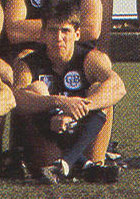
Brendan Hartney’s 60th

Happy 60th birthday to Brendan Hartney.


Career : 19811985
Debut : Round 11, 1981 vs North Melbourne, aged 23 years, 44 days
Carlton Player No. 895
Games : 32
Goals : 0
Last Game : Round 18, 1985 vs Sydney, aged 27 years, 102 days
Guernsey No. 24
Height : 179 cm (5 ft. 10 in.)
Weight : 81 kg (12 stone, 11 lbs.)
DOB : 23 April, 1958

One of the all-time greats of the Bendigo Football League, Brendan Hartney came to Carlton in 1981 to play 32 senior matches over five seasons. At that time, the Navy Blues were on the way to three Premierships in four years, thanks to a playing list as talent-laden as at any period the club’s history. Had he been 5 centimetres taller and 5 kilos heavier, Hartney would surely have appeared at top level for the Blues far more often. He battled champions each week to find a place in Carlton’s team, and rarely disappointed when given a chance.

The son of Sandhurst Football Club stalwart Leo Hartney, Brendan played his first senior game for the Dragons as a 17 year-old, and by his late teens was one of the outstanding centre half-backs in the BFL. Although just 179 cm tall, his pace and spring, endurance, courage and intelligent reading of the play made him more than a handful for the competition’s best forwards.

Carlton had chased Hartney’s signature for some time before Sandhurst won successive BFL flags in 1977-78, but his lion-hearted efforts in both of those Grand Final victories over Golden Square convinced the Blues to ramp up their efforts, and in 1981 Brendan was welcomed to Princes Park by first-year coach David Parkin. Fresh from the 1979 Premiership, followed by the crushing disappointment of 1980, the Blues were intent on regrouping and hungry for more success.

Wearing guernsey 24, Hartney played the first half of the year with the Reserves before being chosen for his first senior game in round 11, 1981 when Carlton hosted North Melbourne at Princes Park and knocked over the Roos by 31 points. Hartney spent that match in a back pocket, doing enough to be earn two more games in succession, and six in total throughout the year. He wasn’t selected for either of Carlton’s finals campaigns that brought Premiership glory again in 1981-82, but that was perfectly understandable, because he was up against the likes of Wayne Harmes, Rod Austin, Peter McConville, Des English and Robbert Klomp – not to mention Geoff Southby and Bruce Doull.

In his debut year, Hartney finished runner-up in the Reserves Best and Fairest to Trevor Keogh. That set a precedent that would see him win the award in 1983 and ‘84, and finish among the top three in every one of his five seasons with the Blues. His optimism and determination was widely admired, and he was voted Carlton’s Best Clubman in 1983.

After playing his last senior match for Carlton against Sydney in round 18, 1985, Hartney returned to Sandhurst with many more weapons in his armoury, and began the third stage of a career that would make him a BFL legend. Already a two-time winner of Sandhurst’s Best and Fairest; the Leo McPherson Trophy, Brendan was appointed captain of the Dragons in 1986, and promptly collected another four McPherson Medals in succession from 1986 to ’89. In 1993, aged 35, he won it for a seventh time. In between, he was adjudged Fairest and Best in the BFL in 1987 and 1989 to join an elite band of just six players to have won the Michelsen Medal twice.

Another proud achievement came in 1989, when Hartney captained the BFL representative side that defeated the Geelong Football League in the Grand Final of the VCFL Division 1 Country Championship. Brendan was carried shoulder-high off the Queen Elizabeth Oval that afternoon, as the BFL collected its first Division 1 Country title since 1972. Always a star in inter-league matches, Hartney represented the BFL on more than 20 occasions, and was inducted into the League’s Hall Of Fame in August, 1996.

Hartney also wore No.35 whilst playing reserve grade football for Carlton in 1979.

Hartney’s nephew Fergus Greene was drafted by the Western Bulldogs with their 4th pick in the 2016 AFL National Draft.

Jones Files: Hartney’s two league medals place him among Bendigo elite.
BRENDAN Hartney was always destined to play for Sandhurst and follow in the footsteps of his late father, Leo. Leo Hartney not only donned the maroon and blue colors of Sandhurst, but when his playing days were over was a faithful servant of the club, serving for a period as chairman of selectors. Brendan’s playing days with the Dragons started when he was 17; 225 games later he pulled the pin on a distinguished career. He was a shining light as far as club loyalty and on-field courage were concerned. Not only did Brendan lead Sandhurst in the late 1980s and into the ’90s he was the skipper of Bendigo’s successful VCFL Division 1 country championship-winning team in 1989. He remains a revered Dragon. Finishing on top in the Leo McPherson Medal count as club fairest and best in 1979-80, before five seasons with Carlton, was just the start of a medal-winning spree. He played 32 senior VFL games with the Princes Park Blues between 1981 and 1985. Hartney then took out the Dragons’ club McPherson Medal from 1986-89 and added an astounding seventh trophy in 1993. In between he was adjudged fairest and best in the BFL in both 1987 (29 votes) and again in 1989 (31 votes) to join an elite band of players to have won the time-honoured Michelsen Medal twice. There are just six players who have won two Michelsen Medals. One of my most enduring BFL memories is of Hartney opposed to outstanding Eaglehawk key position player Robert O’Connell. The Bendigo Advertiser photographers of the day would regularly focus on the absorbing battle between the two BFL stars whenever they were pitted against each other. Their marking duels were just riveting, and an object lesson for the younger players of both clubs. Brendan started as a ruck-rover — a term never used these days when “midfielders” and “on-ballers” are the buzz words — before cementing his place in BFL history as an unrelenting defender. Regularly conceding height to opposing key forwards, centre half-back seemed Hartney’s natural position. His courage in gathering the loose ball and his uncanny ability to read the play set him aside from his peers. And he loved inter-league footy. Hartney played more than 20 games for the Blue and Golds. He, as captain, and the late Neville Strauch as coach were the cornerstone of Bendigo’s country championships campaigns. The BFL representative made the Division 1 grand final in three consecutive seasons two decades back: in 1988, 1989 and again in 1990. The bitter disappointment of losing the Division 1 grand final to Geelong in the 1988 play-off at East Geelong was wiped away 12 months later. Hartney was carried shoulder-high off the QEO in mid-1989 as the Blue and Golds earned their revenge on the GFL, winning 15.10 (100) to Geelong’s 9.5 (59). It was Bendigo’s first Division 1 country title since 1972 and was so momentous that the BFL board of management hosted a special commemorative dinner to celebrate the achievement. The path to that 1989 VCFL grand final was memorable enough in itself. Bendigo made the dreaded road trip to Ovens and Murray territory for the semi-final and prevailed: 10.10 (70) to 7.12 (54). It was Bendigo’s first ever win over the O and M on one of their northern Victorian grounds. An even sweeter victory for Hartney and his teammates was to come a few weeks later that ’89 season with the grand final success over the GFL. Apart from his senior coaching stint in 1988, Hartney has also served as club runner and a selector. These days it’s a family affair at Sandhurst home games, with Brendan on deck as a Dragon senior selector. Twenty-year-old son Tom has been a key member of the Dragons’ senior backline while in 2009 younger son Pat (19), who has graduated from the under-18s, lined up in the Sandhurst reserves. Chopper White’s reserves, with Pat Hartney in the side, bowed out to Kangaroo Flat in this month’s reserves first semi-final. Tom Hartney can glean some valuable advice from his father whenever Sandhurst takes on Eaglehawk. With Derrick Filo still running around in the Eaglehawk forward line — Brendan used to match up with Filo when the evergreen stalwart was at Castlemaine –– the dual Michelsen Medallist is able to pass on tips to his son. “Run him around a lot,” was his succinct advice when the youngster first lined up on the wily Borough veteran. Brendan Hartney was inducted into the Bendigo Football League Hall Of Fame in August 1996. I rate him in the 10 best BFL players I’ve been privileged to watch in a 30-year career broadcasting and writing about local footy. – September 16, 2009 by Richard Jones.

Career Highlights

1981 – 2nd Reserves Best & Fairest
1981 – Reserves Most Improved
1982 – 3rd Reserves Best & Fairest
1982 – Reserves Best Clubman
1983 – Best Clubman
1983 – Reserves Best & Fairest
1983 – Senior Night Premiership
1984 – Reserves Best & Fairest
1985 – 2nd Reserves Best & Fairest

Mark Majerczak’s 50th

 Happy 50th birthday to Mark Majerczak.


Career: 1987 – 1991
Debut: Round 10, 1987 v Brisbane Bears, aged 19 years, 40 days
946th Carlton Player
Games: 17
Goals: 20
Last game: Round 18, 1991 v Brisbane Bears, aged 23 years, 92 days
Guernsey No. 33 (1988 – 1991) and 48 (1987).
Height: 180cm
Weight: 75kg
DOB: 20 April, 1968

‘Magic’, as he was known to Carlton fans, was a goalsneak who played 17 games for the Blues in the late 1980s. He was an accurate left foot kick and a consistent performer in the reserves, but found it hard to crack a regular spot in the team during a time when finals were a given for Carlton. Had better than a goal a game ratio which indicates that he knew where the sticks were, but suffered in comparison to similar size players such as Mark Naley.

Mark’s first kick in senior footy with the Blues resulted in a goal – a classy pick-up, slight shimmy and a kick from about 40 metres out from the scoreboard end at Princes Park.

Recruited from St Marks/Fawkner, Mark has also played Little League Football for Carlton (in 1979). Those were the days when each club ran their own Little League Squads – at this time the Carlton Squad was coached/managed by Keith Duggan, who had an uncanny resemblance to Australian entertainer Rolf Harris.

Magic was later picked up by the Bulldogs in the 1992 pre-season draft, but he did not add to his games tally at the Western Oval.

Career Highlights

1987 – 6th Reserves Best & Fairest
1987 – Reserves Premiership Player
1987 – Reserves Leading Goalkicker 53 goals

Dennis Munari’s 70th

Happy 70th birthday to Dennis Munari.


Career : 19671970
Debut : Round 8, 1967 vs Geelong, aged 19 years, 45 days
Carlton Player No. 799
Games : 54 (41 at Carlton)
Goals : 21 (20 at Carlton)
Last Game : Round 22, 1970 vs Melbourne, aged 22 years, 132 days
Guernsey Nos. 37 (1967) and 8 (1968-70)
Height : 178 cm ( 5 ft. 10 in.)
Weight : 76 kg (12 stone, 0 lbs.)
DOB : April 18, 1948
Premiership Player 1968

Dennis Munari came to Carlton as a promising centreman from that wonderful football nursery of Assumption College at Kilmore. A stylish right-footer, he was solid in his debut season in 1967, only to be edged out of his preferred position early the following year by the arrival of Tasmanian sensation Brent Crosswell. Munari then found a niche as second rover to Adrian Gallagher, and was instrumental in Carlton’s drive to the 1968 Premiership.

Munari wore guernsey number 37 for his first senior appearance – off the bench – in round 8 of 1967, against Geelong at Princes Park. The Blues won a thriller by four points, then lost another cliff-hanger by 2 points to Richmond a week later. In captain-coach Ron Barassi’s third season in charge, Carlton had begun emerging as a force after years of mediocrity, winding up the home and away rounds second on the ladder behind minor premiers Richmond.

In September 1967, before he had played even a dozen senior matches, Dennis experienced the thrill of running out onto the MCG for his first taste of finals football. The Blues fell short of expectations when they lost in successive weeks to the Tigers and Geelong, but one of the many positives to come out of that season was that Munari had shown that he was worth persevering with. In particular, his three goals in a tough debut final against Richmond won him a lot of fans.

He switched to guernsey 8 in 1968, and began a keen rivalry with Ian Nicoll for the second rover’s spot. Strengthened by the addition of Brent Crosswell, Neil Chandler and Ted Hopkins, Carlton rated as real Premiership contenders all year, before firming to favouritism by comprehensively beating the Bombers in the second Semi-Final. Essendon then overcame Geelong in the Preliminary Final, to set up a rematch with the Blues for the ’68 flag. Munari had damaged his left knee late in the season, which ruled him out of the last two home and away games, and that Semi-Final win over the Bombers. Fate then intervened when Nicoll was injured in the clash against Essendon, leaving Barassi to turn to Munari (even though he was short of match fitness) as Nicoll’s replacement for the Grand Final.

On that cool, blustery September day at the MCG, a huge crowd of 116,828 saw Barassi’s Blues break a 21-year drought with a hard-fought win over the persistent Bombers, in a match ruined as a spectacle by a strong cross-wind. Carlton had eight more scoring shots and hung on for a nail-biting three point victory. Although Blues wingman Garry Crane was a worthy Best on Ground, the platform for Carlton’s victory was provided by the ruck dominance of John Nicholls and his rover Adrian Gallagher. And when Essendon surged towards victory late in the third term, ruck-rover Serge Silvagni was rock-solid across half-back. Munari was prominent up forward in the first half, but faded later as his condition gave out.

Coming off the euphoria of that long-awaited Premiership, no-one would have been surprised if the dreaded Premiership hangover had kicked-in in 1969 – but it didn’t. The Blues held their form right through the year, finishing runners-up to Collingwood after the regular season, and knocking over the Magpies by six goals in an impressive second semi-final. Munari shared the two-man reserve bench with future Carlton President Ian Collins in that match, but both took little part in proceedings.

Awaiting Carlton as our Grand Final opponent in ’69 was Richmond, gunning for their second flag in three years under their charismatic coach Tom Hafey. This time however, Grand Final week proved a forgettable time for Munari. On selection night, he lost his place in the team to Nicoll, and on the following Saturday afternoon joined the many thousands of Carlton fans who watched helplessly as a rampant Richmond triumphed over the Blues by 25 points.

Munari’s last game for Carlton came in the final round of the home and away season in 1970, against Melbourne at the MCG. Sharing the roving duties once more with ‘Gags’ Gallagher, Dennis had a good match on an auspicious occasion for the Carlton Football Club – the day when champion forward Alex Jesaulenko became the first Blue to notch up 100 goals in a season. And three weeks later, ‘Jezza’ took his season tally to 115, with three telling goals in Carlton’s magnificent, come-from-behind Grand Final victory over Collingwood.

Munari signed with East Perth for 1971, but instead, ended up as playing coach of Hobart. This came about after Carlton’s former WA recruit Bert Thornley (a pivotal figure in the 1970 Grand Final) requested a release from his contract with Hobart just a few weeks into the season. The Tasmanian club was incensed that Thornley wanted to leave the Apple Isle, until Carlton stepped in to broker a deal, offering them Munari instead. When Hobart agreed, Thornley returned to his home state, and Munari travelled south to begin a turbulent 18-months as captain-coach of the Tassie Tigers. Unfortunately for all concerned, Hobart hardly won a match during that time, and before the mid-point of the 1972 TFL season, Munari was sacked – although many players and supporters of the club felt that he had been unfairly made the scapegoat for problems that ran deep within the administration of the club. By late 1972 Dennis was back at Princes Park playing Reserves football, before Preston lured him to the VFA in 1973.

Munari was contemplating giving football away for good in 1974, when a chance meeting with Ron Barassi (who by then was coaching North Melbourne) led to an invitation for Dennis to join the Kangaroos – who were short on experience and leadership. Barassi’s encouragement rekindled Dennis’ enthusiasm for the game, and he was appointed as assistant to North’s renowned Under-19 coach, Ray ‘Slug’ Jordon. In four years at Arden Street, Munari added another 13 senior matches to his tally, while twice winning the ‘Roo’s Reserves Best and Fairest award.

North’s memorable victory over Collingwood in the 1977 Grand Final replay marked the end of Munari’s time at Arden Street, and by 1989 he had returned to Princes Park to become an active member of the Carlton Past Players Association.In 2003, he was elected President of the Association – a post he held with distinction for a number of years.

Footnote

Munari also wore No.53 when he played Reserve grade football for Carlton in 1972.

Tim Powell’s 50th

Happy 50th Birthday to Tim Powell.


Career: 1993-1994
Debut (Carlton): Round 7, 1993 vs Sydney, aged 25 years, 25 days
990th Carlton Player
Games: 11 (Carlton) (75 overall)
Goals: 10
Last Game: Round 7, 1994 vs West Coast, aged 26 years, 24 days
Guernsey No. 22
Height: 183cm
Weight: 80kg
DOB: 14 April, 1968

Tim Powell came to Carlton via a trade with Richmond for Pick 28, a pick that would deliver Jamie Tape to Richmond (and then on to Collingwood for Aaron James). Powell Was originally from Berrigan, NSW, he later honed his skills as a footballer at Assumption College in Kilmore. Powell had played 64 games and booted 40 goals for the Tigers in his stint from 1988 to 1992.

Powell was a useful enough player – a right footed wingman with a bit of toe. He would play a couple of cracker games for the Blues with 21 possessions off the wing, or half forward flank, in Round 14 (v West Coast) and 15 (v Brisbane) in 1993, and raise hopes throughout Princes Park with 10 goals in 9 games for the year, but at other times he struggled to find the ball. It was the West Coast game in particular that had raised the hopes – he seemed to be able to find space on the outer wing and from memory kicked 2 goals as well. Powell looked dangerous at the time. Powell kicked two crucial goals in the Blues thrilling win over the Bombers in the 1993 Qualifying Final which included a lovely snap at the City end. He played in the Blues losing Grand Final to Essendon in 1993.

Powell was runner-up in the 1993 Gardiner Medal whilst playing for the Blues.

Powell would play a further 2 games in 1994, before finishing up with 11 games at the end of that season. Powell wore the #22 guernsey.

Powell took over the coaching reigns of VAFA club Monash Blues midway through the 2001 season, he was reappointed for the 2002 season.

Career Highlights

1993 – Reserves 2nd Best & Fairest

Baggy blue a classic Carlton throwback

Tony De Bolfo, Carlton Media

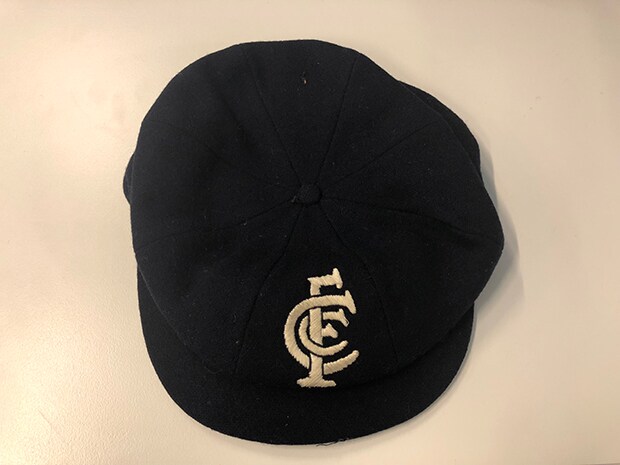
With the coveted baggy green having copped an absolute battering in the international court of public opinion, it’s rather timely that the baggy blue, after almost 100 years, should make a return.

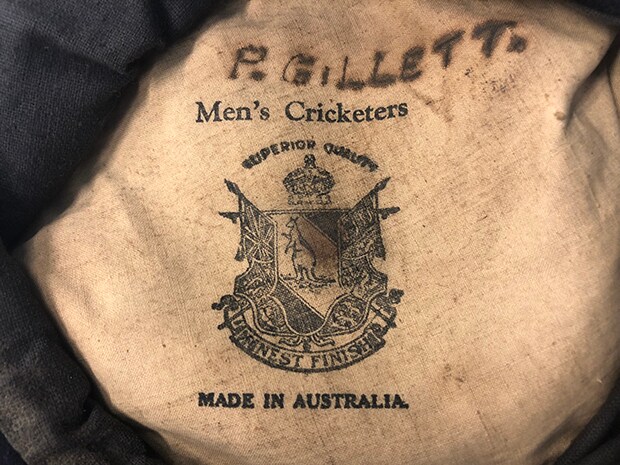
For more than half a lifetime, this coveted item of Carlton apparel – a throwback to the Depression days of the 1920s and ’30s – was the prized possession of its wearer, the long-serving club trainer Perc Gillett.

The superior quality woollen cap, manufactured by Australian firm Men’s Cricketers and sporting the football club’s famed tri-letter monogram, is now in the keep of Percy’s daughter Lorraine Gillett, who wished to share the item with historically-minded Carlton people.

BaggyBluePic.jpg
The baggy blue cap. (Photo: Carlton Football Club)

BaggyBlueZoom.jpg
A close-up of the baggy blue cap. (Photo: Carlton Football Club)

For Lorraine, the cap means the world, for as she recalled: “My father always wore the baggy blue and I’ve been a lifelong supporter of the club because of him”.

Percy Charles Robert (‘Perc’) Gillett was born in the old Victorian goldfields town of Castlemaine on January 23, 1899. Not long after his birth, Perc’s parents relocated to Melbourne and settled in a rental home, before taking occupancy of a house at No.2 Dudley Street (at the corner of Pleasance Street) in North Fitzroy, where Perc spent most of his single life.

Perc carted his books to the local Miller Street Primary School, but pursued an early interest in cycling. According to his son Rob, Perc excelled as a cyclist through his teenage years and secured trophies for the half-mile and ten-mile open road races staged by the Victorian Amateur Athletic Association.

“It was at about this time that my father gave away cycling on medical grounds,” Rob said. “I can only guess that he was advised to do so due to a heart murmur, but in the end my father died of a stroke rather than of any heart condition.”

BaggyBlueTrainingStaff.jpg
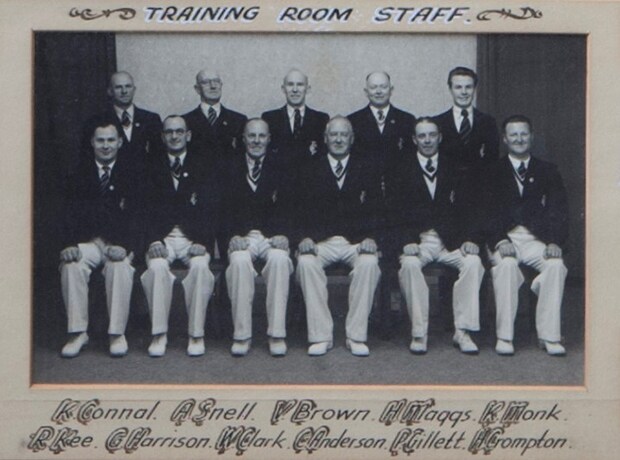
Percy Gillett, pictured second from the right in the front row, during the Blues’ 1947 premiership year. (Photo: Carlton Football Club)

Crucially, that misdiagnosis set in train a series of events which ultimately led Perc to Princes Park, for what would be the beginning of a beautiful friendship spanning more than 30 years.

“I never asked my father when he first went to the Carlton Football Club and why,” Rob conceded. “Was it to get a kick? Was it to play footy? When you’re younger you don’t think to ask and eventually that opportunity passes,” Rob conceded.

“But he must have got involved with the club around the time he completed cycling, probably 1917 or ’18. In time he became a trainer and the club and the game were his true passions.”

Life Membership of the Carlton Football Club came Perc’s way in 1933, in a year in which fellow trainer Charlie Anderson and Carlton players Fred Gilby, Joe Kelly and Harry “Soapy” Vallence were similarly acknowledged. The Grand Final triumphs of 1938, ’45 and ’47 also eventuated as Perc proficiently plied his training craft.

At the conclusion of the 1949 season, Perc gave the training caper away. Family then became the priority for him and his wife Maude Davies, and their two children the subjects of all their attentions.

For Rob, Perc’s baggy blue cap, was but part of his father’s cherished Carlton wardrobe. Also included was a matching beret, blazer and cream pants.

“The beret was a genuine French beret, although I doubt the club would have been able to afford bankrolling a trainers and players trip to Paris,” Rob suggested.

“All I know is that the beret was around the family home for decades and I can remember running around wearing it as a kid.

“My father also kept the blazer and cream pants he wore as a trainer, which I used when I started playing cricket. Lorraine has all those items now because she was and remains such a loyal Carlton follower.”

Percy Gillett was 77 when he died in Melbourne in July 1976, predeceasing Maude by more than a quarter of a century. Though fishing and horse racing became his pursuits in later life, ol’ Perc always kept the club close.

To quote Rob: “He was Carlton to the core and Carlton to the end”.

Bill Bennett’s 70th

Happy 70th birthday to Bill Bennet.


Career : 1966 and 1968
Debut : Round 2, 1966 vs St Kilda, aged 18 years, 18 days
Carlton Player No. 781
Games : 11
Goals : 9
Last Game : Grand Final, 1968 vs Essendon, aged 20 years, 169 days
Guernsey Nos. 13 (1966) and 12 (1968)
Height : 185 cm (6 ft. 1 in.)
Weight : 79.5 kg (12 stone, 7 lbs.)
DOB : 12 April, 1948
Premiership Player: 1968

A fortunate footballer who was in the right place at the right time, David William (Bill) Bennett played at centre half-forward in Carlton’s 1968 Premiership team in just his 11th VFL game. Although he was still not yet 21, he left Princes Park shortly afterward, and never pulled on the Navy Blue guernsey again.

Originally from Maffra, Bennett caught the attention of former Carlton captain Graham Donaldson who played a big role in recruiting for the Blues in the Gippsland region during the early 1960s. Donaldson liked the look of the agile teenager with real football smarts, but getting him to Carlton proved no easy task. Bill was a country boy, apparently bereft of any burning ambition to be a League star, and it took a lot of talking by Donaldson before Bennett eventually agreed to come to Princes Park in 1966 and use up the four match permits that had been negotiated with his club. At Carlton he was greeted by the Blues’ controversial new coach Ron Barassi, and issued with the number 13 guernsey as worn by Donaldson throughout his 106-game career.

Less than three weeks after his 18th birthday, Bennett played his first senior match as 19th man against St Kilda at Moorabbin in round 2, 1966, and was on the end of a 53-point hiding. Moved to full-forward the following week against Fitzroy, he kicked his first career goal in a 32-point comeback win, and followed up with another four goals when the Blues smashed Essendon by 61 points in round 4. His hard leading and quick thinking in that game impressed Barassi , who pencilled Bennett in as the team’s future spearhead – if the club could convince him to stay.

Bennett’s fourth and last match for the year was another effortless victory over Melbourne on the next Saturday afternoon. Then, having used up all his permits, he was back in Maffra by mid-year. After that, it took more than twelve months for Barassi and Donaldson to cajole Bill into having another crack with a Carlton side that was looking a definite contender for the ’68 flag. By then, the dynamics within the team had changed, and the emergence of Brian Kekovich at full-forward had straightened up Carlton’s game plan. So when Bennett returned to the senior side against St Kilda in round 10, 1968 he was wearing guernsey number 12 and playing on a half-forward flank. But he was obviously underdone, so he was sent back to the Reserves to find form before being recalled for round 16 against Footscray at the Western Oval. Although Carlton lost by five goals in a shock result, Bennett showed flashes of his best and kicked two clever majors.

By round 19 – the second-last of the home and away matches – Carlton was clinging to fourth spot on the ladder behind Essendon, Geelong and St Kilda when they hosted Fitzroy at Princes Park. Barassi sent Bennett to centre half-forward, and the Blues attack found real cohesion to pummel the visitors by 52 points. Another win over North Melbourne in round 20 lifted the resurgent Blues to second, and set up a much-anticipated Semi Final clash against minor premiers Essendon.

Playing just his tenth senior match in front of more than 100,000 fans at the MCG on the following Saturday afternoon, Bennett started at centre half-forward, but went down with a serious ankle injury in the second term and was replaced at half-time by Neil Chandler. In a pivotal move, Barassi shifted Robert Walls into attack after the long break, and the resolute Blues drew away to win by six goals.

Bennett was cleared of structural damage to his ankle in the days following, although he was still in doubt for the Grand Final right up until selection night. Meanwhile, Essendon vanquished Geelong in the Preliminary Final and qualified to meet the heavily-favoured Blues in the flag decider. Another enormous, record-breaking crowd of almost 117,000 packed into the MCG to see a tense, dour struggle ruined as a spectacle by a strong cross-wind, but the closeness of the scores kept fans on the edges of their seats throughout.

Carlton clung to an 11-point lead at three-quarter time, and withstood a spirited surge by the Bombers to win the club’s first flag for 21 years – with Bennett watching on from the boundary. Bill’s suspect ankle collapsed on him during the hectic last term, and Neil Chandler came on again to take three timely marks that helped get the Blues home in a hectic finish.

For various reasons, three members of the ’68 Premiership side retired in the days and weeks after the prolonged celebrations; Peter McLean, Brian Kekovich and Bill Bennett. In Bill’s case, he headed home to Maffra, from where he continued to play and coach in various country leagues for more than a decade.

In 1977 he was in Darwin, playing for St Mary’s in the NTFL when he was voted the joint winner of the competition’s Best and Fairest award; the Nicholls Medal, in a tie with Mark Motlop (Nightcliff) and Ian Wallace (North Darwin). He later crossed to Nightcliff, and coached them from 1981 to ’83.

Bill Bennett coaches West FC
As has earlier been indicated, the present site of the Gillen Club became Wests in the mid- 1970’s. In 1978, with Rod Rose as President, the committee decided that, to be truly successful, a top playing coach, who could attract other good players, was required. As this was going to need considerable money, Rod commenced a very successful bingo night at Wests club, with all players rostered to assist. “Bustling” Bill Bennett, a member of Carlton’s victorious 1970 grand final, then a champion for South Adelaide and a Darwin player, was duly appointed. He is remembered most for his ferocious training for fitness, and his demand for skills. All people associated with Wests at that time recall such as his first night’s training ending with 10 laps of the oval, and then later training nights requiring 5 repeats of runs up and down Tank Hill; the training camp out at Glen Helen when players had to carry sizeable rocks above their heads for 2km; another run from the Westies Club to Heavitree Gap, followed by sprints in the sand, a run up the Todd to Anzac Hill, 3 runs up and down the hill, and a long run through the railway yards back to the Nadich home; and as a final illustration at the start of the 1980 season, a series of exercises at Westies oval followed by a run out through Heavitree Gap, along the dump road, then up the hill to the towers. After a recovery of about 5 minutes, the exercises commenced again, we had to run down the hill and then, at Heavitree Gap, commenced sprinting to the front of the line of players, back to the Westies oval. Wests burst out of the blocks that year, and with Bill rucking non- stop, and no one taking a backward step, won their first game against a shell-shocked Federals by 13 goals, their first-ever game after 8 seasons against a very good Rovers team, and all games until the grand final. Players like Leo “Choco” Nadich and Rob Floreani flourished; Adam and Giana Nadich (Choco’s parents) became life-long Wests supporters; and Adam’s brother-in-law Enzo Floreani went on to coach Wests B grade to their first-ever premiership. Unfortunately two key players were reported in the preliminary A grade final so that Rovers, under astute coach Phil O’Brien, a former Hawthorn player, were successful in a very close grand final. It was a big disappointment, but the next year Bill took Wests to their first ever A Grade Premiership over Pioneers. This was an absolute thriller of a game, with both sides no more than a goal or two in front at any stage, John Green (a decathlete and former S.A. F.L. player) at centre half-forward best-on-ground, and Robbie Goodwin (a former South Adelaide player) dominating his wing. With about one minute to go, Robbie kicked to Bill, who marked on the siren then kicked truly for the victory. The celebrations continued until Tuesday night of the next week!

Luke O’Sullivan’s 50th

 Happy 50th birthday to Luke O’Sullivan.


Career: 1988-1997
Debut: Round 20, 1988 vs North Melbourne, aged 20 years, 138 days
953rd Carlton Player
Games: 62
Goals: 58
Last game: Round 18, 1997 vs Adelaide, aged 29 years, 128 days
Height: 182cm
Weight: 94kg
Guernsey No. 41 (1988-9), 27 (1990-97) & 60 (1993 night game)
DOB: 28 March, 1968The story of Luke “Rhino” O’Sullivan is a pearler – was on the list for almost a decade, and only managed to reach his 50th game in his last year. A unique player, O’Sullivan was a 182cm barrel-chested, feet-pumping forward pocket / flanker who loved a goal. He was recruited from the Blues U/19’s, after originally playing for Xavier College (Kew) despite signing on for Footscray where his cousin Shane O’Sullivan had moved to a few years earlier.

Luke also had another brother affiliated with the Blues, older brother Brendan O’Sullivan played Reserve Grade footy with the Blues from 1978 to 1980, he was also later to be the Runner for the Senior team.

Wearing the #27, Rhino had these fantastic side-burns that he wore with pride. His signature move was to take a bounce, rock on to his left foot (preferred) and try to run through tackles. He gave away his fair share of holding the ball free kicks, but also ran over a few opponents. He was a unique player, a player with flair, and clearly a player the Blues loved to keep around despite injury.

First playing in 1988, and perhaps most memorable for a 4 goal burst in Round 6, 1992, O’Sullivan would ironically be delisted after his best year of football, 1997. In the 4 years up to 1997, Rhino would manage 0, 2, 6 and 1 game respectively, due to injury and our strong team a the time. Doing his knee at Waverley didn’t help – remember the surface giving way when he was wearing number 60 in the 1993 ‘Night’ game against Footscray when the Club left his jumper back at Carlton?

1997 was Rhino’s year. 15 games, kicking 12 goals 7 from the flank and occasional midfield role, provided a lot of enjoyment to the fans as Carlton slid out of the finals. Two cracking games – Round 9 versus Freo (26 stats, 2 goals) and Round 11 versus Brisbane are appropriate highlight packages for the man we all loved, the man we all wanted to succeed, the man with the sidies – “Rhino”.

O’Sullivan wore No.54 in 1987 & 1988 whilst playing with the Blues reserves.

Luke O’Sullivan is the uncle of Sydney Swans youngster Daniel Hannebery.

The Rhino’s career acts as a time capsule for a generation of AFL football which will never be seen again. Only Essendon’s Dean Wallis may have taken longer to reach 100 AFL games. The modern player would never be afforded such time to develop/recover. Dogged by injuries and the fact that his natural playing positions were filled by some of Carlton’s most proven players it is a sign of the respect held for ‘The Uncle’ that his presence was sought by the Carlton Football Club for ten years plus.

Milestones

50 Games: Round 3, 1997 Vs Adelaide Crows

Career Highlights

1987 – Reserves Premiership

Dean Rice’s 50th

Happy 50th birthday to Dean Rice.


Career : 19942001
Debut : Round 8, 1994 vs Richmond, aged 26 years, 57 days
Carlton Player No. 997
Games : 234 (118 at Carlton)
Goals : 85 (42 at Carlton)
Last Game : Round 20, 2001 vs St Kilda, aged 33 years, 155 days
Guernsey No. 23
Height : 180 cm
Weight : 92 kg
DOB : 17 March, 1968
Premiership Player 1995

A courageous, versatile, blonde-haired right footer who was given a second chance by Carlton when his career at St Kilda prematurely ended, Dean Rice was a mainstay of the Blues’ 1995 Premiership team and a real asset to the club throughout his 118 games between 1994 and 2001.

Famously nick-named “Special Fried” by Rex Hunt, the 3AW radio caller, Rice was the nephew of former Geelong captain and 1963 Premiership player Colin Rice. After starting his junior football at Essex Heights, which at the time was aligned with Richmond, Dean joined Longwood in the Benalla District League to play alongside his two older brothers. The family connection with Geelong came into play when the Cats recruited him for their Under-19 squad, but he failed to progress further than Reserves level at Kardinia Park before he was discarded.

In 1986 – still just 19, Rice was given a trial by St Kilda and won a place on their senior list. He made his debut for the Saints early the following season and was soon a regular member of their team. Powerfully built, a clever mark and surprisingly quick, he found his niche on the wing at Moorabbin and represented Victoria in an interstate match against South Australia in 1989. By 1991 Dean had played more than 100 games for St Kilda, and had experienced finals football for the first time when the Saints fell to Geelong in that years’ Elimination Final.

However, that charmed run came to an abrupt halt during the 1992 pre-season, when Rice suffered a ruptured ACL ligament in his left knee. A full reconstruction was required, and he was off the field for the entire season. He came back to play 11 games in 1993, only to damage his other knee (thankfully, nowhere near as badly) against Adelaide in round 15. That turned out to be his last game for St Kilda, because the Saints decided not to gamble on his future and delisted him at season’s end.

Meanwhile, Carlton was smarting from a humiliating defeat by Essendon in the 1993 Grand Final, where the Blues’ lack of pace and desperation had been brutally exposed. Rice had his admirers at Carlton – including coach David Parkin, who was very happy when the 25 year-old was picked up by the Blues at pick 19 in the 1994 Pre-Season Draft, and given the number 23 guernsey previously worn by 1987 Premiership player Paul Meldrum.

Rice ran out for his first game in navy blue against Richmond on a Friday night in round 8, 1994, and was immediately under notice. Playing out of a forward pocket, he had taken two excellent marks on the lead and kicked his first goal for the Blues right on quarter-time, before disaster struck. In the first minutes of the second term, Richmond’s Tony Free fell across Rice’s rebuilt knee while both were scrambling for the football, and the pain told Dean immediately that another season was over. Still, Carlton retained their faith in him, and constant reassurance helped him through another reconstruction and the gruelling months of rehabilitation for a second time.

Almost precisely one year later, Rice returned to Carlton’s senior team in time for the Blues’ only two losses in 1995 – against Sydney in round 8, and St Kilda in round 9. From then on, the rampaging Blues swept all before them, and stormed to another flag by demolishing Geelong in a one-sided Grand Final. Rice was more than handy in that triumph – especially during the second quarter, when he kicked the goal that swiftly put down Geelong’s attempted resurgence.

Despite occasional pain in his rebuilt knee, Dean became a true utility as his career progressed – a reliable running half-back or winger, and a crafty defensive forward when required. In 1999 he had perhaps his most consistent season, playing 22 regular season games and four finals – including Carlton’s astounding Preliminary Final victory over Essendon, and the somewhat anti-climactic Grand Final loss to North Melbourne that followed a week later.

Another good season in 2000 produced 24 games (including two more finals) before Rice decided that the next season would be his last. Although a serious ankle strain in round 6, 2001 cost him 10 weeks on the sidelines, he returned to play another five games late in the year. By coincidence, his last match saw Carlton account for St Kilda at Docklands in round 20, with Anthony Koutoufides the star.

His AFL career may have ended that afternoon, but Dean wasn’t quite ready to hang up his boots for good. In 2002 he spent one last season with Scoresby in the Eastern Football League, then took over the reins as coach of country club Wonthaggi for another two seasons (2003 – 04), Rice also coached Berwick for two seasons (2011 – 12), Longwarry for two seasons (2013-14). Since 2006, he has held a number of senior positions with AFL Victoria in junior development, training and education.

Dean Rice continued in his football development role, he was the football development manager in the AFL Yarra Ranges from 2013 to 2017. Rice was appointed the AFL South East football development manager for the 2018 season.

More recently, Dean’s very promising son Bailey Rice was eligible to join either Carlton or St Kilda as a father-son selection in the 2015 National Draft. He trained at both clubs, but eventually chose St Kilda and was taken as a third round pick by the Saints at number 49.

The epitome of sacrifice whose true work on the football field was never reflected in the over-indulged statistic sheets. He forged a brilliant career despite significant injuries that may have compromised someone with lesser ambition and drive. Struggled however to understand the concept of international travel and passports.

Milestones

150 Games (AFL) – Round 19, 1997 vs Collingwood
50 Games (Carlton) – Round 13, 1998 vs Fremantle
200 Games (AFL) – Round 1, 2000 vs Brisbane Lions
100 Games (Carlton) – Round 17, 2000 vs Hawthorn

Career Highlights

1995 – Premiership Player
1997 – Pre-Season Premiership Player
1998 – Equal 9th Best & Fairest

BBQ Postponed: Old Blues to be welcomed back to Princes Park

PLEASE NOTE: The BBQ scheduled for the 24th February has been postponed until later in the season.

Any enquiries should be directed to Lou Katsamas via either Email: lou.katsamas@carltonfc.com.au, Phone: 03 9389 6231 or Mail:  Lou Katsamas c/o Spirit of Carlton PO Box 83, North Carlton, VIC, 3054.


Tony De Bolfo, Carlton Media

The Carlton Football Club is again opening its doors to all senior footballers who ever wore the dark Navy Blue guernsey – together with former officials and staff members – to a free barbecue breakfast at the old ground.

In conjunction with the Spirit of Carlton, the club is extending the invitation to the aforementioned – together with their wives and/or partners, children and/or grandchildren – to also view a training session involving the current-listed footballers under Brendon Bolton’s watch on the morning of Saturday, February 24, commencing 10am.

Carlton is also opening up the inner sanctum – the locker room – to enable former players to be photographed with their loved ones by the lockers carrying their old guernsey numbers.

Robertson Webster Image
Former players Ron Robertson (left) and Peter Webster, pictured at the 2016 event. (Photo: Carlton Media)

The breakfast will be held on the landing by the George Harris Room at which those players and officials who so ably served Carlton can renew their old friendships.

The opportunity to reconnect has been relished by former players and their descendants – a case in point, the kinfolk of dual Carlton Premiership player the late Charlie McInnes – his daughter Laurie Morgan, grandson Luke and great granddaughters Ava and Alexa – who two years ago paid the old ground a welcome visit to be photographed in front of ol’ Charlie’s No.31 locker.

For the McInnes clan, it was as if the club had given Charlie back.

“It was absolutely sensational to see Dad’s locker, but to have Luke there and my two granddaughters to share the moment made it really lovely,” Laurie said at the time.

“It means a lot to go back. I’d only ever been in the old rooms a couple of times and they weren’t done up like they are now.”  

Ron O’Dwyer’s 80th

Happy 80th birthday to Ron O’Dwyer.


Career: 19561958
Debut: Round 2, 1956 vs Melbourne, aged 18 years, 76 days
702nd Carlton Player
Games: 13
Goals: 11
Last Game: Round 2, 1958 vs North Melbourne, aged 20 years, 73 days
Guernsey No. 7
Height: 170cm
Weight: 70kg
DOB: 5 February, 1938

Originally from Broken Hill North, and known as ‘Cookie’ around the club, Ron O’Dwyer wore guernsey #7 in 13 games for Carlton starting in 1956. He kicked 11 goals for the Blues.

O’Dwyer transferred to Collingwood, he played with the Magpies from 1959 to 1961. In his time at Magpies he played a further 27 games and booted 15 goals. He also played in the losing 1960 Grand Final with the Magpies.

Ron O’Dwyer is currently the President of the AFL X-Men organisation.

Picture:
Ron O’Dwyer in the 1956 Reserves.

Jacob Anstey’s 40th

Happy 40th birthday to Jacob Anstey.


Career : 19971998
Debut : Round 7, 1997 vs Richmond, aged 19 years, 103 days
Carlton Player No. 1017
Games : 16
Goals : 5
Last Game : Round 19, 1998 vs Melbourne, aged 20 years, 193 days
Guernsey Nos. 41 (1997) and 12 (1998).
Height : 176 cm (5 ft. 9 in.)
Weight : 71.3 kg (11 stone, 3 lbs.)
DOB : 27 January, 1978

Jacob ‘Jake’ Anstey was recruited by the Blues from Tuggeranong in the ACT – the same club that produced an earlier high-profile Carlton draftee in Aaron Hamill. A clever, but slightly-built rover-forward, Anstey had been considered a likely AFL footballer since his selection in the 1994 Under 17 All Australian team. Carlton’s recruiters were pleasantly surprised when he was still available at selection 63 in the 1995 National Draft, and snapped him up.

Wearing guernsey number 41, Jake was given a patient introduction to AFL football through Carlton Reserves, and wasn’t promoted until well into his second season. Eventually, he made his senior debut in round 7, 1997, when Carlton took on Richmond at the MCG, and emerged victorious by 22 points. Blues captain Stephen Kernahan kicked only one goal in that game, but it was enough to set a new club aggregate goal-kicking record of 723 goals – breaking the mark previously held by another club legend in Harry Vallence.

A fortnight later, Anstey himself booted his first senior goal in round 9 against Fremantle, and two more in round 15 against Melbourne. He finished the year with four goals and nine games to his credit, although in seven of those matches, he started from the bench.

In 1998, Jake switched to guernsey number 12, and played the best game of his AFL career in a desperately-close loss to Essendon in round 3 at the MCG. Sharing the roving duties with Darren Hulme, Anstey gathered 13 possessions and kicked an important major as the Blues finished all over the Bombers, only to lose by a point. Between then and round 18, he managed another six games, but his scoring opportunities had dried up and he added only one more goal to his tally.

Amid concerns over his slender 71 kg frame, the Blues delisted Anstey at the end of that season. So he nominated again for the National Draft, and was picked up by St. Kilda at pick 81. He wasn’t able to break into the Saints’ senior line-up in his only season at Moorabbin however, and at the end of 1999 he moved on to the second stage of a notable career at suburban and country level.

In 2001, Anstey was voted Best on Ground while starring for Yarra Glen in the Grand Final of the Yarra Valley and Mountain District Football League, under the coaching of another former Blue; 1995 Carlton Premiership defender Adrian Whitehead. The following year, when Whitehead was appointed assistant coach at VFA heavyweights Port Melbourne, Anstey went with him, and was joined by his younger brother Sam. Sam Anstey too, had been at Carlton, playing Reserve Grade football in 1999.

After one season at Port Melbourne, Jake Anstey and Whitehead crossed to Donvale in the Eastern Football League as captain and coach respectively. Jake gave the Magpies three valuable seasons, then headed to the far north of Victoria to captain-coach Mildura in the Sunraysia Football League. After leading the Demons to the SFL Premiership in 2007, he retired from the field in 2010, aged 32.

A lightly built on-baller who simply found himself in the wrong place at the wrong time with respect to era and opportunity. Very much like Kade Simpson in build, Anstey was never given easy games to find his feet and was without a Simpson-like kick that could cross lines and cause defensive angst. Anstey’s career, like many others before – and no doubt after – shows that timing and a dash of luck are always relevant commodities in sports.

Career Highlights

1997 – 5th Reserves Best & Fairest
1998 – 2nd Reserves Best & Fairest

Peter Francis’ 60th

Happy 60th birthday to Peter Francis.


Career : 19791981
Debut : Round 3, 1979 vs Essendon, aged 21 years, 73 days
Carlton Player No. 876
Games : 158 (47 at Carlton)
Goals : 58 (15 at Carlton)
Last Game : Round 11, 1981 vs North Melbourne, aged 23 years, 141 days
Guernsey No. 47
Height : 185 cm (6 ft. 1 in.)
Weight : 82.5 kg (13 stone, 0 lbs.)
DOB : 16 January, 1958
Premiership Player 1979

Peter Scott Francis was a hard-running, skilful wingman who is fondly remembered for his starring role in Carlton’s famous 1979 Grand Final victory over Collingwood – before he was controversially traded to Fitzroy, and went on to play 158 career games at four clubs.

Born in Heathcote in central Victoria in 1958, Francis was the nephew of Leo Francis, a wingman himself who had played 78 games with North Melbourne from 1945 to 1951. In 1977, Peter was starring for South Bendigo when he was invited to try out at Princes Park, and his form at Reserves level in the latter part of the season left Carlton’s match committee smiling. In guernsey number 47, Francis played regularly across half-forward and kicked 32 goals in only a handful of games.

The following year, he made his senior debut off the interchange bench against Essendon at Waverley in the Blues’ first game of 1979, when three other future stars in Wayne Johnston, Alex Marcou and Robbert Klomp also started their VFL careers. Peter came on late in the game and racked up nine possessions as Carlton beat the Bombers by 21 points. As that season progressed, Francis consolidated his place in a powerful team that sat two wins clear of North Melbourne on top of the ladder after the home and away rounds. Fashionably tall for a wingman of that era, he was disciplined, quick, and a fine mark overhead. His concentration was good, he was eminently coachable, and he could play either an offensive or defensive role as required.

In late September 1979, Francis took part in his twenty-third VFL game, and was one of the Blues’ prime movers in a thrilling Grand Final victory over Collingwood. In front of nearly 113,000 fans on a muddy MCG, Carlton beat the Magpies by five points in a match forever remembered for Wayne Harmes’ determined chase, dive and round-arm swipe at the ball in the dying minutes. Harmes’ actions sent the ball skidding from Collingwood’s right forward pocket into the goal-square, where Ken Sheldon raced in alone to gather and kick the goal that decided the Premiership. Harmes was a worthy winner of the inaugural Norm Smith medal as Best on Ground, but Francis, ‘Dominator’ Johnston, and champion defender Bruce Doull could all have just as easily been chosen. Whilst the Harmes – Sheldon goal will always be remembered Francis ‘arguably’ kicked the goal of the day with a snap from the boundary in front of near Bay 13 was in front of the Southern Stand, it was a huge effort with the wet, heavy footy.

The Blues confirmed their standing as a League power by topping the ladder again in 1980, only to be bundled out of the finals by two straight losses. Meanwhile, Carlton’s neighbours Fitzroy had gone into freefall. Finalists in 1979, the Lions had plunged from fourth to wooden-spooners in the space of 12 months, despite the emergence of a new star in Frank Marchesani, a classy wingman from Marcellin College who was widely-regarded as Recruit of the Year. Imagine then, the furore that erupted in the off-season when Marchesani told Fitzroy that he wanted a clearance to Carlton. Rumours abounded that he was being lured to Princes Park by financial promises that Fitzroy had no hope of matching – but these were immediately denied (and have continued to be denied) by both Marchesani and the Blues. Frank just wanted out of Fitzroy, and Carlton was his preferred destination. The next problem however, was that Fitzroy flatly refused to negotiate, so Marchesani was forced to stand out of the game for six months – until right on the deadline for mid-season clearances on June 30. With no viable option, the Lions at last relented and agreed to swap Marchesani for Peter Francis, which in turn made the situation uncomfortable for Carlton.

A few hours hours later, Carlton’s Chairman of Selectors, Wes Lofts, had the difficult task of telling Francis that the game he was about to play – against North Melbourne at Princes Park – would be his last in Navy Blue. When the news broke, it caused considerable disquiet among the Blues’ players and fans, because Francis was a popular and respected member of a very good football side. However, it didn’t destabilise the team’s spirit, and Carlton surged on to the glory of two more Premierships in 1981 and ’82.

Marchesani went on to a relatively short and chequered career with the Blues, and it can be argued that he never realised his full potential during 36 matches in five injury-plagued seasons. On the other hand, Francis was valuable and consistent at Fitzroy (40 games), Richmond (52 games) and Essendon (19 games) in a career that stretched through to 1988. Francis will be remembered as a player who could hold his own whether it was as a wingman, half-back or ruck-rover He was a player who was a consistently high possession winner. He had good ball skills and kicked well to position

When his playing days ended, Francis turned to coaching, and in 1989 took over the reins at VFA Club Box Hill (playing coach). In 1991 he moved on to St Kilda, where he was reunited with his Blues Premiership teammate Ken Sheldon and served as the Saints’ last U/19’s Coach in 1991 and Reserves coach from 1991 to 1994. Later still, he began a successful career in coaching (1995 – 1996) and as a football administration as was Regional Manager of the Gippsland Power in the elite TAC Cup Under 17 competition for more than a decade.

Away from football he works in the banking industry and lives in Warragul.

In 2010, Francis’ name graced the football media once again with the news that his nephew Andrew Collins was joining Carlton. By coincidence, Collins had agreed to move from Richmond to Carlton, in a direct swap for the Blues’ 43-game midfielder Shaun Grigg.

Bendigo All Stars Team (1972-1997).
In 1997 the Bendigo FL compiled their best team for players originating from the BFL VCFL zones for the period from 1972 – 1997, Francis was named on the wing in that team.

Playing Career
All up Francis played a total of 244 games in the senior and reserves grades during his time in the VFL, with Carlton, Fitzroy, Richmond , Essendon and more recently St Kilda Reserves.
Pre VFL days; Heathcote to 1975 ; South Bendigo 1976, Games 7, Goals 1 ;
Carlton Seniors 1979-81, Games 47, goals 17 ( Honours – Premiership 1979 )
Fitzroy Seniors 1981-83, Games 52, Goals 25 ;
Fitzroy Reserves 1983-84, Games 2, Goals 4.
Richmond Seniors 1984-86, Games: 51, Goals: 22
Richmond Reserves 1986, Games: 7, Goals: 3
Essendon Seniors 1987-88, Games 19, Goals 2 ;
Essendon Reserves 1987-88, Games 10, Goals 2 ;
Box Hill Captain/Coach 1989-90, Games 29, Goals 13 ;
St Kilda Thirds Coach 1991;
St Kilda Reserves Coach 1991-94, Games 1 ;
Gippsland Power U/18 Coach 1995-96.

Career Highlights

1978 – Reserves Leading Goalkicker (32 goals)
1979 – Premiership Player

Legends Dinner

Join the Spirit of Carlton at the annual Legends Dinner before Carlton takes on St Kilda in Round 1 of the JLT Community Series.

SCHEDULE OF GUEST BENEFITS

  • Two-course meal
  • Beverages
  • Reserved Seat

EVENT DETAILS

Date: Wednesday 28 February, 2018
Time 5:30pm – 7:10pm
Venue: George Harris Room, Ikon Park

CLICK HERE TO BOOK


Vale Keith, the best in the caper

Tony De Bolfo, Carlton Media

Keith McKenzie, an assistant to Carlton Captain-Coach John Nicholls through the Premiership season of 1972, and later the General Manager of the club, has died after a short illness at the age of 95. 

McKenzie, a World War II veteran who, like the future Australian Prime Minister John Gorton served as a Leading Aircraftman in Milne Bay, represented North Melbourne with distinction as a fleet-footed wingman through 130 senior appearances in an eight-season tenure from 1944 – during which time he earned the Syd Barker Medal as the Shinboners’ fairest and best.

McKenzie later assumed Senior Coaching duties at North, replacing Alan Killigrew, in a four-year term commencing 1966 – but 23 wins and a couple of draws from 84 starts reflected winters of discontent at Arden Street.

It was at this pivotal moment (1971) that the call came from Carlton’s then senior coach Ronald Dale Barassi. In an interview with this reporter, McKenzie admitted that the Barassi offer, which came after Graham Donaldson accepted the Senior Coach’s role at Fitzroy, would prove to be life-changing.

“In 1971 Ron Barassi asked me to join him as his assistant at Carlton and I knew then what I never had. I found Barassi’s coaching the ultimate . . . it changed me from a fellow who was dejected and disappointed at not being successful as a coach to a winner in a club which had a tradition of success . . . ,” McKenzie said.

“It (coaching) was a learning curve at North Melbourne (and) unfortunately I lost a bit of self-respect in my own right, but it was a case of when one door closes another opens, and I put it down to ‘Barass’ and Carlton who were marvellous to me. 

“It’s why I’ve never forgotten Carlton and why I’ve stayed with Carlton all my life.”

Nicholls said this week that while he anticipated McKenzie’s passing having recently visited him at Anzac Hostel in Brighton, he was nonetheless saddened to learn of the news.

“I’m very sad about this. Keith was a lovely bloke and he truly was a Carlton person,” Nicholls said.

“Keith originally came over as an assistant to ‘Barass’ and he was assistant to me in ’72. Back in those days, Bert Deacon, who was a wonderful friend of mine, used to play golf with him and Gordon Norris in Dandenong.”

McKenzie, until his passing the League football’s oldest surviving Senior Coach, is accredited with having coached Carlton in three senior matches as a stand-in. The first of them came in the 12th round of 1972, when Carlton faced Fitzroy at Waverley Park. The Blues were without Nicholls, Alex Jesaulenko and Geoff Southby (all of them on Victorian representative duty), yet under McKenzie’s watch still accounted for the ’Roys by six goals.

Keith McKenzie 79 Image

McKenzie then took charge in the second round of 1973, when Carlton accounted for his former team North Melbourne by 27 points at Princes Park. On that occasion, Nicholls (who was under a one-match suspension for striking a Geelong player the previous week) sought League dispensation to enter the ground that afternoon, in order to see the ’72 Premiership flag unfurled.

The third and final time in which McKenzie took charge has gone down in football infamy as The Battle of Windy Hill – an extraordinary affair with Essendon in the 14th Round of 1975. Again, Nicholls, Jesaulenko and Southby were committed to state representation when McKenzie prepared his charges for the match of the day on Saturday, July 5.

The Carlton players piled on an incredible 14.1 in the first 23 minutes of the second quarter of that one (with David McKay contributing eight of his own), but the subsequent felling behind play of Craig Davis led to an ugly all-in brawl. By game’s end, seven players – four from Carlton, three from Essendon – had their numbers taken and the Blues’ final scoreline of 27.13 (175) remains their highest-ever tally against the Bombers.

In 1976, McKenzie was appointed Carlton General Manager, a position he held until 1979. Beyond his four years running the club, McKenzie continued to serve in a myriad of roles, and he had a hand in the latter recruitments of Ken Hunter and Val Perovic, amongst others. 

A long-time confidante of Richard Pratt who employed him at Visy, McKenzie was, until recently, a regular in the Carlton rooms with Pratt’s widow and current club Director Jeanne with whom he previously played midweek croquet.

An entrepreneurial type, he famously found a way to get the better halves of Swedish supergroup ABBA decked out in dark Navy Blue guernseys. That happened on the morning of Saturday, March 5, 1977, when Agnetha Faltskog and Frida Lyngstad, together with their husbands Bjorn and Benny, lobbed at Tullamarine Airport to fulfil their obligations in two shows at the Sidney Myer Music Bowl as part of the band’s Australian musical tour.

In a previous interview, McKenzie vividly recalled the chain of events which led to Agnetha and Frida sporting the famous playing tops, in one of the all-time great club marketing triumphs.

Keith McKenzie Curly Austin Image
Keith McKenzie with Carlton great Rod Austin, 1977. (Photo: Supplied)

“When we knew they were about to land at Tullamarine I told our marketing bloke Michael Whitewood, ‘Grab a couple of guernseys, get up to the airport and take them out to ABBA’,” McKenzie said.

“The band later headed out to Western Australia to play four shows wearing the jumpers. I don’t know what guernsey numbers they got, but it was a real coup.”

A much-loved character at Carlton, McKenzie inherited the endearing nickname ‘Caper’ in the lead-up to the aforementioned Fitzroy game at VFL Park.

“On the Thursday before that game we rehearsed a little bit, and I said to the players, ‘Look, you’re so good you know the caper, so just go out there and do it’,” McKenzie recalled. “It was the shortest speech of all time, but that’s how I got the nickname ‘Caper’.”

McKenzie’s wife of 67 years Joan died in 2013. He is survived by his sons Roger and Paul, daughter Vicki, four grandchildren James, Victoria, Ricky and Kelly, and three great grandchildren.

A private cremation for McKenzie will take place at Springvale Cemetery, with a memorial to be held at the Sandringham Club on Monday, January 15, commencing 1pm.