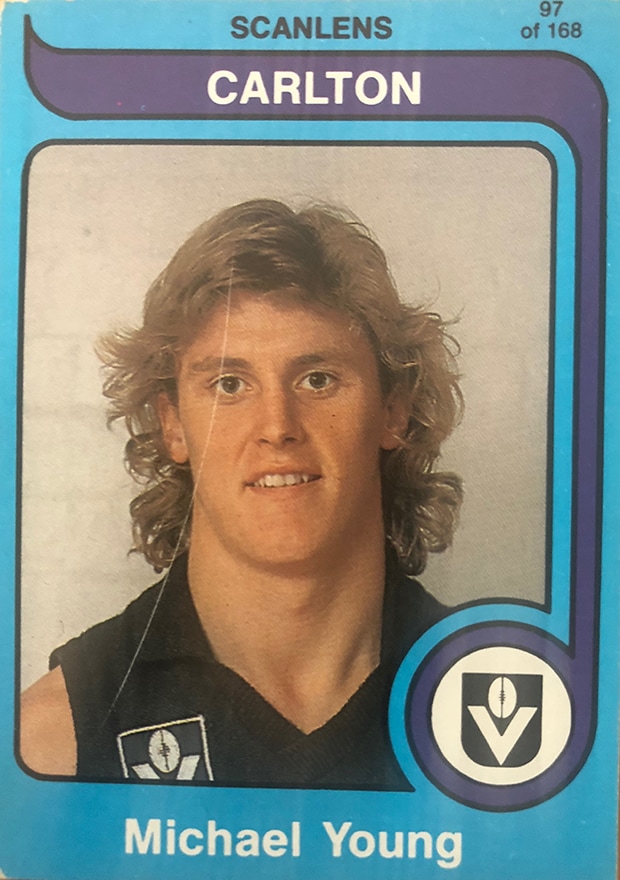
’79 premiership player Young passes away

Tony De Bolfo, Carlton Media 

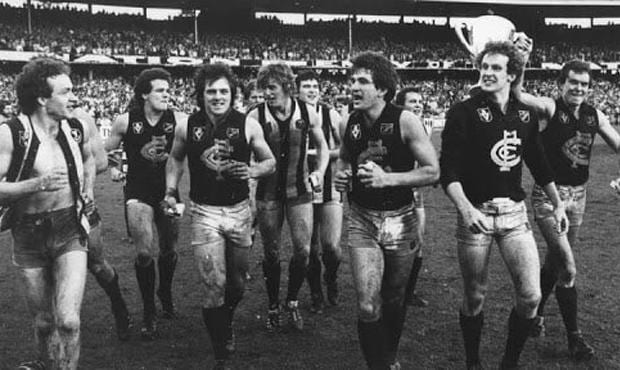
Carlton premiership wingman Michael Young, pictured here between Harmes and Johnston wearing the guernsey of his vanquished Collingwood opponent late on Grand Final day in 1979, has passed away after a long illness. - Carlton,Carlton Blues,AFLCarlton premiership wingman Michael Young, pictured here between Harmes and Johnston wearing the guernsey of his vanquished Collingwood opponent late on Grand Final day in 1979, has passed away after a long illness.

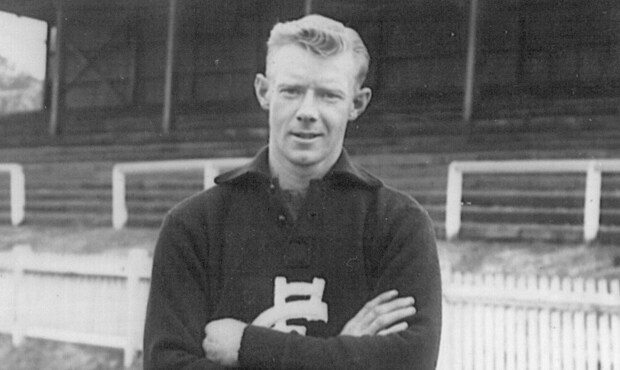
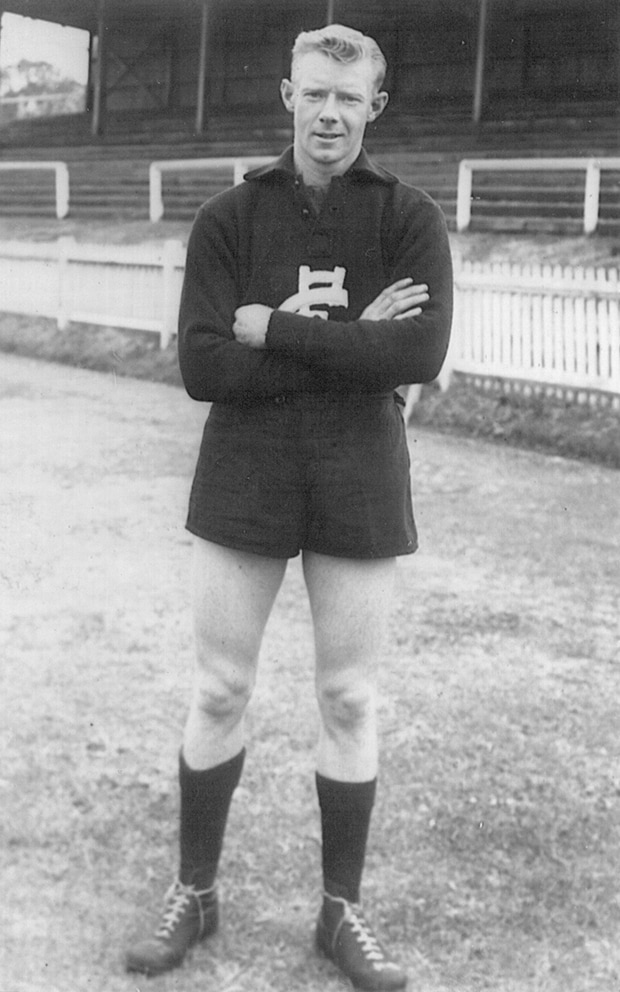
MEMBERS of Carlton’s 1979 premiership team will gather for next year’s 40th anniversary of the Grand Final triumph over Collingwood minus one, with the premature passing of wingman Michael Young.

Young died in Melbourne after a long battle with cancer this morning, three months to the day short of his 60th birthday.

Recruited to Carlton from the Hobart-based Clarence in 1977, Young inherited the No.19 of the 1972 premiership back-pocket John O’Connell, who in late 1989 himself succumbed to cancer at the age of 38.

Young took out Carlton’s reserve grade best-and-fairest award in ’77. The following season, in thr 15th round of that year against St Kilda at inhospitable Moorabbin, he completed his senior debut.

Though the late Denis Collins’ presence on a wing curtailed Young’s senior appearances through 1978, a series of solid showings at reserve grade level through mid-’79 warranted his recall . . . and timing as they say is everything.

Young was part of Carlton’s emphatic semi-final victory over North Melbourne at VFL Park. He was just 20 years old and 22 senior appearances into his senior career when he played his part in the feted outfit, captained and coached by Alex Jesaulenko, which prevailed by five points on a wet deck on Grand Final day.

The following season, Young turned out in 15 senior matches including both finals, but after 37 senior games in total was moved on at the completion of a particularly trying season for the Club. Relocating to Melbourne, Young represented the Redlegs in 15 more matches through two seasons until his delisting in 1982, and despite briefly training with Essendon subsequently gave the game away.

YoungSep16Pic
Michael Young played 37 games for the Blues, including the triumphant 1979 Grand Final.

A fellow member of the ’79 team which delivered Carlton’s 12th League premiership was the three-time premiership player Ken Sheldon, who said of Young: “Michael was a very talented, charismatic and loyal teammate who ran his opponents around in circles . . . and often some of his teammates too”.

Another team member, the four-time premiership player David McKay, said: “Michael was a champion fellow and a very good player for Carlton in a premiership season”.

“I know Michael had been ill and undergoing treatment in The Alfred for quite a while. The old Carlton runner Brendan O’Sullivan was a regular visitor to him and ‘Curly’ Austin, Barry Armstrong and Alex Marcou had also been in to see him,” McKay said.

“I spoke to him a couple of weeks ago and thought he was on the mend. He was going into rehab and was even considering fronting up to our most recent Spirit of Carlton function, but it wasn’t to be.”

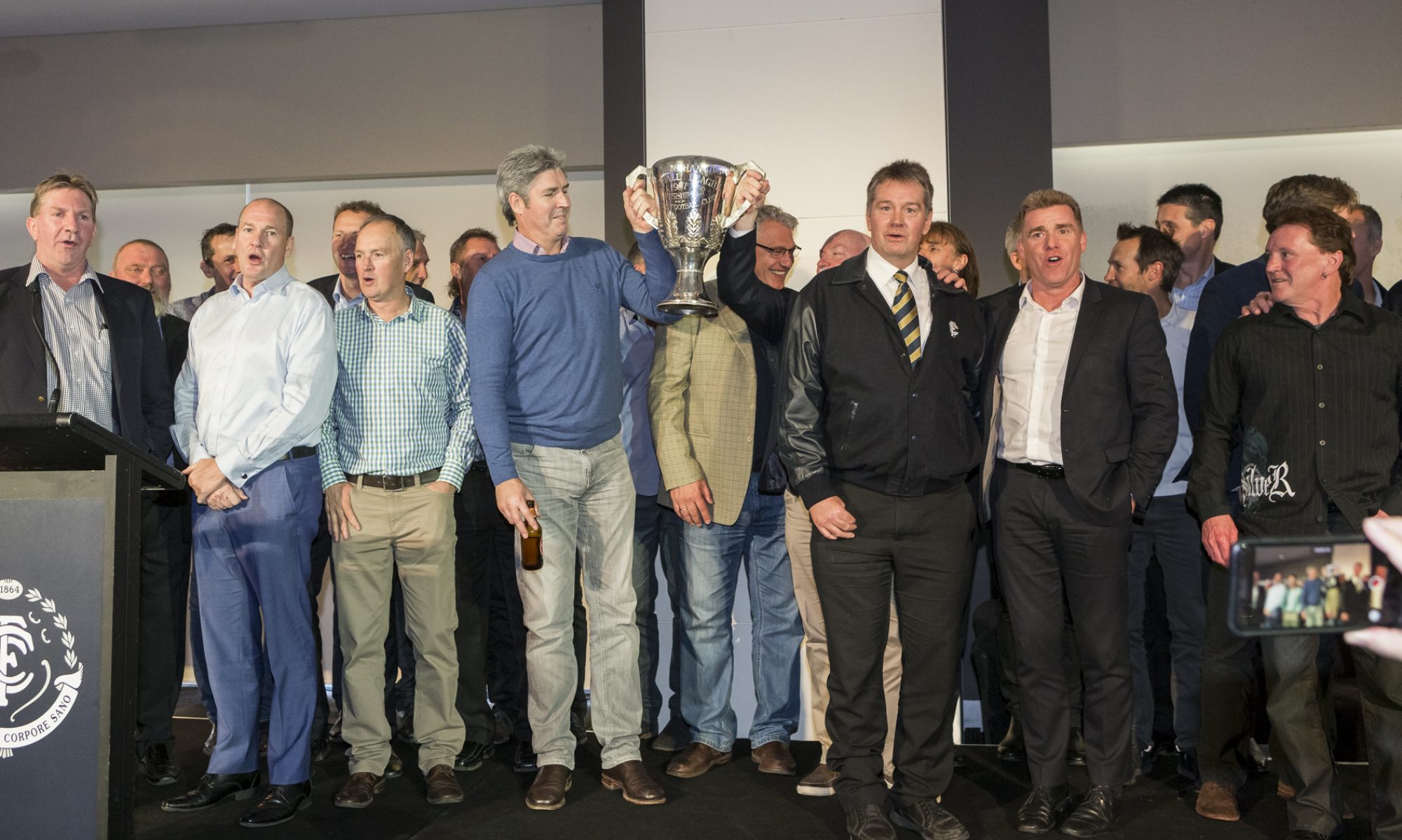
Nineteen members of Carlton’s premiership 20 of 1979, including the inaugural Norm Smith Medallist Wayne Harmes, are still living. Most of them will gather at Prahran’s College Lawn Hotel this week to raise a glass to their old teammate.

The team was as follows:

Backs: Wayne Harmes, Geoff Southby, David McKay

Half-backs: Peter McConville, Bruce Doull, Robbert Klomp

Centres: Peter Francis, Alex Jesaulenko (cc), Michael Young

Half-forwards: Wayne Johnston, Mark Maclure, Trevor Keogh

Forwards: Mike Fitzpatrick, Peter Brown, Ken Sheldon

Followers: Peter Jones, Barry Armstrong, Jim Buckley

Interchange: Rod Austin, Alex Marcou

Former Blue Boyle passes away

Tony De Bolfo, Carlton Media

Former Blue Alex Boyle has passed away at the age of 88. (Photo: Boyles Studio) - Carlton,Carlton Blues,AFL,Ikon ParkFormer Blue Alex Boyle has passed away at the age of 88. (Photo: Boyles Studio)

ALEX Boyle, Carlton’s resident full-back in eight senior matches through 1953 and ’54, has died at the age of 88 after a long illness.

Considered the logical successor to the premiership-winning full-back Ollie Grieve, Boyle joined the Club from Oakleigh having earned a reputation in VFA circles as a dashing defender of renown. Prior to 1949, he’d played for rival Association club Frankston where his on-field prowess was identified by Carlton’s 1938 premiership captain-coach Brighton Diggins.

In football terms, Boyle was hot property. On June 25, 1952, The Argus reported that Oakleigh had finally relented in clearing Boyle, who’d stood out of the game for the opening 10 games of that season out of frustration in not earning a Carlton clearance.

The Devils’ move meant that Boyle’s new club had acquired what The Argus correspondent noted was “one of the most sought after VFA footballers for years”.

“Two other League clubs – South Melbourne and Footscray – were anxious to secure the services of Boyle,” the writer observed.

“Footscray tried to sign him in 1950, 1951 and again early this season. South Melbourne failed to obtain permission from Oakleigh to interview him in 1950. Boyle trained at Carlton four years ago and the club unsuccessfully sought him last year.”

BoyleAug7Pic
Former Blue Alex Boyle. (Photo: Boyles Studio)

Named at full-back between Bruce Comben and Brian Molony, the 23-year-old Boyle completed his senior debut in Dark Navy against Footscray in the opening round of season 1953 – the same game in which a future Brownlow Medallist John James turned out for the first time.

Inaccuracy in front of goal cost Carlton the four points that Saturday afternoon – 7.18 (60) to the Bulldogs’ 9.11 (65) – and Boyle did not represent the team again that season.

On the Wednesday after the match, Boyle’s name appeared in The Argus beneath the headline PROBLEM FOR BLUES.

The unnamed reporter noted that the chief worry facing Carlton selectors was finding a successor to Boyle at full-back.

“Boyle leaves on an overseas business trip this week and may not be available again this season,” the correspondent wrote.

This week, Boyle’s son Phil revealed the circumstances behind his father’s sudden departure.

“Dad got a lucrative offer to be foreman for the construction of a cantilever crane on Christmas Island,” Phil said.

“They used to load phosphate onto ships by hand over there and Dad, who was a structural engineer, arranged for the crane to shovel it out.”

Boyle wore the guernsey No.5 of Sam Petrevski-Seton into the Footscray match and then the No.6 of Kade Simpson through a further seven senior appearances in ’54 – the last of them against Geelong in Round 18 at Kardinia Park.

Later cleared by the club, Boyle took up the role of senior coach for Pearcedale in the then Mornington Peninsula Football League in 1955.

“Dad took on a series of coaching jobs throughout in country Victoria and he was captain-coach of Narrandera Imperials in New South Wales,” Phil said.

“He played on into his mid-30s but he copped a crook hip which meant he didn’t go to watch many Carlton games later on. I can only remember a couple of occasions where he went along to watch, but having said that he always followed Carlton with interest and Carlton was his team.”

Boyle was the 662nd player to represent the Carlton Football Club at senior level since the VFL’s foundation season of 1897.

Two of Boyle’s old Carlton contemporaries, Ron Robertson and Peter Webster, remembered Boyle, but acknowledged that after 65 years, memories of their former teammate are all too fleeting.

In terms of the character of the man, Boyle’s son Phil, who was putting the finishing touches to his father’s eulogy when contacted for this story, offered the following:

“Dad was intelligent and hard-working. For more than a dozen years he worked seven days a week because the family store was burnt out up at Narrandera, we lost a lot and when Dad came back he was fighting to get back on top again,” Phil said.

“He wasn’t one for detail. He didn’t watch a movie or read a picture book. If it wasn’t real he wasn’t interested. As I say in my eulogy, he was a real man – an old fashioned sort of person in that way. Life was tough growing up, his parents broke up and I think he was loyal to all his friends because of that.”

Alexander (Alex) William Boyle died peacefully in Frankston Hospital on July 29. He was a husband to Catherine and formerly Pat (deceased), father to Bruce (deceased), Mal and Phil, step-father to Michael and Kristy. He was also a much-loved grandfather and great grandfather.

A celebration of Boyle’s life will be held at the Rosebud Funeral Chapel, 123 Jetty Road, Rosebud, on Wednesday, August 8, 2018, commencing 2.30 pm.

Andy McKinnon’s 50th

Happy 50th birthday to Andrew McKinnon.


Career: 1989–1990
Debut: Round 1, 1989 vs Footscray, aged 20 years, 247 days
956th Carlton Player
Games: 15
Goals: 7
Last game: Round 22, 1990 vs Fitzroy, aged 22 years, 35 days
Guernsey No. 47 (1989 – 1990)
Height: 175cm
Weight: 79kg
DOB: 28 July, 1968

Andy McKinnon came to Carlton from outer-eastern Olinda as a solidly built, promising rover-forward, and spent almost two seasons with the Blues’ Reserves team before gaining senior selection in 1989.

After showing promise in his first dozen games, he suffered a serious foot injury that prematurely ended his career in just his second year.

McKinnon was a Premiership Player at Reserves Level in 1990.

McKinnon also wore No.51 (1985), 54 1987, 59 (1986) and 60 (1986) whilst playing in the Blues reserves.

Career Highlights

1986 – George Armstrong Medal – U/19’s Best & Fairest Award
1985 – 2nd U/19’s Best & Fairest
1988 – 2nd Reserves Best & Fairest
1989 – 2nd Reserves Best & Fairest
1990 – 5th Reserves Best & Fairest
1990 – Reserves Premiership Player

Past and present combine at Ikon Park

Tony De Bolfo, Carlton Media

Some of Carlton's past and present players and officials come together at Ikon Park. (Photo: Jonathan Di Maggio) - Carlton,Carlton Blues,AFL,Ikon Park

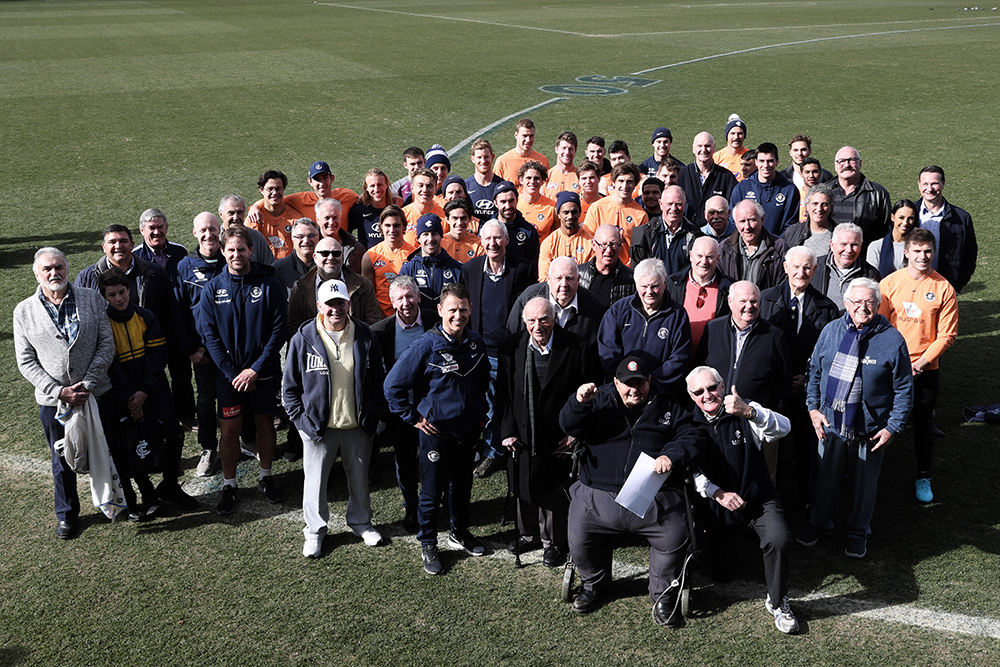
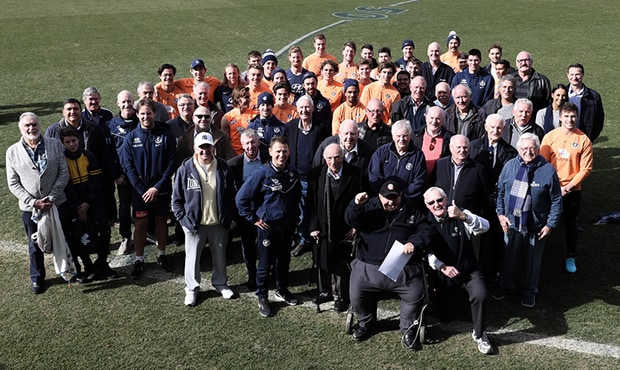
Some of Carlton’s past and present players and officials come together at Ikon Park. (Photo: Jonathan Di Maggio)

IF ever a photograph best reflected the “Bound By Blue” ethos it’s this one – a photo, recently captured at Ikon Park, of the Club’s players and officials past and present rubbing shoulders with the President Mark LoGiudice, senior coach Brendon Bolton and the Carlton players of today.

The image was taken at a meet-and-greet which followed a training session at the old ground last Saturday morning. Amongst those sharing the moment were premiership players Warren Jones, Andy Lukas, Alex Marcou, Ian Robertson, Sergio Silvagni and Geoff Southby, together with assistant coach David Teague and the outgoing Head of Football Andrew McKay.

Other former players sharing the moment with Murphy, Cripps, Curnow, Kreuzer and co. included Leon Berner, Vin Cattoggio and Bob Crowe, together with reserve-grade players Max Dixon, Greg Kazuro and Tony Zoanetti.

Long-serving club property stewards Ken Kleiman and Wayne ‘Bulldog’ Gilbert were amongst the many Old Dark Navy Blues lending their support to the club, not because it was up, but because it was down – a statement of solidarity from those whose love for Carlton only intensifies with the passing years.

Jim Plunkett’s 40th

Happy 40th birthday to Jim Plunkett


Career: 2001-2003
Debut: Round 5, 2001 vs St Kilda, aged 22 years, 276 days
1044th Carlton Player
Games: 37 (Carlton)
Goals: 14
Last Game: Round 21, 2003 vs Hawthorn, aged 25 years, 27 days
Guernsey No. 40 (2001 – 2003).
Height: 179cm
Weight: 79kg
DOB: 26 July, 1978

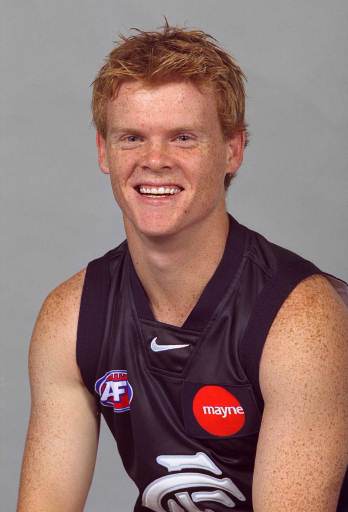
Jimmy Plunkett was a small right-footed inside midfielder with the ability to find the ball. Wearing the #40, Plunkett would come to Carlton through the Rookie Draft, after being delisted by the Bulldogs after 10 games through 1999 and 2000.

Plunkett, a red-head, would play 15 games in 2001 including a magnificent 34 possession game against the Crows in the finals. With 22 kicks and 12 handballs, Plunkett – or simply “Jimmy” or “JP” as he was known, was dynamic as the Blues crunched the Crows with Whitnall and Lappin also starring. Although we lost to the Tigers in the following week, Plunkett’s performance was eye-catching and we thought we had stolen a centreman through the Rookie List.

Plunkett played 18 games in 2002, with a number of high possession games (up to 24 on 3 occasions), although he had a few low ones also.

Plunkett did not have the size or pace of your standard AFL player, he earned the ball through burrowing in and out of packs. Good with his hands, Plunkett also had a limited kicking distance.

Incoming Coach Pagan did not seem to see the merits of Jimmy in 2003, keeping him in the VFL for all but 4 games (2 as a late replacement), and when he was selected for Carlton, he received minimum game time and had minimal impact. Plunkett would continue to perform at VFL level, but he was the sort of player who was caught with the ball so often – through getting it in the first place but not getting rid of it quick enough. Plunkett was released at the end of 2003.

In 2004 Plunkett and Blues teammate Andrew Eccles played with VFL club North Ballarat.

Off the field, Plunkett was also famous for starring in the “Avagoodweegend Mr Walker” Aerogard commercials in the 1980s as the little boy with former Test Fast Bowler Max Walker.

Plunkett was originally recruited from Montmorency.

Career Highlights

2001 – 4th Reserves Best & Fairest

All roads lead to Carlton for Crowe

Tony De Bolfo, Carlton Media

Bob Crowe meets Liam Jones - Carlton's keepers of the No.14. - Carlton,Carlton Blues,AFL,Ikon ParkBob Crowe meets Liam Jones – Carlton’s keepers of the No.14.

BOB Crowe last laced a boot for Carlton in 1964. On Saturday, for the first time in 54 years, the spritely former Carlton half-back flanker returned to the old Princes Park ground, resplendent in his dark navy blue blazer.

That blazer, a Solway standard for players back then, fitted Crowe like the proverbial glove. As the 82-year-old quickly reminded – “I played at 11-stone-four and I now weigh in at 11-five”.

Originally recruited to the Club from Mentone on the sayso of the then Mentone coach and dual Carlton premiership player Jim Baird, Crow’s tenure with Carlton lasted 11 seasons – and these were happy times both on and off the field for him.

“Looking around the ground now, I remember where the Robert Heatley Stand once stood. They used to put a dance on underneath and there’d be a barrel on,” Crowe recalled.

“They were good days.”

Crowe joined Carlton in 1954, the year after training with Melbourne under Norm Smith’s watch. Why the move? Put it down to the persistence of the then Carlton captain Ken Hands and a teammate Ron Robertson, who repeatedly and vociferously mounted the Carlton case.

Round 17, 1954 – the match with Fitzroy at Princes Park – coincided with Crowe’s first senior appearance. Curiously, Crowe’s 129th and final game would also involve the Lions – and to quote Crowe, “I also did my knee against Fitzroy, running down the race at Brunswick Street”.

“The race was like an old suburban dirt road – potholes and everything,” Crowe recalled of the place where he came to grief before the opening bounce in the 10th round of ’59.

“I played for a quarter with pain killers, but the knee was a bloody mess and in those days a cartilage injury meant a major operation. I remember I was a week in hospital, a week at home and a week at work. I resumed training with the stitches still in and I reckon I played in about seven weeks.”

Crowe finished up at Carlton in late ’64 at around the time of Ron Barassi’s landmark appointment as senior coach . . . “but that was of my own choosing”.

As he said: “I was living at Dandenong and I ended up playing a year there, but I never played again”.

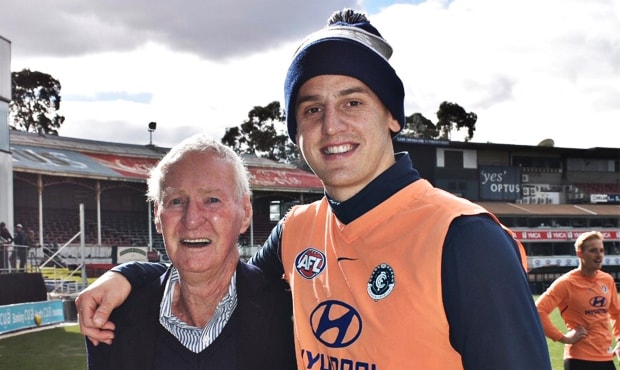
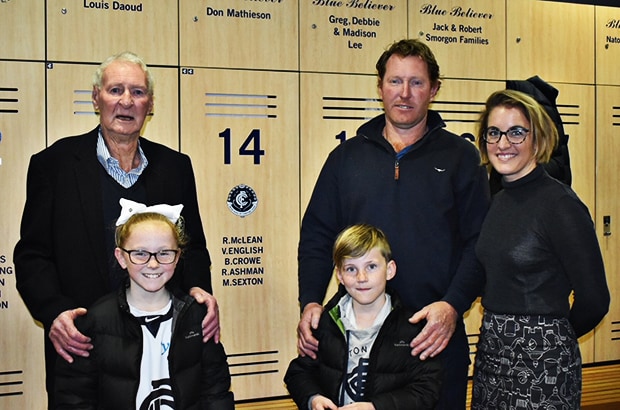
Fifty-four years on, Crowe came back, only this time accompanied by his wife Judith, son Simon, his three grandchildren Sarah, Grace and Xavier and his daughter-in-law Jane – who captured these wonderful images for posterity on a day in which the Club’s past players were invited to a post-training meet and greet.

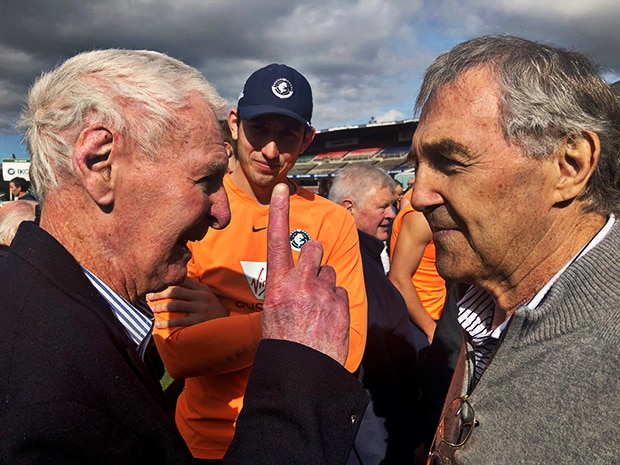
Together with the clan, Crowe posed by the No.14 locker into which his name is etched. Later, he renewed acquaintance with one of his old Carlton contemporaries Sergio Silvagni. Together they fought the good fight in the losing grand final of ’62 (“one game too many” given the drawn preliminary final with Geelong), the same year Crowe joined John Nicholls in representing the Big V.

CroweFamily.jpg
Bob Crowe and his family in front of the No.14 locker.


CroweSilvagni.jpg
Bob Crowe catches up with Sergio Silvagni as Jacob Weitering listens intently.

For Crowe, ‘Big Nick’ was Carlton’s best, although he often wonders what might have been had a barrel-chested bloke from the Riverina hung around.

“We had a bloke here named Des Lyons, a centre half-forward from Barellan,” said Crowe. “Now he only played a couple of games and he got homesick, but in my opinion he would have been the best of the best.”

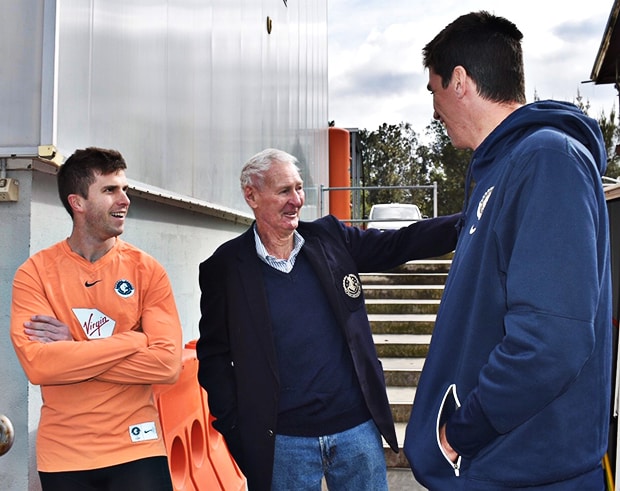
At training’s end, Crowe was introduced to today’s keeper of the No.14 Liam Jones with whom he enthusiastically compared notes. Crowe, you see, was relocated from forward to back by the then coach of the day Ken Hands, just as Jones was more recently repositioned by Brendon Bolton – inspired decisions in both instances.

CroweKreuzer.jpg
Bob Crowe meets Marc Murphy and Matthew Kreuzer.

“I remember playing forward and the ball wasn’t coming down much,” Crowe said.

“I eventually said to Jack Wrout ‘Give me a game on the backline’, ‘Handsy’ put me back there and it actually worked out quite well, because it usually follows that if a player has played forward he’s got a fair idea what the backman’s doing.”

Crowe and his loved ones filed out of the old ground, having completed their sentimental journey. For Crowe, timing was everything, for he wanted to lend the Club his undying support when it was most needed – and as he said, “It’ll turn around . . . it always does”.

Alex Marcou’s 60th

Happy 60th birthday to Alex Marcou.


Career : 1979 – 1986
Debut : Round 3, 1979 vs Essendon, aged 20 years, 268 days
Carlton Player No. 879
Games : 158 (134 at Carlton)
Goals : 165 (148 at Carlton)
Last Game : Round 11, 1986 vs North Melbourne, aged 27 years, 338 days
Guernsey No. 34
Height : 178 cm (5 ft. 10 in.)
Weight : 76 kg (12 stone, 0 lbs.)
DOB : 6 July, 1958
Premiership Player: 1979, 1981, 1982
Carlton Hall of Fame (2006)

Alexander Marcou was a member of Carlton’s fabled Mosquito Fleet of brilliant small men of the 1970s and ‘80s – a lightning quick, three-time Premiership rover renowned for his ball-handling skills and excellent goal sense. After being recruited from VAFA club Thomastown at the age of 18, he won Carlton Reserves Best and Fairest award in 1978, and the following year began his senior career.

Upon arrival at Princes Park in 1976, Marcou was allocated the Blues’ guernsey number 50 before switching to the number 34 previously worn by three-time Premiership star Ian Robertson. Like Robertson, Marcou would go on to win three flags, and as at 2016, his 134 games still stand as the club record for most appearances in this number. Of mixed Greek and Macedonian heritage, Alex grew up in Melbourne’s northern suburbs and inherited his love of Australian football from his father, who at that time was a rusted-on Fitzroy supporter.

Although he was eligible to play at Under-19 level, Marcou started with Carlton Reserves and served a lengthy apprenticeship of 33 games over two seasons, primarily as a winger or centreman. His coach in 1978 was Carlton Legend Sergio Silvagni, and it was Serge who convinced the Blues’ match committee to include Alex in the senior team for the opening round of the 1979 season against Essendon at VFL Park. Three other first-gamers in Wayne Johnston, Robbert Klomp and Peter Francis were also included for that Saturday afternoon match, and all were destined for Premiership glory. Playing as second rover to Ken Sheldon, Marcou collected 15 disposals, 2 marks and 2 goals in an eye-catching debut. Carlton won by 21 points, and from that day on, Alex was an automatic selection in the Blues’ senior side.

Midway through that first fairytale season, in his 13th senior game, Marcou (already nick-named “Marcel” after the famous French mime artist Marcel Marceau) was named Best on Ground when he kicked five goals in the Blues’ big win over Richmond at Princes Park. By September, Carlton was two wins clear of North Melbourne on top of the ladder, and raging hot favourites to claim another flag when they met the Roos in the Second Semi Final at VFL Park. Marcou and Rod Austin warmed the interchange bench for much of that afternoon, before Marcel was unleashed and got busy with eight effective possessions. Carlton won convincingly, and marched straight into the against Collingwood.

A fortnight later, having played every game of the season for an excellent return of 34 goals, Marcel sat next to “Curly” Austin on the bench again on Grand Final day at the MCG, surrounded by an enormous crowd of more than 113,000. A boggy surface, cold wind and intermittent rain didn’t dampen the ferocity of the contest between the game’s greatest rivals, until some individual heroics by Wayne Harmes during time-on in the last quarter won the games’ biggest prize for the Navy Blues. Marcou was on the ground at the final siren, having had a shot for goal that just missed with his 12th possession After just 24 games, Alex had joined the exalted ranks of Carlton Premiership players.

Season 1980 saw upheaval at Princes Park when President George Harris was voted out of office in tumultuous circumstances. Former champion ruckman “Percy” Jones replaced Alex Jesaulenko as senior coach, but the Blues never really gelled as team before crashing out of the finals in straight sets. Marcou had another fine year (apart from spending a month on the sidelines with an ankle strain) and kicked 17 goals in 19 matches. Late in the season he was selected in the VFL squad for a match against a combined ACT team in Canberra. Alex did well and was named among the three best for the Vics, but in a huge upset, the home side won by 13 points. Back at Carlton, Jones was sacked at season’s end and replaced by former Hawthorn Premiership player and coach David Parkin.

Parkin’s methods and discipline took Carlton into the finals again in 1981, thanks in no small way to the Blues’ array of brilliant, versatile small men – the Mosquito Fleet of Rod Ashman, Jim Buckley, David Glascott, Trevor Keogh, Ken Sheldon and Alex Marcou. In the Second Semi Final against Geelong, Buckley and Marcou shared the roving duties and the Blues had so many stars in their 40-point victory that Alex’s 26 disposals, 5 marks and one goal wasn’t good enough to earn a mention among his team’s best five players. Two weeks later, Carlton took on Collingwood for the flag for the second time in three seasons, and triumphed by 20 points after trailing by 21 half-way through the third quarter. In front of another huge crowd of 112,000 at the MCG, Marcou started from the interchange bench, but was soon in the thick of the action, racking up 31 disposals and six marks on the way to collecting his second Premiership medal.

Alex enjoyed his most consistent and rewarding season the following year, when Carlton survived four consecutive tough finals to claim their third flag in four years. The Blues’ opponent in the 1982 Grand Final was their other great traditional rival, Richmond – who began the decider as strong favourites after cleaning up the Blues in a rugged Semi Final. As part of his game plan, Parkin ran three rovers in Ashman, Sheldon and Marcou, and all three became influential as the contest unfolded. With their team behind by 11 points at half-time, Carlton ruckmen “Wow” Jones and captain Mike Fitzpatrick seized the initiative in the second half and the Blues came storming back for a gritty 18-point win. That evening, amid the euphoria of a third flag win in four years by the Blues, Alex’s remarkable career statistics stood at 9 finals, three Premierships and 112 goals in 87 games.

Highlights kept coming for Marcel in 1983, despite a couple of muscle strains that cost him the odd game or two. In May, he played his first and only State of Origin game for Victoria against South Australia in Adelaide, in a famous match that produced an aggregate 43 goals and a 56-point victory to the Crow Eaters. In July, Alex celebrated game number 100 for Carlton with a 6-goal victory over Fitzroy at Waverley, before playing his 20th final when the Blues suffered a devastating Elimination Final loss to Essendon. Perhaps that was a portent of things to come, because in an all too common story, Lady Luck seemed to turn her back on Alex from that time on.

Having already suffered a series of persistent soft tissue injuries, Marcou had his jaw broken in 1985, and again in 1986. Over those two seasons he managed only 10 senior games, and his frustration was compounded when he was on track for a return to the senior side on the eve of 1986 finals, only to tear a hamstring. Before that injury his form with Carlton Reserves had been good enough to see him finish third in the voting for the Gardiner Medal (Reserves Best and Fairest) despite only playing half a season.

Carlton’s heavy defeat by Hawthorn in the ’86 Grand Final turned a blowtorch on the Blues’ roster of players, and indirectly ended Marcou’s career at Princes Park. When club secretary Ian Collins bluntly told Alex that his place in Carlton’s senior team could no longer be guaranteed, it prompted the 28 year-old to consider a fresh start another club. Mainly because a number of ex-Blues were already playing there, he eventually chose St Kilda, and Carlton did not stand in his way.

Alex’s first season with the Saints in 1987 saw him used at both ends of the ground, and his experience was invaluable in a young team. However, hamstring and calf injuries slowed him down in 1988, and when he fell out with his coach Darrell Baldock, he made the decision to retire at season’s end. In two seasons at Moorabbin, he had played 24 games and booted 17 goals.

Although finished with League football, Marcou wasn’t quite ready to hang up his boots for good, so in 1989 he signed on with VFA club Springvale, where he was coached by his dual Premiership team-mate Phil Maylin. In 1993, Marcou, Maylin and another Premiership-winning Blue in Peter McConville formed an organization called the VFL – Virtually Forgotten Legends – as a social club and support network for former players and officials. Later, Alex returned to Princes Park as an energetic member of the Past Players Association, and in 2006 he was inducted into the Carlton Hall of Fame.

Milestones

100 Games : Round 16, 1983 vs Fitzroy
100 Goals : Round 18, 1982 vs Footscray

Career Highlights

1978 – Reserves Best & Fairest
1979 – Premiership Player
1980 – Victorian Representative
1980 – 7th Best & Fairest
1981 – 10th Best & Fairest
1981 – Premiership Player
1982 – 7th Best & Fairest
1982 – Premiership Player
1983 – Victorian Representative
1983 – 6th Best & Fairest
1985 – 3rd in Gardiner Medal (VFL Reserves Best and Fairest)

Vale Allan White – true Blue to the end

Tony De Bolfo, Carlton Media

ALLAN White, an opportunistic Carlton forward in the early years of John Nicholls and Sergio Silvagni, has been laid to rest in the Strathbogie Shire town of Avenel, the place from which he was recruited to Princes Park more than 60 years ago.

At the age of 84 and after a long illness, White died in a Shepparton aged care facility last Friday (June 27). Surviving him is his beloved wife Joyce (the great aunt of Collingwood’s Steele Sidebottom), daughter Anne-Maree, son Richard and their families.

Born in Carlton in November 1933 and raised in nearby Fawkner, White ultimately relocated with his family to Avenel where he found work as a woodchopper. Chasing the leather for Avenel Swans on weekends, White first attracted the interest of a South Melbourne talent scout, but instead resolved to follow his football dream with the Blues whom he’d supported as a kid.

Completing his Carlton senior debut in the 17th round of 1957 – and carrying the No.38 of Ciaran Byrne on his back – White was named on a flank alongside centre half-forward Graham Donaldson and Denis Strauch for the match with Fitzroy at the old Princes Park oval.

AllanWhiteSignsFooty
The late Allan White signs a footy for some young fans. (Photo supplied by Heath Armstrong)

The home team, under the watch of the then coach Jim Francis, comfortably accounted for the visitors – 11.13 (79) to 5.11 (41) – on a day in which John Chick was reported and subsequently suspended for eight matches for kicking Fitzroy’s Wally Clark.

The resident Carlton captain Ken Hands also had his number taken for allegedly striking the Lions’ half-back flanker Brian Pert – a charge later thrown out by the learned members of the Tribunal.

Alternating from half-forward to full-forward between 1957 and ’59, White would find the big sticks on 23 occasions in as many senior appearances for the old dark Navy Blues, including a bag of five to get them over the line by two points against Hawthorn in the 17th round of the ’59 season.

AllanWhiteJohnNicholls
Allan White and John Nicholls on the MCG in 1957. (Photo supplied by Heath Armstrong)

As with the late Doug Beasy and Peter Webster, White’s last hurrah for Carlton came in the 1959 second semi-final with Melbourne. Before an audience of more than 72,000 in miserable conditions on the MCG, the Hands-coached Carlton players were outclassed by the Redlegs – 11.15 (81) – 4.13 (37) – with John Nicholls and Ron Barassi best afield for their respective teams.

During his time at Carlton, White worked at a nearby box factory to help make ends meet. Then in April 1960, quite possibly for financial reasons, White successfully sought a transfer to Sunraysia Football League club Mildura Imperials whom he captained and coached.

Webster, who coincidentally captained and coached rival team Merbein, remembered his old Carlton teammate with affection.

“Gee, this goes back a long way,” Webster said. “Allan wasn’t that big size wise, about 5’11” in the old measurement, but he was quite a good kick – a long kick – and he was a nice fellow too.”

Wearing his Carlton Football Club blazer, White was buried in Avenel Cemetery on Monday. Down the road at Avenel Football Club, he is immortalised as a member of the Swans’ Team of the Century.

This week, White’s grandson Heath Armstrong, who supplied two wonderful images from the old Carlton days, paid a very personal tribute.

“My grandfather taught me how to kick a footy – my only discernible skill when it comes to playing the game,” Armstrong said.

“He was very passionate about his sport and he loved the Carlton Football Club. We always used to chat about the state of the team, this was something we really pondered a lot.

“He was genuinely pretty quiet, a man of few words, but not afraid to tell you what he thought if he thought about it strongly.”