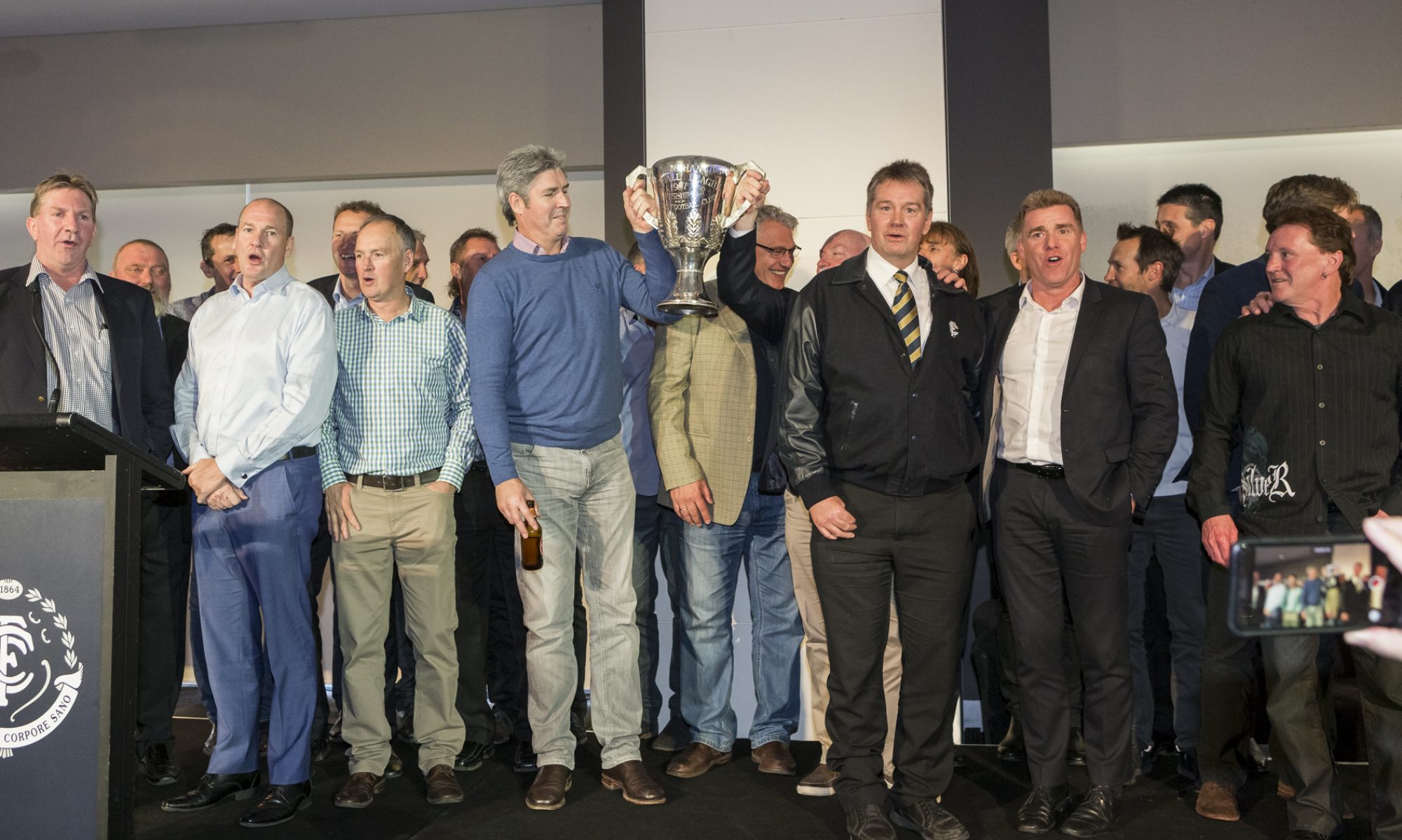

Opportunity for Carlton Past Players to Get Bowling
Latest Videos – Armstrong/Brown/Buckley/Jones
Barry Armstrong
Peter Brown
Stephen Buckley
Peter Jones the 1970s
The big five oh for Bradley
Happy 50th birthday to Craig Bradley today!
——————-
From the Blueseum

Career : 1986 – 2002
Debut : Round 1, 1986 vs Hawthorn, aged 22 years, 159 days
Carlton Player No. 931
Games : 375
Goals : 247
Last Game : Round 19, 2002 vs Port Adelaide, aged 38 years, 291 days
Guernsey No. 21
Height : 182 cm (5 ft. 11 in.)
Weight : 81 kg (12 stone, 11 lbs.)
DOB : 23 October, 1963
Premiership Player : 1987, 1995
Carlton Legend
Carlton Hall of Fame : 1995
Best and Fairest: 1986, 1988, 1993
All Australian: 1986, 1993, 1994, 1995, 1997
Captain: 1998-2002
Team of the Century: Wing
International Rules Series vs Ireland : 2000, 2001 (captain), 2002
Off the field, Craig Bradley was a somewhat quiet, unassuming character who never hungered for the spotlight. But when the umpire’s whistle blew for a game of Australian football, he became a consummate professional whose outstanding ball-winning ability, accurate disposal, punishing non-stop running and longevity in the game made him one of the all-time greats. “Braddles” captained the Blues for three years, won two AFL Premierships, and picked up almost every possible honour in a stellar career that spanned 17 seasons and a record 375 games for the Carlton Football Club.
He began his football journey at Pooraka in outer-suburban Adelaide, where his father was coach of the Under-19 team. Craig was a standout junior footballer, and in 1981 he was recruited by SANFL club Port Adelaide. At the same time, Essendon also made a big pitch for his signature. The Bombers were very intent on getting him to Windy Hill, but Bradley wasn’t then ready to make the big move interstate.
Essendon redoubled their efforts after Bradley’s sensational debut year for Port Adelaide, which culminated in the Magpies’ 51-point demolition of Glenelg in the Grand Final. Playing on a wing, but roaming the length of the ground, 17 year-old Bradley was one of his team’s best. He followed up by winning Port’s Best and Fairest in 1982, before departing for England later that year, as a member of the Australian Under-19 cricket team. Cricket was Braddles’ other great sporting passion, and he would eventually play two Sheffield Shield games each for South Australia and Victoria, before giving the game away to further his football ambitions.
Because of his cricketing commitments, Bradley missed most of the 1983 pre-season with Port, but it made little difference, because he had another dominant season for the Magpies and was named All Australian for the first time. Two more Port Adelaide Best and Fairests followed in 1984 and ’85 – with the latter complemented by All Australian honours again.
In that year of 1985, four South Australians were named as All Australians; Bradley, Stephen Kernahan, Peter Motley and John Platten – and to the chagrin and envy of every other VFL club (especially Essendon) the first three all signed to play with Carlton. In the following year that trio of stars took to VFL football like they were born to it, and a time of bubbling confidence began for the Old Dark Navy Blues.
Braddles wasted little time in announcing his arrival into the upper echelons of our national game by playing in the 1986 Grand Final in his debut season at Princes Park; the same year he won his first Carlton Best and Fairest award in a tie with Wayne Johnston. The Blues lost heavily to Hawthorn on Grand Final day, but twelve months later bounced back to snatch the 1987 flag from the Hawks in Bradley’s 47th senior match.
By then, he was already a budding champion whose amazing stamina was too much for almost every opponent. He simply ran his taggers into the ground, and he was as effective in the last minutes of a game as he was at the start. He won two more Carlton Best and Fairest awards in 1988 and 1993, and by the end of his superb career had been an All Australian six times.
Aged 32, he picked up his second Premiership winner’s medallion in 1995 when the unstoppable Kernahan-led Blues demolished Geelong in a one-sided Grand Final, but those who thought he might retire after that triumph were right off the mark. He still had his zip, his footy smarts and his brilliant foot skills, and he had transformed himself from a purely attacking weapon into an equally-effective sweeper across half-back. And to cap off a memorable season, he became one of only a handful of players to be inducted into the Carlton Hall of Fame while still playing out their career.
In 1997, at the age of 34, Bradley won the Sunday Age Footballer of the Year award. ”It’s not the end of the world when you reach 30,” he said in a blunt response to those who kept asking how long he intended going on – to his considerable annoyance.
After being named All Australian yet again that year, he answered all those sorts of questions when he was appointed captain of his beloved Blues in 1998 – after the retirement of his great mate ‘Sticks’ Kernahan. Braddles led the Blues into another Grand Final in 1999, but the Wayne Carey-inspired Kangaroos proved just too good.
Further indication of Craig Bradley’s enduring ability was his record in the often controversial and passionately-contested International Rules Series against Ireland. He first played for his country in 1984, and was recalled again in 2000. He was appointed captain of Australia in 2001, and played a fourth round of matches in 2002 at the age of 38 – a truly amazing achievement.
In the millennium year of 2000, the honours kept rolling in for Braddles when he was included in both Carlton and Port Adelaide’s Team of the Century. In turn this raised the usual debate over why he had never won the game’s most prestigious individual award, the Brownlow Medal. The answer was apparently found when former field umpire Peter Cameron was interviewed, and he revealed that during most games, Bradley regularly back-chatted the men with the whistle. “He’s in the umpire’s ear all the time,’ said Cameron.
By circumstance, Braddles wore his iconic number 21 guernsey for the last time against Port Adelaide at Princes Park in round 19, 2002. Carlton lost the match by 9 points, and Bradley suffered broken ribs and a punctured lung in a heavy collision. Even so, he was an almost unanimous choice as Best on Ground and was given three Brownlow Medal votes by the umpires.
A few weeks later, Bradley’s farewell was typical of his nature. There was no big press conference, no stage-managed extravaganza. Instead, he issued a written statement through the AFL that caught everyone – including the Carlton Football Club by complete surprise. It read (in part);
I have many people to thank and will do so in the coming weeks. I would however like to thank the Carlton Football Club and the Port Adelaide Football Club for many wonderful times and for their influence in helping to shape my life. To leave the game with a bit left in the tank and in good personal form makes me feel good.
Since the foundation of the VFL in 1897, only three men (Michael Tuck, Kevin Bartlett and Simon Madden) have played more senior games than Craig Edwin Bradley of Carlton. A true Blue champion, he is one of only ten official Carlton Legends, and in 2006 was Carlton’s 17th inductee into the AFL Hall of Fame.
Battle of the Legends Unearthed
Back in 1990 when the Richmond Football Club were conducting their SOS campaign to raise money to keep their club afloat the Carlton past players helped out and the result was a magnificent match held at Windy Hill on the 30th of September in front of more than 20,000 passionate fans. It was an amazing occassion with a plethora of legends from both clubs enjoying the day. Enjoy.
Dave Hughes Shares the Stage with Carlton Legends
Watch as Dave Hughes interviews Stephen Kernahan, Robert Walls and Chris Judd at the recent Spirit of Carlton Captains Luncheon held at the Grand Hyatt.
Latest Videos – Heath/Fitzpatrick/Kennedy/Dickson/Francis
Kevin Heath
Peter Fitzpatrick
Greg Kennedy
David Dickson
Peter Francis
Latest Videos – Mangels/Young/Pinnell/Towns/Maclure
Alan Mangels
Michael Young
Phil Pinnell
Greg Towns
Mark Maclure
Footballer, athlete Tom Simmons dies
By Tony De Bolfo
Former Carlton footballer Tom Simmons. (Photo: Carlton Football Club)
Tom Simmons, whose football prowess at Princes Park in the post-World War II years of Henfry and Deacon was more than matched by his prodigious talents as a professional athlete, has died at the age of 84.
By the time he was recruited to Carlton from Northcote District juniors in Melbourne’s inner-city north, Thomas Edwin Francis Simmons’ reputation on the track preceded him. Standing six foot in the old measurement, he had taken the 100 and 200-yard championships of Melbourne Technical Schools, together with the high and long-jump titles, and had also triumphed in the 220-yard dash at the Inter-Technical schools championship at Olympic Park.
At Carlton, he would later combine football with cricket commitments, as would “Mick” Price and Jim Baird, his club contemporaries.
Simmons earned Carlton’s Best First-Year Player award in 1948 – the first of just two seasons at senior League level – during which time he alternated between half-back and half-forward.
Wearing the famous No.2 of John Nicholls, Greg Williams and (now) Troy Menzel, Simmons completed his senior debut barely a month after his 19th birthday. He would string together 27 senior appearances for the Blues through 1948 and ’49, having been adjudged their best first-year player.
Simmons’ rare litheness was on show in what was an all-too-brief League football foray. His impressive speed, long-kicking and high-marking, together with his insatiable appetite for the contest, made him a formidable foe. An old teammate, the late Laurie Kerr, said of Simmons: “He looked and performed like Mighty Mouse on the field”, and the noted field umpire Harry Beitzel rated the player a champion in the making.
Allan Greenshields, the 16-game Carlton Premiership player of 1947 who later pursued his career with St Kilda, is one of Simmons’ few surviving contemporaries.
“Tom was a good athlete. He had a very good body and a good pair of legs,” Greenshields, now 87, said.
“I went to St Kilda in mid-’49 and I reckon he was still there then. I remember him as a half-back flanker who got a few games and went well, although he got injured and couldn’t play anymore.
“But he was another player up against me, which is why I thought ‘I’d better get out here’. There were just too many blokes in for my position.”
Tragically, Simmons’ football career ended before it had effectively begun. In a pre-season practice match in 1950, he buckled with serious knee damage which later warranted two separate surgical procedures.
Simmons took on professional foot running as he completed a remarkable recovery, taking out the Terang, Ararat, Maryborough and Port Fairy Gifts as backmarker through the summers of 1950 and ’51. Clearly he could still run the straight lines.
But while he again committed to Carlton to help fill the void left by the recently-retired full-forward Ken Baxter, he was never able to emulate his footballing feats, although he did follow up as a field umpire in the sticks.
Simmons married his sweetheart Lorraine the following year, and later forged a successful career as an industrial chemist for companies such as Revlon and Estee Lauder. He and his wife raised a family of seven children, and he was a regular at Carlton games for many years long after his on-field career had ended.
A funeral mass for Tom Simmons is to be held just down the road from the old Carlton ground, at St. Carthage’s Church, Royal Parade, Parkville, this Friday (October 11) from 11am.
A private burial is to follow.
—————-
The Simmons family very kindly provided photos from Tom’s private collection to the Blueseum. Please CLICK HERE to see pictures from Tom’s time at the Blues and his running career.
Happy 60th Birthday to Eric Pascoe
A happy 60th to Eric today!
Latest Videos – Jones/Pickett/Collins/Galt/Catoggio
Peter Jones the 1960s
Tony Pickett
Denis Collins
Rod Galt
Vin Catoggio
Latest Videos – Byrne/Doull/Nicholls/Gill/Gill
Ray Byrne
Bruce Doull No 4
Barry Gill
John Gill
Dual Milestones for Former Blues
Happy 60th birthday to Trevor Fletcher and happy 50th to Greg Williams today.
————–

Career : 1976 – 1977
Debut : Round 17, 1976 vs Hawthorn, aged 22 years, 297 days
Carlton Player No. 861
Games : 4
Goals : 0
Last Game : Round 3, 1977 vs St Kilda, aged 23 years, 198 days
Guernsey No. 33 (1976 – 1977)
Height : 192 cm (6 ft. 3 in.)
Weight : 89 kg (14 stone, 0 lbs.)
DOB : 30 September, 1953
——————-
Career : 1992 – 1997
Debut (Carlton): Round 7, 1992 vs Footscray, aged 28 years, 216 days
Carlton Player No. 983
Games : 109 (Carlton), 250 (career)
Goals : 89
Last Game: Round 16, 1997 vs Essendon, aged 33 years, 293 days
Guernsey No : 2
Height : 175 cm (5 ft. 9 in.)
Weight : 86 kg (13 stone, 8 lbs.)
DOB : 30 September, 1963
Premiership Player 1995
Norm Smith Medal 1995
Brownlow Medal 1994 (Also 1986 at the Swans)
Robert Reynolds Memorial Trophy –Best and Fairest Award: 1994
All Australian: 1993(vc), 1994(c)
Herald Sun Player of the Year: 1993, 1994
Leigh Matthew Trophy AFLPA MVP Award: 1994
Team of the Century: Centre
AFL Team of the Century
Carlton Hall of Fame (Inducted 1999)
AFL Hall of Fame (Inducted 2001)
Robert Walls Highlights Videos
The Spirit of Carlton past and present is determined to present video highlights from as many past players as possible. Next in line are the highlights from Carlton legend Robert Walls which naturally had to be split amongst several videoes.
Flynns come home to Carlton for ol’ Jim
By Tony De Bolfo
The Flynn family at Visy Park earlier this week. (Photo: Carlton Football Club)
Three generations of the Flynn family have fittingly set aside Grand Final week to return to the place once “owned” by Carlton’s first Premiership captain of the 20th century, the great Jim Flynn.
On the hallowed turf at the old Carlton ground, clan members came from various parts of regional Victoria and metropolitan Melbourne to stand in tribute to ol’ Jim – a three-time Premiership player in the Jack Worrall-coached teams of 1906, ’07 and ’08.
Photographed for posterity were the following descendants;
Mandy Allen (Flynn’s great granddaughter, aged 41), Kelli Gayfer (great granddaughter, 42), Di Flynn (daughter-in-law, 66), Paul Flynn (great grandson, 36), Pat Flynn (grandson, 70) and Shane Flynn (great grandson, 33).
Also in the frame were Thomas Gayfer (great-great grandson, two months), Jade Gayfer (great-great granddaughter, six), Grace Gayfer (great-great granddaughter, four), Charlie Flynn (great-great grandson, four), Joe Allen (great-great grandson, 10), Sam Allen (great-great grandson, 12), Georgia Allen (great-great granddaughter, 13) and Tilly Flynn (great-great granddaughter, six).
Of those appearing in this historic photograph, only Pat knew Flynn in person, and only then as a boy of 12.
“He (Flynn) was a great man, a great old person,” Pat said. “He was very fond of his grandchildren and I was the eldest of them. I used to go rabbiting with him and a couple of dogs in a horse and gig on his farm up at Wilby, which was just south of Yarrawonga.
“Jim was a farmer. He farmed wheat and he had a few sheep and cattle on a few hundred acres at that farm, which I think was called Glenview. He used to take me on the horse and gig into the general store in Wilby twice a week. We used to collect the mail and a few groceries at the store and it’s no longer there now.
“He also suffered from Parkinson’s Disease in his later years. I can remember at dinner time he’d be at the table and his knife would be shaking on the plate. But my fondest memories are of going rabbiting with him and heading into Wilby in the horse and gig.”
Pat remembered that Flynn found a soft spot for the Wilby Football Club.
“People well into their 80s who live up there remember him and still speak very highly of him,” Pat said. “Going to the football at Wilby, he had a particular spot on the fence at which he stood, and he’d give advice to members of the team.”
He added that his grandfather never recounted tales of the old days at Princes Oval (other than extolling the virtues of his old mentor Worrall), “and all the old photos which used to grace the walls of the old house are gone now”.
Fortunately, some precious mementoes remain – like the Premiership caps, medallions and certificates hard won and dear – which for years now have graced Pat’s menswear store, Flynn’s of Wangaratta.
As Pat said: “They’re displayed on the wall of the shop and they’re looked at by many, many people. They’ve created a lot of interest.”
James Edward “Jim” Flynn was born in Geelong on March 21, 1871, the son of John and Ellen Flynn (nee Moloney), natives of Tipperary in Ireland. John and Ellen had completed the eight-week voyage to Melbourne from Plymouth aboard the sailing ship Percy the previous year – during which time their two year-old son Thomas had died of a fever and was buried at sea in the presence of Captain James Cooper, passengers and crew.
Little is known of Flynn’s early life, but his football exploits have been documented. He had a run with Benalla, then Collingwood in the old VFA days and for a brief period Canterbury, but later turned out for Geelong in 74 senior appearances through six seasons from 1897 – including the team’s maiden VFL appearance against Essendon at Corio Oval.

Carlton’s first premiership captain, Jim Flynn. (Photo: Carlton Football Club)
Flynn joined Carlton in 1903 (Pat believes it was on Worrall’s sayso) after landing work as a barman, and contributed to the cause as both ruckman and defender through 77 matches in eight glorious seasons. As mentioned previously, Flynn was a member of Carlton’s three consecutive Premiership teams – the third of them (1908) after having been talked out of retirement by the coach.
In Flynn’s first season, Carlton rose in the ladder standings from sixth to third. Such was his impact, Flynn was named vice-captain in the following year, as right hand man to the former Geelong ruckman Joe McShane.
When McShane stepped down at the end of 1904, Flynn assumed captaincy duties. Such was his reputation as a genuine leader that the Punch correspondent of 1907 was drawn to write “he was as Napoleon, Wellington, Julius Caesar, Great Scot and Kitchener . . . ”
By 1910, Flynn was considered lost to football, until fate again played its hand. In the wake of the sensational withdrawals of Doug Gillespie, Alex “Bongo” Lang and Doug Fraser amid bribery allegations, captain-coach “Pompey” Elliott persuaded Flynn to complete yet another comeback for Carlton, in the 1910 semi-final with South Melbourne.
Flynn was 39 at the time.
After that one last tilt at League football, Flynn pursued his business interests, in acquiring the St James Hotel. In October 1911, he married a local St James girl, Ellen Cleary. Together they would raise six children – Edward, Mary, James, Alicia, John and Anastasia.
Sometime later, he put the hotel on the market and relocated with his family to the farm at Wilby.
There he worked the land until August 1955, when he died not long after falling and breaking his hip.
This week, some 68 years after Flynn’s passing and 35 more after he last laced a boot, ol’ Jim’s memory was perpetuated by the clan.
Latest Videos – McKenna/Bedford/O’Connell/McConnon/Ohlsen
Peter McKenna
Peter Bedford
John O’Connell
Leigh McConnon
Russell Ohlsen
Happy 60th to Val Perovic
A very happy 60th birthday to Val “Woof” Perovic.
——
From the Blueseum:
Career : 1980 – 1985
Debut : Round 1, 1980 vs Collingwood, aged 26 years, 185 days
Carlton Player No. 882
Games : 174 (97 at Carlton)
Goals : 13 (1 at Carlton)
Guernsey No. 15
Last Game : Round 10, 1985 vs Hawthorn, aged 31 years, 249 days
Height : 194 cm ( 6 ft. 4 in.)
Weight : 97 kg (15 stone, 4 lbs.)
DOB : 25 September, 1953
Premiership Player 1981, 1982
Vladimir ‘Val’ Perovic was four years old in 1958, when his parents and their family of four boys and two girls arrived in Australia from Croatia, and settled into country life at Ballarat. Some 27 years later, when Val retired from the game of Australian Football as a dual Premiership player with Carlton, he left with a reputation as one of the outstanding tall defenders of his generation.
Perovic found his way to Princes Park in 1980 after a messy parting from his original club, St Kilda – with whom he had played 77 games in seven seasons in a variety of positions including the ruck, wing, and centre half-back. Two years earlier, he had worn the Big Vee for Victoria against WA, and was considered a future star for the Saints. However, late in 1979, after his team had suffered a particularly heavy defeat, St Kilda President Lindsay Fox issued an edict to all the club’s country-based players, demanding that as from the following season, all would have to live and train in Melbourne, or move on.
Perovic immediately spoke out against Fox, and in a shock reaction, was put on the trade market before the year was out. Meanwhile, over at Princes Park, Carlton was in turmoil, too. Under captain-coach Alex Jesaulenko, the Blues had beaten Collingwood in the 1979 Grand Final, only to then fall into disarray as President George Harris was tipped out of office by a reform group headed by Ian Rice. Jesaulenko had publicly supported Harris, so he too resigned when George was voted out.
In the weeks following the election, ‘Jezza’ was cleared to St Kilda as their new captain-coach, and Perovic arrived in his place. It was one of the great trades of its time – especially for the Blues. While St Kilda had gained an ageing super star, the reigning Premiers had picked up a 26 year-old, 77-game key position prospect with his best years still ahead of him. Thank you very much, Lindsay!
At Carlton, Perovic was presented with the number 15 guernsey previously worn by 1970 Premiership defender Phil Pinnell, and told by coach Peter Jones that the key post at centre half-back was his for the taking, if his attitude and application were up to scratch. On both counts, Perovic lived up to expectations. A friendly and garrulous character, he soon became the epicentre of social events at Carlton whenever a feed, a few beers and some good laughs were on offer.
On the field, the Blueboys comfortably made the 1980 finals under Jones, only to bow out in straight sets after successive defeats to arch rivals Richmond and Collingwood. By year’s end, Perovic was settled in at centre half-back, where his booming clearing kicks began to be accompanied by a loud shout of “woof” from the terraces, whenever the ball left his boot. Said to have been started by a group of university students, the novelty soon caught on, and pretty soon the cry was more often a roar.
In 1981 “Percy” Jones stood aside, to be replaced by former Hawthorn Premiership player and coach David Parkin, who brought a more scientific approach to coaching with him. Although the Carlton squad of that time wore their ‘Party Boys’ reputation quite proudly, Parkin successfully melded his code of peak physical and mental preparation with the “train hard, play hard, party hard” philosophy favoured by Jesaulenko and Jones – and the team responded.
Perovic had a breakout year for the Blues in ‘81, and was rewarded with his second state team selection at centre half-back. A few weeks later – boosted by the brilliance of their interstate recruits Hunter, Bosustow and Fitzpatrick, Carlton finished top of the ladder after the home and away rounds, and went on to meet Collingwood in the Grand Final. Perovic was assigned a back pocket role on the Pies’ Brownlow medallist Peter Moore, and blanketed him all day. Collingwood led by 21 points late in the third quarter, before the Blues rattled on a clutch of unanswered goals in the last term, and won their 13th flag by 20 points.
In 1982, with the Navy Blues on the way to finishing third on the home and away ladder, Perovic celebrated a special moment when he steered through the one and only goal of his career at Princes Park, against Footscray in round 18. Sent into the ruck to warm up on a cold day, Val took a good pack mark quite a way from goal, and was immediately urged by his team-mates to take the shot. He settled, kicked sweetly, and sent the ball straight through the middle. What was most surprising about that game however, was not who kicked goals, but who didn’t – as the barnstorming Blues scored 30.21 (210) to Footscray’s 10.12 (72).
In September of that year, Carlton snatched a second consecutive flag after a gruelling finals campaign of four cut-throat matches in four weeks. Our Grand Final opponents, Richmond, started hot favourites after beating the Blues easily in the second Semi Final, but erred by going into the match top heavy. “Wow” Jones was superb in the ruck for Carlton, while Bruce Doull and Perovic led a rock-hard defence. Although Perovic finished the game with a broken rib, the “whoof” repeatedly echoed around the MCG, as Carlton won Premiership number 14 by 18 points.
The huge physical and mental effort involved in those back to back flags took an increasing toll over the next few seasons, as retirements and injuries made it difficult for the Blues to field their best line-up. Carlton finished fifth in 1983 and third in 1984, when Perovic battled through Carlton’s finals campaign with another jumper full of damaged ribs suffered against Hawthorn in round 18.
By 1985, Val knew the end of his career was looming when he was unable to return to the senior team until round 9, and the very next week, Hawthorn handed the Blues a fearful hiding by 79 points at Princes Park in what turned out to be his last appearance. Although it was an undignified end to a fine career, his standing at Carlton, and in the game as a whole could not be tarnished. One of the finest defenders of his era, and among the very best to have worn guernsey 15 for the Blues, Val’s legacy lived on in the ‘Woof!’ bestowed on his successors; Ang Christou, Chris Bryan and briefly, Adam Hartlett.
In a footnote to Perovic’s story, it later emerged that St Kilda made a determined bid to lure him back in 1986. But the fires of ambition had long been doused, and he dreaded the thought of another punishing VFL pre-season. Instead, he headed back to the Ballarat League and signed with Golden Point – despite originally being recruited by St Kilda from North Ballarat. At the end of that year he travelled north to Darwin, and finished off his career with one last season with the Nightcliff Tigers in the Northern Territory Football League.
50 years on, Blueboys of ’63 reunite
By Tony De Bolfo
The surviving members of Carlton’s Under 19 Premiership team. (Photo: Supplied)Fifty years after knocking Essendon over in the big one, surviving members of Carlton’s Under 19 Premiership team of 1963 have gathered at Percy’s Pub in Carlton to reminisce.
The gathering, which included 15 members of the victorious 20, was championed by the best player afield that day, Peter Smith, who took some months to locate fellow Premiership players – including Carlton’s Team of the Century rover Adrian Gallagher, and others like the club’s former Senior coach Denis Pagan, who turned out for the Unders twice in that all-conquering ’63 year.
Smith, who set the ball rolling in publicizing his push for the 50th anniversary reunion, hailed the gathering an enormous success.
“The past players were all over the moon with the turnout,” Smith said. ”We’d never reunited before, so we’re hoping we’ll meet at least once a year from now on to catch up for lost time.”
Smith, then a 17 year-old wingman with the Unders, was adjudged best player of Carlton’s ’63 finals series, which culminated in its 38-point Grand Final victory over Essendon – 12.11 83 to 6.9 45. That win iced a very tasty cake given that the Carlton team was anchored to the bottom of the ladder with only one win from the first seven matches that season – only to win the last 13 on the trot including the GF.
Bizarrely, the Carlton players had to wait three weeks to realize their dream, as Essendon and Richmond drew the Preliminary Final. The Bombers duly won the Prelim replay and earned the right to meet Carlton on Grand Final day, October 12, 1963 – at Bacchus Marsh’s Maddingley Oval of all places.

Smith wisely lobbed at the pub armed with nametags. As he said: “It’s 50 years after all, so without the nametags we would have been struggling”.
“The reunion gave all of us an opportunity to talk about things that had been forgotten,” he said. “For example, Brian Gorman was suspended for four weeks in the second semi and it had slipped my mind. He reminded me that he snotted an Essendon bloke and turned up to the Grand Final to watch on, but got crook, had his appendix out and missed the celebrations.”
Smith said that all past players took the liberty of raising a glass to their former Carlton coach Tom Brooker (“the blokes would have run through a brick wall for Tommy”), together with their old captain John Morrison, Chris Challenger, Clive Gordon and John Kemp, all since deceased.
Other players from the ’63 year – Gerry Nagel, Alan Grace, Bob Cohen, Doug Thomas and Robert Guest – couldn’t be located for the purposes of the reunion, and as Smith suggested, “Maybe we’ll track them down in time for the 51st”.
Blue-friendly bidders sought for Jezza collection
By Tony De Bolfo

With the clock counting down to auction day, a once-in-a-lifetime opportunity exists for a Carlton collector or collectors to acquire the extensive lot of Alex Jesaulenko’s football memorabilia in its entirety.
The Alex Jesaulenko Collection, carrying an estimated worth of $370,000, is to be auctioned at Charles Leski Auctions in Hawthorn East on the evening of Thursday, September 26.
A total of 158 lots (with the exception of lot 13, the No.25 dark Navy Blue guernsey worn by Jesaulenko into the 1970 Grand Final which cannot be authenticated and has been withdrawn) are to go under the hammer.
Each lot, in part, tells the whole of the story of one of the greatest Australian Rules footballers ever to lace a boot – a four-time Carlton Premiership player, Carlton and AFL Team of the Century representative, and a Club and League Legend who is Alex Jesaulenko.
With the Carlton Football Club’s 150th year looming, the vast collection of items carefully managed by Jesaulenko’s late wife Annie – including premiership medallions, trophies, mounted footballs, guernseys both club and representative, blazers, certificates, letters, slides, photographs and scrapbooks – carries enormous historical significance.
Particularly precious items include Jesaulenko’s 1979 Premiership Medallion which he earned as the game’s last Grand Final-winning captain-coach, and the 1976 Players’ Association trophy – the first ever awarded – in 1975.

Jesaulenko evades four Tigers. (Photo: Supplied)
Also available is fragile 8mm footage shot by Jesaulenko of his various international sporting tours, including that which involved Carlton and the Dallas Cowboys.
“You’ve got Carlton players interacting with American gridiron players, and footage like that is years ahead of its time. There wouldn’t be any other footage shot of Carlton in that location. There was no TV crew around then.”
As the club has a blanket policy of not purchasing items of memorabilia, it relies on the goodwill of Carlton-friendly collectors to avail precious items on loan for future display at the club, like those making up The Alex Jesaulenko Collection.
Max Williamson, sports specialist at Charles Leski Auctions, described the collection as “probably the best football collection we’ve had . . . and Alex Jesaulenko is the iconic Carlton player”.
“We’ve had a few others players’ collections, which included Premiership trophies of their particular period, but the difference here are the scrapbooks collected by his wife, together with the photographs that were ordered from the newspapers, which are pretty complete,” Williamson said.
“The reality is that unless you’ve got someone really major – and Carlton possibly has – then the collection won’t remain intact.
“It did happen with Shirley Strickland’s collection, when a group of collectors got together to make an offer for the whole thing. In the end, the items were withdrawn from auction and acquired, which was in keeping with what Shirley actually wanted – and ultimately on-sold to the National Sports Museum.”
Named. Best Bluebeards to make the cut
By Tony De Bolfo

With news filtering through that Kade Simpson is to ditch his sizeable beard in support of the noble cause of Down Syndrome Victoria, time is of the essence in celebrating Carlton’s facial-haired heroes.
After much time and effort (few beards could be found in any Carlton team photographs from the 1890s through the 1960s), a 22-man team of Bluebeards dating as far back as the 1860s, has been selected for your personal enjoyment and edification.
And it’s a team that quite literally grows on you.
Amongst the bearded best is Jack Donovan, Carlton’s captain and the competition’s Champion of the Colony in the pre-VFL years of the 1870s, together with Henry Finch Rix, who was part of an outstanding outfit which took out the Premiership hat trick of 1873, ’4 and ’5.
Donovan’s actual playing position cannot be verified, but he slots nicely into the first ruck role given the following prose of a journalist of the late 1880s who so eloquently wrote:
“There are many thousands of the community who will well remember the days when,
Donovan stout, with a mighty rush,
Through the serried ranks of the foe would crush,
Leaving behind in a shapeless mass
A dozen of coves on the slippery grass.”
Donovan, Rix and the good Alderman John “Tiger” Gardiner are welcome inclusions from the early days, as are the bushy-faced Blueboys of the VFL/AFL era. Making the cut (pardon the pun) from this period are no fewer than nine Carlton premiership players – Rod Ashman, Peter Bosustow, Bob Chitty, Brent Crosswell, Bruce Doull, Wayne Harmes, Robbert Klomp, Brad Pearce and Robert Walls, the club captain of 1977-78 and Premiership coach of 1987.
Named captain-coach of the coveted Bluebeard outfit, Walls was staggered to learn that a 22-man team could actually be sourced . . . “and I’m very proud to be captain-coach”, he dryly suggested.

Carlton great Rod Ashman. (Photo: Carlton Football Club)
“I went with the full beard around the mid-1970s,” Walls said. “It was something that just grew over Christmas holidays and when I let it go for four or five weeks I thought ‘Oh I’ll just let it go’. So if I had to put it down to anything I’d say it was just laziness.
“I stuck with it for about 27 years until 2002 when I opted for the goatee. I remember I was in Ireland on one of those International Rules tours and for some reason I thought ‘Oh bugger it, I’ll shave part of the beard off and go with the goatee’.”
Walls said he had looked back on photographs of Carlton teams he had coached “and I’m the only bloke wearing a beard”.
“But after a while, nobody takes any notice,” Walls said. “It just becomes part of you.”
Current players Zach Tuohy, Andrew Walker and of course “Simmo” are there, with Zach earning bragging rights as the only bearded Blue with a “ginge tinge”.
Ashman, Doull and Walls made Carlton’s 22-man Team of the 20th Century, with Bob Chitty named as one of four emergencies.
Doull and Harmes are also Norm Smith Medallists, with Doull the only bearded member of the AFL Team of The Century’s starting 18.

Brad Pearce, pictured here with Peter Turner and Scott Camporeale in the mid-1990s. (Photo: Carlton Football Club)
It must also be said that some licence has been taken with the inclusion of Chitty, who sported his gargantuan facial growth for the plum role of Ned Kelly in Rupert Kathner’s film feature The Glenrowan Affair, which was shot on location in Benalla in the late 1940s.
So here it is – a 22 of bearded Blues who would undoubtedly beat most clean-shaven opponents by a whisker.
Best 22 Bluebeards
Backs: Robbert Klomp, Geoff Hocking, Greg Sharp
Half-backs: Zach Tuohy, Bruce Doull, Bob Chitty
Centres: Kade Simpson, Wayne Harmes, Alan Mangels
Half-forwards: Peter Bosustow, Robert Walls (c-c), Brent Crosswell
Forwards: Brad Pearce, Andrew Walker, Brad Fisher
Rucks: Jack Donovan, Brad Shine
Rover: Rod Ashman
i/change: Denis Collins, Mark Williams, Wayne Deledio
sub: Henry Rix
President: John “Tiger” Gardiner