Vale Brian Henderson

Former Carlton full-back Brian Henderson, a member of the club’s youngest senior team ever fielded, has died in Wagga Wagga two days prior to his 74th birthday.

Recruited from neighbouring Brunswick City, Henderson was adjudged the Under 19s’ most serviceable player in 1960 and ’61 before completing a two-season reserve grade stint.

It was during his time with the thirds that Henderson met his future wife Joan Matthews . . . and where else but at Princes Park.

“I met him at the Carlton Football Ground,” Joan said this week. “I used to stand behind the goals at the Heatley Stand end and see him in the grandstand.

“He’d be there having played half a game with the reserves after being dragged out of the Under 19s. I think they burnt him out as he also worked on the railways and played once a week for them.

“Anyway he started coming down from the Heatley Stand to speak to me. That was in 1961 or ’62 and we married in ’63.”

Henderson got his first senior call-up in Carlton’s eighth-round match of 1964. Wearing the No.38 now on the back of the Irishman Ciaran Byrne, he was named at full-back for the team which met South Melbourne at the Lakeside Oval.

The match went the visitors’ way – 12.14 (86) to 8.13 (61) – with the late Wes Lofts, a future premiership player in the last line for Carlton, booting five goals from full-forward.

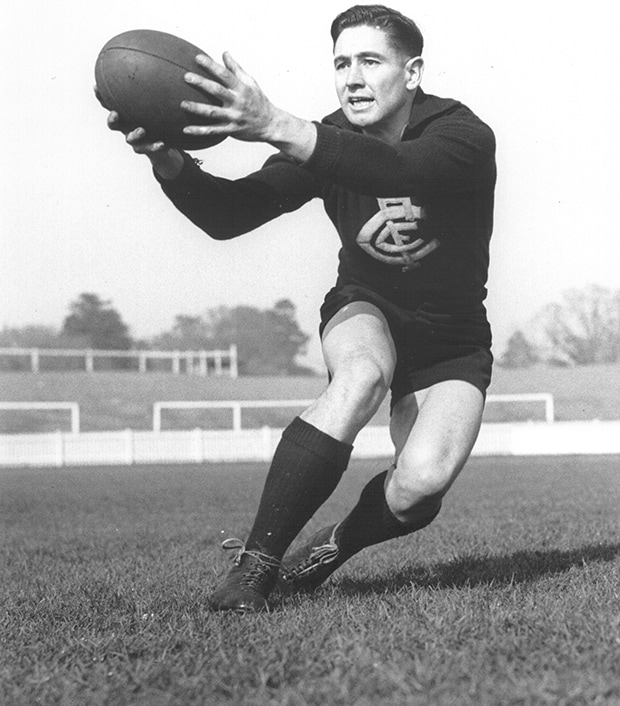
BrianHendersonPic1.jpg
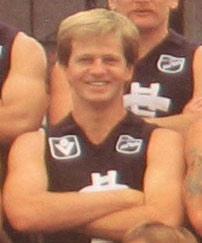
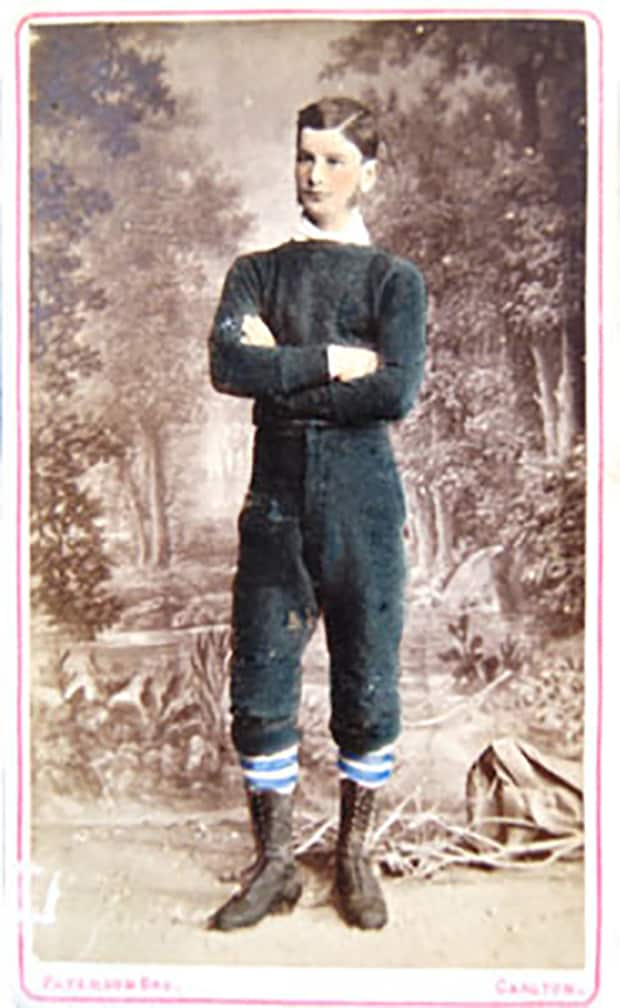
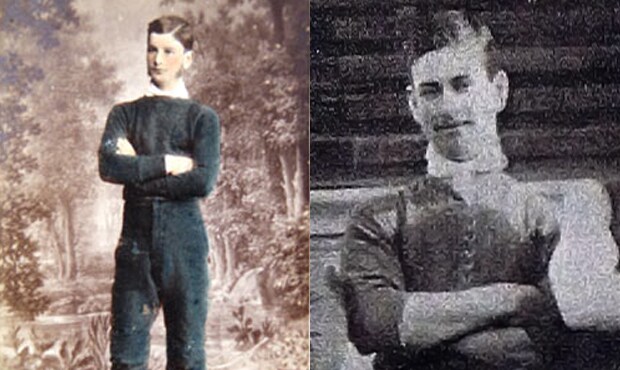
Brian Henderson pictured in action on the left. (Photo: Supplied)

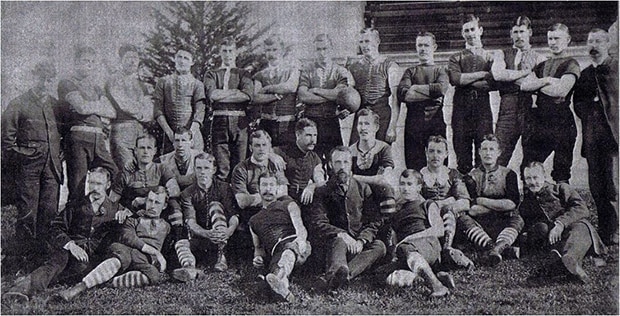
Henderson was four days shy of his 21st birthday when he lined up against Richmond, in what was his second and final senior appearance for the Club the following Saturday. He formed part of the ‘Baby Blues’ – Carlton’s youngest ever 20 (average age 22 years 15 days) – of whom Greg Hardie at 19 years 21 days was the youngest and Sergio Silvagni (25, 350) the oldest.

The match, which resulted in a three-point win to the home team at Princes Park, was notable for an incident in which the Tigers’ Fred Swift uprooted a behind post after grabbing it to halt his momentum – prompting a Carlton trainer to hold the post upright for the game’s duration.

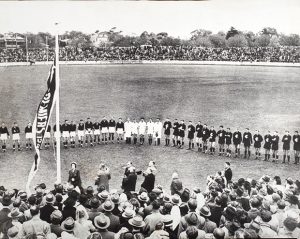
The day after Henderson’s last hurrah (Sunday, June 14), The Beatles jetted in to Melbourne to be greeted by the then Lord Mayor and avid Carlton supporter Sir Leo Curtis – a moment recreated in print by the famed cartoonist for The Age, Sam Wells.

MayorBeatlesPic
The Mayor and The Beatles, The Age, June 15, 1964.

Ken Greenwood, named alongside Henderson in the back pocket for both the South and Richmond games, remembered the latter as “a nice young bloke”.

“Brian was a local bloke who, while not quite up to senior standard for the long haul, was quite a handy type,” Greenwood said. “He stood 6’1 in the old measurement and tipped the scales at 12 and a half stone, and for most of his time through the thirds and seconds basically played as a backman.”

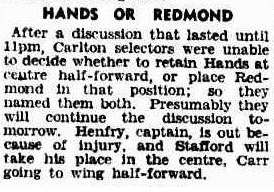
“The Blues had a bad year in ’64, finishing 10th of 12 which at that time was their worst year on record. That brought on the sacking of Ken Hands for Ron Barassi as senior coach and the cleanout. I suspect ‘Barass’ may have put a line though Brian’s name, but he wasn’t on his own there.”

A football journeyman, Henderson later pursued his career with Brunswick in the VFA then joined Epping in the Diamond Valley – the school of hard knocks according to Joan.

“He went mad at me because I grew up with the Diamond Valley League and when he played his first match he said ‘Why didn’t you tell me it was so bloody hard?’,” she recalled.

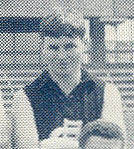
BrianHenderonPic2.jpg
Brian Henderson in 1964. (Photo: Supplied)

Henderson then accepted the role of playing coach with Nathalia during which time he mentored the Richmond great Francis Bourke. He then returned to the Diamond Valley as playing coach of Lalor, then committed to “paddock football” in Urana on the Riverina where he and Joan eventually settled.

For a brief period, Henderson served as assistant to Palm Beach-Curumbin coach and former Carlton rover Maurie Fowler, who died earlier this year.

Coaching, it seemed, was Henderson’s true vocation, and according to Joan it was the former Carlton secretary Allen Cowie who first sewed the seed.

“Brian remembered Allen telling him: “Whatever you do, think of coaching rather than playing’, because he really rated the way Brian handled the players”.

A long-time resident of Urana, situated between Lockhart and Jerilderie, Brian Henderson died on Friday, June 16 at Wagga’s Calvary Hospital.

He is survived by his wife Joan, three children and their respective spouses, 10 grandchildren and two great grandchildren.

Brian Henderson’s first game, Carlton v South Melbourne

Lakeside Oval – Round 8, Saturday, June 6, 1964 

B: Sergio Silvagni (c), Brian Henderson, Ken Greenwood

HB: Vasil Varlamos, Graeme Anderson, Barry Gill

C: Cliff Stewart, Ian Collins, Jim Pleydell

HF: Kevin Hall, Tony Thiessen, John Gill

F: Maurie Sankey (vc), Wes Lofts (dvc), Trevor Best

R: John Nicholls, John Reilly, Ian Nankervis

Res: John Goold, Greg Hardie

Coach: Ken Hands

Remembering Ray – A brave boy in blue

The Carlton Football Club, as with any sporting institution, is about the people – and while only a few are immortalised on the Hall of Fame wall, so many more make their own unique impression.

This is the story of one such person – the late Raymond John Mulder Q.G.M., who died last August just two days after his 86th birthday. Ray’s lifelong love for Carlton came to light when members of the Mulder clan recently returned to the old ground to cast his ashes upon it.

To quote Ray’s wife Anita: “What I did with the ashes was up to me – and the Carlton Football Club was part of his life”.

That day, Anita also came armed with a silver-plated cup thought to have been presented to her husband for finishing runner-up in the Best & Fairest award for Under 21 outfit Carlton Colts.

For years, the trophy – made available by club benefactor Norm Robinson – gathered dust on the loungeroom mantelpiece in the Mulder family home in Kingsbury.

MoulderTrophy
The silver-plated cup thought to have been presented to Ray Moulder. (Photo: Carlton Media)

It also doubled as a conversation piece, as Mulder’s wife Anita revealed.

“As you can see, Ray’s surname was incorrectly etched into the trophy as ‘Moulder’,” Anita said. “Anyone who ever saw that trophy used to comment on it, and Ray himself used to say ‘I never thought it was mine’. I turned to him once and said it could have been worse – it could have been ‘muddler’.”

Ray was born on August 9, 1930, the youngest son of Mary and George “Snow” Mulder who fashioned the original Skipping Girl sign for Claude Neon. Ray’s early years were spent at the family home at 777 Drummond Street, next door to the local mosque, while his future wife’s family were domiciled in nearby Station Street.

As Mulder was later employed at Reid Brothers brass finishers up the road in Bouverie Street, Carlton was always THE team for him and the Mulder clan.

“Ray had had two brothers and they followed Carlton everywhere,” Anita said. “Their Dad used to take them all to Princes Park and they’d stand behind the goals.”

1949 Team Image
Ray Mulder and the 1949 Carlton Colts. (Photo: Carlton Media)

Though he turned out for the Blues as a player of some note at junior level, Mulder never pursued his on-field career. Instead he joined the Victoria Police and upheld the right for 29 years – initially at Russell Street which took in the local Carlton beat.

“Ray never really played footy afterwards because work saw to that. He used to work ten days straight in those days and the pay wasn’t great,” Anita said.

But 2nd Constable Mulder was not lost to the club. On one occasion, in a match at Princes Park against South Melbourne in the early 1960s, Mulder, at the time off duty, famously arrested a spectator he saw bag the matchday football as it disappeared into the crowd behind the eastern end goals.

The spectator was subsequently fined £12 “in default 12 days gaol” and in a moment’s remorse to the beak was reported saying: “I have never done anything like this before. I don’t know what came over me. I would like to apologise to the court and to the Carlton Football Club”.

As a member of the constabulary, Mulder was a noticeable presence on Lygon Street. To the shoptraders, many of them Italian migrants, he was dubbed ‘Elliot Ness’ – a term of endearment because he looked out for them.

Mulder’s son Chris remembered his father relating the tale of a Lygon Street café owner getting grief from the powers that be for unauthorised use of a billiard table on his premises.

“Dad encouraged the bloke to change the table’s cloth from green to red so that when the matter went to court the case would be dismissed – based on the definition of a billiard table which carried green cloth, not red,” Chris said.

Ray Mulder Image
The late Ray Mulder. (Photo: Supplied)

Ray later served the force as a police reservist, but on February 3, 1978 was confronted with a life and death scenario he probably thought he’d avoided in his years on patrol.

Off duty that day, Ray and Sergeant Brendan Bannon, each of whom were shopping separately, happened upon a cash office robbery at a supermarket in Reservoir.

The following was reported in the London Gazette of September 1979:

Sergeant Bannan heard the cashier’s cries over the address system and made his way to the office: as he reached the doorway one of the robbers held him at gunpoint and made the officer and the cashier face the wall with their hands above their heads. Unknown to the men, Sergeant Bannan was still in possession of his service revolver and at the first opportunity produced his weapon, announced his identity and ordered them to surrender.

The gunman turned and faced the Sergeant and a series of shots were exchanged in a running battle between them as the robbers withdrew with the money. Sergeant Bannan repeatedly called on the men to surrender but the armed criminal continued to fire at him as he pursued them through the store.

Meanwhile Police Reservist Mulder had heard a number of shots fired from the direction of the Cash Office, but he was unaware that Sergeant Bannan was involved in the shooting and, as he cleared customers from the store, he saw an armed man carrying an over-night bag run from the Cash Office towards the main entrance. Mr. Mulder followed the armed raider who turned and pointed the pistol at him from a distance of about 15 feet. He dived at the offender who brushed him aside and the armed man pointed the pistol at him and then ran off. Mr. Mulder kicked at the second offender as he ran past him and succeeded in knocking a bag containing money from his grasp.

Mr. Mulder got to his feet, ran after the two gunmen and was then overtaken by Sergeant Bannan during his pursuit of the men from the store. Mr. Mulder caught up with the Sergeant who had brought down one offender and was wrestling with him on the ground while the other man who was armed pointed his pistol at him. As the Police Reservist approached the armed man pointed his weapon at him and then turned and fled. Sergeant Bannan gave chase while Mr. Mulder subdued the unarmed offender whom the Sergeant had detained. 

Sergeant Bannan displayed outstanding gallantry when at very grave risk to himself he persisted in his pursuit of the offenders, in the face of gunfire, as they attempted, to escape. Police Reservist Mulder also displayed bravery of a high order when, despite being threatened by the armed offender, he went to the assistance of Sergeant Bannan.

In the apprehension of two masked offenders during which time shots were exchanged, Sergeant Bannon was subsequently awarded the George Medal for bravery and gallantry.

Similarly, Reservist Mulder earned the Queen’s Gallantry Medal.

In the aftermath of Ray’s passing, members of the Mulder family arranged for a plaque to be displayed at Ikon Park. The plaque, upon which bronze letters are set against a background of blue, serves to perpetuate the memory of a brave Victorian whose football club meant everything to him.

The plaque simply reads;

Ray Mulder Plaque Image

Mario Bortolotto’s 60th

Happy 60th Birthday to Mario Bortolotto.

———————–


Playing Career : 19811983
Debut : Round 1, 1981 vs Richmond, aged 23 years, 275 days
Carlton Player No. 887
Games : 30
Goals : 1
Guernsey No. 6
Last game : Round 21, 1983 vs North Melbourne, aged 26 years, 54 days
Height : 189 cm
Weight : 87 kg
DOB : 26 June, 1957
Premiership Player 1981, 1982
Mario Bortolotto was a journeyman defender who began his VFL career at Geelong, only to be dumped without warning after a handful of senior appearances. Bortolotto played 14 games for the Cats between 1979 and 1980. He was then picked up by Carlton – and through a mixture of diligence, luck and circumstance, gained a place in the Blues’ 1981 and ’82 Premiership teams.

By coincidence, Bortolotto’s career at Princes Park ran parallel with that of West Australian sensation Peter Bosustow. They played their first and last matches for Carlton together, and shared in the glory of those back-to-back flags. But while ‘The Buzz’ kicked 146 goals in his celebrated 65 games, Bortolotto managed just 30 matches and one goal over the same period.

Since then, it has become fashionable to disparage Bortolotto as barely a fringe player – conveniently overlooking the fact that he spent his career at Carlton battling for his place in a playing list that in terms of depth of talent, was one of the strongest in our history. In reality, he was more than a handy alternative anywhere in defence, and reliable whenever he was given his chance to play in big games. He was also popular around the club, particularly because of his ready sense of humour. For a period of time, he also was a flat-mate of Blues speedster Alex Marcou.

This was evident when he once participated in one of Lou Richard’s stunts for The Sun newspaper. Lou had made a statement along the lines of, ‘the Blues can’t win this week. If they do, I will have Mario tip a bucket of spaghetti over my head in Lygon St.’ Carlton duly got up, and a few days later, the back page of the paper featured a beaming Bortolotto doing just that; emptying a large bowl of pasta (complete with sauce) over a hapless Richards.

Mario’s path to VFL football began at his home town of Koondrook in north-western Victoria. After a standout couple of seasons for St Patrick’s College at Ballarat during the last years of his schooling, he was playing senior football for local club Leopold when Geelong first showed interest in the solidly-built centre half-back.

In 1979, he made his VFL debut for the Cats, and racked up 14 games and three goals over two seasons. In one of those matches – against Carlton at Kardinia Park in round 12, 1979, he impressed by keeping Carlton’s star forward Mark Maclure under a tight rein all day, as Geelong inflicted a rare defeat on the Blues. He didn’t know it at the time, but that performance was to be the pivotal moment in Bortolotto’s football career.

Having completed his third pre-season with the Cats in 1981, Mario was enjoying himself at Geelong’s presentation night when he was shocked to see someone else called up on stage to receive his number 29 guernsey! Only then did a club official come over and tell him that he was not required that year. Mario’s response can easily be imagined, but suffice to say that from that day on, he would have nothing to do with any of the non-playing staff at Kardinia Park.

When word filtered through to Princes Park that Geelong has discarded one of their big defenders, the memory of Bortolotto’s earlier effort against Maclure was still fresh. Carlton’s match committee quickly decided that the 23 year-old was worth a punt, and Mario gratefully accepted an invitation to continue his career in navy blue. He was given guernsey number 6, and made his debut for his new club – off the bench – in round one of 1981, against Richmond at Waverley. Carlton thrashed the Tigers by ten goals, as Bortolotto’s senior career was reborn.

He actually sat on the pine for his first three matches, before eventually making the starting line-up for Carlton’s round four game against Footscray at Waverley. The Blues had another comfortable win – during which it was reported that Bortolotto almost brought the house down with a dashing, four or five-bounce solo run from half-back, and a shot for goal that hit the post. But even that effort couldn’t prevent him from being sent back to the Reserves the following week, and he didn’t regain a place in the senior side until the eve of the finals.

Later, Mario (‘Tatts”) summed up his time at Carlton as a Cinderella story – which really began to unfold when he was selected as a reserve for the 1981 second Semi Final. The fact that Carlton’s opponent was Geelong probably had something to do with it, even though in the end Bortolotto’s impact on the match was of little consequence. After a tight first half, the Blues took control in the third quarter, and kicked away to win by 40 points – very much to Mario’s delight.

Although he had been given little game time against Geelong (or perhaps because of it) Bortolotto retained his place as a reserve in the Grand Final team when the Blues met Collingwood for the ‘81 flag. Mario’s career reached a pinnacle that afternoon, as Carlton triumphed by 20 points in a slogging contest on a muddy MCG. In the TV footage of the game, Bortolotto can clearly be seen wearing his tracksuit top as the Blues do their victory lap, which shows that he spent most, if not all, of the game where he started – on the bench. Coach David Parkin later apologised profusely for not giving him more time on the field.

Bortolotto’s second season at Princes Park unfolded much like his first. He was in and out of the side throughout the year, while the defending Premiers trod a much tougher path to the finals. After finishing third on the ladder, the Blues lost a torrid Semi Final to Richmond, and then had to overcome Hawthorn in the Preliminary Final to earn another shot at the Tigers for the flag.

Carlton’s hero against Hawthorn had been defender Rod Austin, who, after being knocked senseless in the first quarter, returned to the field and held their champion Leigh Matthews in check while the Blues ran out five goal winners. However, during a light training run the following morning, Austin was accidentally kicked on a thigh, and tragically ruled out of the Grand Final. So, on the following Thursday night, Bortolotto was named at full-back as Austin’s replacement.

Already starting warm favourites for the Premiership after their convincing Semi Final win over Carlton, Richmond must have felt even more confident when they sent their decorated captain David Cloke to full-forward for the Grand Final. After all, Cloke was taller, heavier, more experienced, and far more accomplished than his opponent. But Mario played the game of his life, and held Cloke to three goals from just a handful of possessions while the Blues triumphed by 18 points. Mario may have felt out of place accepting his Premiership medal in 1981, but in ’82 it was richly deserved.

He collected a third winner’s medal in 1983, when Carlton again defeated Richmond in the final of the Night Premiership at Waverley Park in July. By then however, having achieved more than he really ever thought possible, Mario had decided that he would call it a day after that season. In the end, that decision was hastened, when he was reported for striking North Melbourne’s Donald McDonald during a hectic clash at Princes Park in round 21. Peter Bosustow was also reported that afternoon, copped four weeks, and never played for Carlton again. Like ‘the Buzz’, Mario was found guilty and suspended for two matches, but Carlton lost the Elimination Final to Essendon, and there were no further opportunities.

During the 1984 pre-season, Bortolotto seriously injured his ankle, this plus some other long term injuries curtailed his playing career with the Blues. He was kept on the list for the next two seasons but failed to add to his games tally with his beloved Carlton.

A plumber by trade, Bortolotto once told a Carlton fan at training that he was deeply grateful that he had lived the Cinderella story. He was very aware of the great players of the game that had come and gone without ever playing finals football, while he had been blessed by the opportunity to play in two great Premiership teams. As well as his two Grand Final winners’ medals and his Night Series flag, Mario was also awarded Carlton’s Best Clubman award in 1982. He celebrated his one and only senior goal for the Blues in round 10 of 1983, against North Melbourne at Arden St.

Whatever the merit of his ability, Mario Bortolotto certainly packed an enormous amount of joy and success into his 30 games with the Old Dark Navy Blues.

In 1986, Bortolotto transferred to VFA club Sandringham with Blues team-mate Scott Howell.

In 1990, Bortolotto was the runner for St Kilda who was being coached by his 1982 premiership teammate Ken Sheldon.

Career Highlights

1976 – 4th in the Morrish Medal (whilst at Geelong)
1981 – 3rd Reserves Best & Fairest
1981 – Senior Premiership
1982 – Best Clubman Award
1982 – 2nd Reserves Best & Fairest
1982 – Senior Premiership
1983 – Senior Night Premiership

Vale McMaster-Smith

Bruce McMaster-Smith, the former Carlton wingman between stints with Fitzroy and St Kilda through the early 1960s, has died after a long illness. He was 77.

Of diminutive stature, McMaster-Smith stood just 169 centimetres tall and tipped the scales at 61 kilograms wringing wet. Regardless, he stood tall through 54 League appearances in total and relished every moment. As he told The Age’s Peter Hanlon in a touching interview back in 2011, he liked the old sportsman’s lament: “’Once you hear the roar of the crowd, you hear it for the rest of your life”.

McMaster-Smith’s wife Heather, who had met the then Fitzroy footballer at an after-match function in 1960, recalled that her husband suffered an early setback in a game for the Lions, when a wayward finger almost blinded him in one eye.

“He also lost a contact lens on Brunswick Street Oval, but almost unbelievably he found it the next day,” Heather said.

After just 13 senior appearances with Fitzroy, McMaster-Smith found his way to Carlton, the club he’d followed as a kid in Kyabram. On the eve of the fifth round of 1962, when Graham Donaldson withdrew with an infected leg, McMaster-Smith got his first call-up for the Blues, in what was a baptism of fire at Princes Park.

Carlton met Essendon in what would prove a dress rehearsal to the ’62 Grand Final, sharing space in midfield with Berkley Cox and Murray Kick. Regrettably, the hosts fell 45 points short, and Jim Carroll, in his second and last game for the club, was reported for landing one on the rough noggin of the Bombers’ Ian ‘Bluey’ Shelton.

Former Carlton ruckman Ken Greenwood, who shared following duties with John Nicholls in that match, was saddened to learn of McMaster-Smith’s passing.

“Bruce was a terrific little bloke – very popular and very well-liked,” Greenwood said.

“He was lightning quick, very fast. He was a good little footballer too, and while he had speed and ability, size might have gone against him.

“He was playing off a wing before the finals series in ’62, but I think the selectors felt he was too small to be playing on the MCG and they went with bigger wingmen going into the finals.”

McMasterSmithPic
Former Carlton wingman Bruce McMaster-Smith. (Photo: Carlton Football Club)

Though he wasn’t to feature in any of Carlton’s four finals contests that year, McMaster-Smith made a real impression– sharing Carlton’s most Brownlow votes (10) with Peter Falconer on the night Geelong’s Alistair Lord took Charlie home.

Through three seasons in guernsey No.40, McMaster-Smith turned out 26 times for Carlton – the last of them against Footscray in the fourth round of ’64 at Princes Park.

McMaster-Smith was cleared to St Kilda after the 1964 season and, to script, booted the match-winning goal in the dying seconds of his first senior game for the Saints – Round 11, 1965 versus you know who at Moorabbin.

Greenwood recalled McMaster-Smith bobbing up in that ill-fated match against Carlton. As he said: “Bruce let fly with a kick from the wing late in the game which sunk us – and he was pretty happy about that”.

A further 14 matches for St Kilda, the last of them Grand Final day ’65, rounded out McMaster-Smith’s League career – and Greenwood believed that the man’s effervescent personality served him well beyond his playing days.

“Bruce was really talkative, and if memory serves he went into car sales, which would have suited him as he had the gift of the gab.”

McMaster-Smith was only the second of 13 Carlton players ever to sport the number 40 at senior level after the late Don Rainsford – the-three gamer of 1950 more famously remembered as a voiceover man for the Seven Network.

The number 40 was most recently worn into senior football by the 150-game record holder in it, Michael Jamison, and is now the property of Jesse Glass-McCasker.

In Hanlon’s article of 2011, headlined ‘The enduring battler’, McMaster-Smith, then recovering from his second stroke and having suffered a heart attack, kidney disease and prostate cancer, reflected on his good fortune in chasing the leather with the likes of Kevin Murray, John Nicholls and Darrel Baldock.

Considering himself incredibly fortunate to have run the MCG wing one last time in front 105,000 on Grand Final day ’65, McMaster-Smith’s League days were done at 26 – and yet he always maintained a love for the game and an empathy for those at the heart of the contest at a time when football’s never been more scrutinised.

As he told Hanlon: “A player’s given 100 per cent physical effort, he takes a mark in front of goal, and you see him heaving. He’s sobbing with exhaustion, his muscles are like lumps of lead, sweat’s running into his eyes, his limbs are quivering. And he misses. And the crowd says as one, ‘We’ve gotta get rid of that %$#! He can’t kick!’ ”

McMaster-Smith, an uncle to the Herald Sun chief football writer Mark Robinson, died in a nursing home in Ferntree Gully on Tuesday. He is survived by his wife Heather, daughter Robyn, son Andrew, daughter-in-law Belinda and grandson James. Heather spoke for all of them when she said: “Bruce was very outgoing, very friendly and very loyal . . . he was a nice bloke”.

The Carlton footballers will wear black armbands into Sunday’s match with GWS at Etihad Stadium as a mark of respect.

Stephen Silvagni’s 50th

Happy 50th birthday to Stephen Silvagni.


————-

Stephen Silvagni


show_image.php?id=26017
Career : 1985 – 2001
Debut : Round 7, 1985 vs Sydney, aged 17 years, 346 days
Carlton Player No. 927
Games : 312 
Goals : 202
Last Game : Semi Final, 2001 vs Richmond, aged 34 years, 107 days
Guernsey No. 1
Height : 194 cm (6 ft. 4 in.)
Weight : 99 kg (15 stone, 8 lbs.)
DOB : 31 May, 1967
Premiership Player : 19871995
Best and Fairest : 19901996
All Australian : 1988, 1990, 1994, 1995, 1996, 1997, 1999
VFL AFL Team of the Century: Full Back
Team of the Century: Full Back
Carlton Hall of Fame: 1996
VFL AFL Hall of Fame: 2005
Victorian State Player: 1988, 1990, 1993, 1994, 1995, 1996, 1997, 1999
Mark of the Year: 1988
Carlton Legend

Track watchers at Carlton Football Club in the early 1980s would have noticed a young Stephen Silvagni eagerly helping out at most training sessions. Whether it was retrieving a footy from over the fence, kicking end-to end with the players, or even helping to serve up the after-training meal, the skinny, dark-haired son of assistant coach and club selector Sergio Silvagni spent much of his spare time at Princes Park.

It was a fabulous era for the Old Dark Navy Blues, and a time of inspiration for a young boy who would go on to forge his own magnificent career. Carlton claimed three Premierships in four years from 1979 to 1982, and Stephen’s formative years were spent in the presence of some of the clubs’ all-time greatest players – including his own father. However, Sergio and his wife Rita deliberately kept Stephen’s football education low-key. They insisted that his studies at Marcellin College had to come first, and restricted him to school football.

Even so, Stephen was talented enough to be selected for the 1984 Victorian Under-17 Teal Cup squad. That led to his inclusion in an Australian team that toured Ireland, and before too long Hawthorn was trying hard to recruit him. Under VFL rules of the day, Steve was zoned to the Hawks, and they had first call on him – unless Carlton exercised their rights under the father-son rule. Hawthorn forced the issue when they set a 48-hour deadline for Carlton to decide, and Blues Secretary Ian Collins didn’t hesitate. Stephen became a Carlton player – on the minimum contract wage of the time.

“Serge was terrific in the way he allowed Stephen to develop naturally, rather than by force,” Collins said later; “some kids who play footy at a young age either get sick of it, or resent it and want to do other things. Consequently they never fulfil their potential. But Stephen wasn’t like that. There was balance in his life, which helped him in his football as well. There might have been mind games being played at the time of Stephen’s signing, but there was never any doubt – he was always going to be playing for Carlton. Serge and Rita wouldn’t have allowed him to go to Hawthorn, let alone encouraged him to go there.”show_image.php?id=33587

Stephen believed that he would begin his career with the Under-19s at Carlton, only to be stunned when coach David Parkin informed him during pre-season training that he had been earmarked for an early senior debut. When he was presented with the number 1 guernsey that his father had worn in his wonderful 239-game career in navy blue, it was only a matter of time until Stephen made his senior debut against Sydney at the SCG in round 5 of 1985. By the end of that first year, he was still a skinny, gangly 18 year-old, but he had already been matched against some of the best forwards in the game as a half-back flanker or back pocket. He was a popular winner of Carlton’s Best First Year Player award, and a very deserving AFL Rookie of the Year. Carlton finished fifth, and then abruptly sacked their incumbent coach David Parkin in favour of former club champion Robert Walls.

In 1986, Stephen’s second year was derailed before it got going when he tore a hamstring in his first game, only to contract glandular fever during rehab. It was about this time that he was christened ‘SOS’ – for Son of Serge – by friend and team-mate Peter Dean, and the nickname stuck for the rest of his career. Meanwhile, Walls believed that the agile youngster might develop into a handy forward, and so sent him up the ground for his first senior match for the year against Hawthorn in round 12. The experiment was only partially successful however, because SOS finished the home and away rounds with just nine goals, and he was returned to defence before the Blues beat Sydney and Hawthorn in the first two weeks of the finals to book a place in the Grand Final as warm favourites against the Hawks.

At training on the following Thursday night however, Walls called Stephen into the coaches room and shocked the 19 year-old by telling him that he had been dropped from the Grand Final team in favour of Ken Hunter, who had recovered from injury. It was scant consolation, but SOS was to be included in the Reserves side that was also playing off for a flag, against Footscray.

Understandably, the young man was gutted, but he later said; “There were two ways I could have gone into the Reserves Grand Final – either throw in the towel, or give them something to think about. Fortunately, I took the latter option and went well in what was a winning Grand Final.” He went well all right – playing at centre half-forward, he kicked five goals and was unanimously judged Best on Ground. Later that afternoon, Carlton lost the senior Grand Final by 42 points, with Hawk full-forward Jason Dunstall kicking six goals.

The shock of what Silvagni saw as a rejection by his beloved Blues was the spur to stardom for him in the ensuing years. Determined never to be left out of the senior side again unless injured, he dedicated himself to train as hard as anyone on Carlton’s list, and started running an extra three kilometre circuit of Princes Park before or after every training session. As his game evolved, SOS became the game’s outstanding swingman – a rock-solid defender and a match-winning forward.

In 1987 Stephen played one his most memorable games when Carlton revenged their defeat of the previous year to beat Hawthorn for the Premiership. At just 20 years of age, SOS held the Hawks’ stand-in full-forward Peter Curran to a solitary goal as the Blues triumphed by 33 points. In round 14 of 1988, playing at full-forward in the Match of the Round at the MCG, he used Collingwood’s Craig Starcevich as a step ladder to take a sensational Mark of the Year. In 1990, he won Carlton’s Best & Fairest award by 10 votes from club captain Stephen Kernahan, and polled 16 votes to finish third in the Brownlow Medal. Half-way through the next season however, in Round 14, 1991, SOS tore an ACL ligament in a knee and was sidelined the rest of season.

Back on track at the start of 1992, Stephen kicked 8 goals in Carlton’s 24-point loss to the West Coast Eagles in round 9 at Princes Park. He starred again at Princes Park in round 16, 1993, booting a huge 10.6 as the Blues piled on 20 goals after half-time to beat Fitzroy by 86 points. Even so, by 1995 SOS was firmly entrenched as the premier full-back in the game, and his battles with the gun full-forwards of the time – Lockett, Dunstall, Ablett and others – were eagerly anticipated. While tall enough at 194 cm to cope with most opponents, at 99 kg he sometimes found himself out-muscled, so he had become master of the desperate late spoil. With his steely concentration, his exceptional balance and agility, he was the anchor of a daunting Carlton defence in a team that won 23 of its 25 games for the season – including the Grand Final.show_image.php?id=29318

In that wonderful ’95 final series, the Blues played Brisbane, North Melbourne and Geelong to win the flag. Steve’s opponents in that series – in order – were Daryl White, Wayne Carey and Gary Ablett. The collective return by these three against him was a miserly one (yes, one) goal. Topping off a stellar season, SOS was named 1995 All Australian for the first of three successive years, and in 1996 (after winning his second Best and Fairest at Carlton) he was sensationally awarded the full-back position in the AFL Team of the 20th Century. It was a huge honour, and one not without its controversy in some quarters.

Steve later said about that award; “It didn’t really sink in until I was called up at the end of the night to join the legends who had already been named. I remember looking at the faces around me – the likes of John NichollsAlex Jesaulenko and Bruce Doull – wonderful players I used to watch as a kid, and thinking to myself, ‘what’s going on here? I’m twenty-eight and still have a bit of football left – I’m not finished yet.'”

And indeed he was not. With his stature in the game assured, Steve became much more a vital part of the on-field leadership at Carlton. His impassioned plea to his team-mates at three-quarter time in the 1999 Preliminary Final was one of the factors in the Blues glorious upset win over Essendon. And though Carlton lost that year’s Grand Final to the ‘Roos, SOS kept a rampant Wayne Carey to one major for the game and was clearly Carlton’s best.

In 2000, a groin strain sidelined Stephen from the first four matches. In May, he and his proud dad shared the limelight at the announcement of Carlton’s Team of the Century before a season of highs and lows culminated in a severe hamstring injury during the finals. The tendon was ripped from the bone and he was sorely missed on Preliminary Final day, when Essendon thrashed the Blues by 45 points.

Steve was still recovering through the 2001 pre-season, and although he was absent for three games early on, he was back to near top form when he played his 300th career game in round 11, 2001 against Richmond at the MCG. Carlton may have lost by 27 points that afternoon, but when the final siren sounded, the Tigers were herded to the visitor’s race by their coach Danny Frawley. In a unique mark of respect by a traditional enemy, Frawley and his players formed a guard of honour and SOS was clapped from the ground.

Later that year, Steve’s hip injury flared again. His doctors advised surgery, but he declined and soldiered on. In a strong finish to the home and away rounds, the Blues beat St Kilda and Collingwood decisively to book another finals berth, before meeting Geelong in round 22 at Princes Park. Although only pride was at stake, it was a spiteful match that the Blues won by 70 points. Late in the game, Geelong defender Darren Milburn crashed through SOS with a front-on shoulder charge as Carlton’s champion flew for a mark. Out cold before he hit the ground, Steve was stretchered off the field, and Milburn’s reputation was permanently blackened.

Two weeks later, Carlton’s 2001 season and Silvagni’s playing career ended with an 11-point loss to Richmond in a hard-fought Semi Final. SOS kept the Tigers’ Matthew Richardson to a handful of possessions and two goals, before announcing that he was taking specialist advice to call it a day after 16 gruelling seasons. Tributes galore from friends and foes alike poured into Princes Park over the following days and weeks, with the words respect, skill and courage commonly used.

Stephen didn’t remain at Princes Park for long after his playing career ended, later saying, “I always felt if I wanted to stay in football, whether that was coaching, or administration or whatever other level, I needed to go outside Carlton for experience – and that’s what I did.” Between 2002 and 2010 he filled various roles as an assistant coach at Collingwood, Sydney, the Western Bulldogs and St Kilda, before earning the prestigious position of List Manager at Greater Western Sydney.

In June 2014, during celebrations marking Carlton’s 150th year of VFL/AFL competition, SOS was honoured once more when he was officially recognised as one of the five greatest Blues of all time, alongside John NichollsStephen KernahanBruce Doull and Alex Jesaulenko. Having also won plaudits for guiding the Giants’ young roster through their first three seasons, Stephen then surprised and delighted Carlton supporters everywhere by accepting an offer to return home to Princes Park, and to take up a role similar to what he had done so well at the Giants.

“I always hoped there may be an opportunity I could come back.” said Stephen when the news broke in December 2014. “And when the club came knocking, it really did tickle my fancy. It’s nice to be home. I love wearing the navy blue. I always have.”
show_image.php?id=11775

Milestones

50 Games: Round 5, 1988 vs Collingwood
100 Games: Round 4, 1991 vs Melbourne
150 Games: Round 11, 1994 vs Fitzroy
200 Games: Round 12, 1996 vs Collingwood
250 Games: Round 2, 1999 vs Collingwood
300 Games: Round 11, 2001 vs Richmond

100 Goals: Round 16, 1993 vs Fitzroy
200 Goals: Round 17, 2001 vs Hawthorn

Career Highlights

1987 – Premiership Player
1988 – Mark of the Year
1988 – Victorian State Player
1988 – All Australian
1988 – 7th Best & Fairest
1990 – Victorian State Player
1990 – Robert Reynolds Memorial Trophy – Best and Fairest
1990 – Peter Sullivan Memorial Trophy (Most Carlton Votes in the Brownlow Medal)
1990 – All Australian
1993 – Victorian State Player
1993 – 5th Best & Fairest
1994 – Victorian State Player
1994 – 2nd Best & Fairest
1994 – All Australianshow_image.php?id=25991
1995 – Victorian State Player
1995 – 3rd Best & Fairest
1995 – Best Clubman
1995 – All Australian
1995 – Premiership Player
1996 – Victorian State Player
1996 – Robert Reynolds Memorial Trophy – Best & Fairest Award
1996 – All Australian
1996 – Carlton Hall of Fame
1997 – Victorian State Player
1997 – 4th Best & Fairest
1997 – All Australian
1998 – 8th Best & Fairest
1998 – Jim Stynes Medal (International Rules Series- Best Player for Australia)
1999 – Victorian State Player
1999 – 6th Best & Fairest
1999 – All Australian
2000 – 5th Best & Fairest
2001 – 6th Best & Fairest
2005 – VFL AFL Hall of Fame
2007 – Italian Team of The Century


Bill Redmond’s 90th

Happy 90th birthday to Bill Redmond.


————-

Bill Redmond


Career : 1947 – 1948
Debut : Round 13, 1947 vs South Melbourne, aged 20 years, 44 days
Carlton Player No. 620
Games : 7
Goals : 0
Last Game : Round 5, 1948 vs Collingwood, aged 20 years, 352 days
Guernsey No. 2
Height : 182 cm (5 ft. 11 in.)
Weight : 80 kg (12 stone, 8 lbs.)
DOB : 29 May, 1927

Although he was a footballer of undoubted ability, Bill Redmond was also a victim of circumstance in that he wasn’t able to fulfil his potential at VFL level. In his first two seasons at Princes Park, he rose from Best and Fairest with the Blues’ Under-19 squad, to being named as an emergency in Carlton’s 1947 Premiership team. But in 1948 a wrangle over his recruitment saw him leave the Navy Blues, and head off to a long and successful career in country football.

Born William George Arthur Redmond at North Melbourne in 1927, Bill grew up in inner-suburban Brunswick during the grim years of World War II. Football, cricket and his apprenticeship as an engineering pattern-maker occupied his teenage years, and he was outstanding at all three. By 1946 he had already played in the First XI at Brunswick Cricket Club before Carlton invited him to join their Under-19 team preparing for the inaugural season of the VFL Thirds competition.

Under their coach Jim Francis, the Blues youngsters made an impressive debut and qualified to play North Melbourne in the first-ever Under-19 Grand Final. Carlton was comfortably beaten, but at centre half-back, Redmond won the Ken Luke Cup as Carlton’s best player. A few days later, Bill and his team-mate Ron Dunn were voted joint Best and Fairest, and the following year Redmond was promoted to Carlton’s Reserves list and given the honour of wearing the Blues’ number 2 guernsey.

Carlton’s senior team finished on top of the ladder in 1947 and went on to beat Essendon by one precious point in a thrilling Grand Final. Earlier in the season, Redmond had come under notice for his poise in defence for the seconds, leading to his inclusion in the seniors for the first time in round 13, when Carlton hosted South Melbourne at Princes Park and won by 4 points. Bill was 19th man that afternoon, as he was a month later in his second match, when the Blues demolished St Kilda. He finished off a notable first year as a senior player by being nominated as an emergency for Carlton’s Grand Final team, but wasn’t required.

In 1948, Redmond established himself as a regular member of Carlton’s senior side from round one, when he lined up in a back pocket alongside champion full-back Ollie Grieve and went on to play the five games in succession. Then in mid-May, North Melbourne caused a stir by protesting to the VFL that Carlton had signed Redmond in contravention of the League’s zoning rules. Bill lived on a street in West Brunswick that was a boundary between the zones. “If you lived on one side of the road, you played for Carlton – and if you lived on the other side of the road, you were North Melbourne,” he explained many years later. Regardless, the VFL sided with the Shinboners, and revoked Redmond’s playing permit.

North Melbourne were intent on getting Redmond to Arden Street, and flatly refused to clear him to Carlton. In turn, the Blues dug their heels in, and the dispute dragged on until VFA club Williamstown stepped in, and trumped both clubs by offering to almost double his match payments. “We got three pounds a game back in those days, and Williamstown offered me five, so I went with them,” he said.

At Williamstown, Redmond played at full-forward in the Seagull’s 1948 Grand Final team that lost to Brighton. In 1950 he transferred to the Bendigo Football League club Eaglehawk, before joining North Bendigo in the Heathcote District Football League as captain-coach two years later. He was voted Best and Fairest in the HDFL in 1954, then switched to South Bendigo to star in their 1956 Premiership team.

On the move again, Bill was appointed captain-coach of Inglewood before the Blues won the 1958 Loddon Valley Football League Premiership. He then returned to South Bendigo as captain-coach of their seconds, and collected consecutive flags in 1959 and 1960. By 1963 he was at Bridgewater in the LDFL, where he won yet another Premiership – as well as finishing as the competition’s leading goal-kicker with 51 majors.

Eventually, after a varied and quite notable career, Bill retired at last in 1964, aged 37.

Footnotes

While Redmond was at full-forward for Williamstown in the 1948 VFA Grand Final, future Carlton star Keith Warburton was playing in the centre for Brighton.

During his time in Bendigo, Redman also played A Grade cricket for Golden Square and Sandhurst.

Career Highlights

1946 – Under-19 Best & Fairest
1946 – Ken Luke Cup (Best Carlton player in the Under-19 Grand Final)


Larrikins and legends gather for book launch

The Carlton players who took to the paddock through those four seasons of 1979-1982 were amongst the finest ever to don the Dark Navy – and yet they’ll be the first to tell you it’s about the friendships that endure long after the games are run and won.

So it was in this spirit of amity that the likes of Buckley, Johnston, Maclure, Perovic and Southby – men of stature one and all – gathered at the North Fitzroy Arms for the launch of Larrikins & Legends – The untold story of Carlton’s greatest era.

MaclurePic
MC Mark Maclure at the launch. (Photo: Supplied)

A quick flick to the book’s contents page, and the chapter headings offer salient insight into a period in which the aforementioned played – from “Jezza’s Way”, “Scared to Lose” and “The Bluebirds”, through to “Going to the Lodge” and “Naked, Brutal Greatness”.

Author Dan Eddy’s entertaining tome, which chronicles this period of spectacular on-field success juxtaposed with off-field mirth and mayhem, not surprisingly attracted a healthy collection of football lovers who fondly remembered how it was.

Seasoned guests – amongst them the famed Channel 7 commentator Mike Williamson – were in the house as tales tall and true were told by Bartlett, Marcou, McKay and Sheldon et al.

BortolottoPic
Carlton premiership players Mario Bortolotto, Warren Jones, Jim Buckley and Val Perovic. (Photo: Supplied)

Restoring order was the then Carlton coach David Parkin, who to this day rates those teams under his watch – “the forgotten Champions” as they’ve been dubbed – on a par with the Brisbane, Geelong and Hawthorn juggernauts that followed.

To quote ‘Parko’ – “they played hard on the day and played hard in between”.

In endorsing Eddy’s much-researched digest, Parkin humbly noted that ‘Legends & Larrikins’ might have been the more apt title, given his reckoning that 27 legends and eight larrikins contributed to three grand final successes in those four years.

Maclure, a most capable multi-media performer who led from the front in 243 games through 13 seasons at Carlton, talked of what the culture calibrated in the days of Ron Barassi meant to him and his comrades from Bruce Doull down.

“The culture was set in a very simple way. It was all about continual improvement. That’s what it was for me,” Maclure said.

“This is not written in the book, it’s not featured on a wall in the room or anywhere else – it’s what we players remember of what was said to us by the players before us – players like David McKay, ‘Percy’ Jones, Alex Jesaulenko, Bryan Quirk and Gary Crane. All those guys who played under Barassi, who were taught, learned and carried on.”

Larrikins & Legends – The untold story of Carlton’s greatest era is published by Slattery Media Group and is available for $39.95 through all good bookstores including the Carlton Shop.

When Cyril fought for Carlton and country

Tony De Bolfo, Carlton Media  

James Mann is justifiably proud that his grandfather Cyril Mann is forever remembered amongst the early trailblazers for Carlton’s Indigenous players – the second of its Indigenous XVIII after Alf Egan to complete his senior debut.

And it is to James that Carlton is indebted for alerting it to a photograph which serves to tell an equally-powerful tale, that Cyril also served his country through the Second World War.

For it’s a shameful reality of the time that while Aboriginal and Torres Strait Islanders were not classed or treated as Australian citizens, many like Cyril fought for their country in conflict, and many died.

“I never met my grandfather as he died very young, but my Pop used to tell me a lot of stories about him and show me the old footy records,” James said.

“I’m very proud to be able to say that Cyril Mann was my grandfather.”

Cyril’s wartime profile portrait is included in wartime records sourced by James through the National Archives of Australia. The images formed part of a document dated January 15, 1941 when Cyril Stanley Mann, then living with his wife Evelyn of 68 Rae Street in nearby North Fitzroy, formally enlisted for active service.


Cyril Mann played 42 games for the Blues. (Photo: Carlton Media)

Born in Carlton and recruited to the club from Silvan in the Yarra Valley, Cyril completed his senior debut for the old dark Navy Blues in the fourth round of 1939, against Footscray at the Western Oval. Named on a forward flank alongside Jack Wrout, Cyril booted a goal on debut as the visitors posted an emphatic 58-point win.

A maternal grandson of early Aboriginal activist William Cooper and nephew of the 1928 Stawell Gift winner Lynch Cooper, Cyril was a real eye-catcher. His inherent athleticism was noted by football scribes of the day, not the least of whom was Carlton’s first 200-gamer Rod “Wee” McGregor. A cartoonist perhaps paid Cyril the greatest compliment, captioning his drawing of the high-flyer with the words “Mann marks in positions unthought of by Nash, Todd and Pratt”.

Cyril continued to play while waiting for the call to arms. He was there in September ’41, (booting three and two goals respectively in Carlton’s second semi and preliminary final losses to Melbourne and Essendon on the MCG) and he managed another five senior appearances through 1942 before finally being called into uniform.

Though his military record reveals intermittent detentions for one or two run-ins with military authorities – and he was actually court martialled for an offence following his return from wartime service, Private Mann VX68975 served in the 2/23 Battalion, which helped defend Tobruk, before his discharge in April 1944.

Almost two years later, he saddled up for the Blues again, in what would be Carlton’s Peace and Victory Premiership of 1945. But for reasons unclear he managed just three home and away matches before calling it a day in May of that year.

Cyril Mann War Image
Private Mann VX68975, member of the 2/23 Battalion. (Images: Supplied)

Cyril never talked about his Indigenous heritage. When a heart attack claimed his life at just 45, stories of the Yorta Yorta went to the grave with him.

That happened in March 1964, when he was laid to rest in Preston Cemetery – a few kilometres north of the Carlton ground where the high-flying centre half-forward crafted a 42-game career either side of his wartime duties.

For all these years, Cyril’s Indigenous links were not known to either Carlton or the AFL.

Only in 2013, and with the assistance of his surviving daughter Karen Mann-Brooks, was Cyril’s connection with his people revealed – and it’s a truly splendid connection.

It was Karen who confirmed Cyril’s kindred link with the great William Cooper, who hailed from the Yorta Yorta territory near the junction of the Goulburn and Murray Rivers. William is remembered as the Australian Aboriginal political activist, much-respected community leader and genuine man of stature whose extraordinary lifetime achievements cannot be properly acknowledged in the limited space available here.

“It was only after Dad died that my great aunty Sally, William Cooper’s daughter, told us a lot of things,” said at the time.

“I don’t remember a lot about Dad because I was only eight when he died. But Mum used to talk a lot about Dad, that he played for Carlton and that he loved Carlton.

“And I do remember on my birthdays that he’d take me up Plenty Road to the shoe shop and he’d buy me two pairs of shoes. That was really good.”

Cyril furthered his playing career in the Association with Brunswick and, later, Port Melbourne. He earned the plaudits of The Association Football Recorder correspondent for “defeating Ron Todd in the air” and as the club’s reigning B & F starred at centre half-back when the Borough beat Sandringham in the ’47 Grand Final.

Cyril married Evelyn Pendelbury, a Fitzroy girl whom Karen suspects he met at a social on the night after a Carlton game, and together they raised three children – a son Keith and daughters Lorraine and Karen.

Four years ago, Karen and her husband Warren caught up with this reporter for a cuppa on High Street in Preston, not far from the old Mann family home at 16 Eisenhower Street, Reservoir, where she spent her formative years.

Karen’s love of the club for which her late father once played has not waned – the legacy of those happy times where she followed her mother to the old Carlton ground and in turn led her own children through the turnstiles there.

Then there’s her love for the people of the Yorta Yorta.

“I am proud of that Aboriginal link and I always tell everyone I have Aboriginal in me,” Karen said.

“Perhaps my father was a victim of the times and it was never spoken about, but you grow up now and it doesn’t matter what you are, does it?”

Cyril Stanley Mann

August 31, 1918 – March 3, 1964

Carlton player no. 548

Recruited from Silvan

Career 1939-1942 & 1945

Senior debut: Round 4, 1939 versus Footscray, aged 20 years, 255 days

Final game Round 3, 1945 versus Essendon, aged 26 years, 247 days

Guernsey No 25 (1939-40), 27 (1941 & 45) & 34 (1942)

Games 42

Goals 65


Carlton’s Indigenous VFL/AFL senior XVIII

Alf Egan – 36 games, 20 goals, 1931-1933

Cyril Mann – 42 games, 65 goals, 1939-1942 & 1945

Syd Jackson – 136 games, 165 goals, 1969-1976

Rod Waddell – five games, two goals, 1981-1982

Mark Naley – 65 games, 74 goals, 1987-1990

Troy Bond – 36 games, 26 goals, 1994-1995

Sean Charles – one game, 0 goals, 1998

Justin Murphy – 115 games, 105 goals, 1996-2000 & 2002-2003

Andrew Walker – 202 games, 139 goals, 2004 – 2016

Eddie Betts – 184 games, 290 goals, 2005 – 2013

Cory McGrath – 50 games, four goals, 2004-2006

Joe Anderson – 17 games, 0 goals, 2007-2010

Chris Yarran – 119 games, 90 goals, 2009 – 2015

Jeffery Garlett – 107 games, 183 goals, 2009 – 2014

Liam Jones – 18 games, 16 goals, 2015 –

Clem Smith – seven games, 0 goals, 2015

Sam Petrevski-Seton – nine games, five goals, 2017 –

Jarrod Pickett – five games, two goals, 2017 –

Remembering Maurie

Former Carlton footballer Maurie Fowler, who completed an emotional return to the club just a few years ago, has succumbed to the insidious Motor Neurone Disease at the age of 70.

Diagnosed less than 12 months ago, Maurie was almost totally incapacitated by the disease with which Neale Daniher is currently grappling, and for which there is no cure. Maurie’s own struggle has since been touchingly told by Maurie’s stepdaughter, the Victorian Equal Opportunity and Human Rights Commissioner Kristen Hilton, by way of an article in the Herald Sun.

“My stepfather, Maurie Fowler, was diagnosed with MND less than a year ago and the progression of the disease was ferocious and unrelenting,” Kristen wrote.

“In the early hours of Monday morning he passed away. Mum was curled up beside him.

“Towards the end, Maurie could move only his right hand a little, with great effort. But his eyes followed everyone across a room and the day before he died he listened to Carlton win and he squeezed my hand as tight as he could when I promised him we would look after Mum.”

It’s more than 50 years since Maurie Fowler first donned the famous dark Navy Blue guernsey. It came in the opening round at Princes Park on Anzac Day 1966 against Richmond.

Recruited to the club from Kyabram in the Goulburn Valley, Maurie was one of three senior debutants for Carlton that day. Also named were Traralgon’s Max Thomas and Dalyston’s Ian Robertson, who would soon enough savour the grand final successes of 1968, ’70 and ’72 – as would Kevin Hall with whom Maurie shared the pine as 20th man for that match.

By the time he trudged from the field at Glenferrie Oval in the 9th round of ’66 against Hawthorn, Maurie had turned out for his eighth and final game, taking with him a lifetime of memories.

Five years ago, those memories were recently rekindled for Maurie on his return to the Carlton Football Club, to the place that was home for an all-too-fleeting moment of his sporting career. This reporter accompanied him on that sentimental journey of the old ground, one of the truly special moments in retrospect

Maurie’s Carlton homecoming meant much to him, so much so that in March last year he came back again – this time with his son Mark, Mark’s wife Lenny and their children Kayne, Caleb and Amy.

Together they were photographed by Maurie’s old No.29 locker – just as Maurie was in that maiden 2012 homecoming.

On that occasion, Maurie was prompted to reflect on his time at Princes Park and pen the following first-person account of what it was like to take to the field in the colours of Carlton.

MY JOURNEY TO CARLTON

I was so lucky to get a game for Carlton. The club could quite easily have turned its back on me between 1963 and ’66, but for each of those years Carlton gave me another chance.

I first came under the club’s notice as a centre half-forward in Kyabram’s Under 17 premiership year of 1960. I felt comfortable playing at centre half forward, but because I was too short for this position at Carlton I had to try and make it as a rover, which I found extremely difficult.

Carlton first invited me to try out in 1962, after I’d played two games for the Kyabram senior side as a 17 year-old. From ’62 until ’65 included I’d take my holidays in February/March, come to Melbourne to train, play in the practice games and be lucky enough to make the final training list each year… only to return to Kyabram.

In ’63 I was actually offered 12 senior games at Carlton under coach Ken Hands, no matter how I played. I refused, basically because I was worried about relocating to Melbourne and had doubts about whether I could actually make it as a rover. In retrospect, by not accepting Carlton’s offer to play in those 12 games I probably ruined my chances of a long-term League career.

When Ron Barassi was appointed Carlton Captain-Coach in 1965 I was tempted to move to Melbourne, but again I returned home, hopeful of playing in a premiership side with Kyabram. Kyabram had been defeated by Shepparton, then coached by Tommy Hafey, in the 1963, 64 & 65 Goulburn Valley Grand Finals and I dearly wanted to be around to experience Grand Final success.

But in 1966, together with three other members of Kyabram’s 1965 grand final players Dick Clay (Richmond), Ross Dillon (Melbourne) & Frank Fanning (Footscray), I made the move to Melbourne to try my luck.

Maurie1966Pic
Maurie Fowler, Carlton footballer, circa 1966.

Although I only played eight senior games and about 14 games in the reserves and considering I did not capitalize on the opportunity I had been given, I regard my time at Carlton as an incredibly exciting time in my life.

Barassi was one of three coaches during my time at Carlton, together with Hands and Jack Carney. I have to say that playing under Barassi was probably the highlight of my entire football career. In those days the only access a country kid had to any League footballer was by way of the back page of The Sun and there was this intrigue with Barassi. I always believed, even back in ’66 that ‘Barass’ would coach Carlton to a premiership(s).

THE MEMORIES

I remember how apprehensive I was on that first night I went to training in 1962. As I was only 17, I used public transport to get to training from North Balwyn where I was staying with my cousin.

The late Allen Cowie, the Carlton secretary at the time, took me into the rooms and introduced me to some of the players. It was strange, because I knew all the players’ names, but no-one knew mine.

After these quick introductions I was invited to get changed and go out and train. I remember that I was so nervous that I struggled to run a couple of laps. I also remember wearing my Kyabram jumper (Essendon colours) with number 27 on the back and whenever I got the ball during training other players would call for me to kick to them by referring to me as “Essendon” or “27”. It was terrific when the practice games started and players began to remember my name. I was fortunate enough to show a bit of form in my first practise game and after that it was like I’d been at the club for a year or more.

It’s hard to convey the feeling I had when I heard I was selected to play in my first game in 1966 against Richmond. I still remember walking into the changeroom and opening locker 29 (my number) to prepare for that game. I looked to my left and beside me at locker 28 was the 6’6” Peter (Percy) Jones. To my right at locker 30 was strongman ‘Vinnie’ Waite and one up from him at locker 31 was Ron Barassi. I felt totally overawed and that “what the hell am I doing here?!!!” feeling was only accentuated every time I felt like a “nervous pee” and on the way to the toilet passed Serge Silvagni and John Nicholls who both had thighs bigger than my waist.

It’s nice to say that I was part of winning Carlton teams; that I kicked the winning goal against South Melbourne at Princes Park in 1966 and that I can still rattle off the numbers worn by the players in that year.

It’s also nice to experience a contentment and pride in later life, knowing my family and my grandchildren can say “my Dad/Pop played for Carlton”.

AFTER CARLTON

My time at Carlton provided me with an opportunity to experience a lifestyle largely supported and financed by football. I became a much-travelled player and for the next 15 years moved throughout south-eastern Australia thanks initially to my time there.

On leaving Prices Park, I, along with other ex-Carlton players Ian Nankervis & Bobby Lane, played with Williamstown in the VFA. After one season at “Willy”, which was also a great place, I was transferred in my employment to Shepparton where I played a season with Mooroopna in the Goulburn Valley League before going home to Kyabram.

I then embarked on a coaching career which took me to Palm Beach-Currumbin on the Gold Coast, Robinvale in the Sunraysia League, Hay (Mid Murray League) and Cobram (Murray League).

During my 13-year coaching experience the net return was 10 finals appearances for three grand finals, two premierships and one runner-up.

THE RETURN

I doubt that I could adequately explain how I felt the day I returned to Carlton. The honest truth is that it was quite incredible to think that the club would be at all interested in me, and how I viewed my time at Carlton.

I guess I’ve always thought that because I only played eight games I was never really part of the club after 1966. For that reason, the Carlton experience has remained more a personal feeling of satisfaction for me.

But having returned, it became a bit more than that. Now I think of the “not so famous” guys who played for Carlton, who would get a huge kick out of going back to the club and being treated like I was.

I actually left feeling “important” and thinking (for the first time in my life) that no matter how many games I had played, I was a part of the history of the Carlton Football Club forever.

MaurieFamilyPic
Maurie Fowler at the No.29 locker with son Mark, grandsons Kayne 11 and Caleb 9, granddaughter Amy 4 and Mark’s wife Lenny – March 5, 2016.

I was most impressed with all the facilities including the Membership Shop & Bistro and the player facilities are sensational.

My reaction to seeing my old No.29 locker was to immediately include Heath Scotland in my Supercoach & Dreamteam sides! That’s true, but seriously it was a terrific feeling.

With regards to me giving any advice to young guys trying to make it in League football today, to do so would probably make me a bit of a hypocrite because the advice I would give today would be the advice I should have given myself 50 years ago.

But if asked, I would have to say; “Your football career will be great for as long as you are playing but be aware that it won’t end there”.

“It will be with you for life.

“Your football career provides so many positive personal, social and emotional benefits/feelings for you all the way through”.

Family and friends are invited to attend a memorial service to celebrate the life of Maurice John Fowler at the Ocean Grove Football Club, Shell Road, Ocean Grove, next Wednesday, May 17, commencing at 11.30 am, with a private cremation to follow.

The Carlton players will honor Maurie’s memory by wearing black armbands into Saturday’s match with St Kilda at Etihad Stadium.

To help in the fight against MND, please support the Cure for MND Foundation.

Ian Aitken’s 50th

Happy 50th to Ian Aitken.


———-

Ian Aitken


Career : 1987 – 1992
Debut : Round 2, 1987 vs Collingwood, aged 19 years, 323 days
Carlton Player No. 942
Games : 66 (61 at Carlton)
Goals : 10 (all at Carlton)
Last Game : Round 20, 1992 vs Sydney Swans, aged 25 years, 78 days
Guernsey No. 22
Height : 190 cm (6 ft. 3 in.)
Weight : 91 kg (14 stone, 5 lbs.)
DOB : 16 May, 1967
Premiership Player 1987

In just his sixteenth senior game for Carlton, tall blonde defender Ian Aitken was an acclaimed member of the Navy Blues’ victorious 1987 Grand Final side. Earlier in his debut season he had suffered a broken jaw, but had recovered in time to take part in Carlton’s finals campaign. On his return he quickly found form, and after collecting his Premiership medal, was honoured with the inaugural AFL Players Association Rookie of the Year award.

Only weeks after those twin triumphs however, Aitken was the victim of a callous king-hit during a controversial exhibition match against North Melbourne in London. In the second quarter of a vicious match dubbed the “Battle of Britain” by the local newspapers, Ian was punched from behind by the Kangaroos’ Alistair Clarkson, and the young Blue’s jaw was smashed for a second time. Although he went on to eventually rack up 66 games in an injury-plagued seven seasons at Carlton and St Kilda, Aitken was clearly never quite the same player again.

Ian grew up in Melbourne’s northern suburbs and was educated at Coburg Primary and Coburg High School, where his ability on the football field was first recognised. He was playing for Strathmore in the Eastern Districts Football League when he was recruited to the Carlton Under-19 squad, and promptly underlined his potential by winning the team’s 1985 Best and Fairest award. By 1986 he was regularly being promoted to the Blues’ Reserves team, and at the culmination of that year he was one the stars of Carlton’s victory over Footscray in the Reserves Grand Final – on the same day that the club’s seniors were soundly defeated by Hawthorn.

Heading into 1987, Carlton’s match committee knew that the team’s defence had to be bolstered to match the rampant Hawks and their champion full-forward Jason Dunstall. Aitken and another promising youngster in Stephen Silvagni were quickly promoted, and Aitken wore Carlton’s number 22 guernsey out on to the vast expanses of Waverley Park to play his first senior match against Collingwood in early April. Starting from the interchange bench, Ian was eased into the action and picked up 10 disposals, including a set-shot for goal late in the match. His kick sailed straight through for his first career goal, and set up a narrow win for his team.

By the latter part of that season, Aitken and Silvagni were settled into Carlton’s defence, and impressing everyone with their versatility. In Ian’s case, he was big enough for a key position, but equally at home on a flank or in a pocket, where his aerial skills were complemented by steely concentration. In round 14, 1987 at Waverley, Carlton and Hawthorn met for the second time in that season, and late in the game, Aitken bent low to pick up the ball and was hit hard by an opponents’ hip. That impact broke his jaw and cost him a month on the sidelines, but as soon as he was given a medical clearance he was straight back into the Blues’ line-up. Carlton finished the season on top of the ladder, and qualified for a second successive Grand Final against Hawthorn on a blisteringly hot day at the MCG.

The 1987 Grand Final will be remembered for many reasons, including the extreme heat, another huge crowd, and the impenetrable Carlton defence led by Norm Smith Medallist David Rhys-Jones. All of Carlton’s back six; Mick KennedyStephen SilvagniPeter Dean, Ian Aitkin, Rhys-Jones, and Tom Alvin – either shaded or comprehensively beat their opponent on the day, in a glorious five-goal Carlton victory.

Afterwards, amid the extended celebrations of Carlton’s fifteenth flag, Aitken was acclaimed as Rookie of the Year before the entire team jetted off to London to play an exhibition match against fellow 1987 finalists North Melbourne. Held at The Oval in South London, the game attracted a crowd of 18,000 and was intended to showcase all the spectacle and skills of the Australian game. Instead it turned into an ugly brawl sparked by Clarkson’s assault on Aitken. With nothing left to prove, the Blues approached the game as a bit of fun, while North Melbourne arrived at the ground with a chip on their shoulder and mayhem on their minds.

The incident involving Aitken and Clarkson wasn’t the first in the game – indeed there was niggle and some cheap shots from the first bounce – but when Aitken went down in the second quarter the entire Carlton team went looking for retribution. The match ended in a hollow victory for the Shinboners and with seven players reported – including Clarkson, who was later found guilty and suspended for 4 games.

Once recovered, Aitken saddled up for Carlton in 14 games in 1988, including consecutive finals losses to Hawthorn and Melbourne. He played another 15 matches in 1989, then suffered the first in a string of niggling injuries that eventually ended his tenure at Princes Park. When he wasn’t injured, Ian was still a worthy competitor – as shown by his role in Carlton’s Reserves Premiership in 1990 – but by 1992 he was on the outer with the Blues’ match committee and requested a transfer to St Kilda.

Unfortunately for both parties, Aitken’s move to Moorabbin lasted just one season. Ian and Saints coach Stan Alves didn’t hit it off, and Ian managed only five games before retiring at the age of 26 in 1993. His last game for St Kilda ended his career where it started – at Waverley in round 22, 1993 when the Saints thrashed Richmond by 43 points.

In hindsight, Aitken’s retirement probably came at an opportune time. He decided to move into coaching and was able to combine his love of surfing with assignments at bayside clubs Cowes and Barwon Heads. Later, he established and supervised football programs at Xavier College and Box Hill Secondary College. In 2013 he coached Kew to a Premiership in Division 3 of the Victorian Amateur Football Association and was honoured as Coach of the Year. He followed up by winning flags again in 2014 and 2015, lifting the club up a division each time.

In December 2015, Aitken’s football journey came full circle when he was appointed senior development coach for the Northern Blues. The General Manager of Carlton’s VFL affiliate, Garry O’Sullivan, welcomed Ian back to Princes Park by saying “He’s got a terrific coaching and developing record when it comes to nurturing younger players, and his man management skills are second to none.”

Career Highlights

1985 – George Armstrong Medal – Under 19s Best & Fairest
1986 – Reserves Premiership Player
1987 – Premiership player
1987 – AFLPA Rookie of the Year
1990 – 1990 Reserves Premiership player
1992 – 5th Reserves Best & Fairest


Paul Constance’s 70th

Happy 70th birthday to Paul Constance.


——–

Paul Constance


Career : 1966
Debut : Round 11, 1966 vs Collingwood, aged 19 years, 59 days
Carlton Player No. 786
Games : 3
Goals : 0
Last Game : Round 17, 1966 vs Footscray, aged 19 years, 101 days
Guernsey No. 40 (1966).
Height : 173 cm (5 ft. 8 in.)
Weight : 67 kg (10 stone, 7 lbs.)
DOB : 11 May, 1947
Recruited locally from the Carlton Youth Foundation, Paul Constance confirmed his potential when he was voted Best and Fairest for Carlton’s Under 19 team in 1965. A lightly framed rover, he was allocated guernsey number 40 the following year when he stepped up to Reserves level, and in round 11, 1966 he was called into the senior side as 20th man for the clash against Collingwood at Princes Park.

The ladder-leading Magpies were expected to have little trouble with the inconsistent Blues on that Saturday afternoon. However, led by a dominant ruck division of John Nicholls and Adrian Gallagher, Carlton jumped the Magpies in the first term and held on for a thrilling win by 16 points. Constance got only the briefest of runs on debut, but held his place on the bench for round 12 – when the Blues took on Richmond at the MCG, and lost by five goals.

After that, Paul was sent back to the Reserves for a month to hone his skills, before being recalled for the round 17 match against Footscray at the Western Oval. Once again, he warmed the bench almost throughout, as the Blues took control in the second quarter, and restricted the Bulldogs to a final score of 4.1. (25) – which still stands as Footscray’s lowest total ever against Carlton.

Sent back to the Reserves to finish off the season, Constance capped his year by winning the Reserves Best and Fairest. Despite that honour however, his senior career at Carlton ended shortly afterwards, when he was delisted after the annual season review.


Adrian Gleeson’s 50th

Happy 50th birthday to Adrian Gleeson.


———


Adrian Gleeson


show_image.php?id=24878
Career : 1986 – 1996
Debut : Round 7, 1986 vs Collingwood, aged 19 years, 10 days
Carlton Player No. 938 
Games : 176
Goals : 174
Last Game : Round 18, 1996 vs Fremantle, aged 29 years, 95 days
Guernsey No. 12
Height : 178 cm (5 ft. 10 in.)
Weight : 78 kg (12 stone, 4 lbs.)
DOB : 30 April, 1967
Premiership Player: 1987
Victorian Representative 1990, 1991

Adrian ‘Bear’ Gleeson joined Carlton from Koroit – near Warrnambool, in Western Victoria – in 1986, and carved out a fine career of 176 games, including two Grand Finals and the 1987 Premiership. A cheeky, hard-running rover-forward with great endurance and an eye for the goals, he was also a loyal clubman who happily contributed his skills and experience to the Blues’ Reserves team for an extra season after his days as a senior player were curtailed by injury.

Gleeson was the youngest in a family of seven sons who all played senior football. As a toddler he was nicknamed ‘Humphrey’ which later became ‘Humphrey Bear’ when he was given a Humphrey B. Bear suit as a gift and couldn’t be parted from it. On the football field however, his team-mates just called him ‘Bear’, a moniker that was to become his trademark at Princes Park.

Gleeson played all his junior footy with Koroit, beginning with the Under 12 team, and progressing right through to the senior side at the age of 16. After representing Victoria in the elite Teal Cup (Under 17) competition, he was approached by Melbourne and Geelong, but those were the days when every VFL club had its own zone, and Koroit was smack in the middle of Fitzroy’s patch. As a result young Gleeson was invited down to train and played a reserves game and one seniors practise match. The Lions expressed their interest in putting the youngster on their list but as he was in the middle of his VCE he refused the offer. Walls must have seen something promising in the young rover however, because when he was abruptly appointed senior coach at Carlton in 1986 (replacing David Parkin), Walls invited Gleeson to Princes Park for a trial with the Blues. And as they say in the classics, the rest is history.

Bear spent the early part of ‘86 with Carlton’s Reserves, where his efforts demanded elevation to the senior team for the first time in round 7. Although he faced perhaps the toughest initiation of all; taking on Collingwood at Victoria Park, it didn’t turn out that way at all. The rampaging Blues – with Craig BradleyWayne Blackwell and Ken Hunter dominant – smashed their fiercest rivals by seven goals. Proudly wearing the number 12 guernsey recently relinquished by 1981 Premiership defender Scott Howell, Gleeson shared the roving duties with champion Rod Ashman, in just about the perfect start for any new Bluebagger.

Bear kicked his first career goal the following week in another decisive win over Geelong at Princes Park, then suffered his first defeat on a freezing cold and miserable day at the Western Oval in round 9, when ninth-placed Footscray upset third-placed Carlton by 14 points in a low-scoring slogfest. After that, it was back to the seconds to see out the season – which ended on a spectacular note for the kid from Koroit when he revelled in the magic of the MCG on Grand Final day as a member of Carlton Reserves Premiership team.

Rod Ashman’s retirement in 1986 opened the door to a regular senior berth for Gleeson, who grabbed his chance in both hands and played 23 of a possible 24 games in 1987 – including Carlton’s glorious Grand Final victory over Hawthorn on the hottest Grand Final day on record. Mark Naley and Fraser Murphy were the first-choice rovers for the decider, so Bear started on the bench, and came on in the third quarter. On a scorcher of a day when the temperature reached 37 degrees, Carlton’s coaching staff knew that Gleeson would be running hard right through to the last minute, and that Hawthorn would be hard-pressed to hold him. That’s exactly what happened, and Bear was a real headache for the tiring Hawks in the latter stages of the match. Picking up plenty of possessions, he kicked a nice goal to the city end of the ground in the final quarter, while the Navy Blues charged home to win Carlton’s fifteenth flag by 33 points. After only 26 games for the Blues, Gleeson had added his name to the exclusive list on the door of the number 12 locker at Princes Park.

In 1988, Bear followed up with an even better individual year, although it finished prematurely when he was hit with a heavy shirt-front in a fiery game against Melbourne at the MCG in round 22. He suffered significant rib damage, and couldn’t play again before the Blues were knocked out of contention by the Demons in the Preliminary Final. Still, Gleeson could look back fondly on a landmark season in which he kicked 37 goals from 23 games ( including bags of six against Fitzroy, and five against Sydney) while earning 13 Brownlow Medal votes to be Carlton’s major vote-winner. He also finished a solid fourth in the club’s Best and Fairest award.

Over the next five seasons, Gleeson was an automatic selection in Carlton’s senior team, although the Blues went through a rocky time as the VFL expanded into a 15-team competition with the addition of teams from Brisbane ( the Bears), Perth (the Eagles) and Adelaide (the Crows). By then, Gleeson was ranked among the elite of the game, and represented Victoria in State of Origin matches in 1990-91. His cheerful nature and “can do” attitude made friends easily, and he was a voted Carlton’s Best Clubman in 1992. Polling strongly again in the voting for Best and Fairest, he finished third behind his captain Stephen Kernahan, and crowd favourite Mil Hanna.

It wasn’t until 1993 that the Blues qualified for September action again, and raised the hopes of thousands of supporters with a hard-fought, 2-point win over Essendon in one Qualifying Final – the first VFL final ever played under lights. A week later, Carlton accounted for Adelaide by 18 points in an impressive Semi Final victory on the vast expanses at VFL Park, Waverley – setting up yet another Grand Final clash against the resurgent Essendon. As they had done throughout the latter part of the year, Gleeson and former Melbourne goal-sneak Brent Heaver shared the roving duties in the premiership decider, only to be swept aside by a fresher, faster and far more focused Bomber outfit that inflicted a humiliating defeat on the Blues to the tune of 44 points. For months afterward, that hiding burned deep at Princes Park, and sparked the Blues into a deep commitment to atone for a totally unacceptable capitulation. show_image.php?id=37934

That task took another two seasons – until the shame of ’93 was finally expunged by the magnificent Carlton squad of 1995. On Grand Final day, the Blueboys’ sixteenth win on the trot delivered Carlton’s sixteenth flag – by ten goals over Geelong. Unfortunately for Gleeson however, he was on the wrong side of the fence that afternoon, thanks to a knee injury that derailed his season. After playing nine of the first ten matches, he had strained a ligament in the Blues’ huge win over Melbourne in round 10. While he was back on the field with the Reserves within a month, the quality and consistency of Carlton’s senior list was such that Bear just couldn’t get another look in.

Further injury problems stretched Gleeson’s absence from the senior side to more than a year, before he was welcomed back with another emphatic victory – this time over Adelaide at Princes Park in round 15, 1996. He played the next three games in succession, only to be omitted from the team after Carlton destroyed the competition’s 16th team; Fremantle, by 61 points at Princes Park in round 18. That turned out to be Gleeson’s last senior appearance for the Navy Blues, although he was retained on the roster until the end of the 1997 season. Throughout that time, he continued lending his wealth of experience and on-field leadership to Carlton’s younger brigade, and finished off his fine career with consecutive Reserves Best and Fairest awards in 1996-97.

While playing for Carlton, Gleeson studied accountancy and financial planning. After his retirement, he began a new career as a consultant, and established a successful business. Meanwhile, his ties at Carlton remained strong, and in May 2006 he was appointed to the Blues’ Board of Management, and served for more than a decade.

Milestones

50 Games : Round 1, 1989 vs Footscray
100 Games : Round 17, 1991 vs Adelaide
150 Games : Round 12, 1994 vs Melbourne

100 Goals : Round 4, 1992 vs North Melbourne

Career Highlights

1986 – Reserves Premiership player
1987 – Premiership player
1988 – 4th Best & Fairest
1988 – Peter Sullivan Memorial Trophy (Most Carlton Votes in the Brownlow Medal)
1989 – 9th Best & Fairest
1990 – Equal 7th Best & Fairest
1991 – Equal 9th Best & Fairest
1992 – 3rd Best & Fairest
1992 – Best Clubman Award
1994 – 8th Best & Fairest
1996 – Reserves Best & Fairest
1997 – Reserves Best & Fairest