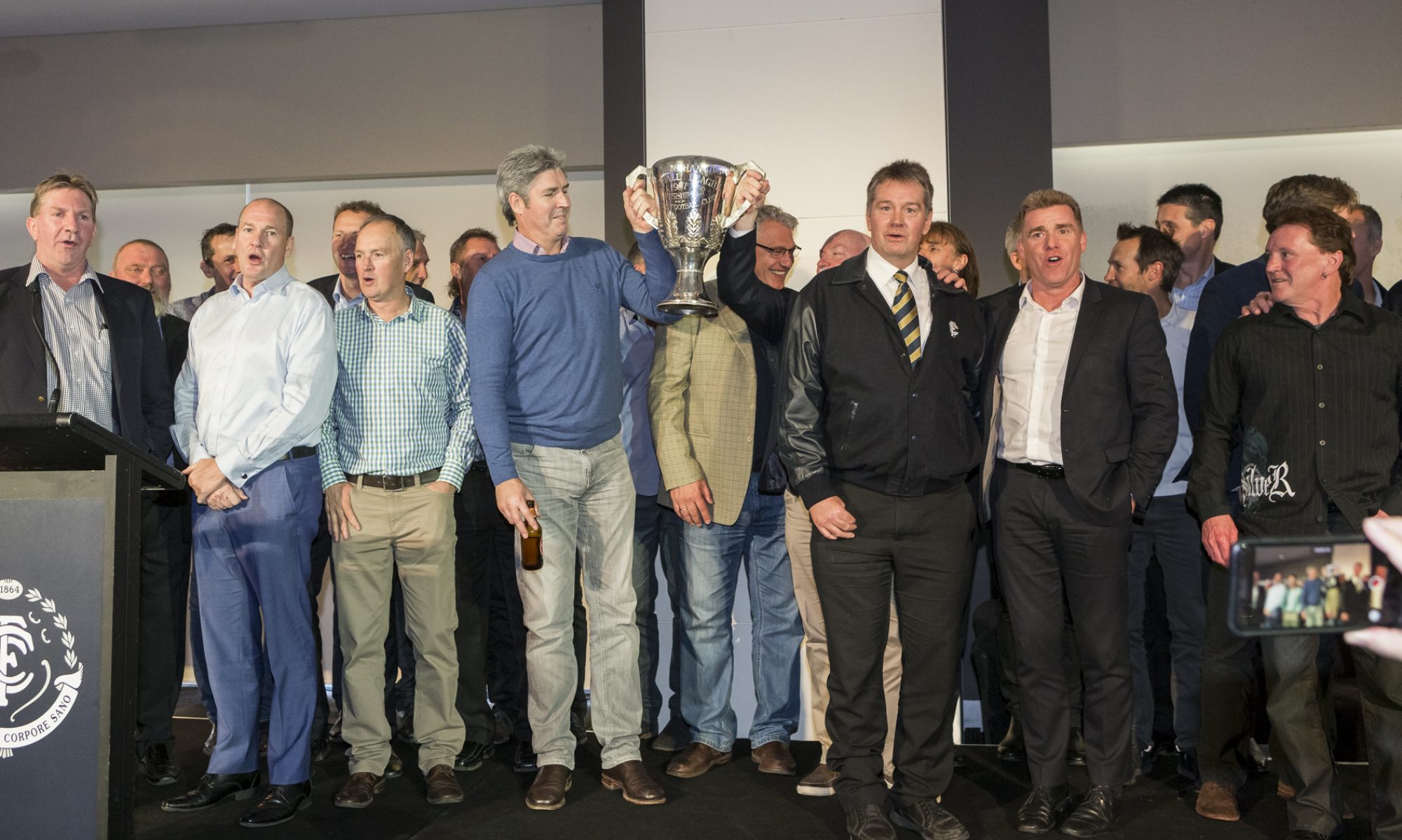

How Ray returned Carlton’s kindness
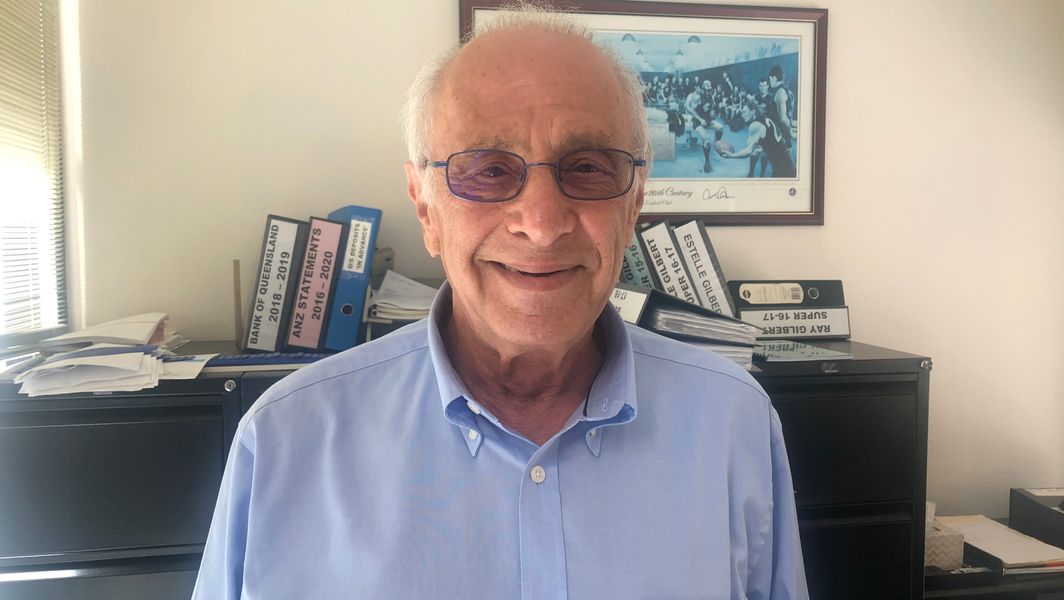
Ray Gilbert: A Carlton supporter, coterie member and sponsor.
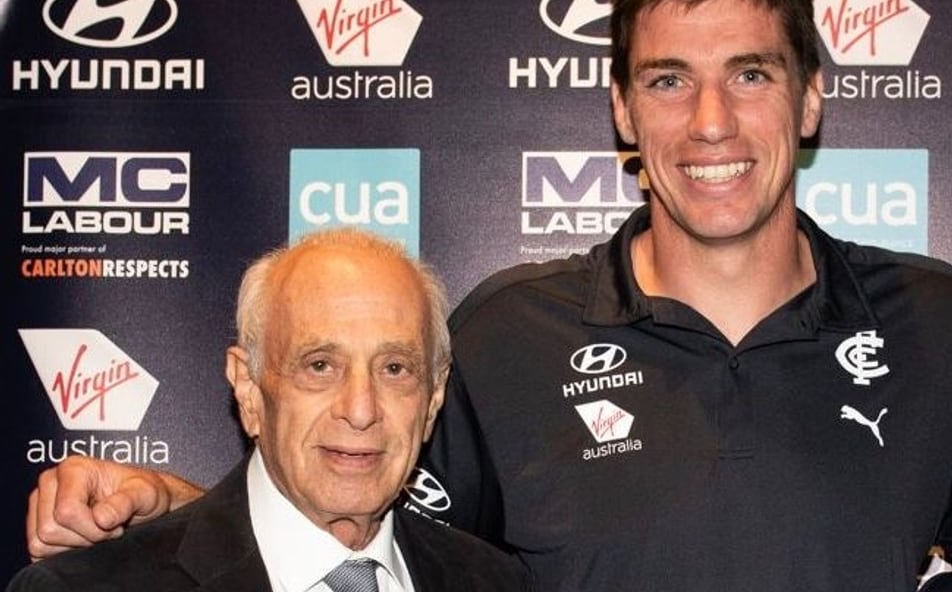
SOMETIME soon, Ray Gilbert will quite literally flick the switch on his business in High Street Armadale.
For the past 47 years, Gilbert has committed his energies to the Custom Lighting showroom – and yet the man’s enduring love for his football club – whether as supporter, coterie member or sponsor – can be sourced to the immediate post-war years in the local Carlton neighbourhood.
For Gilbert, home was an apartment in the gloriously art deco Havana Court buildings on Drummond Street, east of the Princes Park ground, in the days when footy was gloriously territorial.
“I was born in Drummond Street at No. 887 – apartment No.9 I think it was. The apartments are still there, right next door to the church,” Gilbert said.
“Funnily enough, I lived over the road from the residence of Harry Frydenberg – Josh Frydenberg’s father (which is why Josh also follows Carlton) – and I used to play football with Harry in Drummond Street.”
Gilbert also remembered with affection his first forays to the place formerly known as Princes Park.
“I used to go the ground as a seven or eight-year-old. In those days you’d walk to the ground to watch the game and you’d get in at half-time for nothing,” Gilbert said.
“I remember Ollie Grieve, No. 27, and Bruce Comben in the back pocket, as well as Jim Clark and Ken Hands.”
And yet, it’s another childhood tale that Gilbert, a Life Member of the football club, will take to the grave with him.
“That I was born in Carlton, followed Carlton and love Carlton is true,” Gilbert said . . . “and yet this particular story is not about me and my journey, but more broadly about the important part that players play in helping young people”.
In 1951, Gilbert, then ten, was cut down with a serious kidney infection. The infection left him bedridden for six months, at a time when there was no television to take his mind off his malady.
Then came a knock at the front door to which Gilbert’s father responded – and there to greet him was the Carlton ruckman Ken Hands, the ’47 Brownlow Medallist Bert Deacon and the Premiership half-back flanker Jim Clark.
Hands, Deacon and Clark had all fronted up to pay young Ray a “get well soon visit” – a gesture Gilbert’s never forgotten.
“It was a total surprise, completely out of left field,” Gilbert said.
“My grandfather, who lost a leg in a roadside accident, had a driver – and the brother of the driver was the doorman at Carlton. Now my grandfather must have told the driver that his grandson had been laid up in bed for six months and the driver relayed that to his brother who arranged for Deacon, Hands and Clark to come down and visit me.
“This is a story I often tell the current players . . . at the end of the day, when you’re little and you’re not well it means so much that a player cares enough about you to tap you on the shoulder or shake your hand.”
The kindness afforded him by Clark, Deacon and Hands has been more than reciprocated by Gilbert, who for 27 years served The Carltonians coterie group as secretary, treasurer and president.
It’s also a matter of fact that Gilbert introduced Optus to the Carlton Football Club by way of a chance meeting with Optus’s head honcho.
“Custom Lighting bought a building in City Road, Southbank, at which we managed Commercial Lighting . . . and one day out of left field a very large electrical company Lawrence & Hanson came in and literally took that side of our business over,” Gilbert said.
“In the end the business closed and once that happened I tried to rent out the empty building which we tried to rent out – and lo and behold that’s how I met Ian May the head of Optus.
“I twigged straight away that Optus might be interested in Carlton, so I took Ian and (Chief Executive) Ian Collins out to lunch at an Italian restaurant in Nicholson Street. Ian then took over and had a discussion with one of the Carlton directors George Varlamos who was able to convince the council to agree to change the name from Princes Park to Optus Oval.
“Optus effectively became Carlton’s major sponsor, which probably indirectly saved the club from going belly-up.”
Amid the hovering uncertainties of season 2020, those in high places at the Carlton Football Club take comfort in the knowledge that passionate, loyal people like Ray Gilbert stand with them in the blue corner.
‘Sticks’ busts Bruce myth behind his 10.1 for SA
It’s time for Stephen Kernahan to set the record straight.
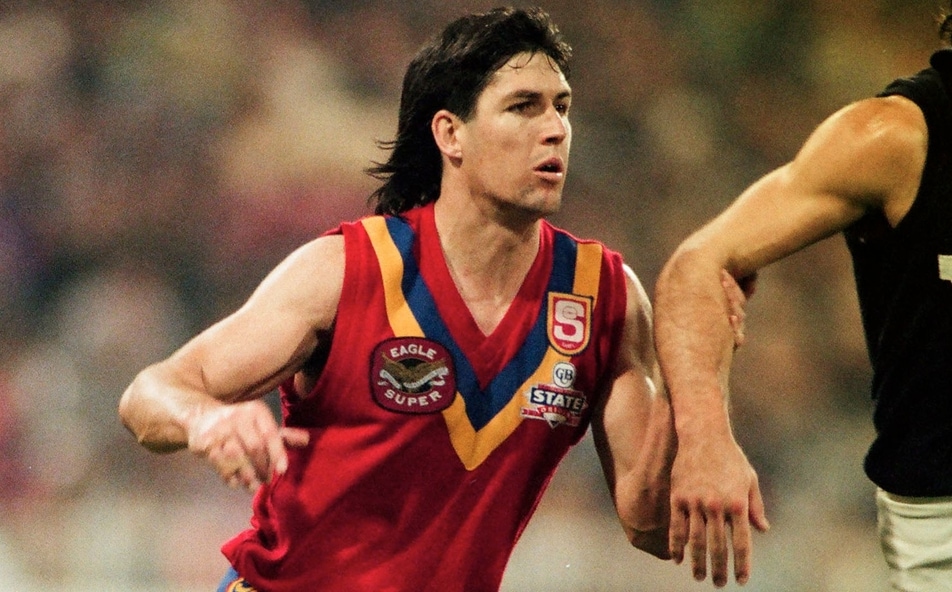
IN THE lead-up to the State Of Origin for Bushfire Relief match, it’s rather timely to set the record straight on Stephen Kernahan’s 10-goal haul for South Australia versus Victoria on the night of Tuesday 15 May, 1984.
It’s more than 35 years now since Kernahan, then a fresh-faced 20 year-old, posted that incredible 10.1 from full-forward in a losing team – thereby earning the Fos Williams Medal for best South Australian player afield and offering Carlton supporters a tantalising glimpse of what was to come.
Along the way, urban myth has unfairly dictated that most of ‘Sticks’’ ten were booted on the legendary Bruce Doull.
But in truth:
- Kernahan’s first six goals came when Victoria’s Gary Pert was his direct opponent through the entire first and second quarters, and part of the third;
- Kernahan’s next two goals were booted on Bruce Doull after Victorian coach Allan Jeans made the switch late in the third; and
- Kernahan’s final two goals came on Chris Mew, who replaced Doull as Kernahan’s direct opponent from the first bounce of the final quarter.
This week, Kernahan took the opportunity to go into bat for Bruce, confirming that his greatest haul came on Pert: the former Fitzroy and later Collingwood full-back.
“To tell you the truth, I can’t recall anyone ever asking me over the years, but I’m sure somewhere along the line I’d cleared Bruce’s name… and if I hadn’t I clear him now,” Kernahan said.
“State football was fantastic back then, unfortunately it wasn’t supported when it was wound up a few years ago, but it’s nice to see it back and blokes embracing it.”
For the record, Victoria 16.12 (108) defeated South Australia 16.8 (104) before a partisan Adelaide audience of 52,719, with Kernahan booting 10 of 16 for a South Australian outfit which also included future Carlton footballers Craig Bradley, Mark Naley and Peter Motley.
Conversely, Carlton players Doull, Jim Buckley and Wayne Johnston all flew the flag for Victoria in that famous contest – and despite Ker best efforts the Big V, to quote the late great EJ, “stuck it right up ’em!”.
Though replays of state games like the aforementioned in ’84 are getting a run on FOX Footy at the minute, Kernahan conceded he had not yet had the opportunity to put the feet up and relive a famous performance.
However, he did get the chance to view the replay of the Round 22, 1987 contest between Carlton and North, when his famous goal after the siren gave Carlton the victory and – as a consequence – top spot, the week’s break and ultimately the 1987 flag.
Jimmy Buckley speaks with Dylan Buckley on his podcast
Alby’s book sheds further light on song’s origins
The oldest known version of the club’s famous theme song has surfaced after eight decades.

The oldest known version of the club’s famous theme song, for 85 years buried within the pages of a former Carlton player’s scrapbook of the mid-1930s, has surfaced after eight decades.
The lyrics to the reworked music hall ditty Lily Of Laguna, typed onto a piece of carbon copy paper, are amongst the many and varied clippings contained within an old Rabbit and Hares inventory – which doubled as the scrapbook of Alby De Luca, a 32-game player for the old dark Navy Blues through 1934 and ’35.
Alby’s granddaughter Sue Hiam graciously loaned the scrapbook to the historic football club website The Blueseum, which in turn forwarded digitised copies of the scrapbook’s pages for inclusion in Carlton’s ever-expanding archive.
Significantly, De Luca’s version of the theme song tallies with this author’s theory – first expounded in the book Out Of The Blue in 2009 – that the reworked lyrics were originally penned in the early 1930s by Irene McEldrew and her cousin Agnes Wright – a niece of the then Carlton coach Dan Minogue.
According to Agnes’ half-sister Dorothy O’Riordan, the lyrics were put together by the two ladies in the kitchen of a double-fronted weatherboard at No.17 Liddiard Street Hawthorn – which doubled as a boarding house for Carlton footballers of the day Eric Huxtable, Jack Green and Harry ‘Soapy’ Vallence.
“One night, the players returned from training bemoaning the fact that the team had no theme song – so Agnes and Irene sat down at the kitchen table and wrote the song to the tune of Lily of Laguna, which was a tune they liked,” Dorothy revealed in the 2009 interview.
“I don’t believe they (Agnes and Irene) ever got any acknowledgment for writing the words to the song, but I think it still stands up.”
Alby’s version is noted for a couple of subtle differences to two lines in particular – “We’re the team that never lets them dream” instead of “We’re the team that never lets you down” and “With the famous old dark blues” instead of “Against the famous old Dark Blues”.
Also of note, with regard to the “us” versus “up” controversy associated with the song, is that the De Luca version carries the “up” and “up” rhyme.
Born in Wollongong in November 1908, Albert Edward De Luca first chased the leather for VFA club Sandringham (for whom he booted the club’s first goal in competition) and later Prahran, before attracting Carlton’s interest. In 1936, following his time at Princes Park, De Luca managed a further nine senior appearances for Hawthorn.

Alby Da Luca died in Hampton on June 30, 1978, at the age of 69.
Notwithstanding the theme song lyrics, De Luca’s scrapbook contains a treasure trove of rare newspaper articles and photographs, amongst them a Charles Boyles image of Carlton’s 1935 team and another of the man himself, proudly decked out in his playing gear in front of the Ald. Gardiner Stand. Also included on club letterhead, dated March 11, 1935, is Secretary Newtown Chandler’s invitation to Alby to resume training with the club on the 19th . . . “and kindly bring your Football kit”.

Alby De Luca’s scrapbook, in its entirety, can be browsed at http://www.blueseum.org/gallery1650. The Carlton Football Club and The Blueseum would welcome anyone in possession of a pre-World War II player’s scrapbook to consider lending the item to the club (and/or The Blueseum) so that it can be digitised for posterity.
Great youtube video of our 2017 Luncheon
Just discovered this video from an attendee of our 2017 luncheon celebrating the 1987 premiership. Fantastic. If there are any other videos out there like this, please let use know!
Join Carlton Legends at Ikon Park
Tickets for the Spirit of Carlton Legends Dinner are now on sale.

Bluebaggers will have the rare opportunity to interact with some famous Carlton names when the Spirit of Carlton Legends Dinner takes place on Sunday 8 March.
This is your chance to meet the likes of Geoff Southby, David Rhys-Jones, Alex Marcou and Kevin Hall before Carlton takes on Brisbane in Week three of the 2020 Marsh Community Series.
The event will be located in the George Harris Room at Ikon Park, with proceedings kicking off at 5pm.
The on-field action will then commence at 6.30pm.
For just $115 per person, you will have access to delicious canapes, beverages and a reserved seat to the coveted event.
You will also get the unique opportunity to meet and interact with some of Carlton’s former players and hear some famous stories from the past.
Raffle and auction items will also be available on the night.
Featured past players in attendance include:
- Geoff Southby
- David Rhys-Jones
- Alex Marcou
- Kevin Hall
- Anthony Francina
- Sam Rowe
- Simon White
Secure your ticket today | Click here to purchase your ticket for the Spirit of Carlton Legends Dinner
Spirit of Carlton Legends Dinner:
Date: Sunday 8 March
Time: 5pm onwards
Location: George Harris room, Ikon Park
Tickets: $115 p/p
Inclusions: Canapes, beverages and reserved seat for Carlton’s Marsh Community Series game against the Brisbane Lions
Blue diamond Dick Merton passes away
by Tony De Bolfo
Lifelong Carlton supporter ‘Dick’ Merton has passed away.

LIFELONG Carlton supporter ‘Dick’ Merton, the former President of the Blue Diamonds coterie group and a father figure to the likes of Carlton Premiership players Jim Buckley and Wayne Harmes, has died after a long illness in The Northern Hospital in Epping. He was 76.
Born in Richmond, Richard Arthur Merton’s lifelong love for the old dark Navy Blues was forged through his relationship with one of his uncles – a rabid supporter who for years ferried the impressionable kid to Carlton contests.Traditional Saturday games, particularly at Princes Park, must have brought welcome escape to Dick, who was only a lad of 11 when his mother died.
In the wake of his profound personal loss, Dick relocated to Preston, where he was raised by his maternal aunt in a house in Tierney Street. The house still stands, not far from the Olympic Hotel where Dick’s wake is to be held.
At Tierney Street, Dick got on with his life – aided and abetted by his aunt’s children who, according to Dick’s son Brent, “were like brothers and sisters to him”. He pursued his studies at Northcote High School, but was forced into the workforce sooner rather than later to support his newly-inherited kinfolk.
Dick first found work at the Huttons Bacon Factory off High Street. Not long after, he and a mate established their own meat business, first in Kingsbury and later Fairfield, where he took on aspiring young Carlton players like Buckley, Harmes, Greg Towns and Russell Ohlsen. To quote Brent: “Those boys of 1979, ’81 and ’82 had a very special bond with him”.
In 1967, after meeting his lifelong beau at a local Preston dance, Dick exchanged marital vows with Kath Symons. A daughter Leanne and son Brent followed as the family found their new digs at No.7 The Fairway in Kingsbury – the place Jim Buckley also called home from 1976 when he came down from Kyneton to try his luck in the big time. As Brent remembered: “Jimmy and I slept in the same bedroom”.
This week, Buckley, the three-time Premiership player and 1982 club Best and Fairest, remembered with affection his years at The Fairway.
“It was a great place to be,” Jimmy remembered.
“Kath looked after me with her home cooked meals, Dick got me work in the meat game and the Mertons gave me a place to live. They were exciting times, a lot of things were going down back then, because Dick was well-known,” he said.
“Dick was a big Carlton man who gave a lot of people a start. he had a heart as big as himself.”
In 1981, Dick resolved to further his support for his beloved Blues by committing his energies to a recently-established club coterie he remembered as the ‘Blue Chips’, but was formally known as the ‘Blue Sapphires’.
On the eve of the ’81 year, the Blue Sapphires morphed into the Blue Diamonds – so named after Caulfield’s famed Group 1 race for two year-olds – and prominent amongst the coterie was the jockey Normie Waymouth, who in the Carlton Premiership year of 1982 rode Rancher to victory in the famous race.
Assuming the Presidency of the Blue Diamonds, Dick hosted matchday Carlton functions with fellow coterie members including Colin De Lutis, Eric Salter and the late Sam Smorgon. Throughout the period, the Blue Diamonds contributed to the cause by assisting players with job placements or vocational advice.
In the aftermath of the Premiership season of 1987 the Blue Diamonds drifted into oblivion, but Dick’s love for the club never waned.
Two years ago, Dick was front and centre with former players and officials who gathered on Ikon Park following a training session involving the current group.
Then in August last year, he completed his final Carlton appearance when he joined mourners at the funeral of the club’s long-serving Property Steward Ken Kleiman in Doncaster.
Dick was recently admitted to The Northern Hospital as his health steadily deteriorated. He died last Friday (January 24) with Kath, his wife of 53 years, by his side. Together with Kath, Dick’s daughter Leanne, son Brent and six grandchildren survive him.
It’s fair and reasonable to assume that Richmond’s St Ignatius’ Catholic Church will be packed to the rafters when the Diamond in the rough who was Dick Merton is farewelled at ten o’clock this Thursday morning (January 30).
As Brent said: “I’ve had poor people and rich people ring me to say ‘Your Dad helped so many’. He always wanted to do someone a good turn, particularly those who needed it most, and that’s because he grew up that way”.
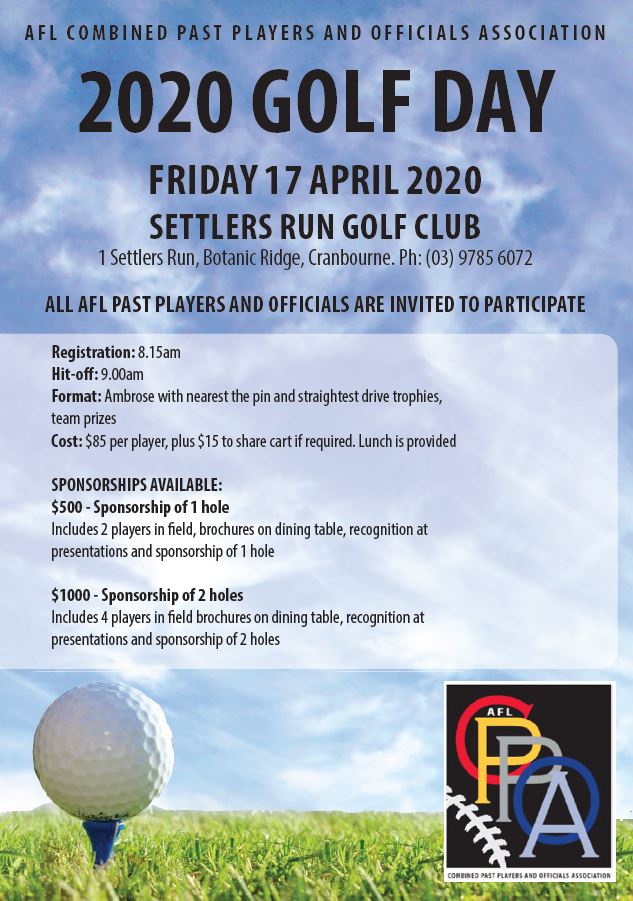
Save the Date – 2020 AFLPPOA Golf Day
Blues mourn the passing of Carlton rover Board
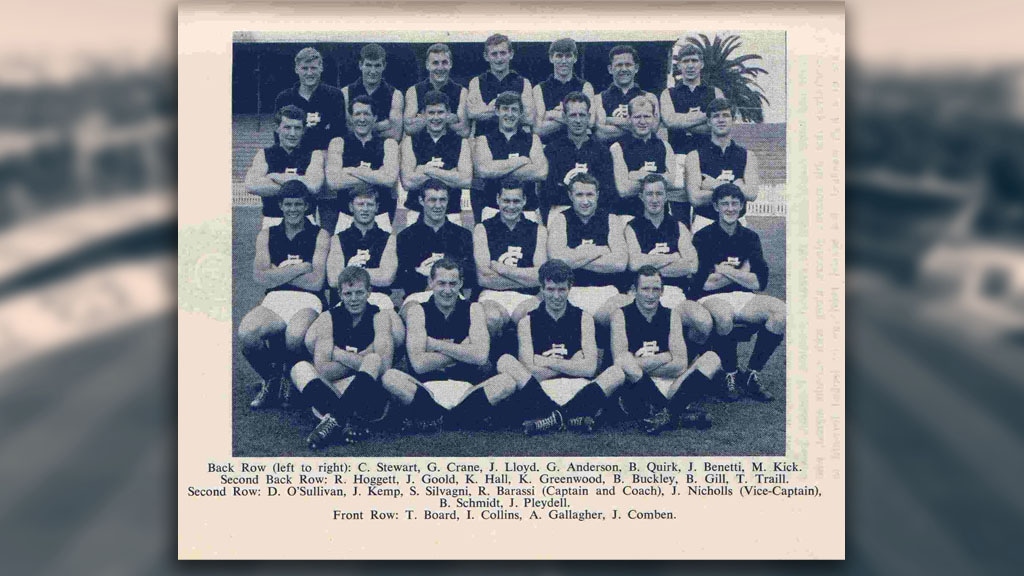
The 1965 Carlton team. Terry Board sits in the front row at the far left, alongside Ian Collins and Adrian Gallagher.
FORMER Carlton rover Terry Board, who completed his senior debut on the same day Ron Barassi led his players down the race for the first time as Captain-Coach, has died at the age of 74.
Recruited to the club from South Warrnambool and handed the No.24 now on the back of Nic Newman, Board and Pascoe Vale hopeful John Kemp were each named in the Carlton senior team for the first time on Saturday, April 17, 1965, in what was the opening match of the season with John Kennedy’s Hawthorn at Glenferrie Oval.
36,000 supporters somehow crammed into that sardine tin by Linda Crescent, to see Barassi lead his Blues to a famous 37-point win – on an afternoon in which Board, named in a forward pocket, earned Hawthorn’s David Parkin as his opponent and fared well.
Adrian Gallagher, the three-time Carlton Premiership rover and club best and fairest, was adjudged BOG in that historic ’65 season opener. Gallagher recalled going head to head with the Hawks’ No.1 rover Ian Law on what was a typically boggy ground “and I vaguely remember Serge (Sergio Silvagni) thumping a couple of torpedo goals from centre half-forward”.
“The place was so narrow that the people hanging from the terraces appeared to be on the ground,” Gallagher said. “You can imagine what it would have been like – Ron Barassi’s first game as Carlton Captain-Coach, John Kennedy bellowing from the Linda Crescent wing and ‘Barass’ more or less telling him to shut up.”
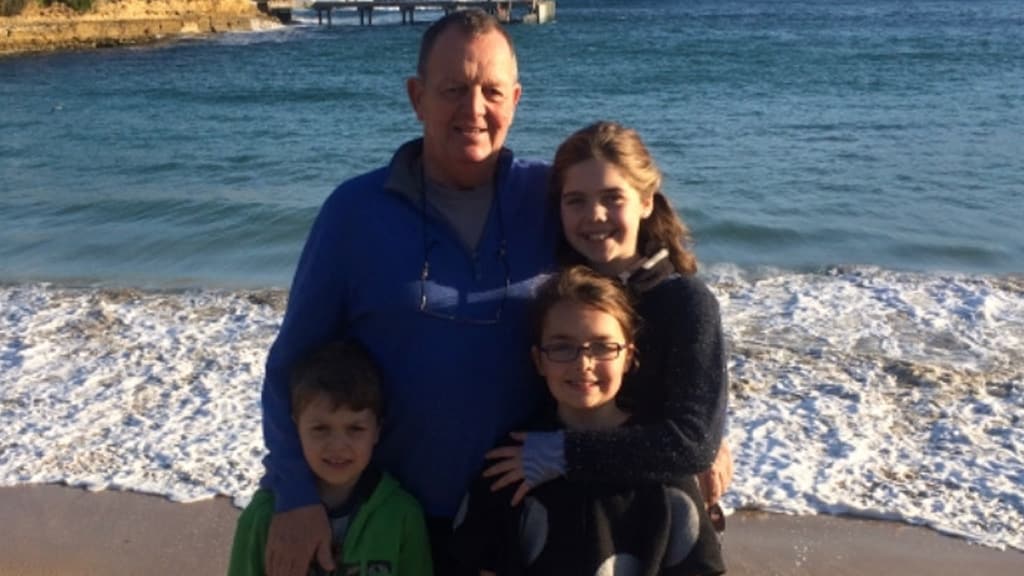
A recent photograph of Terry Board at Warrnambool with his grandchildren (clockwise) Eliza, Lana and Patrick.
Gallagher shared roving duties with Board through those first two seasons on Barassi’s watch and (later) Denis Munari through the Premiership season of 1968. As he recalled: “Terry and ‘Shark’ (Munari) were vying for the role of No.2 rover and in ’68 Shark got it”.
“Perhaps Terry’s kicking mightn’t have been what it could have, but he was very good,” Gallagher said.
“He was quick, he was smart and he had courage.”
Board strung together 16 games in his maiden season, but only five in 1966 – a year in which he also copped four weeks for whacking Richmond’s Peter Hogan in the 12th Round match on the MCG.
By the time Carlton contested the 1967 finals series, Board had been displaced by Munari, who partnered Gallagher in the straight sets September losses to Richmond and Geelong.
Board broke back into the senior team in ’68, stringing together five consecutive games between Rounds 4 and 8 – only to be omitted after the Round 18 match with Collingwood – his 41st and last appearance – on the cusp of the finals series which culminated in the drought-breaking Grand Final victory over Essendon.
“For whatever reason it came down to how you were with ‘Barass’,” Gallagher noted. “Back in those days, whenever Barass had a go at you, you had to go back and say I’ll show you, you bastard’. But Terry got the s..ts with Barass – he took it to heart.”
In the end, Board accepted a coaching position with the North Gambier Football Club – on ten times the coin he earned at Carlton.
Off the field, Board was fabulous company – “great fun as Gallagher put it. At Princes Park he earned the nickname ‘Crockett’ after the last man standing at The Alamo, as he tended to prevail in Sunday euchre nights with Brian Kekovich and Peter Jones at the Brunswick home of the then Chairman of Selectors Jack Wrout.
According to ‘Gags’, “Jones used to make out that he was a big punter, which is where he inherited the nickname ‘Percy’ – after Percy Galea, Sydney’s prince of punters”.
“Jones, Kekovich, Terry and myself all got on well because we were all the same age and it was just a great era,” Gallagher said, “and Terry did very well with his life after football.
“He was the biggest hotel broker in the country going around, and he worked his way up from nothing. He put himself through school and with John Thomson the solicitor who played at Richmond he more or less turned that industry around.
“TJ Board was big. People like the Mathiesons dealt with Terry.”
Board died in his home town of Warrnambool last Saturday (November 23) after a brief battle with melanoma. He is survived by his sons Terry jun. (a 15-game former Fitzroy player), Peter and Michael, together with Peter’s wife Michelle and their three children Eliza, Lana and Patrick.
Peter described his father “as a huge inspiration to me both in life and in business”.
“It makes me feel very proud to know how appreciated and admired Dad was,” Peter said. “He was absolutely adored by his family and friends.”
The Carlton team, including debutant Terry Board, which met Hawthorn at Glenferrie Oval
in the opening round, Saturday, April 17, 1965
B: 36 Roger Hoggett 26 Graeme Anderson 5 Ken Greenwood
HB: 11 John Goold 17 Gordon Collis 12 John Gill
C: 30 Murray Kick 19 Ian Collins 39 Cliff Stewart
HF: 9 Berkley Cox 20 Wes Lofts 33 Jim Pleydell
F: 16 Maurie Sankey 1 Serge Silvagni 24 Terry Board
Ruck: 2 John Nicholls (vc) 31 Ron Barassi (cc) 10 Adrian Gallagher
Res: 7 John Kemp 21 Barry Gill
Latest Video – Adrian Gleeson 1986
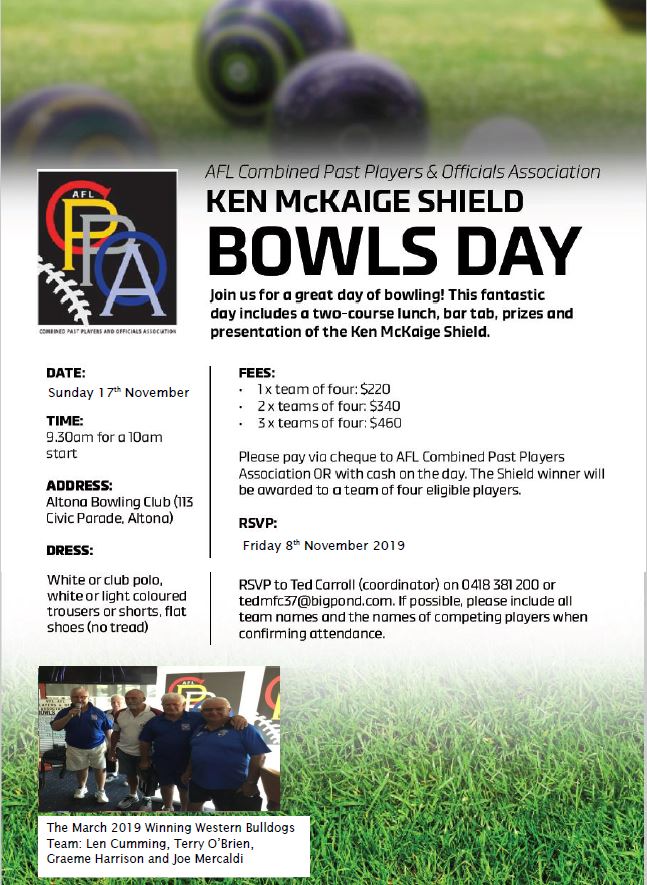
2019 November AFL CPP&OA Bowls Day
Blues’ father/son link ends with Williams’ passing
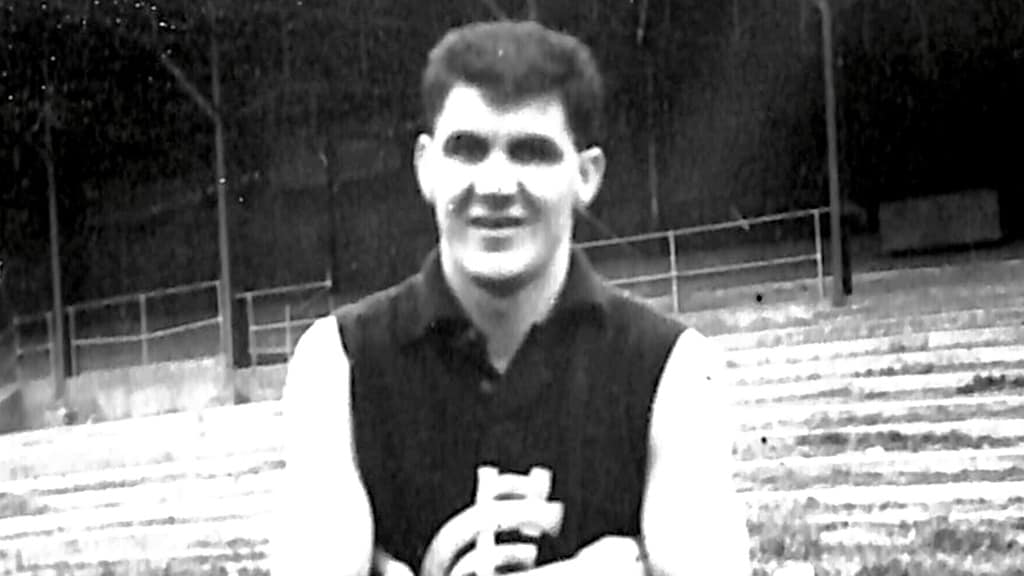
John Williams in the early 1960s. John Williams, a utility player in the Ken Hands-coached Carlton teams of the late 1950s and early ’60s, has died at the age of 79.
Recruited to the club from neighbouring Princes Hill having earlier chased the leather for Brunswick YCW, Williams furthered his football through Carlton’s Under 19s and reserves, and turned out at senior level for the first of 25 matches in total wearing the No.31 later made famous by Ron Barassi.
That happened in the opening round of the 1959 season – Saturday, April 18 versus Essendon at Princes Park – just four days after Williams turned 19. Named at centre half-forward, he contributed a goal to Carlton’s 13.20 scoreline, with Sergio Silvagni booting four of his five goals up front in a match-winning opening quarter.
As fate would have it, the Essendon match would double as Williams’ only senior appearance for the ’59 season. But season 1960 would offer a 12-game return, during which time he was a more than handy contributor whether as ruck-rover or forward pocket (booting a personal best three goals in the 11th round match with Melbourne).
In 1961, Hands in his wisdom resolved to switch Williams to defence, and there he represented the club in ten more contests. But as the season progressed, he was more often than not consigned to the bench, and after managing just two senior appearances in the Grand Final year of 1962 – the legacy of a serious injury to his kicking foot (the right) – he parted company with the club.
Almost 30 years later, Williams saw his boy Mark take to the field for the first of 19 senior appearances for the old club to which they were both zoned. As with the old man, Mark was 19 when he completed his Carlton debut, against Footscray in the 13th round of the 1983 season at VFL Park.
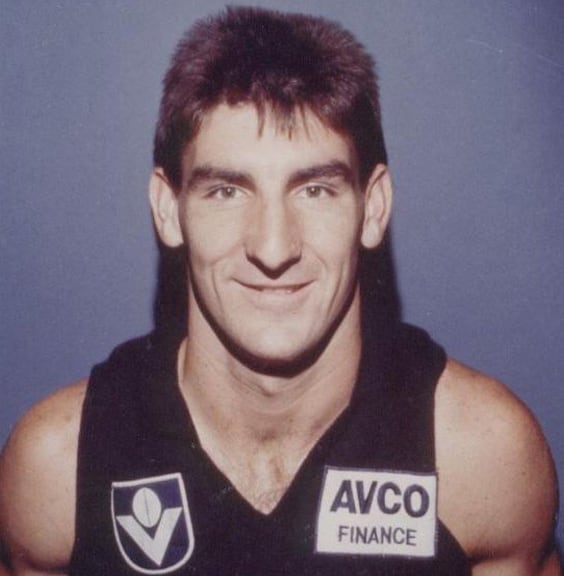
Mark Williams during his time with the Blues.
Mark was adjudged the club’s best first year player in ’83, but the ensuing five seasons would provide a return of just 14 senior games – during which time he represented the Blues in their reserve grade back-to-back Premiership teams of 1986 and ’87 – before rounding out his League career with 13 senior appearances for Footscray.
In 1998, Mark was appointed senior coach at VFL club Preston for what would be the first of six seasons at the helm, during which time the club amalgamated with Carlton and transitioned to the Northern Bullants.
In 2004 he was appointed senior coach at Sandringham with immediate success, taking the Zebras to three successive Premierships in 2004-05-06. Whilst at Sandringham, he combined his duties with the role of development coach at Melbourne, and after eight seasons with the Demons, joined Richmond as a senior assistant to Damien Hardwick.
Earlier this week, Mark took the opportunity to reflect on his father’s life, his seismic influence as a family man, and his precious father/son relationship at Carlton.
This is Mark’s story:
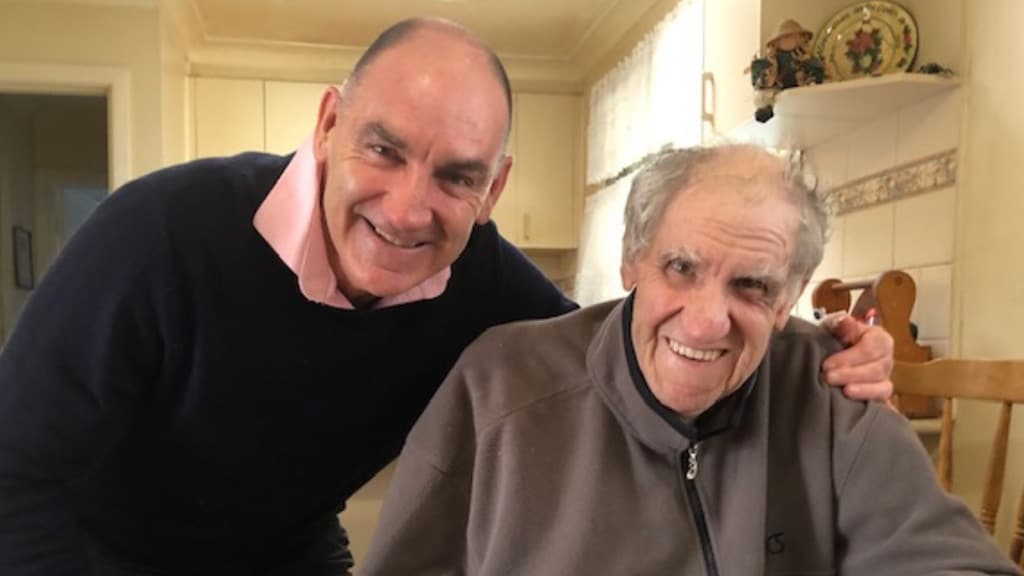
Mark and John Williams.
Dad was a fantastic leader, teacher, great confidante and counsellor. He was one of a kind. He was a hero to our family and we loved him deeply.
We were all really close to him, but I had a great connection because of the footy. He was mates with ‘Collo’ (Ian Collins) and Vasil Varlamos and there’s not many others of that era left.
Dad originally lived at 319 Lygon Street. It’s a pizza shop now, but back then it was a barber shop as Dad’s Dad was a barber and they lived above the shop upstairs.
Though he lived in the Carlton area, Dad had some early allegiance to Collingwood because his maternal uncle Harry ‘Bottles’ Chesswas played for the Magpies in he 1920s and ‘30s. But from the age of eight or nine, when he started going to Princes Park, Dad supported the Blues . . . and supported them ever since.
At Carlton, Ken Hands gave Dad the nickname ‘Effie’ because he always used to swear. He came through the thirds, seconds and firsts and he always had to play above his age group, so it was never easy for him. He got beaten up a bit early, but he often said that he got his own back when he got bigger. He was a utility as they called it back in those days – he stood 6’1” in the old measurement and weighed about 85kg. He had massive hands and massive feet, and from all accounts he was a tough nut.
Dad related a really funny story to me about his time at Carlton. He recalled that a lot of the players used to play table tennis in their down time at the club, and on one particular occasion the ball got crushed. He told me that Brucey Comben the then captain got hold of the key to the property room and the players helped themselves to the footy jumpers and socks while they were in there. It was like Christmas for the players because the then property steward was a miserable character who hung onto everything – and the players knew that they could only ever wear the stuff at home as the property steward would twig otherwise.
Dad started going alright with his football, but early in the ’62 season at his workplace a massive iron bar rolled off the bench and landed on his foot, crushing his big toe into about 20 pieces. The doctors told him they were going to cut his toe off but he talked them out of it. He couldn’t walk for a while, and when he told Carlton that he couldn’t train the club delisted him and he never went back. Mind you it was no big deal then.
After Dad recovered he went to Coburg YCW where he played and coached them to a flag. He then had a year at Black Rock and a year at Tongala, which he really loved – until a car accident left him with a broken jaw and forced him to step down.
Dad later captained and coached Merlynston to a flag – and then he gave the game away.
On the eve of my first senior game in ’83 I knew I was in the squad, but I went to bed on the Thursday night before. Back in the early 1980s, League Teams would be broadcast at around 11pm on a Thursday and I can remember Dad running in to the bedroom saying “You’ve got a game. Congratulations”. Dad was super proud. He was really rapt.
When I played for Carlton I got to meet Dad’s old teammates, so they looked out for me. I reckon Dad came to most games that I played, whether seniors or reserves. He used to work overtime, knock off at 11 o’clock on a Saturday morning then front up to wherever I was playing. When I played for Footscray later on, I remember he mistakenly went to the Carlton ground, because old habits die hard I suppose . . .
I was very lucky that I remained in footy for a long time, because while he always let me find my own way he was also happy to pass on advice. I remember as far back as Under 11s him telling me: “You need to be on the move whenever there are ball-ups or throw-ins – you can’t stand still”. After all these years that still sticks in my mind.
When I coached at St Paul’s East Bentleigh, I used to pick him up in the car on the way down and we discussed the game together. On the way home we’d dissect the game too and he pretty much consolidated my thoughts on coaching.
A little while ago, Dad developed lung cancer and I used to drive him into ‘Peter Mac’ (Peter MacCallum Cancer Centre) for treatment. One day we had a couple of hours between sessions, so I said to him – “Come on Dad, let’s go for a drive to some of your old haunts”.
I took him on a tour of places like the Lygon Street barber shop where he lived, the place at Moreland near Northcote Golf Course (Glenross Stainless Steel) where he worked and the old East Brunswick Footy Ground where he used to play. I also took him to the new development at the old Carlton ground.
Dad was too crook to get out of the car, but he really enjoyed returning to those places that were so important in his life. He pointed out a few things on that drive and I recorded some of them on audio and later video . . .
As I said earlier, my whole family was extremely close to Dad. I’m very emotional at the moment just thinking of him. The thing I’ll miss most is just being able to talk to him, particularly about footy. He was a great fellow.
John Leonard Williams was the 724th man to represent the Carlton Football Club at senior level since the foundation season of the VFL in 1897.
He died on October 9 after a short illness. He is survived by his wife Lynette, son Mark, daughters Megan and Linda, daughter-in-law Michelle, son-in-law Stephen Gumley (a former Carlton reserve grade player) and six grandchildren.
John’s funeral is to take place at the Cordell Chapel, Fawkner Memorial Park, commencing 12 noon this Thursday (October 17).
Panel Interview at Spirit of Carlton 1979 Premiership Reunion Lunch
David Teague interview at 1979 Premiership Reunion Lunch
Latest Video – Mark Williams 1986
40 years after the Grand Final, ’79 team gather on the ‘G
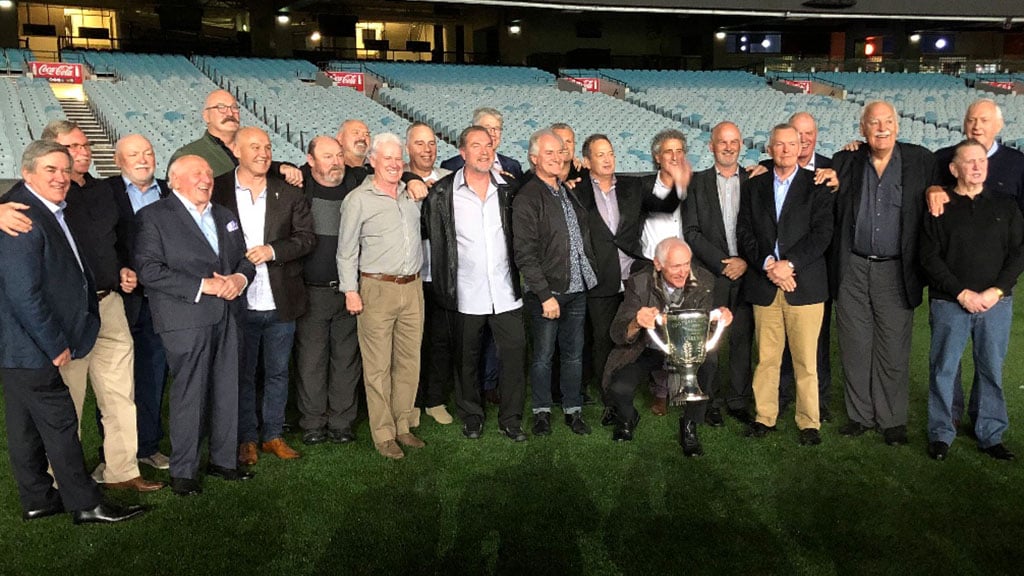
Former Carlton players and officials of the Premiership year of 1979 gather with the silverware on the MCG
FORTY years ago this Saturday, Wayne Harmes famously thumped the footy Ken Sheldon’s way to help land the 1979 Premiership for Carlton over good old Collingwood.
Last night, in a week where which Richmond readies for a tilt at its 12th League Premiership, Harmes and fellow members of the ’79 team returned to the MCG to savor the memory of what was the Blues’ 12th of 16 Premierships in their storied VFL/AFL existence.
Following the reunion dinner in the Keith Miller Room, Harmes, the inaugural Norm Smith Medallist, was photographed on the hallowed turf with fellow members of the ’79 Premiership outfit – Barry Armstrong, Rod Austin, Peter Brown, Jim Buckley, Mike Fitzpatrick, Wayne Johnston, Peter ‘Percy’ Jones, Trevor Keogh, Robbert Klomp, Alex Marcou, Peter McConville, David McKay, Ken Sheldon and Geoff Southby.
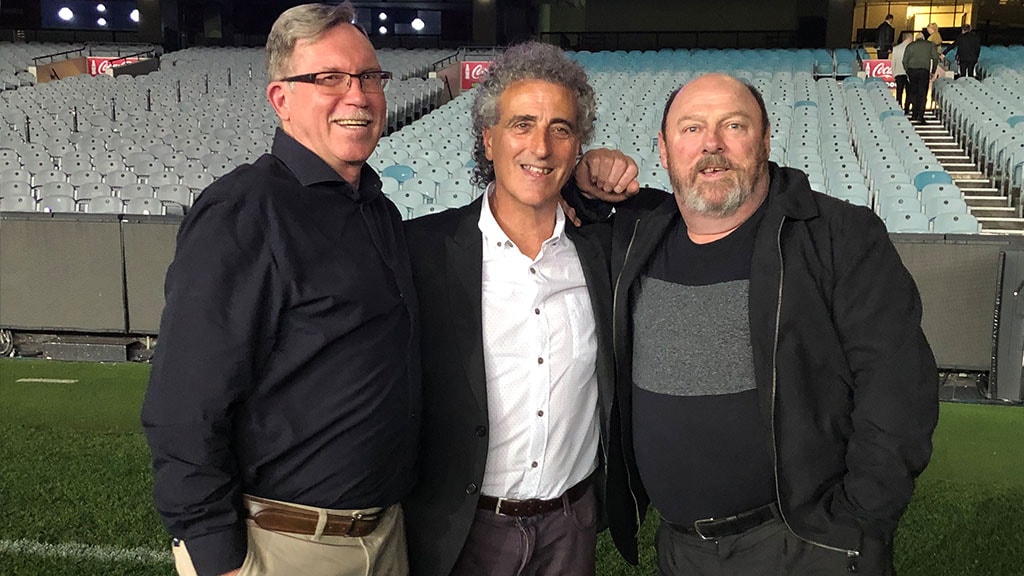
’79ers Greg Towns, Vin Catoggio and Wayne Harmes, MCG
Also pictured for posterity were ’79 squad members Vin Catoggio, Kevin Heath, Warren Jones and Greg Towns, together with former club staff members George Frigo, Bob Lowrie (whose grandson Michael Gleeson took these photos) and Shane O’Sullivan, and the former committeemen John Minuzzo who, aside from Ian Collins, is one of only two committeemen of that year still living.
Lowrie, the Carlton runner on that frenetic last Saturday in September ’79, said that those whose fortune it was to be present on the ground following a reunion dinner in the Keith Miller Room would be forever thankful to reunion organisers Mike Fitzpatrick and his wife Helen.
“It was a really down to earth, lovely night. Mike and Helen are to be commended for what they did for those who were there. They made their dreams come true, “Lowrie said.
“Geoff Southby officiated as MC at the dinner and a number of players took the microphone to reflect on the ’79 Grand Final and what it meant to them. At one point, Kevin Sheedy, who was attending a Richmond reunion next door, bobbed up in the room wearing a Richmond and GWS scarf.
“I heard Tom Lynch say in front of 95,000 after Richmond’s win in the Preliminary Final against Geelong that footy doesn’t get bigger than this. Back in ’79 there were 114,000 at the Grand Final and Carlton beat Collingwood, so I’d say it doesn’t get any bigger than that.”
1979 Carlton Premiership players unable to attend the reunion gathering were the Captain Coach Alex Jesaulenko, Bruce Doull and Peter Francis.
The ’79 Premiership wingman Michael Young, who swapped guernseys with Collingwood’s Ricky Barham moments after the final siren sounded, died one year and ten days ago.
Latest Video – Dean Strauch 1986
Latest Video – Stephen Silvagni 1986
Carlton home to Blues and country
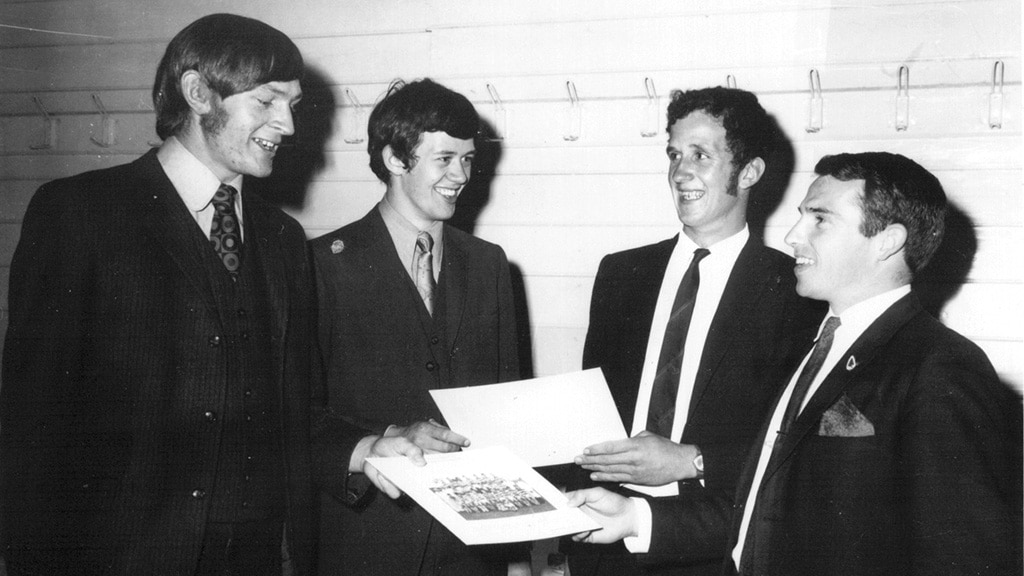
THE Bacchus Marsh Football Club, at which AFL chief executive Gillon McLachlan launched the AFL’s $18million joint-funded investment into country football, brought welcome focus to a place in which the Carlton Football Club has greatly benefited in an historic on-field sense.
Bacchus Marsh was in fact the area from which former club greats Harry ‘Soapy’ Vallence, Keith Shea and Ollie Grieve all hailed.
Vallence represented Carlton in 204 games between 1926 and 1938 – the last of them the ’38 Grand Final victory over Collingwood. He topped the club’s goalkicking 1929, 1931–1933 and 1935–1938, and in the ’31 season earned VFL honours for most goals kicked.
Shea turned out in 91 matches for the Blues between 1932 and ’37 – the first of them before he turned 18 – and was a four-time Victorian representative.
And Grieve’s war-interrupted career through seasons 1942, 1944 and 1946-’52 took in 137 matches including the ’47 Premiership, and ended with him earning B & F honours in his final year.
The League’s country Victoria investment, in conjunction with the State Government, has also brought focus to the contributions rural footballers have made to the great Australian game at the highest level, Carlton included.
As such, the following is a Carlton team comprising some of the greatest Victorian country recruits ever to lace a boot. The team comprises players recruited from clubs 40 kilometres or more from the Melbourne CBD, under the watch of Carlton’s three-time Premiership secretary/coach Jack Worrall.
Amongst the starting 18 are no fewer than 12 Carlton Team of the Century Members (including emergencies) – Rod Ashman, Bob Chitty, Horrie Clover, Garry Crane, Adrian Gallagher, Ken Hands, John James, Rod McGregor, John Nicholls, Geoff Southby, Harry Vallence and Greg Williams.
Also in their number is:
- the most capped state representative John Nicholls, the club’s record five-time Best & Fairest winner (1959, ’63, ’65, ’66 and ’67);
- three Carlton Premiership captains – Jim Flynn (1906 and ’07), Chitty (1945) and Nicholls (1968, ’70 and ’72 (the latter also as coach));
- three Brownlow Medallists – John James (1961) Gordon Collis (1964) and Greg Williams (1994); and
- three club Best & Fairests in a Premiership year – Southby (1972), Jim Buckley (1982) and Brett Ratten (1995).
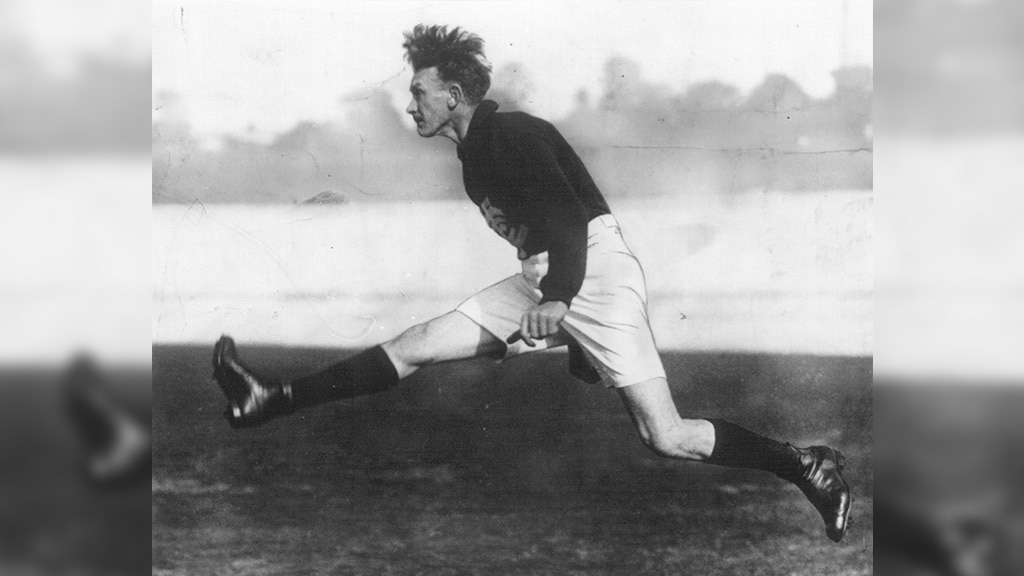
Maryborough’s Horrie Clover, considered Carlton’s greatest player between the First and Second World Wars.
David McKay, Carlton’s four-time Premiership player through 277 matches in 13 seasons, was recruited to the club from Newlyn.
“Zoning must have been introduced in ’68, the year I as recruited, because I was the first player from the Bendigo zone to play at Carlton. I remember I played a game in the seconds against Collingwood at Princes Park. I played on Vaughan Ellis who looked like a man mountain and I was just a skinny kid from the sticks,” McKay said
“I was lucky as Newlyn was in the Clunes League which only just fell into the Bendigo zone.
“The Bendigo League contributed the greatest number of country footballers to Carlton in my time – so many good players like Brian Walsh, Paul Hurst, Geoff Southby, Trevor Keogh and Rod Ashman.”
Carlton’s greatest Victorian Country team is as follows;
Backs: Jim Flynn (Benalla), Geoff Southby (Sandhurst), David McKay (Newlyn)
Half-backs: John James (Ballarat), Gordon Collis (Healesville), Bob Chitty (Cudgewa)
Centres: Garry Crane (Yallourn North), Greg Williams (Golden Square), Rod McGregor (Katamatite)
Half-forwards: Brett Ratten (Yarra Glen), Horrie Clover (Maryborough), Keith Shea (Bacchus Marsh)
Forwards: Ken Hands (Geelong Scouts), Harry Vallence (Bacchus Marsh), Rod Ashman (Eaglehawk)
Rucks: John Nicholls (Maryborough), Jim Buckley (Kyneton), Adrian Gallagher (Yarram)
Interchange: Bryan Quirk (Morwell), Ollie Grieve (Bacchus Marsh), Graham Donaldson (Clunes)
Emergencies: Jim Clark (Enmore), Peter Dean (South Bendigo), Ian Robertson (Wonthaggi)
Coach: Jack Worrall (Chinaman’s Flat)