
Michael Gallagher 1987 – Latest Video
Bernie Evans 1987 – Latest Video
Jamie Dunlop 1987 – Our Latest Video
Remembering Ron Rhodes, a Blueboy born and bred
Tony De Bolfo pays tribute to former Blue Ron Rhodes.
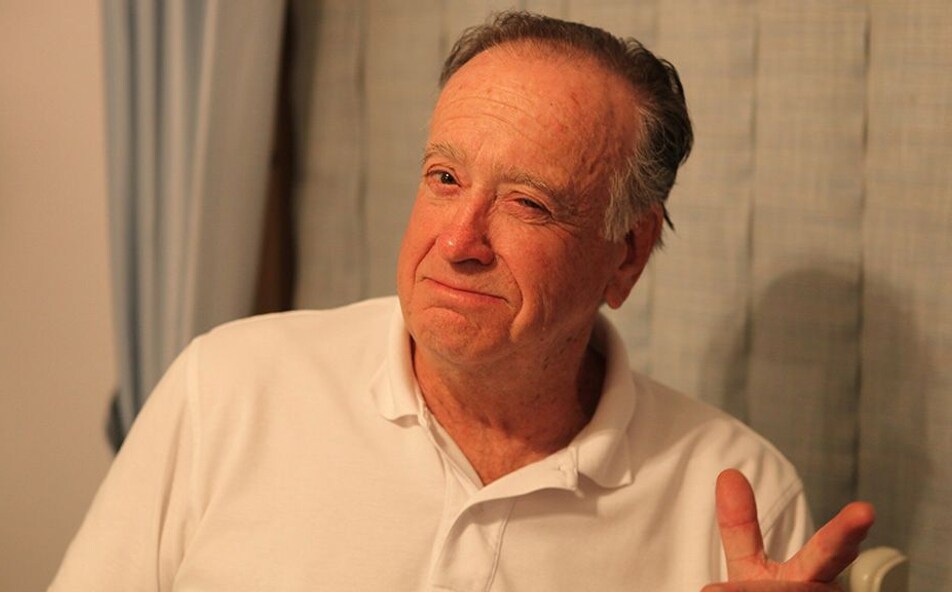
AS IS so often the case, the life story of the one-game player lost to the club after an all-too-brief on-field foray is of more interest than the 300-gamer with whom everyone in the football world identifies.
So it is with Ron Rhodes, a one-game Carlton senior player of 67 seasons ago, who died recently at the age of 88.
Ronald Thomas Rhodes was born on November 17, 1932, the son of Thomas Lewis Rhodes and Ruby Agnes Ryall – a cousin of Keith Ryall, the visionary behind Leigh Creek’s Kryal Castle. Ron was the youngest of three brothers, with Frederick (who died at a young age) the first born, and Keith the middle child who also turned out for Carlton.
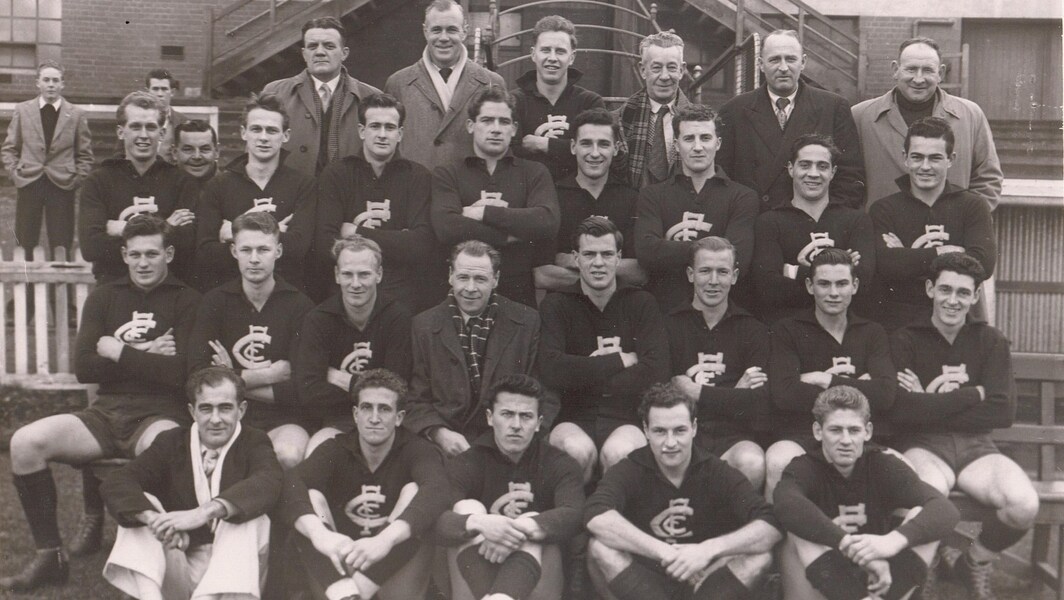
The ‘Mick’ Price-coached Carlton Reserve Grade team of 1954. Ron Rhodes is the player standing third from the left. Second from the right in the same row is Peter Bevilacqua, League football’s only known Italian-born footballer. Seated with his legs crossed in the front row, second from the right, is Harvey Dunn, the first League footballer ever recruited under the father/son rule.
Ron was part of the fabric of the Carlton neighbourhood. He spent the first 70 years of his life in the family home at 667 Drummond Street, North Carlton, having been schooled at Carlton North Primary at Lee Street, and later Princes Hill Secondary College in the shadows of the Legends Stand.
He was recruited to the Carlton Football Club from neighbouring Princes Hill on the cusp of the 1950 season when the club’s Under 19 team of which he was part fell to the unbeaten Essendon by a miserable point in the Grand Final. That season, Ron was recognised with the Most Serviceable Award donated by the club’s 1938 Premiership defender Frank Gill.
Ron progressed through the Under 19s and reserves, stringing together games as a ruckman/ruck rover with the occasional appearance in defence. Named as an emergency in Carlton’s reserve grade Premiership team of 1953, Ron was frustrated by four breaks to his left hand through the course of the ’53 season.
The following year, Ron featured in the team photograph with Carlton’s reserves – amongst them the captain Harry Sullivan, football’s first father/son recruit Harvey Dunn and the game’s only Italian-born League footballer Peter Bevilacqua.
July 1953. John James, a future Brownlow Medallist, supports Ron Rhodes, whose left hand, broken on four separate occasions through the course of the season, is supported in a sling (photo below).

In mid-June 1954, Ron was hospitalised with a kidney injury sustained in a reserve grade match with Hawthorn. Three weeks later, Coach Percy Bentley called his name for his Carlton senior debut.
Donning the No.36 now worn by Josh Honey, Ron followed the captain Ken Hands down the race and onto Princes Park for his one and only senior appearance – specifically the Round 11 match of Saturday, July 3, 1954 between Carlton and St Kilda.
That afternoon, Ron fulfilled duties as ruck-rover in a Carlton following division which included ruckman Bill Milroy and rover Jack Mills. Regrettably the home team lost that match to the visitors 9.16 (70) to 12.10 (82), and of the 22 who took to the field in Dark Navy only Peter Webster and Ron Robertson are still living.
Ron parted company with the Carlton Football Club at the end of the ’54 season and never pursued a playing or coaching career elsewhere, as his work away from the game became a focus.
An electrician by trade, he was for years employed with the Melbourne City Council, connecting electricity to premises within the council’s jurisdiction and installing meters accordingly. At the time of his retirement in 1995, he was as a foreman in charge of the council’s various work teams.
Ron’s life took an incredible turn for the better in April 1984 when he accompanied friends on a holiday to the Philippines. There he met, fell in love with and ultimately married Alicia Montero, a single mother making ends meet working as a sales rep for a Rice Milling Business.
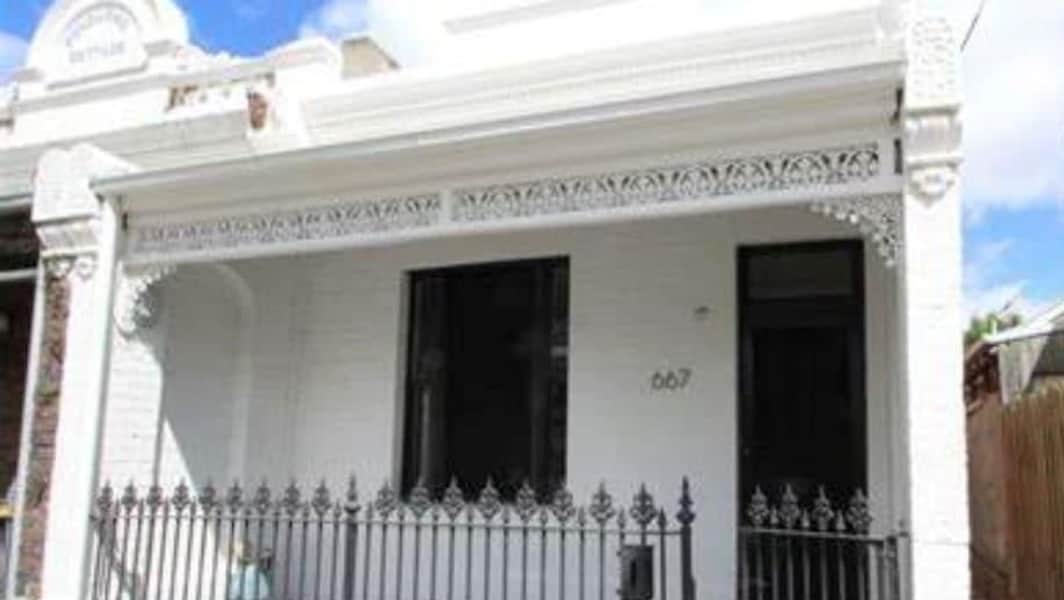
The Rhodes family home in North Carlton. It was here in October 1986 that Ron and his Filipino wife Alicia exchanged marital vows in a private ceremony.
Ron met Alicia in Manila through mutual friends, and as the relationship flourished, Ron travelled to the country several times until they tied knot in Manila on January 6, 1985.
Ron returned to Australia two months after the marriage and by August 1986 had arranged for his wife Alicia’s and stepson Michael’s passage to Australia. On October 8 of that year, he and Alicia again exchanged marital vows, only this time under Australian law, in a private ceremony attended by close friends and relatives at the Drummond Street home.
He then completed the protracted step-parent adoption process to fully legalise his parentage to Michael, whose surname is now formally “Rhodes”.
In 2002, having lived most of his life in Drummond Street, Ron vacated the old Rhodes home in Carlton. Together with Alicia, he headed north to Lalor to be closer to their son Michael, daughter-in-law Jem and grandchildren Michael and Gabriel.
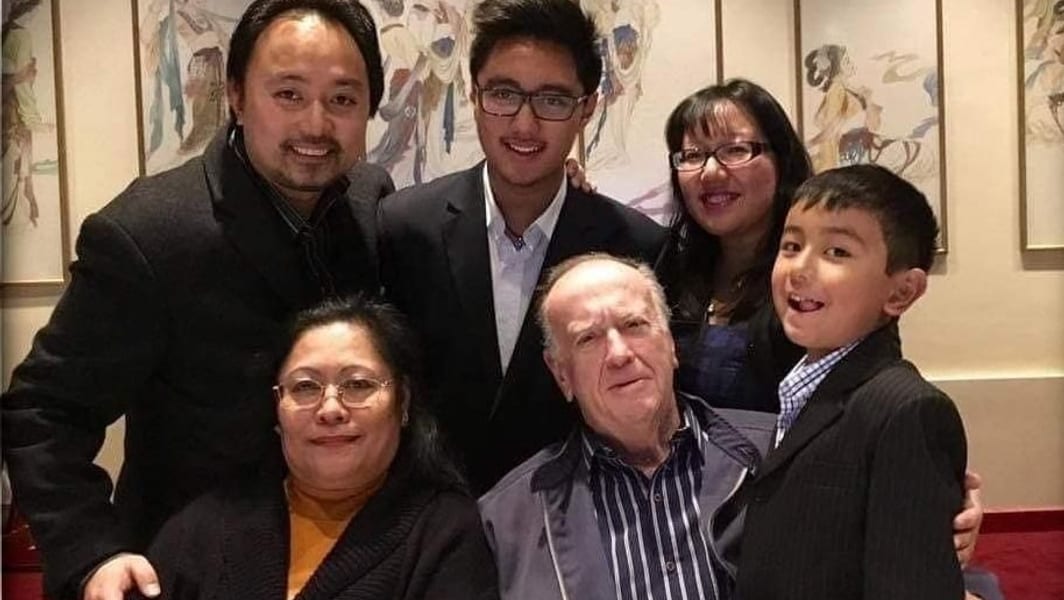
The Rhodes family – clockwise from left rear Michael, Michael (jnr), Jem, Gabriel, Ron and Alicia.
Ron maintained a solid fitness regimen and was a regular at the local gymnasium well into his 80s. He was mowing the lawn at the front of his home when he suddenly collapsed and could not be revived.
“Dad never liked any fuss, so I guess the silver lining to all this is that he went as he would’ve wanted – quick, with no long decline at a nursing home or hospital – just mic drop and outa here, may God bless his soul,” Michael said.
“He was a good man, he was my Dad, and he and his family treated me no differently to a biological son.”
Ronald Thomas Rhodes is survived by his wife Alicia, son Michael, daughter-in-law Jem and grandchildren Michael and Gabriel.
He was the 682nd player to represent the Carlton Football Club at senior level since the formation of the VFL in 1897 – and his love for Carlton never abated.
“Dad was Navy Blue through and through, being born and bred in Carlton,” Michael said.
“He followed the Carlton teams through the decades, and did not miss watching a single Carlton match on TV.
“Dad’s house was always adorned with Carlton paraphernalia and the door chime carried the club’s theme song. He lived and breathed the Blues. He felt the club’s ups and downs, the joys and disappointments, and he passed on that passion to me and the next generation of our family.
“We do truly feel grateful for the club’s validation of Dad’s previous history with the club . . . and with that, whenever the Bluebaggers play, you can be assured that there will always be a Rhodes screaming at the top of their lungs ‘Carn the Blues!’.”
The Carlton team, featuring Ron Rhodes in his one and only senior appearance, v St Kilda at Princes Park – Round 11, Saturday, July 3, 1954
B: 15 Bruce Comben 25 George Ferry 37 Bernie Moran
HB: 30 George Stafford 33 Peter Webster 16 John Brown
C: 28 Graham Gilchrist 21 Ron Robertson 19 Denis Zeunert
HF: 10 John James 18 Max Wenn 17 Doug Beasy
F: 1 Ken Hands (c) 26 Noel O’Brien 23 John Chick
Ruck: 2 Bill Milroy 36 Ron Rhodes 9 Jack Mills
Res: 3 Harry Sullivan 11 Laurie Kerr
Coach: Percy Bentley
Join the Spirit of Carlton at the 1981 and 1982 Premiership Reunion
Don’t miss your chance to mingle with club greats at this momentous occasion.
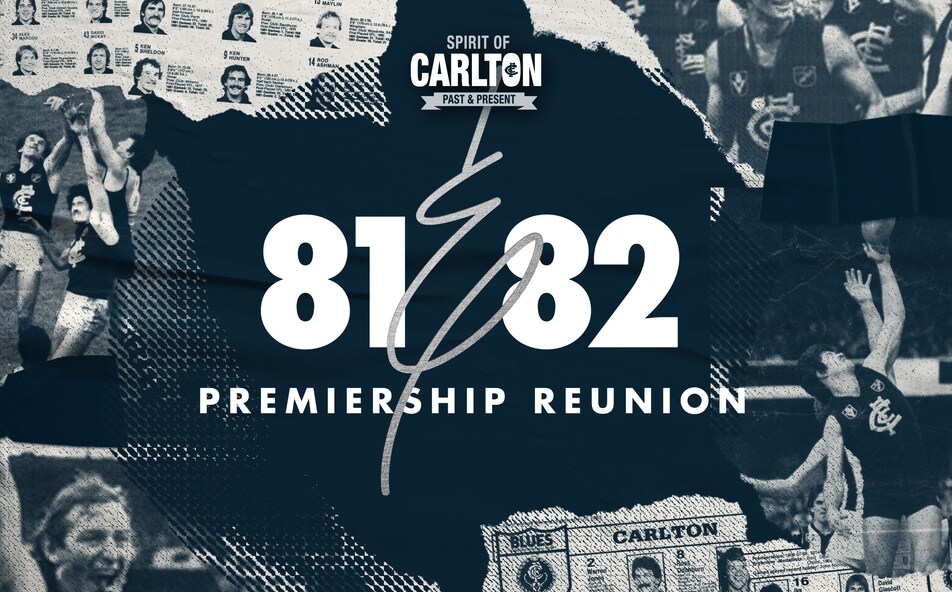
JOIN members of Carlton’s 1981 and 1982 premiership teams to celebrate the 40th and 39th anniversaries of the Club’s famous Grand Final victories over Collingwood and Richmond.
Held in the Victory Room at Marvel Stadium on Friday 30 July, this unmissable event will provide the opportunity to mingle with former club greats as well as a number of current AFL and AFLW Blues to relive two memorable moments in the history of the Club.
Guests will enjoy a delectable two-course lunch and premium beverages, with special guest speakers and entertainment throughout the function.
Tickets are now on sale. Click here to secure your place now.
Function details:
Date: Friday 30 July
Time: 12pm
Location: Victory Room, Marvel Stadium
Dress code: Smart casual
Jon Dorotich 1987 – Our Latest Video
Richard Dennis 1987 – Our Latest Video
Collection of Carlton Podcast Interviews
Peter Dean 1987 – Our Latest Video – Bonus Interview
Tom Alvin Interview on SEN 21-4-2021
Big Nick pays tribute to the late Ken Greenwood
A tribute to former Carlton ruckman, Ken Greenwood

FORMER Carlton ruckman Ken Greenwood, who shared following duties with the likes of Brian Buckley, Graham Donaldson, John Nicholls, Maurie Sankey and Sergio Silvagni through the 1960s, has died at the age of 79 after a long illness.
Recruited to Carlton after taking the South Bendigo Football Club’s best & fairest honours, Greenwood, wearing the No.5, plied his ruck craft through 55 games for the Blues under the watch of coaches Ken Hands and Ron Barassi.
John Nicholls remembered Greenwood, a member of Carlton’s 1962 Grand Final twenty, as a capable footballer deprived of opportunity.
“They (Carlton) got him from the Bendigo League, but he was a bit stiff because there were quite a few of us on the scene at the same time – Brian Buckley, Serge (Silvagni), Maurie Sankey and myself – and like ‘Bucks’ (Buckley) he couldn’t get much of a look-in,” Nicholls recalled.
“Ken was a big raw-boned bloke, a bit like Brian Buckley, but probably found it a bit hard to get games . . . and I know I wasn’t going to stand aside for them.
“But he went to Footscray, was a good player there and if memory serves he also served the Bulldogs as an administrator for which he was highly-regarded . . . and he was a good man to go with it.”
Greenwood, who later rounded out his playing career as captain-coach of VFA club Preston, famously came to Barassi’s aid at the end of the ’65 season, when senior coach and player were amongst a squad of 52 Carlton footballers and officials on an end-of-season trip to New Zealand’s North and South Islands.

During the New Zealand foray, both Greenwood and Barassi found themselves in a diabolical predicament in climbing Mount Cook – New Zealand’s highest mountain at 3724 metres – and as Nicholls remembered “they were told not to climb it because they wouldn’t get down”.
The newspapers of the day reported that Barassi had survived a near-death experience on the mountain, having been caught on a ledge at 5000ft.
The following was Greenwood’s recollection of that experience, as told to this reporter in 2015 on the 50th anniversary of the Mt Cook foray:
“We were staying at this chalet-type hermitage at the base of Mount Cook for about three days, and on this particular day the sun was shining, we weren’t doing too much and Barassi said ‘Does anyone feel like going for a walk?’.
Three or four of us set off on the walk up this mountain – Johnny Gill was one and I really can’t remember who else – and we found this track through mountain scrub. After a while, Johnny Gill said: ‘This is getting too far for me – I’m going back’ – so ‘Barass’ and I pushed on.
I said to Barass, ‘How far do you want to go?’ and he said ‘Let’s climb until two o’clock, three o’clock or whatever’. Now I was a boy scout, I’d done a lot of hiking, and I knew we were getting up into the snowline and it was a bit rugged.
We kept pushing on and pushing on, and I thought ‘Well I’m not going to squib it, I’ll keeping going with him’, and as we got higher and higher it got pretty dicey.

Barass was ahead of me and he got us into a situation where we were both climbing quite vertically up the rock – and he got onto a ledge, grabbed a rock above his head to pull himself up, but couldn’t because it was too high. And he couldn’t come back down either because he’d slip, so he effectively became stuck there.
Prior to that, as we were walking along, he said to me: ‘I don’t help you, you don’t help me – let’s do this together’ – which I thought that was silly as you’d always help someone if they got into trouble.
Anyway, he was stuck there on the ledge, he wasn’t moving, his hands were getting wider and wider and I could see that he was getting a bit worried. I was below him, I was quite safe and I said to him ‘You need help don’t you’.
‘Yeah I do,’ came the reply.
So I managed to get up on the ledge with him, put my arm around him and steady him. This enabled him to inch along to another rock, which gave him stability. We were then able to sit down together and he turned to me and said ‘That was close’ and I said to him ‘Well we had to help eachother – we were at a height that was dangerous’.
When Barass said ‘We’ve gone far enough’, we then had to get back down. But when you’re walking down a mountain you get this feeling of falling over and somehow we lost our way. We saw snowdrifts happening and rocks disappearing, and we knew we couldn’t go on the snow. So we got to another ledge where the only alternative from there was to jump onto another ledge. It was a drop of more than 10 feet and Barass said ‘Look, I’ll jump first, then catch you when you jump’. So he jumped, falling forward, and he managed to grab hold of a bush on the way to cushion his fall. But he cut his hand open and I could see the blood even though he put his hand behind his back so I couldn’t see it, and I knew then that because he only had one good hand he couldn’t catch me.
He then said to me ‘Come on, you can do it’, but I was long-legged and lanky and I told him I had a feeling that I did what he did he wouldn’t be able to stop me. But he kept saying to me ‘Come on, you can do it’ and eventually I did it.
We eventually made it back. His hand was cut open, we were both covered in scratches and bruises and we both copped the park ranger who was waiting back at the hermitage for us. He tore strips of us for doing something without telling anybody, for forcing them to send out a search party and for basically putting ourselves in danger – we got a real dressing down and I never saw Barassi look so sheepish.
By the time we had climbed Mount Cook I’d already had a season with Ron, so I knew that he was a driven man. At Carlton he made an enormous impact. He was a breath of fresh air for us young blokes with his whole demeanour, his attitude and his drive for football. It was just terrific and we loved him. Barass had that gritty determination to succeed no matter what, just like on the mountain where he wanted to keep going and going just to prove that he could do it.
Did I save Ron Barassi’s life? I don’t like to say that. Anybody could have done it. The thing was he had nowhere else to go, he was stuck there and if he moved he would have fallen. He just got himself into a terrible predicament on a ledge that wasn’t safe.
We both understood the danger we were in, and in a quiet moment not long after I remember him saying to me, ‘Thank God we were both able to help eachother’. In the years since we have had that special bond and whenever I bump into him now we have a quiet chuckle.”
Carlton senior players will wear black armbands into Saturday night’s match with Brisbane at Marvel Stadium as a mark of respect to the late Ken Greenwood.
New Player Highlight Videos for 2021
At the moment we are going through the 1988 season and taking out the highlights which will be collated for 2022. Meanwhile in 2021 we get to enjoy an entire season of player highlights videos from the 1987 season.
These are the videos that have most recently published so far in 2021, expect many more as the year progresses!
McColl reflects on football and fate
Former Carlton player and trainer Graham McColl has penned the following reminiscences of his life and times at Carlton.

It’s almost 60 years since Graham McColl completed his senior debut for the Carlton Football Club. For McColl, the game against North Melbourne in the second round of 1958 would herald in an association that would endure for more than a quarter of a century at Princes Park – but not as he had anticipated.
Just 10 senior games into his maiden season, in the night grand final against St Kilda at the Lakeside Oval in September ’58, McColl ruptured the anterior cruciate in his right knee. Resuming training the following March, the young ruckman again broke down with the same injury. At 24, McColl’s League career was over before it had begun.
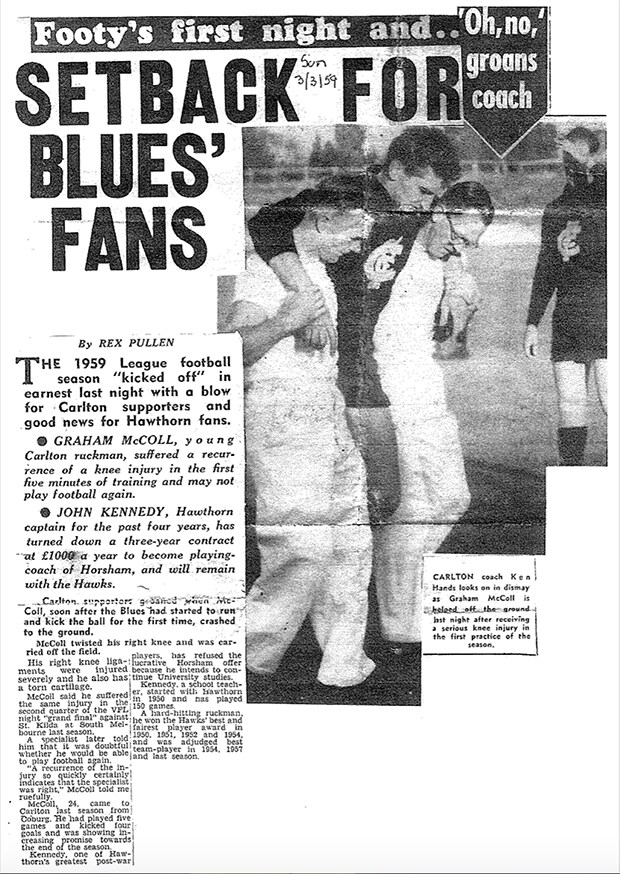
McColl is carried from Princes Park in a training mishap in March 1959. (Article by The Sun)
The proverbial silver lining came with McColl’s subsequent pursuit of recovery techniques – which in turn piqued his interest in becoming a club trainer. So it was that McColl embarked on his new career at Carlton, rising through the ranks of the support staff from thirds, to reserves and ultimately seniors.
In the premiership season of 1981, McColl’s contributions to Carlton as trainer were rewarded with Life Membership – the same year in which players Mark Maclure and Graeme Whitnall were similarly honoured.
Now 83, McColl recently penned the following reminiscences of his life and times at Carlton.
“Before I reminisce about my life to date as a player, member of the training staff, member of past players’ association and Life Member, it may be of help to give you some prior history of my football life with some details of how I became a Carlton player in 1958.
Early school years (commencing 1940) were at Wagga Wagga, New South Wales. I attended Forest Hill school, located outside the Aerodrome, on which I lived. I played Rugby and represented the school in athletics to year six.
After the War, we moved back to Melbourne and various parts of Victoria, which resulted in me attending many different schools. Eventually we moved to East Coburg where my parents obtained a home and my father was discharged from the R.A.A.F.
At this time I went to Preston Technical School and, after learning NOT to RUN with the ball under my arm (as in Rugby), I played in the school’s Australian Rules team, where we played against other Technical Schools in the metropolitan area and won many games. Ron Barassi (who later went to Melbourne) played as a half-forward flanker, and Brian Pert (later to play for Fitzroy) and myself were the wingmen.
I was invited to play for the Carlton Under 19s, however I wasn’t able to play a game, as family commitments forced me to look for a club in the vicinity and that’s how I came to play at Coburg in the VFA, playing 68 games. I feel my summer training with Preston Harriers and at Preston Tech., in running, high jump and hurdles, helped me with my ability to play in various positions if required.
1950s saw me as a telephone technician in training, working in many exchanges in Melbourne and country areas, and moving through various levels. With a transfer for eight weeks to Geelong Exchange, my father arranged for me to train at Geelong Football Club, with Reg Hickey as coach. I learnt a lot there and won Coburg Football Club’s Best & Fairest in 1956. Geelong asked me to sign a Form 4, however, Carlton was aware of this and claimed me as their player, where I played ten games in 1958 for the seniors. Of interest during this time was the payment the players received, which was 12 pounds for a full match and the Provident fund only being available after 50 games!
My first game was against North Melbourne, where I played as centre half-forward, my opponent being Albert Mantello. He tried me out physically and I more than held my own, with two goals. I also gave Mantello a hefty bump to which his teammate commented: ‘You’ve got one here, Albert’.
The night series at the South Melbourne ground saw me playing in the ruck, where I received my knee injury in a final against St Kilda. Medical staff didn’t know how serious my injury was. I drove home and went to work the next day. My boss sent me off to the local doctor and then to a physiotherapist. He didn’t know what the full extent of my injury was either. I missed the next year and so I wrote to the American National Football Association and received a strapping procedure – 30 strips of tape – but not much help.
When Dr. Arnold Cooper came to the club he explained what the problem was an I was offered a position on the training staff, with ongoing training by Dr. Cooper and our new physiotherapist Geoff Luke.
I was employed as a trainer for the Under 19s. In addition to looking after injured players, I became a messenger to players from the coach. Some of the players who started in the Under 19s were Adrian Gallagher, Jim Sullivan, Ray O’Halloran, Mark Maclure, John Morrison and Bruce Doull. The Under 19s won the premiership in 1963.
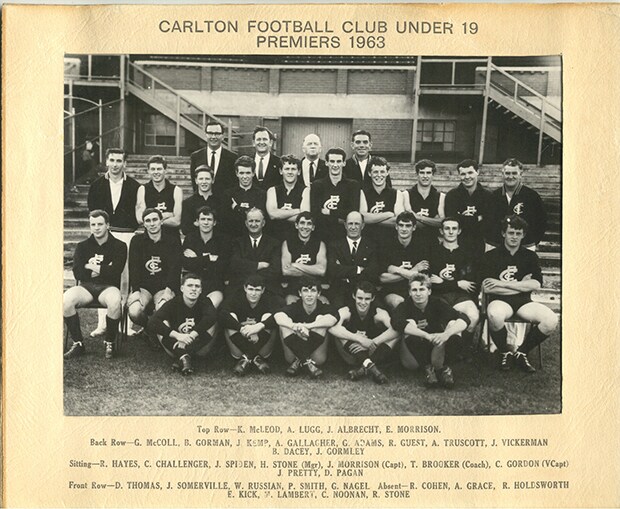
Trainer Graham McColl (middle row, far left) with members of Carlton’s under-19 premiership team of 1963, which includes Adrian Gallagher and Denis Pagan.
During my time as a trainer, the senior team won four Grand Finals in 1968, ’70, ’72 and ’79 – the latter in which Wayne Harmes (a local boy with a ‘never-say-die’ attitude) saved the ball on the boundary to enable Ken Sheldon to kick the winning goal. This is still a matter of discussion for Collingwood supporters. Alex Jesaulenko captained and coached his grand final team, but we had to carry him off with a serious ankle injury. However, with true spirit, he was there to receive the premiership cup at the end of the game.
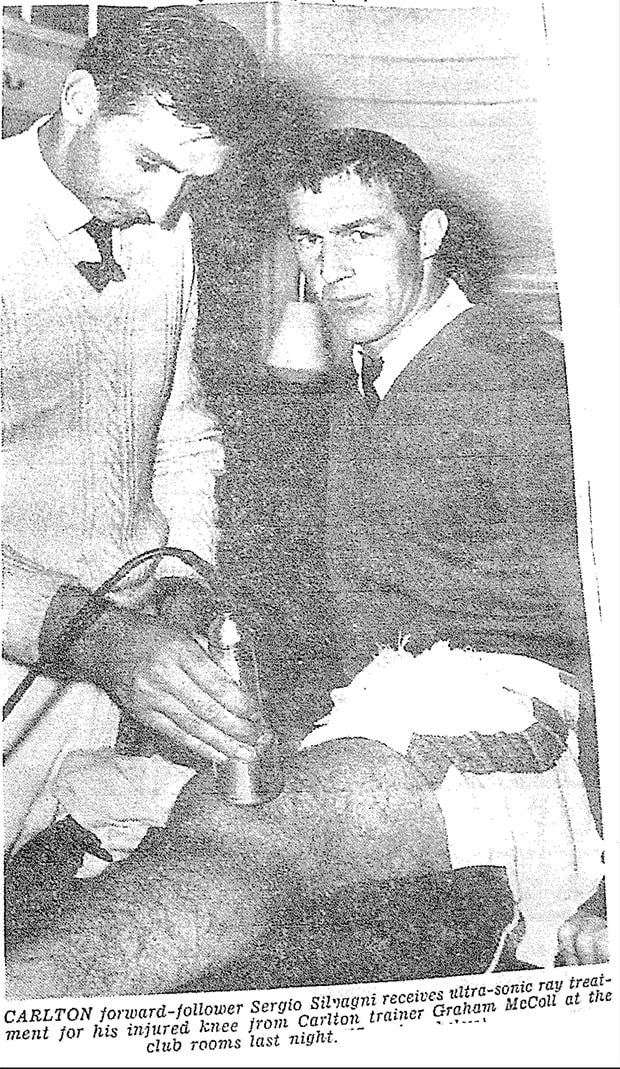
McColl tends to Sergio Silvagni’s knee in 1966.
Back in the ’70s, a VFL Trainers’ Association was established by a couple of Hawthorn trainers. The association established a training scheme for those persons who wanted to become members of their club’s medical team and be present on the ground during games. Interested parties were required to participate in a six to 12-week practical course, which involved resuscitation and different methods of strapping. The course was conducted at the Collingwood ground.
As the years rolled on, my employment with Telecom caused me, at one stage, to resign my position with the senior XVIII staff. I was able to overcome this, as management moved me to a position that enabled me to attend training sessions during the week. Later, I was offered the position of Head Trainer, but had to decline as my work for Telecom would not allow me to be at the ground for commencement of training and in time for strapping.
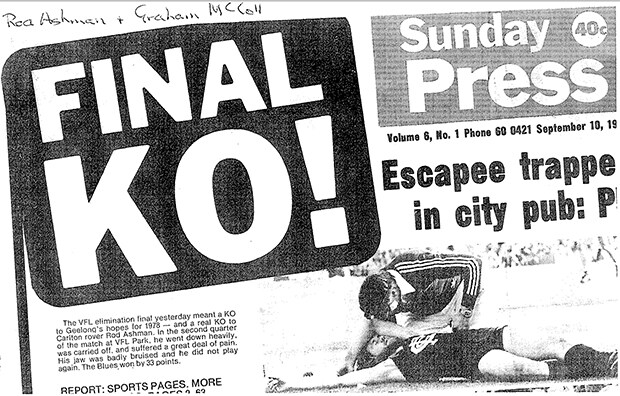
McColl to the rescue of Rod Ashman, elimination final vs. Geelong, VFL Park, September 1978.
On a brighter note, I enjoyed assisting those who were new to the club, the camaraderie and the interaction between training staff and players was excellent, even though we were all on various levels. Sunday morning recovery sessions consisted of lap running, hot and cold showers and rubdowns and a drink of some description to finish off. On many occasions, players, trainers and staff got together with wives and girlfriends, sometimes not getting home until mid-afternoon.
I tended to lose my interest when we basically became ‘waterboys’. However, nowadays the players have doctors, physios and mini-ambulances available to get them to more specialised treatments – and they sure need it with the game edging towards a Rugby format. I’ve always known the game as Australian Rules football (but there’s a) number of ball-ups (scrums), handling the ball incorrectly (throwing) and running the ball down the ground before kicking or shooting for goal (basketball). Umpires should also be able to assess that players are required to bounce the ball within 10-20 metres of running, or otherwise be penalised. I feel the umpires need to be re-trained in these areas.
Overall, I have enjoyed my time with Carlton. In writing these reminiscences, it has brought back some wonderful memories, of trips away, pride in winning Premierships and watching new players develop their skills.
Thanks for your interest in my time at Carlton, and to finish – Go Blues!”
Graham McColl (No.36)
60 years on, Vern Wright’s vision endures
Club historian Tony De Bolfo uncovers the story behind a landmark moment in Carlton history: the establishment of the Spirit of Carlton.

On the night of Tuesday, August 16, 1955, the former Carlton footballer Henry William Cleveland Toole wheeled his way through the doors of the football club entrance at the old Princes Park ground. Toole, whose recent illness had forced the removal of both legs, had regained his mobility by way of a wheelchair paid for by the then President Ken Luke.
At the much-anticipated reunion, “Harry” Toole had come home to thank the great “KG” for this noble gesture, and to formally acknowledge the enduring support of two old on-field contemporaries of the 1920s – Billy Blackman and Newton Chandler, “The Grand Old Man of Princes Park”.
Toole’s welcome presence on a night in which yarns were shared of the days that used to be, underpinned a landmark moment in Carlton history. Earlier that evening, the club’s Former Players and Officials Association (the Spirit of Carlton as it is now known) was formally established.
The Association’s founding was recorded by the then Carlton secretary Wally Floyd in the club’s annual report of that year.
“The formation of a Former Players, Officials and Staff Association has been under discussion for some years, but during the past season the committee made a decisive move, after presentations from a number of former players – headed by M. Ewins, V. Wright, R. Hiskens and J. Watson – to have the secretary draw up a draft constitution for consideration at the annual re-union of former players,” Floyd wrote.
“Accordingly, on Friday, 12th August, a very representative gathering, called together by press notices and circular where addresses were known, met and successfully launched the Association. The secretary’s draft constitution was adopted with only minor alteration and office-bearers elected and installed.”
Floyd noted that the Brunswick-born five-game former Carlton footballer Vernon Wright was elected President with the 18-game returned serviceman Morris Ewins “of 66 Glengyle Street, Coburg” the Honorary Secretary and another former player, Cr. Frank Williams, Treasurer.
“A strong committee was also formed and this has met on many occasions since and has drawn up details for full-scale activities for 1956,” Floyd declared.
“Those eligible for membership are former senior players, officials and staff of the C.F.C. and further information can be gained from either the Club or Association secretaries.”
The Former Players and Officials Association prospered through the 1960s under the watch of Wright and secretary Reg Morgan – the baseballer turned footballer who was lucky to survive a ruptured spleen when representing this club’s reserve grade team in 1943.
Through the years, past player reunions were regularly convened at Princes Park on matchdays – for a time in the Heatley Stand, then in the Gardiner and later the Hawthorn Stand, in a room whose walls were festooned with photographs of past Carlton greats. The President Chris Pavlou, himself a loyal servant as player, coach and director, hosted these much-loved club functions.
In November 2006, through the informal overtures of the club’s former runner Bob Lowrie, a solid core of former players, coaches and administrators gathered at Giancarlo Caprioli’s University Café on Lygon Street to assess their beloved Carlton’s waning fortunes. Pondering the malaise were Jim Buckley, Mike Fitzpatrick, Ken Hunter, Steve Kernahan, Mark Maclure, Keith McKenzie, David Parkin, Val Perovic, David Rhys-Jones, Geoff Southby and Robert Walls, with apologies accepted from Alex Marcou and David McKay.
The gathering of greats to a man resolved to restore and enhance the spirit and culture of the Carlton Football Club in a non-political way.
Hence the slogan “Spirit of Carlton” was born.
Two years later, at an annual general meeting of the Past Players’ Association, it was resolved that the Spirit of Carlton group would form an amalgam with the traditional association, and that the entity’s name “The Spirit of Carlton Past & Present” would be adopted.
The outgoing president, 1968 Carlton Premiership player Dennis Munari and former president Pavlou, both of whom had worked tirelessly in keeping the traditional association up and running, were on hand for the transition, in keeping with Vern Wright’s vision of all those years ago.
Heroes of 1970 gather for old time’s sake
Grand Final heroes reunite for a special day.

IT’S ARGUABLY the greatest Grand Final of them all . . . and quite probably the Club’s most famous victory . . . and more than 50 years after the event the Carlton men who spectacularly wrested the 1970 Premiership from Collingwood’s grasp recently gathered to reminisce for what may well be the last time.
Though the COVID-19 lockdowns put paid to the 50-year reunion last year, 14 of the 19 surviving members of that feted 1970 team (Vin Waite died in July 2003) came together over dinner at East Melbourne’s famed Italian restaurant Il Duca – before taking in the Round 2 match involving today’s Carlton and Collingwood footballers over the road at the MCG.

Ian Robertson, 1970 Grand Final Reunion Luncheon
For the record, team members at the reunion dinner convened by the club were Neil Chandler, Garry Crane, 1970 club Best and Fairest Adrian Gallagher, Barry Gill, John Goold, Kevin Hall, Ted Hopkins, Syd Jackson, Peter Jones, David McKay, Barry Mulcair, Phil Pinnell, Ian Robertson and Robert Walls.
Also present was the Premiership coach Ron Barassi (and his runner Rod Wilkinson who jetted in from Adelaide) along with Premiership captain John Nicholls – while ‘Big Nick’s’ Premiership teammates Brent Crosswell, Alex Jesaulenko, Sergio Silvagni and Bert Thornley forwarded their apologies.

1970 Carlton Premiership player Barry Mulcair and his wife Carmel.
Vin Waite’s widow Christine was also present, as was Jo Stuckey (nee McLean) – the daughter of the late 1968 Premiership player Peter McLean who supported Barassi as a Carlton Committeemen through the ’70 Premiership season. Gordon Newton, the last surviving member of the George Harris-led Board of Management in that year, was also on hand – as was the 1968 Premiership player Bryan Quirk and current Carlton President Mark LoGiudice, who welcomed guests to the Luncheon before they boarded a coach to the MCG, courtesy Firefly Director Joe Bono, a fervent Blues man.

Spirit of Carlton Manager Shane O’Sullivan, who organised the historic get-together, said he was overwhelmed to see so many former players and their wives/partners in the room.
“The Club was really keen to do something for its Premiership players of 1970 even after COVID restrictions meant we couldn’t,” O’Sullivan said.
“‘Barass’ and the players really seemed to enjoy themselves – particularly players like Barry Mulcair who came down from Bendigo and hadn’t been back in a while.”
Carlton Life Members gather on eve of season opener
Carlton’s Life Members come together for annual luncheon.

All images supplied by Vicki Walsh.
THE PAST eight decades (and as many League Premierships) of the Carlton Football Club’s illustrious 156-year history were on show at Kew Golf Club yesterday (Sunday), for what was the much-anticipated annual Life Members Luncheon.
In the lead-up to Thursday night’s season opener with Richmond at the MCG, Carlton presidents past and present, together with Premiership coaches, captains and players, joined former committeemen, staff members and their wives and partners at a function which was cancelled 12 months ago due to the COVID-19 lockdown.

Carlton Premiership teammates Mark Maclure, Jim Buckley and Val Perovic.
Amongst the Blues’ luminaries at Kew was Premiership coaches David Parkin and John Nicholls, together with Nicholls’ fellow Premiership captains Mike Fitzpatrick and Stephen Kernahan; four-time Premiership players Wayne Johnston, Peter Jones and David McKay; three-time Premiership players Jim Buckley, Neil Chandler, Adrian Gallagher, David Glascott, Mark Maclure, Alex Marcou, Peter McConville and Ken Sheldon; and dual Premiership players John Goold, Robbert Klomp, Val Perovic and Geoff Southby.
Ian Aitken, Rod Austin, Adrian Gleeson, Matthew Hogg, Ted Hopkins, Michael Kennedy, Andy Lukas, Warren McKenzie, Paul Meldrum, Denis Munari, Fraser Murphy, Phil Pinnell, Bryan Quirk, David Rhys-Jones, Warren Jones and Shane Robertson – Premiership players one and all – were also conspicuous by their presence.
So too were Michael Jamison and Heath Scotland – the most recent of the club’s on-field retirees –who were there to represent 21st century Carlton. Also on hand was the club’s longest-serving President John Elliott and its current President Mark Lo Giudice.

Former Carlton Chief Executive Stephen Gough, who together with Frank Brosnan, Shane O’Sullivan and Sharon McColl was responsible for organizing the Carlton Life Members Luncheon, described the event as a strictly social get-together “that’s not a day for speeches, fundraising, raffles or panels”.
“But as the Luncheon was cancelled last year and Life Members had not come together since 2019, it’s important to acknowledge the passing of five Life Members,” Gough said.
“I am of course speaking of Mark Naley, Ken Kleiman, Henry Gardner, Sam Smorgon and most recently Eric Salter – and we extend our deepest condolences to the friends and families of those esteemed Life Members.”
Gough also acknowledged the President and board of directors of the Carlton Football Club for supporting the Life Members Luncheon “and getting everyone together”.

Carlton’s three-time Premiership coach David Parkin, former Director Marcus Rose and dual Premiership captains Stephen Kernahan and Mike Fitzpatrick.
Special mention was also made of the club’s most recently-awarded AFL Life Members Eddie Betts, Marc Murphy and Shane O’Sullivan, and tribute was paid to David McKay following his recent elevation to Legend status in the Carlton Football Club’s Hall of Fame.
As Gough noted: “If you think of the history of this club since 1864, only 14 people have been afforded that recognition . . . so to the great ‘Swan’ and (wife) Meg, well done”.
In closing, certificates were presented to 20 Life Members attending the function for the first time, as the countdown to Thursday night’s contest with the reigning Premier began in earnest.
For ‘Dizzy’, one game was an honour
A tribute to Daryl Gutterson.

As a Carlton senior footballer he ran out but once wearing the famous button-up dark Navy Blue guernsey with the No.47 on the back.
It happened almost 50 years ago – but Daryl Gutterson always deemed it an honour to wear that jumper.
Now, in the wake of Daryl’s untimely passing at the age of 67, the item carries even greater poignancy for the loved ones he leaves behind.

Pictured from left to right is the late Daryl Gutterson’s son Brent, daughter Emmilee, wife Robyn and son Rhys, proudly displaying Daryl’s treasured Carlton guernsey worn into his one and only senior appearance for the Blues, Round 10, 1971.
Zoned to Carlton (but only just as the dividing line with Fitzroy was across the road from his family’s home in Derrick Street, Lalor), Daryl, then an impressionable 16 year-old, joined fellow Lalor player Ian Cartwright in the move to Princes Park in 1969 – in what was a magnificent epoch in Carlton history.
A second cousin of the seven-game Footscray player and 1962 Gardiner Medallist Jim Gutterson, Daryl – or ‘Dizzy’ as Brent Crosswell dubbed him for his breathtaking turn of speed – first turned out for the Bill Hoogen-coached Under 19s.
He progressed through the reserves – initially under the watch of the late Keith McKenzie – and in 1971 finally earned his one and only call-up, ironically against the Lions, in the Round 10 match at Princes Park.
Having blown out the candles on his 18th birthday cake just 27 days earlier, Daryl featured in another first when he followed ‘Big Nick’ down the race in that maiden senior appearance.
For this was also the game in which Carlton coach Ron Barassi and Fitzroy coach Graham Donaldson (Daryl’s reserve grade coach at Carlton the previous year), famously agreed to trial the 50-yard centre square, within which only four players from each team were permitted to frequent at the centre bounce.

Carlton Secretary Bert Deacon’s letter welcoming Daryl Gutterson to the senior supplementary list, July 1970
Named 20TH man on the bench alongside John Warden (wearing the No.46), the budding wingman with a thumping left foot got the call-up early in his solitary senior appearance and stood both David Rhodes and Treva McGregor, eight weeks after McGregor took out the ’71 Stawell Gift – the last League footballer to win the coveted footrace.
Daryl’s oldest son Brent (so named after Crosswell his long-time friend) said that a lack of application in his tender years probably went against his father.
“After making his senior debut against Fitzroy in ’71, Dad played the rest of that year in the reserves . . . and he played on in the twos until the end of ’73,” Brent said.
“Although ‘Barass’ liked Dad as a footballer, Dad always told me that with the likes of Garry Crane, Ian Robertson and Bryan Quirk going around, it was a case of ‘right place, wrong time’ for him.
“Being a young guy, Dad probably thought natural talent would get him through . . . and in the end a run-in with ‘Barass’ didn’t help.”
“The run-in” to which Brent referred took place on another occasion, when Daryl was kicking the dew of the grass.
A former teammate, the 1968 Premiership player Ian Collins, recalled the incident.
“Daryl was quite a clever wing/half-forward, although he wasn’t very big and was quite light. Anyway he was playing in the reserves this particular day and at half-time, while we were stripping for the senior match, he walked into the room,” Collins said.
“Barassi lined Daryl up and told him he was shirking the issue. Barass grabbed him by the throat and tried to put him into one of the lockers. The locker was about half the size of Daryl, but Barass was trying to force him headfirst into it.”
Little did Barassi realise that Daryl, a southpaw, was a more than handy amateur welterweight, and retribution came swiftly – courtesy a left hook across the chops – which split the coach’s lip and drew blood in the process.
Not surprisingly, Daryl, at 21, and with 68 reserve grade matches and the one solitary senior appearance to his name, parted company with the club he loved. He sought a clearance to Fitzroy, but the Blues played hard ball and so he crossed to VFA outfit Brunswick.
By the age of 28, after having represented Watsonia in the Diamond Valley Football League, Daryl opted to give the game away – his commitment to work as a sales rep for a fittings and bearings business taking precedence.
“Though he loved Carlton, Dad always thought that if he’d lived on the other side of Derrick Street he might have been a 100-game Fitzroy player given the players he was competing against at Princes Park in that era,” Brent said.
But Daryl always kept a soft spot for Princes Park and its people. He was a regular at Spirit of Carlton functions and only recently took great delight in seeing Callum Moore getting around in the old No.47.

Daryl Gutterson, Princes Park, 1970
“Dad used to say to me “I only played one game’, but I’d tell him ‘Dad, you played in exalted company – the company of absolute legends of the VFL/AFL’ and I’d have given anything to have run out once in a senior game wearing a Carlton guernsey,” said Brent – himself a Carlton reserve grade player who trained with the likes of Bradley, Fevola, Koutoufides and Ratten through 2002 – and took goalkicking honours with 30 from a half-forward flank.
“Dad played in a magnificent era at Carlton with Crane, Crosswell, Gallagher, Jackson, Jesaulenko, McKay, Nicholls, Robertson and Walls – famous names that are still talked about now.
“As a person, Dad was a pure gentleman. He wanted to know everyone’s stories. When I was playing he used to follow me down to the games and we’d talk footy, because footy brought him so much joy.”
The four-time Carlton Premiership player David McKay, as with Collins another of Daryl’s old teammates, remembered the one-game wingman as “a good player who like so many of his time found it difficult to break into the side”.
“But that one game meant so much to Daryl. He was proud of his association with Carlton and he was loved and respected by his former teammates,” McKay said.
“He was a terrific fellow too. Every time you saw him at a past players function, which was often, his face lit up. He had a rough look about him, but underneath beat a heart of gold.”

Daryl Gutterson, January 2020
Daryl died in the Intensive Care Unit of Heidelberg’s Austin Hospital on Thursday, August 13, after suffering a cardiac arrest five days previous. He is survived by his wife Robyn (a niece of Carlton’s first Brownlow Medallist Bert Deacon), sons Brent and Rhys, daughter Emmilee and their respective spouses, and six grandchildren.
The funeral service for Daryl Graeme Gutterson will be held next Monday, August 24, commencing 11.00am. To view the service via webcast, go to www.tobinbrothers.com.au
Daryl Gutterson’s one senior appearance, Carlton v Fitzroy, Round 10, Saturday, June 5, 1971
Carlton 13.12 (90) defeated Fitzroy 10.15 (75)
B: Ian Collins Geoff Southby Vin Waite
HB: Kevin Hall David McKay Barry Gill
C: Trevor Keogh Bill Barrot Phil Pinnell
HF: Ian Robertson Robert Walls (vc) Syd Jackson
F: Peter Jones Alex Jesaulenko Barry Armstrong
Ruck: John Nicholls (c) Sergio Silvagni Adrian Gallagher
Res: John Warden Daryl Gutterson
Coach: Ron Barassi
Vale Mark Naley
By Tony De Bolfo
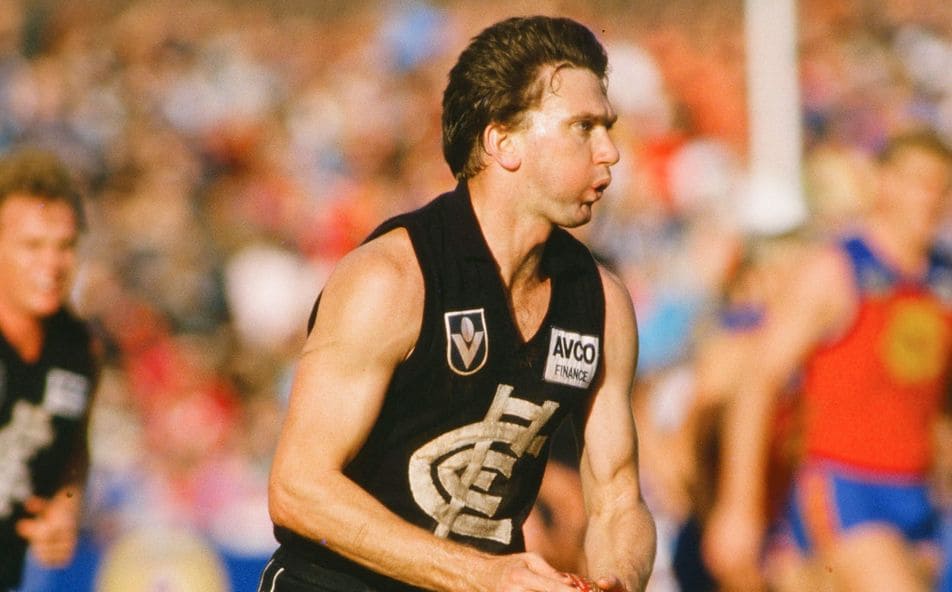
MARK Naley, whose 65-game Carlton career was punctuated by the 1987 Grand Final victory, has passed away in his home town of Adelaide at the age of 59.
Naley died in palliative care this morning (Monday), having bravely waged a personal battle to overcome a succession of aggressive brain tumours over the past three years.
Recruited to the club from South Adelaide on the cusp of the 1987 season, Naley found himself in fair company with Craig Bradley, Peter Motley and Stephen Kernahan – all of whom had joined the club from over the border in the lead-in to season ’86.
In his maiden season at Princes Park, the blisteringly-paced Naley quite literally took time to find his feet. The turning point came in the mid-year Australian Football Championships when a series of stellar performances for South Australia against Victoria and Western Australia earned him the Tassie Medal for most outstanding player.
From then on, ’Nails’ starred in the No.17 – a guernsey made famous by Brent Crosswell and the Brownlow Medallist Gordon Collis – and his place in Carlton’s starting 20 for the 1987 Grand Final was assured.
In reflecting on Grand Final day ’87, two memories of Naley endure.
The first involves him lining up in long sleeves (when Hawthorn’s Michael Tuck uncustomarily went sleeveless), on what was a sweltering 32-degree afternoon.
The second relates to him putting on the afterburners and cutting a swathe through three physically and mentally spent Hawthorn players to slam home a big running goal late in the final quarter – a glorious moment just as gloriously called by the recently-retired Channel 7 commentator Dennis Cometti.
At the premiership celebrations back at the Southern Cross that night, when the likes of David Glascott and Peter Dean sought solace in upstairs rooms to recover from their taxing physical ordeals, Naley was amid the frivolity downstairs – belting out the Judy Garland hit ‘When You Wore a Tulip’ whilst clobbering the drums on the ballroom stage.
Naley finished fourth in his club’s best and fairest in the Premiership year, behind David Rhys-Jones, Wayne Johnston and Kernahan – the club captain and eventual winner.
On his return to South Adelaide in 1991, Naley, then 30, took out the Magarey Medal for competition champion – an honour that was pre-empted by Footscray’s bold but forlorn attempt to take him at selection six in the ’91 mid-season draft.
In the end, Naley turned out for more than 50 matches for South Adelaide before hanging them up in 1993.
Back in Adelaide, and having always been told as a child that his paternal grandfather was of Afghan descent, Naley discovered that Charles Gordon Naley – his Pop – was of Indigenous descent. This, couple with the fact that Charles served with the Australian Infantry Forces at Gallipoli, filled Naley with a sense of deep personal pride.
In November 2016, Naley was behind the wheel of his car when he inexplicably lapsed into unconsciousness.
“I had a seizure, which started it,” Naley told this reporter in an interview the following month.
“At the time I was turning into a street, saw the street sign and that was it. The next thing I remember was waking up in hospital an hour and a half later.”
In the years since, Naley underwent a succession of surgeries and was subjected to the terrible side-effects of his treatment – all the while taking a glass half-full approach. Through social networking, him and his wife Cassie provided regular updates to a host of well-wishers – amongst them the former players Vin Cattogio, Warren Jones, Alex Marcou and the likes of Ian Aitken and the Norm Smith Medallist David Rhys-Jones – all of whom savoured September success with Naley more than 30 years ago.
This afternoon, Rhys-Jones recalled Naley’s name being on his radar long before fate brought them both to Blueland.
“I came across ‘Nails’ in the early days because Greg Miller had secured the signatures of him, Greg Anderson and Peter Motley on form fours binding them to the Swans,” Rhys-Jones recalled.
“The Swans then gave Miller the a..e and that was that, but I kept an eye on all three players in the following state games and I had a fair idea of how good they all were.
“I think ‘Nails’ found the move to Melbourne initially difficult and I reckon he might have played a game or two in the seconds early days, but in state games and in finals he just lifted. Once he got a feel for it he was quality. He was a gun rover. He took off from a standing start and left them all in his wake.”
Naley’s love for his old club never waned. On many occasions he’d fly in for Spirit of Carlton functions and on one return to the old Carlton ground he was famously photographed with his daughter Hanna in front of the No.17 locker.
In turn, ‘Nails’ took great solace from his Carlton well-wishers. As he said: “When you realise how long you’ve been out of it, it’s comforting to realise that people still remember”.
Stay Safe as We Take a Break
Due to the shutdown as a result of fighting Covid-19 the Spirit of Carlton Past and Present will be pausing activity. Our regular video and social media updates will pause until the club can safely get back to business as normal. The website will stay online, we will just pause any new articles and information.
Any past players that need help can still contact us, your contact at the club is still Shane O’Sullivan, he can help you out with any concerns.
Stay safe and look after each other. We will see you again soon!