Mil Hanna retells the day he came up against St Kilda reserves player, Shane Warne.
By Tony De Bolfo
IN THE aftermath of his untimely passing, Shane Warne’s life as a leg spinner par excellence has quite rightly been lauded — and with it is his brief tenure as a St Kilda footballer at under-19 and reserve grade level.
In truth, Warne kicked the dew off the ground but once in a curtain raiser – the 15th round match at Moorabbin on Saturday, July 9, 1988 – and his direct opponent in that one was Milham Hanna of the Col Kinnear-coached Carlton team.
This week Hanna, a member of the Blues’ last Premiership team of 1995, remembered with affection the time he went head-to-head with the Saints’ SK Warne at the old Linton Street ground.
“I ended Shane Warne’s football career . . . I burnt him off his feet,” Hanna dryly suggested.
“I remember this kid with bleached blond hair, but to be honest I didn’t know who he was . . . it wasn’t until years later that I finally realised.”
The St Kilda historian Russell Holmesby recently wrote that Warne’s solitary reserve grade appearance coincided with the return of St Kilda champion the late Trevor Barker after a 14-week layoff with a heel injury. Holmesby also noted that The Football Record had mistakenly recorded St Kilda’s No.60 as one “Trevor” Warne and by the time the error was rectified the player was back in the thirds and by early ’89 out the door.
Remarkably, Warne hadn’t expected to take the field at all for that wintry Saturday arvo in ‘88. Bed-ridden with the flu all week, he’d intended to phone the club’s reserve grade coach Gary Colling to declare himself unavailable – but was instead called by Colling who told him he’d be a starter for the reserves, an opportunity the kid from Mentone Grammar couldn’t pass up.
Hanna, meanwhile, had overcome the bitter disappointment of rupturing the anterior cruciate ligament in his knee in the early minutes of his first senior match for Carlton in the opening round of 1986, and was quite literally trying to find his feet at senior level.
“I missed all of 1986, came back from injury in ’87 and played the first eight or nine games before I got dropped,” Hanna said. “I managed 16 games in ’88 and can only guess I was coming back from injury or had been dropped (the record books reveal the latter) when I played in that game at Moorabbin.”
Hanna’s senior League tenure would ultimately endure for 190 matches through 12 seasons at Carlton, while Warne’s future career in the creams would know no bounds.
Along the way, their paths would again cross, although the reserve grade contest comfortably won by St Kilda was never discussed. As Hanna recalled: “I met up with ‘Warnie’ a few times, mainly through ‘Sammy’ (Aaron) Hamill, who was a great mate of his, but I never brought the game up with him”.
“At the end of the day I towelled him, but imagine what might have been if he’d played well?,” Hanna said. “I reckon I did the world of cricket a favour.”
A summary of the 2022 Carlton Life Members Luncheon.
By Tony De Bolfo
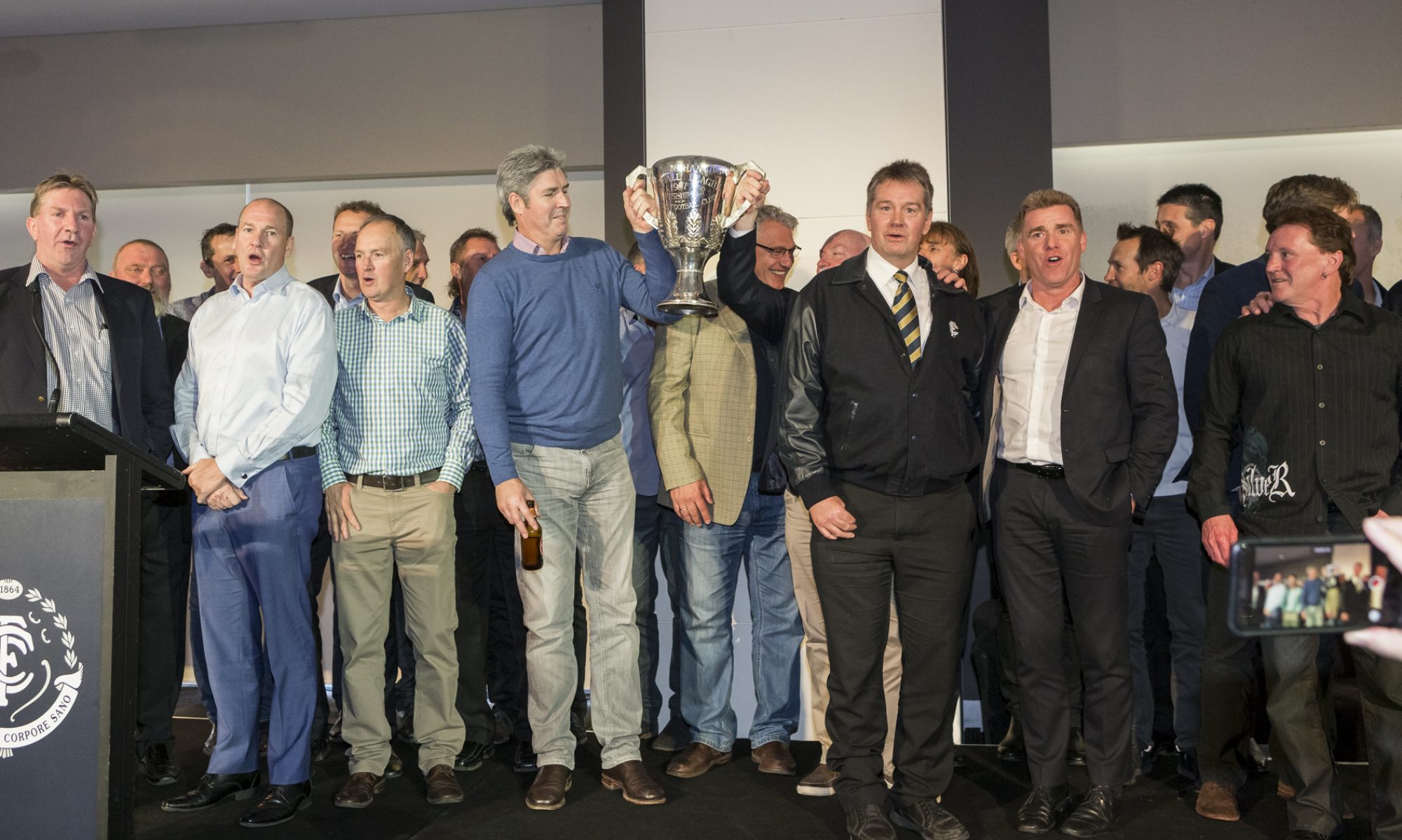
PICTURED below are 63 Life Members of the Carlton Football Club, all posing for the mandatory team photograph to round out Carlton’s annual Life Members Luncheon at Kew Golf Club.
In attendance were former club officials, staff members and players honoured with Life Membership, from John Nicholls in 1965 through to Matthew Kreuzer in 2015.
Thirty-five premiership players – amongst them the four-time premiership greats Wayne Johnston, Peter Jones and David McKay – were there, together with 10 club best and fairests including the five-time winner John Nicholls after whom the award is named and the Club’s Brownlow Medallist Greg Williams.
The Life Members pictured in the team photo underneath the third paragraph are as follows:
Standing left to right: Robert Walls, Jim Buckley, Dennis Munari, Mario Bortolotto, Lewis Bearman, Don Mathieson, Vince Loccisano, Sam Salamone, Marcus Rose, Craig Bradley, Matthew Kreuzer, Fraser Murphy, Rod Austin, Peter McConville, Andy Lukas, David Dickson, Trevor Keogh, Frank Brosnan (partially obscured), Peter Newbold, Laurie Carter, Mike Fitzpatrick, Rohan Bromley, Richard Newton, Barry Gill, Robbert Klomp, Stephen Kernahan, Neil Chandler, Marcus Clarke, Tom Alvin, Ian Wotherspoon, Ray Gilbert (partially obscured), Phil Maylin, David Rhys-Jones (partially obscured), Wayne Gilbert, Barry Armstrong, Adrian Gleeson, Phil Pinnell, Peter Kerr and Adrian Gallagher.
Middle row: (kneeling) Bryan Quirk, (seated) Don Hall, David Nettlefold, George Varlamos, ?Ted Hopkins, David McKay, Syd Jackson, Peter Jones, David Parkin, Col Kinnear, Gordon Newton, Lionel Watts and Alan Espie (partially obscured).
Front: Wayne Johnston, Alex Marcou, Shane Robertson, David Glascott, Shane O’Sullivan, Sharon McColl, Greg Williams, Stephen Gough and Greg Lee.
Also present were premiership coaches Nicholls, David Parkin and Robert Walls; premiership captains Nicholls, Mike Fitzpatrick and Stephen Kernahan; and Norm Smith Medallists David Rhys-Jones and Williams.
David Rhys-Jones holds court with his two former coaches. (Photo: Vicki Walsh Photography)
Joining them all at the luncheon, underwritten by the Club, was Carlton President Luke Sayers.
Former Carlton CEO Stephen Gough, who together with Shane O’Sullivan, Sharon McColl and Frank Brosnan form the Life Members Committee which organised the event, said that the Luncheon provided Life Members across the decades with an opportunity to come together in a relaxed and informal manner.
“We actually cover Life Memberships from as far back as 1965, and all of the past eight premierships from 1968 onwards,” Gough said.
Dual premiership player Syd Jackson acknowledges fellow Life Members. (Photo: Vicki Walsh Photography)
“The Luncheon is a great get-together which draws people back every year. We’ve managed three get-togethers in over four years due to Covid, which isn’t bad.
“Nobody has to get up to join a panel or wait for a raffle. The Luncheon basically serves as a day of reminiscing, of remembering old times. It’s a fantastic initiative by the Club, which recognises that Life Members are a very important part of the Club’s DNA and will be supported – so to Mark LoGiudice and now Luke Sayers, we’re very thankful.”
First-time attendees Marcus Clarke, Barry Gill, Syd Jackson, Matthew Kreuzer and Robert Walls were formally welcomed, and the recently-deceased Life Members Geoffrey Edelsten, John Elliott, Henry Gardner, Mark Naley, Alan Rees, Eric Salter and Sergio Silvagni were remembered, as was the late Graeme Whitnall.
See below for more photos from the day: all images courtesy of Vicki Walsh Photography.
Carlton premiership captains Mike Fitzpatrick and John Nicholls. (Photo: Vicki Walsh Photography)
Three No.21s – Rod Austin, Barry Gill and the Club’s games record holder Craig Bradley. (Photo: Vicki Walsh Photography)
Clockwise from the left, premiership players Peter Jones (seated), Bryan Quirk, Greg Williams and Robert Walls. (Photo: Vicki Walsh Photography)
Premiership players Trevor Keogh, Peter McConville, Stephen Kernahan and Wayne Johnston. (Photo: Vicki Walsh Photography)
Four-time premiership player Wayne Johnston, three-time premiership coach David Parkin and former Carlton Chief Executive and Life Members Committeeman, Stephen Gough. (Photo: Vicki Walsh Photography)
Premiership players David Glascott, Tom Alvin, Mike Fitzpatrick and Adrian Gleeson. (Photo: Vicki Walsh Photography)
1970 premiership heroes Ted Hopkins and Syd Jackson. (Photo: Vicki Walsh Photography)
1972 premiership players Phil Pinnell, David Dickson and Neil Chandler. (Photo: Vicki Walsh Photography)
The discovery of an image of one-game senior player, Alf Key.
By Tony De Bolfo,
THE CARLTON footballers of today, the likes of Patrick Cripps, Harry McKay and Sam Walsh, are photographed and filmed ad nauseum. But there was a time when cameras were not in plentiful supply and players quite literally disappeared into the ether.
The Carlton Football Club’s digital archive boasts images of 1103 of the 1224 men to have donned the famous Dark Navy guernsey in senior League competition – from Jimmy Aitken in 1897 to Brodie Kemp in 2021 – which means 121 more aren’t represented by a single photograph.
Alf Key, proudly wearing his Carlton guernsey, 1922.
That number has now been whittled down to 120 with the discovery of an image of one-game senior player Alf Key, by way of a team photo in which he appeared precisely 100 years ago, and thanks to the generosity of a lifelong Carlton supporter (more of that later).
Born in North Carlton in November 1897, Key was recruited to the club from local team Carlton District. On the end of a turbulent week in which Charlie Fisher resigned as captain, Key completed his debut for the old dark Navy Blues against Melbourne at Princes Park in Round 6 – Saturday, June 5, 1920.
Not surprisingly, the home team lost by 18 points, on a day incessant rains left Princes Park under water and prompted a delayed start.
In 1921, Key crossed to neighbouring Fitzroy and featured in two senior matches with the Maroons, before returning to Carlton District in 1922. That year, Key (as resident vice-captain) posed for the team photographer wearing the Carlton guernsey with the CFC monogram as opposed to the CDFC monogram – and it’s worth noting that seven other players including the captain Dee, Harry Bell, Rowley Faust and Vern Wright are all pictured wearing Carlton Football Club guernseys.
The Carlton District Football Team, 1922. Vice-captain Alf Key sits in the second row from the front, fourth from the left.
Key passed away at the age of 80 in November 29, 1977, some 44 years before his image found its way the club’s archive thanks to Lorraine Gillett, whose father Percy was a long-time Carlton trainer of the 1920s, ’30s and ’40s.
Prior to being struck down with ill health, Lorraine instructed her partner Gordon Archer to forward her father’s precious items of Carlton memorabilia to the club – including her father’s trainer’s cap and blazer which she treasured, a trophy awarded to him by the VFL in recognition of his services to the club in the 1947 Premiership year, and various certificates and photographs like the one featuring Alf Key.
Now in her late 70s, Lorraine’s propensity to horde items of Carlton memorabilia, amongst other things, has proved to be a godsend for the club, but Lorraine and her loved ones are equally thrilled that Percy’s items have found the right home.
Gordon Archer with one of the precious items donated to the club by his partner Lorraine and the Gillett family – the trainer’s cap worn through the 1920s, ’30s and ’40s by long-time trainer and Life Member Percy Gillett.
“Lorraine has lost most of her memory now, but she still remembers most of the Carlton theme song . . . and she is thrilled to pieces to know that Percy’s items may one day be displayed at the club for everyone to see, as she’d always promised that the items would go to Carlton – a place where they would be wanted.
“Lorraine treasured her father’s blazer and cap in particular,” Gordon said. “As a young girl, she and her brother Robert would accompany their mother to Carlton games, as their father had left for the ground early to fulfil matchday duties.
“Lorraine’s mother would take them to Princes Park by bus from Ivanhoe Station to the Sarah Sands Hotel, then walk down Royal Parade to the ground. At Carlton their father would meet them afterwards, but during the matches the children would sit by themselves and watch.”
Gordon, a fellow teacher who met Lorraine at the Glen Waverley Special School for the Mentally Disabled more than 40 years ago, said that Lorraine was a lifelong Carlton devotee – “but she had no choice” in terms of her allegiance, given her father’s presence.
As he said: “Even after Percy gave training away, Lorraine continued to support Carlton. She was a Social Club Member and she just loved everything about it”.
The following is a list of those Carlton players whose images are still outstanding. If you can provide an image of any of the following players, please feel free to contact Tony.DeBolfo@carltonfc.com.au.
The Carlton Football Club is mourning the loss of the League’s oldest surviving player, Keith Rae.
By Tony De Bolfo
Keith Stanley Rae – Carlton’s, Richmond’s and League football’s oldest surviving past player – has passed away peacefully in his sleep at the age of 104 years, four months and 24 days
News of Keith’s death in a Mornington Peninsula nursing home was conveyed to the club by his daughter Julie.
A Carlton centreman in the days of Diggins, Francis and Chitty, Keith’s long life was bookended by two global pandemics – the Spanish flu and now the Corona virus.
Keith was but a toddler when returning soldiers brought the flu ashore in 1919.
He was too young to comprehend then, but the story goes that as thousands succumbed to its killer grip, his Mum and Dad took him north to the Queensland sun so that the little boy could overcome a worrying bout of bronchitis.
The Carlton team prior to the match with Hawthorn at Princes Park in Round 13, 1943. Keith Rae stands in the back row, fifth from the right.
Born before the Armistice was signed, and hardened by the days of the Great Depression, Keith was of that fast disappearing generation who also served their country through the Second World War (in his case as a leading seaman).
Between times, the boy from Williamstown chased the pigskin in the VFL through 15 games out of the centre for Carlton in 1939 and again in ’43, and in two more for the Tigers after the guns fell silent in ’46.
Keith was the oldest of five Rae siblings, with three sisters and a brother following.
Appropriately, Carlton’s 550th player to complete his senior debut was born in the Blue Room of his grandfather’s Stag’s Head Hotel in ‘Willy’ on July 30, 1917.
Keith carried his books to the local Williamstown state school, and later Footscray Technical College, despite his father’s best efforts.
“Dad wanted me to go to Scotch College and I said ‘Why go all the way out there?’”, he told me in an interview on the occasion of his 100th birthday.
24 year-old Keith Rae, HMAS Nestor, Egypt, 1941.
Not long after finishing up at Footscray Tech, Keith took on a welder’s course at the Williamstown naval dockyards, “but in the end I joined the Navy because I was 16 and I couldn’t get a job”.
That move would later have significant ramifications.
In Williamstown, Keith’s prowess as a midfielder soon came to the attention of the renowned Carlton talent scout Newton Septimus Weston Chandler.
“I reckon it was Newton who approached me at a game at Williamstown and said ‘Son, we think we could use you’,” Keith recalled. “In the end I went up to Carlton to practice and I remember breaking into the team and running down the race.”
Keith got the nod for his first game more than 80 years ago – against Footscray in the 15th round of the 1939 season – with the imprimatur of the then Carlton premiership captain-coach Brighton Diggins.
As he recalled: “He was quite a good bloke Diggins. He told me I was playing and I couldn’t wait to tell my father”.
Keith was named in the centre, between Jack Carney and Bob Green. He followed Diggins down the race with the likes of Baxter, Crisp and Hale.
Together they contributed to Carlton’s 88-point annihilation of the visitors, with Paul Schmidt and Baxter booting nine and eight goals respectively, and ‘Micky’ Crisp putting another five over the goal umpire’s hat.
Omitted after the following match against Hawthorn, Keith’s ’39 season was done and dusted when Carlton failed to make the cut for September.
Then the war came . . . and Keith, already serving with the RAN Volunteer Reserve, was called upon by the navy.
Keith Rae proudly wears his Carlton guernsey at a naval camp in Portsmouth in 1941. The jumper later went down with a ship in the Mediterranean, but it’s wearer survived.
The ensuing three years would see him fulfil various duties on a number of ships, amongst them the destroyer HMAS Nestor which, in June 1942, was amongst a convoy attacked from the air by the Luftwaffe, by U boats and by E boats.
Both engine rooms of the Nestor were flooded and four stokers were killed in that incident.
But Keith lived to tell the tale.
“The plane came over and dropped a bomb. The bomb hit the yard arm of the mast and deflected into the water,” he said.
“I’d just come off the wheel and wooden pieces of it came flying down, some of it hitting me in the leg. It’s why I’ve still got this crook leg, but I was lucky. I sat on top of the deck until a rescue ship came by.”
In 1943, Keith was posted back to Melbourne, and wasted little time resuming his playing career by Royal Parade, under the watch of Diggins’ successor as Carlton senior coach, Percy Bentley.
Sporting the No.23 later worn by Bert Deacon and now Jacob Weitering, he got a call-up for the opening round match of the ’43 season – and in the lead-up stood with his teammates to observe a minute’s silence for his old teammate Jim Park, who had been killed in action in New Guinea.
After the lone bugler played The Last Post, the ball was bounced, and the Carlton players attacked it with sheer ferocity. Prominent amongst them was Jim Baird with 10 goals from full-forward, and Keith was acknowledged for his handy contributions on a wing.
Carlton ended the ’43 home and away season in fourth place, only to be bundled out of the finals by Fitzroy in the first semi. Keith, despite appearing in 13 of the 16 regular season matches, was omitted for the that Gorillas game and never again took to the field in dark navy.
The Navy called Keith back to the colours in 1944, and he was still on duty when World War II ended.
Amongst those who could genuinely claim that they served ‘for the duration,’ Keith was finally discharged in May ’46 – and fronted up for two senior games at Richmond before calling it a day as a League footballer.
At Carlton, Keith is accredited with just two career goals – two too many as he dryly suggested.
“I remember one game there was a boundary throw-in, I got the football, swung around and kicked a goal, even though the centre half-forward Jack Wrout was calling for it,” Keith said.
“After that happened and the ball was being taken back to the centre, he (Wrout) came up to me and said: ‘I kick the goals’.”
Through his days as a League footballer, Keith was paid three pound a game for his troubles – with all proceeds passed on to his mother.
“Not that she needed it,” Keith said.
“It was more that money never meant anything to me.”
Keith Rae, sporting his Carlton scarf, on the eve of his 100th birthday in 2017.
Keith celebrated his 100th birthday with family and friends on the Peninsula where he lived for many years in coastal tranquillity.
The best wishes card from Her Maj had already found its way to his modest home, as had a card from the PM, when he gave of his time for what was his final interview.
He became the third former Carlton footballer known to have notched the three figures after his recruiter Newton Chandler, who died at the age of 103 years, six months and six days in 1997, and Mac Wilson, who lived for 103 years, one month and a day before he met his maker in August 2013.
As Keith’s daughter Julie observed, her father was “truly hardy considering the life he has led – elite sportsman, World War II veteran who overcame dysentery and malaria, and fisherman who was washed off the rocks many times”.
“Dad absolutely enjoyed his time at Carlton,” Julie said.
“His only disappointment was that his football career was interrupted.”
On turning 100, Keith quite rightly predicted there were a few more birthdays left in him yet.
As he said at the time: “Have a look at me. I never smoked, I never had an argument, and when you live to be 100 it’s got to mean you’re happy”.
Keith Rae’s first senior game for Carlton, Round 15, Saturday, August 5, 1939, versus Footscray at Princes Park:
B: Don McIntyre, Frank Gill, Jim Park
HB: Bob Chitty, Jim Francis (vc), Frank Anderson
C: Jack Carney, Keith Rae, Bob Green
HF: Ron ‘Socks’ Cooper, Jack Wrout, Creswell Crisp
F: Harry Hollingshead, Ken Baxter, Paul Schmidt
FOLL: Brighton Diggins (cc), Rod McLean, Jack Hale
19th man: Jack Skinner
Seven former Carlton players and officials joined John Goold for his 80th birthday.
By Tony De Bolfo
Former Carlton players and officials – amongst them the club’s greatest player John Nicholls – have completed a three-hour drive to southwestern Victoria to celebrate (albeit belatedly) the 80th birthday of the dual Premiership centre half-back John Goold.
A troupe of seven made the trek to Goold’s property just outside of Camberdown, in a Hyundai van organised by the Spirit of Carlton Manager Shane O’Sullivan. On board was Nicholls and fellow Premiership players Ian Collins, Ken Hunter and Mark Maclure, together with former Carlton Chief Executive Officer Stephen Gough and the club’s recent Life Membership recipient David Nettlefold.
At Goold’s idyllic property they reminisced about the golden days of Barassi – the latter having coached “Ragsy” in 108 matches for Carlton including the Grand Final triumphs of 1968 and ’70 – just as they did back in 2011.
A famous gathering. Standing from left to right: John Nicholls, John Goold, Ian Collins, Mark Maclure, David Nettlefold and Ken Hunter. Kneeling is Shane O’Sullivan and Stephen Gough.
“Ten years ago a few of us headed down to the property with all the cows and horses to celebrate ‘Ragsy’s’ 70th birthday,” Nicholls said this week.
“We were to have returned in June to celebrate his 80th birthday (June 27) but COVID restrictions forced a couple of cancellations . . . we finally got there on the weekend.”
Nicholls said that those in attendance truly savoured the moment with their flamboyant host.
John Goold holds court with three fellow Carlton Premiership players John Nicholls, Ian Collins and Mark Maclure.
“It was a great catch-up. We talked about old days and the culture of Carlton, and I talked about how positive I am with things at the club now looking up,” Nicholls said.
Through the course of the ‘swinging sixties,’ John William Crosbie Goold, with his long hair and dapper dress sense, earned as colourful a reputation off the verdant green of Princes Park as he did on it – and his involvement in the rag trade earned him that unmistakeable moniker.
After chasing tack to pursue a career in farming, Goold formed a diversified pastoral company and purchased a magnificent complex called Ballangeich Run at nearby Ellerslie. As his passion for farming and livestock grew, Goold began breeding top quality polo ponies, represented Australia in international competition, and further built on his already handsome reputation as a Hunt Master of the hounds.
An image of the Hunt Master of the hounds graces the wall as Goold gestures to his captive audience.
As for his footballing prowess, Goold earned high praise from the best.
“He was a good player,” Nicholls said. “He played centre half-back and he played on the best of them, Royce Hart included . . . and he more than held his own with them all.”
Sir James Gobbo, the former Supreme Court judge and later Governor of Victoria, was a staunch follower of the Carlton Football Club prior to and beyond his public life – perhaps a throwback to a time when the game was territorial and the club and its vibrant Italian community were inextricably linked.
Sir James – “Giacomo” as he was christened – was born in Carlton’s Royal Women’s Hospital in 1931 to Italian parents Antonio and Regina Gobbo (nee Tosetto). Antonio, who hailed from Cittadella in the Veneto region of Northern Italy, traversed the globe to Australia in 1927; his wife following with their oldest son Flavio aboard the steamship Regina d’Italia not long after.
In a series of articles for the newsletter of the Italian Historical Society of which he was chairman, Sir James recalled with affection the early family years in Carlton.
“My links are personal as I was born in Carlton and lived in Newry Street and later, after a childhood in Italy, returned and eventually settled in Carlton,” he wrote.
“Our first home was in University Street, near Tibaldi’s salami factory. Later we moved to 501 Drummond Street, a house with a great deal of character and a long garden covered with grape vines. At the rear was a sleep-out, where for years we had as a friend and lodger Chenno Baggio – who still bakes some of the best bread in Melbourne at San Remo Bakery.”
Sir James’ parents later found permanent lodgings at 501 Drummond Street within walking distance of the Carlton ground. It was here in 1951 that Sir James learned that he had been awarded a Rhodes Scholarship for Oxford University.
Clearly, Sir James inherited his great empathy for migrants through his father and mother. The historians Michelle Stevenson and Laura Mecca noted that Antonio, a terrazzo worker, sponsored many people from his hometown to Australia and supported them in the assimilation process. On Sundays, these new Australians would all gather at the Gobbos house for a meal, and during the Great Depression Regina took in Italian boarders, enclosing the veranda of their terrace house with calico to create sleeping quarters.
In 1935, Antonio returned to Italy with Flavio, James and the youngest child Natalina. Three years later the children followed him back to Australia. To quote Sir James: “We came back here in 1938, so at this point I was truly a migrant. I did not speak any English and I went to school initially at St George’s in Carlton (later St Joseph’s North Melbourne and Xavier College)”.
In 1939 Antonio and Regina purchased the St Kilda Grill Rooms cafe at 274 Victoria Street, North Melbourne (opposite the Victoria Market) and Regina’s sister Savina, who later married an Italian POW Bruno Bianchi, supported them in managing the café.
Regina, it has been said, was the driving force behind her son James’ academic success, from his schooldays at St Joseph’s North Melbourne and later Xavier College, through to the University of Melbourne and Oxford. A Rhodes Scholar in 1952, James was also a member of the crew that took line honours in the 100th Oxford-Cambridge boat race and he also served as President of the Oxford University Boat Club.
Sir James returned to Melbourne to pursue a life in the legal professional, and in 1957 married Shirley Lewis, a former librarian. Together they raised five children.
In 1978, following a successful career as a barrister, Sir James was appointed a Judge of the Supreme Court of Victoria. In 1997, he was appointed Governor of Victoria, the state’s 25th Governor and the first Australian of non-English speaking background to be elevated to that office.
Sir James was honoured with a knighthood in the Carlton back-to-back Premiership year of 1982 for services to the community. In 1993, he was honoured with the Companion of the Order of Australia for his contributions to the law, multicultural affairs and hospitals.
(L-R) Sir James Gobbo, Jim Buckley and John Elliott.
At Carlton, the 1968 Carlton Premiership player and former Chief Executive and President Ian Collins remembered Sir James as an understated, but passionate devotee.
“I’m very sorry to learn of Sir James’ passing,” Collins said. “Sir James was very quiet, but very supportive. His family was one of those classic Italian migrant families who came to Australia and settled in Carlton.
“As with Sir Robert Menzies, Manning Clark and BA Santamaria, Sir James was a guest speaker of the club, invariably at player inductions or guernsey presentations whether at the Southern Cross, or in the Social Club or the John Elliott Stand.
Sir James’ address to the Carlton players on the eve of what would be the 1981 Premiership season remains firmly in the memory of the three-time Carlton Premiership player, ’81 club Best & Fairest and former Director Ken Hunter – a promising West Australian recruit in that particular year.
“I distinctively remember Sir James as guest speaker. He delivered an eloquent address about Carlton and what it meant to him. That was on the eve of the ’81 season and for me it was incredibly inspiring,” said Hunter some 40 years after the event.
“Sir James spoke about Carlton and what it meant to his family. He spoke about the significance of representing the club and the impact on Members and supporters. It made me want to go out and play straight away.
“Sir James made me feel how fortunate I was to be representing the Carlton Football Club.”
Sir James Gobbo, AC, CVO, QC served as Governor until 2000 under Premiers Jeff Kennett and Steve Bracks.
In 1997, he shared the podium with the then Lord Mayor of Melbourne Ivan Deveson and Carlton President John Elliott when Premier Kennett formally opened the Legends Stand at the Carlton ground prior to the Round 3 match with Adelaide, on April 13. The following year, he returned to the ground, officiating at the launch of “The Old Dark Navy Blues”, Dr Lionel’s Frost’s definitive history of the club; and in July 2000 he was amongst the dignitaries present for the last suburban battle with Collingwood at Carlton, which ended with the Blues’ record 111-point hammering of the hapless black and whites.
Dr Frost remembered Sir James as “a sincere, down-to-earth fellow”.
“I can recall Sir James’ speech from the book launch in which he talked about watching Carlton games from the outer wing in front of the old Northey Stand at Princes Park,” Dr Frost said.
“Interestingly, he also considered the 1972 Grand Final our greatest win – not 1970 as most people think.”
After leaving office as Governor, Sir James took up the position of Commissioner for Italy for the Victorian government until June 2006, and continued on various boards and councils. He officiated as Chairman of the Council of the National Library of Australia and Chairman of the Australian Multicultural Foundation. He also served as vice-president of the Order of Malta, which supported home-based palliative care in Victoria through Eastern Palliative Care (EPC).
But for all his lofty achievements in life, Sir James Gobbo – the son of Italian migrants – remained true to his humble origins . . . and his lifelong love for Carlton and the Carlton Football Club never waned.
Alan Rees, a Life Member of the Carlton Football Club, has passed away in a Brighton nursing home four weeks short of his 99th birthday.
A former member of The Carltonians coterie, Alan was awarded Life Membership of the club in 2006, the same year Brendan Fevola and Matthew Lappin were so honoured.
Born in nearby Brunswick on November 14, 1922, Alan was a five year-old when he was gifted his first Carlton Football Club Membership by his father. So began a 93-year association with his beloved Blues.
The owner of Richmond’s Sydenham Hotel, Alan regularly availed his licensed premises to Carlton officials and players through the 1970s and ’80s. As the long-serving former runner Bob Lowrie recalled: “We used to go down there after Sunday morning training . . . and Alan was the perfect host.”
It was at the Sydenham that Alan’s raucous voice quite literally caught the ear of the football club’s patrons – amongst them the three-time Premiership player Jim Buckley who gave him the nickname “Bullfrog”.
For a time Alan owned and operated the Ampol service station (later Dan’s Car Wash) on the corner of Rosanna Road and Burgundy Street in Heidelberg. Prior to his retirement, he managed The Grandview Hotel in Pearson Street, West Brunswick.
Alan was photographed with Lowrie and the late property steward Ken Kleiman for the front cover of the AFL Record on the occasion of Carlton’s 150th year celebrations in 2014.
In later years Alan was a regular at the club’s Bequest Society Luncheons.
Alan’s beloved wife of 65 years June predeceased him.
IN SEPTEMBER 1961, in the aftermath of what was then its first Grand Final victory in League football history, Hawthorn Premiership Coach the late John Kennedy sen. acknowledged the influence of his former coach the Carlton Premiership hero of 1938 Jack Hale.
As coach, Hale mentored Kennedy through most of his 164-game career, and clearly influenced the latter’s coaching methodology.
To quote Kennedy: “Jack Hale taught Hawthorn to hate defeat”.
Sixty years on, and the Hale legacy endures, through a generational coaching connection with some of the game’s true luminaries – from Kennedy through to David Parkin, Leigh Matthews and now Michael Voss.
Carlton’s 26-man squad, including the 19 members of its 1938 Premiership team. Jack Hale sits at the far left in the second row.
More of that later, but for the moment it’s important the Hale story is told.
Raised just a stone’s throw from the Carlton ground in nearby Richardson Street, Jack Hale’s childhood days invariably took in the terraces of Princes Park where he and his father watched on in wonderment as the likes of Horrie Clover and Paddy O’Brien strutted their stuff in dark navy.
Taking his highcuts to Carlton in the early 1930s, Hale broke through as a senior player in the third round of 1933, against Geelong at Princes Park, when he was named on a half-back flank alongside Jim Park. Ultimately he found his feet as first rover for the greater part of his 123-game, nine-season career which was prematurely ended when he badly broke his leg – the best of them the drought-breaking Grand Final victory over Collingwood in 1938.
Carlton ended a 23-year Premiership drought on that one day in September – in no small part due to Hale whom captain-coach Brighton Diggins had assigned the task of curbing the Magpies’ star rover Des Fothergill. Before a then record audience of more than 96,000, Hale kept Fothergill in check and played a blinder, booting the sealer to secure the Blues’ sixth Premiership in League competition.
“To be part of the team which defeated Collingwood that day was a great experience,” Hale said later.
“The crowd was so massive that it spilled over the MCG fence to sit three deep behind the boundary line. I just couldn’t do anything wrong. It was one of those days when the ball just seems to follow you.”
Hale maintained his Carlton connection as coach of its reserve grade teams for four years, before accepting an offer to coach the South Melbourne seniors in 1948. Amid bitter acrimony at board level, Hale resigned from the position after just two seasons, and in ’52 he took on senior coaching duties at Hawthorn.
“When I went to Hawthorn I took the Carlton spirit with me,” Hale said later. “I wanted to create a Hawthorn spirit by encouraging the local kids to become involved. I suppose it was the start of the ‘family club’ tradition.”
At Glenferrie, Hale took Hawthorn from rock bottom to its first ever finals appearance – the 1957 first semi final, ironically against Carlton – and the Hawks triumphed in a contest best remembered for a freakish half-time hailstorm.
Beyond his years as Hawthorn coach, Hale continued to give back to the great Australian game as a member of the VFL Umpires Appointment Board, a role he held for 15 years. A Life Member of Carlton, Hawthorn and the AFL, he died at the age of 88 in June 2001.
But in the 20 years since his passing and the sixty since Hawthorn’s maiden Grand Final triumph, Jack Hale’s coaching legacy has not only endured, but come full circle – through the Kennedy-coached Hawthorn Premiership player and Hawthorn and Carlton Premiership coach David Parkin; who as with Kennedy coached the Hawthorn Premiership player and Collingwood and Brisbane Premiership Coach Leigh Matthews; and now the Matthews-coached Carlton mentor Michael Voss – a three-time Brisbane Premiership captain under Matthews and the man Voss cites as his greatest influence.
THE HALE COACHING LINEAGE
JACK HALE
At Carlton Senior player (123 matches, 1933-’41, including the victorious 1938 Grand Final)
At Hawthorn Senior Coach (146 matches for 61 wins, 84 losses and a draw) 1952-’59
JOHN KENNEDY Sr.
At Hawthorn
Senior player (164 matches, 1950-’59, including eight seasons under Hale);
Senior Coach 1957, 1960-’63 and 1967-’76 (299 matches for 181 wins, 116 losses and two draws); Premiership Coach 1961 and ’71
DAVID PARKIN
At Hawthorn Senior player (211 matches 1961-’64, including the victorious Kennedy-coached 1971 Grand Final);
Senior Coach 1977-’80 (94 matches for 57 wins and 37 losses); Premiership Coach 1978
At Carlton Senior Coach 1981-’85 and 1991-2000 (355 matches for 219 wins, 134 losses and two draws); Premiership Coach 1981-’82 and 1995
LEIGH MATTHEWS
At Hawthorn Senior player (332 matches 1969-’85, including the victorious Kennedy-coached 1971 Grand Final and the victorious Parkin-coached 1978 Grand Final)
At Brisbane Senior Coach 1999-2008 (237 matches for 142 wins and 92 losses and three draws); Premiership Coach 2001-’03
MICHAEL VOSS
At Brisbane Senior player (289 matches 1992-2006, including the victorious Matthews-coached 2001-’03 Grand Finals);
Senior Coach 2009-2013 (109 matches for 43 wins, 65 losses and one draw)
Syd Jackson, Carlton Football Club legend and 2021 AFL Honouree is asking for your assistance.
CARLTON Football Club Premiership Player and star Syd Jackson is aiming to raise much-needed funds to help Roeland’s Village.
Syd Jackson was taken to Roelands Mission (now Roelands Village) when he was a child and he lived there until age 16.
He played with both South Bunbury then East Perth Football Clubs, before being recruited for the Carlton Football Club by Ron Barassi. Syd returned to Roelands Village in 2013 to assist his former mission brothers and sisters to convert the former mission into a happy, and productive place of healing, skills development and business, including agricultural business on the farm the children worked in former mission days.
Syd’s dream is to see many community members developing skills, getting fit and healthy, and having employment through Roelands Village enterprises in food and honey production, tourism and accommodation, health and fitness programs on site, and contracting works opportunities.
Syd believes that Roelands Village will continue to change the lives of young people and others for the better through the social enterprises on site, alongside opportunities for education, employment, healing and sports programs.
“I’m running a fundraiser for my community and my home, Roelands Village,” Jackson said.
“My dream is to see many community members developing skills, getting fit and healthy, and having employment through Roelands Village enterprises in food and honey production, tourism and accommodation, health and fitness programs on site, and contracting works opportunities.
“I believe that Roelands will continue to change the lives of young people and others for the better through the social enterprises on site, alongside opportunities for education, employment, healing and sports programs.”
But Syd needs your help. Your donations will assist Syd to achieve his dream of seeing Roelands Village as a thriving community business hub. Any contribution is appreciated. All donations are tax deductible with Woolkabunning Kiaka Aboriginal Corporation, the organisation that manages Roelands Village today, having DGR1 status.