
Bernie Evans 1988 – Latest Video
Coleman Medallists Tom and Harry cross paths at Carlton
A meeting between Carlton’s inaugural and reigning Coleman Medallists.

PICTURED here for posterity are Carlton’s inaugural and reigning John Coleman Medallists – Tom Carroll (to the right of the photograph) and Harry McKay – after meeting for the first time at IKON Park in the lead-up to the team’s Round 10 match with Sydney.
Sixty years separates their achievements – Carroll having earned the medal retrospectively for his 54-goal return from 18 home-and-away matches from full-forward in his inaugural season of 1961, and Harry having won the medal for the competition’s leading goalkicker with 58 from 19 last year – both at the healthy average of three goals a game.
“Harry made me look like a rover,” Carroll dryly suggested afterwards. “It was lovely to meet him at the Club, and I also got to talk to ‘Diesel’ (Greg Williams) and Sam Walsh.
“I also got to say g’day to ‘Vossy’ (Michael Voss) and Matthew Kennedy, who came from Collingullie, not far from Ganmain.”
Recruited to Carlton from Ganmain in the Riverina and now living quietly in Albury, the 82 year-old Carroll, a guest of the Carlton President for the Swans match, is like most former players buoyed by the current group’s recent performances – “and having used 36 players the depth is obviously good”.

Charles Boyles’ glass negative of Tom Carroll, pictured in front of the Ald. Gardiner Stand at Princes Park, circa 1961.
At Carlton, Carroll opted for the flat punt throughout his 55 senior matches over three seasons, during which time he took the Club’s goalkicking honours with the Coleman Medal-winning 54 in 1961, 62 in 1962 and 27 in 1963.
So named after John Coleman, the Australian Football Hall of Fame Legend who booted 537 goals in 98 senior appearances for Essendon, the Coleman Medal was first presented to former Richmond full-forward Michael Roach in 1981.
In September 2001, the League recognised all leading goalkickers prior to Roach’s victory – from 1955 (the year after Coleman’s last match) to 1980 – and all including Carroll were named retrospective Coleman Medallists.
Winners prior to 1955 – at Carlton Mick Grace (45 goals, 1906), Ern Cowley (35 goals, 1918), ‘Horrie’ Clover (54 goals, 1922) and Harry Vallence (72 goals, 1931) – were also named Leading Goalkicker Medallists, and in July 2004 medals were presented to their surviving families in a ceremony at the Melbourne Town Hall.

Coleman Medallists Brendan Fevola and Tom Carroll at Lavington in 2012. (Photo: Stephen Hicks)
Aside from Carroll and McKay, former Carlton full-forward Brendan Fevola is a two-time winner with 84 goals in 2006 and 86 in 2009.
Ten years ago, Carroll and Fevola were photographed together at Lavington.

Tom with fellow Carlton greats John Nicholls and Syd Jackson. (Photo: Supplied)
In the aftermath of the stirring Carlton-Sydney contest, Tom’s son Dean Carroll said the following:
“Thanks to Shane O’Sullivan and the club, Mum and Dad have had a special couple of days at Carlton and at last night’s President’s Dinner.
“Dad hadn’t been back inside the club for a lot of years – the ‘70s was the last time he reckons! It was pretty surreal for Dad to walk in the door last night and meet ‘Big Nick’ and Syd Jackson straight up! They had a great 15-20mins or so together.
“The dinner was great, Dad was able to mingle pre-game and he loved the Blues’ win!”
Latest Video – Jamie Dunlop 1988
Bruce Doull breaks silence for David Rhys-Jones’ challenge
Bruce Doull speaks with David Rhys-Jones ahead of the #15for15 Challenge.

CARLTON’S four-time Premiership player and club Best and Fairest Bruce Doull – one of the few universally admired footballers in League history and without question its most shy – has generously agreed to break his silence in support of an important cause led by fellow Norm Smith Medallist David Rhys-Jones.
Doull, a member of Carlton’s and the AFL’s Teams of the Century, is one of 15 former sportsmen who have agreed to be interviewed by the 182-game former South Melbourne/Sydney and Carlton footballer, as part of an annual fundraiser for the Prader-Willi Syndrome Association of Victoria of which Rhys-Jones is an Ambassador.
Joining Doull in fielding Rhys-Jones’ questions as part of the #15for15 Challenge are fellow former Carlton players Matthew Allan, Jim Buckley, Milham Hanna and Matthew Kreuzer; on-field adversaries Peter Daicos, Mick McGuane, Tony Shaw and Dane Swan (Collingwood), Terry Daniher (Essendon) and Scott West (Footscray/Western Bulldogs); and the one-time Australian Super Featherweight boxing champion Barry Michael.
The two-minute video-taped Doull interview has been availed to the Club exclusively. In it, the 356-game great reflects on his great rivalry with Richmond’s Royce Hart (“I didn’t sleep well the night before I played on Royce”) and he offers his thoughts of today’s Carlton and where it is heading under Michael Voss’ watch.

For Rhys-Jones, the coup of securing an interview with Doull was part of a bigger picture.
“This is about getting more people on board and creating an awareness for PWS,” Rhys-Jones said of his commitment to the challenge.
“I’m hoping to raise a few bob for the Prader-Willi Syndrome Association of Victoria because there’s a bit of research happening.”
The #15for15 Challenge takes its name from the actual Prader-Willi Syndrome condition in which several genes on the 15th chromosome are deleted or unexpressed – leading to individuals developing insatiable appetites, difficult behaviour traits and developmental problems.
This rare and complex non-inherited genetic spectrum disorder reduces the average life expectancy for someone with the condition to just 37 years.
Rhys-Jones’ interest in promoting awareness of PWS and raising funds for the cause is deeply personal, as his son Cooper, now 18, lives with the condition. Not surprisingly, much of David and his wife Cheri’s days are taken as Cooper’s carers.
“Cooper was given growth hormone because he wasn’t able to produce it himself. He’s on medication for anxiety, and he’s ticking along.
“He basically needs 24-hour supervision and there are carers to assist. He experiences a lot of anxiety and as a result Cheri and I probably don’t go out as much as you don’t know when or where Cooper could have a melt-down.”
According to Rhys-Jones, around one in 15,000 individuals live with PWS – amongst them the daughter of the dual North Premiership defender Frank Gumbleton, who according to Rhys-Jones “is around 40 years old now and doing quite well”.
Though treatment for PWS has become more accessible and less expensive there is still much to be done, according to Rhys-Jones.
“It would be terrific if anyone was able to throw a few shekels into help,” he said. “The PWA of Victoria does a great job to support the families dealing with this. It’s a real little community and I’m part of it.”
David Rhys-Jones launches his 15-day challenge on his Facebook page today (17 May). Carlton members and supporters who might like to support Rhys-Jones’s cause by way of donation are encouraged to access this link.
Latest Video – Jon Dorotich 1988
Latest Video – David Kernahan 1988
Latest Video – Richard Dennis 1988
Latest Video – Steve Da Rui 1988
Latest Video – Jim Buckley 1988
Remembering Ross: Footballer, doctor, soldier
Thomas Gordon Ross is forever remembered for his bravery in wartime.

THOMAS Gordon Ross’s name can be found amongst the greats of Carlton’s golden era – men of stature like ‘Pompey’ Elliott, ‘Hackenschmidt’ Clark and ‘Mallee’ Johnson.
And while his time at Carlton ended with his 30th and final on-field appearance in the 1903 semi final with Collingwood, Ross is forever remembered for his bravery in wartime, and a recipient one of the British Commonwealth’s highest awards for gallantry: the Distinguished Service Order.
Born in the captivating gold mining town of Chewton in central Victoria way back in 1878, Ross followed Jack Worrall from Fitzroy to Princes Park – the former having turned out at Brunswick Street in four senior appearances for the Maroons through 1900 and 1901.
Worrall, as Carlton Secretary/Coach, took Carlton to the VFL Grand Final triumphs of 1906, ’07 and ’08, but by then Ross was long gone, his Princes Park playing days having been brought to premature end by the demands of his medical studies down the road at Melbourne University.

Carlton footballer Thomas Ross, a member of Carlton’s 1902 team, poses at far right for the photographer. At the far left is the legendary Carlton Secretary/Coach Jack Worrall, whom Ross followed to Princes Park from Fitzroy.
On completing his medical degree, Ross and his wife Florence relocated to Brisbane, where he established a private practice, and not long after became a Reserve officer with the Australian Army Medical Corps.
When the world was plunged into war in August 1914, 36 year-old Captain Ross was working as a surgeon at Townsville Hospital. He immediately enlisted in the AIF, and by the middle of the following year had been promoted to Major. At Gallipoli he was subjected to a baptism of fire with 12 Field Ambulance – and it was at Gallipoli that the heroics of the stretcher bearers, doctors and other medical staff became the stuff of Anzac legend.
In October 1915, having survived the horrors at the Dardanelles, Captain Ross was admitted to a field hospital with a particularly potent strain of influenza, later dubbed ‘Spanish flu’. He eventually recovered, but the after-effects of that serious illness were to plague him for years.
The following year, Captain Ross was further promoted to Lieutenant Colonel, and given command of 12 Field Ambulance. But Gordon Ross was no staff officer. Despite his rank, he led his men into the thick of the action whenever the Australians went on the offensive – as he proved at the village of Warloy in August 1916, when he was awarded a Distinguished Service Order for courage and leadership under fire. The official recommendation for this honour reads as follows:
Lt Colonel Ross personally supervised the evacuation of wounded from 6 August 1916, to 15 August 1916 from the firing line to the main dressing stations at Warloy, all of which were carried out without a hitch. He was also responsible for the advanced dressing stations, collection posts, reinforcements to Battalion stretcher bearers etc. He was instrumental in advancing the Regimental Aid Posts on the right and the left about one thousand yards, which greatly facilitated the evacuation of the wounded, and altogether carried out the work in a most admirable manner.

Lieutenant Colonel Ross’s Distinguished Service Order notification.
In February 1917, having been further honoured by being Mentioned In Despatches by his Commander In Chief General Sir Douglas Haig, Lieutenant Colonel Ross was again struck down by illness, his already weakened lungs ravaged by bronchitis. He was invalided to England for rest and recuperation, but it was clear he was unlikely to regain full fitness.
Therefore, as a volunteer non-combatant who had spent almost three years in front line service, Lieutenant Colonel Ross was offered, and accepted, an honourable discharge. He returned to Australia aboard the Megantic in August 1917, and resumed duties at his private practice in Brisbane.
In 1939, when Australia was drawn into another war against the same enemy, Doctor Ross was practising in Sydney – and having maintained his links with the AAMC, he didn’t hesitate when asked to again volunteer. He was immediately restored to his former rank of Lieutenant Colonel, and commanded 104 Australian General Hospital at Bathurst, New South Wales from 1941 to 1944 – by which time he was 66 years old and on the verge of retirement.
Thomas Gordon Ross D.S.O., M.B., B.S., F.R.A.C.S. died at his home in the northern Sydney suburb of Chatswood, at the age of 74 in August 1952. He was amongst the 229 players known to have risked their lives for liberty over the past 125 years – whether in The Boer War or the First and Second World Wars.
There were 22 Carlton players who did in wartime. Their names are as follows:
From the First World War: George Challis, Harold Daniel, Dave Gillespie, Albert Gourlay, Tom McCluskey, Fen McDonald, Stan McKenzie, Charlie Oliver, Alby Paterson, Jim Pender, Willie Rogers and Alf Williamson.
And from the Second World War: Wilf Atkinson, Jim Knight, Norm Le Brun, Jim Park and Henry Thomson.
They were amongst the tens of thousands of Australians who paid for their nation’s freedoms in blood, who sacrificed their tomorrows so that we could have today.
Craig Bradley 1988 – New Carlton Past Player Video
Wayne Blackwell 1988 – New Past Player Video
Tom Alvin 1988 – New Past Player Video
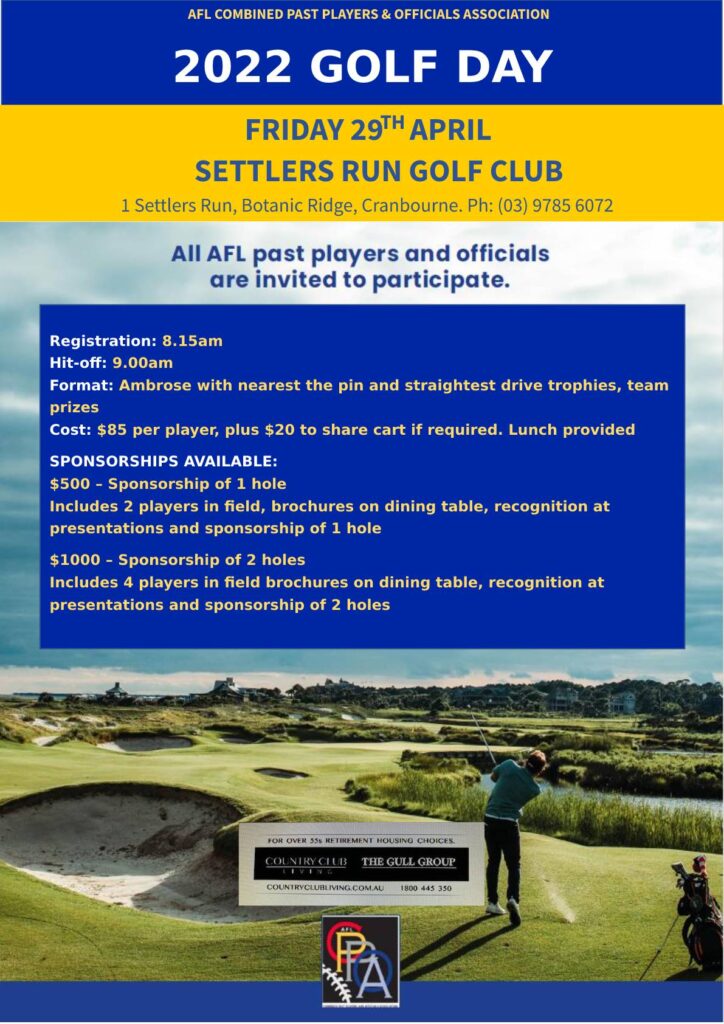
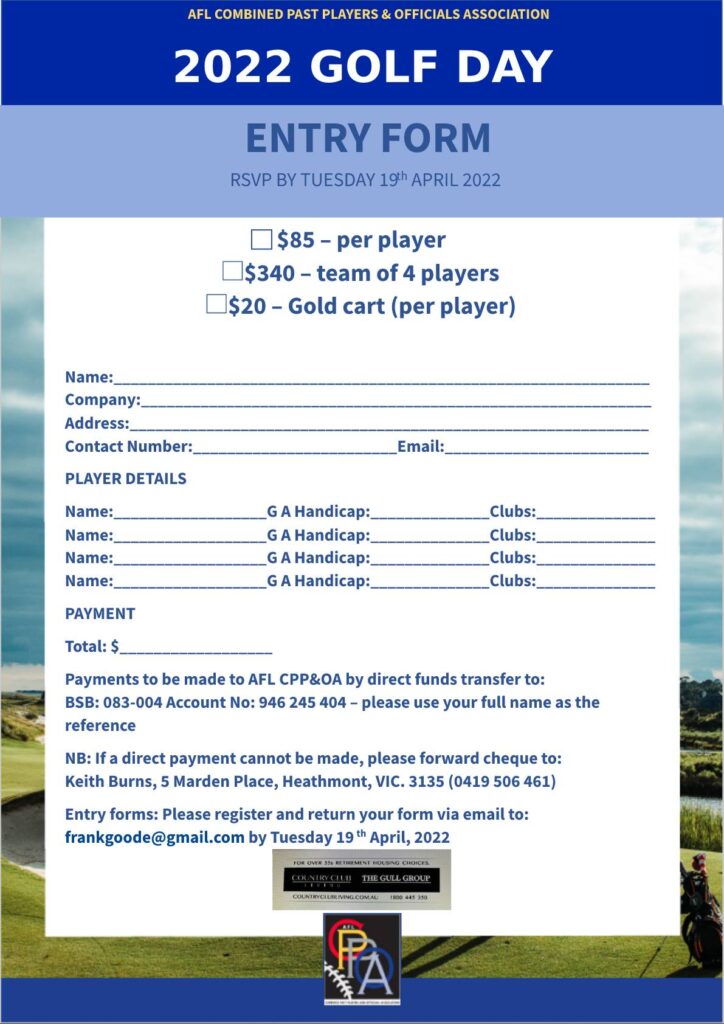
2022 AFL CPP&OA Annual Golf Day
Ian Aitken 1988 – New Past Player Video
A Walk in the Park to Raise Money to Fight Parkinson’s
— Spirit of Carlton (@SpiritofCarlton) March 29, 2022
93-year member Phyllis Taig passes away at 106
Vale, Phyllis Taig.

Phyllis Taig, whose years of dedicated support to the Carlton Football Club (93 of them as a member) was recently rewarded with Life Membership, has passed away at the grand age of 106.
Born in the Carlton premiership year of 1915, and a committed fan (as with her father) from as far back as the late 1920s, Phyllis’ love for the only team old Carlton knows transcended the generations.
“I liked Ron ‘Socks’ Cooper – he was our centre player back in the ’30s and ’40s,” said Phyllis in an interview with Carlton Media back in 2015. “Then there was Craig Bradley, he was my absolute favourite, and Stephen Kernahan of course.”

Phyllis Taig with her newly awarded Life Membership in November 2021. (Photo: Carlton Media)
A student of the great Australian game, and a face in the crowd for her favourite Grand Final in 1970, Phyllis lamented where football had gone in terms of aesthetics. As she said: “I think in the ‘70s – around about that time – was the best really. We had some tough players, but now it’s all altered and it’s too fast now”.
And she always got her two bob’s worth in if she was less than satisfied with team performance.
“I always used to write David Parkin lots of letters if I thought he did the wrong thing,” she said.

John Nicholls, Phyllis Taig, Shane O’Sullivan and definitely the real-life Stephen Kernahan enjoy a laugh. (Photo: Carlton Media)
“I’d always let him know and I can honestly say I always got a reply from David. I’ve kept quite a few of his letters too, I thought he was a wonderful coach . . . and Ron Barassi was alright, he called a spade a spade.”
For years the mother of three fronted for most Carlton home games, watching on from the comfort of a function room of the Carlton Coterie whose membership was covered by her children.
Of match-day functions, Phyllis declared: “We’ve made such a wonderful group of friends – I always look forward going to the football to see them (and) even when the football isn’t on we keep in touch”.
In the lead-up to her 100th birthday, Phyllis kicked off the celebrations at the old Carlton ground, in the George Harris Function Room festooned with balloons and streamers: she was presented with a No.100 Carlton guernsey.
Last October, on the occasion of her 106th birthday, Phyllis was the recipient of birthday greetings from the club’s respective AFL and AFLW Senior Coaches in Michael Voss and Daniel Harford.
Then in December, Phyllis was rewarded with Life Membership – Carlton’s greatest player John Nicholls and Spirit of Carlton Manager Shane O’Sullivan both on hand for the presentation at her home.
Nicholls, who paid Phyllis a final visit early last week, described the Taig family – including Phyllis’s daughter Ada and son Donald – as “great Carlton people”.
“I’m glad I got to see Phyllis again,” Nicholls said. “I held her hand and talked to her for a while.
“I’ve had a bit to do with her because Ada had been running the Carlton ladies functions at the Club for some years and I used to sit with Phyllis at those functions.
“One of my oldest friends, Patricia Robinson, is the daughter of the former Carlton player Creswell ‘Micky’ Crisp, and on the wall of Phyllis’s home was a photo of ‘Micky’, who was her favourite player. Phyllis remembered all of those players from the 1930s and ’40s – Crisp, Vallence, Hands and Henfry.”

Carlton’s greatest-ever player John Nicholls visits Phyllis Taig last November. (Photo: Carlton Media)
“She was incredibly loyal and a staunch supporter who deserved Life Membership.”
To honour Phyllis’ memory, the Carlton senior players will wear black armbands for Thursday night’s match with the Western Bulldogs at Marvel Stadium.
Heroes of ’72 gather on a grand night for Carlton
Watching on with pride at the Round 1 win were the Club’s heroes of Grand Final day 1972.

AS THE players completed a famous victory over Richmond at the MCG on Thursday night, watching on with pride from their vantage point in the MCC Members Reserve were the Club’s heroes of Grand Final day 1972 – the men of Carlton who 50 years ago posted the record scoreline of 28.9 against the same old foe at the same venue.
Thirteen of the 18 surviving team members – Barry Armstrong, Neil Chandler, David Dickson, Adrian Gallagher, Kevin Hall, Paul Hurst, Syd Jackson, Peter ‘Percy’ Jones, Trevor Keogh, Andy Lukas, David McKay, Geoff Southby and Robert Walls – gathered in the Harrison Room for the 50-year premiership reunion, as special guests of The Carltonians coterie.

Peter ‘Percy’ Jones, Jarrad Waite, David McKay and Geoff Southby gather on a great night for the Carlton Football Club.
John O’Connell and Vin Waite – members of the feted team who died in 1989 and 2003 respectively – were represented at the gathering by their sons Luke O’Connell and the 184-game Carlton player Jarrad Waite. Said Waite in a Facebook post: “Great night . . . celebrating the #1972flag. It was really good to see some great fellas that I haven’t seen in a bit. Thanks for @thecarltonians and @carlton_fc for inviting @jacwaite and I to represent the old man. #baggers #lovebeatingthetigsrd1”.
McKay, who was also part of the Club’s 1970, ’79 and ’81 premierships, and who somehow got through the second half of the ’72 Grand Final with a broken jaw, said reunions of this type are special “and the 1972 Grand Final was a special game”.
“The team posted the highest Grand Final score in history, in a shoot-out involving both teams,” McKay said.

The backline “O’Connell, Southby, Waite” was a constant at Carlton through the 1970s – and flanking Geoff Southby at Thursday night’s 1972 Premiership reunion are Jarrad Waite (son of Vin) and Luke O’Connell (son of John).
“This was THE game of Perc’s (Jones’) career – a masterstroke of John Nicholls to play Perc first ruck. Perc took on Craig McKellar who was athletic, but Perc completely nullified him and played well in his own right. ‘Nick’ kicked six up forward too, so that was a win-win.”
McKay spoke for all of his former teammates when he said of Carlton’s stirring 25-point victory over the Tigers on Thursday evening: “To see the team take the first round for the first time in 10 years and be there to celebrate the ’72 premiership made it all the more sweeter”.
Vale Graham McColl: Former player and trainer
The Club remembers former ruck Graham McColl

FORMER Carlton ruckman Graham McColl, whose association with the club would endure for more than a quarter of a century – but not as he anticipated – has died in Geelong Hospital after a short illness.
McColl, the 712th man to represent the club at senior level since the formation of the VFL, passed away at the age of 87. He is survived by his wife of 64 years Dorothy, son Glenn, daughter Meryl, son-in-law Bill Whiteside and grandson Liam.
Recruited to the club from neighbouring VFA outfit Coburg, McColl, a Life Member of Carlton, completed his debut with Bill Arch and Chris Pavlou in the 2nd round match of 1958 against North Melbourne at Princes Park. He was just ten games into his maiden season when he ruptured the anterior cruciate in his right knee.
McColl suffered the injury in the night Grand Final against St Kilda at the Lakeside Oval that September. He resumed training the following March, only to break down with the same injury, and at 24, his League career was over before it had begun.
The proverbial silver lining came with McColl’s subsequent pursuit of recovery techniques – which in turn piqued his interest in becoming a club trainer. So it was that McColl embarked on his new career at Carlton, rising through the ranks of the support staff from thirds, to reserves and ultimately seniors.

Trainer Graham McColl (middle row, far left) with members of Carlton’s under-19 premiership team of 1963, which includes Adrian Gallagher and Denis Pagan.
In the premiership season of 1981, McColl’s contributions to Carlton as trainer were rewarded with Life Membership – the same year in which three-time Premiership player Mark Maclure (who wore McColl’s No.36) and Graeme Whitnall were similarly honoured.
In 2017, McColl agreed to put pen to paper and record the following memoirs of his life and times at Carlton.
“Before I reminisce about my life to date as a player, member of the training staff, member of past players’ association and Life Member, it may be of help to give you some prior history of my football life with some details of how I became a Carlton player in 1958.
Early school years (commencing 1940) were at Wagga Wagga, New South Wales. I attended Forest Hill school, located outside the Aerodrome, on which I lived. I played Rugby and represented the school in athletics to year six.
After the War, we moved back to Melbourne and various parts of Victoria, which resulted in me attending many different schools. Eventually we moved to East Coburg where my parents obtained a home and my father was discharged from the R.A.A.F.
At this time I went to Preston Technical School and, after learning NOT to RUN with the ball under my arm (as in Rugby), I played in the school’s Australian Rules team, where we played against other Technical Schools in the metropolitan area and won many games. Ron Barassi (who later went to Melbourne) played as a half-forward flanker, and Brian Pert (later to play for Fitzroy) and myself were the wingmen.
I was invited to play for the Carlton Under 19s, however I wasn’t able to play a game, as family commitments forced me to look for a club in the vicinity and that’s how I came to play at Coburg in the VFA, playing 68 games. I feel my summer training with Preston Harriers and at Preston Tech., in running, high jump and hurdles, helped me with my ability to play in various positions if required.
1950s saw me as a telephone technician in training, working in many exchanges in Melbourne and country areas, and moving through various levels. With a transfer for eight weeks to Geelong Exchange, my father arranged for me to train at Geelong Football Club, with Reg Hickey as coach. I learnt a lot there and won Coburg Football Club’s Best & Fairest in 1956. Geelong asked me to sign a Form 4, however, Carlton was aware of this and claimed me as their player, where I played ten games in 1958 for the seniors. Of interest during this time was the payment the players received, which was 12 pounds for a full match and the Provident fund only being available after 50 games!
My first game was against North Melbourne, where I played as centre half-forward, my opponent being Albert Mantello. He tried me out physically and I more than held my own, with two goals. I also gave Mantello a hefty bump to which his teammate commented: ‘You’ve got one here, Albert’.
The night series at the South Melbourne ground saw me playing in the ruck, where I received my knee injury in a final against St Kilda. Medical staff didn’t know how serious my injury was. I drove home and went to work the next day. My boss sent me off to the local doctor and then to a physiotherapist. He didn’t know what the full extent of my injury was either. I missed the next year and so I wrote to the American National Football Association and received a strapping procedure – 30 strips of tape – but not much help.
When Dr. Arnold Cooper came to the club he explained what the problem was an I was offered a position on the training staff, with ongoing training by Dr. Cooper and our new physiotherapist Geoff Luke.
I was employed as a trainer for the Under 19s. In addition to looking after injured players, I became a messenger to players from the coach. Some of the players who started in the Under 19s were Adrian Gallagher, Jim Sullivan, Ray O’Halloran, Mark Maclure, John Morrison and Bruce Doull. The Under 19s won the premiership in 1963.
During my time as a trainer, the senior team won four Grand Finals in 1968, ’70, ’72 and ’79 – the latter in which Wayne Harmes (a local boy with a ‘never-say-die’ attitude) saved the ball on the boundary to enable Ken Sheldon to kick the winning goal. This is still a matter of discussion for Collingwood supporters. Alex Jesaulenko captained and coached his grand final team, but we had to carry him off with a serious ankle injury. However, with true spirit, he was there to receive the premiership cup at the end of the game.
Back in the ’70s, a VFL Trainers’ Association was established by a couple of Hawthorn trainers. The association established a training scheme for those persons who wanted to become members of their club’s medical team and be present on the ground during games. Interested parties were required to participate in a six to 12-week practical course, which involved resuscitation and different methods of strapping. The course was conducted at the Collingwood ground.
As the years rolled on, my employment with Telecom caused me, at one stage, to resign my position with the senior XVIII staff. I was able to overcome this, as management moved me to a position that enabled me to attend training sessions during the week. Later, I was offered the position of Head Trainer, but had to decline as my work for Telecom would not allow me to be at the ground for commencement of training and in time for strapping.
On a brighter note, I enjoyed assisting those who were new to the club, the camaraderie and the interaction between training staff and players was excellent, even though we were all on various levels. Sunday morning recovery sessions consisted of lap running, hot and cold showers and rubdowns and a drink of some description to finish off. On many occasions, players, trainers and staff got together with wives and girlfriends, sometimes not getting home until mid-afternoon.
I tended to lose my interest when we basically became ‘waterboys’. However, nowadays the players have doctors, physios and mini-ambulances available to get them to more specialised treatments – and they sure need it with the game edging towards a Rugby format. I’ve always known the game as Australian Rules football (but there’s a) number of ball-ups (scrums), handling the ball incorrectly (throwing) and running the ball down the ground before kicking or shooting for goal (basketball). Umpires should also be able to assess that players are required to bounce the ball within 10-20 metres of running, or otherwise be penalised. I feel the umpires need to be re-trained in these areas.
Overall, I have enjoyed my time with Carlton. In writing these reminiscences, it has brought back some wonderful memories, of trips away, pride in winning Premierships and watching new players develop their skills.
Thanks for your interest in my time at Carlton, and to finish – Go Blues!”
Graham McColl (No.36)
A funeral service for Graham McColl will take place at William Sheahan Funerals, Drysdale, next Wednesday (March 23), commencing at 2pm. The service will be live-streamed and recorded through the William Sheahan Funerals website.
The Carlton players taking to the field for Thursday night’s opening round match with Richmond at the MCG will wear black armbands in memory of John Elliott, Alan Rees and Graham McColl.