Congratulations to Syd

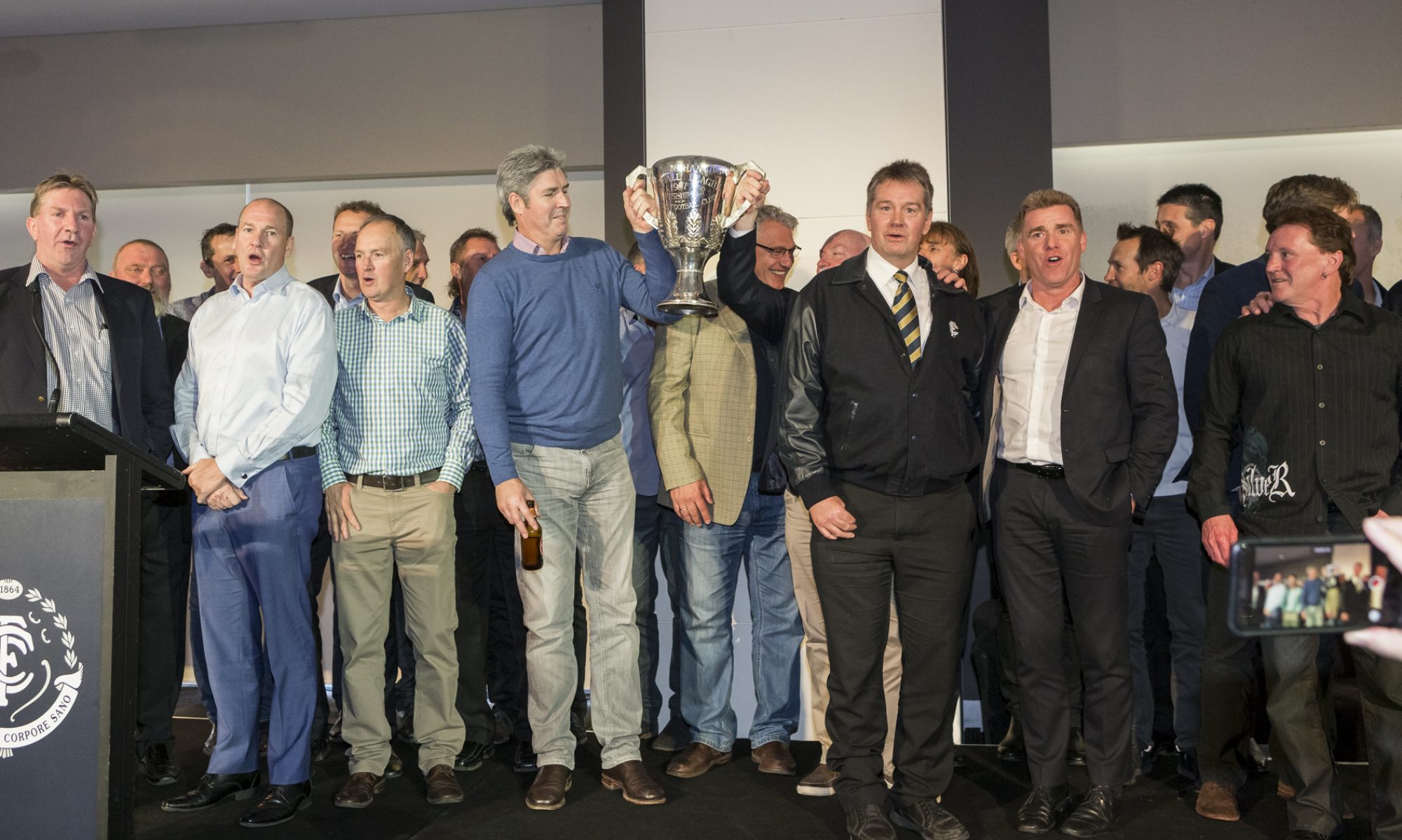
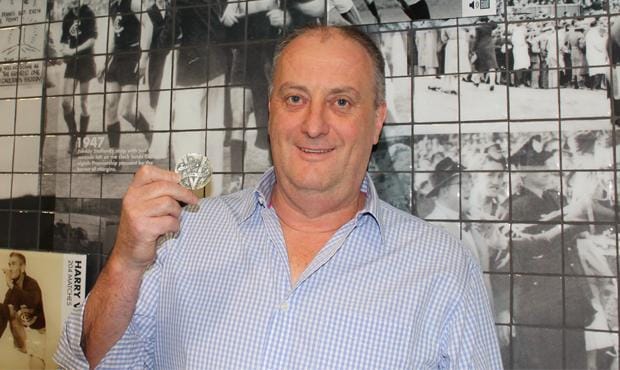
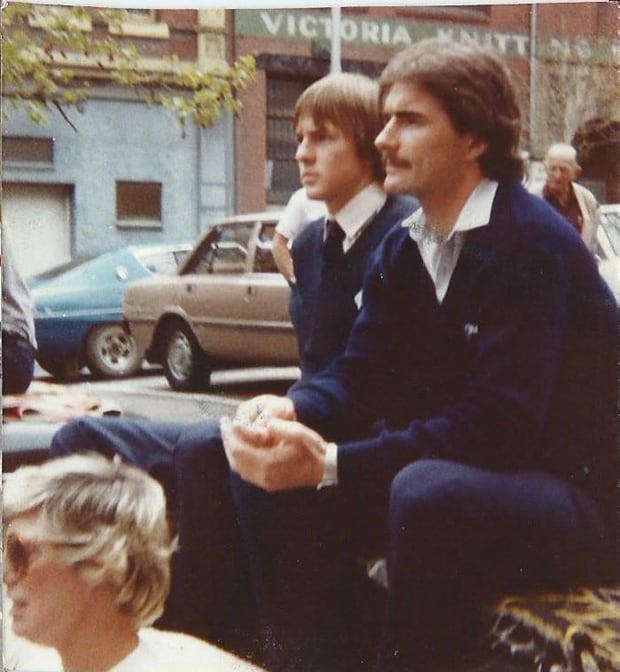
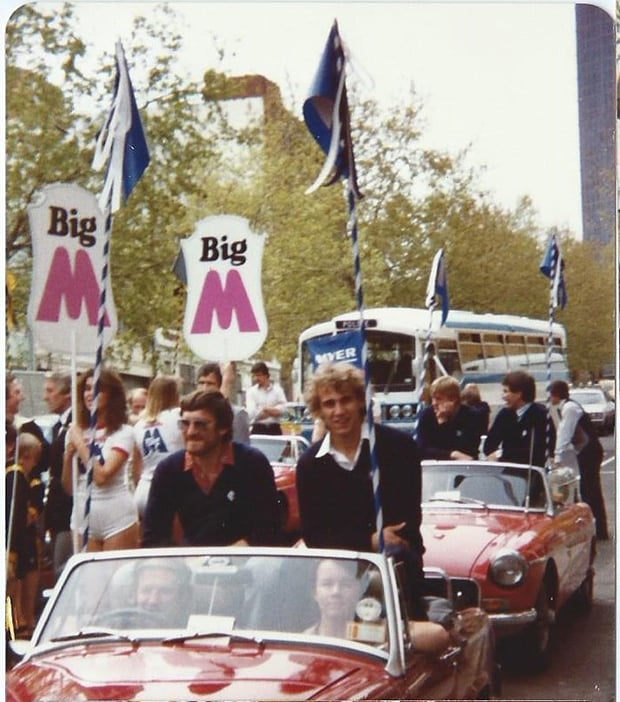
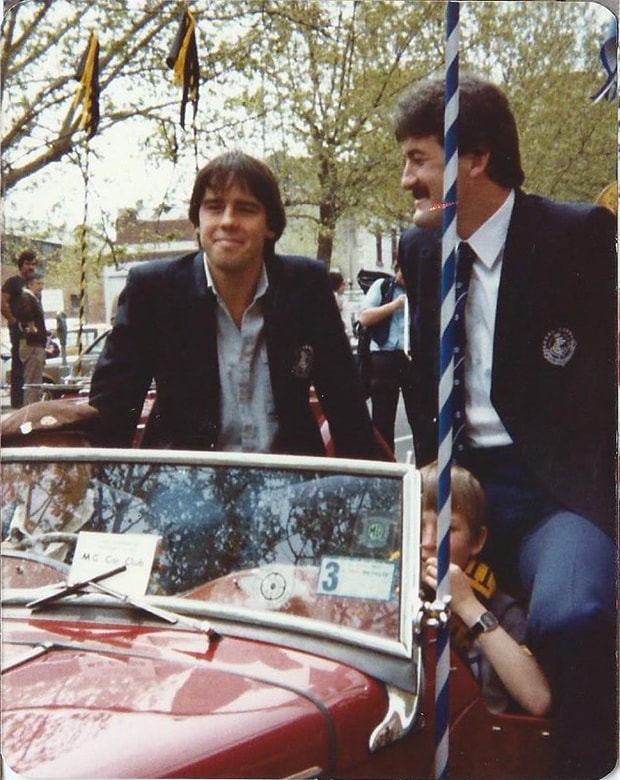
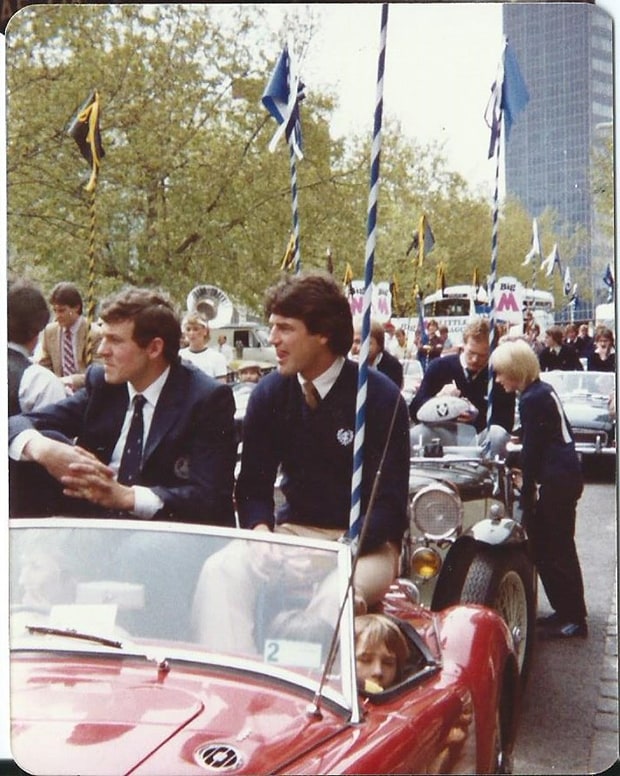
Congratulations to Syd Jackson, who was inducted into the West Australian Hall of Fame last night.

A well deserved recognition for a great man.

This distinction adds to Syd’s membership of the Carlton Hall of Fame and the AFLPA Indigenous Team of the Century.

Macka in cinematic puff piece

See http://www.carltonfc.com.au/news/2015-07-14/macka-in-cinematic-puff-piece for Video
Paul McCormack in Slow Service Slow Service – Courtesy of ACMI Collections and Marcus Lyall

Who’s the former Carlton player pelted with pastries (specifically two meat pies and an Aussie pizza) in a film currently featuring at ACMI’s Screen Worlds exhibition?

If you guessed the Blues’ former 14-gamer Paul McCormack then treat yourself to a jam tart, as McCormack and a host of other models appear in filmmaker Marcus Lyall’s Slow Service, which was produced back in 2003.

Why McCormack completed this unusual cinematic cameo is another story altogether – and it’s a long story,” according to the man in question.

“I was in Adelaide playing footy for Norwood, during which time I got involved in some drama classes and a bit of acting,” McCormack said. “I landed a few little roles here and there, and the opportunity to appear in Slow Service came through Marcus, who’s a friend of a friend of mine Shauna Keenan, ‘Crackers’ Keenan’s niece.

“Marcus said to me ‘We’re filming these slow-mos in Melbourne, would you be interested in being part?’, and I said ‘no worries’.

It happened a few years ago now, and if my memory serves the pizza was loaded up with spaghetti.”

Shot on a high-tech, ultra-slow motion digital camera normally used for industrial purposes such as crash-test dummy demonstrations, Slow Service introduced a new element to the gallery experience: the food fight. In it, we see slow-moving swaths of pumpkin soup, dollops of pea mash and the apocalyptic cloud of white flour landing on Lyall’s hapless subjects, McCormack included, each unable to avoid the imminent crash.

Incredibly, Slow Service’s genesis involved a film crew, a large studio, 50,000 watts of lighting, a large supermarket trolley of food and ten days of post-production.

McCormack’s acting foray was not confined to Lyall’s film. He appeared in a television commercial for Hostplus, and later as a racist cop in Jay Harkness’ Australian feature film “Dope”. Of his celluloid appearance in the latter, McCormack advises “there are a couple of scenes in there, but a few ended up on the cutting room floor”.

McCormack then bobbed up at the Fringe Festival in the play “Electric Zoo”, in the role of Robert Wright – one of five prisoners killed when a fire was lit behind the bluestone walls of Pentridge’s maximum security west wing in which they were barricaded back in 1987.

Now a teacher at Parkdale Secondary College (and resident coach of 2nd division football club Bayswater), McCormack conceded that his days as a thespian are all but over. As he said: “It just got a bit too difficult with auditioning and even then you’re no certainty of getting the job”.

Slow Service can be seen in its entirety at Screen Worlds – a permanent exhibition at ACMI, Federation Square, which tells the remarkable story of the moving image. Screen Worlds is open daily and is free of charge.

Maclure reaches 60

Happy 60th to Mark Maclure!


—————

From the Blueseum:


Career: 19741986
Debut: Round 13, 1974 vs Geelong, aged 18 years, 350 days
Carlton Player No. 846
Games: 243
Goals: 327
Last Game: Grand Final, 1986 vs Hawthorn, aged 31 years, 75 days
Guernsey No. 36
Height: 188 cm (6 ft. 2 in.)
Weight: 89.5 kg (14 stone, 1 lb.)
DOB: 14 July, 1955
Premiership Player: 1979, 1981, 1982
Club Leading Goalkicker: 1977, 1985
Victorian Representative: 1977, 1980
Club Captain: 1986
Carlton Hall of Fame: 1995

In a long and successful career with the Blues between 1974 and 1986, “Sellers” Maclure wore his number 36 guernsey in 243 games, including solid contributions in each of the 1979, 1981, and 1982 Carlton Premierships. Originally groomed as a defender, he became one of the better centre half-forwards of his era; a strong marking, hard-tackling team player who brought those around him into the game. Although sometimes prone to inconsistency, his career average of 18 games per season is a good indicator of his value to the Blues.

Early in his career, when Maclure began confirming that Carlton had unearthed another promising key position prospect, the football press of the day made much of the story that the 188 cm, 89 kg blonde forward had been recruited from the East Sydney Australian Football Club in Sydney. Portrayed as one of the trail-blazers for our code in the heartland of rugby league, Maclure was later seen as one of the standard-bearers of the AFL push into Sydney.

That claim proved to be a very cheeky one. While Maclure was in fact signed to Carlton from the Sydney club, he had actually been born in WA, and took to the game in the southern states. This came about because Mark’s father was in the Australian Navy at the time, so Mark played football wherever his family was sent. At the height of the Vietnam conflict in the early 1970’s, that meant Sydney.

Maclure began his career at Princes Park with the Under 19 squad, but progressed quickly through the Reserves team and made his senior debut in round 13 of 1974, against Geelong at Princes Park. Although Carlton dominated the match and won by 73 points, Maclure had a torrid introduction to senior football at full back. It was a spiteful affair, and players from both sides ended up on report.

Two weeks later, ‘Sellers’ was given his first opportunity at centre half-forward when Carlton played Richmond in the Match of the Day at the MCG. This time, the Tigers’ notorious knuckleman, Mal Brown, tried working him over, and Maclure was reported for retaliating. He beat the charge at a tribunal hearing, but afterward was sent back into defence, where he spent the best part of two seasons.

In 1976, Maclure experienced finals football for the first time. Carlton topped the ladder, only to lose the Second Semi-Final to Hawthorn by three goals, and the Preliminary Final to North Melbourne by 1 point. ‘Sellers’ played both of those matches at centre half-back, and finished the year with a career total of 51 games and five goals – figures that made his subsequent achievements even more impressive.

Eventually, in 1977 he was sent forward again, and this time, proved to be a more than handy extra marking target in a Carlton attack that already featured the aerial skills of Robert Walls, David McKay and former Collingwood star Peter McKenna. Although Carlton disappointed by tumbling to sixth on the ladder, Maclure was a revelation. His 39 goals for the season won him the Blues’ goal-kicking award, and he was selected in the Victorian state squad mid-season.

When Robert Walls played the last of his 218 games for Carlton against South Melbourne at the Lake Oval in April, 1978, and then departed for Fitzroy, Maclure stood out as his logical replacement at centre half-forward. From then on, and for most of the next decade, the big blonde was an integral part of some of Carlton’s all-time great teams.

From 1979 his partnership with ‘The Dominator;’ Wayne Johnston, often created havoc for opposition teams – as it did in Carlton’s thrilling 5-point victory over Collingwood that year’s Grand Final. And when brilliant West Australian Peter ‘The Buzz’ Bosustow arrived at Princes Park in 1981, he completed a half-forward line that still stands as one of the Blues’ best ever. At times unstoppable, the trio were a big factor in the back to back Carlton flags of 1981-’82.

Maclure was Carlton’s leading goal-kicker for the second time in 1985, and was honoured with the captaincy of the club in 1986. Unfortunately for Mark, that season, which should have been a highlight for him, was ruined by a serious back injury. He played in his fourth Grand Final in Carlton’s big defeat by Hawthorn, then retired at the end of the year aged 31. Later, he headed north to take up an appointment as assistant coach of the fledgling Brisbane Bears before becoming a popular and television and radio commentator. In 1995, he was a worthy inductee into the Carlton Hall of Fame.

And what of that nickname? Well, Carlton folklore has it that Premiership ruckman ‘Percy’ Jones dubbed Maclure “Sellers” because Mark used to bumble his way around Princes Park like Peter Sellers’ famous character, Inspector Clouseau, in the popular Pink Panther movie series. However, in a 2012 radio interview, Maclure revealed that it was in fact Carlton trainer Leo Brooks who came up with the name.

Mark Maclure Interview

In a 4-part interview, Mark talks at length about his career to Mark Fine and Geoff Poulter on radio station SEN, Feb 15, 2012.
www.sen.com.au/audioplayer/Audio/Mark-Maclure-Part1/3924 (external link)

Milestones

50 Games: Semi Final, 1976 vs Nth Melbourne
100 Games: Round 7, 1979 vs Nth Melbourne
150 Games: Round 13, 1981 vs Fitzroy
200 Games: Round 21, 1984 vs Footscray

100 Goals: Round 10, 1979 vs Collingwood
200 Goals: Round 17, 1982 vs Geelong
300 Goals: Round 6, 1986 vs Sydney

Career Highlights

1974 – 5th Reserves Best & Fairest won on countback
1974 – Mrs Jean Cook Most Improved Reserve Player Award
1975 – 10th Best & Fairest
1976 – Equal 9th Best & Fairest
1977 – Victorian Representative
1977 – Club Leading Goalkicker
1977 – 4th Best & Fairest
1978 – Arthur Reyment Memorial Trophy: 2nd Best & Fairest
1979 – 4th Best & Fairest
1979 – Premiership Player
1980 – Victorian Representative
1981 – Best Clubman Award
1981 – Premiership Player
1982 – Premiership Player
1984 – 3rd Best & Fairest
1985 – Club Leading Goalkicker
1985 – 3rd Best & Fairest
1985 – Best Clubman Award
1986 – Captain
1995 – Carlton Hall of Fame

David Kernahan turns 50

Happy 50th to David Kernahan!


—–

From the Blueseum:

Career: 1988–1993
Debut: Round 1, 1988 v Hawthorn, aged 22 years, 266 days
949th Carlton Player
Games: 53
Goals: 8
Last game: Round 18, 1993 v Hawthorn, aged 28 years, 20 days
Guernsey No. 28
Height: 188cm
Weight: 83kg
DOB: 11 July, 1965

The younger and smaller brother of Carlton’s immortal Stephen Kernahan, David spent six seasons at Princes Park from 1988 to 1993. He seemed destined for a good career when he kicked the match-winning goal in his first senior game against Hawthorn, and then making the top 5 in the B&F in both 1990 and 1991. Incidentally, it was in 1990 that he brought up the only Brownlow Vote of his career, with a strong game against the Swans in Round 14.

Unfortunately for David, his arrival at Carlton from Glenelg in South Australia coincided with a slump in team performance in the years following the 1987 Premiership. Originally considered as a forward, he found a niche in defence in his second year, playing a string of solid games.

Then, just as he was cementing a regular place in the team, he was struck down by hamstring and groin injuries that hampered his career from that point on, taking a heavy toll on the 188 cm, 83 kg utility and restricting him to just 53 games in six seasons. He showed plenty of grit in persisting until 1993 before returning home.

Milestones

50 Games: Round 16, 1992 Vs Brisbane Bears

Career Highlights

1989 – Reserves Best Clubman Award
1990 – Equal 5th Best & Fairest
1991 – 5th Best & Fairest

Past Players in Need

Alumni in need

The AFLPA currently have a handful of past players who are searching for employment. If you, or anyone you know might be able to offer any employment leads, please contact Alumni Manager, Brad Fisher – bfisher@aflplayers.com.au


Access the AFLPA services

We have never had greater uptake of our Alumni benefits and services, but we still have plenty of scope to offer support to all past players.
Click here for participating doctors.

Players Trust has assisted 12 Alumni members since 2014
Total of $122,590

Hospital Excess Reimbursements have assisted 703 members since 2008
Total of $356,851

Geoff Pryor Hardship Grants have assisted 98 Alumni members since 2008
Total of $369,058

Bulk Billing of General Practitioners assisted almost 100 Alumni Members so far in 2015.

Rhys and Tiger meet again in Tassie

Almost thirty four years had passed since the last time David Rhys-Jones and Brent Crosswell had met off the footy field. Last week it was in the luxury of Garry Baker’s RockWall restaurant in Hobart’s Salamanca Place. Thirty four years ago it was on a Monday night at the VFL tribunal.

The then 19 year old Rhys-Jones was facing five charges from the recent clash at the MCG between his South Melbourne Swans and the Melbourne Demons. Luckily Rhys managed to avoid any sanction for the first four charges and decided to plead guilty to his last charge. The last charge happened to be for striking Peter Smith, yes that Peter Smith, 33 games for Carlton and former team-mate of Brent Crosswell, also the son of legendary Melbourne coach, Norm Smith. Who is of course the VFL legend for whom the Norm Smith medal is named, which David Rhys-Jones won in the 1987 Carlton premiership. Footy can weave some intricate webs at times.

Rhys, struck Peter in the aftermath of a tussle with Peter ‘Crackers’ Keenan, where Rhys told the tribunal that Peter Smith tried to break up the two wrestling footballers using extenuating circumstances. In fact the two circumstances which were extenuated were so painful they resulted in the subsequent strike to the noggin. The tribunal decided to give Rhys four weeks on the sidelines and his 1981 season was over. Needless to say, Rhys decided never to plead guilty again at the tribunal.

Brent Crosswell was up for ‘charging’ Rhys-Jones earlier in the game. In an act of symmetry the tribunal also dealt Tiger a four week suspension and the end of his 1981 VFL season. Brent was towards the end of his career and it looked like this suspension may spell the end. But as fate would have it Tiger would go around again for two more seasons continuing the great proton and electron dance of repulsion and attraction he and Ron Barrassi had been doing for thirteen years.

Vale Leo Catoggio

The Spirit of Carlton Past and Present would like to extend our deep condolences to Vin Catoggio and his family on the loss of family patriarch, Leo Catoggio. Leo was a well loved member of the Carlton family who will be missed by everyone at the Carlton Football Club.

Club greats return to Ikon Park

Members of the Spirit Of Carlton with President Mark LoGiudice, Director Zac Fried and CEO Steven Trigg. (Photo: Carlton Football Club)

Members of the Spirit Of Carlton with President Mark LoGiudice, Director Zac Fried and CEO Steven Trigg. (Photo: Carlton Football Club)

Members of the Spirit Of Carlton, amongst them Premiership coach David Parkin, recently gathered in the George Harris function Centre at Ikon Park, on the invitation of Carlton CEO Steven Trigg.

Trigg sought to brief members of the Spirit with strategic plans for the club’s short, medium and long-term future and took many and varied questions from those who have so strongly supported Carlton for a long time and in a myriad of ways.

Amongst those in attendance were; Rod Austin, Mario Bortolotto, Peter Brown, Vin Catoggio, Ian Collins, Lauraine Diggins, David Glascott, Kevin Hall, Milham Hanna, Col Kinnear, Ken Kleiman, Alex Marcou, Denis Munari, David Rhys-Jones, Ken Sheldon, Geoff Southby and Sergio Silvagni.

Also there was Carlton President Mark LoGiudice, Director Zac Fried and Head of Football Andrew McKay.

Carlton wingman Graham Gilchrist dies

Graham Gilchrist played 114 games for the Blues from 1952 - 1961. (Photo: Carlton Football Club)

Graham Gilchrist played 114 games for the Blues from 1952 – 1961. (Photo: Carlton Football Club)

Graham Gilchrist, a Carlton Under 19 and reserve grade Premiership player who represented the Blues with distinction in 114 senior appearances through the 1950s and early ’60s, has died after a short illness. He was 82.

Considered a talented, agile footballer who could comfortably ply his craft whether at centre half-forward or on a wing, Gilchrist was a local boy who joined the club as a student from nearby Coburg High School.

That was in 1949 – two years before Gilchrist, as Captain of the thirds, led Carlton to Grand Final victory. That feted team, coached by Jim Francis, included the late Dick Pratt.

In the wake of some solid showings at reserve grade level, Gilchrist broke into the seniors in the 18th Round of 1952, against St Kilda at the Junction Oval.

Initially sporting the No.26 worn by his predecessor Jim Clark, Gilchrist later switched to the No.28 now worn by Tom Bell. He initially found senior selection difficult with the presence of Laurie Kerr and John Chick, but Chick’s unavailability with a groin muscle tear in mid-August afforded Gilchrist an opening, before he later rejoined Carlton’s reserves for their imminent finals campaign.

That campaign ended with victory over Essendon before 80,000 in the curtain-raiser to the Collingwood-Geelong Grand Final on the MCG, with Gilchrist booting two goals and staking his claim for regular senior call-ups through the next eight seasons of his Carlton football life.

Gilchrist nobly represented his team through a difficult period in history, which netted him the return of just three finals appearances, including the 1957 semi-final loss in the hail to Hawthorn and the 1959 Preliminary Final loss to the eventual Premier Melbourne.


Graham Gilchrist (front row, second from left) in 1957. (Photo: Carlton Football Club)

He turned out for his 100th senior appearance against Collingwood at Victoria Park in Round 8, 1960 – sharing that milestone with the late Denis Zeunert – and finished up after the one-point loss to Melbourne on Princes Park in the 18th round of 1961.

In later years, Gilchrist maintained his allegiance to Carlton, regularly taken his four children to matches at Princes Park. Together they’d fine their niche on the flank in the shadows of the Richard Pratt Stand and follow the fortunes of their much-treasured team.

The kids loved it.

Gilchrist is survived by his daughters Debbie, Kate and Angie, son Tony and their respective spouses and eight grandchildren.

He is also survived by his second wife Eileen, his first wife Bev having passed away in 1982. Gilchrist’s brother Max, an accomplished footrunner who competed at Stawell, predeceased him.

“As a footballer, Dad was agile. He liked space because he liked to run,” Gilchrist’s daughter Angie said this week.

“He was passionate about things and very determined. He had a fierce loyalty and if he loved something he stuck with it through thick and thin – the Carlton Football Club included.”

Graham Gilchrist’s funeral will be held at Allison Monkhouse, Charman Road, Cheltenham, next Wednesday (July 1), commencing 2.30pm, with a wake to be held at Victoria Golf Club.

Members of the family will all be in attendance for Sunday’s match between Carlton and Gold Coast at Etihad Stadium when the Carlton players take to the field wearing black armbands to honour Gilchrist’s memory.

Club greats return to Ikon Park

Members of the Spirit Of Carlton with President Mark LoGiudice, Director Zac Fried and CEO Steven Trigg. (Photo: Carlton Football Club)

Members of the Spirit Of Carlton with President Mark LoGiudice, Director Zac Fried and CEO Steven Trigg. (Photo: Carlton Football Club)

Members of the Spirit Of Carlton, amongst them Premiership coach David Parkin, recently gathered in the George Harris function Centre at Ikon Park, on the invitation of Carlton CEO Steven Trigg.

Trigg sought to brief members of the Spirit with strategic plans for the club’s short, medium and long-term future and took many and varied questions from those who have so strongly supported Carlton for a long time and in a myriad of ways.

Amongst those in attendance were; Rod Austin, Mario Bortolotto, Peter Brown, Vin Catoggio, Ian Collins, Lauraine Diggins, David Glascott, Kevin Hall, Milham Hanna, Col Kinnear, Ken Kleiman, Alex Marcou, Denis Munari, David Rhys-Jones, Ken Sheldon, Geoff Southby and Sergio Silvagni.

Also there was Carlton President Mark LoGiudice, Director Zac Fried and Head of Football Andrew McKay.

A tribute to Terry

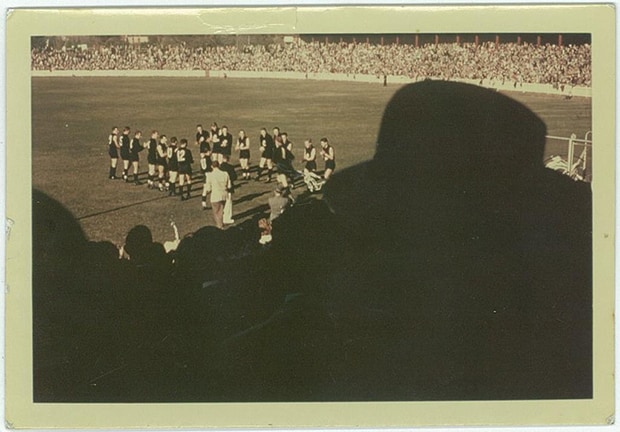
The Carlton team, versus Melbourne, Princes Park - Round 8 (Saturday, June 30), 1934. Carlton 19.20 (134) defeated Melbourne 11.19 (85) (Photo: Carlton Football Club)

The Carlton team, versus Melbourne, Princes Park – Round 8 (Saturday, June 30), 1934. Carlton 19.20 (134) defeated Melbourne 11.19 (85) (Photo: Carlton Football Club)

Pictured here in the shadows of the since-demolished Robert Heatley Stand, just moments before the first bounce, are members of the Carlton team which met Melbourne in the 8th round match of 1934 (Saturday, June 30) at Princes Park.

Featured are legendary figures like “Soapy” Vallence, “Mocca” Johnson and Ron “Sox” Cooper. Also there, front and centre with his legs crossed, is the relatively unknown Terry Ogden, whose older brother Gordon lined up for the Redlegs in the same game.

Within eight months of this photograph being captured, Ogden’s life would be tragically taken following somewhat mysterious circumstance on that very ground.

And Ogden’s untimely passing – on the eve of the 1935 home and away season – would prompt teammates to call on the Carlton committee to strike an award to perpetuate his memory.

Originally hailing from Northcote CYMS, Terence William John Ogden, the son of the Essendon dual Premiership rover and captain-coach Percy “Butcher” Ogden, originally chased the leather for the Essendon reserve grade team.

He joined Carlton on the cusp of the 1934 season, having participated in Melbourne’s reserve grade Premiership in ’33. The previous year (1932) he managed three senior appearances for the Redlegs.


Terry Ogden played 15 games for the Blues in 1934. (Photo: Carlton Football Club)

A fleet-of-foot wingman, Ogden’s athletic prowess was also acknowledged by a correspondent for The Advocate who in February 1934 wrote: “Mr. Terry Ogden has been showered with congratulations on his splendid performance of winning the Bendigo Centenary Gift and third in the Wangaratta Gift”.

At Carlton the break finally came Ogden’s way when he was named for the fourth round match against Geelong at Princes Park – the first of his 15 senior appearances in succession that year.

Ogden, it seemed, had found his niche. But fate would play its cruel, cruel hand, in an otherwise innocuous training session at the old ground sometime in late February 1935.

On February 28, The Argus correspondent reported that Carlton administrators and former players Newton Chandler and ‘Horrie’ Clover were amongst those rallying behind the 23 year-old Ogden, a mechanic of 11 Christmas Street, Northcote, who was experiencing rapidly failing health.

“Mr. N. Chandler and Mr. H. Clover, respectively secretary and delegate for the Carlton club, offered their services for a blood transfusion when it was announced that the club’s wing man, Terry Ogden, was seriously ill. After a blood test, Mr. Chandler was accepted, and the transfusion took place,” the reporter noted.

“Ogden who is suffering from pleurisy in both lungs, is in the hospital at Fairfield. It was said that he had improved yesterday.”

But, Ogden’s demise was imminent – and he died three weeks prior to his 24th birthday.

As the Riverina Herald of March 2 reported;

Terence Ogden, 23, Carlton footballer, died in a private hospital in Fairfield today, after an illness which is believed to have resulted from an injury sustained on the football field. Ogden had been an inmate of the hospital for about a week and a few days ago was given a blood transfusion by the secretary of the Carlton Football Club (Mr Newton Chandler).

At that time hopes were held for his recovery, but complications set in yesterday and he failed to rally.

(Carlton President) Mr Crone said today that Ogden was one of the most popular players at Carlton. He came to the side as a junior and proved a wonderful success as a player and clubman. He would be sadly missed by everybody connected with the club.

A death notice placed by the Carlton players, subsequently appeared in The Argus. “In affectionate memory of Terry, who died on March 2. A popular clubmate. (inserted by the players of the Carlton Football Club)”.

As there was no inquest held, the circumstances surrounding Ogden’s mishap on Princes Park may never be known. Ogden’s niece Shayne Valdemarin came close, in sourcing a death certificate which states that the player “died from osteomyelitis of the left scapula (shoulder blade) and septacaemia. Duration – days”. But what actually happened on the track some 80 years after the event to this day remains a mystery.

At the time of his death, Ogden was engaged to local South Preston girl Clare Hanrahan, and what became of her is unknown.


Ogden’s final resting place at Coburg’s Pine Ridge Cemetery. (Photo: Tony De Bolfo)

He lived at Glendalough, 11 Christmas Street, Northcote, not far from St Joseph’s Roman Catholic Church, Westbourne Grove where the funeral took place.

The Advocate correspondent, in a report published on March 14, 1935, paid fitting tribute to an endearing character at the time of the funeral.

Northcote CY.M.S. suffered a very severe loss by the recent death of Terry Ogden,one of its most popular and talented members, at the early age of 24 years. He was the younger son of Percy Ogden, of Essendon fame, and a brother of Gordon, the Melbourne footballer.

Terry joined the branch in 1928, and for some years gained distinction as a prominent member of the cricket and football teams. In the latter sport he performed brilliantly, annexing the trophy for the best and fairest player on two occasions. Rapid improvement saw him with Melbourne 2nd XVIII, being a member of their championship teams of 1931-2-3; from there he transferred last year to the Carlton League team, earning regular selection through brilliant, heady and manly play on the wing. Terry’s magnificent successes on the running track further exemplify his sporting ability.

This young athlete was a perfect gentleman, deservedly popular for his affable and modest demeanor. His courage, modesty and sincerity made him a firm favourite, and endeared him to all, and his early death is indeed a sad blow to his many friends and admirers.

A striking tribute to his popularity was the large number of members of the Northcote C.Y.M.S. and Carlton Football Club who attended and marched at the funeral, which was one of the biggest ever held in the district.

Ogden’s final resting place can be found at Coburg’s Pine Ridge Cemetery, Roman Catholic grave F899. There he lies with his father Percy and mother Mary.

The gravestone reads;
In Loving Memory
– OF –
TERENCE OGDEN
AGED 23
WHO DIED 2ND MARCH 1935
FROM AN INJURY SUSTAINED ON CARLTON OVAL
Those lowering Ogden’s coffin into the grave were pallbearers including his Carlton coach Dan Minogue and teammates ‘Mocca’ Johnson and Charlie Davey. Johnson, the club captain and Davey, together with every other Carlton footballer, later resolved to honour the memory of their “manly and brilliant little player” by presenting to the club a trophy known as the Terry Ogden Memorial Trophy, for the most improved.

The trophy was awarded between 1935 and 1950, then to the third placegetter in the B & F from 1951 and ’54 and, for a period in the late 50s, to the best first year player.

From 1955 through to 2002, the Trophy for Carlton’s third placegetter in the best and fairest carried the famous name of Perc Bentley, the dual Premiership coach of 1945 and ’47.

Sadly, the Memorial Trophy is no more, although Ogden’s niece harbours hope that it might be reinstated.

“I rang the club a long time ago and asked if the Trophy was still awarded, and the people there couldn’t tell me,” she explained.

“Wouldn’t it be great if the Terry Ogden Memorial Trophy was reinstated? It would be lovely for Terry to be remembered. From what I have read from the tributes he was a terrific fellow.”

The Carlton team, versus Melbourne, Princes Park – Round 8 (Saturday, June 30), 1934. Carlton 19.20 (134) defeated Melbourne 11.19 (85) (Photo: Carlton Football Club)

Back row, left to right: Joe Kelly, Ron “Socks” Cooper, Gordon Mackie, Ted Pollock (19th man), Horrie Bullen, Keith Dunn, Robert Green, Eric Huxtable, Cresswell Crisp

Middle row, left to right: Alby De Luca, Frank Gill, Harry “Soapy” Vallence, Jack Cashman (acting VC), Maurice “Mocca” Johnson (C), Edward Clarke, Jack Cooper

Front row, left to right: Keith Shea, Terry Ogden, Fred Gilby

Five former Blues to pull on the boots

Five former Bluebaggers will pull on the boots for this year’s annual EJ Whitten Legends Game.

The match, in its 20th year, celebrates and honours the life of the great EJ Whitten who sadly passed away from prostate cancer in 1995.

The Legends Game between the Vics and the All Stars brings together retired AFL players, comedians and celebrities from across the country.

This year former Blues Brendan Fevola, Lance Whitnall, Heath Scotland, Ryan Houlihan and Ang ‘Woof’ Christou will lace up their boots and put their fitness to the test.

While the rivalry is fierce between the two teams, their goal is the same: to promote men’s health in Australia and raise funds for the EJ Whitten Foundation.

If you’d like to watch your favourite past players in action, head to Etihad Stadium on Tuesday 30 June at 7.30pm.

Click here to buy tickets.

Garry Higgins is 60

Happy 60th birthday to Garry Higgins

———–


Career: 1975 – 1976
Debut: Round 16, 1975 v St Kilda
Carlton Player No. 854
Games: 7
Goals: 0
Last Game: Round 11, 1976 v Footscray
Guernsey No. 29
Height: 180cm (5’11”)
Weight: 76kg (12.00)
DOB: 15 June, 1955

Gary Higgins was recruited from Maryborough / Maryborough Rovers and wore guernsey #29, he played 7 games for Carlton after debuting in Navy Blue in Season 1975.

Higgins was Carlton’s 5th debutant in 1975, after Mike Fitzpatrick, Russell Ohlsen, Wayne Deledio and Danny Halloran.

Career Highlights

1975 – Reserves Best First Year Player Award

1995 Anniversary Dinner

Join us for the grandest of Grand Final celebrations.Join us for the grandest of Grand Final celebrations.

It’s 20 years now since the team forever remembered in football lore as “The Recordbreakers” took Carlton to an unprecedented 16th Premiership.

To mark the 20th anniversary of the Blues’ 1995 famous victory, the Carlton Football Club is calling on its rank and file to once again savour the spoils of “Sweet Sixteen”.

Join us for the grandest of Grand Final celebrations, when the Blues’ all-conquering former players – the likes of Kernahan, Silvagni, Williams & Coach David Parkin – relive their finest hour in a celebratory dinner.

Date: Saturday 25 July
Time: 7pm start
Location: Grand Hyatt, Savoy Ballroom, 123 Collins St, Melbourne
Dress code: Lounge suit, Women accordingly
Includes: 3 course dinner & beverages
Price: $300 per person

CLICK HERE TO RESERVE YOUR SEATS

Congratulations to Chris Judd

The Spirit of Carlton Past and Present would  like to congratulate Chris Judd on a magnificent playing career with the West Coast Eagles and the Carlton Football Club. While the end of a playing career is often a tough transition one thing that Chris can look forward to is his career getting better and better with every passing year.

We received a lovely note from Brian McMahon, a Blues member of over 50 years standing and would like to share it with the broader Carlton family.

Such a sad day after such an improved performance by the Blues.

A shame Chris could not play out his career with a developing young team now we have our SPIRIT  back.

In every way Judd epitomised the ” SPIRIT OF CARLTON”.

When all seemed lost he walked into our Club when we were down and out after years on the bottom of the ladder.

He set our standards again, led by example, gave us hope and taught us to win and restored our pride.

He as Captain led us into finals and won. Whenever he was on the ground the game was never over and could be won!

Thank you number 5 you join the Carlton greats.


Greg Hardie celebrates 70 years

Happy 70th to Greg Hardie.

—————–


Career : 19631965
Debut : Round 1, 1963 vs Fitzroy, aged 17 years, 331 days
Carlton Player No. 752
Games : 24
Goals : 18
Last Game : Round 14, 1965 vs South Melbourne, aged 20 years, 69 days
Guernsey No. 15
Height : 170 cm (5 ft. 7 in.)
Weight : 76 kgs (12 stone, 0 lbs.)
DOB : May 23, 1945

James Gregory (Greg) Hardie was recruited by the Blues from the northern Victorian town of Leitchville in 1963. A very young, yet already accomplished rover, Hardie represented the Blues in 24 senior games over three years, before somewhat prematurely returning to the bush in 1966.

Carlton’s match committee thought highly of Hardie’s potential – so much so that they presented him with the number 15 guernsey previously worn by club legend Bruce Comben. Greg was still a month short of his 18th birthday when he was selected to make his debut in the senior side in round 1 of 1963, against Fitzroy at the Brunswick Street Oval. On that fine, cool Saturday afternoon he put in a lively performance, and kicked three goals as the Blues accounted for the Maroons by 23 points.

A fortnight later, he kicked four goals against South Melbourne at the Lake Oval, and Carlton fans began speculating that the Blues just might have picked up a special talent. Although his form tapered off later in the season, he finished 1963 with a dozen games to his credit and a bright future ahead.

As often happens to young players however, Hardie caught a dose of the second year staggers in 1964, not helped by Carlton’s overall poor performance that saw them tumble to tenth place on the ladder. Greg managed 9 games and 7 goals, and no doubt wondered what was to come when the news broke that Melbourne’s firebrand champion Ron Barassi had been appointed captain-coach of Carlton for the next five years.

It is easy to imagine that Barassi’s intensity and rigid discipline took the fun out of the game for a homesick youngster who, up until that point, had made his way on skill alone. Barassi demanded more from everyone, so Hardie soon found himself a regular in the Reserves team. While Carlton climbed back to sixth in 1965, Greg managed only three senior games. He wasn’t selected again after sharing the roving duties with Adrian Gallagher in a 17-point loss to South Melbourne at Princes Park in round 14, and was delisted after the season by mutual consent.

Back home in the Murray Valley, Hardie played a couple of seasons with Echuca, before accepting the role of captain-coach with North Wagga. In 1969-70, he won back-to-back Farrer League Best and Fairest as captain-coach of the Saints. In 1972 he moved on to Mildura in the Sunraysia League, and in 1978 – after more than 250 games at senior level in a career spanning 15 seasons – finally retired after his side Meringur lost to Nangiloc in the Grand Final of the cross-border Millewa League.

From The Age review of the Fitzroy vs Carlton match Round 1, 1963, Greg’s debut game.
“Tall follower Maurie Sankey was brilliant in the air for Carlton, and his good work was capped off by the grass-cutting passes of rover Bruce Williams. The Blues had a “find” in Leitchville recruit Greg Hardie, who filled the second roving berth with distinction and scored three goals.
At the spearhead, Tom Carroll, marking and leading well, found fine first match form. He kicked four of Carlton’s seven goals in the second term. With the rucks and attack and a dominant back line, the Blues had put the “writing on the wall” by posting a 49 point lead at half time.
An angry third-term clash, which followed after Hardie, of Carlton, had been knocked down when marking near goal, was the turning point in Fitzroy’s form.”

(Left) “Carlton recruit Greg Hardie, 17, got initiated the hard way. Tempers became heated after this incident in which Hardie was sandwiched between Fitzroy players Gary Lazarus and Ian Powell at Fitzroy.” (Age photo.)

(Right) “Greg Hardie (Carlton) takes a nicely judged mark as Essendon’s Hugh Mitchell rushed in during the game on Saturday.” (Age photo.) Round 4, 1963

Long-serving Director Lloyd Bendall dies

BendallArticle_200X300.jpg

Lloyd Bendall was a Carlton Football Club director over a 28-year period. (Photo: Supplied)

Lloyd Bendall, a Carlton Football Club director over a 28-year period through seven Premiership seasons, has died at the age of 93.

Bendall served in that capacity in two stints – the first from 1965-1977 through the Presidential terms of George Harris and Ivan Rohrt; the second from 1980-1994 through the presidencies of Ian Rice and John Elliott. He committed his energies to both the Football and Social Club Boards as well as Carlton’s Finance Sub-Committee.

A fellow long-serving former Carlton director John Perriam remembered Bendall as “a hard-working bloke like all the boys around at that time under George (Harris)”.

“He (Bendall) was one of the originals who came in with George Harris,” Perriam said. “He was in the car business so he used to look after the players by loaning them cars. He even loaned them money.”

Carlton’s four-time Premiership player David McKay said his relationship with Bendall was fairly close given his wife’s racing connection.

“Lloyd was a friend of Meg’s uncle Kevin Wynne, who trained the 1968 Caulfield Cup winner Bunratty Castle,” McKay said.

“In one of my times of being disenfranchised from the club, not long after I’d accepted the role of assistant coach of Subiaco, Lloyd came over to talk me into coming back. It was early in the ’78 season and I ended up playing in two more Premierships.”

Bendall, who never married, was a steadfast racehorse owner who savoured the spoils of more than 300 victories. Notwithstanding his awarding of Life Membership of Carlton in 1973, Bendall also earned Life Memberships of the VRC, MRC and MVRC.

The Carlton players will wear black armbands as a mark of respect to the late Lloyd Bendall, in Friday night’s Round 8 match against Geelong at Etihad Stadium.

Sean Charles 40th

Happy 40th to Sean Charles

——–


Career : 1998
Debut and Only Game : Round 1, 1998 vs Adelaide, aged 23 years, 314 days
Carlton Player No. 1022
Games : 56 (1 at Carlton)
Goals : 66 (0 at Carlton)
Guernsey No. 10
Height : 182 cm (5 ft. 11 in.)
Weight : 83 kg (13 stone, 11 lbs.)
DOB : 18 May, 1975

Another of the many gifted players of aboriginal descent to have graced the game of Australian Rules Football, Sean Charles represented three clubs in an eight-year career between 1992 and 2000. Unfortunately for all concerned however, he was never comfortable in the spotlight, and his one game with Carlton ended before it even started when he suffered a broken leg.

Originally from Powelltown, in the Yarra Ranges east of Melbourne, Charles was an outstanding schoolboy footballer who was already playing at elite level with the Eastern Ranges Under-18s when he was signed by Melbourne. Promoted to the Demons’ senior list just a week after his 17th birthday, he made a sensational debut when he kicked five goals against North Melbourne in round 10, 1992.

Over the following five seasons, however, Sean found increasing difficulty in coping with the demands of professional sport. Shy by nature and never comfortable in city life, he hurried back home at every opportunity, and regularly didn’t return on time. But when he did take to the field fit and confident, he could be electric – as he showed with a dynamic game against Carlton in the 1994 Qualifying Final. Melbourne shocked the Blues that afternoon and won by 27 points, with Charles kicking five goals against one of the strongest defences of all time.

Injuries dogged Sean throughout the rest of his time at Melbourne, in particular a chronic wrist injury that required three separate operations in 1995 alone. He played all but four of Melbourne’s games in 1997, but it was painfully obvious that his confidence was down, and at the end of that season the Demons cut him loose. Meanwhile, Carlton still had vivid memories of Charles’ exploits three years earlier, and jumped at the chance to get him to Princes Park.

Handed the number 10 guernsey worn previously by Barry Mitchell, Sean was diligent in his preparation for the new season. Looking confident, he ran out onto Princes Park for his first game for his new club against Adelaide on Saturday, March 28, 1998 – only to suffer an horrific injury in the first quarter when his team-mate Mark Porter fell across one of his legs, and broke it in a couple of places.

After surgery, Charles made a determined start to his rehabilitation program at first, until the discipline required became all too much and he began missing appointments. The situation reached breaking point early in 1999, when he didn’t turn up for pre-season training, and so his contract was cancelled by mutual agreement.

Later that same year, having fully recovered, Sean pulled his football boots back on and turned out to play for Woorinen, near Swan Hill. After getting through the season unscathed and with his passion for the game restored, Charles caused another surprise by nominating himself for the Pre Season Draft. St Kilda took a punt on him with their last pick (no. 15) and he went on to add another eight matches and six goals to his career tally in two seasons at Moorabbin, before he was delisted for the last time at the end of 2001.

Robbert Klomp reaches 60

Happy 60th birthday to Robbert Klomp

——————


Career : 19791983
Debut : Round 3, 1979 vs Essendon, aged 23 years, 321 days
Carlton Player No. 878
Games : 84
Goals : 17
Last game : Round 11, 1983 vs Essendon, aged 28 years, 21 days
Guernsey No. 22
Height : 183 cm
Weight : 89kg
DOB : 14 May, 1955
Premiership Player: 1979 & 1982

Mention the name Robbert Klomp to any keen Carlton supporter over the age of forty, and you will probably get a reply along the lines of; “oh yes – the bloke that won the television.” But more on this fabled subject later.

Robbert “Clippity” Klomp was born in Holland, and his family later emigrated to South Australia. He played his early football for Heathfield-Aldgate United in the Hills Football League, where he won the 1971 Under-16 Mail Medal. A year later he awarded the Best All Round Player Award for Sturt Colts in the SANFL, and by 1975 he was representing Sturt at senior level. After captaining his state’s Under-21 team, he made his senior interstate debut for South Australia in 1977 against Western Australia, while he was a chemical engineering student.

In the summer of 1978-79 – aged 23 – Klomp arrived at Princes Park with a reputation as one of the best defenders in the country. Strong, courageous and a willing competitor, Klomp was no speedster – but he read the play beautifully, stuck like glue to his opponent and was rarely beaten. Along with fellow debutants Peter Francis, Wayne Johnston and Alex Marcou, Klomp made his VFL debut in Carlton’s first game of 1979 against Essendon, and by the end of that extraordinary season had become Carlton’s Best First Year Player in a Premiership team.

Wearing guernsey number 22, Klomp did not miss a match all season, and showed his qualities under finals pressure with a superb game in the Semi Final against North Melbourne at VFL Park, Waverley – when he thrashed an old foe from Port Adelaide; Russell Ebert. Then in the Grand Final against Collingwood, he was assigned to the Magpies’ powerhouse Rene Kink, and although Klomp racked up only a few possessions, Kink had even fewer, and was hardly sighted after quarter time.

Injury kept Klomp out of the 1981 flag side, but he was back for the 1982 triumph over Richmond. The following year, after 84 games and 17 goals for the Navy Blues, he was cleared to Footscray, where he managed just 9 more games and 3 more goals in two seasons. Klomp then went back home to South Australia, and played out his career with his original club Sturt. Now, about that television set.

On a cold, wet night in 1979 at VFL Park, Carlton played Fitzroy in a pre-season night match. Commentators Lou Richards and Bob Skilton noted on a couple of occasions throughout the game that Carlton’s new SA recruit was keeping a tight rein on Fitzroy’s livewire half-forward Mick Poynton. Carlton won the game comfortably, but Richards was apparently caught unprepared when host Peter Landy asked him to name his best player. “I’d have to give it to..er…Klomp,” said Lou – followed by an awkward silence as Robbert’s statistics flashed up on the screen; 6 kicks, 0 marks, 6 handballs. Klomp won a Thorn 18 inch colour television for his night’s work, while Richards was lampooned for years afterward for rewarding a player with so few possessions. However he and Skilton stuck to their guns, saying that Klomp was indeed a worthy winner, because he had cut a dangerous opponent out of the match.

In mid-2005, Robbert was quoted as saying that after all that time, he was still regularly asked about his performance on that cold night at Waverley – and the colour TV. Apparently by then it was at his daughter’s house, where it was still working well. Even later, in a radio interview on the ABC pre-match in 2007, Klomp claimed his actual stats from Waverley – as recorded by Carlton’s statisticians, were 9 kicks and 9 handballs, and he still maintains a healthy sense of humour about the incident.

In 2010, having returned to Victoria, Klomp was appointed coach of the Donvale Under-18’s in the strong Eastern Football League.

Milestones

50 Games: Round 3, 1981 Vs Fitzroy

Career Highlights

1979 – 5th Best & Fairest
1979 – Best First Year Player
1979 – Premiership Player
1982 – Premiership Player