
Vale Ken Kleiman

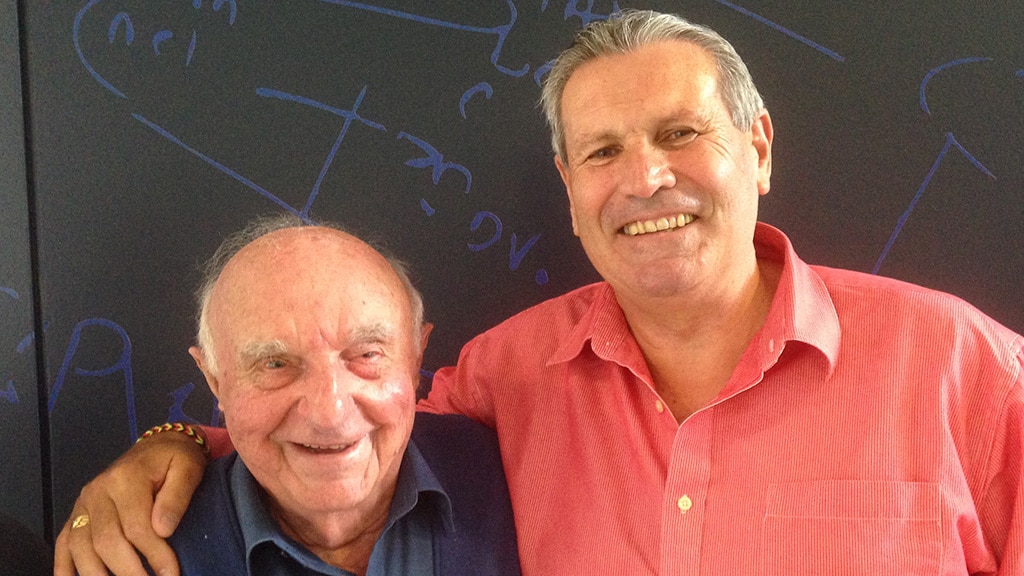
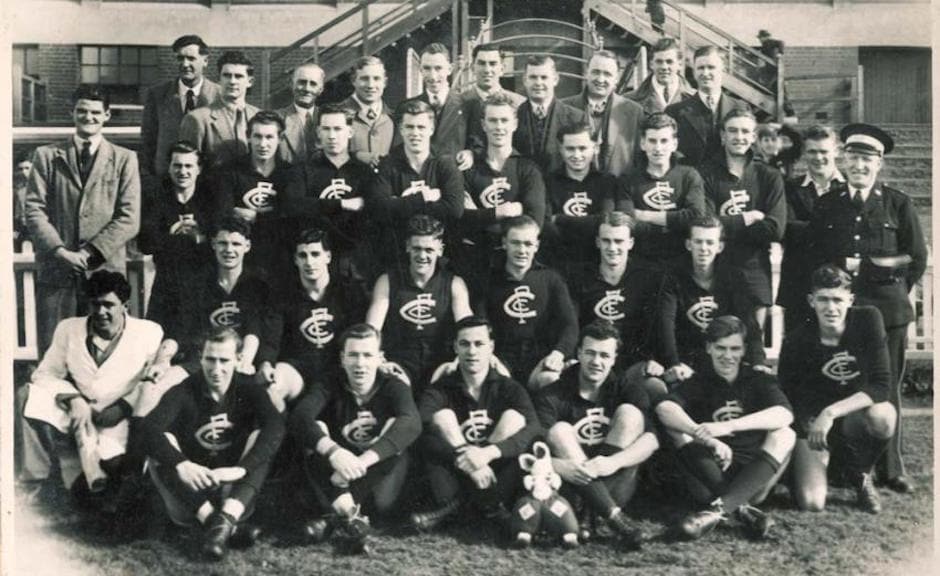
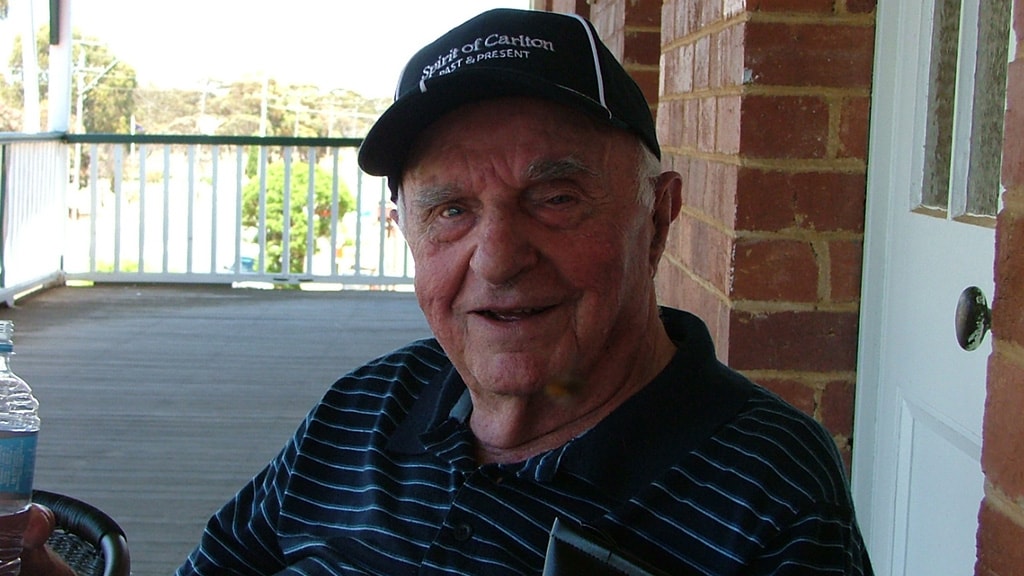
Ken Kleiman with former Carlton player Kevin Heath.
LONG-SERVING and much-loved former property steward Ken Kleiman, a Life Member of both the Carlton Football Club and Spirit of Carlton, has died after a short illness at the age of 93.
Born on Christmas Day 1925, Kleiman often quipped that “there were only ever two half decent blokes born on that day and I was one of them”.
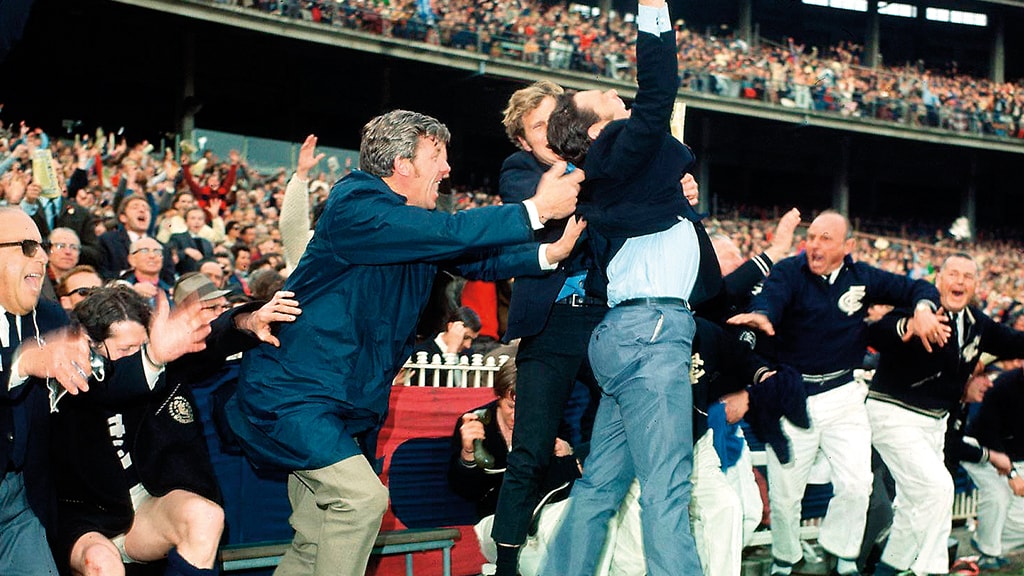
A lifelong supporter, he joined the club in 1965 at the time George Harris’s Progress Party was swept into power and Ron Barassi signed on as Captain-Coach. A famous photograph of a euphoric Barassi at siren time of the 1970 Grand Final features an equally jubilant Kleiman in the frame.
In terms of his allegiance to the old dark Navy Blues, few were as passionate or as endearing as Kleiman, as his friend and former club runner Bob Lowrie attested.
To quote Lowrie: “He loved Carlton and Carlton loved him”.
“Kenny’s life was just full of fun, and you never had a conversation with him without the Carlton footy club coming up. The people he really respected at Carlton were Jack Carney and Jack Wrout – they were his two favourites,” Lowrie said.
“I remember at one point that Kenny was battling with a badly bruised arm that he copped after a knock in the course of his work. His arm was quite blue, but when I questioned him about it his response was: ‘I’m a Carlton supporter – blue blood in the veins’.”

Siren time, 1970 Grand Final – Ken Kleiman can be seen to the immediate right of Ron Barassi as you look at the photograph.
For years, Kleiman supported the late Carlton property steward Ken Monk. Awarded Life Membership in 1985, he was recognised in the club’s Annual Report of that year as one of “Carlton’s most faithful workers” and the 1995 Premiership saw him out in terms of his official commitments.
But this lovable identity with a twinkle in his eye never strayed too far from Princes Park, where he invariably found himself on the receiving end of good-natured gags from players and officials alike.
For years, the following poem, devised by Blue Diamonds Coterie President Dick Merton, was cheekily adopted by those who knew Kleiman whenever they crossed paths with the follicly-challenged old-timer.
Kenny Kleiman met a pieman
Going to the fair,
Said the pieman to Kenny Kleiman
‘Where’s you’re f… hair?’.
Four-time Carlton Premiership player David McKay, now recovering from recent triple bypass surgery, fondly talked of his relationship with the two Kennys this week.
“Kenny Monk and Kenny Kleiman were very good mates of mine. They used to let me hide in the property room so I wouldn’t have to partake in the psych stuff which I thought was all a bit silly,” McKay said.
“I’ll never forget the Snappy Panties Bedford van Kenny used to ferry our gear to our away games. Kenny was a real Carlton person who will be sadly missed.”
Kleiman, who was recently acknowledged at the Carlton Life Members Luncheon as the oldest member within club ranks, was admitted to Heidelberg’s Austin Hospital on Friday and died the following Monday (August 5).
He is survived by his beloved wife Pam, son Mark, daughter-in-law Carolyn and grandchildren Samantha and Joel.
As a mark of respect to Kleiman, the Carlton players will wear black armbands into Sunday’s match with Richmond at the MCG – and while funeral arrangements are yet to be finalised, he’ll be laid to rest in an old woollen Carlton guernsey signed by Barassi and surviving members of the 1968 Premiership team.
Clearly, Kleiman was a revered figure at Princes Park. As Lowrie said: “He was a great Carlton man in every sense. He’d never say a bad word about the club”.
Former Carlton centreman dies
ROGER Hoggett, the 12-game former Carlton centreman through the Hands/Barassi transitional seasons of 1964/’65, has died peacefully in Wonthaggi at the age of 77.
Recruited to the club from Longford in the northern midlands of Tasmania, Hoggett was adjudged Blues best and fairest at reserve grade level in his maiden ’64 season. That same year, having strung together half a dozen stand-out performances in the twos, Hoggett got his first senior call-up and was named 20th man in the 11th round match involving Geelong.
That winter Saturday, Hoggett took his place on the pine with John Comben, as fellow team members, including the then captain Sergio Silvagni, John Nicholls, the late Wes Lofts and the ’64 Brownlow Medallist Gordon Collis, took their places on Princes Park.
Wearing the No.36 later worn by Mark Maclure and (now) Patrick Kerr, Hoggett was only called upon in the remaining few minutes of that contest and was omitted by Senior Coach Ken Hands for the following game.
However he soon won a senior recall and turned out in the 13th and 14throunds with Hawthorn and Melbourne respectively.
By season’s end, and with Carlton having completed its worst ever finish (tenth) in its Centenary year, George Harris and his Progress Party completed an audacious boardroom coup and sensationally landed Ron Barassi as Captain-Coach.
In the ensuing summer months under Barassi’s watch, Hoggett and fellow members of the playing list were subjected to a searching pre-season regimen. Unfortunately, Hoggett’s papers were stamped after the 11th round of 1965, when Carlton met St Kilda for the first time at Moorabbin. In a tight, even contest involving the two top four teams, former Carlton player Bruce McMaster-Smith broke the deadlock with a crafty match-winning snap – precipitating five Carlton omissions, Hoggett included – and he never again turned out in Dark Navy.
Collis remembered Hoggett as a solidly-built midfielder, “but probably a casualty of the Barassi revival”.
“‘Barass’ was always big on pace and height in players, and was always looking for that archetypal type. Roger was a solid player, but wasn’t real quick, which probably didn’t help, and he was a bit stiff in not being able to land that regular spot in the team.”
Garry Crane, the three-time Carlton Premiership player, Best and Fairest, and Team of the Century player, completed his senior debut in the same season as Hoggett. He remembered the Tasmanian recruit as “very powerfully built, strong and hard at the ball”.
“Roger wasn’t real quick, but he made himself known. Anyone who was hard at the footy earnt respect at Carlton and that’s the way that he was,” Crane said.
“I didn’t really get to know him well, because in those days there weren’t as many functions where you got to collaborate with the players, and me being in hotels at the time meant that I’d train then dash back to the pub. But I do remember him making an impression, more than anything else because he was a good bloke.”
Three years after parting company with Carlton, Hoggett was appointed captain-coach of New South Wales powerhouse Western Suburbs and duly led the Magpies to a Premiership in his first season.
Hoggett, whose wife Lyn predeceased him, is survived by his children Dyson, Mycalie and Shahn, son-in-law Boo, and four grandchildren.
His funeral is to be held at the Anglican Church of Ascension in Inverloch next Tuesday (August 6).
Cornell flies flag for ’49ers
With both Don Hyde AM and the ‘49ers captain Alan ‘Alby’ Mangels sen. late apologies for the pre-match Luncheon, Cornell flew the flag in fine style. Now 88, Cornell was formally welcomed by Mark LoGiudice to an audience which included the great John Nicholls, and he later took his place in the stand to see the home team prevail by 24 points.
“I really enjoyed the experience. I give the club a rating of 100 per cent on everything. The people on my table were very pleasant and I even got the chance to share a few words with Chris Judd,” Cornell said.
“I actually got the first ‘49ers reunion going – a 50-year reunion back in ’99 – with the help of the late Chris Pavlou who was with the Spirit of Carlton. To then be invited back by the Club after 70 years was most appreciated.”

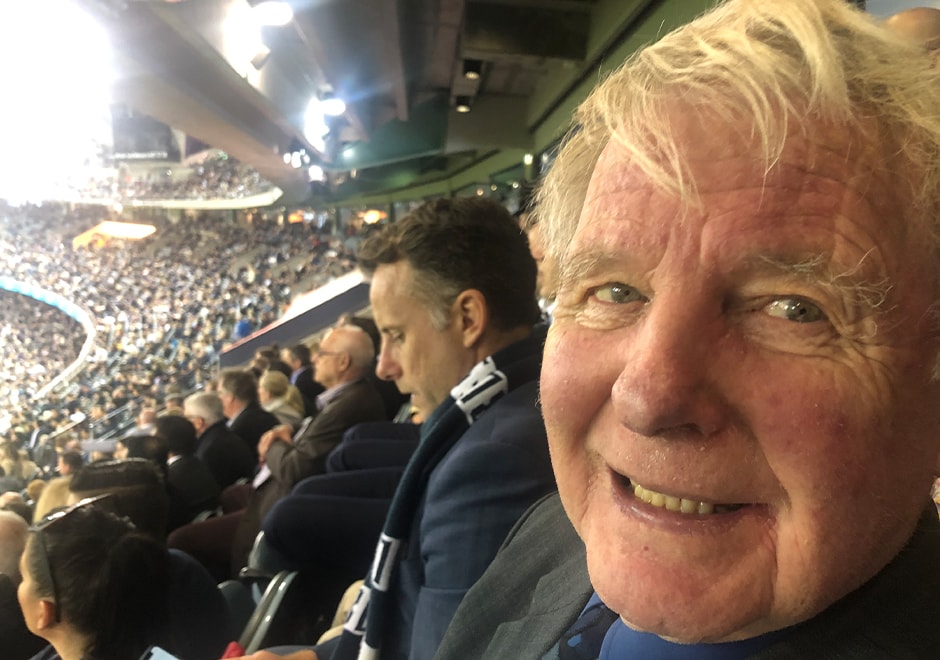
Hugh Cornell, a member of the 1949 under-19s premiership team, at Marvel Stadium on the weekend. (Photo: Supplied)
For the record, Hugh’s under-19s team prevailed against a committed Geelong – 9.8 (62) to 7.9 (51) – to secure the ’49 pennant in a tight contest.
The ’49 triumph completed back-to-back Grand Final victories for the thirds, whose members also included Ian Clover and Dick Gill, the sons of Carlton greats Horrie Clover and Frank Gill. Jim Francis, the Carlton Premiership player at senior level in 1938, served as coach throughout that period, having taken control of the junior outfit when it was first admitted to the Northern District Football Association in 1944.
Francis, who succumbed to a knee injury the previous season, imparted his football nous on the players, with University High School sportsmaster Mr. Gaynor offering his services as an administrator.
The then Secretary Harry Bell, in his season overview for the 1944 Annual Report, somewhat prophetically reported:
“Mr. Gaynor and Jim Francis formed the ideal combination for the control of the boys, and it is hard to assess their value to your club, but it is thought that full realisation of the plan may be expected in two or three years, when five or six of these boys will be regular First Eighteen players, and when this is achieved it may then be recognised that the fielding of an under-18 years team in the N.D.F.A. was one of the most progressive steps ever undertaken by the Carlton Club”.
Cornell recalled that in those fledgling years of the under-19 competition, Collingwood was the only team not represented, “which is somewhat surprising when you think about it”.
“I think the 12th team at that time was a TAA team,” he recalled.
Cornell also remembered his old mentor with great affection.
“Jim Francis was a wonderful coach. He asked his players to play hard and fair,” Cornell said.
“He was a real gentleman. He was always very measured and he never lost his temper.”
For the record, Carlton’s Trophy winners in the ’49 Premiership year included Harry Sullivan (Best and Fairest), Tom Jones (Most Consistent), Keith Robinson and Noel Rundle (who tied for Best Team Man), Max Thomas (Most Serviceable Player) and George Ferry and Gerald Burke (who tied for Most Improved Player).
With the exception of Rundle, all award winners later represented Carlton at senior level – Ferry in 139 games, Burke (87), Sullivan (31), Thomas (24), Jones (seven) and Robinson (two).
Until recently, Cornell had dutifully convened reunions of the Carlton ‘49ers in every year since 1999 – the 50th anniversary of their famous victory at the old Princes Park ground.
Those reunions have ended with the ‘49ers’ advancing years – not that Cornell is letting Old Father Time have his own way. As a retired industrial chemist who turned his attentions to the food industry, the former RMIT Associate Professor is in the throes of completing a book which explores the many and varied human diseases and how they can be remedied through healthy lifestyle.
Previously, Hugh committed his energies into coeliac disease result, with the result that a tablet to assist coeliacs – of which there are one in 70 sufferers – is now on the market.
Hugh also had a book published by the English company Minerva Press, entitled Mostly Mozart, which in part explored the therapeutic qualities of the famed composer’s music.
Why Mozart?
“I discovered Mozart when I was 14 after my uncle, himself a musician, played Beethoven’s Pastoral Symphony to me. That was like a conversion,” Cornell said.
“Back then I was interested in American big bands like Glenn Miller’s and Tommy Dorsey’s, but when I heard the pastoral symphony that was great music, not good music – and that in turn led me to Mozart.”

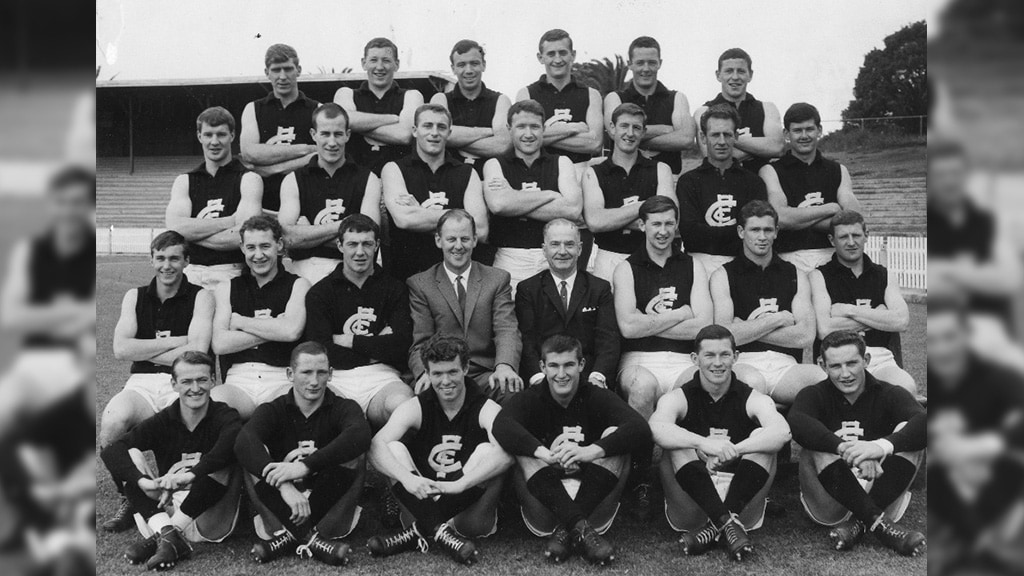
The Carlton 49ers
3rd row: Jim Johnson, Brian Amarant, Ray Clover, Keith Robinson,
Harry Sullivan, Tom Jones, Ron Price, Don Hyde, Dick Gill
2nd row: Ambrose Curtis, Hugh Cornell, George Ferry, Alan Mangels (c.), George Stafford, Noel Rundle, George Handley
front row: George Crowley, Max Thomas, Maurie Rossi, Charlie Blake, Gerald Burke, Ken Reed
Coach Jim Francis stands is in the back row, fifth from the right.
AFLCPPA Match Day Function Round 15
AFLCPPA Round 14 Match Day Function
Latest Video – Des English 1986
Bruce Doull Entire Career on Video
Latest Video – Bruce Doull 1986
Alex Marcou Entire Career on Video
Rod Ashman Entire Playing Career on Video
1979 Premiership Reunion – 2019 SOC Luncheon
1979 PREMIERSHIP REUNION
THE SPIRIT OF CARLTON INVITES YOU TO JOIN MEMBERS OF CARLTON’S 1979 PREMIERSHIP TEAM AND THE CURRENT CARLTON TEAM TO CELEBRATE THE 40TH ANNIVERSARY OF OUR FAMOUS PREMIERSHIP VICTORY OVER COLLINGWOOD.
SCHEDULE OF GUEST BENEFITS
YOUR EXPERIENCE INCLUDES
- Delectable two-course lunch
- Premium beverages
- Guest speakers and entertainment
EVENT DETAILS
Date: Friday 9 August 2019
Function Time: 12:00pm
Venue: Victory Room, Marvel Stadium
Dresscode: Smart casual attire
Tickets are not sent out for this event, entry will be via a guest list only.
INVESTMENT
$150 per person
OR
$1,500 per table of 10 plus the chance to be joined by a current Carlton player
BOOKINGS & ENQUIRIES
Carlton Corporate
P: (03) 9389 6354
E: CorporateSales@carltonfc.com.au
Latest Video – Jon Dorotich 1986
“Walking on air”: Francis recalls ’79 GF
In the lead-up to the 40th anniversary reunion of members of Carlton’s 1979 Grand Final victory (yet again over Collingwood), thoughts invariably turn to Wayne Harmes and the dramatic lunge and thump that’s long been part of League football lore.
And yet Grand Final day ’79 proved to be the defining football moment in the life and times of Heathcote’s own Peter Francis – the 47-game Carlton wingman often considered best afield on that last Saturday in September and therefore the Norm Smith Medallist who wasn’t.
Few would realise the enormous responsibility that was entrusted with Francis by his great mentor Alex Jesaulenko – League football’s last Grand Final-winning captain-coach – in the lead-up to that dramatic contest in sodden conditions in September ’79.
But as Francis explains, Jesaulenko had steeled him for such tasks in a pivotal discussion just prior to the commencement of the pre-season training period some 10 months before.
The following is Peter Francis’ story, in his own words.
It’s hard to believe 40 years have lapsed since Grand Final day 1979. As I often tell my kids here (as Talent Manager with Gippsland Power) – “Your footy career goes really quickly – don’t take it for granted, make the most of it”.
I’d played reserves at Carlton through the 1977 and ’78 seasons. In ’78 I played in a night game and kicked four, but I didn’t get the nod for the next week. As the year went on I feared I wouldn’t make it, and in the last reserves match of ’78 when I was named on the bench I thought “Gee, I’m in real strife here”. I honestly thought I’d get delisted.
But looking back on it now, the ’77 and ’78 years were really part of my football apprenticeship, and ‘Jezza’ (Alex Jesaulenko) played a massive part in that.
Jezza had a good eye for talent. I remember that he used to always sit upstairs, even before he coached, to watch the reserves play. Obviously he got a handle on guys coming through, and he recognised players like myself and Alex Marcou who was in the same boat as me, having played a couple of seasons in the reserves before he made it.
Jezza came to me at the end of ’78, just before pre-season started in November, to raise a couple of points. The first of them related to the positives, that I had the skill and good speed, but then he told me about the areas in which I needed to improve. “You need to get tougher, you need to get stronger and you need to get harder”, he said. In other words, he was telling me to get bigger and become more aggressive in my attack on the footy . . . and he was right.
Jezza said to me: “I’ve booked you in to do some boxing with a fellow named Des Duguid (a former Amateur boxer) at the Police Academy and I’ve also booked you in to do weights at the Melbourne Weightlifting Centre . . . on top of the other training that we’ll do”. He also said to me: “If you don’t do that, I’ll know that you don’t want to play”.
So I went and did it, I put on a stone in weight, and whereas I thought I’d hate the boxing, I absolutely loved it: while I still couldn’t fight, it gave me real confidence. After that pre-season I knew that no-one could hurt me, in the end I got the nod for Round 1 in 1979 and away I went.
I loved Jezza as a coach. He was brilliant for me. He gave me my opportunity and he taught me how to play my part for the team. Every week he’d say to me, “Peter, you play your role, you do what I tell you and you’ll stay in the side. You go outside that and you’ll be out”. Every week he’d say “You’re on the wing this week Peter, you’re on (for example) Michael Turner. I only want him to get seven kicks and I don’t care if you only get six.” So I knew that day that I had to be a defensive wingman and that I had to keep my opposing wingman quiet – whereas on another day he’d tell me to go for it.
In terms of my relationship with Jezza I knew my role, I knew what I had to do each week and I knew that I had Jezza at my back – and I think that’s the real art of coaching.

Peter Francis played a starring role on Graeme Anderson in the 1979 Grand Final. (Photo: Supplied)
The MCG was a heavy deck on Grand Final day, but I knew that my body could stand up to it and again I knew my role. Michael Young was told he had Ricky Barham and I was told I had Graeme Anderson. Now Graeme had kicked three goals on Keith Greig in the Preliminary Final and five the week before in the first semi against Fitzroy. As such, my role was to keep Graeme quiet and not allow him to kick a goal (Anderson managed just one behind), and as much as I got a little bit of the ball that day, my real role was to prevent Anderson from playing well.
It’s funny – when I think back to the ’79 Grand Final, what sticks in my mind is that I slept really well the night before. I was always a nervous player, I always got terribly anxious before games, and while I had a little bit of trouble getting into the ground on Grand Final day I wasn’t nervous, which was a bit bizarre.
I don’t remember a lot of what happened in the rooms or what Alex said before the game, but the biggest thing I remember is that when we ran out to the roar and to all the balloons flying, I felt like I was walking on air. It was the most amazing feeling I’ve ever had and the hardest thing to describe. But I knew that I felt good that day, I was confident I was going to play well and so too the team.
People remember you for playing in Grand Finals, but certainly for playing in Premierships – and I’ll tell you now I played better in a lot more games before and since.
In saying that, the 1979 Grand Final defined me as a player for sure. A lot of people remember me for that game, not realising I played at four clubs. They think I only played at Carlton and they remember me for the 1979 Grand Final. All I can say is that I was lucky enough to play well in what was a star-studded side – Southby, McKay, Doull, Keogh, Ashman, Buckley. I was just a “good ordinary player” as Jack Dyer would say, with a lot of champions around me.
In fact, that game defined my life. For the past 27 years, I’ve been working full-time in it and I put it all down to that day, no doubt.
I played more games at Richmond, but I was at Carlton for five years, Carlton was my first club and Carlton gave me the opportunity. My obvious preference would have been to stay at Carlton, but it didn’t work out that way and that doesn’t matter – that’s how football goes, I’ve never been bitter and I’ll always be indebted to Carlton for what it did for me.
Life’s really busy and with the passing of time you do tend to go your separate ways. But I remain good friends with Kenny Sheldon and Wayne Harmes and I’m really looking forward to seeing Jezza again at the reunion for all those reasons I have outlined. As with Carlton, I’m indebted to Alex Jesaulenko too. Without Alex, I would never have got my opportunity. I really believe that.
Latest Video – Peter Dean 1986
Latest Video – Rohan Burke 1986
50 years ago: An immortal enters the stage
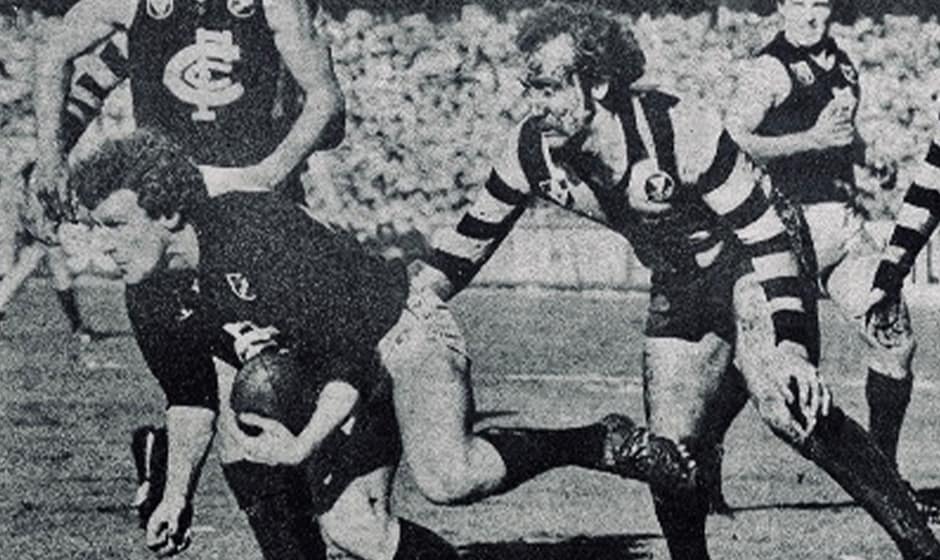
It happened in the fifth round of the ’69 season, against South Melbourne at Princes Park – for Bruce Doull the first of 356 senior appearances through 18 seasons of a truly grand career for Carlton.
This week marks the 50th anniversary of Doull’s senior debut – and on the eve of Sunday’s match with North Melbourne, the legendary Carlton figure recounted a tale which would suggest he could quite easily have played for Geelong or even North, had fate not intervened.
In a wide-ranging to-camera interview with this reporter by the No.11 locker a little while back, Doull – who was born in Geelong – recalled his childhood passion for the Pivotonions.
“I used to wear my Geelong jumper to school, but I didn’t really have a football background in Geelong, I didn’t play at Geelong at all,” Doull said.
“I was nine years old when we (the Doull family) came up to Melbourne, to Broadmeadows. I joined Jacana through friends at school. That was Under 13s and that was the first period of football for me.
“In the early years each club had a boundary . . . and ours was in the northern suburbs. I was half a street within Carlton’s zone, the other was North Melbourne’s.”
In truth, Doull’s father (and Rod Austin’s father as it happened) settled into new houses on the Carlton side of Camp Road, the dividing line separating the Carlton and North Melbourne zones. Also in the neighbourhood were the families of Wayne Harmes and Shane Robertson – fellow Carlton Premiership players who all lived on the right side of the divide.
Doull cut his footballing teeth at Jacana through the Under 13s, Under 15s and Under 17s (curiously as a ruckman), before joining Robert Walls as a Carlton Under 19 hopeful in 1966. For Doull, on-field progress was slow. As he said: “I played a lot of games in the Under 19s, a lot of games in the reserves, and was in and out of the firsts for a long time”.
Recounting his somewhat delayed emergence as a bona fide senior competitor, Doull offered a forthright response.
“I think it was because I just wasn’t a very confident person . . . I also had an injury in my early years, a dislocated collarbone which wouldn’t go back into place, and I had to have it pinned – so I was out for a long time with that,” he said.
“Then when I did get back in I got a hit from behind and got a fractured cheekbone, which put me out for a few weeks . . . I don’t know whether I lost confidence or what, but I just wasn’t aggressive enough for that style of footy at the time.
It was at this crucial moment in time that the perceptive Carlton senior coach Ron Barassi intervened.
“He (Barassi) really tried to help. He sent me off to do judo training to learn how to fall, which I don’t think a lot of people wouldn’t have been doing in those days, and he also sent me to a psychologist just to try and get some confidence in me,” Doull said.
“When we were training, if we were doing circle work he (Barassi) would call my name out to get involved – even if I was on the other side of the ground he’d just yell it out – otherwise I probably would have just hung in the background.
“He (Barassi) was a massive influence on me. I was very scared of him. Very scared of him. He was the coach, you were the player and that was it. But I appreciate that he took the time to (help) . . . and I can’t thank him enough for the start.”
Named 20th man for that first senior outing against South and wearing the comparatively obscure No.4, Doull took his place on the pine alongside Barry Gill – and when the call finally came though from the coach’s box, Doull replaced Alex Jesaulenko no less.
Sadly, Doull remembers precious little of his first on-field sortie.
“I don’t remember anything about that game, nothing at all,” he said. “In those days they’d call you over on the Thursday night to tell you that you were playing. That’s what would have happened.”
But history records that Doull did get to sing the song post-match, the home team having accounted for the Bloods by 25 points – 20.17 (137) to 17.10 (112) – with the resident ruckmen John Nicholls and Peter Jones each contributing three goals to the winning tally.
The Carlton-South Melbourne contest of Round 5, 1969 was not without incident.
Volatile Carlton full-forward Ricky McLean was reported for the second time in eight days and duly outed for two matches by the Tribunal for having used abusive language towards field umpire Ian Coates.
‘Barass’ was also the subject of a League investigation in respect of his umpiring remarks for which he was later reprimanded in writing.
But for one of the most revered football figures ever to lace a boot, a glorious career awaited.
Bruce Doull bio
DOB: September 11, 1950
Carlton Player No.: 811
Senior career: 1969-1986
Senior debut: Round 5, 1969 v South Melbourne, aged 18 years, 234 days
Games: 356
Goals: 22
Last Game: 1986 Grand Final, v Hawthorn, aged 36 years, 16 days
Guernsey nos.: 4 (1969-71) & 11 (1972-86)
Premiership Player: 1972, 1979, 1981 & 1982
Best and Fairest: 1974, 1977, 1980 & 1984
Norm Smith Medallist: 1981
Carlton Hall of Fame: 1987 (elevated to Legend)
Carlton Team of the Century half back: 2000
AFL Team of the Century half back


Subscribe to my channel