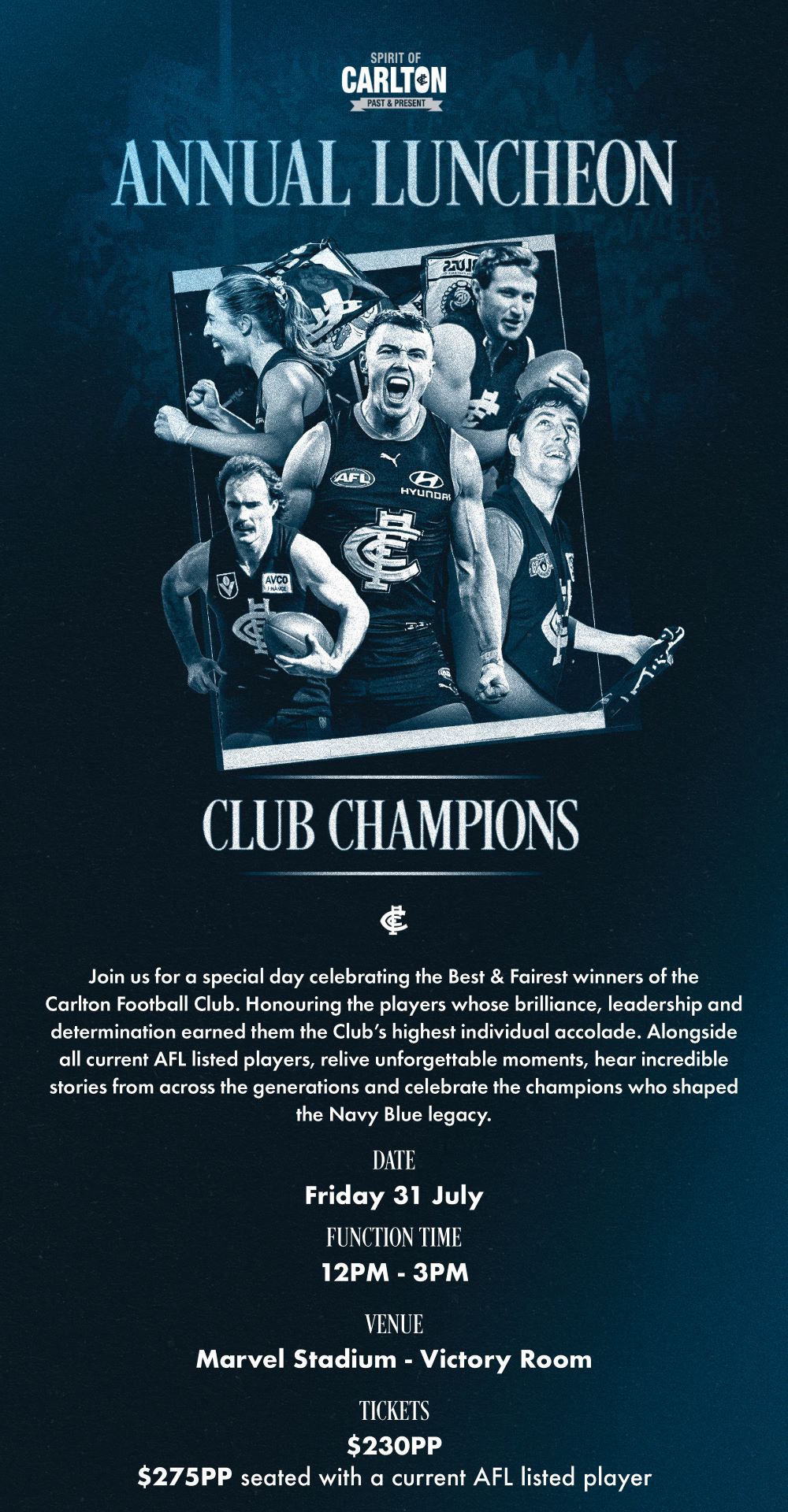
2026 Annual Luncheon
Spirit of Carlton Past and Present
We represent the past players and officials of the Carlton Football Club
The AFLPA is providing another round of free health check days for AFLPA Alumni past player members, these 20 minute consultations check blood pressure, glucose and cholesterol, liver and kidney function amongst others. A great opportunity to look after yourself.
Date: Tuesday 3rd June and Wednesday 4th June 2026
Location: Marvel Stadium, Docklands
Time: Each appointment it confidential and run approx 20 minutes
For further details and to book your time please either consult your latest AFLPA emails or contact the AFLPA directly.
On the eve of the 31st Peter Mac Cup, Sam Rowe reflects on his own cancer battle won with the support of the three ‘Fs’ – family, friends and football club.
By Tony De Bolfo
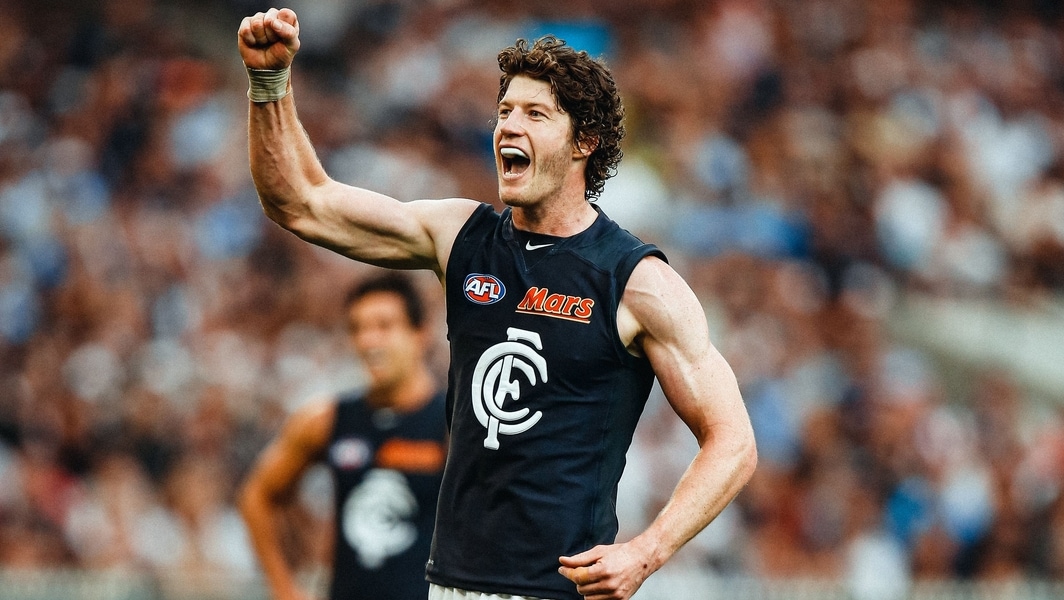
FOURTEEN years ago this week, Sam Rowe faced his mortality at the very moment his lifelong dreams were beginning to materialise.
At 24, the boy from Walla Walla – whose name was called by Carlton in the 2011 AFL National Draft – was a “second chance” story which resonated with supporters.
Rowe’s path to the big time had been anything but linear. First given a chance at the elite level when he was rookied to Sydney in 2006 and ’07, his evolution from a teenager fresh out of school to a professional athlete in the rigorous SCG environment proved somewhat demanding. By Rowe’s own admission, he wasn’t ready for the mental and physical demands of the league at 18, and he and the Swans parted ways.
Refusing to let his career end there, Rowe relocated to South Australia in 2008 to hunt the pigskin for Norwood. As a Redleg, Rowe truly came into his own, developing into a solidly built, reliable key forward and eventually catching the eye of talent scouts again.
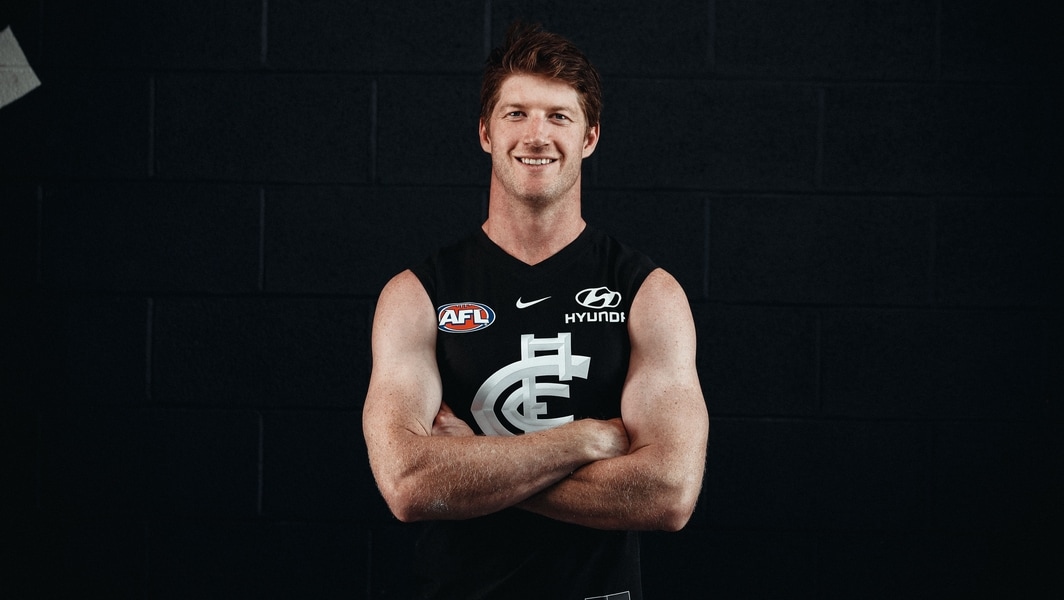
When the Blues called Rowe’s name at selection No.44 of the 2011 AFL National Draft, they knew what they were getting. Here was a player older, wiser and physically capable of contributing to their future successes.
Alas, the Rowe comeback was cruelly halted in 2012 – Friday 13 April to be exact – by way of a devastating medical diagnosis, stage one testicular cancer. The news sent shockwaves through the Club and the wider football community, and suddenly forced Rowe’s seismic shift from marks and goals to health and survival.
Rowe underwent surgery to remove the tumour and subsequently underwent a rigorous course of chemotherapy. The treatment was expected to last between six and nine weeks, a period bound to test his physical resolve far more than any pre-season training session ever could.
Despite the gravity of the situation, Rowe displayed a remarkable stoicism. Even in the face of chemotherapy, Rowe remained focused on his return to the sport, telling the Club he fully intended to be available for the 2013 pre-season.
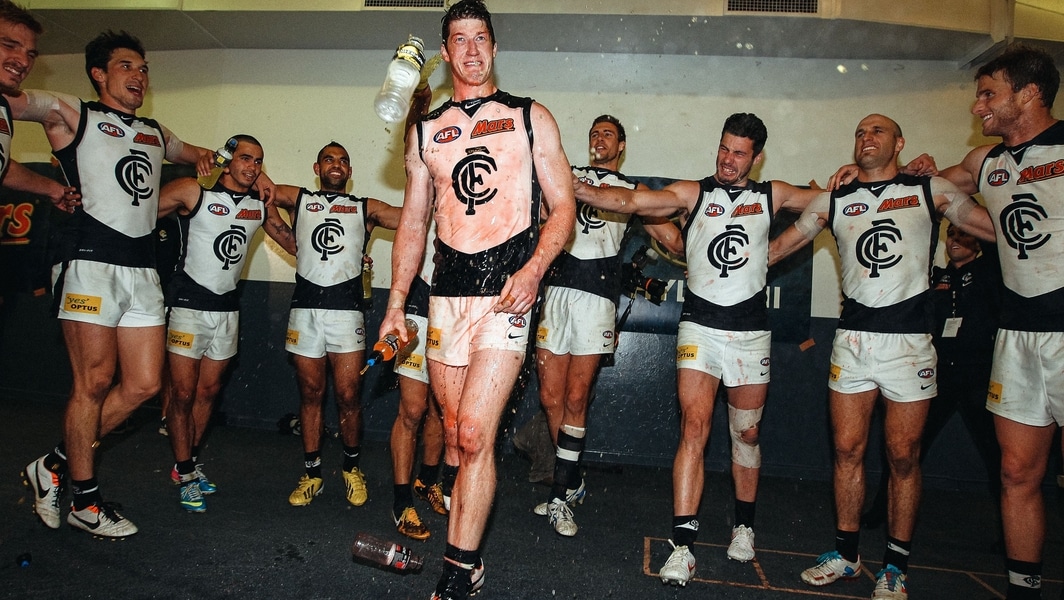
The Carlton Football Club rallied behind Rowe, requesting privacy whilst providing a platform for fans to send messages of support. Through it all, Rowe dealt with the inevitable side effects of cancer treatment whilst keeping the mindset of an elite athlete determined to reclaim his place on the football field.
Rowe’s successful battle with cancer and his eventual return to senior football became a source of inspiration. He didn’t just return to play: he became a mainstay of the Carlton defence for years, in earning 99 senior call-ups before the end came in 2018. In that time, his ability to transition from a forward to a dependable key defender showcased an adaptability that mirrored his journey through life’s hardships.
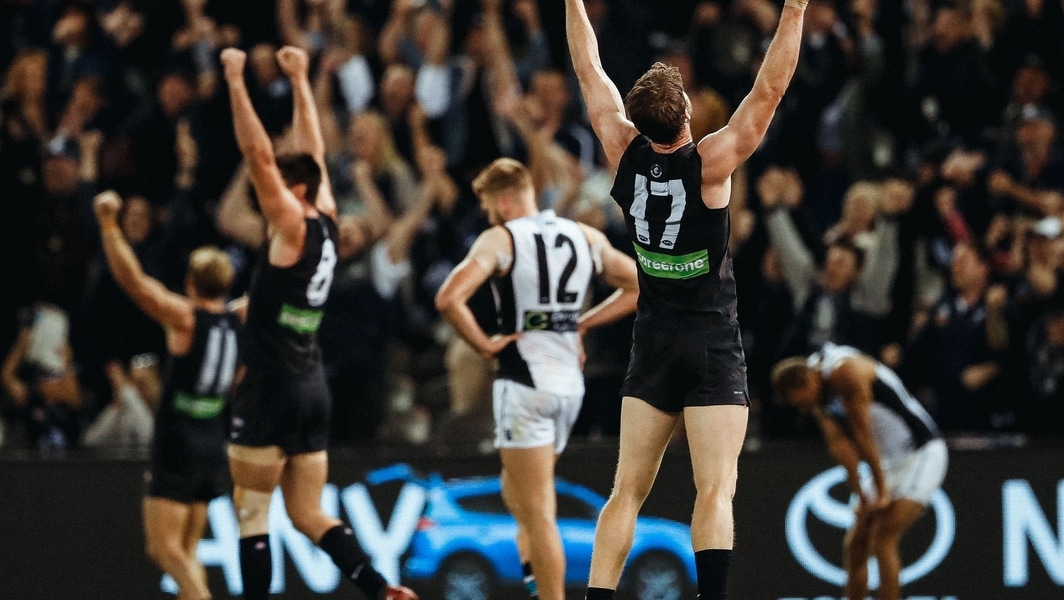
Beyond his playing days, Rowe’s legacy is intertwined with his role as a survivor. His career serves as a reminder that the rigours of League football are often mirrored by the rigours of real-world adversity. By speaking openly about his diagnosis and the reality of his treatment ever since, he has helped raise awareness for men’s health within the sporting world.
In the years beyond his retirement, Rowe, now the proud father of three boys, is remembered not only for his “big man” presence on the field, but also for the character he displayed off it.
The following is Sam Rowe’s recollections of that moment in time; his advice to those who may now be facing similar challenges, and, on the eve of the longest-running charity match, his call for on-going funding to aid the cause of the Peter MacCallum Cancer Foundation and life-saving cancer research.
I went to the Peter Mac Breakfast on Monday, on what was the 14th anniversary of my diagnosis. In the years since, my health has been perfect. I have a clean bill other than a few grey hairs.
How well I remember Friday the 13th 2012. It was a sliding doors moment and I’m so thankful I was with the Blues at that time.
By then I’d already felt a lump, had told the Club, and had undergone an ultra sound at a local radiologist. At two o’clock that Friday afternoon I met with the then club doctor Ben Barresi who said he knew someone at Cabrini Hospital in Malvern who could assist after hours.
The Club and the hospital moved quickly, and I was lucky that they did. My testicular cancer was stage one and while it hadn’t spread, it was fast-growing. At the time I was battling away as a carpenter, my wife was my then partner and I’d not yet played my first Carlton game – knowing the person I was then, I would have honestly delayed any treatment.
As a result of the diagnosis, surgery and subsequent treatment, I missed the 2012 season. It took me the year to get to the point when I could again push my body. I actually wanted to play the last six weeks of that season because I was in remission, but I had to get through chemo first. In the end I attacked the pre-season and broke into the ones in Round 2, 2013.
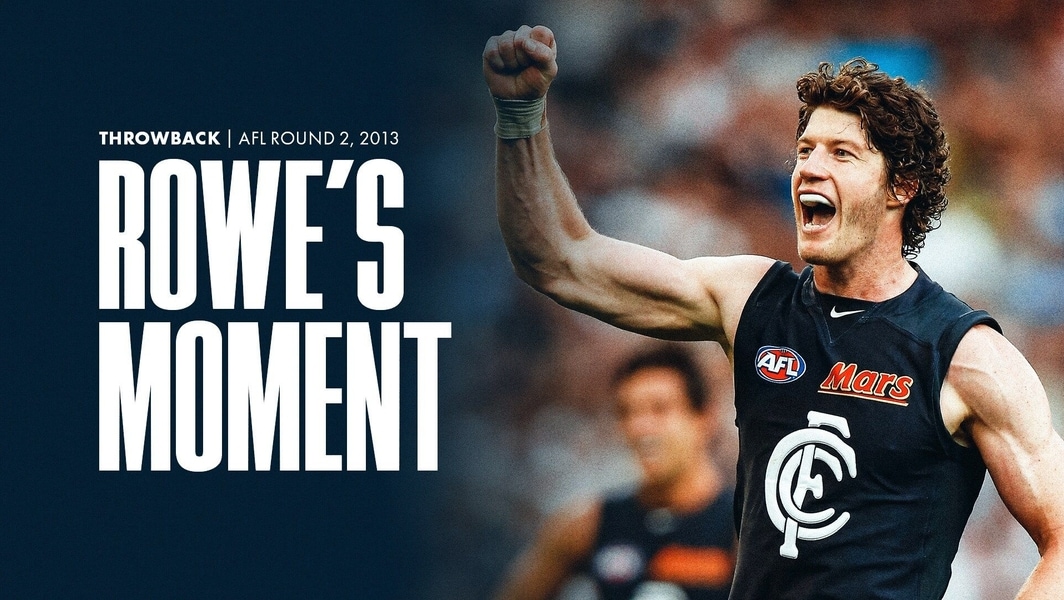
Apr 15 2026
Making his Carlton debut in Round 2, 2013 after a cancer battle, relive Sam Rowe’s first goal against Collingwood.
My wife (Natarsha) was my then partner at the time we’d moved across from Adelaide. She was such a great support – as was my family – through the treatment. I felt pretty good during this time, but the hardest thing was seeing family members tormented by what I was going through. Everyone wanted to help but couldn’t.
Personally, you go through wild fluctuations – the initial shock . . . denial . . . not wanting to tell anyone . . . then everyone wants to reach out. I’m a naturally positive person, but the goal for me was to keep positive. That was my focus.
Some people prefer to take on the illness themselves, but if I could offer any advice to someone in a similar situation it’d be to lean on close friends and family – to basically go through it with someone. I think that helped my mental state.
Regarding testicular cancer, it’s also important to know that it’s a young man’s disease. I was in my 20s at the time and thought I was invincible, so it’s vital that young blokes understand the implications.
I was invited to the Peter Mac Cup luncheon by Sam Docherty. I caught up with a few former players, saw the current players of both Carlton and Collingwood, and got to hear some incredible speakers. In listening, you quickly come to understand that Peter Mac is a world leader in terms of cancer treatment – even though it is so reliant on funding.
Peter Smith, son of the legendary Melbourne Coach Norm Smith, has died after a long illness at the age of 78.
By Tony De Bolfo,
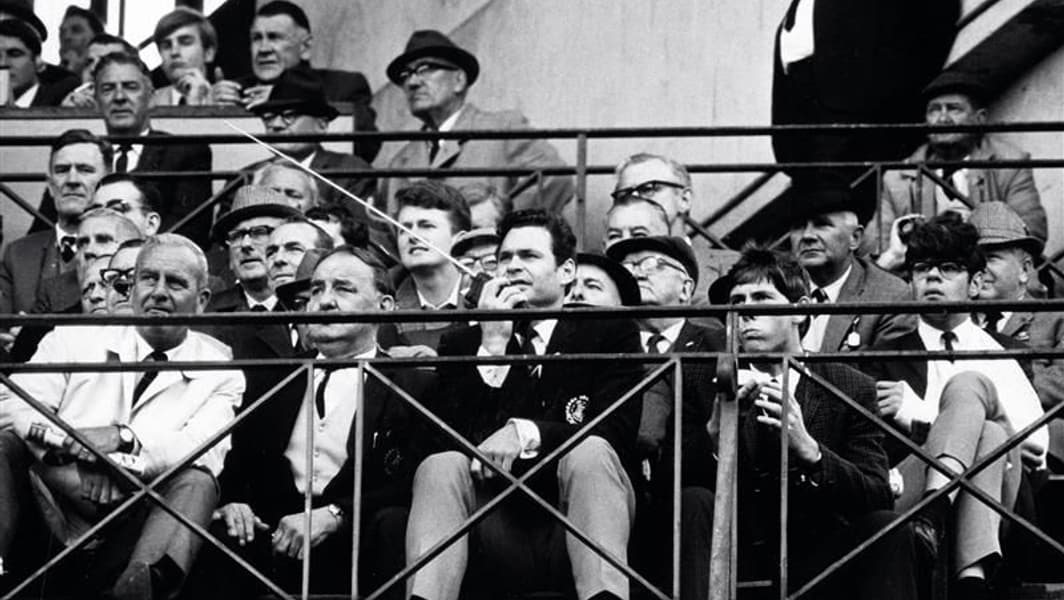
Peter Smith, son of the legendary Melbourne Coach Norm Smith, and a senior Carlton player in the Ron Barassi-coached Premiership seasons of 1968 and ’70, has died after a long illness at the age of 78.
Smith, who strung together 15 matches for the Blues, followed Barassi and Peter McLean across after a 13-game senior stint with the Redlegs that began with his recruitment from Melbourne Grammar in 1965.
Wearing the No.37 later made famous by his second cousin Wayne Harmes, Smith was named at full-forward for his Carlton senior debut in ’68, in the Round 2 Anzac Day contest with arch rival Richmond on the MCG.
As fate would have it, Smith’s on-going prospects up front were restricted with the sizeable presence of both Brian Kekovich and Alex Jesaulenko, and by 1970 he found senior selection increasingly difficult.
Accordingly, he turned out for the last time in Round 17 of that year, against Fitzroy at VFL Park – having earned the respect of his peers for which he was acknowledged with the President’s Trophy for Best Clubman in 1969.
To quote the unnamed correspondent in the ’69 Annual Report: “In winning this Trophy, Peter displayed all the attributes which combine to make an ideal clubman. The type of Club spirit he has is shown in the spirit in which he played in the Reserves for the major part of the Season and, undoubtedly, was one of the major contributing factors in their success. peter is at all times willing to assist in attending Clinics and promoting junior football, and is a worthy recipient of this Award”.
Smith managed just two senior appearances in 1969 and three in ’70 – the latter season in which he served as Carlton’s reserve grade captain and booted 45 goals for thew twos. Again, Smith earned glowing praise in the ’70 Annual Report: “The responsibilities of Captain would distract a certain amount of a player’s concentration, but despite this his (Smith’s) play was consistently good. He played in many positions, mostly where the pressure was greatest (and) this was a tribute to his versatility. A really great Captain’s effort.
Smith ended his time at Princes Park with the Club’s good wishes – and after having been cleared to VFA outfit Port Melbourne leading into season 1971, his opportunities suddenly presented.
As the Borough’s first-choice full-forward, Smith averaged 70 goals a season over the course of his first three.
Port Melbourne’s decision to trade Smith to Coburg in a direct swap for Mick Erwin, resulted in spectacular successes for the Lions, as they dropped just one 2nd division game in 1974 as Smith went on a goalkicking rampage.
In the final home and away round of the season he booted 13 goals against Mordialloc, then followed up with 12 in the second-semi against Waverley and another eight in the Grand Final with the same opponent.
Ultimately Coburg won the flag in a canter on the back of Smith’s 121-goal haul – a feat which saw him join Bob Pratt, Jack Titus and the former Carlton Premiership player Lance Collins as the club’s only players to kick the ton – and in his final season with the newly-promoted 1st Division outfit he booted another 82 before hanging them up.
In 1979, in the immediate aftermath of the hard-fought Grand Final victory over Collingwood, Harmes accepted the inaugural Norm Smith Medal for best player afield from Norm’s widow Marj – his great aunt through marriage to the acclaimed Melbourne Coach.
Years before, Harmes had crossed paths with Norm’s son when the former was a kid at Westbreen Primary School in Pascoe Vale.
“I remember back in grade six that Peter and his great friend Robert Walls turned up for a footy clinic at the school. I knew in advance that Peter was going to be there and I mentioned it to Dad who said to me ‘Peter’s your second cousin’,” Harmes said.
“I never knew until he mentioned it about four weeks ago that he wore the number 37 at Carlton. I first wore the number 54, but ended up with 37 when Ken Sheldon vacated it for Syd Jackson’s number five.”
In 2023, Smith and former Carlton footballer David Rhys-Jones shook hands to bring finality to an ugly on-field incident of 42 years previous. In Round 1981, Smith, who had returned to Melbourne as runner, and Rhys-Jones, then playing for Sydney, were involved in a fracas on the MCG for which Rhys-Jones was subsequently reported for striking Smith and duly suspended for four matches.
The great irony in all of this was that six years after the altercation, Rhys-Jones was presented with the medal in Peter’s father’s name as best afield for the Blues in the 1987 Grand Final.
Peter Victor Smith was the 803rd player to represent Carlton at VFL/AFL level since the formation of the competition in 1897. The Carlton Football Club extends deepest sympathies to his family and friends.
The Carlton Football Club’s on-field fortunes have been seriously shaped by some of the Bendigo district’s greatest exponents of the great Australian game.
Mar 25, 2026, 4:00 pm
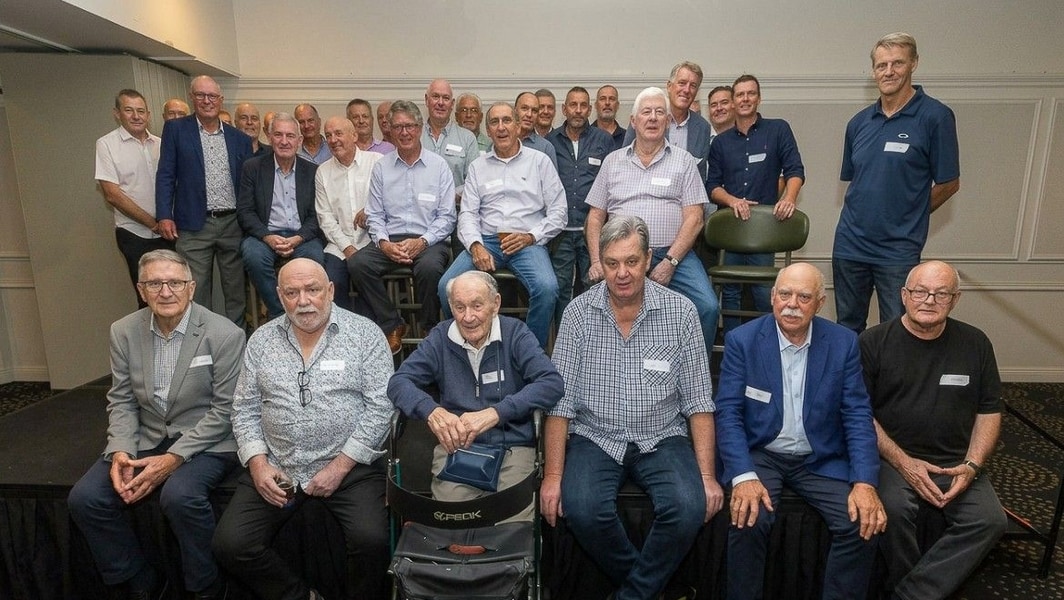
THE Carlton Football Club’s on-field fortunes have, throughout the decades, been seriously shaped by some of the Bendigo district’s greatest exponents of the great Australian game – from as far back as Eaglehawk’s Fred Jinks Fred Jinks who featured in the old dark Navy Blues’ acclaimed premiership teams of 1906, ’07 and ’08 under Jack Worrall’s watch.
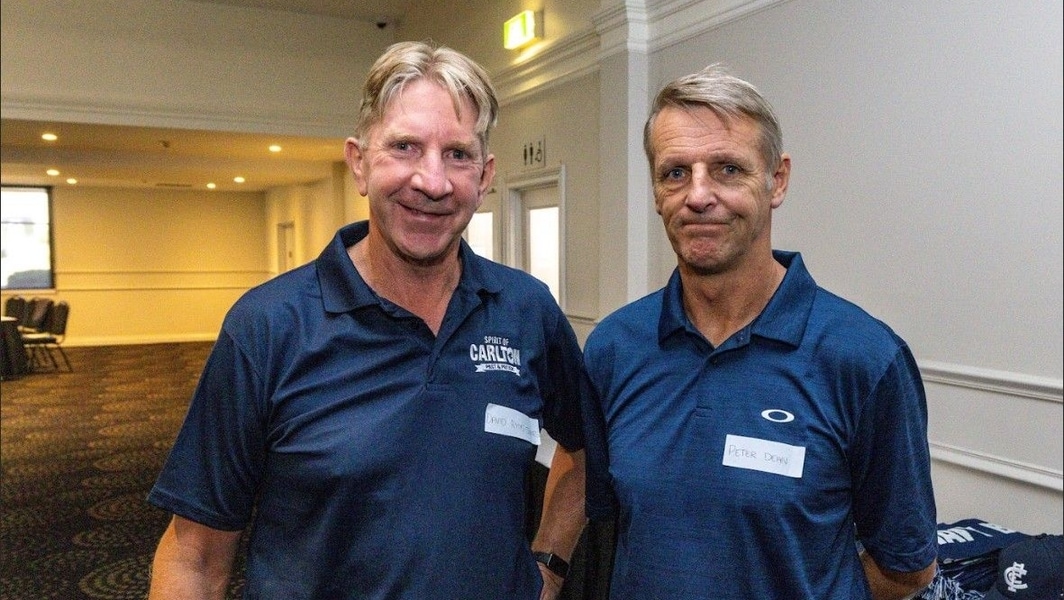
Fast forward 60 years to the early 1970s, when the likes of Sandhurst’s Geoff Southby and Trevor Keogh formed part of the Blues’ all-conquering Carlton premiership teams, and others such as Newlyn’s David McKay, Campbells Creek’s Peter Brown, Eaglehawk’s Rod Ashman and Des English, Kyneton’s Jim Buckley, Mitiamo’s Ken Sheldon, Castelmaine’s Warren Jones, South Bendigo’s Peter Dean, Sandhurst’s Michael Sexton, and Golden Square’s Peter McConville and Greg Williams followed suit.
Which is why the Spirit of Carlton saw fit to celebrate the seismic contributions to the Club of Bendigo’s finest, at a reunion of Carlton’s first, second and third-grade players of the region at Strathdale’s All Seasons Hotel, in support of former players facing various health and welfare issues.
The event attracted many of the aforementioned past players. Others in the house included Castlemaine’s Peter Fyffe, Chewton’s Paul Starbuck, Heathcote’s Tony Zoanetti, Maryborough’s Garry Higgins, Northern United’s Eric Pascoe, Golden Square’s Michael Gallagher and Tony Southcombe, Eaglehawk’s Greg Kennedy, Paul O’Brien, Golden Square’s Dean Strauch and Sandhurst’s Brendan Hartney.
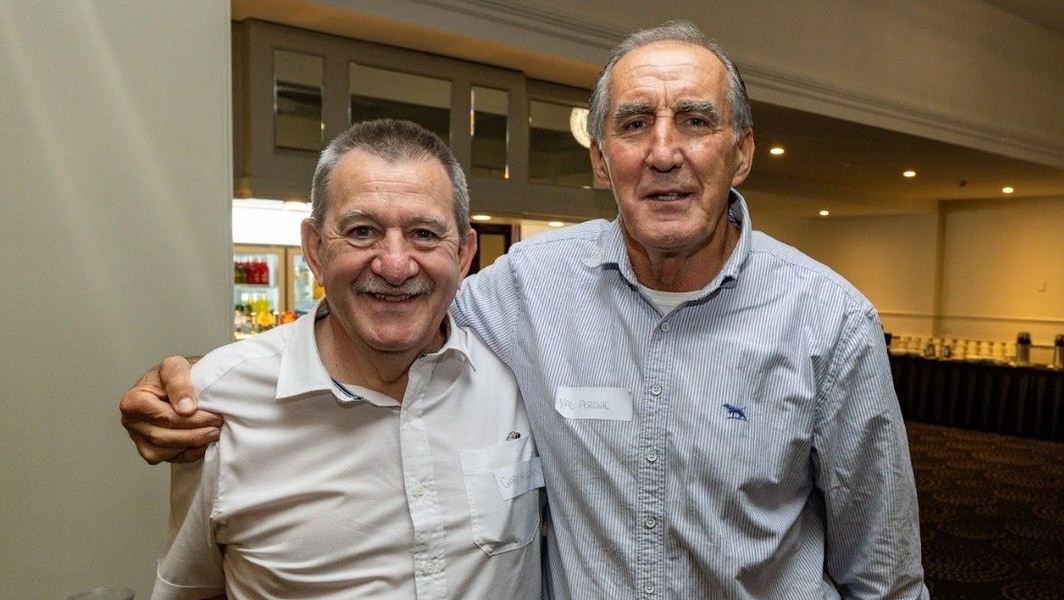
Bill Redmond, who starred for South Bendigo in its 1956 Grand Final victory, and who at 98 is Carlton’s oldest surviving former player, was also in the house, as was the former Geelong rover and long-serving VFL/AFL administrator Kevin Sheehan (ex-Sandhurst).
Former Carlton Chief Executive Stephen Gough, an old Bendigo boy himself, officiated as Master of Ceremonies.
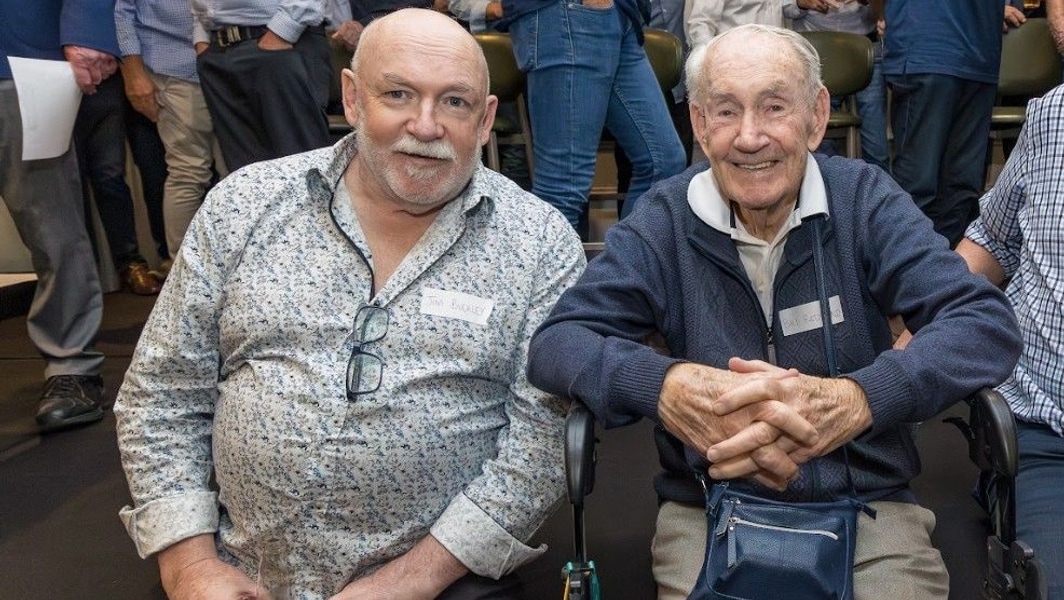
“The Bendigo district and Carlton association was created by the VFL midway through the ’67 season where the state was divided into 12 zones. How very fortunate for the Blues that the Bendigo district became the Carlton zone,” Gough said.
“The strength of the Bendigo Football League in the early 70s was amazing. Southby, Keogh and (Brian) Walsh were stars but had headed off to Carlton. However, the late Ron Best, Greg Kennedy and Tony Southcombe provided fans with some great football. The ’71 GF showed the quality of these players.”
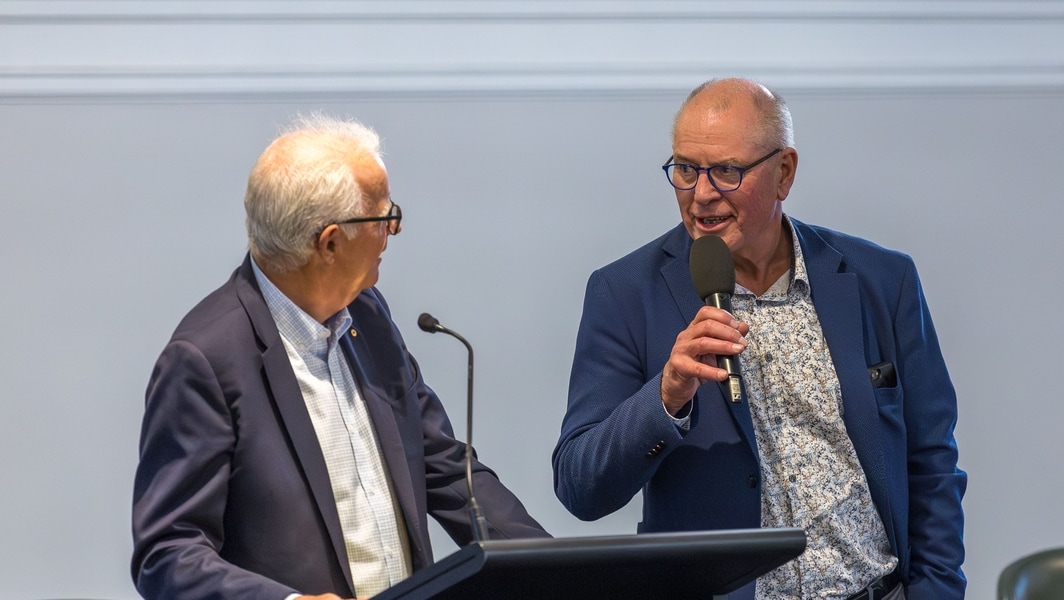
A letter penned by Carlton and Australian Football Hall of Fame Legend John Nicholls was also read to the audience.
Nicholls’ letter is as follows:
To the people of the Bendigo community,
I am incredibly sorry that I can’t be there with you in person to share a glass and a few stories. I’ve been sitting here thinking about my connection to the Bendigo district, and the truth is, it goes back a lot further than most people realise – long before I was recruited to Carlton, and captained and coached at the top level.
My territorial history with the Bendigo area goes back a long way. I grew up in a little place called Cotswold near Carisbrook – a locale I’m sure not many in Bendigo have even heard of – and my earliest memories are of nearby Castlemaine.
Warren Jones and Arthur Sanger, the Carlton premiership players of 1982 and 1945 respectively, had both represented Castlemaine – and if you go back to the 1920s my father Charles and his three brothers Alex, Percy and Roy all played for Castlemaine. My Dad actually topped the Bendigo competition’s goalkicking tally with 58 goals off a half-forward flank in Castlemaine’s inaugural season of 1925. The following season, he was a member of the team which defeated Sandhurst to earn the League pennant – so that’s where it all started for me.
I remember playing for a local Maryborough team called Primrose when I was just a kid of 12 or 13. We used to play on the ground at nearby Campbell’s Creek, which was dairy country back then – cows everywhere you looked – and that’s the same ground on which a future Carlton premiership player Peter Brown chased the leather. Then in June 1956, I played my one and only game on Bendigo’s Queen Elizabeth Oval. My brother Don and I got a call up from Maryborough to represent the Ballarat League team in the country championships, and we beat Bendigo by 13 points in the final. At Carlton later on, my involvement with Bendigo became more serious – and I spent plenty of time travelling to the region with Bert Deacon and scouting the zone to recruit future champions like Geoff Southby to Princes Park.
Though I’ve never been a big believer in the old zoning system myself – I think talent should be open to everyone – I have never lost my respect for the history of the Bendigo district or the players who were and are part of it. The players I’ve had the privilege to play with, coach or recruit from your neck of the woods are among the best I’ve ever known. They have given me memories that will stay with me forever.
To those of you gathered at this afternoon’s function – especially the old-timers still flying the dark Navy Blue flag – have a wonderful day. You represent a proud football league with a massive heart, and I’m honored to have been a small part of it. All the best. John
The 150-year-old story of the Blues’ lost Holy Grail, a replica with a historical Carlton link and an example of the Club’s enduring spirit.
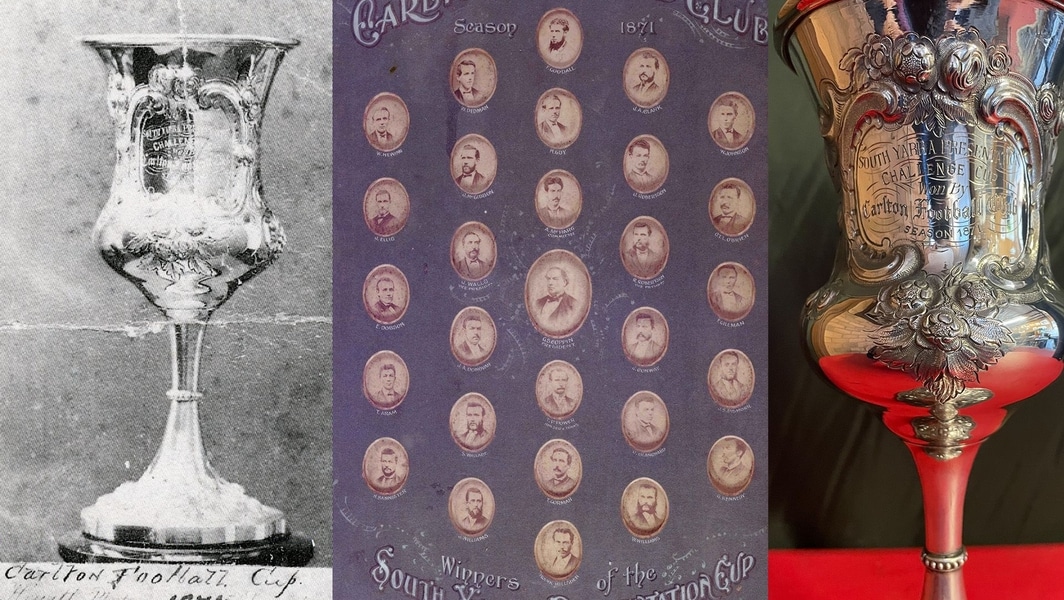
IN THE domain of Australian Rules football, success is often measured in premiership cups – at Carlton, by the 16 trophies earned across almost 120 years of League competition.
And yet, what is arguably the Club’s most coveted prize takes the form of a diminutive sterling silver goblet, handcrafted by a master silversmith and earned on a muddy afternoon in Albert Park in the spring of 1871 – a trophy that predates the Australian Football League, Victorian Football League and Victorian Football Association.
This is the story of the South Yarra Presentation Challenge Cup – Carlton’s lost ‘Holy Grail’ – and the lengths to which the Club went to retrieve the precious long-lost relic. For the cup is considered Carlton’s first trophy since its inception in 1864, and the last of three such cups contested by the major metropolitan teams.
By way of background, first was the Caledonian Challenge Cup donated by the Royal Caledonian Society of Melbourne and awarded to Geelong in perpetuity in 1864. The cup’s whereabouts are unknown to this day.
Next came the Athletic Sports Committee Challenge Cup, valued at ten guineas, which was awarded to South Yarra in perpetuity in 1866. The cup was long thought forever lost, but it unexpectedly resurfaced in 2007, having been inherited by a distant descendant of South Yarra President John Steavenson in Bristol – and has subsequently been loaned to the National Sports Museum.
No cup was contested between 1867 and 1869. But this story begins 156 years ago when South Yarra, one of the pre-eminent clubs in the colony at the time, purchased and donated a silver cup to be contested by the teams who finished first and second on aggregate in 1870 – in what was a five-team competition where finals had not yet been instituted.
Albert-park, with four wins and five draws, claimed permanent ownership of the cup in season ’70, but when the legitimacy of a match involving that team an undermanned Railway was brought into question, the trophy was returned to South Yarra.
The South Yarra Challenge Cup was again offered for competition in 1871, and while Albert-park declined to contest it, the club continued to field teams. The remaining three clubs – Carlton, Melbourne and South Yarra – resolved that their sides would each meet the other three times during the season, with the top two to contest a single playoff for the cup.
By season’s end, Carlton (with victories of Albert-park, Geelong, Richmond and South Yarra) and Melbourne were clear qualifiers for the Challenge Cup playoff – and the match was scheduled for the old Emerald Hill Ground (within the area bounded by City Road, Albert Road and Clarendon Street) at three o’clock on the afternoon of Saturday 7 October, 1871.
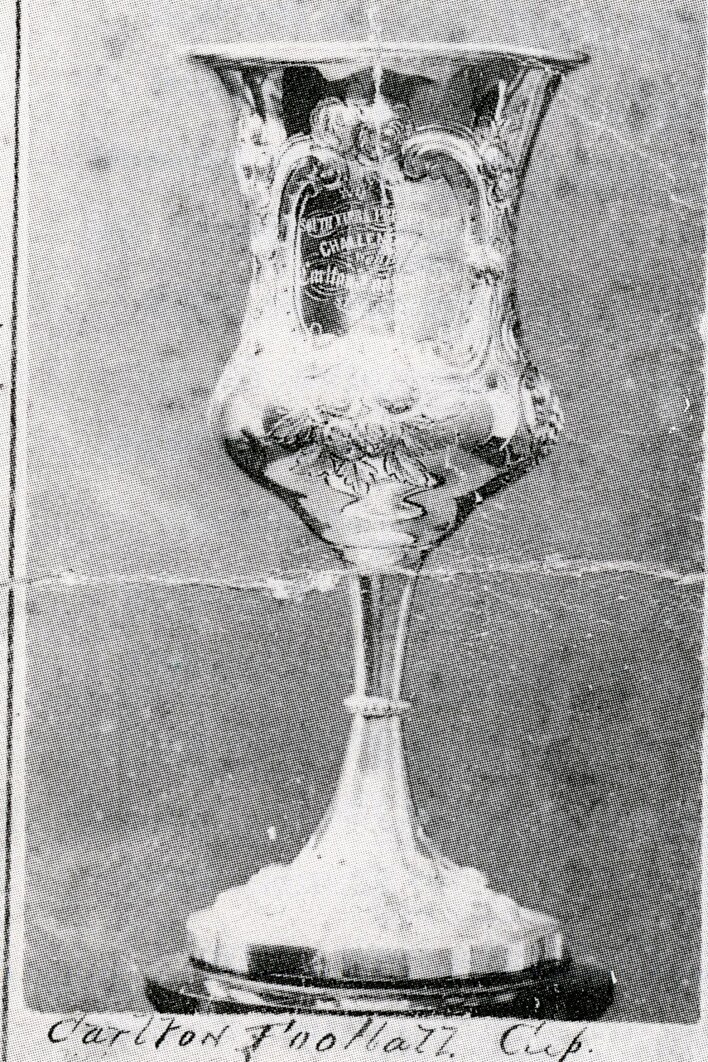
Before an extraordinary audience of 25,000, many of whom spilled onto the ground, Carlton captain John Donovan won the toss and elected to kick with the wind. Donovan’s men then engaged in a brutal 18-a-side struggle across three hours with Melbourne – and when the dust settled, Carlton, through goals to James Clarke and Billy Dedman secured the 2-0 victory and permanent ownership of the South Yarra Presentation Challenge Cup.
The cup itself was a work of art. Standing 22 centimetres tall, it was fashioned by William Edwards, a London-born silversmith of choice for Melbourne’s elite. Edwards, whose workshop stood at the top end of Collins Street, was famous for its intricate craftsmanship, and the 1871 cup was no exception — a silver goblet engraved with the proud declaration of Carlton’s dominance.
Donovan and his on-field heroes were photographed for posterity at Carlton’s Annual General Meeting of 1872 – as was the cup whose silver glimmered in the flashbulbs of the era.
The photograph of the cup, which later appeared on a carte de visite, would prove crucial.
In 1885, the South Yarra Presentation Challenge Cup was presented to long-serving secretary Tom P. Power as a token of the Club’s appreciation. By the 1920s, the precious cup was still known to be in the possession of the Power family, but then it vanished – and despite the various public appeals and online manhunts of the past 15 years, its whereabouts remain unknown.
Perhaps it’s sitting in a dusty attic or an unrecognised private collection, its significance to Carlton forgotten by its custodian.
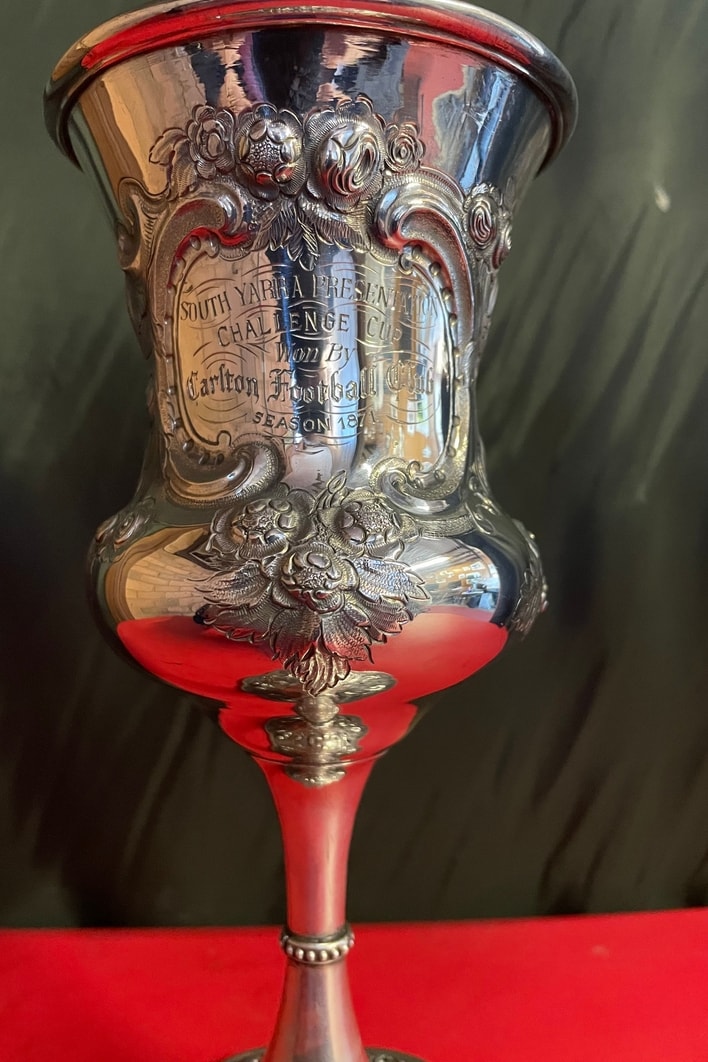
In early 2024, Carlton CEO Brian Cook suggested to this reporter (and resident club historian) that a quote for the replication of the lost 1871 cup be sourced through a local Melbourne silversmith. When the silversmith advised that an identical hand-made sterling silver goblet would cost as much as $20,000 to replicate, another course of action was taken – and fate intervened through a simple Google search.
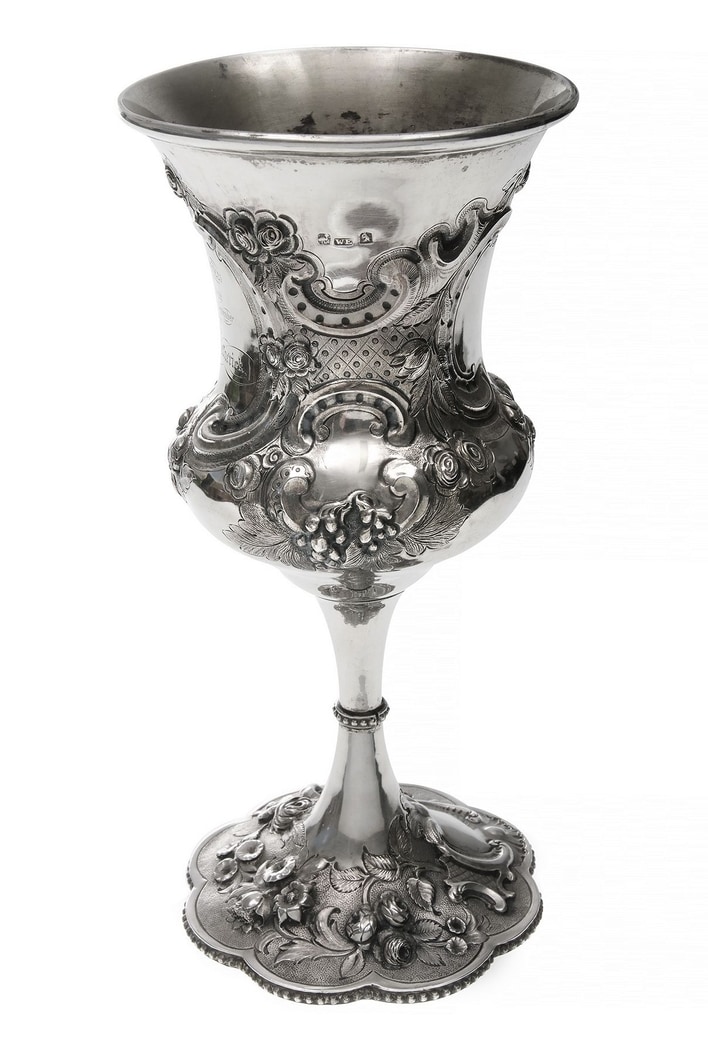
In sourcing 19th century silverware on the Carter’s Price Guide to Antiques website, an image of a goblet, a molecular clone of the lost 1871 cup, jumped off the screen. The item had fetched $2280 at a Sydney auction in 2017 and crucially bore the maker’s mark of the same Collins Street silversmith – William Edwards.
Engraved into the “twin” was script acknowledging the cup’s recipient – Peter John Heath Petherick, a beloved local figure and former rate collector in neighbouring Collingwood – who was presented with the cup in 1867.
Petherick’s story is as rich as the silver itself. He was a bookseller who arrived in Melbourne in 1853 with nothing but 400 books and a young family, who rose to become the landlord of the Studley Arms Hotel and a pillar of the local inner city community.
The hunt for the Petherick cup led Carlton from an auction house in Sydney’s inner west to the buyer – a silver collector who, moved by the Club’s quest, agreed to sell the piece.
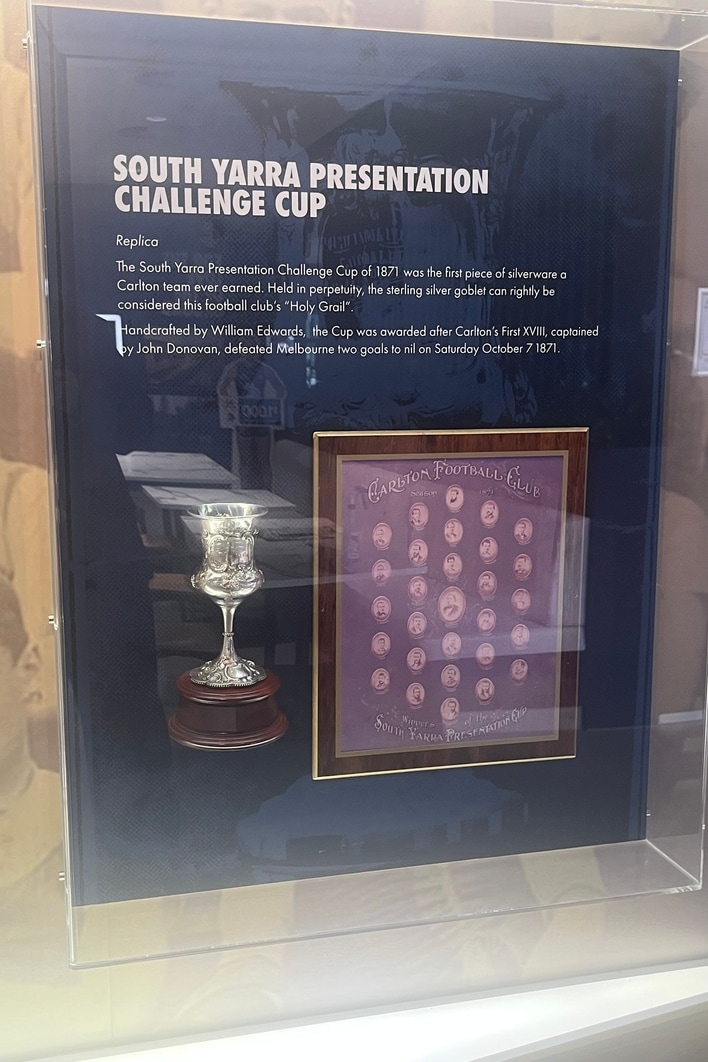
On 26 August 2024, the South Yarra Challenge Cup replica safely arrived at IKON Park in a parcel box.
This tale took a poetic turn in tracing a descendant of the man whose name was featured on the cup, Peter Petherick. Trevor Worth, now in his 80s living in Western Australia, confirmed a kindred connection with the Pethericks, and revealed a startling coincidence: Peter’s son, Julius Evan Petherick was himself a Carlton footballer.
Julius represented the old dark Navy Blues in the late 1870s before relocating to the mining town of Burra Burra to work as a watchmaker. Not long after, he tragically died of pneumonia at the tender age of 29, leaving behind an infant daughter.
The Petherick goblet, created by the same hands as those which fashioned Carlton’s first trophy and once owned by the father of a former player of yesteryear, had effectively “come home”. The Petherick script on one side of the cup remains intact, but the following has been engraved on the opposite side, in keeping with the script visible in the original carte de visite photo:
SOUTH YARRA PRESENTATION CHALLENGE CUP
Won By
Carlton Football Club
SEASON 1871
While the search for the original 1871 South Yarra Presentation Challenge Cup continues, the acquisition of the Petherick goblet provides a tangible bridge to the past.
The ‘Holy Grail’ may still be out there somewhere. But in the Petherick cup, Carlton has uncovered something just as precious: a shared acknowledgement of craftsmanship, community and the Club’s enduring spirit.
Carlton Premiership players, former club officials and members of the current executive have heralded in the start of the 2026 AFL season.
By Tony De Bolfo,
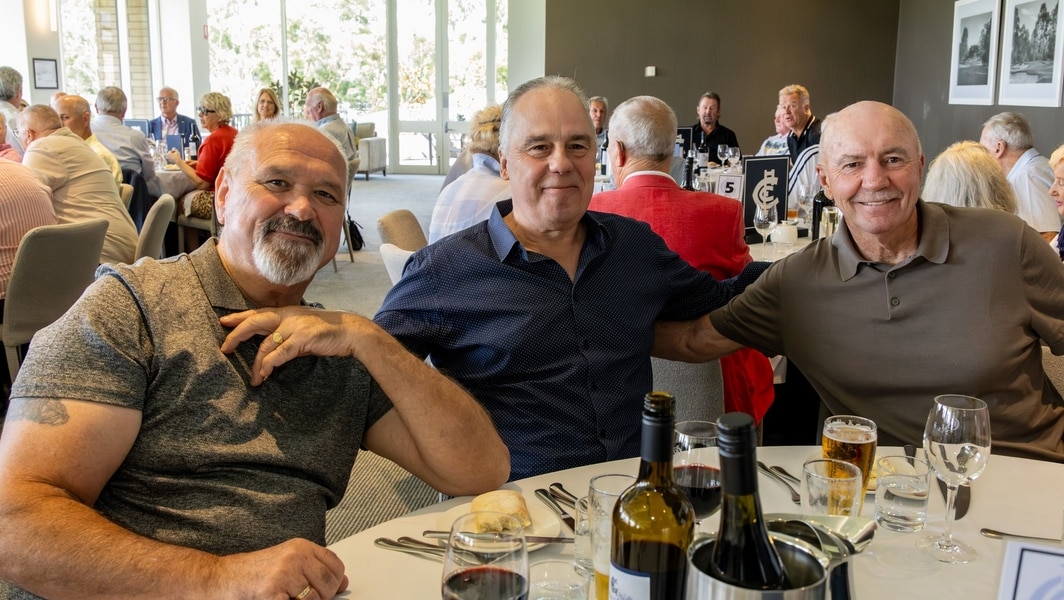
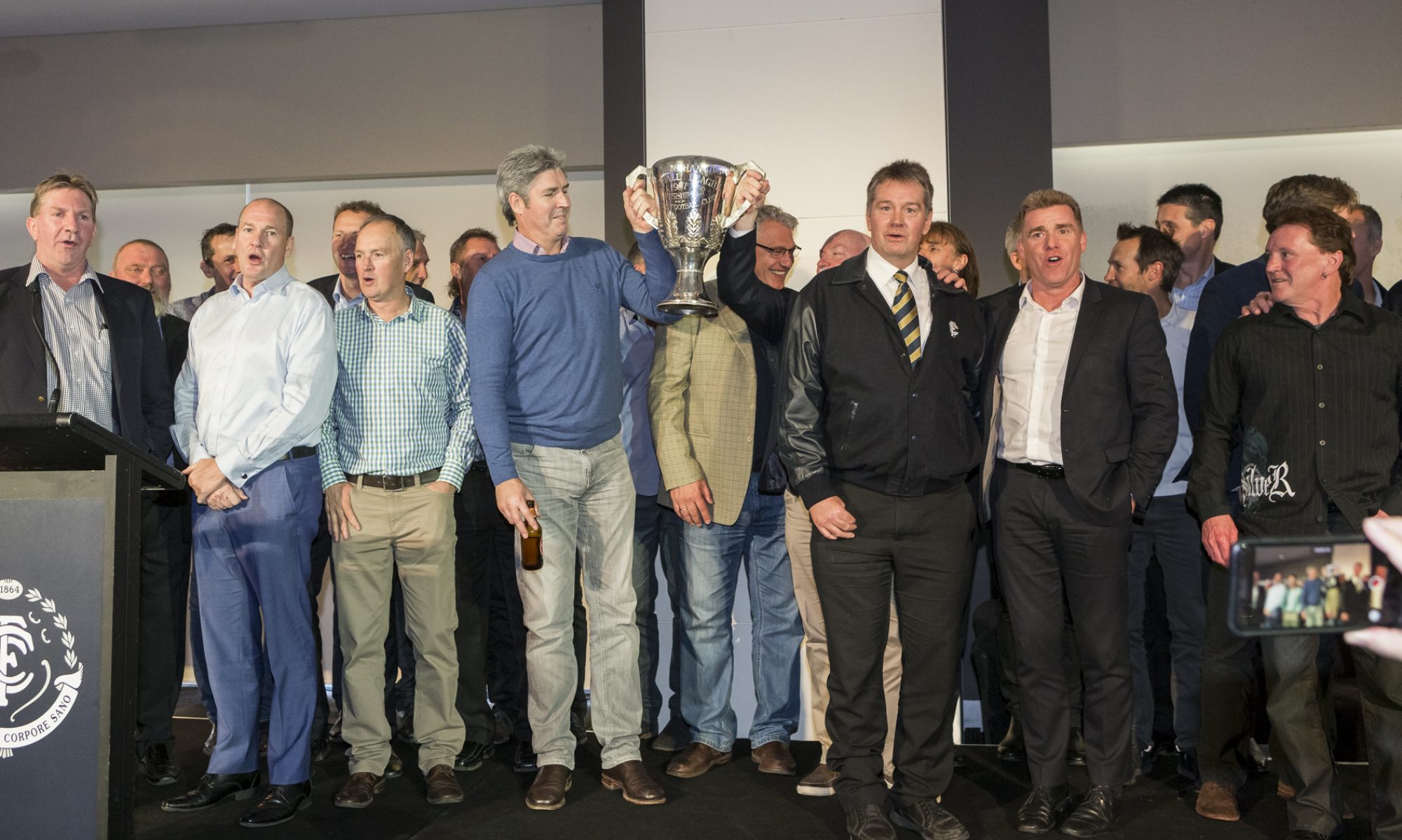
Carlton Premiership players, former club officials and members of the current executive have heralded in the start of the 2026 AFL season, in a well-patronised gathering at Kew Golf Club for the annual Life Members Luncheon.
In what was the eighth such luncheon since its inception in 2019, everyone from the Blues’ oldest surviving Best & Fairest John Nicholls through to their most recent Premiership Captain Stephen Kernahan attended.
Also present were former players who were collectively part of each of the club’s past eight Grand Final conquests – amongst them Bill Bennett, Adrian Gallagher, Peter Jones, Phil Pinnell, Bryan Quirk, David Dickson, David McKay, Andy Lukas, Peter Brown, Rod Austin, Mark Maclure, Ken Hunter, Des Wayne Johnston, Paul Meldrum, Peter McConville, David Glascott, Tom Alvin, Ian Aitken, Shane Robertson, Fraser Murphy, Justin Madden, Greg Williams and Andrew McKay.
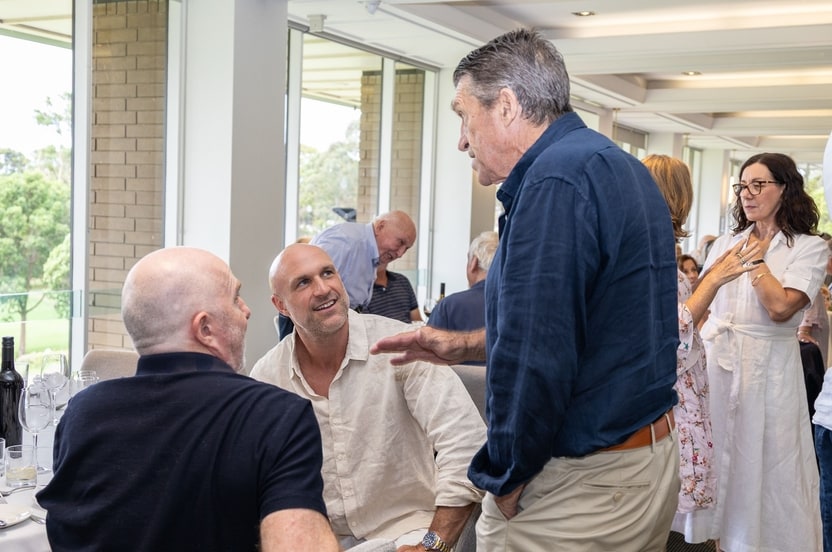
Conspicuous in the room was the dual Carlton Premiership Captain and former AFL Commission Chairman Mike Fitzpatrick, and the former Captain and Brownlow Medallist Chris Judd, together with former President Mark LoGiudice. Carlton’s current President Rob Priestley and CEO Graham Wright also attended.
The contributions to Carlton of recently-deceased Life Members Peter Bosustow, Laurie Carter, Brian Kekovich and Robert Walls were also recognised, as were those of the late Warren Ralph.
The Carlton Life Members Luncheon was first convened in 2019 – an initiative driven by a committee comprising the club’s former Chief Executive Officer Stephen Gough, Frank Brosnan, Sharon McColl and Shane O’Sullivan.
From: https://www.aflplayers.com.au/players-home/alumni#afl-aflw-players-injury-support-fund
AFLPA Alumni members may be eligible for reimbursement of medical costs associated with any joint surgery and dental procedure related to their football career.
Members with private health insurance will be able to access up to $10,000, while members without private health insurance will be able to access up to $8,000.
This program also includes Surgery Avoidant Treatments (SATs) Benefit, which provides for medically directed treatments forming part of a broader healthcare plan intended at avoiding or delaying surgery (e.g., cortisone injections or orthopaedic devices).
The criteria to qualify for an SAT benefit includes:
The treatment is being used as part of a broad management plan that may include exercise, rehabilitation, weight management, strength work, etc.
Extract from the Weekly Times
The luncheon is being held at the All Seasons Resort, Bendigo, 20th March, $50 for firsts, seconds and thirds Carlton past players, with other guests at $85 or $850 for a table of 10.
For bookings contact Shane O’Sullivan on 0412-179797 or email shane.osullivan@carltonfc.com.au
Former Carlton players recruited from country Victoria will be honoured at a lunch in Bendigo next month.
The occasion will celebrate the estimated 60 Bendigo and wider region footballers who played for the Blues at senior, reserves and under-19 levels in the years 1955 to 2016.
It will also honour the hundreds of Carlton supporters in the district from the past few decades, with some of Carlton’s greatest past players to attend.
The lunch, organised by past players’ group Spirit of Carlton, will be held on March 20 and is open to the public.
The list of 60 past country players is headed by AFL and Carlton Hall of Famers John Nicholls (Maryborough), Greg Williams (Golden Square) and four-time premiership player David McKay (Newlyn).
Most were recruited from Bendigo and the wider central Victoria area when Carlton had exclusive rights in the VFL zoning era between 1967 to 1986.
Outside those years, other recruits came from centres including Kyabram, Mildura, Corryong, Donald, Shepparton, Swan Hill, Robinvale, Tongala, and Leitchville.
From Donald came 1962 grand final player Murray Kick, Kyabram pair Peter Aitken and Barry Bryant, Robinvale’s Dick Vandenberg, Mark Amos and Michael James.


Players this century included 200-gamer Andrew Walker from Echuca, and ruckman-forward Ian Prendergast from Kerang.
Southby, a Spirit of Carlton committee member, said the lunch would be a fundraiser for past players in need.
“Key objectives of the Spirit of Carlton include health and welfare support of needy past players, Carlton history management, as well as past player engagement,” he said.
“Carlton has many past players who have significant physical and mental health issues because of playing high-level football.
“The lunch will feature a large group of past Carlton players who played in the firsts, seconds, and thirds and their guests, as well as passionate Bendigo region supporters of Carlton.”
MC will be Stephen Gough, who was Carlton’s general manager and Melbourne Cricket Club chief executive.
“Originally from the Bendigo region Stephen will be able to display his great knowledge of Carlton-Bendigo history and former local players,” Southby said.
“Spirit of Carlton would be most grateful if you could join us on the day to celebrate and reminisce on the achievements and highlights of the players and your experiences of a great AFL footy club.”
The luncheon is being held at the All Seasons Resort, Bendigo, 20th March, $50 for firsts, seconds and thirds Carlton past players, with other guests at $85 or $850 for a table of 10.
For bookings contact Shane O’Sullivan on 0412-179797 or email shane.osullivan@carltonfc.com.au
