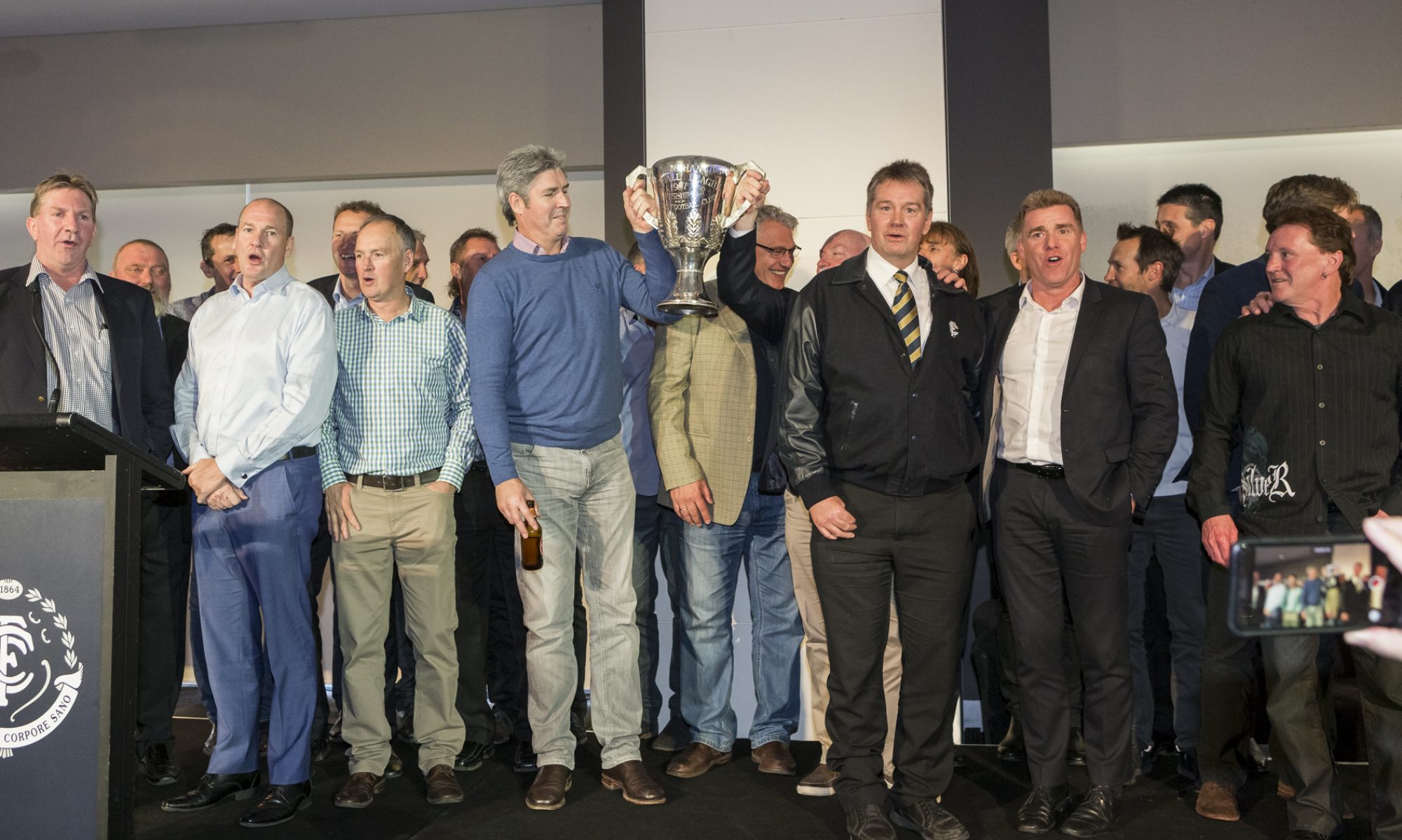

Peter Bosustow Career Highlights – Link to Donation
“I’m in the fight” – ‘The Buzz’ readies for major health battle
Peter Bosustow has confirmed he’s been diagnosed with cancer.

UNTIL Melbourne’s most recent lockdown, Peter Bosustow had planned to jet in for a fundraiser to help him through the disastrous collapse of a lifetime home lease scheme in which he’d invested.
Now the Mandurah-based Western Australian must rely on the goodwill of the Carlton fraternity and the football community at large; the Blues’ flamboyant back-to-back Premiership player of 1981 and ’82 having now confirmed he’s been diagnosed with colon cancer and facing a series of chemotherapy sessions in the months to come.
“It’s been a bit of a shock,” said the 63 year-old Bosustow, who first experienced health issues last Christmas. “I was losing a bit of weight, which I thought was good at the time, until my doctor sent me off for a colonoscopy. The colonoscopy revealed a mass, and subsequent tests revealed spots on my liver, which means it’s spread a bit. But I’ll be in the fight. I’m not going to shirk the issue.”
Bosustow is of the view that his health issues can be put down to the stresses brought on with the collapse of lifetime home lease scheme Sterling First, which cost a number of retirees their life savings, and in his case a quarter of a million dollars.
“But that’s all by the by now,” Bosustow said. “I’m in the fight now and I’m meeting it head-on. I’m positive about it all, which is the way you’ve got to be.”

Peter Bosustow taking arguably the greatest mark ever produced at the old Carlton ground.
A much-loved favourite of the Carlton faithful through the halcyon years at Princes Park, Bosustow and fellow Western Australian Ken Hunter sensationally impacted on the game when they crossed the Nullarbor and turned out for the David Parkin-coached Blues on the cusp of season ’81.
In just 65 games through three seasons, ‘The Buzz’ contributed to an extraordinary highlights reel – which included the Mark and Goal of the Year double in that maiden season – as part of an irresistible half forward line which took in Mark Maclure and Wayne Johnston.
Ultimately, the health of Peter’s father Bob, himself a 20-game Carlton player through 1955 and ’56 , prompted Peter’s untimely return to the West – and Bob was 63 when he died of leukaemia in December 1997.
Bosustow had also planned to be in town for the 40-year reunion of fellow teammates of 1981 and ’82 – sadly also postponed – but had already won the support of Carlton luminaries including Parkin and Stephen Kernahan – “the second greatest No.4” as Bosustow dryly suggested.
The Carlton legend Alex Jesaulenko is also lending Bosustow his support by promoting the My Cause crowdfunding page established by his daughter Kate. At the time of writing, the fund had raised $6300.
Carlton Members and supporters wanting to support Peter can do so via the following link – https://www.mycause.com.au/p/262303/the-legend-peter-bosustow
Sixty years on, Carlton’s inaugural Coleman Medallist salutes Harry
“Turkey Tom” congratulates the 2021 Coleman Medallist.
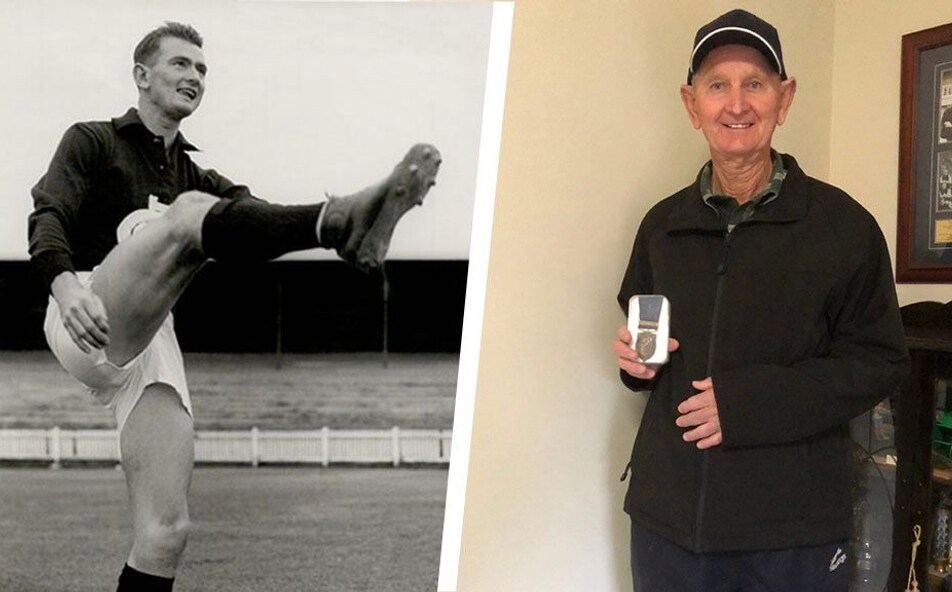
FORMER Carlton full-forward Tom (“Turkey Tom”) Carroll – the Club’s inaugural Coleman Medallist for most goals kicked in the home and away period of League competition – has commended Harry McKay’s breakout season to earn the medal some 60 years after he completed the feat.
Wearing the No.22 of the famous Carlton full-forward of yesteryear in Harry ‘Soapy’ Vallence, Carroll earned the medal retrospectively for his 54-goal return from 18 home and away matches at an average of 3.0 – in what was also his inaugural season with the club after joining from Ganmain in the Riverina.
“Wasn’t it great,” said Carroll of McKay’s medal victory from his home in Albury.
“Harry averaged three goals a game – 58 goals from 19 – and three a game is what I averaged in ’61.”
“I haven’t met Harry before as I can’t get down to Melbourne, but it’s wonderful that his achieved this milestone, just for the history. He was pretty much a lone hand without Charlie Curnow and Mitch McGovern there for the most part.”
Tom conceded to having “a few reservations” with McKay’s kicking for goal from the left forward pocket.
“He’s such a lovely field kick, and from the right forward pocket he’s good, but when he gets in the left pocket he hasn’t got an answer there has he? My answer would be for him to keep practising the drop punt more until he could perfect the banana, and for the club to get ‘Fev’ (Brendan Fevola) in as a goalkicking coach.”
Carroll actually opted for the flat punt throughout his 55 senior matches over three seasons at Carlton, during which time he took the Club’s goalkicking honours with 54 in 1961, 62 in 1962 and 27 in 1963.

“I reckon Jack Titus introduced the drop punt from close in – anywhere within 20-30 metres out, but until Peter McKenna came along – and he could kick it 50 metres couldn’t he? – the flat punt was used . . . and I used the flat punt all the time.
“They talk about the snapshot (kick around the corner) and how you get more foot on the ball. Well that was the flat punt. You got the full purchase because the side of the ball was at the right angle to the foot. The only thing I did differently was the angle kick from the right pocket – the banana – every now again.”
So named after John Coleman, the Australian Football Hall of Fame Legend who booted 537 goals in 98 senior appearances for Essendon, the Coleman Medal was first presented to former Richmond full-forward Michael Roach in 1981.

Aside from Carroll and McKay, former Carlton full-forward Brendan Fevola (who was unavailable for comment) is a two-time winner with 84 goals in 2006 and 86 in 2009.
In September 2001, the League recognised all leading goalkickers prior to Roach’s victory – from 1955 (the year after Coleman’s last match) to 1980 – and all including Carroll were named retrospective Coleman Medallists.
Winners prior to 1955 – at Carlton Mick Grace (45 goals, 1906), Ern Cowley (35 goals, 1918), Horrie Clover (54 goals, 1922) and Harry Vallence (72 goals, 1931) – were also named Leading Goalkicker Medallists, and in July 2004 medals were presented to their surviving families in a ceremony at the Melbourne Town Hall.
Latest Video: Ken Hunter 1987
Ian Herman 1987 – Latest Video
Highlights of Bruce Doull’s Career 1970 to 1986 – Latest Video
Wayne Harmes 1987 – Latest Video
Vale Graeme Whitnall, Carlton’s quiet achiever

FORMER Carlton wing/half-back Graeme Whitnall, the father of the club’s 200-game former captain Lance, has died in Darwin at the age of 69.
Hailing from Talbot, within close proximity of John Nicholls’ home town of Maryborough in 1973, the 21 year-old Whitnall found his way to Princes Park, having earned Maryborough Football Club’s senior Best and Fairest award at 19 and savoured Premiership success with Maryborough the following season.
After earning Best and Fairest honours at Carlton reserve grade level, Whitnall broke into the seniors for the first of 66 senior appearances – the opening round match of 1974, against Melbourne at Princes Park. He was named on the bench in that one, alongside Castlemaine’s Peter Hall, a future National member of the Victorian Lesgislative Council. A month later at Victoria Park, Whitnall slotted two goals against Collingwood and was on his way.
Whitnall’s strength was in his versatility, and in 1977 was the only Carlton player to feature in all 22 senior contests of the home and away season, Ray Byrne aside. But an apparent difference of opinion with Carlton Captain-Coach Alex Jesaulenko saw Whitnall’s appearances confined to just four in ’78. On being refused a request for a clearance at season’s end, Whitnall returned to Maryborough and duly took out the club’s ’79 B & F.

The Ian Thorogood-coached Carlton senior squad of 1976 – Graeme Whitnall stands in the back row, third from the right.
A former teammate, the 158-game three-time Premiership player Alex Marcou, was deeply saddned with the the news of Whitnall’s passing – for it was Whitnall who showed the way to him and fellow members of the famed Mosquito Fleet, the likes of Buckley, Harmes and Sheldon
“I was just starting out and Graeme was playing in the back pocket. He was a quiet achiever, a nice guy, he was respectful and he helped the young guys coming in,”Marcou said.
“Graeme loved a beer and I always enjoyed his company. He was a passionate Carlton player who loved the Blues and he was a great man.
Following Jesaulenko’s much-publicised departure in support of the incumbent President George Harris, Whitnall accepted an invitation to return to Princes Park. He managed another 11 senior appearances through 1980 (the same year he took out the reserve grade’s award for Club Champion) and ’81 – but he gave the League caper away after being overlooked for the finals campaign in what was ultimately a Carlton Premiership year.
Graeme Whitnall was the 842nd player to represent the Carlton Football Club at senior level. Sixteen years later, Graeme’s son Lance Whitnall – the heir apparent to Stephen Kernahan in the front half – donned the famous old dark Navy Blue guernsey for the first time, in a career that would bring him the captaincy of the club, a Grand Final appearance in 1999, All Australian selection, the 2006 John Nicholls Medal, and 216 senior League appearances – while another boy Shane flew the Carlton flag at reserve grade level.
In August 2018, when Lance was inducted into the Carlton Football Club’s Hall of Fame with Brent Crosswell, Graeme was there to savour the moment.
Mil Hanna 1985 to 1987 – Latest Video
Adrian Gleeson 1987 – Latest Video
Marcou Tailoring

We are only too pleased to promote any business, interest or charity any Carlton past player would like to promote. If you would like something to appear on the website please contact us.
Addio e grazie: A tribute to Sergio Silvagni
A tribute to a Club Legend.

THE CARLTON Football Club – and the Italian quarter of Lygon Street with which his name is inescapably linked – is collectively mourning the passing of Sergio Silvagni, patriarch of one of the great Australian game’s most famous dynasties.
In the exalted company of John Nicholls and Adrian Gallagher, Silvagni, was central to perhaps the greatest following division in football history.
Through him, and through his son Stephen and grandsons Jack and Ben who followed, the Silvagni name is forever part of Australian rules lore.
But it wasn’t always the case, as Serge once revealed.
“I had some friends at Carlton who were playing in the Thirds,” Silvagni said in an interview with this reporter back in 2002, “and on practice match days of a Saturday you’d have the Thirds, Reserves (Seconds) and Seniors – each boasting a squad of fifty players from which to select.
“I was still a schoolboy attending Parade College when I went along to the Carlton ground to try out with my mates. I turned up at half past nine in the morning to get a run with the Thirds, but when the teams were named, they said to me, ‘Son, run the boundary’.
“During the course of the game, a few other leftover players got a run, but at the quarter-time and half-time breaks they told me to keep running the boundary. It wasn’t until the third quarter that they put me on their gun full-forward, but I managed to blitz on this bloke.

“In the end I discovered how lucky I’d been to even make it onto the ground. The reason I hadn’t got the call-up earlier was because they knew I could play but they didn’t know how to pronounce my name.”
Sergio Silvagni was born in Carlton in 1938, the son of Giacomo and Antonia Silvagni – migrants from Asiago in the Northern Italian province of Vicenza, who set sail for the Great South Land between the wars.
For the first 25 years of his life, until his marriage to his beloved Rita in 1963, Silvagni lived with his sister Milena and their parents in a single fronted dwelling in Canning Street, Carlton – a stone’s throw from Lygon, the epicenter of Melbourne’s Italian community.
A student of St Thomas’s school Clifton Hill and later Parade College East Melbourne, Sergio, as No.1 ruckman, formed part of Parade’s formidable 1st XVIII Premiership team of 1954 – an outfit which included his cousin John, and was captained by Kevin Bergin, the College captain.

The following year, Bergin completed his senior League debut at Carlton . . . and John and Sergio followed suit in 1958.
Silvagni remembered the difficulties of life in Carlton in the immediate post-war years. He recalled that the family home once doubled as a boarding house for newly-arrived Italian men, invariably from his father’s northern Italian town of Asiago, who would board there for a week or two until Dad found them a job, more often than not in concreting.
“Times were tough back then. You thought you were doing well if you got a bottle of lemonade or an ice cream at the weekend,” Silvagni said.
“When the war broke out, a year after I was born, the Italians suddenly became enemies. The Italians who had taken out citizenship here were all right but Dad never bothered, so after a while he was sent away to an alien camp in Broadford, where he lived in a tent and cut timber. I was only about four at the time, but I will always remember him leaving. He was lucky enough to be detained for only a couple of months; some of the Italians served three or four years at internment camps in the country.
“During the war all the Italians kept a low profile. In football, Frank Curcio was the first player of an Italian background to really emerge, and then there was ‘Onga’ [Tony Ongarello] at Fitzroy. I was around during Onga’s time, and if the League’s racial vilification laws had been in place when Carlton and Fitzroy played then half the crowd would have been locked up. Half the crowd would get into me and half would get into Onga.
“Because the Italians were seen as enemies through the war, I had to be a very quiet and low-key kid, almost introverted. I just kept quiet and kept to myself, but playing sport was a way of assimilating. I started playing football at St. Thomas’ in Clifton Hill, I enjoyed it and it just went from there.”

Sergio and son Stephen.
Silvagni was named for his first senior appearance in the 7th Round of 1958, the match with South Melbourne at the Lakeside Oval. In the largely forgotten No.20 guernsey, he followed the hard-edged Carlton captain Bruce Comben and vice-captain Laurie Kerr down the race.
In ’59 he switched to the famous No.1, which would sit comfortably on his back through the great Carlton conquests of which he was part through the Barassi years.
Sergio’s CV at Carlton reads thus; 239 games for 136 goals from 1958-’71; Premiership player 1968 and ’70 (the latter after coming out of retirement); best and fairest 1962 and ’68; leading goalkicker with 40 in 1958; captain in 1964; coach in 1978; Team of the Century ruck-rover; Hall of Fame Legend. At Carlton, the bandy-legged bloke with the downed socks and the brutal physicality truly wrung the cloth dry.

Sergio Silvagni and John Nicholls in pursuit of the football.
The three-time Premiership player and five-time best and fairest John Nicholls, considered Carlton’s greatest footballer of all time, regarded Silvagni – “with Rita a friend for 60 years” – amongst the best of his generation.
“Serge and I had 13 years in the first ruck together, we played together every week and no matter what angle I was coming from he was always there. We didn’t discuss tactics, we just knew eachother,” Nicholls said.
“With the socks down and the bandy legs, Serge was underrated, but he could play anywhere. He was built like Ron Barassi but he could beat ‘Barass’ and he was a good mark. I saw him go to a back pocket to play on blokes like Len Thompson and none of them outmarked him. I also saw him beat (Darrel) Baldock at centre half-back.
“Serge was as strong as a bull, but he was fair. He never did anything wrong. In all the years I never saw him do anything untoward, save for a game against South Melbourne when Eric Sarich played up a bit. Rather than hit Sarich, Serge picked him up by the scruff of the neck and shook him like a rabbit. The problem was that Sarich had an arm free and split Serge’s eye open.”
The three-time Premiership player and club Best and Fairest Adrian Gallagher, in paying tribute to his fellow member of Carlton’s famous triumvirate, talked of Silvagni as “a great man”.
“His was a great Italian story and an even greater Australian story,” Gallagher said.

“I saw Serge play in the first Carlton game I saw – a match against Essendon after I came down from the country. My father had found work as an administrator at the nearby Mount Royal Hospital for the Aged and we lived on the premises. Of course you had to barrack for the local team and Princes Park was just up the road.
“It was the opening game of ’59 and the big no.1 was at full-forward. He booted a few goals that day, including the biggest torpedo I’ve ever seen to the scoreboard end at Garton Street. I think I marked him down for five in the Footy Record, I got him to autograph my book which I still have, and he was my favourite Carlton player from that afternoon on.”
In reflecting on his later association with Silvagni and Nicholls as a fellow Carlton player, Gallagher put it simply.
“How fortunate was I to have those two looking after me – one hitting the ball in right direction, the other paving the way. It was like the Red Sea parting in front of me.”
The former Carlton Premiership player, CEO and President Ian Collins, who last paid Silvagni a visit on his 83rd birthday barely a fortnight ago, lamented the loss of his great teammate.
“Serge’s friendship through our wives and families from 1960 onwards was what I appreciated more than anything,” Collins said.
“I played 160 games for Carlton and there was only a couple I didn’t play with Serge. We finished on the same day in 1971, in the final home and away round of the season against Collingwood at Princes Park. He retired that day and I crossed to Port Melbourne to coach. That was the same day Ron Barassi coached his last game for Carlton that day and Billy Barrot stormed off.

“That last game against Collingwood in ’71 was a virtual carbon copy of the last time we played them in 1970 – the ’70 Grand Final. We were 44 points down at half-time in ’70 and 42 down at half-time in ’71, and we got up both times. By then most of the Collingwood blokes slept with the lights on, and fancy Carlton playing Collingwood this week.”
Collins recalled Silvagni turning in a string of commendable performances as a forward for the Carlton thirds, “and I reckon he bypassed the seconds to play seniors”.
“Serge was so strong it wasn’t funny. When he finished up at school he followed his father into the concreting profession and he didn’t do weights because he didn’t need to.
“He was a great back-up to ‘Big Nick’ in the ruck, in the days when the ruck-rover could also fly from the back at the throw-ins. He was an inside player and there was no flashiness, but he could take a good mark for his size. He never got pushed off the ball and he was fair, but the tougher it got the better he played.
“Even when he retired he kept his connection with the club. He contributed greatly on match committee, he coached for a brief time and all he ever wanted to do was help. Serge was born in Australia, grew up in Carlton, lived in Carlton and played for Carlton. He couldn’t have given Carlton more.”

Sergio and grandson Jack.
The record books are littered with the names of League footballers of Italian origin who made an impact between the wars – men of stature like Len Incigneri at Richmond, Frank Curcio at Fitzroy and Albert Boromeo at Carlton.
Yet it were those of Silvagni’s ilk – the first generation Australian footballers of Italian origin in the immediate post-World War Two years? like Peter Pianto at Geelong and Albert Mantello at North Melbourne – who caused the greatest stir.
The late Lygon street hairdresser Ernesto (Ernie) Angerame, for a time the Carlton Football Club’s official barber – put it best when he reflected on the Silvagni influence in a previous interview.
“I knew the parents of both Sergio Silvagni and John Benetti, and they all lived in the Carlton area, like so many of the Italians,” Angerame said.
“When their boys broke through at Carlton we all followed them because we knew their names and it was wonderful to hear those names on radio. When Australia opened up to the migrants in the early to mid-1950s, the majority of Italians continued to come to Carlton. By then the people of my generation were already settled, so we began to take the new migrants to the football at the Carlton ground to see Silvagni and Benetti play.”
David Glascott 1987 – Latest Video
Michael Gallagher 1987 – Latest Video
Bernie Evans 1987 – Latest Video
Jamie Dunlop 1987 – Our Latest Video
Remembering Ron Rhodes, a Blueboy born and bred
Tony De Bolfo pays tribute to former Blue Ron Rhodes.
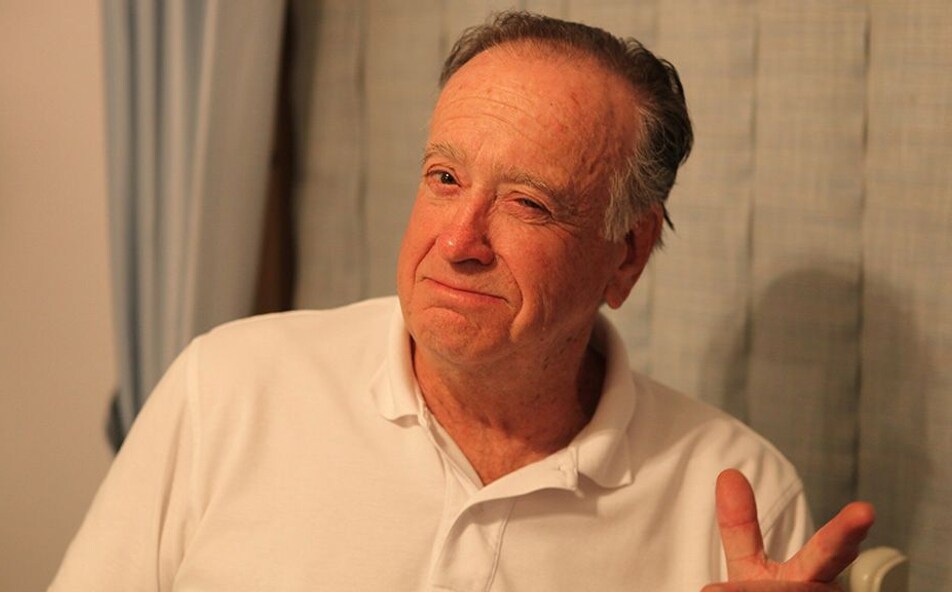
AS IS so often the case, the life story of the one-game player lost to the club after an all-too-brief on-field foray is of more interest than the 300-gamer with whom everyone in the football world identifies.
So it is with Ron Rhodes, a one-game Carlton senior player of 67 seasons ago, who died recently at the age of 88.
Ronald Thomas Rhodes was born on November 17, 1932, the son of Thomas Lewis Rhodes and Ruby Agnes Ryall – a cousin of Keith Ryall, the visionary behind Leigh Creek’s Kryal Castle. Ron was the youngest of three brothers, with Frederick (who died at a young age) the first born, and Keith the middle child who also turned out for Carlton.
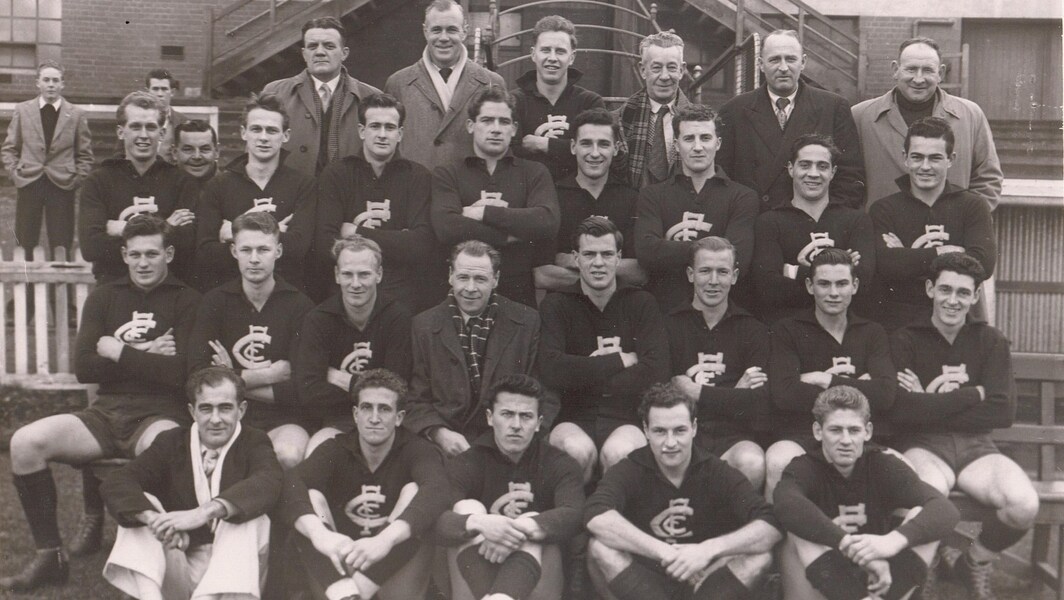
The ‘Mick’ Price-coached Carlton Reserve Grade team of 1954. Ron Rhodes is the player standing third from the left. Second from the right in the same row is Peter Bevilacqua, League football’s only known Italian-born footballer. Seated with his legs crossed in the front row, second from the right, is Harvey Dunn, the first League footballer ever recruited under the father/son rule.
Ron was part of the fabric of the Carlton neighbourhood. He spent the first 70 years of his life in the family home at 667 Drummond Street, North Carlton, having been schooled at Carlton North Primary at Lee Street, and later Princes Hill Secondary College in the shadows of the Legends Stand.
He was recruited to the Carlton Football Club from neighbouring Princes Hill on the cusp of the 1950 season when the club’s Under 19 team of which he was part fell to the unbeaten Essendon by a miserable point in the Grand Final. That season, Ron was recognised with the Most Serviceable Award donated by the club’s 1938 Premiership defender Frank Gill.
Ron progressed through the Under 19s and reserves, stringing together games as a ruckman/ruck rover with the occasional appearance in defence. Named as an emergency in Carlton’s reserve grade Premiership team of 1953, Ron was frustrated by four breaks to his left hand through the course of the ’53 season.
The following year, Ron featured in the team photograph with Carlton’s reserves – amongst them the captain Harry Sullivan, football’s first father/son recruit Harvey Dunn and the game’s only Italian-born League footballer Peter Bevilacqua.
July 1953. John James, a future Brownlow Medallist, supports Ron Rhodes, whose left hand, broken on four separate occasions through the course of the season, is supported in a sling (photo below).

In mid-June 1954, Ron was hospitalised with a kidney injury sustained in a reserve grade match with Hawthorn. Three weeks later, Coach Percy Bentley called his name for his Carlton senior debut.
Donning the No.36 now worn by Josh Honey, Ron followed the captain Ken Hands down the race and onto Princes Park for his one and only senior appearance – specifically the Round 11 match of Saturday, July 3, 1954 between Carlton and St Kilda.
That afternoon, Ron fulfilled duties as ruck-rover in a Carlton following division which included ruckman Bill Milroy and rover Jack Mills. Regrettably the home team lost that match to the visitors 9.16 (70) to 12.10 (82), and of the 22 who took to the field in Dark Navy only Peter Webster and Ron Robertson are still living.
Ron parted company with the Carlton Football Club at the end of the ’54 season and never pursued a playing or coaching career elsewhere, as his work away from the game became a focus.
An electrician by trade, he was for years employed with the Melbourne City Council, connecting electricity to premises within the council’s jurisdiction and installing meters accordingly. At the time of his retirement in 1995, he was as a foreman in charge of the council’s various work teams.
Ron’s life took an incredible turn for the better in April 1984 when he accompanied friends on a holiday to the Philippines. There he met, fell in love with and ultimately married Alicia Montero, a single mother making ends meet working as a sales rep for a Rice Milling Business.
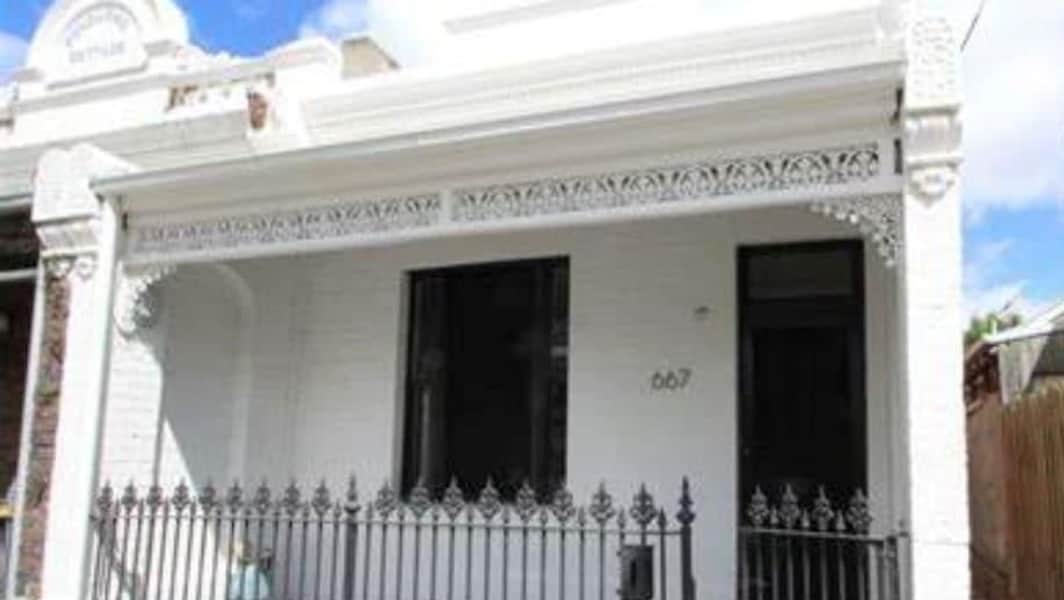
The Rhodes family home in North Carlton. It was here in October 1986 that Ron and his Filipino wife Alicia exchanged marital vows in a private ceremony.
Ron met Alicia in Manila through mutual friends, and as the relationship flourished, Ron travelled to the country several times until they tied knot in Manila on January 6, 1985.
Ron returned to Australia two months after the marriage and by August 1986 had arranged for his wife Alicia’s and stepson Michael’s passage to Australia. On October 8 of that year, he and Alicia again exchanged marital vows, only this time under Australian law, in a private ceremony attended by close friends and relatives at the Drummond Street home.
He then completed the protracted step-parent adoption process to fully legalise his parentage to Michael, whose surname is now formally “Rhodes”.
In 2002, having lived most of his life in Drummond Street, Ron vacated the old Rhodes home in Carlton. Together with Alicia, he headed north to Lalor to be closer to their son Michael, daughter-in-law Jem and grandchildren Michael and Gabriel.
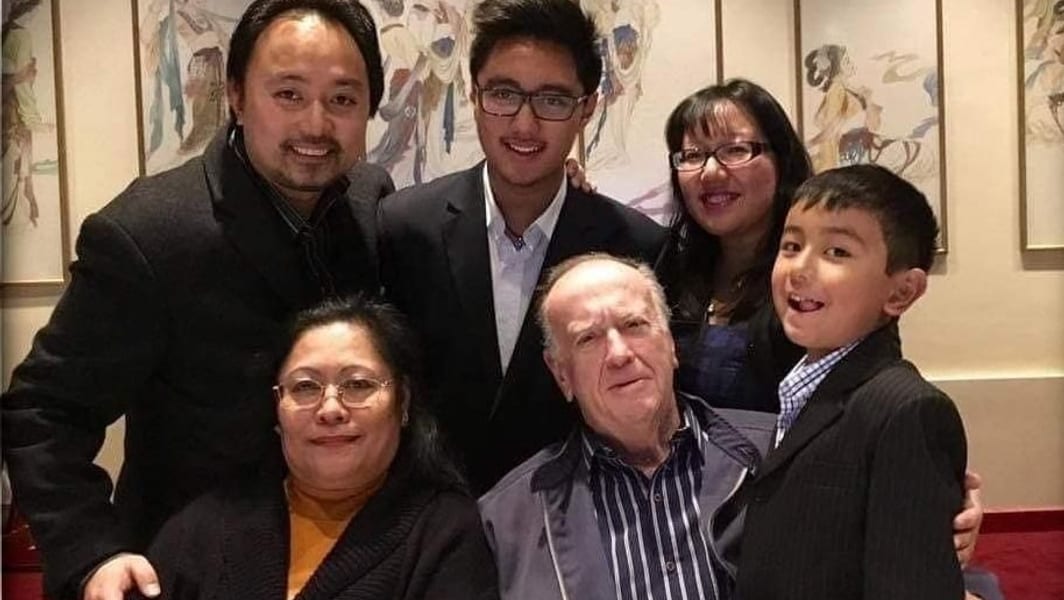
The Rhodes family – clockwise from left rear Michael, Michael (jnr), Jem, Gabriel, Ron and Alicia.
Ron maintained a solid fitness regimen and was a regular at the local gymnasium well into his 80s. He was mowing the lawn at the front of his home when he suddenly collapsed and could not be revived.
“Dad never liked any fuss, so I guess the silver lining to all this is that he went as he would’ve wanted – quick, with no long decline at a nursing home or hospital – just mic drop and outa here, may God bless his soul,” Michael said.
“He was a good man, he was my Dad, and he and his family treated me no differently to a biological son.”
Ronald Thomas Rhodes is survived by his wife Alicia, son Michael, daughter-in-law Jem and grandchildren Michael and Gabriel.
He was the 682nd player to represent the Carlton Football Club at senior level since the formation of the VFL in 1897 – and his love for Carlton never abated.
“Dad was Navy Blue through and through, being born and bred in Carlton,” Michael said.
“He followed the Carlton teams through the decades, and did not miss watching a single Carlton match on TV.
“Dad’s house was always adorned with Carlton paraphernalia and the door chime carried the club’s theme song. He lived and breathed the Blues. He felt the club’s ups and downs, the joys and disappointments, and he passed on that passion to me and the next generation of our family.
“We do truly feel grateful for the club’s validation of Dad’s previous history with the club . . . and with that, whenever the Bluebaggers play, you can be assured that there will always be a Rhodes screaming at the top of their lungs ‘Carn the Blues!’.”
The Carlton team, featuring Ron Rhodes in his one and only senior appearance, v St Kilda at Princes Park – Round 11, Saturday, July 3, 1954
B: 15 Bruce Comben 25 George Ferry 37 Bernie Moran
HB: 30 George Stafford 33 Peter Webster 16 John Brown
C: 28 Graham Gilchrist 21 Ron Robertson 19 Denis Zeunert
HF: 10 John James 18 Max Wenn 17 Doug Beasy
F: 1 Ken Hands (c) 26 Noel O’Brien 23 John Chick
Ruck: 2 Bill Milroy 36 Ron Rhodes 9 Jack Mills
Res: 3 Harry Sullivan 11 Laurie Kerr
Coach: Percy Bentley
Join the Spirit of Carlton at the 1981 and 1982 Premiership Reunion
Don’t miss your chance to mingle with club greats at this momentous occasion.
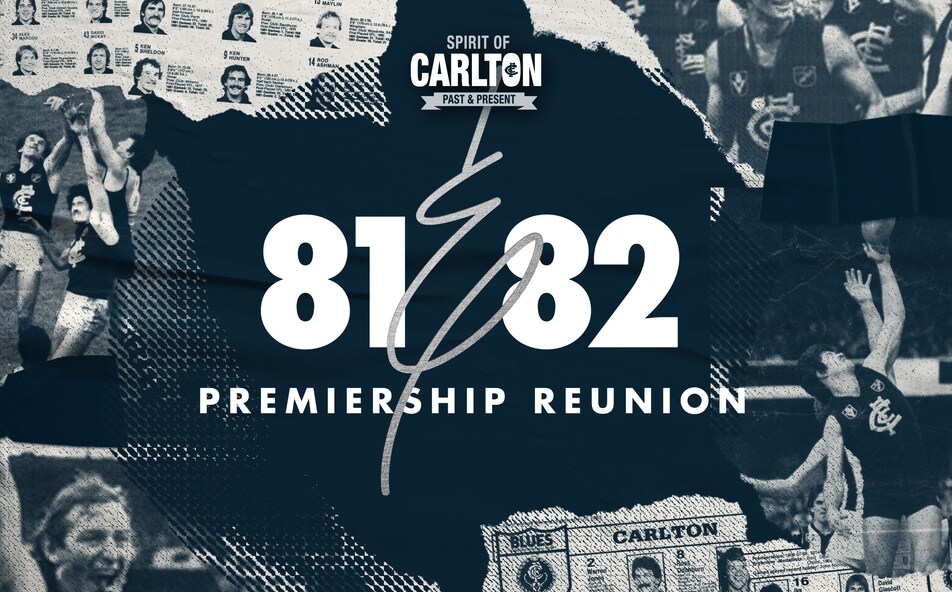
JOIN members of Carlton’s 1981 and 1982 premiership teams to celebrate the 40th and 39th anniversaries of the Club’s famous Grand Final victories over Collingwood and Richmond.
Held in the Victory Room at Marvel Stadium on Friday 30 July, this unmissable event will provide the opportunity to mingle with former club greats as well as a number of current AFL and AFLW Blues to relive two memorable moments in the history of the Club.
Guests will enjoy a delectable two-course lunch and premium beverages, with special guest speakers and entertainment throughout the function.
Tickets are now on sale. Click here to secure your place now.
Function details:
Date: Friday 30 July
Time: 12pm
Location: Victory Room, Marvel Stadium
Dress code: Smart casual