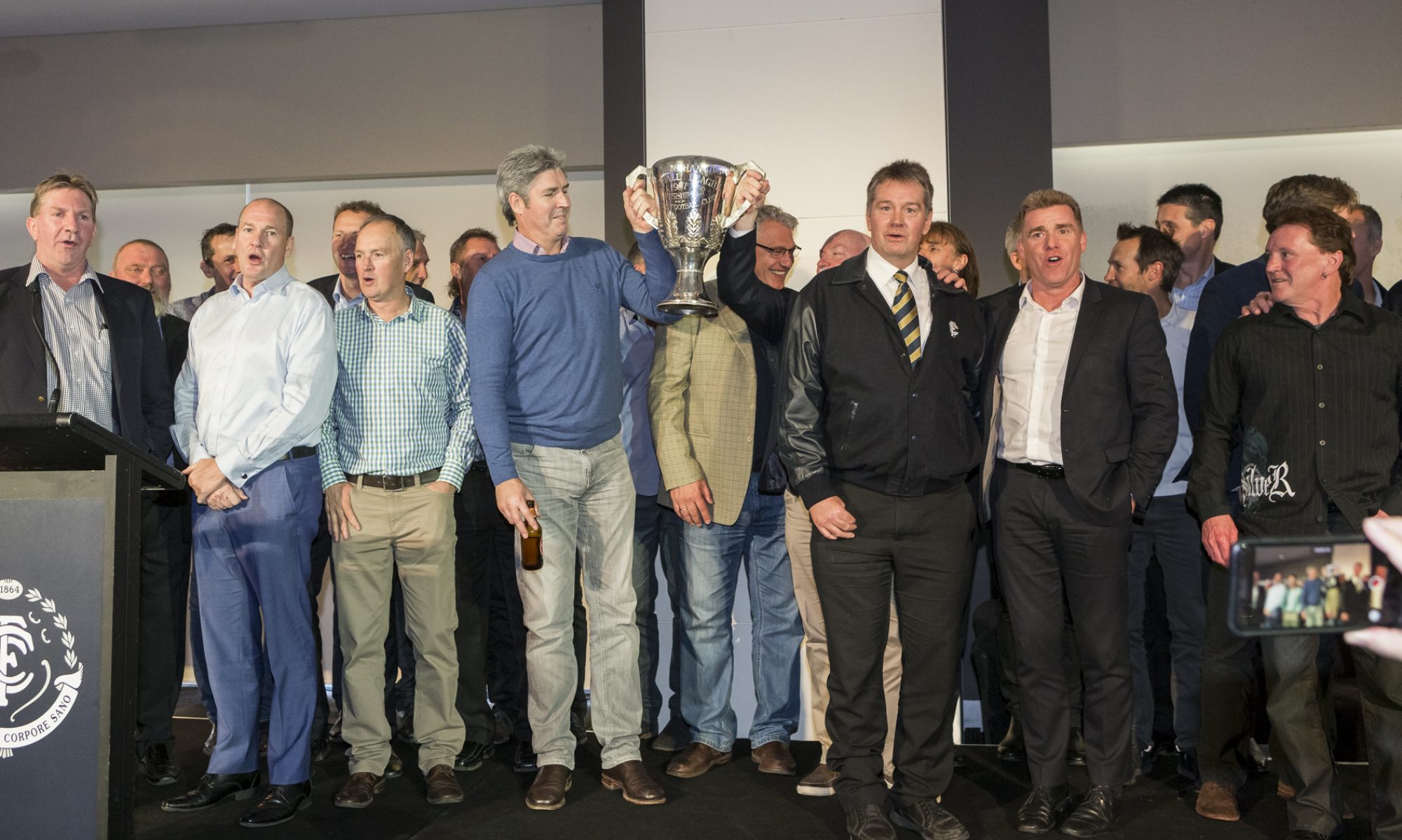




































Don’t miss your chance to celebrate Carlton’s newest Hall of Fame inductees.
PAST and current Carlton Football Club players will come together to honour the newly inducted members of the Hall of Fame.


Held in the Victory Room at Marvel Stadium on Wednesday 1 March 2023, this unmissable event now held at night will be jam packed with past and current Carlton players.

The evening will provide you with the opportunity to mingle with former, present-day players and coaches, while enjoying a delectable two-course dinner and premium beverages.
Merging our Guernsey Club and Carltonians Pre-season event will provide the opportunity for our Player Sponsors to sit with their sponsored players.
Along with this our newest Guernsey Club offering will now allow for past players to be sponsored within the program, where a benefit of this is to have the opportunity to sit with your sponsored past player at this event.
To find out more about the Past Player Sponsorship offering, Click here.
THE FORMER ruckman/forward Chris Mitchell, who died last Saturday (November 26) at the age of 75, managed just five senior games for Carlton in what was Ron Barassi’s final season as senior coach.
But the first of them was one to remember.
Mitchell, the former Geelong Grammarian, was a member of the Cats’ 1967 Grand Final twenty. He made the move to Princes Park in mid-1971 after completing the second of two stints (and 48 games in total) at Kardinia Park. The Geelong years sandwiched Mitchell’s 1969 and ’70 seasons with Western Australian club East Perth, during which time he represented WA at the 1969 Adelaide carnival.
Wearing the No.9 of current Carlton Captain and reigning Brownlow Medallist Patrick Cripps, Mitchell got the call-up for the 15th Round, co-incidentally against the Cats at the old Carlton ground – and he more than vindicated Barassi’s selection.
In a high-scoring affair, Mitchell and Alex Jesaulenko each contributed five goals to the Blues’ emphatic victory, 21.15 (141) to 15.14 (104). Which prompted The Sun’s on-the-spot reporter Bob Crimeen, to write afterwards: “Would Geelong have beaten Carlton at Princes Park on Saturday if a fortnight ago the Cats had not cleared big Chris Mitchell to the Blues? Unfortunately, this question will never be answered. But if you said ‘yes’, there is strong statistical evidence to support your belief”.
Mitchell turned out for the next four Carlton games – St Kilda at Moorabbin Oval, South Melbourne at Princes Park, Footscray at the Western Oval and finally Richmond at Princes Park – and at 24 years of age never played League football again.
Mitchell’s wife of 40 years, Mandie, believed her husband’s decision to give the game away was both football and work-related.
“He had trouble being told what to do, but he and Ron (Barassi) remained good friends,” Mandie said.
“At the time he also got a job in the mines through BHP, I think in Gove (in the north-eastern corner of Arnhem Land), and he remained with BHP until around 1983 or ’84 – during which time he took two years off to complete an MBA at Harvard.
“Later he worked for Parbury Henty grainmillers, ironically out of BHP House in Melbourne, and he found further work afterwards.”
Geoff Southby, the Carlton Best and Fairest winner in his maiden season of 1971, and a former teammate of Mitchell’s, remembered him as “a good bloke and a good footballer in his short time with the Blues”.
So too the four-time Premiership player David McKay.
“Given that ‘Nick’ (John Nicholls) and ‘Perc’ (Peter Jones) were there in ’71, it was a bit unusual that the club went for another ruckman, but Chris was a pretty good player before he came to Carlton,” McKay said.
“He was fairly athletic, he had the physique and he had the football smarts, but he wasn’t egotistical. He was a nice guy to go with it.”
Mitchell discovered the presence of three separate cancers back in March, and while Mandie conceded her husband knew his time was limited, he never let on.
“Chris was incredibly brave. He was a very strong man.”
Chris Mitchell, Carlton’s 830th senior player since the maiden VFL season of 1897, died in Geelong’s Epworth Hospital.
He is survived by Mandie and sons James and Edward – “one blessed with Chris’s athletic ability, the other with his intuitive sense of football” to quote his beloved wife.
The Carlton senior team, including Chris Mitchell on debut, v Geelong – R15, Saturday, July 10, 1971
B: John O’Connell Geoff Southby Vin Waite
HB: Barry Gill David McKay Kevin Hall
C: Garry Crane Bill Barrot John Warden
HF: Ian Robertson Robert Walls (vc) Bryan Quirk
F: Chris Mitchell Alex Jesaulenko Brian Walsh
R: John Nicholls (c) Sergio Silvagni Adrian Gallagher
Simon Verbeek made a spontaneous trip to his old home for the first time since 1991.
By Tony De Bolfo,
THE FORMER Carlton half-forward and self-confessed green thumb Simon Verbeek had just completed a rose inspection at Flemington Racecourse when he decided to make an impromptu beeline to IKON Park.
Not since 1991 – the last of his three seasons as a flanker in the days of Kernahan, Bradley and Silvagni – had the 38-game forward in the No.15 set foot in the old stomping ground on Royal Parade.
And like all former players, he was truly gobsmacked by what he saw.
“I cannot believe the changes,” Verbeek said after completing his inspection of IKON Park and its recently completed Stage 3 redevelopment.
“Where I’m standing now is where the old Robert Heatley Stand stood, with its little tunnels both inside and out to the changerooms. Compared to now, that’s miles apart.
“It’s been a long time since I’ve been back, I can’t honestly remember the last time I was here, and the changes are just incredible.”
The seemingly endless conga line of Carlton premiership trophies at the main entrance made a real impression on Verbeek, but the names featured on the flip boxes and the walls elicited an even greater response.
“I wasn’t part of Carlton at a successful time, so I don’t have that connection with the cups, but when I see the names like Stephen Kernahan, Craig Bradley and Stephen Silvagni that’s when I realise how privileged I was to be here.”
Verbeek – who joined Carlton on the recommendation of his then coach at Oakleigh, the Blues’ 1968 premiership wingman Bryan Quirk – savoured every moment of his spontaneous sentimental journey.
He was photographed by the players’ wall carrying his name and the accompanying number (957) as the 957th Carlton footballer to complete his senior debut since Jimmy Aitken in the inaugural VFL season of 1897.
Later he rested his legs by the old No.15 locker – now the domain of the current keeper of the No.15 guernsey Sam Docherty, and previous keepers Jim Marchbank, ‘Mocca’ Johnson, Bruce Comben and Val Perovic amongst them.
“I wasn’t here for a long time but it’s nice to have been connected to a great club and I’ll be forever grateful for that,” said Verbeek.
“I’m very excited with how the Club is trekking along now. I’m looking forward to seeing more games and savouring more successes – and how good was it that ‘Crippsy’ (Patrick Cripps) won the Brownlow!”
CARLTON’S 79-game half-back Graeme Anderson, a Life Member whose father Frank played off a flank in the Club’s victorious 1938 Grand Final team, has died after a long illness.
He was 83.
Recruited to Carlton under the father-son rule after spending his formative years in neighbouring Brunswick, Graeme was destined to play for Carlton – and yet he was chasing the leather for the Watchem-Corack Football Club (and later Cobram) in north-western Victoria when the Blues came calling, as Frank was then running the local Watchem Hotel.
Graeme Anderson, Carlton player No.740, circa 1961.
So it was of no surprise that when Graeme made his way to Princes Park on the cusp of the 1961 season, Frank lent his son his full support by relocating to Melbourne and accepting a coaching role with VFA outfit Preston.
Graeme was duly handed the No.43 later worn with distinction by David McKay and Anthony Koutoufides. It is a matter of record that Graeme was the first Carlton footballer to sport that number on the back of his guernsey, although he later reverted to the No.26.
Named at full-back between Bruce Comben and Brian Buckley, Graeme completed his Carlton senior debut in the Round 9 of 1961 against Essendon, when he followed John Nicholls down the race and onto Windy Hill.
Graeme’s 79 senior appearances took in the coaching tenures of Ken Hands (a close friend of the Andersons as both families were virtual neighbours in East Brighton) and Ron Barassi with whom he also enjoyed a healthy relationship. Under Barassi’s watch, Carlton emerged as a competition powerhouse, but fate would cruelly rob Graeme of the chance to be part of the drought-breaking premiership of 1968, as his son Scott explained.
The Suns News-Pictorial flags Anderson, the prospective Carlton debutant. 17 June, 1961.
“Dad talked about getting an injury to his elbow in a marking contest in the ’68 season,” Scott said. “He accidentally punched John Nicholls in the back of a head, broke some bones in his elbow and that was it.”
Graeme’s final senior appearance in Dark Navy came in Round 16 against Footscray at the Western Oval. Eight weeks later, he watched on from the stands at the MCG as his old team took the flag with less goals kicked. By then Carlton’s Best Clubman of 1966 had forged friendships for life – the closest with teammates Kevin Hall and Garry Crane.
Crane – the three-time Carlton premiership player, Club best-and-fairest winner and Team of the Century member – remembered Graeme as “a tight-checking player who was hard to get kicks on”.
“Graeme wasn’t flamboyant, he wasn’t stylish, but he was very effective,” Crane said.
“Funny thing, I got to know him better after football. He looked after me when I took ill and he gave me employment when I didn’t know what to do. It’s taken me a long time to get where I am now and I thank Graeme for his support along the way. He was very helpful and pretty kind. He was a very nice man.”
In the early 1970s, Graeme and Peter Poynton took out joint ownership of the famed watering hole the Carlton Club Hotel on Grattan and Cardigan Street corner, where many a Carlton identity toasted the latest team win into the wee hours of a Sunday.
1938 premiership backmen Frank Anderson and Frank Gill flank 1960 teammates Graeme Anderson (son) and John Gill (nephew).
After selling the pub in 1984, Graeme and his wife Gael, whom he had met in ’63 on an end-of-season trip to Surfer’s Paradise, relocated to Elsternwick (and later East Brighton), and Graeme established a landscaping business. True to his beloved Blues, Graeme employed former players like Tom Alvin and Ken Hunter to lend a green thumb, and through it all he and Gael raised their two children – daughter Jane and son Scott.
“Dad was a very strong family-driven man. He was very loyal and tight with his friends and he was a popular publican at the Carlton Club Hotel,” Scott said.
“Dad loved Carlton and Carlton was in his blood. He was heavily involved with the Carlton Past Players and he served the association as secretary. He had a passion for Carlton like there was no tomorrow, and the same applies for me and my four kids and Jane and her three.
“Dad kept up the connection for as long as he could, but the early onset of Alzheimer’s was what took him away.”
Graeme Anderson died at Benton’s Lodge in Mornington on Monday (7 November). He is survived by his beloved wife of 55 years Gael, son Scott and daughter Jane, their respective spouses Sarah and James, and seven grandchildren.
The funeral service for Graeme Anderson is to take place at Tobin Brothers, 189 Boundary Road, North Melbourne, on Monday, November 21, commencing 12.30pm
Refreshments will be served at the Carlton Football Club (Ikon Park), 400 Royal Parade, Carlton North, from 2.00pm
The Carlton team, including first-gamer Graeme Anderson, which met Essendon at Windy Hill in Round 9 – Saturday 17 June, 1961
B: Bruce Comben Graeme Anderson Brian Buckley
HB: Vasil Varlamos Bob Crowe John James (acting vcapt.)
C: Bill Arch Berkley Cox Chris Pavlou
HF: Dave McCulloch Gordon Collis Ian Collins
F: Maurie Sankey Tom Carroll Martin Cross
Ruck: John Nicholls (act. cpt.) Sergio Silvagni Leo Brereton
Res: John Williams Graham Gilchrist
A classic Carlton tale of former runner, Bill Stapleton.
By Tony De Bolfo,
THE recent passing after a long illness of Bill Stapleton – the former Carlton reserve grade runner of the mid-1980s and friend and confidante of the Club’s players of the day – has given light to a classic story involving a curtain-raiser once staged at the long-gone VFL Park.
The tale relates to the opening round seconds game of 1986 against Hawthorn, when Stapleton ran for the-then reserve grade coach Col Kinnear. Carlton emerged 17-point victors over the Hawks in that one, with a future premiership player Adrian Gleeson booting four goals in his first appearance in dark Navy.
Mark Kleiman, these days an athlete manager for Kapital Sports Group but back then a Carlton match-day waterboy, recounted the story this week.
“Bill Stapleton was running messages to the players and I was running water off a wing on the opposite side of the ground to the dugout,” Kleiman recalled.
“Suddenly the head trainer, I think it was Steven Tuohy, came over to me saying ‘You better put the fluorescent top on’. It turned out that Col (Kinnear) had given Bill too many messages, and Bill cracked the s….s and walked off.
“It happened just before half time and I ran the entire second half. I remember ‘Goughy’ (the-then Carlton Football Manager Stephen Gough) wasn’t overly impressed at the time, but in the end he saw the funny side.
“I’d always wanted to be a runner too, but that was the one and only time I ever ran.”
Kinnear corroborated Kleiman’s recollections, but with his own unique take on his association with Stapleton and THAT relayed telephone message from the coach’s box which fell on deaf ears late in the second term.
“Bill was running for me in the game at VFL Park and all of a sudden he wasn’t there,” Kinnear said.
“I said ‘Where’s Billy?’ and someone said ‘He’s gone up the race’, so ‘Climax’ (Kleiman) was asked to put on the runner’s top. This was at about the time they were starting to fine runners for running too many messages, which is why ‘Goughy’ gave ‘Climax’ the greatest spray – something along the lines of ‘What the bloody hell are you doing on the ground?’.
“In the rooms at half-time I again asked ‘Where’s Billy?’ and was told ‘He’s gone’. I said ‘Where’s he gone?’ and the comment was that he’d had enough. I took that to mean that he was crook because VFL Park was a big ground, but it seemed he might have got one too many messages – and when I later turned up to the after-match function there was Billy having a beer.”
Kinnear recalled that at the following Tuesday night’s training session, Stapleton was conspicuous by his presence at Princes Park, where the likes of Harmes, Maclure, Marcou and Sheldon each handed the runner a baby’s dummy to suck on.
“And they never let him forget it either,” Kinnear said. “Whenever Billy crossed paths with a former player he was always asked ‘Are you going to spit the dummy today?’ – and that happened for years.”
Stapleton was one of Carlton’s much-valued support staffers – “the bread and butter of the Club”, as he put it.
“Not only did Billy run for me in the reserves, but he helped put out the markers on training nights,” Kinnear said. “He was one of four of us out on the ground, with ‘Parko’, myself and Serge Silvagni as the assistant.
“Billy and Serge used to lay out all the markers for different drills, whether kicking or shepherding or whatever, but halfway through ‘Parko’ would change his mind and they’d have to rearrange them. In the end Billy gave each of the markers a name and within earshot of ‘Parko’ would say ‘Don’t worry Harry,’ or ‘Don’t worry Charlie, I’ll be back to move you on’.
“Bill was a mate of Jimmy (Buckley), and when ‘Sticks’ (Stephen Kernahan) and ‘Braddles’ (Craig Bradley) first came to Melbourne they both lived with Jimmy, so Billy was always around. He was good fun and a good bloke.”
Buckley, the three-time Carlton premiership player and club best and fairest, considered Stapleton – the owner of Ararat Meat Exports and Montara Estate Wines – “one of my best mates”.
“I got Bill down to the Club. I knew him from the meat game. He was a highly respected fellow and a great friend of the Buckley family,” Buckley said.
“Bill ran for the reserves, but was an integral part of the Club. I reckon he was the only runner to be invited on an end-of-season trip, and he joined us in Hawaii because all the boys knew him and liked him. You ask ‘Pera’ (Val Perovic) and any of the other players from that time. They’ll tell you that Bill was like a mentor to them. He was also a good friend of ‘Parko’s’.”
David Rhys-Jones, Carlton’s 1987 premiership player and Norm Smith Medallist, concurred with Buckley’s character assessment of Stapleton – a brother to the dental mechanic Bob Stapleton and the noted Melbourne pop singer Wendy Stapleton.
“No-one had a bad word to say about Bill,” Rhys-Jones said. “You wouldn’t have wanted to get on the wrong side of him because I heard he could go a bit, but I never saw it.
Bill Stapleton’s funeral is to be held at the Essendon Football Club’s Windy Hill venue (“of all places” according to Buckley), from 2.30pm next Monday (October 17) – and already the tributes are flowing.
A notice recently placed by the St. Bernard’s Old Collegians Football Club reads in part – “A man’s man with a cheeky sense of humour, Bill will be very sadly missed by us all. The St Bernards OCFC community sends its deepest condolences to his wife Robyn, daughters Billie and Angie, sons Michael, James, Andrew, Matthew & the extended Stapleton family”.
Former Carlton premiership player Mario Bortolotto has passed away.
By Tony De Bolfo,
Mario Bortolotto, the former Carlton defender whose 30 games included the David Parkin-coached back-to-back premierships of 1981 and ’82, has passed away overnight after a short illness. He was 65.
With Bortolotto’s passing, the first member of the Blues’ successive Grand Final-winning teams of that glorious era is gone.
Originally hailing from Koondrook in Victoria’s northwest, and recruited to Carlton after 14 senior appearances for Geelong through 1979 and ’80, Bortolotto first piqued the Blues’ interest when he kept Mark Maclure in check in a match-winning display in Round 12 of ’79 at Kardinia Park. Though he wasn’t to know it then, Bortolotto’s showing on Maclure was pivotal.
“We got bundled out in 1980 and going into ’81 we thought we needed a big-bodied, physical player who could knock a few blokes around going into 1981 . . . and (Chairman of Selectors) Wes Lofts thought Mario would fit the bill,” the-then Match Committeeman Shane O’Sullivan said.
“We went down to Geelong, saw Mario and told him we needed him to make a decision. He said yes and actually signed a serviette, which went in with his contract to the VFL. He then came to Carlton and fitted in straight away because everyone liked him.”
One of Bortolotto’s closest friends was the 1982 Carlton premiership ruckman, Warren ‘Wow’ Jones. Of Bortolotto, Jones said: “Mario was just a great fellow”.
“When he first came across from Geelong he turned up in a Commodore with an ‘Italian Stallion’ sticker on it. He was Italian through and through, a great family man and his folks were lovely old school people.”
Bortolotto completed his Carlton senior debut in the opening round of the 1981 season, against Richmond at VFL Park – coincidentally, the same game in which Western Australians Peter Bosustow and Ken Hunter also wore dark navy for the first time.
Sporting the No.6 now worn by Zac Williams, Bortolotto pitted his size and strength against the game’s key forwards, amongst them David Cloke on Grand Final day ’82. Having spent all of the ’81 GF in the dugout – and later earning an apology from his coach as a consequence – Bortolotto played the game of his life on his Richmond opponent, having negated Hawthorn’s Michael Tuck in the previous week’s preliminary final.
To think that an ankle injury almost put paid to Bortolotto’s ’82 season.
“Earlier that year, Mario went over on his ankle during training on the No.1 Oval and a couple of us had to carry him in. The sock was the only thing holding his foot in place,” Jones recalled.
“Mario missed a lot of football, played a few reserves games towards the end of ’82, but wasn’t named in the 25-man squad for the finals. He went to David Parkin saying ‘You haven’t included me, can I help out?’ – and ‘Parko’ included him in the squad to train through the finals to get him ready for the following year.
“But when Frank Marchesani ran into ‘Curly’ Austin in a game of soccer on the Sunday after the preliminary final, the selectors suddenly had to find a replacement – and the man who was available was Mario.”
The 1982 Carlton premiership squad. Bortolotto stands in the back row, third from the right
In the post-match victory lap, Bortolotto was famously photographed hoisting the silverware as his premiership medallion catches the sun. The year before he ran the lap in the training top he never got the chance to remove.
A lighter off-field moment involving Bortolotto was also captured on film. The footage, taken on Lygon Street, shows Bortolotto emptying a bucketload of spaghetti over the head of the former Collingwood rover and The Sun columnist Lou Richards – after yet another of Richards’ renowned Kiss of Death predictions spectacularly backfired on him.
In July 1983, Bortolotto featured in Carlton’s pre-season Grand Final victory, again at Richmond’s expense. Then in August, in what was the penultimate home-and-away round of the season, he was reported for striking North Melbourne’s Donald McDonald, which resulted in a two-match penalty and effectively ended his Carlton career.
Bosustow also copped a four-match penalty for an on-field transgression in that contest, and as with Bortolotto he never represented Carlton again.
Regardless, Bortolotto’s three seasons at Princes Park brought him a lifetime of memories shared with some of the greatest players of his or any other era – Fitzpatrick, Ashman, Doull, Harmes (with whom he later ran a sports store), Hunter, Johnston and Marcou to name but a few. Such was Bortolotto’s popularity amongst his contemporaries at Carlton that in 1982 he was also declared Best Clubman.
“He was very down-to-earth and the fact that he was named Best Clubman in ’82 gives you an indication of the quality of the man,” Jones said.
“He was part of an era when we had a lot of talent in the team, and he could come out and player a ripper of a game if given a job. He was tenacious and he played a very physical game. He couldn’t put many games together but give him a job like that one on Cloke and he’d follow it through . . . he really did his job for the team.”
Bortolotto always made it back for the premiership reunions – as was the case in the opening round of this season when he joined fellow members of the ’82 team in the 40-year reunion gathering at the MCG.
But his absence at the Spirit of Carlton reunion of the 1972, ’81 and ’82 teams at Marvel Stadium in late July rang alarm bells for Marcou, who placed a call to Bortolotto’s mobile – only to be told be a family member that his old teammate had become desperately ill with what was later identified as septicemia.
“It’s a very sad day for Carlton. Mario’s passing is a great loss,” Marcou said.
“After he came to the Club from Geelong he lived with me in Thomastown. We lived there for the best part of five years and we had some great times together.
“Mario was a true friend who was always there when you needed him . . . and ‘Parko’s’ move of him onto Cloke in the ’82 Grand Final was one of the great ones.”
Bortolotto spent his final three weeks in St Vincent’s Hospital, during which time his loved ones got to say their goodbyes.
Mario Bortolotto was the 887th footballer to represent Carlton at senior level in League competition.
Awarded Life Membership in 2003, Mario Bortolotto is survived by his wife Birgit, son Marcello and daughters Bella and Stephanie, to whom the Carlton Football Club extends its deepest sympathies.
Carlton’s AFLW players will wear black armbands into Sunday’s Round 3 match with Port Adelaide at IKON Park as a mark of respect.
Members of the 1972, ’81 and ’82 premiership teams gathered to celebrate their history.
By Tony De Bolfo,



THE WALLS of the aptly named Victory Room reverberated to the strains of ‘Lily of Laguna’, as members of Carlton’s 1972, ’81 and ’82 Premiership teams belted out the Club’s theme song in celebration of those famous Grand Final victories of yesteryear.
More than 900 Carlton people joined in the chorus, to bring rousing finality to the ’72, ’81 and ’82 Premiership Luncheon – one of the greatest events convened by the Spirit of Carlton.
Earlier, they had heard reminiscences from the key cast members of ’72 – Captain-Coach John Nicholls, rover Adrian Gallagher and full-back Geoff Southby, the Club’s best-and-fairest winner in that same year – and later from 1981 and ’82 Senior Coach David Parkin and captain Mike Fitzpatrick, together with team members Jim Buckley, Phil Maylin and Ken Sheldon.
Those in the house included Carlton’s 1982 premiership ruckman Warren Jones, now living in Sydney; and 1970 and ’72 premiership player Syd Jackson, 1981 and ’82 premiership player Peter Bosustow, and ’82 premiership player Ross Ditchburn, all of whom jetted in from their native Western Australia.
Endearingly nicknamed ‘Farmer’ by way of his kindred links to the five-generation Ditchburn family farm in Kukerin, some 302 kilometres south-east of Perth, Ditchburn was recruited to the Club on the recommendation of his old Claremont and Carlton premiership teammate Ken Hunter.
Though his on-field career spanned just 28 games through two seasons at Carlton, Ditchburn’s friendships with his premiership teammates truly endure.
“It was amazing to get back and catch up with all the boys,” Ditchburn said, in a to-camera interview for the Carlton Football Club archive.
“I cherished every minute I spent with those players. It was just unbelievable.
“There weren’t too many handshakes, only hugs, because that’s how close we are. It’s such a warm feeling when you’re in the midst of those players – and for someone who only played 28 games and was only here for two years I feel so humble to be in their midst.”
Spirit of Carlton Manager Shane O’Sullivan described the reunion, belatedly staged due to COVID-19 lockdowns, as “one of the great Carlton events”.
“The number of people we got to the function ensured that the atmosphere in the room was just electric. The auction got the event buzzing even more and topping it all off were the players on stage singing the song before all the cameras,” O’Sullivan said.
“To see the Carlton members and supporters so happy to mix with past champions was the best part of the day.”
O’Sullivan said that the event had generated funds “to go towards supporting past players who have fallen on hard times with their health or wellbeing”.
“So from the Spirit of Carlton’s past players, a big thank you to all the supporters who attended,” he said. “You were the people who made the day.”
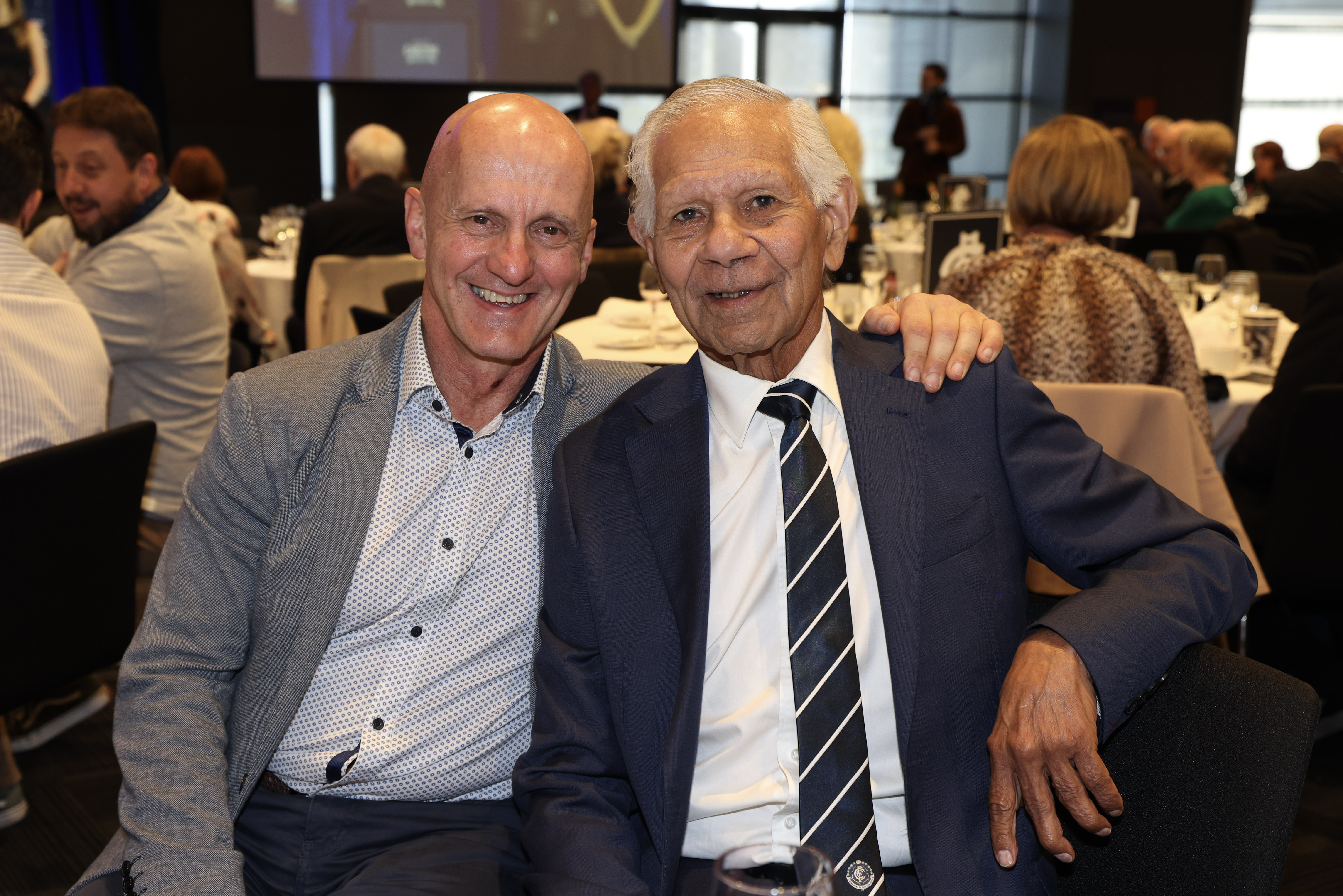
David Dickson and Peter ‘Percy’ Jones (photo credit: Jonathan DiMaggio)
Our August 11th luncheon was one of the if not the most successfull event in our history. Over 1000 patrons, and enormous energy in the room and hearing from the President, AFL coach, AFLW coach, 1972 legends, and 1981-82 legends was an afternoon never to forget. These are a few of our memories from the day.
Former player Peter Webster celebrates his 90th birthday on Saturday 6 August.
By Tony De Bolfo
IT’S ALMOST 70 years since Peter Webster first turned out for four quarters with the Carlton seniors. It happened against the old enemy Collingwood in the inhospitable environs of Victoria Park on the afternoon of Saturday 8 August 1953 – and as Webster recalled, the late Murray Weideman also lined up at centre half-forward in his first senior hitout for the black and whites.
“I actually got picked to play on what was my 21st birthday the previous Thursday,” said Webster, who celebrates his 90th birthday this Saturday (6 August).
“I was in the fire brigade and at home in bed at the time because I was on night shift. I remember answering a knock at the door at our house at 761 Drummond Street and standing there was a photographer from The Herald. The photographer asked ‘Are you Peter Webster?’, I said ‘Ýes’ and he said ‘You’ve been named in the Carlton senior team for Saturday’.”
“The photographer was keen on getting a pic, so I took him down to the fire station and he snapped me holding a ‘firey’s’ helmet . . . and I remember there was a celebration at a nearby hall in North Carlton.”
For the local boy who would serve his club through 97 senior matches in seven seasons, Drummond Street was where Webster first got a feel for the leather air conveyance.
“Drummond Street had a grassway through the middle of it and I used to kick a footy there,” he recalled. “I also went to the local Princes Hill Primary School, which was a block away from the ground, and from the time I was a young guy I played for Carlton – a couple of years in the fourths, a couple in the thirds, a couple in the seconds and finally the firsts.
At the far right is the old Webster family home, 761 Drummond Street, North Carlton. Also pictured is the grassway where Peter first kicked a football.
“My background was only ‘Carlton, Carlton, Carlton’ – and it was the same for others like George Stafford, Alan Streeter and Dick Gill, whose Dad Frank was a club champion for years.”
Collingwood got up by 17 points at the Magpies’ nest in that 15th Round contest of ’53, but Webster’s memory of that senior appearance relates to a lovely pre-match moment involving the team’s resident ruckman.
“I remember heading down the race with Jack (‘Chooka’) Howell, who was running alongside with his arm over my shoulder to help me steady the nerves. I thought that was nice,” Webster said.
“It seems so long ago that that happened. Where have all the years gone?”
Peter Webster, Carlton footballer, by the picket fence, Princes Park.
Ultimately, Webster forged his 97-game, seven-season Carlton career as a centre half-back, sharing defensive duties with half-backs John James and Denis Zeunert, the full back George Ferry, and the back pockets Bruce Comben and an emerging talent named John Nicholls.
Webster saw the best of James and unhesitatingly declares the 1961 Brownlow Medallist the best Carlton footballer of his era.
“I always admired John James,” Webster said. “He was only 5ft 9 and his kicking was a little ragged, but he was as tough as nails. When I saw him approaching the ball I wouldn’t go near him because he’d beat anybody trying to stop him getting it.”
Along the way, Webster pitted his skills against the game’s finest – Footscray’s Ted Whitten (“a player who wanted to play everywhere on the ground”), Melbourne’s Ron Barassi (“got him for about a quarter once when he pushed forward”), Geelong’s Fred Flanagan, South Melbourne’s Ron Clegg, Essendon’s Ken Fraser and North Melbourne’s John Brady – the latter “the best of them” according to the soon-to-be nonagenarian.
“The only message I ever got in a game was to pick up Fitzroy’s half-forward Owen Abrahams, who was a damned good footballer,” Webster said of yet another formidable foe. “(Murray) Weideman and I didn’t get on too well as he used to sneak up from behind, but one day I raced in and laid one on him.”
Webster 97th and final senior appearance for Carlton coincided with the 44-point loss to Melbourne in the 1959 semi-final. At 27, his time at Princes Park was cruelly curtailed by injury.
Peter Webster (at right) with former Carlton teammate Ron Robertson, at the old Carlton ground in 2016.
“I hurt the main ligament on the inside of my right knee in a practice match in my final year, this was my kicking leg and it was wobbling around,” Webster said.
“I sought out a few doctors to get the knee fixed, but no-one was interested. They (the club) even sent me to a specialist in Collins Street, but he wouldn’t touch it either.
“After doing my knee I thought I’d go coaching. Merbein offered me a job of captain-coach for 33 pound a week, plus a house rent-free for the first 12 months, and I was on eight pound a week at Carlton.
“At the time I didn’t even know where Merbein was, but when I found out it was up near Mildura where it was nice and warm and with no rain, I jumped at it, because I never liked playing in the rain.”
Webster recalled the then Carlton committeeman and former Premiership player Jack Wrout trying to talk him out of the Merbein gig.
“Jack said to me ‘You know you’ve played 97 games . . . what about coming down for those three games and starting on the bench to get your hundred up?’. But I’d already committed to Merbein and wanted to honour the agreement,” he said.
Webster took Merbein to the finals in each of his five seasons at the helm, with his teams landing two Premierships from the four Grand Finals in which they competed. When his knee again gave way in the fifth season, Webster hung the high-cuts up for good, but he remained in Merbein with his nearest and dearest for the better part of 30 years.
For the past 15 years, Webster has lived quietly in a retirement villa in Rosebud’s Village Glen – although he still gets a regular round in at the nearby golf course and will this Saturday blow out the 90 candles when family and friends gather for his birthday party at the nearby clubhouse.
To this day, he keeps a place close to his heart for the old dark Navy Blues.
“It’s a long time ago since I last played, but I still have a soft spot for the Club,” Webster said.
“It’s a bit too far for me to come down to watch the players play thesedays, but I never miss when they bob up on the telly, and I look out for Jesse Motlop who wears my old No.3. He’s pretty raw, but he has a lot of ability.
“When I started there I was just a young kid coming through, but I always played for the jumper whenever I ran out.
“In those days every kid in the area wanted to play for Carlton and I was no different. There wasn’t much money around then, but gee, I wish to God I was playing now.”
Tony Pickett returned to IKON Park and was blown away by the recent redevelopment.
By Tony De Bolfo
CHARLIE Curnow’s unofficial fan club probably runs into the tens of thousands thesedays… and chief amongst them is Tony Pickett, who more than 40 years ago carried the exhilarating forward’s No.30 on his back.
Pickett, the former Carlton wingman who today lives quietly in retirement near the Bay of Fires on Tasmania’s idyllic east coast, was a welcome visitor to the place he remembered as Princes Park, having earlier reunited with some of his old contemporaries – the likes of Rod Ashman, Rod Austin, Wayne Harmes, Trevor Keogh, Mark Maclure, Val Perovic and Geoff Southby – over lunch at their traditional inner city go-to trattoria, Maria’s in nearby Peel Street.
Pickett was blown away by the new IKON Park redevelopment – a far cry from the place he knew in his maiden season of 1976.
“This is an unbelievable facility. If you’re a player here you’ve got no excuses,” Pickett, who turns 70 in January, said.
The Ian Thorogood-coached Carlton senior squad of 1976. Tony Pickett sits in the second row, second from the left.
“I remember the Heatley Stand and walking into reasonably dim rooms. There were weights there back then, but only a limited supply, and it didn’t matter whether you were 12 stone or 18: you lifted the same weights.”
Recruited to Carlton from North Launceston on the recommendation of the Club’s 102-game former centreman Berkley Cox – co-incidentally an old schoolmate of his father – Pickett joined Carlton on the eve of the 1976 season (as did the fleet-footed North Hobart wingman Leigh McConnon) and was billeted out to a Reverend and his wife at a premises within walking distance of the ground.
He fared well on Geoff Ablett in a practice match with Hawthorn and was promptly handed the No.30 vacated by the late Vin Waite. As he said with some modesty: “I was lucky in that I think it was Bryan Quirk who retired the year before, so there was a gap on the wing and I happened to be the man on the spot”.
“I can’t remember when it happened, whether on the following Tuesday leading up to the opening round, but they said to me ‘If you sign up you’re in the first game’. Well, how could I resist that? That’s how it all happened really,” he said.
Tony Pickett circa 1979.
Conscious of the need for speed if he was to progress, Pickett was as ready as he could ever be for the rigours of League football, having worked on his pace in the immediate years preceding the move.
“I was as slow as a wet week when I was 13, 14 and 15, so for about five years in a row I trained with the sprinters who were preparing for the Devonport, La Trobe and Burnie Gifts,” he said.
“Over five or six years I gradually got quicker, I grew a little bit and I cut the gap down – and I became more competitive with it which helped with my football.”
Adjudged the Club’s best first-year player, Pickett booted four goals on debut in what was an opening round baptism of fire involving Collingwood, and was a member of the 20 that fell agonisingly short of North Melbourne in the ’76 preliminary final. Incredibly, he was jetting in and out of Hobart for the first eight games as he balanced his footy with a career in teaching.
Finding his place across midfield, Pickett turned out for the old dark Navy Blues in 60 senior appearances through four seasons in total. Regrettably, an injury to the hip bone brought premature end to Pickett’s career after the Round 11 match with South Melbourne in 1979 – a premiership season under Captain-Coach Alex Jesaulenko’s watch.
In the end, Carlton wingers Peter Francis and the late fellow Tasmanian Michael Young emerged, and ultimately made it to the podium – and that’s football as Pickett readily attested.
“I wouldn’t change anything,” declared Pickett, who also agreed to a substantial to-camera interview for the Club’s archive in reflecting on his time in the League football industry.
“I had a brief but interesting career at Carlton, I made some great friends which is what I remember most of my time here, and I still follow today’s teams from afar – and whenever Charlie kicks a goal I always point the number out to my wife.”