
Latest Video – Wayne Harmes 1985
Latest Video – David Glascott 1985
Latest Video – Des English 1985
Alex Marcou’s 60th
Happy 60th birthday to Alex Marcou.
Career : 1979 – 1986
Debut : Round 3, 1979 vs Essendon, aged 20 years, 268 days
Carlton Player No. 879
Games : 158 (134 at Carlton)
Goals : 165 (148 at Carlton)
Last Game : Round 11, 1986 vs North Melbourne, aged 27 years, 338 days
Guernsey No. 34
Height : 178 cm (5 ft. 10 in.)
Weight : 76 kg (12 stone, 0 lbs.)
DOB : 6 July, 1958
Premiership Player: 1979, 1981, 1982
Carlton Hall of Fame (2006)
Alexander Marcou was a member of Carlton’s fabled Mosquito Fleet of brilliant small men of the 1970s and ‘80s – a lightning quick, three-time Premiership rover renowned for his ball-handling skills and excellent goal sense. After being recruited from VAFA club Thomastown at the age of 18, he won Carlton Reserves Best and Fairest award in 1978, and the following year began his senior career.
Upon arrival at Princes Park in 1976, Marcou was allocated the Blues’ guernsey number 50 before switching to the number 34 previously worn by three-time Premiership star Ian Robertson. Like Robertson, Marcou would go on to win three flags, and as at 2016, his 134 games still stand as the club record for most appearances in this number. Of mixed Greek and Macedonian heritage, Alex grew up in Melbourne’s northern suburbs and inherited his love of Australian football from his father, who at that time was a rusted-on Fitzroy supporter.
Although he was eligible to play at Under-19 level, Marcou started with Carlton Reserves and served a lengthy apprenticeship of 33 games over two seasons, primarily as a winger or centreman. His coach in 1978 was Carlton Legend Sergio Silvagni, and it was Serge who convinced the Blues’ match committee to include Alex in the senior team for the opening round of the 1979 season against Essendon at VFL Park. Three other first-gamers in Wayne Johnston, Robbert Klomp and Peter Francis were also included for that Saturday afternoon match, and all were destined for Premiership glory. Playing as second rover to Ken Sheldon, Marcou collected 15 disposals, 2 marks and 2 goals in an eye-catching debut. Carlton won by 21 points, and from that day on, Alex was an automatic selection in the Blues’ senior side.
Midway through that first fairytale season, in his 13th senior game, Marcou (already nick-named “Marcel” after the famous French mime artist Marcel Marceau) was named Best on Ground when he kicked five goals in the Blues’ big win over Richmond at Princes Park. By September, Carlton was two wins clear of North Melbourne on top of the ladder, and raging hot favourites to claim another flag when they met the Roos in the Second Semi Final at VFL Park. Marcou and Rod Austin warmed the interchange bench for much of that afternoon, before Marcel was unleashed and got busy with eight effective possessions. Carlton won convincingly, and marched straight into the against Collingwood.
A fortnight later, having played every game of the season for an excellent return of 34 goals, Marcel sat next to “Curly” Austin on the bench again on Grand Final day at the MCG, surrounded by an enormous crowd of more than 113,000. A boggy surface, cold wind and intermittent rain didn’t dampen the ferocity of the contest between the game’s greatest rivals, until some individual heroics by Wayne Harmes during time-on in the last quarter won the games’ biggest prize for the Navy Blues. Marcou was on the ground at the final siren, having had a shot for goal that just missed with his 12th possession After just 24 games, Alex had joined the exalted ranks of Carlton Premiership players.
Season 1980 saw upheaval at Princes Park when President George Harris was voted out of office in tumultuous circumstances. Former champion ruckman “Percy” Jones replaced Alex Jesaulenko as senior coach, but the Blues never really gelled as team before crashing out of the finals in straight sets. Marcou had another fine year (apart from spending a month on the sidelines with an ankle strain) and kicked 17 goals in 19 matches. Late in the season he was selected in the VFL squad for a match against a combined ACT team in Canberra. Alex did well and was named among the three best for the Vics, but in a huge upset, the home side won by 13 points. Back at Carlton, Jones was sacked at season’s end and replaced by former Hawthorn Premiership player and coach David Parkin.
Parkin’s methods and discipline took Carlton into the finals again in 1981, thanks in no small way to the Blues’ array of brilliant, versatile small men – the Mosquito Fleet of Rod Ashman, Jim Buckley, David Glascott, Trevor Keogh, Ken Sheldon and Alex Marcou. In the Second Semi Final against Geelong, Buckley and Marcou shared the roving duties and the Blues had so many stars in their 40-point victory that Alex’s 26 disposals, 5 marks and one goal wasn’t good enough to earn a mention among his team’s best five players. Two weeks later, Carlton took on Collingwood for the flag for the second time in three seasons, and triumphed by 20 points after trailing by 21 half-way through the third quarter. In front of another huge crowd of 112,000 at the MCG, Marcou started from the interchange bench, but was soon in the thick of the action, racking up 31 disposals and six marks on the way to collecting his second Premiership medal.
Alex enjoyed his most consistent and rewarding season the following year, when Carlton survived four consecutive tough finals to claim their third flag in four years. The Blues’ opponent in the 1982 Grand Final was their other great traditional rival, Richmond – who began the decider as strong favourites after cleaning up the Blues in a rugged Semi Final. As part of his game plan, Parkin ran three rovers in Ashman, Sheldon and Marcou, and all three became influential as the contest unfolded. With their team behind by 11 points at half-time, Carlton ruckmen “Wow” Jones and captain Mike Fitzpatrick seized the initiative in the second half and the Blues came storming back for a gritty 18-point win. That evening, amid the euphoria of a third flag win in four years by the Blues, Alex’s remarkable career statistics stood at 9 finals, three Premierships and 112 goals in 87 games.
Highlights kept coming for Marcel in 1983, despite a couple of muscle strains that cost him the odd game or two. In May, he played his first and only State of Origin game for Victoria against South Australia in Adelaide, in a famous match that produced an aggregate 43 goals and a 56-point victory to the Crow Eaters. In July, Alex celebrated game number 100 for Carlton with a 6-goal victory over Fitzroy at Waverley, before playing his 20th final when the Blues suffered a devastating Elimination Final loss to Essendon. Perhaps that was a portent of things to come, because in an all too common story, Lady Luck seemed to turn her back on Alex from that time on.
Having already suffered a series of persistent soft tissue injuries, Marcou had his jaw broken in 1985, and again in 1986. Over those two seasons he managed only 10 senior games, and his frustration was compounded when he was on track for a return to the senior side on the eve of 1986 finals, only to tear a hamstring. Before that injury his form with Carlton Reserves had been good enough to see him finish third in the voting for the Gardiner Medal (Reserves Best and Fairest) despite only playing half a season.
Carlton’s heavy defeat by Hawthorn in the ’86 Grand Final turned a blowtorch on the Blues’ roster of players, and indirectly ended Marcou’s career at Princes Park. When club secretary Ian Collins bluntly told Alex that his place in Carlton’s senior team could no longer be guaranteed, it prompted the 28 year-old to consider a fresh start another club. Mainly because a number of ex-Blues were already playing there, he eventually chose St Kilda, and Carlton did not stand in his way.
Alex’s first season with the Saints in 1987 saw him used at both ends of the ground, and his experience was invaluable in a young team. However, hamstring and calf injuries slowed him down in 1988, and when he fell out with his coach Darrell Baldock, he made the decision to retire at season’s end. In two seasons at Moorabbin, he had played 24 games and booted 17 goals.
Although finished with League football, Marcou wasn’t quite ready to hang up his boots for good, so in 1989 he signed on with VFA club Springvale, where he was coached by his dual Premiership team-mate Phil Maylin. In 1993, Marcou, Maylin and another Premiership-winning Blue in Peter McConville formed an organization called the VFL – Virtually Forgotten Legends – as a social club and support network for former players and officials. Later, Alex returned to Princes Park as an energetic member of the Past Players Association, and in 2006 he was inducted into the Carlton Hall of Fame.
Milestones
100 Games : Round 16, 1983 vs Fitzroy
100 Goals : Round 18, 1982 vs Footscray
Career Highlights
1978 – Reserves Best & Fairest
1979 – Premiership Player
1980 – Victorian Representative
1980 – 7th Best & Fairest
1981 – 10th Best & Fairest
1981 – Premiership Player
1982 – 7th Best & Fairest
1982 – Premiership Player
1983 – Victorian Representative
1983 – 6th Best & Fairest
1985 – 3rd in Gardiner Medal (VFL Reserves Best and Fairest)
Latest Video – Bruce Doull 1985
Vale Allan White – true Blue to the end
ALLAN White, an opportunistic Carlton forward in the early years of John Nicholls and Sergio Silvagni, has been laid to rest in the Strathbogie Shire town of Avenel, the place from which he was recruited to Princes Park more than 60 years ago.
At the age of 84 and after a long illness, White died in a Shepparton aged care facility last Friday (June 27). Surviving him is his beloved wife Joyce (the great aunt of Collingwood’s Steele Sidebottom), daughter Anne-Maree, son Richard and their families.
Born in Carlton in November 1933 and raised in nearby Fawkner, White ultimately relocated with his family to Avenel where he found work as a woodchopper. Chasing the leather for Avenel Swans on weekends, White first attracted the interest of a South Melbourne talent scout, but instead resolved to follow his football dream with the Blues whom he’d supported as a kid.
Completing his Carlton senior debut in the 17th round of 1957 – and carrying the No.38 of Ciaran Byrne on his back – White was named on a flank alongside centre half-forward Graham Donaldson and Denis Strauch for the match with Fitzroy at the old Princes Park oval.

The late Allan White signs a footy for some young fans. (Photo supplied by Heath Armstrong)
The home team, under the watch of the then coach Jim Francis, comfortably accounted for the visitors – 11.13 (79) to 5.11 (41) – on a day in which John Chick was reported and subsequently suspended for eight matches for kicking Fitzroy’s Wally Clark.
The resident Carlton captain Ken Hands also had his number taken for allegedly striking the Lions’ half-back flanker Brian Pert – a charge later thrown out by the learned members of the Tribunal.
Alternating from half-forward to full-forward between 1957 and ’59, White would find the big sticks on 23 occasions in as many senior appearances for the old dark Navy Blues, including a bag of five to get them over the line by two points against Hawthorn in the 17th round of the ’59 season.

Allan White and John Nicholls on the MCG in 1957. (Photo supplied by Heath Armstrong)
As with the late Doug Beasy and Peter Webster, White’s last hurrah for Carlton came in the 1959 second semi-final with Melbourne. Before an audience of more than 72,000 in miserable conditions on the MCG, the Hands-coached Carlton players were outclassed by the Redlegs – 11.15 (81) – 4.13 (37) – with John Nicholls and Ron Barassi best afield for their respective teams.
During his time at Carlton, White worked at a nearby box factory to help make ends meet. Then in April 1960, quite possibly for financial reasons, White successfully sought a transfer to Sunraysia Football League club Mildura Imperials whom he captained and coached.
Webster, who coincidentally captained and coached rival team Merbein, remembered his old Carlton teammate with affection.
“Gee, this goes back a long way,” Webster said. “Allan wasn’t that big size wise, about 5’11” in the old measurement, but he was quite a good kick – a long kick – and he was a nice fellow too.”
Wearing his Carlton Football Club blazer, White was buried in Avenel Cemetery on Monday. Down the road at Avenel Football Club, he is immortalised as a member of the Swans’ Team of the Century.
This week, White’s grandson Heath Armstrong, who supplied two wonderful images from the old Carlton days, paid a very personal tribute.
“My grandfather taught me how to kick a footy – my only discernible skill when it comes to playing the game,” Armstrong said.
“He was very passionate about his sport and he loved the Carlton Football Club. We always used to chat about the state of the team, this was something we really pondered a lot.
“He was genuinely pretty quiet, a man of few words, but not afraid to tell you what he thought if he thought about it strongly.”
Carlton great Keith Warburton dies

Keith Warburton was endearingly remembered by Carlton supporters as the ‘the acrobat in football boots’. (Photo: Boyles)
KEITH Warburton, endearingly remembered by Carlton old-timers as ‘The acrobat in football boots’, has died at the age of 90.
That the high-flying ‘Warby’ lived so long is something of a miracle – for in truth the 74-game great of the early 1950s suffered an horrific injury in his one and only finals appearance – and hovered precariously between life and death as the denizens of the football world held their collective breath.
It happened at the MCG on the afternoon of Saturday, September 6, 1952, in what was Warburton’s one and only finals appearance, the first semi-final involving the now-defunct Fitzroy.
Carlton lost to the Gorillas by a miserable point – 8.20 (68) to 10.9 (69) – with the golden point booted in the dying seconds by Fitzroy captain Alan Ruthven.
But the match was overshadowed by Warby’s dreadful injury – the result of a wayward blow to the lower abdomen incurred in the opening quarter of the contest.
“I got an accidental elbow to the lower stomach early in the game from Bill Stephen, one of the fairest players of the game,” Warburton told this reporter in what was his last interview a little more than two years ago.
“I actually turned around in a pack as Bill was coming through. He put his arm up to protect himself and he collected me. I was dry reaching all through the game, but played it out. It was then that I got into trouble. In the rooms after the game I passed blood in the toilet and later collapsed at the club dance.
“I was bundled into a car and taken to the Royal Melbourne, but was later ferried to Prince Henry’s Hospital by a little mate of mine from Cheltenham, Lexy Robertson.
“We got there and it was full of drunks. There I collapsed and a sister came in and put me straight into the operating theatre. After the op my condition worsened over the next few days.”
Warburton underwent emergency surgery to have part of his bowel removed – the legacy of a severed minor artery leading to the bowel – and as news of Warburton’s perilous condition filtered through, supporters gathered for a vigil outside Prince Henry’s.
Back at Princes Park, all from Carlton President Ken Luke down were mobilised into action, with Ken Hands and Jack Howell amongst the many answering the blood bank’s appeal for precious plasma.
This was big frontpage news, with The Argus of Tuesday, September 9 carrying a report headlined ALL WORRY ABOUT SICK STAR.
The article featured an image of Warburton’s wife of 65 years Rose in the company of nurse Aileen Keilan, who was afforded the lofty task of tending to the desperately ill footballer. Another image featured two young Carlton fans, Ike Weir and his brother Sam, hovering around the Bakelite radio in their pyjamas awaiting updates on their hero’s condition. A further image featured a hospital switchboard attendant taking calls from concerned members of the public.
The newspaper report, in part, read as follows;
While Keith Warburton, Carlton football idol, still battled for life in Prince Henry’s Hospital, countless thousands of people throughout the State yesterday waited anxiously for news.
The news late last night was “No change. He is still on the danger list, but is maintaining the slight improvement he showed on Sunday”.
Doctors at the hospital are confident that Warburton’s fine physical condition will help him recover.
The Warburton drama has aroused greater interest than any injury to a player has ever done before. Yesterday it even drove interest in the end-season matches into the background.
Just before noon yesterday it was widely rumoured that a wireless station had announced the young forward’s death. The rumor spread quickly throughout the city. In hotels, clubs, shops and on the street the topic was “bad luck about Warby”.
The hospital, receiving telephone inquiries at the rate of six a minute, finally was forced to issue an appeal to the public to desist – they were interfering with the work of the hospital.
Hundreds rang from factories and offices to pass on the news to workmates. Hospital officials reported that they could not recollect when so many inquiries had been received about a patient’s condition.
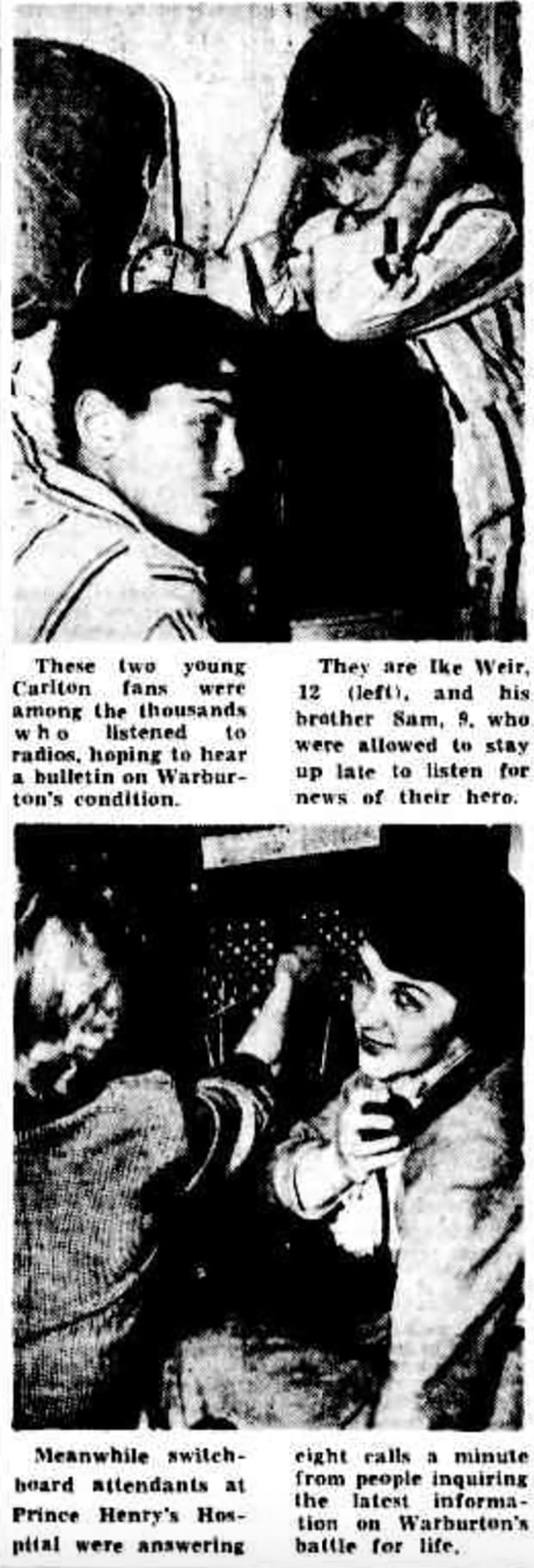
Carlton supporters come to the aid of their hero, as reported in this article from The Argus.
Warburton was forever thankful to all those who helped him through his darkest hour.
“I can remember many people popping in to offer blood. It was unreal,” he said. “I had a ruptured bowel and burst intestine. My belly blew right up. I can remember looking down and all I could see was a great big stomach.”
In time, and to the relief of all football lovers, Warburton came through. Remarkably he made the cut for the opening round match of the 1953 season, against Footscray at Princes Park, albeit with the necessary safeguards.
“I later had to play with a big belt on. It was like a girdle around my midriff and it slowed me up a bit,” Warburton said.
“I had it stuck there in the cupboard for a while and only a year or so ago I threw it away.”
At 26 years and 24 days, Warburton’s on-field career came to an untimely end. It happened in Round 11, 1955, against Richmond at Punt Road Oval after the club realised it was not in a position to cover the player’s insurance.
On leaving Princes Park, he accepted the role of captain-coach at Tatura. “I was only supposed to hang around for 12 months as coach of Tatura as I was going to head up to Mildura,” he recalled.
“But ‘Spider’ O’Toole, who was, the big cattleman here said ‘See that land out there? You can take what you want, put a house on it and stay here’ and that’s what I finished up doing.”
Years later, Warburton watched on with pride when his son Peter completed his Carlton senior debut in coach Ron Barassi’s final season of 1971. Throughout it all, the old man pursued his post-game interests.
“I had a nursery for a while, grew veggies and kept dogs,” Warburton explained. “I trained greyhounds and made a stack out of it. It was cash and it kept me going. I was an owner/trainer.
“I never retired from work until late – I used to pick horses and greyhounds up for people.”
Warburton readily admitted he lost interest in an ever-changing game. As he said: “It’s played so differently now and I’ve said so before, but I’ve also been told I’m out of touch.”
And yet, he still kept a place in his heart for the place he remembered as Princes Park and the people who made it famous.
“When I joined Carlton in 1951 I used to catch the train from Bonbeach to Flinders Street and the tram up Royal Parade to the ground. Back then I was playing for two quid,” Warburton said.
“It’s hard thinking about some of these things at Carlton now because it’s such a long time ago. My wife bought out the scrapbooks and there were players in some of the teams I just don’t recall, but I do remember Dennis Zeunert, Peter Webster, Johnny James, Bill Milroy and Ken Hands.”
At two pound a game, “Warby” was undoubtedly underpaid. For few at Carlton, with the probably exception of Peter Bosustow, crammed so much so soon into his career highlights reel.
“Carlton people remembered me as a mad acrobat and I’ll tell you why,” Warburton said.
“As a kid I once got into a circus to have a look. I got under the tent and watched the acrobats perform all these tricks. From then on everything I did was acrobatic and that’s why they called me ‘The Acrobat’.”
A resident of the Moyola Gardens Retirement Village, Warburton died there yesterday morning (June 27) after a short illness, surrounded by family members. Two weeks ago, he was inducted into the Goulburn Valley Football League Hall of Fame.

The late Keith Warburton. (Photo: Supplied)
Keith’s beloved wife of 65 years, Rose, died 12 months ago. They are survived by daughter Lizzie, son Peter (himself a four-game Carlton senior player through 1971 and ’72), Susan, David and Tracey, together with 14 grandchildren and 19 great grandchildren.
Carlton’s senior players, Kade Simpson in game No.300 included, will wear black armbands into Saturday’s match with Port Adelaide as a mark of respect to Warburton, whose funeral will take place at the Tatura Bowls Club next Monday, July 2, commencing at 11.00am.
Speaking for his family, Peter offered a fascinating insight into Keith Warburton the man.
“To the day he died, I never ever heard Dad swear, never saw him intoxicated, never saw him raise his hands to anybody within or outside the family, or raise his voice in anger,” Peter said.
“If you go back to his footy that’s why he never hit back. He always used to say ‘I’m out there to play football’.”
Latest Video – Peter Dean 1985
Serge Silvagni’s 80th
Happy 80th birthday to Serge Silvagni
Career : 1958 – 1971
Debut : Round 7, 1958 vs South Melbourne, aged 19 years, 330 days
Carlton Player No. 718
Games : 239
Goals : 136
Last Game: Round 22, 1971 vs Collingwood, aged 33 years, 61 days
Guernsey No. 20 (1958) and No. 1 (1959 – 1971)
Height : 183 cm (6 ft. 0 in)
Weight : 92 kg (14 stone, 7 lbs.)
Date of Birth: June 28, 1938
Premiership Player: 1968, 1970
Best and Fairest: 1962, 1968
Leading Goalkicker: 1959
Captain: 1964
Victorian Representative: 1962, 1963
Carlton Hall of Fame (1989)
Carlton Legend (2016)
Team of the Century
The Sergio Silvagni story mirrors that of thousands of European settlers in Australia following World War II. His parents had arrived years before the start of the conflict and settled in Carlton, but Sergio grew up in a time when his family’s homeland; Italy, had been a recent enemy. Team sports were a perfect a way of assimilating, so he took to the local game in primary school.
By his late teens he was a standout in senior school football with Parade College, and in 1956 he was invited to try out in a practice match with the Under-19 squad at Carlton. With fifty players involved and changes only being made at the regular intervals, he didn’t get a run until after half time – only to be sent to full-back to play on the team’s gun full-forward. In Serge’s words, he “blitzed” the bloke because he was so annoyed at having to wait to get his chance. Only later was he told that the officials at the game knew he could play, but they didn’t call on him earlier because they couldn’t pronounce his name!
The dark-haired, solidly-built kid with determination written all over him forced his way into Carlton’s senior team in 1958. Originally given guernsey number 20, such was his impact that prior to the ’59 season his coach Jim Francis insisted that he switch to number 1. By this time Serge was a rapidly-maturing 21 year-old, standing 183 cm. When not playing or training with the Blues, he continued working in his father’s concreting business – hard physical labour that paid big dividends in the powerful 92 kg physique he developed.
By 1962 Silvagni was established among the very best ruck-rovers in the game and was selected in the Victorian State team. A one-pace performer, he ran and worked as hard in the last minute of the game as he had in the first. He was a superb team player and a strong, safe mark; when Serge took front position or swooped on the ball at ground level, only a Mack truck could shift him. He wasn’t quick, but he read the play superbly and revelled in the fiercest contest.
Carlton made the 1962 Grand Final, only to lose to Essendon by 32 points, with Silvagni named among the best for the Blues. A couple of weeks later, Serge won Carlton’s Best and Fairest award with a record number of votes, polling in 19 of a possible 22 games. And in a portent of things to come, he had already developed a special on-field relationship with the Blues’ emerging champion ruckman John Nicholls.
Two years on, the third member of perhaps the greatest ruck combination of all played his first game for the Blues. Adrian Gallagher came to Carlton from Yarram, and claimed a rover’s spot in the senior team from day one. From 1964 to 1971 Nicholls, Silvagni and Gallagher were the most respected on-ball trio in the game. Nicholls’ brilliant palming, Silvagni’s tenacity and Gallagher’s fluent disposal made them a potent combination.
Serge was honoured with the captaincy in ’64, but the Blues had a poor year, finishing tenth before the sensational arrival of Ron Barassi in 1966 revitalised the club. Two years afterward, Carlton beat Essendon by 3 points in a dour struggle before a record crowd on Grand Final day to claim our first flag in 21 years. Serge was in his element in that ’68 Grand Final, and was among Carlton’s top half-dozen contributors. He then topped off a great season with another Best & Fairest award.
In 1970 we saw him on the podium with a Premiership medal around his neck again, and with that infectious grin still in place after a herculean effort helping the Blues fight back to eventual victory from a hopeless position at half-time against Collingwood. In many ways, that was Sergio Silvagni’s (and Carlton’s) finest hour, because the whole team adopted “Silva’s” never-say-die attitude, and pulled off a football miracle.
Aged 32, Serge wanted to retire after the 1970 triumph, but coach Barassi and the match committee talked him into just one more season. Somewhat understandably, the Navy Blues faded to fifth that year, despite another big-hearted effort from their socks-down champion wearing number 1. When Serge eventually called it quits, supporters from every club acclaimed him. There was open, genuine affection for a man from humble beginnings who made the Carlton Football Club – and the wider community – a better place by his presence.
Happily, the Sergio Silvagni story did not end there. After 239 games and 136 goals, two Premierships, one year as captain, two Best & Fairest awards and two Big V appearances, he went on to further serve the Blues as a committeeman, selector and even a caretaker coach for three matches in 1978. In 1989 he was elected to the Carlton Hall of Fame, and in May 2000 – when the Carlton Team of the 20th Century was announced – Nicholls, Silvagni and Gallagher were right where they richly deserved to be, as the team’s first ruck combination.
Honours kept coming for Serge in 2007 when he was named on the interchange bench in the Italian Team of The Century. At full back in that side, as well as in the corresponding AFL Team of the Century, was Stephen Silvagni – the champion son of a champion father. Then in May, 2016 – only months after his grandson Jack Silvagni was drafted by the Navy Blues – Sergio was awarded the ultimate accolade for a Carlton player when he became an official Legend of the Club.
1971 Poll on Best Ruck-Rovers of All-Time
In third place was the recently retired Sergio Silvagni. Firstly he said he had enough after the 1970 season but was persuaded to don his boots for another year. ‘Old Serge’ will never be forgotten. He was an untidy looking player with his great bulging thighs and calf muscles and the navy blue socks always hanging down over the top of his boots. Off the field Silvagni had a dry personality. In front of the TV cameras he brought many a laugh with his humour. But, despite his unruly football attire, Silvagni was a master of the ruck-rover role. No-one battled harder when the going was tough; when someone had to bore in, head down, into a milling pack, Sergio was just the man. Serge might not have been the most artistic or gifted player the game has produced, but if he made up his mind to get the ball – and that was pretty often – he usually got his way. He won Carlton’s best and fairest award in 1962 and 1968; was captain in 1964; played in the 1968 and 1970 premiership sides and for Victoria in 1962 and 1968. A career that took in 239 games and included 135 goals, which was started back in 1958. (Football Life)
1st – Ron Barassi (Melbourne / Carlton)
2nd – Kevin Murray (Fitzroy)
3rd – Sergio Silvagni (Carlton)
Milestones
50 Games: Round 8, 1961 vs Richmond
100 Games: Round 18, 1963 vs Footscray
150 Games: Round 2, 1967 vs Hawthorn
200 Games: Round 13, 1969 vs Hawthorn
100 Goals: Round 10, 1966 vs North Melbourne
Career Highlights
1957 – 2nd Under 19s Best & Fairest
1958 – 5th Best & Fairest
1958 – Terry Ogden Memorial Trophy: Best First Year Player Award
1961 – Perc Bentley Trophy: 3rd Best & Fairest
1962 – Robert Reynolds Memorial Trophy: Best & Fairest Award
1963 – Arthur Reyment Memorial Trophy: 2nd Best & Fairest
1964 – 5th Best & Fairest
1965 – Arthur Reyment Memorial Trophy: 2nd Best & Fairest
1967 – Perc Bentley Trophy: 3rd Best & Fairest
1968 – Robert Reynolds Memorial Trophy: Best & Fairest Award
1968 – Premiership Player
1970 – Premiership Player
1971 – 5th Best & Fairest
2007 – Italian Team of The Century
Spirit of Carlton Special Resolution
Spirit of Carlton Special Resolution
At our recent AGM (held at 6pm on Tuesday, May 30 at Ikon Park), there was a special resolution for the current year by the Spirit of Carlton Committee and attending members. It was recommended and proposed by the Spirit of Carlton committee that the incorporated entity be de-incorporated and a new structure formed within the administration of the Carlton Football Club.
Incorporation v De-Incorporation – Background Information
- The SOC is currently a registered incorporated association under Vic Government Consumer Affairs
- Due to the ever increasing and excessive costs to the SOC and work required by the CFC for achieving annual compliance and auditing under Victorian Consumer Affairs Association rules, the CFC and the SOC have questioned seriously whether the SOC should continue as an Incorporated Association.
- It was proposed that the SOC could become a special entity of the CFC under the guidance of the SOC committee.
- As per Vic incorporated Association rules, exiting or de-incorporation requires a formal special resolution to be put at a SOC AGM.
- A special resolution relating to this proposal was put to the last SOC AGM in May 2017.
- Members at the meeting argued that there had not been enough background information available prior to that AGM to be able to vote on this special resolution.
- It was agreed that the special resolution be put to the May 2018 AGM and appropriate background information be forwarded to members prior to the AGM.
- It should be noted that the CFC Coterie Group, The Carltonians, have recently de-incorporated for the same reasons as above.
OUTCOME: The motion to De-Incorporate was carried and as such the Spirit of Carlton will now become a special entity of the CFC.
IMPORTANT:
- The existing committee will continue on during the transition and are currently reviewing a committee nominations process under the new structure.
- The core purpose of the SOC remains unchanged – Our mission is to bring together past players & officials and current players to renew and build the Carlton spirit and at the same time raise funds to help improve the Carlton team performance and team spirit by running major events on an annual basis. In addition to the above, we aim to provide welfare assistance to past players who are deemed to be in real need of support as well as to help preserve and present the history of the Carlton Football Club.
- All remaining funds following de-incorporation will be transferred and quarantined within the Carlton Football Club as a SOC budget and administered by the committee.
- The SOC website remains as is. http://spiritofcarlton.com.au/
- Moving forward there is no requirement for an AGM. An information night will be held in future to update members as required.
- Members information will be updated as outlined below.
Spirit of Carlton Committee Formation Process
Following the SOC AGM, a committee meeting was held on Friday the 15th of June. It was recommended that the current committee continue during the transition phase to ensure consistency. A draft of a committee formation process was presented to the committee and is currently under review. Once finalised by the existing committee, the new process will be sent to members and timings for the nominations will be communicated.
Privacy Laws and Communication to Members
It is important to note that under new privacy laws, the new structure will enable the Spirit of Carlton to communicate more freely with its members and the AFLPA via the Carlton Football Club. Members will have greater control over the communications they receive. In the coming months the SOC Committee and CFC will undertake a process to ensure all past and present players & officials contact details are accurate and up to date.
Next Events
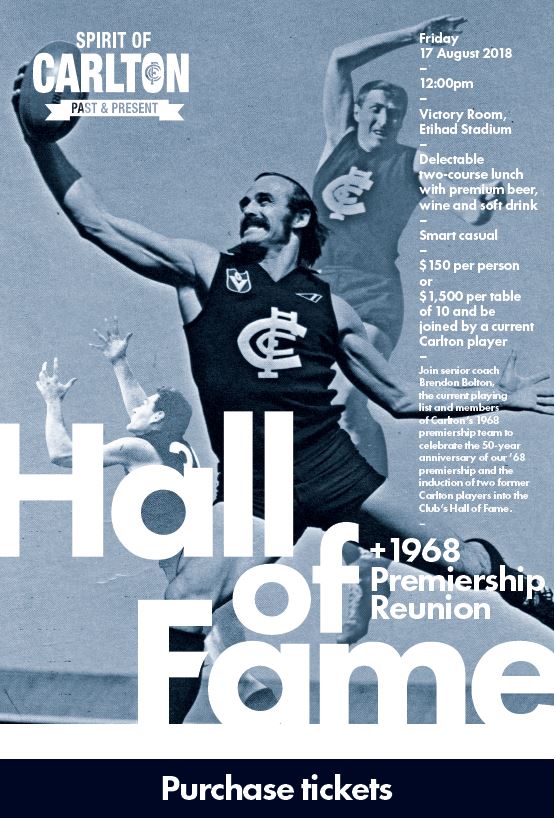
Please note that the next event will be the annual Spirit of Carlton luncheon at Etihad Stadium, Friday 17 August. Join senior coach Brendon Bolton, the current playing list as well as members of the 1968 Carlton Premiership team as they celebrate the 50 year anniversary. There will also be an induction of two players into the Carlton Hall of Fame.
- SOC Annual Dinner – Wed Sept 12, 6.30 pm Fitz Café Fitzroy
2017 Annual Report
A copy of the 2017 Annual Report is available here for members reference.
Spirit of Carlton – 2017 Annual Report
Please click link below to read/download the SOC 2017 Annual Report.
Latest Video – Jim Buckley 1985
Latest Video – Wayne Blackwell 1985
Simon White’s 30th
Happy 30th birthday to Simon White
Career : 2010 – 2017
Debut : Round 4, 2010 vs Adelaide, aged 21 years, 303 days
Carlton Player No. 1127
Games : 87
Goals : 12
Last Game: Round 19, 2017 vs Geelong, aged 29 years, 42 days.
Guernsey No. 43
Height : 190 cm (6 ft. 2 in.)
Weight : 87 kg (13 stone, 10 lbs.)
DOB : 17th June, 1988
West Australian Simon White was recruited by the Blues as a mature-age rookie in the 2010 AFL Rookie Draft. Originally from the Carine Junior Football Club, White made his WAFL debut for Subiaco in 2009, and had a stellar year – earning the Lions’ Rising Star award before playing in their Grand Final loss to South Fremantle.
A versatile, strong-marking defender capable of pinch-hitting roles up forward, Simon was compared to former West Coast Eagle Adam Hunter during pre-draft discussions. When he was still available at number 56, Carlton snapped him up with their fourth round selection, and allocated him guernsey number 43. Only five other players in Carlton’s history have worn this number at senior level, and two of them were all-time greats in David McKay and Anthony Koutoufides.
After an impressive pre-season, White played just once at VFL level for the Northern Bullants before being called into Carlton’s senior team for the trip to Adelaide to take on the Crows in round 4, 2010. Handed the big task of controlling Adelaide captain Brett Burton, Simon did all that could have been asked of him. His 18 possessions and 11 marks, while keeping ‘The Birdman’ to the solitary goal, was influential in a big win by the Blues.
Over the following five weeks, White averaged 15 disposals and almost 8 marks per game as Carton strengthened their hold on a top eight ladder position. He kicked his first career goal with a textbook drop-punt from deep on a flank against Collingwood in round 6, before Hawthorn toppled the Blues by 50 points in round 9, and Simon suffered a knee ligament strain that kept him out of senior football for the rest of the year. Still, the club liked what they saw throughout White’s debut year, and promoted him to the senior list at the 2010 National Draft.
Unfortunately, Simon’s second season mirrored his first, and he just couldn’t shake the curse of injury. He played five of Carlton’s first six matches in 2011, before tearing a hamstring, and that injury kept him out of the senior side for ten weeks. Eventually recalled for round 15, he promptly damaged the same medial ligament that had troubled him previously, and didn’t play again that year. During the off-season, Simon underwent remedial surgery on his knee. As part of that procedure, an artificial LARS (Ligament Augmentation & Reconstruction System) ligament was implanted to help strengthen the joint, but his body tissues did not accept the synthetic fibres, and the repaired ligament ruptured again while White was beginning another comeback with the Northern Blues in round two of 2012.
More surgery and a long rehabilitation program later, he was welcomed back into the Blues’ senior line-up at last for round 19, when Carlton hosted Sydney on a Sunday afternoon at Docklands. Deep in defence for most of the game, Simon collected 15 disposals and nine marks in a solid return, although Carlton’s finals hopes took another heavy hit with a 22-point defeat. White retained his place in the side through to the end of a tumultuous season for the club, and his dedication was rewarded when his contract was renewed for another 12 months. Unfortunately, the same did not happen for senior coach Brett Ratten, who was sacked by the club’s board and replaced by former West Coast and Collingwood Premiership coach Mick Malthouse.
White was overdue for a smile from Lady Luck in 2013, and seemed like he was getting it when he played in nine of Carlton’s first 13 games, before a relatively innocuous incident during a VFL match in late July wrecked another season. Playing for the Northern Blues against Box Hill, Simon tried to duck under an opponent’s tackle, but slipped and copped an old-fashioned “coat-hanger.” Although he was stunned at the time and sat out the remaining minutes of the game, he seemed to make a quick recovery and completed a full training session three days later. Less than 24 hours after that however, a precautionary scan revealed that he had fractured vertebrae at the base of his neck. Eight weeks in a full neck-brace and another four in a collar support wasn’t the best way to see out the season, but with those precautions Simon was at least able to commence his preparation for 2014 on time, and in good shape.
White went on to enjoy his most productive season to date, playing 19 games in a variety of defensive roles that also gave him the freedom to influence the scoreboard when the opportunity arose. On a Sunday afternoon at Docklands in round 16, Simon had a day out against St Kilda, when he started the game in attack, and kicked four majors as the Blues ended a four-game losing streak and slaughtered the Saints by 85 points. Despite that big win however, Carlton still finished 2014 in a miserable 13th spot on the ladder. White’s growing maturity was one of the few positives to emerge from a wretched season, and his contract extension for another two years was well deserved.
The buzz around Princes Park in the lead-up to season 2015 seemed a good omen for the club, but soon proved to be totally misplaced. The Blues lost their first three games by big margins, and from that point on, the season descended into near-chaos. In late May, as defeat followed defeat, Malthouse was sacked and replaced by his assistant John Barker.
A big factor in Carlton’s demise was that the club was being decimated by injury, and White was among the casualties. During the Blues’ heavy loss to West Coast in round two at Subiaco, Simon had strained the medial ligament in his left knee once more. He played twelve of the next seventeen games, but was rarely at his best before he suffered another knock to the suspect joint in early August. So a fortnight later, the club decided that Simon’s season was over. He would undergo surgery yet again, with the aim of having him ready to begin pre-season training for 2016. Simon accepted that latest set-back with his usual positive attitude, one of the reasons why he was such a popular winner of Carlton’s Best Clubman Award at season’s end.
Former Hawthorn assistant coach Brendon Bolton was appointed to the senior role at Carlton in 2016, and it didn’t take him long to recognise White’s attributes. Given a variety of roles in defence – often in a key position – Simon rarely lowered his colours as he completed another consistent 17-game season.
After playing 11 games in the 2017 White was delisted at the end of the season by the Blues.
2018 – White would join Doncaster East in the second tier of the Eastern League.
Latest Video – Rhett Baynes 1985
Latest Video – Rod Austin 1985
Des Lyons’ 80th
Happy 80th birthday to Des Lyons.
Debut : Round 1, 1960 vs Richmond, aged 21 years, 313 days
Carlton Player No. 729
Games : 2
Goals : 1
Guernsey No. 20
Last Game : Round 3, 1960 vs St Kilda, aged 21 years, 332 days
Height : 183 cm (6 ft. 0 in.)
Weight : 95.5 kg (15 stone, 0 lbs.)
DOB : 9 June, 1938
Throughout the decades after World War II, the football press used to be filled with stories of the “March Champions” – country recruits at each VFL club who were making a big impression in the weeks before the football season began. Invariably, these future stars could “kick a bag of spuds over a wheat silo”, or “flick off a light switch, and jump into bed before the room was dark.” Sadly, such hype was rarely justified, and most of those who showed real potential early often succumbed to home-sickness within a few short weeks.
One such recruit for the Blues was Des Lyons, from Barellan in the Riverina in southern NSW. A powerfully-built 183 cm forward, he had strong hands, good endurance and a booming kick. In 1955, at the age of 16, he had briefly trained with Collingwood, but soon missed the open spaces and went back home. Over the next five seasons, Lyons played senior football with both Barellan and Leeton, where his talent was obvious, and attracted an offer of another crack at first grade football with Carlton.
Des agreed to terms, and bypassed the Reserves to make an immediate senior debut for the Blues against Richmond in the first round of the 1960 season at Princes Park. Wearing guernsey number 20 at centre half-forward, he took some time to adjust, while Richmond held sway and were travelling like winners at the last break with a handy lead of 28 points. The Blues found some extra energy in the last quarter however, and surged back into contention, with Lyons providing a reliable marking target. Carlton kicked 4.5 in a dominant last term – including a long bomb from Des that split the big sticks. Richmond were held to a solitary point for the quarter, and Carlton snatched a nail-biting draw.
Injury kept Lyons out of round 2, but he was back in action on a cold and wet afternoon at the Junction Oval in round 3, when the home side had six more scoring shots than the Blues, only to lose by four points. Shortly afterwards, Des told Carlton that he would not be continuing on. The lure of a family business, along with the comfort of a close-knit community was too strong, and it drew Des home to the bush once more.
Over the next nine seasons, Lyons forged a superb career in Riverina football with Leeton, winning three Premierships, two League Best and Fairests, two club Best and Fairests and the South West District League’s top goal-kicker award in 1967. He represented the SWDFL on 20 occasions, and more than 50 years later, is still regarded as one of the Riverina’s all-time greats.
Footnote:
The Age said of Lyon’s debut;
“Des Lyons played brilliantly in the first half to be the focal point of the Blues’ attack. He was quiet later but splendid marking and accurate kicking made him a constant danger.”
Photo:
Des Lyons in the South West District Football League team, July 28 1963. Courtesy of griffithswansarchive.com
SOC Luncheon – 1968 Premiership Reunion and Hall of Fame
Rod Waddell’s 60th
Happy 60th birthday to Rod Waddell.

Career : 1981 – 1982
Debut : Round 18, 1981 vs Geelong, aged 23 years, 70 days
Carlton Player No. 898
Games : 5
Goals : 2
Last Game : Round 8, 1982 vs Footscray, aged 24 years, 357 days
Guernsey No. 10
Height : 178 cm (5 ft. 10 in.)
Weight : 76 kg (12 stone, 0 lbs.)
DOB: 23 May, 1957
Rodney Steven Waddell was a talented, pacey, aboriginal footballer who forced his way into one of the strongest Carlton teams ever assembled when he made his debut for the Blues on the eve of the 1981 finals. Although he was a reluctant recruit at first – having already played Reserves football at Collingwood – Carlton claimed him under the VFL zoning rules in force at the time, and Rod eventually played five matches while the Navy Blues won back to back flags in 1981-82.
Waddell began his senior football career with Southern Districts in NSW, but it was his slashing performance as a ruck-rover for Lalor in the 1980 Diamond Valley Football League Grand Final, against Reservoir-Lakeside, that made VFL scouts take notice. Collingwood and Carlton soon became involved in a tug of war over his services, and the Magpies seemed to have come out on top when Waddell turned out for two Reserves games with them early in 1981. Carlton however, was convinced that the 23 year-old was residentially tied to us, and a VFL investigation quickly agreed. Collingwood were fined $500 for flaunting the zoning rules, and stripped of the four competition points they had earned with Waddell in their team. Rod was then welcomed to Princes Park, and presented with our number 10 guernsey.
After spending most of the remainder of 1981 with Carlton’s Reserves, Waddell was eventually called into the seniors in August, as one of six changes for the round 18 Match of the Day against Geelong at Princes Park. Stationed on a half-forward flank, he flashed in and out of the game, kicked a nice goal, and had a grandstand view as Carlton’s mercurial forward Peter Bosustow took Mark of the Year. Carlton won by 33 points, in a fitting tribute to champion defender Bruce Doull in his 250th game.
While elbowing his way up into the senior side was a creditable achievement by Waddell, the bigger task by far after that was to stay there. After all, Carlton had assembled a fleet of midfield runners that was the envy of every other club, and Rod faced intense competition for his place in the side each week from a galaxy of stars such as Ashman, Buckley, Sheldon, Harmes, Marcou, Keogh, Armstrong and Glascott. Although Rod didn’t lack self confidence, it was a daunting prospect indeed.
Waddell’s second match came on a Sunday afternoon at the MCG against South Melbourne in round 19, when he came off the bench to replace his captain Mike Fitzpatrick during the third quarter, and helped his side to 23-point win. His third was another unforgettable occasion; the second Semi Final against Geelong on the wide expanses of Waverley Park, in front of a crowd of 66,000. Waddell had a relatively easy day and warmed the bench for most of the game, as Carlton dominated the second half, and qualified for the Grand Final with an emphatic win by 40 points.
During the fortnight leading up to the Premiership-deciding clash between traditional rivals Carlton and Collingwood, the Blues’ concerns revolved around two players who were automatic inclusions if fit; full-back Geoff Southby, and rover Rod Ashman. Southby was never a real chance of playing because of a torn thigh muscle, and he was replaced on selection night by Scott Howell. Ashman, however – with ongoing concerns about a knee – only convinced the selectors he was right on the day before the match, and Waddell was the obvious choice to make way for him. On that fabled Saturday afternoon, Howell and Ashman both put in solid efforts in a spine-tingling contest that eventually fell to the resolute Blues by 20 points.
As Carlton set about defending that hard-fought flag in 1982, Waddell managed two more senior appearances by round 8, but then was informed by the match committee that his future lay down the Western Highway at Geelong. The Cats, knowing full well the depth of talented small men at Princes Park, had approached the Blues to secure the services of Waddell, and come up with an offer hard to refuse. Waddell too, realised that he would get far more opportunities at Sleepy Hollow, and was happy to make the move.
Rod added another 20 senior matches and 10 goals to his credit over the next three seasons, although the highlight of his time with the Cats was his dominant game in the 1982 Reserves Grand Final defeat of St Kilda. Playing as a ruck-rover, Waddell kicked six goals and was clearly Best on Ground.
After finishing at Geelong in 1984, he headed off to Darwin in the off-season and took part in another Grand Final when his team Nightcliff lost to St Mary’s in that season’s NTFL Grand Final. He then returned to Victoria, and rejoined the Lalor Bloods to finish off an interesting and varied career. He would later play at Ararat and Marong Football clubs.
Rod Waddell’s sister is the mother of Geelong premiership player Steven Motlop.